

Conferences

Creators Project in San Francisco

Last weekend the Creator's Project garnered significant attention from national media.  From the mission statement on the website "The Creators Project is a global celebration of art and technology." and "The Creators Project is a new kind of arts and culture channel for a new kind of world."   As an intersection between art and tech it seems appropriate that the blog weigh in and take a look at what they did, how they did it, and the implications.  The Creator's Project has major sponsorship from Intel Corp and VICE with significant online free content focusing on mostly short form interview of Creator associated artists.  This Project offers similar promise to other ventures to offering culture and arts online to ideas such as On The Boards TV and Jacob's Pillow Virtual Pillow but is already operating on a much larger scale than either of these.

The Creators Project offers arts and culture online at a scale that is extraordinary for such a young institution.  The levels of participation on information sharing that is happening through their website looks unparalleled and should be looked towards as a model for successful integration of technology and the arts.   The Creators Project was started in May of 2010 by VICE and seems to have two major interfaces with the public.  There is a exhibit/show that has toured around the world each year and an expanding web presence that now counts video downloads in the millions.  The content is broken out into six different categories:  Music, Film, Art, Design, Gaming, and Fashion and has engaged with artists from all of these areas to provide content online and for the annual festival.  They will be rolling out content collected from the event last weekend (March 17-19, 2012) in the coming weeks.

Current content on the website is a mind blowing array of new directions taken by artists in each of the fields.  One of the standout artists at the event last weekend was a new work from visual multidisciplinary artist Chris Milk.  The installation called the Treachery of Sanctuary incorporated user interaction with digital transformation to look at elements of flight.  Visuals of this can be found here.

Anther fascinating example that was found on the Creator's Project website was the Electronic Shadow from France.  Electronic Shadow uses imaging technology and software to generate interactive 3D maps of people places and objects.  These images then can be used and manipulated in artistic fashions.  The implication for this technology would, for instance, be a game changing one for other art forms such as dance.

Exchange of ideas such as Creator's Project bring together the bleeding edge of Technology and the Arts and as such should be a point of engagement for institutions that are looking to modernize and include new audiences (and younger audiences).  The artists involved have obviously successfully engaged these audiences already and by following the lead of these success stories arts leaders at more conventional organizations can find hope in a new direction in reshaping structure and content to address the demands of a more complex world.



Festivals Galore!

As the month of March rolls on, and the weather starts to warm up, two things immediately come to mind: vacation, and festivals. The gang here at Tech in the Arts is on spring break this week, so expect a lighter posting schedule as we take a (well deserved!) break from our studies. Having said that, I wanted to briefly check in and point out two festivals happening this week that are highlighting some of the best and most creative technology and arts projects occurring from across the country.

The first, South by Southwest, or SXSW for short, is currently underway down in Austin, Texas, as anyone with a Twitter account is well aware of by now. Having grown massively in size over the years, the show is divided between three festivals: film, music, and interactive. The interactive portion, including keynotes, speakers, presentations, shows, parties, events and so much more (it really is a sight to behold) is taking place this weekend and ends tomorrow, the 13th.

Tech in the Arts is live down in Austin covering the action; you can follow our Twitter feed (@techinthearts) for live updates and recaps of SXSW events, including the big bash that Carnegie Mellon held this weekend, along with one of our staffers, Terry Boyd, who is tweeting from his personal account (@boydleservice). We all wish we could be there this weekend, but those two accounts are representing us well!

We’ll also have a wrap-up of all the great action at SXSW following the conclusion of the festival, so stay tuned for that.

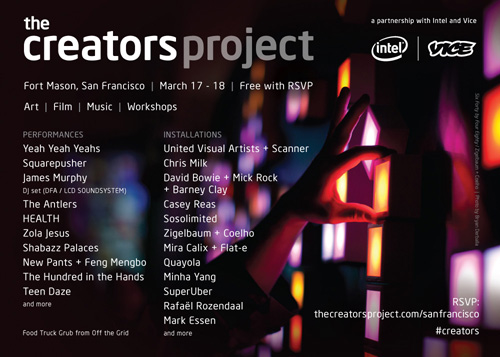
I’m typing this from beautiful San Francisco, California, and the second festival I wanted to mention is the 3rd Annual Creators Project, taking place this upcoming weekend (March 17th-18th) here in the Bay Area. Sponsored by Intel and VICE, the festival seeks to bring together the best of art, music and is “dedicated to supporting artists in realizing their creative visions through technology.” In addition to the works of art on display, there will be performances by the Yeah Yeah Yeahs, James Murphy, and Squarepusher.

The best part of the festival? It’s free with an RSVP! So if you’re in the Bay Area this weekend, definitely check it out.

Even if you can’t make it to either Austin or San Francisco this week, stay tuned as we’ll be posting follow ups to both exciting festivals and highlighting the best art and technology trends coming from both.


Expanding the Dialogue with the CultureCode Initiative

While the intersection of technology and the arts has always presented a series of exciting opportunities for us here at Technology in the Arts, the reality is many cultural and arts organizations find technology challenging. It can seem especially prohibitive to small organizations and individual artists who may lack expertise. The Arts Council England and Codeworks have developed an interesting forum to increase the dialogue between arts organizations and the developers of this intimidating technology, the CultureCode Initiative.

No definition fits the CultureCode Initiative better than the one straight out of their digital press release,

“The CultureCode Initiative is a series of free events designed to open up new opportunities for highly skilled developers, designers and assorted geeks to work collaboratively with cultural organisations and artists.”

Here’s why I find the idea of the CultureCode Initiative so fascinating: technology often overwhelms people and appears antithetical to cultural organizations that feel that new technology can make them obsolete. The CultureCode Initiative seeks to completely debunk that myth, as Tyneside Cinema Chief Executive Mark Dobson explains, “You don’t need to have any previous experience of digital to attend this event”.

The CultureCode Initiative’s website even states “you don’t need an IT department” to partake and learn from their events, and some are guaranteed to be "jargon-free". The advent of web 2.0 and the current culture of sharing absolutely everything via the internet has democratized information. The CultureCode Initiative, to me, is increasing accessibility and informing arts and cultural organizations know that it is possible and it is easy for them to join this discussion.

Most importantly, perhaps, the discussion is not meant to be in one direction. While most similar opportunities are aimed at instructing arts organizations in utilizing technology, the CultureCode Initiative encourages two-way dialogues, with events showing developers how they can take a new look at cultural organizations and how cultural organizations can reconsider their “digital assets”.

If you’d like to join the discussion live, their first events start early next week (Tuesday, February 21st ) and CultureCode ends with a huge twenty-four hour Hack towards the end of March.

If you don’t happen to live in the North East of England (where these events take place) you can join the discussion digitally by tweeting @Culture_Code.

Any of our readers going? Be sure to let us know your perceptions of the events – you can bet Tech in the Arts will be watching to see what cool solutions come out of the CultureCode Hack.

Solve for X

Try not to have horrible flashbacks of high school algebra! In this case, Solve for <X> is a new Google initiative, defined as “a forum to encourage and amplify technology-based moon-shot thinking and teamwork”, and <X> is defined by as the intersections of “huge problem”, “radical solution”, and “breakthrough technology”. http://youtu.be/uDDy7QSdt6A

While the website is fairly vague, Solve for <X> sounds like a hub for crowdsourced solutions with a focus on innovative thinking and technologies. The website already has some brilliant talks online – as a visual person, I found Mary Lou Jepsen’s discussion on “Imaging the Mind’s Eye” fascinating.

http://youtu.be/SjbSEjOJL3U

Solve for <X> has a Google+ page to encourage and facilitate discussion; anyone with a relevant talk is invited to share it on the page as long as it meets the criteria (huge problem, radical solution, and breakthrough technology). Solve for <X> even hosted a conference in the beginning of February to bring together innovators to discuss major problems and solutions of the modern world. There’s a YouTube channel with more videos from the site and their conference, with presumably more on the way.

Crowdsource thinking like Solve for <X> and the TED talks certainly provide an interesting set of viewpoints on a wide range of topics. You can bet we’ll be watching to see how Solve for <X> has an affect on culture and the world of art.

Speaker Series' Spotlight: Chad M. Bauman, Director of Communications for Arena Stage at the Mead Center for American Theater

On February 10th, the Master of Arts Management program at Carnegie Mellon University will welcome Mr. Chad Bauman, Director of Communications for Arena Stage at the Mead Center for American Theater to speak as part of our Speaker Series. His presentation, Confessions from an Arts Marketer – Learning from the Past, Looking Toward the Future, will highlight the worst practices in the field, what can be learned from them, and how to move beyond them. I recently chatted with Chad and talked Tweet Seats, fire in the belly, and what he wished he had known about the field from the very beginning…

Elizabeth @ Technology in the Arts: You’ve held top, senior positions as the previous Director of Marketing and Communications for Americans for the Arts and now as Director of Communications for Arena Stage. You’ve clearly figured it out. But even so, what’s the one piece of advice you wish you had received before entering the field?

Chad Bauman: I am very thankful for my education from CalArts in Producing and Theater Management. But I would have to say…I wish I had learned how to get stuff for free. When you are first starting out, it’s how good are you at convincing people to give you stuff for free- advertising space, promotional opportunities…it’s absolutely critical for smaller companies; you have to do it really well.

E: Now, with all the social media networks out there, it must be easier to get recognized and make connections with those who CAN give you stuff for free.

C: Earlier on, it was super controversial for arts organizations to be on social media; they didn’t understand what the value would be. It also used to be a smaller company could distinguish itself on social media, but now there is a lot more clutter. Being on social media is an exceptional way to get free promotion, but now you have to compete with everyone else out there.

E: So I have to ask, in your opinion, which is the better platform to get a message out and to get attention, Twitter or Facebook?

C: I’m liking Twitter more and more. It’s the most efficient platform. It began with Friendster, then MySpace, then Facebook. I think Facebook use is on the decline and Twitter is on the incline. It’s more of a conversational tool.

E: How about audience members Tweeting during a show? Tweet Seats?

C: You have to be careful; you have to find a balance with Tweet Seats. There was a case where a theater established Tweet Seats for a show, but the resident writers of the production were never consulted and they were not on board with it.

E: What are you more in favor of then, Tweet Seats or post-experience Tweeting?

C: I am more in favor of post-experience Tweeting. You can’t get the full experience if you are on your phone, you’ll miss something. You can miss the most crucial detail, especially in a very nuanced performance. There are many other ways to invite conversation about a production.

E: For those of us logging in hours on online job boards and stalking career services on an daily basis, what are the qualities you look for as Director in a potential employee or intern?

C: Fire in the belly. By that I mean, a person who is internally motivated. I’m not sure you can teach it. They want to do a great job and are motivated by wanting to do a great job. You can teach skills, but you can’t teach internal motivation.

E: In particular to marketing?

C: I look for people who are not afraid to take risks, calculated risks, but risks nonetheless. You have to be willing to take a risk in an entrepreneurial spirit.

E: We, my fellow job and internship seekers, thank you for that advice! I don’t want to take up too much more of your time, so one last question. In a recent blog, I looked at the changing face of America over the next four or five decades and its shift to a minority-majority population. How can visual arts or performing arts organizations expand their audience to reflect this change?

C: First, it’s about programming and community outreach. At Arena Stage, we go out into the community, to churches, to schools, to make personal relationships. You can communicate to younger demographics about your organization’s activity and productions using technology tools. But it’s about programming. Marketers are very good at targeting a specific demographic and figuring out what tools to use. But regardless of the tool, there has to be an interest in the production or the organization’s mission.

You can read more about this Speaker Series event on the Master of Arts Management Speaker Series' website, discuss arts marketing with Chad on his blog, and find further information about the Master in Arts Management (MAM) program on the Heinz College webpage.

Interview with Chad Bauman conducted and condensed by Technology in the Arts contributor, Elizabeth Quaglieri.

13 Social Media Infographics Every Marketer Needs to See

Happy Friday! What’s everyone doing this weekend? Perhaps you’re saddling up to head to Louisville for the National Arts Marketing Project Conference. The conference starts tomorrow and goes through next Tuesday the 15th – in which case, enjoy the conference! If you can’t make it to Kentucky this weekend, a lot of the conference will be online. Three sessions will be streaming live and archived as webcasts if you miss them. The conference will also be accessible via twitter with hashtag “#nampc”. The National Arts Marketing Project (NAMP) offers resources year round on their website to help your arts organization be better marketers. One of these is their newest ebook, 13 Social Media Infographics Every Marketer Needs to See.

The first in a series of free publications, 13 Social Media Infographics Every Marketer Needs to See is an accessible and enlightening tool for those interested in social media marketing. The publication covers the history of marketing channels, basic tips for social media usage, and then moves on to more complex topics like the demographics for each social media website. If you're looking for a way to make sense of all the social media out there, this is a great starting point.

Technology in the Arts also has a lot of great social media resources, including how to analyze your success, tap into that prized demographic, and important current trends. How is your organization using social media to be better marketers?

10 Takeaways From the 2011 Emerging Practice Seminar

CultureLab, a partnership between an informal consortium of arts consultants and the Cultural Policy Center (CPC) at the University of Chicago, recently held an 'Emerging Practice Seminar' in April. The organization was formed to break down the silos of research, policy and practice, and create a new capacity and approach to tackling challenging issues. The topics at this year's seminar were:

  • Uses of technology in audience engagement
  • Revenue management and dynamic pricing

The seminar's website features all of the speakers' presentations (both videos and slides) and is an extremely helpful resource!

Here were my top 10 takeaways from the 'Use of Technology in Audience Engagement' portion of the seminar.

1. Embrace technological innovation, there's nothing to fear! Tim Roberts of ARTS Australia provided an introduction to the day's topics. Tim's introduction called attention to the unfortunate fact that any arts managers and organizations still view technology as something they are fighting against. He quoted NEA chairmen Rocco Landsman as saying "the arts are battling the technology invasion". Roberts argues that many also believed cable television to be the death of television and photography to be the death of painting and that technical innovation has not caused the death of an artform but has contributed to its spread and created new audiences.

Uses of Technology in Audience Engagement - Tim Roberts from Cultural Policy Center on Vimeo.

2. Engagement is an ongoing process: Technology is least effective when it's not used in a proper context of engagement. This process of engagement often begins prior to the audience coming through the doors. Likewise, the process shouldn't end after the performance or visit ends. Technology can help to provide context to a piece of art or performance, personalize the experience and even augment the experience. There are many options when it comes to sustaining a deeper level of audience engagement.

3. Layered Arts Experiences are cool! This type of technology has been extremely underutilized in the performing arts sector. Layered Arts Experiences offer audiences options for real-time assistance imperative during arts programs. They can come in the form of supertitles for opera and dance performances. The Columbus Symphony Orchestra had a device called the 'Concert Companion' which enabled patrons to read something about the piece they were hearing as they listened to the concert.

4. Museums continue to lead the way when it comes to adapting technology: Another common theme during the seminar was the overwhelming lack of technological innovation in performing arts organizations. Even though there were examples of organizations using layered arts experience tools and mobile interactions, it seemed as though they were few and far between and many had even stopped using these tools.

5. The verdict is still out on Tweet Seats: A 'Tweet Seat' is simply a seat reserved in a theater for Twitter users. Tweet Seats have many benefits, including: encouraging a younger audience demographic to get involved in the performance, having this demographic spread the word about the performance to their Twitter followers, and cutting down on distracting other audience members by blocking off a section for Twitter users. The question, however, remains whether or not people can truly become immersed in a performance if they are multi-tasking with other technological devices.

6. Mobile Interaction isn't just limited to QR Codes in Museums Ron Evans of Group of Minds had some great ideas about ways to engage audiences via mobile devices. Evans suggested placing a QR Code on tickets for previews of the show. Evans also suggested distributing digital keepsakes after shows. He also discussed the importance of using these mobile technologies in the proper context of audience engagement. Unfortunately, most technology has focused on the pre-performance and pre-sale with the sole intention of making the sale and increasing attendance. Engaging audiences should also involve increasing their understanding and appreciation of an artform. The 'during' and 'after' is just as important to leading people to the next experience.

Mobile Interaction: adding content and context - Ron Evans from Cultural Policy Center on Vimeo.

7. Location Based Servies has a long way to go: Devon Smith presented the findings of a research study she conducted on arts organizations using location based services. Location Based Service is simply a service that uses the geographical position of a mobile device (Foursquare, Yelp, Google Maps). Applications like Foursquare can be useful in providing real-time analytics on the demographic of those who are "checking in" to a venue. Smith's study found that only 36% of the 76 nonprofit theatres she tracked, had properly claimed their venues on Foursquare, yet 97% of the venues had a mayor. Even though claimed venues had 3% more activity, the real-time analytic information could be very useful to any organization.

8. Blogging Isn't Dead!: Thomas Wickell of Malmo Opera shared one of the most interesting case studies of the day. Wickell emphasized the importance of viewing the stage from the audience's perspective as opposed to looking out at the audience from the stage. With this key distinction in mind, Wickell and his team found that the audience they wanted to attract was not responsive to traditional channels of advertisement (newspapers, television, etc). Since most of their target audience were highly engaged online, the team created a blog that was centered around the life of a character in an upcoming opera. The blog became so popular, at one point in time, traffic to the blog surpassed that of the company's main website! The staff even invited readers to a ceremony for the character (since she does not survive) and over 100 people came to pay tribute to her life. The blog can still be found here!

9. Technological Innovation Often Requires a Culture Change Within an Organization : Linda Garrison and Thomas Weitz at Steppenwolf Theatre gave an overview of helpful practices for creating video content. An important theme during this presentation was the importance of finding allies when seeking to implement any changes. Whether designing a new video campaign or placing QR codes on marketing material, implementing new technology can often mean a culture change within an organization. Finding out who your champions, advocates and contributors are beforehand can make a world of difference when proposing any sort of change. It's also well worth your time to watch the Steppenwolf videos here.

10. Know Your Target! The Steppenwolf and Malmo case studies highlighted the importance of understanding who the target audience is prior to implementing any of the strategies and tools listed above. Steppenwolf researched and found their audience tended to be highly educated, comfortable with direct marketing and confined to a very specific geographic location. As a result, Steppenwolf decided that an online video campaign could be effective in engaging their audience. The Malmo Opera worked backward and began by envisioning what type of audience they wanted to attract. Either way, this process is extremely effective when the target audience is clearly defined.

What's the Big Idea? 5 Key Takeaways from the Museums and the Web Conference

In this post, I thought I’d try to “connect the dots” regarding some of the threads that seemed to come up frequently over the course of M&W2011.

Arts and Technology Round-up: Museums and the Web Edition

Happy Friday everyone! For this arts and technology round-up we decided to try and hone in on a few of the awesome projects that we saw at the Museums and the Web conference last week. Up first are our picks of some of the best and most innovative projects. After that, the winners of the Best of the Web 2011 awards from the conference.

Technology In The Arts Picks

Zooniverse - This group marries together the researching needs of the scientific/historical communities and the power of crowdsourcing. By creating a series of interactive web portals, Zooniverse creates communities of "Citizen Scientists".

PhilaHistory - Philly based GIS firm Azavea worked with the City of Philadelphia to create a platform for linking historical photos of the city to their real world locations using geo-location and augmented reality.

One To One with the Artist: Ai Weiwei - A simple idea with a great effect, this project from the Tate allowed museum visitors to record and upload a video in the gallery and have a video dialogue with the artist Ai Weiwei.

The WALL - The Museum of Copenhagen's giant multi-touch multimedia screen installed in one of the central squares of Copenhagen.

ARTfinder - A new recommendation engine for artwork, this site works very much like Last.fm, taking your current interests and using them to introduce you to new works.

The Collective - Sounding a little bit like a bad 50's sci-fi flick, The Collective is the Denver Art Museum's interactive website/online programming space and a new way of connecting and bringing in the Denver community.

MoMA Learn - An extremely in-depth arts education web portal, the Museum of Modern Art's education department went all out on this one.

ARtours - The Stedelijk Museum's innovative augmented reality program.

The Best of the Web 2011

Education & Best Overall: The ACMI Generator

Mobile: The AB EX NY iPad app

Innovative: Nationnaal Historisch Museum / Museum of National History

Museum Professional & People's Choice: Smithsonian Web and New Media Strategy Wiki

Long-Lived: Exploratorium.org

Research/Online Collection: Portable Antiquities Scheme

Audio/Visual/Podcast: Access All Areas podcast

Project by a Small Institution: ASI: Archaeology Scene Investigations in North County Louth


Museums and the Web 2011 - Thomas's Recap

logoThe 2011 edition of the international Museums and the Web conference wrapped up this past Saturday and was a 4-day whirlwind of presentations and workshops. Presentations covered many of the exciting new technology projects currently in place and coming up from museums around the world. Topics at the conference ran the gamut from mobile technology to augmented reality to ways of creating interactive communities of constituents online. All of the papers from the conference can be found online at the Museums and the Web’s conference website. Here are just a few of the themes and tidbits that stood out to me from the 4-day conference:
I

Crowdsourcing - Now in 6 delicious flavors!

I attended an unconference session, roundtable talks with topics proposed by conference attendees, that aimed to crowdsource the idea of crowdsourcing. The overall feel I got from the discussion was that many museums are taking crowdsourcing very seriously these days. The talk brought up a lot of cool new projects, ranging from including constituents in collections and archives work to new ways to display crowdsourced material.

Johan Oomen, Head of Research of the Netherlands Institute for Sound and Vision, presented his ideas on how crowdsourcing can now be defined in 6 distinct ways:

  • Correction & Transcription
  • Contextualization (Adding to wikis, telling stories)
  • Complementing the Collection
  • Classification, Tagging
  • Co-Curation
  • Crowdfunding
  • Out of the Museum, into the streets - taking advantage of geo-location

    Geo-location was a popular theme, using GPS and mapping to take information and media from the museum and attach it to a location. Many presentations touched on how this idea could really help visitors build a strong connection to the history and importance of objects and sites of a community.

    Some notable projects included PhilaPlace and the Rock Art Mobile Project.

    I

    Access, access, and more access

    There was a lot of discussion around how to not only get more content on the web, but also make that content easily accessible. The types of content being made available on the web, for free, ranged from things like online collections to projects like online teaching portals. There was a general call to standardize access to this content and data and to use more open systems to encourage data sharing among organizations.

    I

    Intuitive design - What's the point of building it if no one can figure out how to use it?

    The conference featured a variety of opportunities for museum professionals to gain feedback on their projects, one of the most popular being the Mobile Crit Room. A reoccurring theme of these critiques was the emphasis placed on the user experience, how easy was it for someone to use your mobile app/website? The Rock Art Mobile Project led the charge, along with a few others, in insisting that any project's user experience needs to be designed in a way that is both intuitive and immediately easy to use. Building around this concept will ensure that users of all ages and skill levels can take part in a project, not just the tech-savvy ones.

    Check out the range of mobile projects from the conference’s Mobile Parade.

    IIII

    So now you want to build an mobile program? Better be up on some of the new business models.

    One of the most informative presentations I attended was the “Getting on (not under) the Mobile 2.0 bus”. This talk featured case studies by MoMA, SFMOMA, Balboa Park and the Smithsonian on the new business models that now exist for developing a mobile program.

    Some of the subjects from the presentation included: Digital retail (app/download sales), Donations (e.g. by text message), Sponsorship and ad-supported content, Monetizing data from mobile social media and Using mobile to support membership and other revenue channels. The full paper is available here.

    I

    The Rise of the Mobile Internet

    Kristen Purcell, from the Pew Research Center Internet and American Life Project, gave the opening plenary of the conference. Kristen presented on some of the changes in technology from 2000 to 2011. Some pretty surprising stats were thrown up during the presentation. Among them:

    • 1 in 3 adults do not have broadband Internet access.
    • 69% of Internet users watch online video content, 14% of Internet users upload/create video content.
    • 85% of adults will own a cell phone by 2011, making 2011 really the Year of the Mobile. (Purcell stated respondents had difficulty being able to distinguish between what was and was not a smartphone, so that statistic was not available)
    • Mobile usage varied among different ethnic groups, Latinos and African Americans were shown to be in the highest percentage of users actively engaging with mobile content.
    • 11% of mobile users use their phones to make charitable donations. (These numbers may be skewed by mobile donation drives for large natural disasters like Hurricane Katrina and the recent earthquakes in Japan)
    • 35% of adult mobile users have apps on their phones, but only 24% use them.
    • The 90:9:1 rule for understanding the level of engagement on social media. It states that 90% of social media users are lurkers, just observing content and never really interacting or contributing. 9% are regular contributors, the ones who often like, retweet or comment on online content. 1% are the super users - always online, always engaged.

    These were just a few highlights, for me, of the conference. Coming up, Molly will do her recap on what she found interesting at Museums & the Web 2011. Definitely go to the Museums & the Web conference site to check out all of the presented papers from the conference.

    NAMP 2010 - Day Three - Chip Conley and Providing the Peak Arts Experience

    To conclude the 2010 National Arts Marketing Project Conference, Chip Conley delivered an inspired closing plenary to encourage arts organizations to provide "peak" experiences based upon their audience's hierarchy of needs. Conley is the author of Peak: How Great Companies Get Their Mojo from Maslow, an arts lover, as as the founder and CEO of the Joie de Vivre Hospitality. In his address, Conley shares his unique prescription for success based upon Maslow's classic Hierarchy of Needs. Conley illustrates how audiences are ultimately motivated by peak experiences and discusses how arts organizations can give those experiences to their audiences. Americans for the Arts streamed Conley's presentation live via Livestream. The recorded version is embedded below. (Skip to the 16 minute point to get to Conley's presentation.)

    NAMP 2010 - Day Two - Recap Discussions

    David, Corwin and Amelia report out on Day Two of the 2010 National Arts Marketing Project Conference. Items discussed: disembodied panelists, Vimeo analytics, the Audience Engagement Platform, the value of quantifying intrinsic impact, and more.

    NAMP 2010 - Day One - Recap Discussions

    David, Corwin and Amelia report out on Day One of the 2010 National Arts Marketing Project Conference. Items discussed: keynote by Chip Heath, breakout sessions (pros and cons), designing conferences for people with varied experience levels, social media rock stars, and more.

    On the Way to San Jose & NAMP 2010

    namp-2010Corwin, Amelia and I are heading out to San Jose for the National Arts Marketing Project (NAMP) Conference this weekend. In addition to presenting a panel on using performance video to motivate audiences and leading roundtables on Twitter and search engine optimization (SEO), we will be interviewing various presenters and arts marketing superstars for upcoming podcast episodes.

    We will also be chatting with conference attendees to find out what useful information and experiences they will be acting upon when they go home.

    If there are particular people whom you would like us to interview or particular questions you would like us to ask conference participants, then drop a note in the comments area below.

    If you are on Twitter, you can read our thoughts about the conference by following TechInTheArts.  You can also follow the #NAMPC10 hashtag on Twitter to read the chats taking place during the conference.

    Stay tuned for more from NAMP 2010 in San Jose!

    Raising More Money for the Good Work We Do

    This afternoon, I had the pleasure of working with Jerry Yoshitomi on a conference session dedicated to grassroots fundraising for the attendees of The Association of American Cultures (TAAC) conference in Chicago. Below are the slides for each of our presentations. Jerry's presentation on grassroots fundraising:

    Grassroots Fundraising

    Download presentation here.

    My presentation on online tools and practices for grassroots fundraising:

    Four free online tools you should know about

    Roving arts management reporter, reporting for duty! I’m taking a brief break from my summer gig at Wolf Trap Opera Company to resume my TitA duties and re-cap the delights of the Opera America Conference this week in Los Angeles. Conferences are great places to exchange ideas. I always come away with a list of things to check out. Here are a few great free tools on my list:

    • Box.net—Simple online file sharing. Can be used instead of a share drive, OR as a way to upload your season brochure for easy patron download.
    • Pitchengine.com-the social PR platform—Make fuss-free digital press releases with easy links to multimedia. No coding, no WYSIWYG editor screwing up what would otherwise be a reasonable task.
    • Twitalyzer.com- Does a slogan like “serious analytics for social relationships” take the fun out of Twitter? No way! Track your impact through hard data, not just anecdotal evidence.
    • Polleverywhere.com-create polls that audience members can answer via SMS text messages, Twitter, or the web. Some great advanced features for a little extra money, too!

    [And I won’t assume you don’t know about Foursquare.com. If you’re not offering people who check in (or your “mayors”) something cool, look into it.]

    And I must mention one that is not free (but cheap): Wildfireapp.com is ideal for setting up campaigns, coupons, and sweepstakes. Great way to capture data on your patrons.

    Also, this is pretty sexy: operabyyou.com

    Look for conference interviews by yours truly coming up on future Technology in the Arts podcasts!

    Thanks to Ceci Dadisman and Palm Beach Opera for many of these sites!

    Tweet the Arts on National Arts Advocacy Day

    Next Tuesday, April 13th, is National Arts Advocacy Day, when more than 500 arts advocates will be talking to their government officials in Washington, D.C. about the power of the arts and the need for arts education and arts funding. Whether or not you can make it to DC on April 13, please take the time to create a tweet featuring the hashtag #arts on your Twitter accounts and tell you friends to do the same.   If we get enough tweets with #arts we’ll push “arts” into Twitter trending topics for the day.

    More information can be found at http://www.tweetartsday.org

    Fear not what "They" will say: Relinquishing control and opening up the conversation

    Misnomer Dance Theater's "Breakfast With You"

    Arts organizations, especially in this economy, rely heavily on positive reviews and audience raves to generate ticket sales and interest.  As technology improves, so has the speed and reach of these review: one voice can be heard across an infinite distance, and one individual's bad experience can be heard around the World Wide Web.

    Damage control, clean up in the wake of widely-disseminated destructive commentary, is never as good as the kind of real-time management that is possible when an organization is able to react and engage as the conversation is developing.  Even better when the conversation takes place in a forum that is controlled by the organization and populated by unaffiliated supporters who can voice unsolicited positive defense of the organization.

    This is one of the most powerful elements of Web 2.0, and one that seems to strike the most fear in the hearts of arts managers. The NAMP Conference was an eye-opener: arts managers are really afraid of relinquishing control over the conversation.  From the keynote to the final session three days later, attendees at every Q&A expressed concern about allowing organization-related conversations to publicly occur with outsiders and audience. (For example, allowing user-generated comments on a blog on the organization’s website, comments on the YouTube channel, Twitter conversations, Facebook dialogue.)  The question asked by managers time and again: "What if 'they' say something negative?"

    The reply? “They’re saying it anyway.”  Would you rather they said it behind your back? Imagine that your organization begins to open up the conversation. Great examples of this can be found by looking at the Mattress Factory Museum's Friendship 2.0 page, or Misnomer Dance Theater's blog, which links to a variety of other interactive possibilities (though Misnomer's Chris Elam would like to improve upon this even more, by having an aggregate feed that pulls in the conversations happening in various forums and making them accessible in one place on the site). Perhaps you have a way for visitors to post publicly from the venue, or link to articles that have been written about your organization and allow users to comment. Maybe you have a Flickr page to which your audience can contribute, or a YouTube channel. People start commenting on a piece or an interview, a post or an exhibit.

    Let’s look at the positive outcome of enabling and encouraging audience participation online.

    It is generally accepted that people are more likely to complain than they are to express happiness about something.  That changes as social media and Web 2.0 enable people to easily share thoughts and feelings, and so they do not have to make the same kind of effort to offer praise.  They can take five minutes (and feel good about) publicly expressing to you how good they feel.

    Remember, “everyone wants to be an insider.”  When they can express themselves on your site, or engage in dialogue with your organization and its other supporters, that person feels like they are special.  They are being included and being respected as a participant--which givees them a sense of ownership.  And they will hopefully keep returning to their conversation, see who has responded to their opinions, and continue to engage with your organization and with other supporters.  This builds loyalty, especially when you acknowledge them, and your relationship may lead to this person's friends also getting involved.

    But certainly the fear of negative public feedback is not unfounded.  Along comes a disgruntled patron.  This unhappy patron lambasts your organization for the offenses you have, in his estimation, committed (dirty bathrooms? Offensive scene? Maybe they just thought the work was garbage?).  This person comments angrily on your blog, and complains on your Facebook wall.  Your organization can now fully benefit from the power of Web 2.0.

    If this person posts to your sites, count yourself lucky (if not, you can keep tabs on what is being said about your organization elsewhere with Google Analytics, and respond on your site, thereby directing the traffic to your organization) .  This negative view now can be addressed directly by you—both publicly and personally—and a conversation can occur.  You can find out the real source of this person’s vexation, and you can demonstrate that your organization is invested in the experience of its audience.

    You are also aware of something that has fallen short of an audience member’s expectations.  Sure, maybe that person was just having a bad day, but perhaps there is a greater issue there that you can now work to solve.  If you were not involved, it is possible you never would have known of their dissatisfaction.  You might have missed them renewing their membership, or you might have lost friends of theirs.  But you might never have known why.

    New visitors to your sites will see this dialogue and appreciate your honesty. (Who isn't skeptical about something that NEVER receives negative feedback?  It smacks of censorship, and seems disingenuous.)  Your loyal followers may also have gotten involved and expressed positive opinions in your defense. By endorsing both the positive and negative views, by demonstrating your appreciation and value of both sides of a situation, your organization gains credibility for its honesty and forthrightness.

    Elam urges organizations not to avoid something out of fear that might prove a most powerful tool.  “If you don’t open the floodgates you have zero comments.  If you do open them and you get 100 comments and three are bad, you are building energy around your work.”  But be aware: “If you have 98 that are bad, that tells you something about your organization.”

    Remember, opening the conversation can be incredibly powerful, but you must not just sit back once you have made available the possibility for user-generated content. Your engagement is important to keep the conversations relevant and to connect your organization to the discussions being had.

    Content is King (but a compelling subject line is crucial): Effective E-mail Marketing

    The Crown of the Moon by gilderic The Crown of the Moon by gilderic Organizations too often overlook the hidden powers of e-mail marketing, a relatively inexpensive powertool if used correctly.  As Gene Carr of Patron Technologies will tell you, a strong e-mail marketing plan is a critical component of your online presence.  "Why?  Because the average arts consumer doesn’t. . . go to an arts website to browse around to see what’s happening next Tuesday.  [Now,] when they get an e-mail in their inbox, they say 'OH! That’s happening next Tuesday!' and they forward it to their boyfriend and they send it on.  So I say, get your e-mail marketing program great, you’ll solve half your problems."

    How do you do this?

    I was fortunate to attend a great session at NAMP called "Beyond the Blast: E-Mail Marketing Well-Done" featuring a panel of Playwright Horizons' Bradford Louryk and The Book Report Network's Carol Fitzgerald, and moderated by Carr, who chatted with me for the blog.  Following his "Three B's" I offer you some take-aways.

    • BUILD YOUR LIST

    You must have a strong list to have an effective e-mail marketing campaign. Building a list can be challenging, and is often seen as secondary to other elements of the e-mail or newsletter (design, content, etc.)--but Carr argues that building the list should take 75% of your time.  To collect e-mail addresses and learn what these individuals want to receive takes time and finesse, and involves regular (about thrice-yearly) follow-up surveys to define their interests and ensure that your messages are hitting their appropriate mark.  If you are sending out one blanket e-mail to everyone on your list, you are blasting, and are likely seeing a low return on such messages.  It also may decrease your revenue: "You won’t advertise a $5 ticket lottery to a full-season subscriber.  You really have to think about who is getting what messages," reminds Louryk.

    • BE PROFESSIONAL

    Exercise professionalism when managing your e-mail campaigns: "[p]lan a schedule in advance, get (the e-mail) proofread, get great graphics, send it to outside readers (to look it over before you send it to your lists). All the things that professional publishers do," explains Carr.  "It doesn’t mean that your newsletter can’t be in a personal voice;" you should cultivate a specific tone and feel to make your organization accessible and relatable.  Set the sender's name to appear as a person in the organization rather than the company's name.  "But there better not be any typos in there and it better come on Tuesday if you say it’s going to come on Tuesday."

    And don't underestimate the power of timing: your communication should be timed to coincide with reviews, published profiles, podcasts, etc.  Driving traffic to other locations where your organization receives publicity demonstrates that you are connected and aware of how your organization is being represented and perceived.

    • BE INTERESTING

    Once you have determined who your segmented audiences are and established how your campaign will be structured (once monthly newsletters? event-specific?), remember that every recipient will read the subject line of your e-mail. 100% of them.  Their decision to open the e-mail is based on what they get from that subject line.  So be engaging, intriguing, exciting--but exercise caution.  A "tantalizing" subject may get filtered as spam.

    Within the message, Louryk stresses the importance of representing your organization's mission, expressing its urgency and importance.  Integrate your logo but vary the colors, designs, header graphics to reflect the particular content of each message.  Remind your audience who you are and why they support you.

    Everyone wants to feel like an insider. People want to catch a behind-the-scenes glimpse of the inner workings of an arts organization.  This may take the form of staff blog entries, artist personal stories, backstage video tours, or any number of personal touches that will give your audience a taste of the other side.  Fitzgerald regularly shares personal stories with organizational information, authors of featured books write newsletters, and readers keep reading.  Newsletters are not just about the sale, but about making connections.  The more your audience feels a vested interest in what your organization is doing, the more they are to come around in real life. Give them the opportunity to receive special discounts, participate in lotteries, and get additional details beyond the website--and acknowledge those who open every e-mail with personalized thank-yous.

    • FINALLY

    Don't despair if  your organization already has established an e-mail marketing program that is less-than-effective, Carr is confident that that is not a death knell if you are prepared to put in a little work, figure out what makes you unique, and what your recipients want to read.

    "We have an e-mail newsletter that goes out to seven- or 8000 arts managers every month.  We’ve been doing this for eight years.  And about a year ago we started sending an interview, first it was an interview format, then we switched it to a video format.   And we were spending a lot of time taping the person and then editing it, and the open rates were abysmal.  Terrible, really terrible.  And we were, depressed, we spend all this time, and (each interviewed person) was really excited, and nobody was opening it. So we threw out the interviews, rethought the content, and started writing about things we knew people were interested in: Facebook and Twitter, started putting contests in and quoting from clients and just totally reinvented the content.  And the open rates jumped."  The lesson?  "Basically the reason people are tuning out is because YOU’RE BORING.  The content that you send is what you’re about.  It’s almost like you’re a magazine publisher and you don’t really pay attention to what is in the magazine.  People are not getting your magazine because they like a bound thing showing up in their mailbox.  People are tuning out because you’re not interesting."