Meta Data: What is it and How should it be used

The way that meta tags and meta data has been used by search engines has changed dramatically over the last dozen years.  Meta data, for those who are uninitiated roughly means data about data. Meta tags, in theory, are one of several tools that search engines and other clients use to return results in searches.  How much time should you spend on writing meta tags and meta data?  For the purposes of organization Meta will be divided into three categories:  Keywords, Tags, and Other Meta. Several articles about the demise of Meta Keywords have been written in the last couple of years. Google announced a while back that they no longer use meta tag keywords.  Bing and Yahoo do, however, use keywords as one of several hundred published criteria.  Key words are, by most expert assessments, the least valuable of meta data.  While they may assist in some search engine optimization, the best way to get your webpages in search engines is to use wording in the body of the email that contains they keywords that you would normally use in meta.  How much time should you spend on keywords?  Not much.  If you are low on time or energy this is the first thing that you should drop.

Tags are also meta data that is used in web searches.  They help to categorize your content much in the same way that keywords used to. Google has a great page for usage of these items that tell browsers and search engines what to do with the data that it sees on your web site.  You can leave instructions to not index information, not provide alternative descriptions, and not to cache your website.  You can also set up links for translation to other languages.

Title and description is essential meta data.  If you are using a WYSIWYG editor such as Word Press or Joomla the Title and Description are automatically embedded into your HTML as you fill out the handy fields that are provided to you.  The description of any page returned through search is displayed as a snippet in the results.  This text is sometimes truncated depending upon the search engine and settings on your computer and the length of the description.

For more information about Meta go to the W3 website.  In fact even if you aren't interested in Meta Data you should probably go to the W3 website and familiarize yourself with the content.  Anyone who has a website should be aware of W3 and the tools and information available.

An Uncontroversial Use of Cell Phones in Movie Theaters with This American Life Live

This American Life Live made us use our cell phones in theaters this last Thursday, May 10, 2012.  It was great.  In fact is was so engaging that we made music together.  The audience stomped and snapped their fingers along to music that OK Go was playing live. The instructions were:  if you have an iPhone or an Android you were to download the This American Life Live app before coming to the show.  The app was written in part by one of the members of OK Go to enable the audience to play a backup part to the music that the band was playing.  Those without smart phones had a role too.  They stopped and snapped their fingers.  The cues for this were scrolled down a split screen (with the band on the other half of the split screen) in a similar fashion to the cues for Guitar Hero or Rock Band (though actually a bit easier to read).  The warm up song was a hand bell version of Nirvana's Smells Like Teen Spirit followed by Ok GO's Needing/Getting.  The theater rang with music from over the speakers but was lent depth by the sounds generated by the mobile devices.  There was a palpable sense of excitement as people tried to keep up with the musical instructions and percussive stopping directions. It was easy to sense the engagement and the audience was giddy and laughter rang out after the collective performance.  All in all it was a great success.

The success of this event want predicated upon the idea that the rules will have to be broken.  Ira Glass stated during his introduction to the piece using cell phones that he, himself had to call the heads of two movie theater companies to clear the usage of cell phones in the theaters he was using.  The convention of not using cell phones helps to create a positive experience for other patrons during a regular show.  The usage of these devices as part of the show was a refreshing and creative way to break the rules and to let the cell phone juju out.  Interestingly after the cell phone piece no one in the audience ventured to use their phones.

Perhaps the best and most effective way to discourage cell phone use in a theater is to provide engaging and captivating content.  A sure sign that a performance is failing to engage is cell phone use which is an indicator that checking out is occurring.  A recap of the This American Life Live event has links and images of the performance including a Terry Gross and Mike Birbiglia short film which is priceless.

In Case You Missed It - May 2012

Things are slowing down here at Tech in the Arts as we prepare to enter our summer schedule. A decrease in posts does not mean a decrease in quality, however, and this past month we had some great articles.

Overall, a really great month. Here's to June!

American Association of Museums Trend Watch 2012

The American Association of Museums recently published a report titled Trends Watch 2012, Museums and the Pulse of the Future. According to AAM, the field of museology could beat to the rhythm of seven emergent practices in upcoming years. Namely, these are crowdsourcing, alternative social enterprises, public engagement, microgiving or crowdfunding, changing demographics, augmented reality, and new educational opportunities.  Of these trends, crowdsourcing, crowdfunding, and augmented reality will be explored in detail as technology fuels their very existence while the arts nourish their popularity. Crowdsourcing

Museums of 2012 should not shy from “harnessing the crowd”, especially when that crowd is more than willing to engage in unique tasks and activities. The report cites examples such as the Smithsonian Museum, which asked the public to vote on “which examples of video games to include in its “Art of Video Games” exhibit. As the PSFK reports, even the New York Public Library sought help from the public in its effort to overlay historical maps “onto the open, modern-day map, drawing from the library’s expansive map database that includes everything from maps of building types for fire insurance purposes to agricultural maps of droughts.” The report mentions Wikipedians in Residence, Digitalkoot project, and the Children of Lodz Ghetto Project as other examples of engaging the online world in content publishing and editing, archiving (through gaming!), and even historical research.

For museums, crowdsourcing is a novel way to increase volunteering while capturing the interest of experts and community members alike. Yet, not all tasks lend themselves well to the phenomenon; the crowd is best utilized when tasks are fun, meaningful, or interesting, and require large amounts of individual input. Additionally, while crowdsourcing speeds up the pace and broadens the scope of projects, “it also increases the burden of oversight and quality control.”

Crowdfunding    

When it comes to funding for the arts, not everybody (including the government) is willing to give a lot. But when a lot of people give a little, what emerges is the financially fantastic, win-win idea of crowdfunding. The report suggests that Kickstarter, Indiegogo, and Peerbackers can be used “to reach people who may never have heard of your museum and invite them to support projects ranging from acquisitions to exhibits to building expansions.”

The report also points to the possibilities of mobile giving with the introduction of Google Wallet and Card Case. Another fundraising initiative noted is Philanthroper, a start-up that helps raise funds for non profits via “an e-mail each day featuring a 501(c)(3) organization that subscribers can choose to support with donations of up to $10.”

For a successful crowdfunding initiative, an organization needs to think beyond the incentive of tax deductible donations. The most successful Kickstarter campaigns involve people in their creation send them tokens of appreciation (often the end products themselves). Thus personalized, fun, and unconventional incentives are key to appeasing to the masses.

Augmented Reality    

Reality limits the possibilities of what is, could be, and was. So augmented reality, in all its limitlessness, was introduced to help us imagine beyond what is. According to the report, “AR refers to a set of technologies that can layer digital elements—sound, video, graphics, even touch sensations—over real world experiences via mobile devices.”

One of the examples noted in the report is Streetmuseum Londinium, an app developed by the Museum of London which lets visitors explore Roman London and “ provides soundscapes to accompany scenes of Roman life superimposed on the modern city and encourages users to brush away dirt by blowing into their iPhones, “excavating” virtual artifacts in the process.” Another example of AR, not noted in the report, but cool nonetheless was used by the Science Museum in London. For its exhibit, Making of the Modern World, the museum created an app using a 3D avatar of Top Gear host, James May, who explained the significance of the objects in the exhibition.

Augmented reality certainly opens up possibilities but as the report notes, there is a fine line between engaging visitors and overwhelming or confusing them.  It also suggests that AR can be used to exhibit and exist beyond the walls of the museum. Layar, an app by The Andy Warhol Museum that lets “users to explore Pittsburgh and New York City through the eyes of Andy Warhol”, is one such boundary defying example.

Additional details and insight into all the other emergent practices can be viewed in the AAM report. While these trends may not necessarily define the future of museums, they certainly put them on the path to a new technological era. Museums, who says you can’t be both conservative and trendy?


Turning Around Education with the Turnaround Arts Initiative

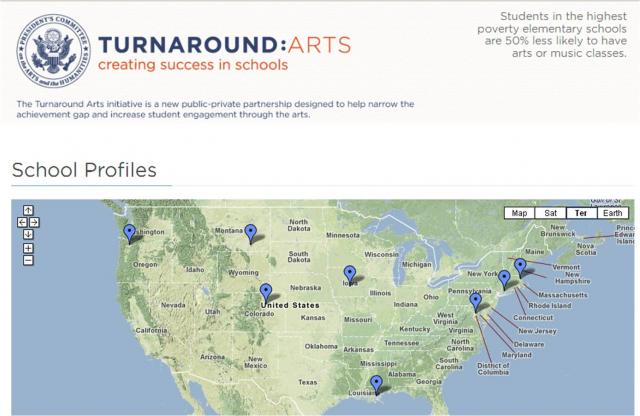
By now, you have probably read about President Obama’s Turnaround Arts Initiative in the paper, seen a segment about it on the nightly news, or heard about it on Entertainment Tonight  between cosmetic secrets of the stars at the Metropolitan Gala and celeb sightings of Blake Lively with Ryan Reynolds (Wedding plans in the works? You didn't hear it from me...). If you are still curious about the Turnaround Arts Initiative, then this post will provide you with a tidy summary of the program from a policy and arts education perspective. Unfortunately though, this post does not include details on Eva Longoria’s summer workout plan and how-to advice on beating the heat in Mila Kunis-esque summer dresses. Sorry.

“We are, as a country, engaged in a national conversation about how to fix our nation’s broken schools. We feel strongly that, while no one strategy alone is a silver bullet, art education should have a seat at the table. Turnaround Arts will test that theory, in addition to bringing effective arts education to thousands of our neediest young people and creating more access to the arts in our most underserved neighborhoods.”

The Turnaround Arts Initiative is:

• an arts education funding initiative in full swing as of April 23, 2012

• a public-private partnership designed to help narrow the achievement gap and increase student engagement through the arts (private partners include: the Ford Foundation, the Herb Alpert Foundation, Crayola, the NAMM Foundation, the Aspen Institute and Booz Allen Hamilton)

• a creation of the President’s Committee on the Arts and Humanities (PCAH), in coordination with the U.S. Department of Education and the White House Domestic Policy Council (other public partners include the National Endowment for the Arts, the Arts Education Partnership, the Council of Chief State School Officers, and the National Assembly of State Arts Agencies)

• testing the hypothesis put forward by the PCAH’s 2011 report Reinvesting in Arts Education: Winning America’s Future Through Creative Schools, that “high-quality and integrated arts education can be an effective tool to strengthen school reform efforts-boosting academic achievement and increasing student motivation in schools facing some of the toughest educational challenges in the country”

• directed at the nation’s lowest-performing elementary and middle schools across the country, known as “turnaround schools” (turnaround schools are in the lowest-performing 5 percent of their state and receive School Improvement Grants through the Department of Education)

• a pilot project at this point, schools have already been selected to participate

• a two-year project, results will be evaluated at that point, program expansion will be considered, and resources will be made available from which ALL schools can benefit

What will the Turnaround Arts Initiative do and how will it be evaluated?

• Provide the selected schools with arts education services, resources and materials to “increase the likelihood of successful school turnaround, engage their community, and raise the visibility of their achievements”

• The key to the program's success is fully integrating the resources into the curriculum, making effective, impactful and rigorous arts programming part of the school’s being

• The impact and effectiveness of arts education in advancing academic achievement, student and community engagement, and overall school performance will be evaluated and reported by Booz Allen Hamilton, a consulting firm, at the close of the two-year term

Why did Entertainment Tonight cover the Turnaround Arts Initiative? Eight under performing schools across the country were selected through an application process. These schools have each been “adopted” by celebrity artists who will remain involved in the school’s curriculum reform by participating in events, performances, and classes. Below is the breakdown of each parent artist and their adopted school(s):

• Chuck Close (award-winning visual artist), Roosevelt Elementary in Bridgeport, Connecticut

• Yo-Yo Ma (award-winning cellist), Orchard Gardens School in Boston, Massachusetts

• Sarah Jessica Parker (award-winning actress), Martin Luther King, Jr. School in Portland, Oregon

• Kerry Washington (award-winning actress), Savoy Elementary in Washington, DC

• Forest Whitaker (award-winning actor), Findley Elementary School in Des Moines, Iowa

• Damien Woetzel (arts leader, previous Principle Dancer with New York City Ballet), Lame Deer Jr. High School in Lame Deer, Montana and Orchard Gardens Schools in Boston, Massachusetts

• Alfre Woodard (award-winning actress), Batiste Cultural Arts Academy in New Orleans, Louisiana and Noel Community Arts School in Denver, Colorado

Is there opposition?

• Diane Ravitch, author and previous U.S. Assistant Secretary of Education under George H. W. Bush and Bill Clinton, says the Turnaround Arts Initiative is just a “teeny, tiny little band-aid on what is a giant, national, festering problem…And it doesn’t begin to address the needs of the schools.”

But we have to start somewhere, right? Many school systems and communities are eager to be included in the program as it offers promising opportunities and resources customized to fit the needs of each school. However, as a pilot project with strict parameters, the Turnaround Arts Initiative is currently focused on evaluating the impact and results of the program on the eight selected schools over the next two years. Meanwhile, schools and the general public can stay informed about the project, its progress, and resources made available by referring to the Turnaround Arts Initiative website, its Twitter feed, and the Arts Education Partnership’s webpage.

Stay informed about the Initiative, stay inspired by its intentions, and keep advocating for arts education funding on a local level.

A Recap of the Year We Spent Together

First, some sad news to share with everyone: this is my last post for Tech in the Arts, the quintessential blog looking at the intersection of arts and technology online. As a student here at Heinz College, it has been an honor to share with you on a weekly basis a look at different trends and topics at that very intersection, with a little bit of policy thrown in. For my final post, I wanted to take a look back at some of my favorite posts from the past year, and share with everyone what my thought process was when it came to writing about the important issues that affect the arts community on a daily basis.

Compared to the other writers here at Tech in the Arts, I have always tried to take a different approach – one that is centered on public policy, and how it impacts the arts community and arts lovers everywhere. As a Master’s student in public policy here at Carnegie Mellon, this is what I study on a daily basis and what I am passionate about, and I have been determined to include it in the overall conversation.

One of the topics I have written about frequently is the issue of funding for the arts, and the somewhat uncertain future it faces. Many cities and states, and even the federal government, are facing times of budget austerity, and cuts to the arts are happening at an alarming pace. I also wrote about the National Endowment for the Arts and its funding history, along with the new upstart on the arts funding block, Kickstarter. Arts financing in Europe has also been the target of deep cuts, and I finally looked at the debate surrounding what method of funding was the best for the arts in America. And in my very first post, I talked about how important it was (and still is!) to protect federal funding for the arts.

One of my favorite topics to write about was where arts and public policy intersected. One of my favorites to write was looking at where public policy lived through the eyes of the artists; another was a look at artistic revisions of the American Dream of buying a home. As we all know, the arts play a large role in economic development, which I wrote about, and I also took a look at how cities are thinking differently when it comes to development, often using the arts to differentiate them. Finally, I took a look at how cities are beautifying themselves through public works of art, as they face budget shortfalls and have to think creatively.

The most popular piece I wrote this year (and perhaps the most controversial, given some of the feedback and comments!) was looking at the debate over the most artistic city in America. The winner (as crowned by the Atlantic) was Santa Fe, but certainly cities everywhere can make their own legitimate cases for being the most artistic. Its topics like that are so much fun to write about; everyone has an opinion, wants to make their case for their own city, and it encourages discussion and debate.

I also enjoyed writing about an issue that doesn’t receive a lot of attention in the arts community, but is very important nonetheless, which is the issue of net neutrality. I wrote about how important the issue is, and also about how the issue is not going away anytime soon.

Finally, two of my favorite posts were about topics that don’t fit neatly within any of the above categories: My look at the Google Art Project and the White House, and also my look at the fall of Kodak and its effect on artistic inspiration.

It’s been a pleasure being a part of the fantastic and talented team here at Tech in the Arts for the past year. Thanks go out to everyone on the team for their help and support, and chiefly for the opportunity to write for all of you on a weekly basis. Thank you to everyone for reading, for being so supportive and for the kind comments and responses throughout the year.

For those so inclined, you can follow me on Twitter at @seanbowie, and can reach me by e-mail at seanmbowie@gmail.com. It’s been a pleasure everyone, thank you!

25 Best Kickstarter Tips for Creative Students

While blockbuster Kickstarter projects receive a lot of attention, it's important to remember that small projects have more success on the website than these massive funding campaigns. We talk a lot about the best ways for organizations and artists to utilize Kickstarter, but what about students who haven't entered the field yet? Fortunately a Tech in the Arts reader pointed us to this article on BachelorDegreesOnline.com's blog with 25 Best Kickstarter Tips for Creative Students. It's got some great tips that every Kickstarter project could benefit from. One of my favorite tips on the list is number 24:

24. Engage your audience

A neglected Kickstarter page is one that will likely go unfunded. Be careful not to simply set up shop and walk away. Rather, you've got to stick around, posting updates, answering questions, and interacting with the people who have put their faith and money into your project. Your backers want to be a part of what you're doing, and you've got to make an effort to let them do that.

After all, isn't engagement the ultimate goal of web 2.0? To read the rest of the tips, click here.


Confirmed by Nonprofit Quarterly: Generating online content is NOT optional

Just when you thought your nonprofit’s résumé was updated and accurate, it is time to add another job responsibility: publisher.

As recently reported by Joe Waters with Nonprofit Quarterly, “Nonprofit employees have always had to wear a lot of hats: fundraiser, marketer, grant writer, etc. Here’s one more you need to get used to wearing: publisher. Fortunately, this additional job has a real benefit, as it engages current and potential supporters with useful, interesting and credible information that directly drives donor support.”

The key to generating and publishing online content is to be timely, stay relevant, and to “inform, educate and inspire.” Unlike an advertisement, online content allows followers to interact with the information, contribute and hear/see/participate in the organization’s story.

While many of our followers have already identified and addressed the publishing aspect of their nonprofit work, Nonprofit Quarterly offers three reasons why generating and publishing online content is no longer an option for small nonprofit organizations.

1) “It’s part of being a top nonprofit brand”

Build community around your brand and cause by publishing engaging, inspiring, visually compelling and relevant content (and just to clarify, that is NOT your monthly newsletter).

2) “You need to stand out”

It’s a dog-eat-dog world out there. We are all on Facebook, we all have Twitter accounts for our organizations, many organizations maintain blogs—it’s time to step up your online content, videos, podcasts, links, downloadable and free content, etc. Simply having an online presence is no longer enough. Though we prefer to think we are not competing with other nonprofit organizations, the truth of the matter is, we are.

“With more and more nonprofits coming online each year, content is a key tool in separating your nonprofit from the pack. This is especially important as people search for your nonprofit on Google, Bing and Yahoo. Several factors are important in how search engines rank and deliver search results, but one thing is clear: if you don’t produce high quality content and links, online searchers won’t find you. Period.”

3) “You can’t just do good work anymore”

Nonprofit to nonprofit, many of us share similar, philanthropic visions for our organizations. Because of this, the general public has its pick of relevant, benevolent, and noble organizations to support and fund. So now that you can’t claim your work is MORE important or MORE charitable than the next nonprofit’s, how do you get that donor’s attention and dollar? Answer: tell your story in a compelling way, manipulating the resources the web provides. Facebook photo albums, Twitter contests, IncenTix by ShowClix, Pinterest, podcasts, infographics – these and the resources we feature here on Technology in the Arts can help you do just that.

Am I suggesting all nonprofits abandon the newsletter and print medium in this competitive, nonprofit landscape? Of course not. YouTube channels and 140-character-Twitter-contests are wasted on my parents. They look for the newsletter in the mail every month (but continue to impress me when they sign up to receive them by e-mail…way to go, Mom and Dad, makin' me proud).

Publishing online has become increasingly dynamic, visual, and allows for a voice in 3-D; a voice that speaks louder, in more colors, and more emotionally than the traditional newsletter printed and mailed for years and years. Storytelling has moved online with a worldwide audience waiting to feel emotionally compelled, connected, and stimulated by the content your organization generates and publishes.

Up for Debate: What is the Best Way to Fund the Arts in America?

It is a topic that we have covered extensively here at Tech in the Arts over the past couple of months: what is the best way to fund the arts in America? With the National Endowment for the Arts seeing budget cuts, Kickstarter growing in popularity, and increased austerity measures around the world forcing large cuts to the arts, the topic has received a fair amount of attention in recent months. Last week, the New York Times, as part of its perennial “Room for Debate” series, asked the question I mentioned above, along with some others: What can we do to stabilize funding? Can we learn from the experiences of other countries? What can be done to improve effectiveness?

The Times gathered eight individuals from the artistic, non-profit, and political sectors, asking them what they believed were the best ways to fund the arts. Their answers might surprise you.

The eight respondents in the series tended to gravitate towards two positions: either the government needs to do more to fund the arts and various programs, or the government needs to get out of the way and the responsibility should rest on individuals instead. Like most policy debates, the question naturally comes back to what role the government should play; while some would argue too little is spent on funding (for example, the NEA received $147 million last year, a tiny, tiny fraction of the overall federal budget), others would say that instead of the government using taxpayer dollars to fund programs, it’s better left to the private sector and individuals to decide what programs should be funded.

Going through the eight responses, it was interesting to see how each person eventually gravitated towards one of these two areas. Some were more explicit and forward than others, but it’s this tug of war between more government investment and less government involvement that always seems to come up when debating any kind of public policy. The arts are no exception.

I encourage everyone to read the entire discussion, but I will summarize the eight viewpoints below.

Beth Nathanson, director of development at Playwrights Horizon, is quick to point out America’s “culture of philanthropy,” and says the following:

“It is a misconception that corporate or government support has ever provided the majority of arts funding. Each United States citizen pays about the cost of one postage stamp in taxes to support national arts and arts education programs. And those corporations that fund the arts primarily fund prominent organizations serving a high number of people. The real stars of arts giving are individual donors. They provide the lion’s share of support across the country, and on average, give more to arts than corporations and government entities combined.”

Nathanson points out that the arts are a fundamental part of our daily lives, and encourages individual investment in the arts, instead of government involvement. She, and many others, point to the Brazil model, which is a sort of public-private partnership that raises funding for the arts through payroll taxes. Everyone can certainly agree that “the arts should be an integral part of our lives,” the question becomes, in the end, how is that managed and developed? While taxes are certainly one way, personal responsibility, through giving, is another possibility as well.

David Boaz, of the Cato Institute, a libertarian think tank based in Washington, takes the individual model a bit further, and says that all arts funding needs to be separated from the government, because the government has too much control over where the money is spent. Better to let individuals and the private sector handle the responsibility instead, Boaz writes:

“People should not be forced to contribute money to artistic endeavors that they may not approve, nor should artists be forced to trim their sails to meet government standards.”

Boaz goes on to mention Kickstarter, an outlet for individuals to direct money to programs they explicitly support. This approach, Boaz argues, is preferable to the NEA’s approach, which is to take money from all taxpayers and then direct it to programs the agency support.

Robert Lynch, CEO of Americans for the Arts, disagrees. Instead of spending less on the arts at the federal level, we should be spending more, and seek to start a “national dialogue” on the importance of arts funding. Lynch writes:

“Last month, 800 advocates were in Washington to defend to Congress the 47 cents per person that America spends on the National Endowment for the Arts. This amount should be much more but despite its seemingly small percentage, government support leverages billions in matching dollars, increases access — especially for the underserved — and encourages new voices, ideas and expressive endeavors that have kept the U.S. at the vanguard of creativity and innovation.”

Lynch writes about America needing to have the “creative will” to move past the issue of why funding is so important and start talking about how we should do it. Lynch, and many others, believe government revenue is the best way to do that.

Sergio Munoz Sarmiento, an artist and arts lawyer, takes issue with “mandatory funding,” the idea that everyone contribute to the same pot and those funds have to be spent each year:

“Arts funding should be encouraged, yet voluntary. Mandating government and corporate subsidies for the arts raises a few concerns for me. Will mandated art subsidies affect the quality of artistic production? Will this type of funding encourage a passive artistic community? And finally, will it create a curatorial practice on behalf of granting institutions?”

In other words, a program where funding is guaranteed does a disservice to artists, who will not be as entrepreneurial or imaginative if funding is a certainty. Better to have more competition and uncertainty, which will lead artists to become more daring, creative, and/or original in their works.

Clyde Valentin and Kamilah Forbes, of the Hip-Hop Theater Festival, focus on the reliability of arts funding, and maintain that a stronger commitment to the arts will encourage more collaboration and certainty among artists and arts groups:

“The experience of the Hip-Hop Theater Festival is that where our funding is most reliable, our programs have the most impact. In Washington, for example, our partnership with the D.C. Commission on the Arts and Humanities has enabled our organization to produce the D.C. Festival for little or no direct cost to the public. The festival draws an unprecedented audience annually to some of D.C.’s most prestigious arts institutions, reaching thousands who get to experience art they would never otherwise have an opportunity to see.”

Michael Royce, executive director of the New York Foundation for the Arts, is another defender of federal funding for the arts. In addition to greater federal funding, he encourages greater incentives, through federal tax policy, for individuals to donate to the arts as well:

“The U.S. model has traditionally given incentives for private support, usually through tax deductible donations. Likely the most efficient method of increasing private funds is to strengthen those incentives. For example, the current cap on tax-deductible contributions is 10 percent of taxable income and could be raised for arts contributions, perhaps to 15 percent. Smaller companies, through cash grants or in-kind donations, can make vital and targeted contributions to specific artists' projects. On the individual level, tax forms could allow for earmarked donations to the arts.”

Royce, and many others, agree that the problem is that there simply isn’t enough funding for the arts at this time. Through greater federal investment, and tax incentives, Royce argues for a new model.

Finally, Stacy Palmer, editor of the Chronicle of Philanthropy, talks about how little of the money donated to charitable causes in 2010 went to the arts community: only five percent. The majority of the money went to places like universities, religious groups, and hospitals. She also points out the myth that most arts funding is donated by the wealthy:

“It's a myth that the rich are keeping the arts alive; while many are to be commended for their huge donations, America's millionaires and billionaires provide a small portion of the money that flows to cultural causes.”

Palmer points out that it is time to “rethink” how everyone, including the public and private sectors, individuals, and arts organizations steer money towards the arts, which is something I think all of us can agree on.

Taken together, the New York Times series was a fascinating look at the different perspectives towards how arts should be funded in the U.S. All of us can agree on the problem: the arts need more funding. The question, going forward, is how to best do so.

Whether it is continued federal support towards groups like the National Endowment for the Arts, more of a focus on private alternatives, like Kickstarter, or some kind of combination of the two, the debate is sure to continue.

After reading the different responses, where do you stand? How should funding for the arts be developed in the United States, and what steps can we take to get there?

In Case You Missed It - April 2012

April showers brought May flowers and some great articles here on Tech in the Arts. In case you missed it, here are some of our highlights from the month. We had the honor of featuring Kickstarter Art Program Director Stephanie Pereira in our speaker series, and offered our additional thoughts on her visit on the blog. We also took some time to reflect on how cities are thinking about art differently and Melissa Snoza of Fifth House Ensemble elaborated on how her organization thinks about art and technology. Since new technologies are constantly improving how organizations function, we took a look at Eventbrite’s Newest Ticketing system for your iPad!

The Google Art Project is often on our minds, and we took a look at its new home – The White House. It’s a global application, and we discussed it along with Art.sy as methods to help us understand our cultural universe. A universe that expanded into the realm of the internet with the BMW Tate Live.

What a month! As our school year draws to a close, we hope your May is as pleasant as those flowers we’ve been promised.

Playing by the Rules: Creating a Social Media Plan

Your organization has been using social media for some time now. But does the staff know all rules? How to handle and respond appropriately to negative comments and criticism? What they can and not write on the organization’s page? How to fix errors in posts without compromising the integrity of the content the public has already shared on that post? Are employees allowed to “friend” your organization using their personal accounts? How do you ensure your brand image is enhanced, not threatened by social media usage throughout the organization? A comprehensive, widely-circulated social media plan can eradicate these issues and guarantee all employees understand the procedures, policies, rules, and expectations for using social media to promote the organization’s brand.

A good social media policy will provide clear guidelines as to what staff should and shouldn’t do when posting and interacting with the community on a day-to-day basis, freeing them up to think more strategically. It’s also likely to help leadership feel more comfortable with the less-formal nature of social media by letting them establish boundaries for its use. -- from the Nonprofit Social Media Policy Workbook

If you do not have a social media plan, you are surely not alone. However, given this year’s projected estimate that Facebook will exceed 1 billion users and Twitter, 500 million, it’s time to protect what this SIZEABLE population has access to- your brand, your image, and your Facebook wall.

Above all, a social media plan is a LIVING document. As your organization experiments with trending social media platforms, faces new challenges, expands its presence online, or changes its online branding, the social media plan must reflect that growth. Below are guidelines, best practices, and resources to help you clearly define your social media objectives and policies in a complete and effective social media plan. And to clarify, an effective social media plan is not one that controls and restricts participation, rather, facilitates and encourages an open relationship with the public. I’m talkin' 24/7 PR.

1) Meet your new best friend: The Nonprofit Social Media Policy Workbook April 2012 (scroll down the page and click "Download the Report"). Download it. Swear by it. Love it. Be best friends with it forever. Thank you, idealware and Balance Interactive.

2) Determine if your social media plan will address policies for internal social media use (expectations for employee-to-employee use), procedures regarding proper usage and maintenance for PR purposes, and/or community guidelines for participation.

3) Facebook, Twitter and Linkedin are the Big 3. If your organization employs one or all of these, be certain the plan includes specific guidelines for each platform.

4) Video blogs, written blogs, podcasts, wikis, community forums, and on and on and on…these need to be considered as well. Perhaps the plan is not as developed for these various platforms, but nonetheless, expectations for their usage should be made clear if your organization/brand is the subject.

5) RESIST THE INCREASINGLY ATTRACTIVE URGE TO COPY AND PASTE YOUR PLAN, especially when you realize your organization not only uses the Big 3, but also has a YouTube, Pinterest, Tumblr, and Wordpress account…

As Chris Boudreaux, a social media consultant said:

What is important are the differences that are unique to your particular organization and circumstances, and should be based on your business outcomes and how you conduct your business. Just don't copy everyone else's policy and put it in your database of procedures.

6) TRANSPARENCY. How public are we talking? Will the entire world have access to this document (like the Smithsonian Institution and NPR have done), just your Facebook community (as AARP has done in its "Company Information" section), or will it be an internal document for office staff only? Knowing who will receive this information will determine the language you use and the direction you take with it.

7) Regardless of how public the document will be to the outside world- INTEGRATE IT. It should not be considered an isolated document. I’m going to be bold and take a wild guess that at least ONE person on your staff has a personal Facebook account, just one…Your organization's social media users need to know what is considered appropriate and inappropriate to say in reference of the organization, what copyright issues they may face when posting photos, when they can post things that are “off message” and who can friend whom. The social media plan should be included in the organization’s employee handbook- HR and the legal departments should be involved in making this document come to life, too.

8 ) What to say, what to say. The language you use should be clear, as this is a guide for staff and perhaps, the public. For a few examples on strong and clear language in a social media plan, check out this post from Nonprofit Tech 2.0’s blog.

9) Enjoy this cartoon/graphic by Rob Cottingham depicting the process of creating a social media plan.

10) Look at examples of social media policies (213 organizations listed here). Read social media plans that are inclusive of all social platforms. Read plans and guidelines that are specific to blogging or Pinterest. Browse plans of organizations of a similar size and much larger size, of a similar audience and larger audience, and of a similar or completely different mission. While copying and pasting their plan into your own template serves no one, referencing a model will make you aware of things you hadn’t considered, including policies you agree/disagree with and procedures you admire.

Let employees know what is expected of them regarding social media usage. Let the public know what the organization's expectations are for the social media pages themselves and for participation. Keep everyone in the loop, out of trouble, and participating-- with a social media plan.

Six Ways Arts Organizations Can Improve their Facebook Advertising

Guest blogger Erik Gensler is the President of Capacity Interactive, a digital marketing consulting firm for arts organizations. This fall Capacity Interactive is hosting Digital Marketing Boot Camp for Arts Marketers, a 2-day conference October 25-26 in NYC. Conference topics include: Marketing the Arts with Video, Mobile Marketing, Writing for the Web, Online Fundraising, and the topic of this blog post: Facebook Marketing. More information at http://www.dmbootcamp4arts.com

I'm calling for a moratorium on boring Facebook ads for the arts. As arts marketers, we have amazing products to sell -- live arts that provide moving experiences to audiences every night. We have beautiful sets and costumes, sexy dancers, and attractive actors. But what do most performing arts Facebook ads look like?

Headline: Show I've Never Heard of

Stock Production Photo

Come see <Show I've never heard of> at< theater I like>.

Starts April 5th. Tickets start at $25.

Snooze. We could do much better. Here are six tips to improve your Facebook advertising.

1.) Set goals. Before you begin, set goals for your campaigns. These can include things native to Facebook like: drive sharing, build fan base, drive event RSVPs, drive video views, etc. or drive visits to our website. One campaign can’t do everything to pick two to three goals and focus. I tend to think you can be most successful driving the native Facebook functions such as sharing, video views, RSVPs, etc. These are the easiest to track on Facebook and what the new ad formats are designed to do. I've also ran many campaigns that take users off of Facebook to a website. As Facebook builds more advertising options to keep users on Facebook and track their interactions, I think there are more benefits to running those types of ads.

Then review your advertising reports often. You can see what is working and what is not. Pause and replace the duds. Also make sure to closely watch for frequency. If your average frequency for any ad approaches 10 then you need to replace it to fight fatigue.

2.) Highlight benefits, not features. I see far too many Facebook ads laden with features and with zero benefits. Features are much less interesting. Features would include: At xxx theater, performances begin 4/25, comfortable seats. They are useful, but benefits make far more compelling ad copy. Strong quotes provide great benefits. "The most brilliant ballerina of her generation" or "You don’t just see an Ailey performance, you feel it." Tell a story. Build excitement.

3.) Use imagery that captures attention and change it frequently. As I mentioned earlier, we have the benefits of beautiful sets, costumes, sexy dancers, and attractive actors. For our dance clients, the Facebook posts that get the most interaction are ones with shirtless men and dancers in super-human poses.

Have your designer alter the images so they capture attention. Try adding borders or bright background colors. Or try to crop out the image and put it on a white background so it pops.

Also, if you ever ran a good ad on Facebook, you know your click-through rate (CTR) lasts only a couple of days. The only way to keep your CTR high is to keep your images fresh. So create lots of ads and rotate them often.

4.) Tighten your language. Is the language as tight as can be and under 90 characters? If not, cut nonessential words. Keep sentences short. Use active voice. Posts with fewer than 250 characters see about 60% more engagement

5.) Micro Target. Facebook allows you to slice and dice your audience in many different ways. Say, for example, that you are promoting the musical White Christmas. Determine all of the potential audience groups: people who like classic movies, people with kids, people who like Irving Berlin or his contemporaries, people interested in musicals, people who like tap dancing, etc. Then create unique ads for each interest with headlines that will grab their attention. For people with kids the headline should be "Family Holiday Entertainment" for those who like tap dancing "A Tap Dancing Delight," etc. It is best to create at least two headlines for each interest group to start. The more versions the better.

6.) Take advantage of the new ad types. There are many types of ads you can run on Facebook. The two types of ads I think are most useful in selling performances are:

  • Stories to build up your likes. This just shows the name of your organization and the name of a friend who likes it. Social ads, ones with the names of friends attached, get far more clicks than non social ads. Target these ads to friends of your current fans. Make sure to add the demographic targeting on top of these ads to target the type of audience you are after. For one client we only target college educated women over 30 since we know they purchase 80% of tickets.
  • Page Post ads. These allow you to select a recent post and promote it as an ad. This is the only way to get videos into your ads without purchasing a premium sponsorship (which starts at $25,000). Just save your video on Facebook and create a post about it. Then go to the ad interface and select your organization as the target, choose "a specific post on your organization," then choose the story you want to promote from the dropdown. Voila, a video ad. The other advantage of these types of ads is that users can like, comment, and share the ad. When a user “shares” your ad, you get thousands of endorsed impressions. Also consider RSVP ads where you build an event on Facebook and the call to action is for users to RSVP.

Want to learn more about Facebook advertising? Don’t miss the half day session on Facebook Marketing at Digital Marketing Boot Camp for Arts Marketers, October 25-26 in NYC. More information at http://www.dmbootcamp4arts.com.

White Space on the Broadcast Spectrum and Why We Should Care

The Federal Communications Commission (FCC) regulates every device that emits radio waves.  This means cell phones, radio, television, and wireless microphones.  In 2010 the FCC issued a rule that ordered users of wireless microphones to stop broadcasting at 700 MHz.  This resulted in the forced scrapping and purchase of tens of thousands of dollars of wireless microphones that broadcast on that length of spectrum.  Story over?  Not really.  Now, two years later the FCC is talking about 'repacking' the broadcast spectrum again. Any change of this type would result in tens of thousands of dollars of additional cost for every arts organization effected.  This is cost that was already borne out in good faith two years ago.  As congress moves forwards with legislation that would patch the budget with broadcast spectrum  auctions the arts community finds itself potentially under the gun in a time where budgets are already lean.

To give a sense of scope for this issue, there are an estimated 21,000 school theaters in addition to the thousands of professional theaters.  Combined, these facilities serve millions of patrons and students and contribute nearly eight billion dollars to the economy.

The problem is that the FCC hasn't formally recognized wireless microphones formally as a broadcast user of the spectrum.  As a result it is easy to give away the spectrum that they use.  For more information on this issue Theater Communications Group (TCG) has put together a list of articles on the subject.

Beautifying the City through Public Works of Art

There may be no better way to beautify a city (or most cost effective way, in many aspects) than by using public works of art. As I have written about before, cities, especially cities that are losing population and/or facing severe budget shortfalls, are turning more and more to public art to revitalize areas and encourage more tourism. And as I wrote about last week, cities are turning more and more to what makes them unique, a significant change in focus from the tried and true method of trying to outdo or outclass your neighbors. Gone are the days (I hope, at least) of cities competing for visitors by building bigger stadiums or concert halls in an attempt to prove that they are, in fact, the most exciting city this world has ever seen.

In light of all this talk about urban renewal, green spaces, and new works of public art, what are some of the latest and greatest pieces of work on display? A number of outlets, including the New York Times, the Atlantic and others, have recently taken a look at works from across the world, and I have assembled them here for your viewing pleasure!

The New York Times recently took a look at a new project in Mexico City that seeks to provide both aesthetic pleasure and help the environment: a set of three “eco-sculptures” that comprise a sort of urban garden in the city. As you can see in the image above, these arches, comprised of thousands of plants each, are an attempt to beautify the city and help ease pollution in the large metropolis. Installed by a local non-profit, the sculptures are part of an overall effort to help green a city that is not particularly known for having a sustainable reputation; as the New York Times reports, these three sculptures are just a small part of a broader garden movement, and the attention these works of art have received are bound to make the effort that much more noticeable.

Over in Los Angeles, a new public art project has taken a little of bit of nature and transported it, visually at least, to an urban area. Artist Paige Smith has crafted little miniature geodes, crystals that form inside of some rocks, and installed them in unassuming places around the city: inside pipes, brick walls, or even the cracks of a wall. Smith has created little 3D sculptures made of paper to have the appearance of geodes, and the result is a unique little diversion from the normal city wall. She’s up to a dozen installations across the city, and you can see a full map of locations on her website.

(Photo courtesy of Paige Smith)

In St. Louis, public art is being used to help solve a problem: how do theatres make their patrons more efficient? In other words, is there a way to encourage patrons to stay longer and keep themselves busy, instead of just standing around waiting for the show to start?

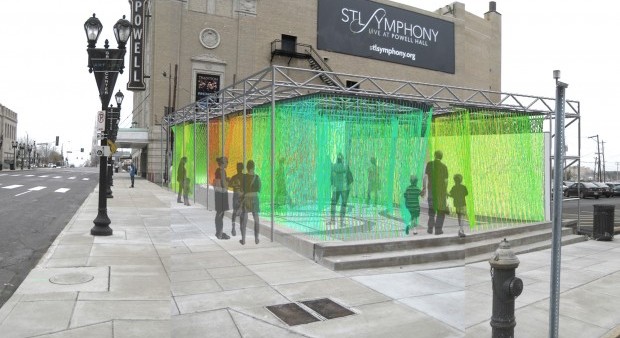
A piece is going up in the Grand Center neighborhood of St. Louis that is designed to encourage patrons and visitors to stay a while. Titled “A Chromatic Confluence,” it will be a mazelike sculpture made up of about 20,000 feet of different colors of string. The overall structure will be fairly large in size, about 25-feet by 65-feet, and will be lit up at night, as you can see below. Hoping to draw in patrons and foot traffic, it is an attempt to grab people’s attention and give them something to do before the show starts. The piece is the first of a planned series of public art projects in the St. Louis area, in an overall attempt to bring more culture and artistic pieces to the city.

(Photo courtesy of the St. Louis Post-Dispatch)

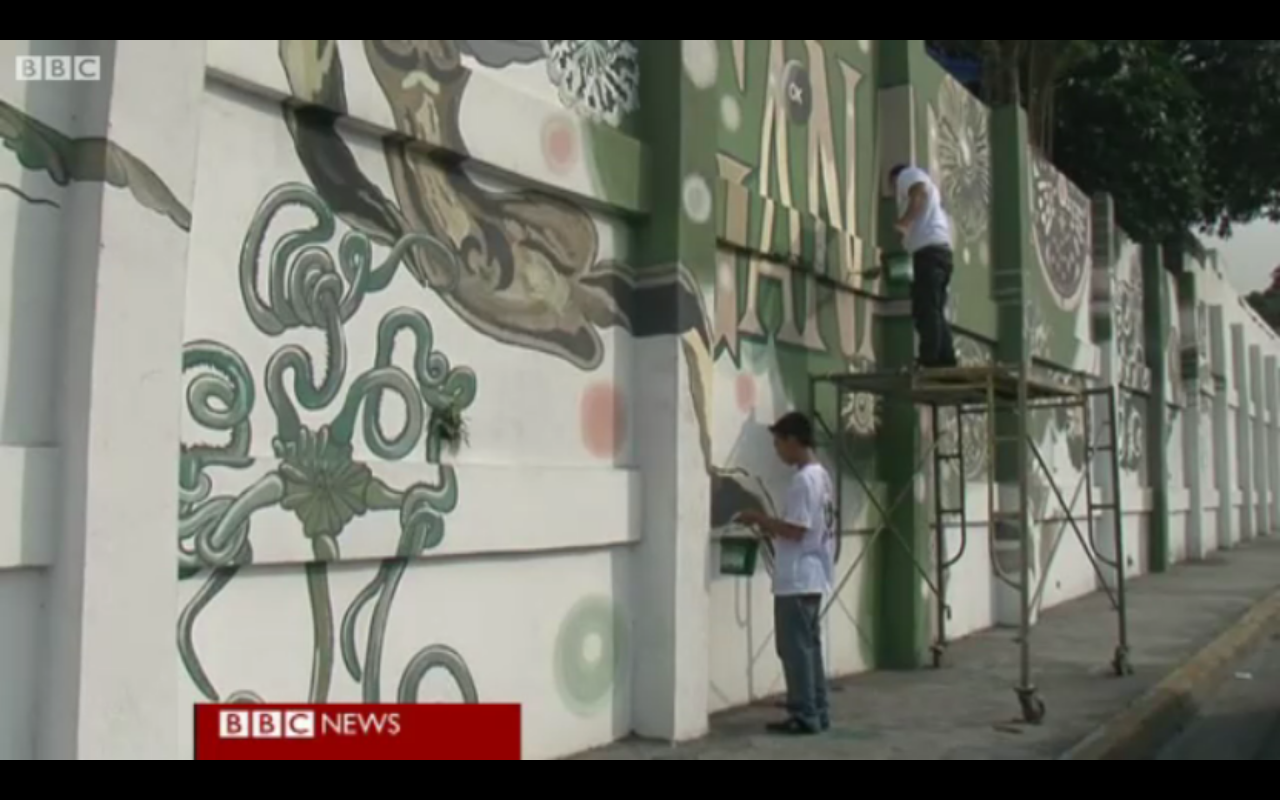
Overseas, the city of Manila is moving ahead with public art, but is doing so in an attempt to be as environmentally sustainable as possible. Manila has the distinction of being one of the world’s most polluted cities, and attempts have been made in recent years to help cut down on emissions and improve air quality.

Courtesy of the Atlantic, a local Philippine company has created a paint which it claims can help purify the air while being used, and since the discovery, murals have been painted all over the city in attempt to not only beautify areas of the city that been victims of neglect and destruction, but also help the environment as well. The BBC recently filed a report about the paint and the attempt to improve the city through public art.

(Photo courtesy of The Atlantic)

These are just a few of the examples of cities using public art to help improve the aesthetic quality of their cities. Many more projects are underway, popping up in cities all across the United States and the world. What are some of your favorite public works of art in your cities, or perhaps favorites you’ve seen in others? Feel free to comment below!

(Top photo courtesy of the New York Times)

Let's Talk About Tumblr: Part 3 [mini-nar]

Tumblr is one of those platforms I love to talk about - and this mini-nar is for those who love it too. I've got cool tricks and tips, but this mini-nar moves are a pretty good clip. If you haven't seen our other posts on Tumblr, maybe check those out before you watch this. We discussed the arts communities possible shift towards Tumblr, some of the recent updates, and last week - in the second part of this series - we had a mini-nar on the basics of creating a Tumblr. If you feel you've got all that down, here's a lesson in really engaging a Tumblr audience. http://youtu.be/HAqAO0VgukA

Newsweek and Anderson both have great Tumblrs, and I was excited to feature them this week. Call Me A Heinzer is a hilarious Tumblr (and personal fave, as Tech in the Arts is an initiative from the Master of Arts Management program of Carnegie Mellon University's Heinz College).

If you or your arts organization have a Tumblr, please let us know! Write a comment! I'd love to see what you're doing!

The O: Audience Engagement at the Museum of Old and New Art in Tasmania

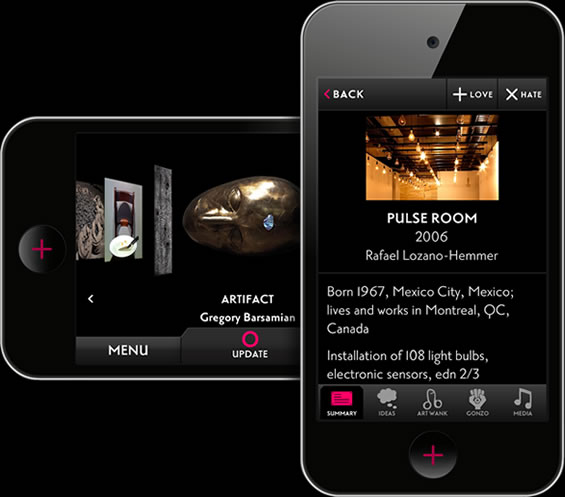
A recent blog post by the Walker Art Center featured some highlights from the Museums and the Web Conference that took place in San Diego earlier this month. Among these conference notes, the audience engagement practices at the Museum of Old and New Art (MONA) in Tasmania were undoubtedly innovative. The 6000 sq ft privately owned museum, which has an “eclectic collection of 2210 antiquities and artworks,” has not a single wall label or sign to guide its visitors. Instead it relies on The O, “the first mobile interpretive solution designed to replace traditional wall labels and signage.”

The O, a mobile device, equips a visitor with all the information they require including museum maps and cafe hours. Additionally, the O uses a visitor’s geo-location to suggest nearby artworks, allowing them to select the artworks they would like to know more about. It then goes on to provide them with curatorial information such as viewing notes and artist interviews. But even here, the approach is unique.

A visitor at the MONA recently wrote about her experience with The O and she mentioned how information on a particular artwork can be viewed in different styles. So Artwank presents you with information in “a formal curatorial style,” while Gonzo provides you with “personal musings on the art from MONA’s owner David Walsh.”

Besides curatorial information, The O lets a visitor interact with an artwork by leaving comments, tweeting about it, and sharing it on Facebook. It even has features that allow them to indicate whether love or hate it; art lends itself well to such extremes. Visitors also have the option of saving their O Tours and retrieving them the next day on MONA’s website. In fact, access to the museum’s online collection is reserved exclusively for those who saved their O Tours.

For the MONA’s curators and museum staff, The O unlocks a lot more than art. It provides them with a whole array of statistics that can be used to improve the visitor experience.The shuffled movement of MONA visitors using The O can provide stats on the most visited artworks,  the most visited rooms, artworks with most likes, the number of tours, museum traffic, repeat visitors etc. Yes, The O is for omniscient.

According to Art Processors, the creators of The O, the device is used at the MONA by over 40,000 visitors per month. Since the MONA’s opening in January, 70% of visitors have indicated that they prefer The O to traditional signage and 80% said that the device enhanced their museum experience.

http://vimeo.com/40188545

The O improves on the visitor experience in several ways. They no longer huddle around a single text panel, reading the description at unimaginable speeds. Their path through the museum is altered by The O’s suggestions, leading them in unexpected directions and towards unseen artworks. They can revisit their tour in 3D on the museum’s website.

Museums have much to benefit from a device like The O.  They may, at times, miss the reassurance of wall texts.  But they can rest assured that with a device like The O, visitors will have access to a lot more than curatorial text.  Conversely, the same visitors will leave behind a dotted trail that can be traced and analyzed by the museum. The O is for opportunity.

Lessons from the Bronx

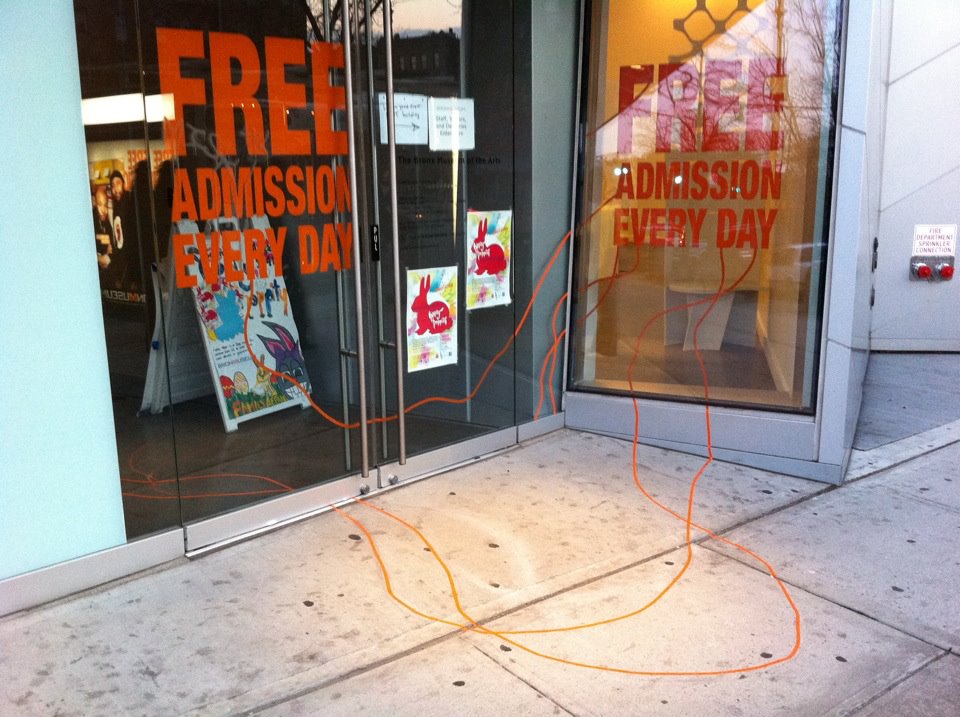
By now you may be aware of the Bronx Museum of the Arts' new ticketing initiative. If not, take a look at the Museum's Facebook status from March 30th: "Starting today, the Bronx Museum of the Arts will be Free to all. Thursday through Sunday, FREE! First Fridays! FREE. Whether you're 8 or 88, FREE! Getting Here: B/D train to 167th St (Unlike the Museum, the train fare is not free)." In celebration of its 40th anniversary, the Museum announced just last month it would offer free admission to guests-- this coming at a time when student discounts, twofer deals, good coupons, and gas below $3.99/gallon are at a premium. According to Museum Director, Holly Block,

With our immediate community being the poorest per capita in the nation, and at a time when many are struggling to pay bills…we don't want anyone to have to use (admission costs) as excuse not to visit us.

It is because of a grant from the New York Community Trust that the museum is able to offer free admission to the public- though the grant only covers admission costs up to 15 months. The Museum is hoping to secure a more permanent funding source to be able to continue to provide free admission to the public after those 15 months.

Not only does this reduce barriers of entry for Bronx residents, New Yorkers, tourists, and artists, but it also benefits the museum community at large. Many museums have implemented similar free admission pilot programs and have reported varying results. It will be interesting to follow up with the Bronx Museum at the conclusion of the 15 month, free admission period to review its attendance numbers and demographics during that time.

While snooping around for more information on the Museum’s new pilot program, I stumbled upon two special offerings at the Museum. How did I NOT know about these programs?!

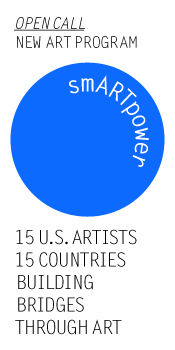
1) smARTpower: In conjunction with the U.S. Department of State’s Bureau of Education and Cultural Affairs, the Bronx Museum administers this cultural diplomacy program. The program funds and provides travel opportunities for 15 U.S. artists to create and work abroad on a community-based art project. smARTpower supports “the development and implementation of community-based art projects that engage youth and other local residents, including artists. The projects are strongly encouraged to create a tangible legacy of the work accomplished through smARTpower in a variety of visual arts media…” The program is open to professional artists only with U.S. citizenship.

2) Artist in the Marketplace (AIM): Established in 1980, the program seeks to provide “networking opportunities for emerging artists residing in the New York metropolitan area" and to introduce "their work to a greater audience.” Thirty-six selected participants attend weekly seminars led by a faculty of specialists. Topics covered in these sessions “address areas of practical concern to artists including: career management and gallery representation; exhibition and public art opportunities; grant writing, copyright law, and marketing.”

It is a hopeful sign, especially in these financially trying times, when a non-profit arts organization remains so concerned with serving its constituents- accessibility for its local audience, professional advancement for its arts community, and greater cultural understanding in diplomacy efforts.

How much are you worth to Facebook?

Now that Facebook is going public (reluctantly, due to a Federal Trade Commission rule) and is releasing financial statements we actually know how much money Facebook is making off of us:  about $1.21 a quarter according to Techcrunch.  This amounts to around $4.84 a year per user average.  This figure is of course only part of Facebook's income portfolio as it makes money off of advertising, investments, and licensing.  At times like these it is important to remember that Facebook is not ours, it is run for the profit of the shareholders.  The dozen or so iterations of Facebook that have been implemented over the last eight years have all had modifications that were put in place to maximize data mining and advertising sales. A worthwhile re-read at a time like this was done by a former blogger for this site.  Here are links to Amelia Northrup's social media analytic series:

http://www.technologyinthearts.org/2011/05/the-art-of-social-media-analytics-part-1/

http://www.technologyinthearts.org/2011/06/the-art-of-social-media-part-2/

http://www.technologyinthearts.org/2011/06/the-art-of-social-media-analytics-part-3/


Cities Thinking Differently, Through the Arts

The past couple of years have been rough on America’s cities. The recession, job losses, budget cuts, and more people moving to the suburbs have all resulted in less tax revenue and a sense of unease about their future. Through these struggles, the cities have to consider questions like: What steps can be taken to foster economic growth? How can we become a player in an increasingly competitive global marketplace? The cities of the Rust Belt, however, have had it a little worse. Unlike booming cities like Phoenix or Houston, cities like Detroit, Cleveland, and Pittsburgh are losing residents, with a fear that population losses will continue unless something drastic is done to “save the city.”

But instead of looking to traditional approaches like building an expensive sports stadium, performing arts complex or shopping malls, residents in cities like Cleveland and Detroit are taking a different route: embracing what Grist calls “Rust Belt chic,” the gritty, industrial, working class roots that embody and define the cities. One of the ways these cities are embracing this new dynamic is through the arts, and proving that having a thriving arts city doesn’t require investments or new arts venues: sometimes, all you need is to do is tap into what makes your city unique.

Much has been made about the struggles that face cities like Cleveland, Detroit, and Pittsburgh. This “Rust Belt chic,” first dreamed up by the “I Will Shout Youngstown” blog, based out of Youngstown, Ohio, can be best described by Governing magazine:

“A certain fascination with places that have fallen on hard times like the Rust Belt…has taken hold. Part of it is the scruffy, industrial look. It may also be a rejection of cities with gleaming condo towers, bistros and boutiques that were once so trendy yet now seem so frothy and fake.”

In other words, instead of trying to compete with the New York’s and LA’s of the world for visitors and potential residents, think different.

Cities all across the Rust Belt are taking this approach. But what many cities are doing is taking a low cost and high reward strategy towards economic development, which includes the arts community in a big way.

One example, as I wrote about in a recent post, is Detroit, who is embracing the arts community by providing tools and equipment to up-and-coming artists, fostering a sense of community for new artists moving into the city, even as thousands of residents leave every year. Detroit has the furthest to go of any city on this list, but businesses have started to move back to the city, young people are starting to move downtown, and its art scene has become home to increasingly diverse and eclectic artists, seeking to make a name for themselves.

Our home town of Pittsburgh is thriving (as any of us Pittsburgh residents would certainly tell you), and part of that is due to a thriving arts scene, which is frequently cited as one of the best things Pittsburgh has to offer. Much of the decay and abandoned buildings caused by the steel industry leaving decades ago has been taken over by the arts community and transformed into art spaces. What used to be an abandoned warehouse is now an art gallery; what used to be a factory plant is now a mixed use performance space.

It is because of this determination and grittiness, the drive to think differently and transform existing spaces, which makes Pittsburgh a perennial power in “America’s most livable cities” lists, often taking the top overall spot, as it did in 2010.

Cleveland is another case study. City leaders have struggled to come up with catchy slogans in an attempt to draw visitors, but local artists and arts venues aren’t focused on what Cleveland can do to “catch up” with other cities; they’re embracing what makes them different.

The Next American City recently looked at what it calls the “creative allure of urban grit,” focusing on cities like Cleveland. Because in cities like Cleveland and other across the Rust Belt, “you’re forced to accept that shit happens, and with that comes a freedom to creatively make sense of what’s happening. That’s art in a nutshell: the burn to make meaning out of failed plans and ruin.”

Some local artists are doing just that. The Next American City looked at Cleveland artist Amy Casey, whose paintings offer a unique and real look at the city. Housing vacancy and abandoned industrial plants a huge problem in Cleveland; Casey draws paintings where houses are connected together by ropes, or industrial areas are marked by decay.

One cannot help but to notice the economic strife and abandonment that has taken part in these cities; but while some would find such a sight depressing, others see inspiration. Casey’s paintings, and many others throughout Cleveland, seek to symbolize both the struggles it faces going forward, and the opportunity that awaits them.

Cities like Detroit, Pittsburgh and Cleveland all have many problems, and no one is here to suggest that the arts can save them on their own. But while all three areas, and dozens of others, create economic development plans and seek to spur investment and population growth to cities long forgotten by their neighbors, the arts is a way to provide a short-term boost to lift spirits, provide inspiration, and instill a sense of pride to communities.

We know it will be a tough and long road back for these cities. But at the same time, embracing what many call “rust belt chic” is a way for these cities to focus on what makes them different and unique, and offer a taste of what people can expect from these faded, but not yet broken, great American cities.

Let's Talk About Tumblr: Part 2 [mini-nar]

If you haven't heard about Tumblr, you haven't been reading Tech in the Arts. Tumblr just announced they will be including ads in their service soon, and has been making waves in the news. We've talked about the use of Tumblr for the arts communities, the latest updates to Tumblr, and now we're proud to present a mini-nar on how to use Tumblr. New technology can seem prohibitive, but this mini-webinar is designed to show you how simple Tumblr can be, and how other arts organizations are utilizing Tumblr. http://youtu.be/m8fT-RJhizc

Featured Tumblr blogs include SFMOMA, February 30th Productions, and Cave to Canvas.

Part 3 of our "Let's Talk About Tumblr" series will be posted next friday - but in the mean time, how are you using Tumblr? Is your arts organization reaching out to the community on Tumblr? Tell us about your success (or failure!)