Digital Futures

NFTs and Arts Management

NFTs and Arts Management

As the world seemed to erupt with NFTs in spring 2021, AMT Lab thought it would be an appropriate time to curate a collection of essays on the emerging, some might say exploding, world of NFTs with a focus on the arts and technology’s disruptions. The following article provides context to the arts marketplace, ownership, and the disruptions caused by blockchain technology, especially NFTs, and concludes with a short commentary on the forthcoming collection and an existential thought to send you along your way down the rabbit hole of NFTs and blockchain.

For Theatres, Digital Experiences are Here to Stay

For Theatres, Digital Experiences are Here to Stay

One of the biggest shifts that the theatre industry has seen as a result of the pandemic is the rise in virtual experiences. For millennia, theatre has been an art form that brings people together in the same space to share the buzz of excitement and thrill of emotion connected with live performances. However, Covid-19 has made this almost impossible. Over the past few months, institutions have been forced to make changes, but this has allowed for innovations in the field as well. The issue moving forward into the “new normal” is how to operate in terms of offering seasons as in-person or virtual experiences. I believe that theatres will choose to integrate both types of programming into their future season planning because of the developments made during the pandemic.

New Tech Impacts Ancient Sites

New Tech Impacts Ancient Sites

Last April, contributor Jana Fredricks attended the 2018 Museums and the Web conference in Vancouver. Amidst the chatter of digital collections, online audience engagement, and shiny new tech, she presented research on three technologies that have changed the way cultural heritage sites are understood and documented in the digital age. Her paper, Digital Tools and How We Use Them: The Deconstruction and Reconstruction of Cultural Heritage in Syria, was presented in a panel entitled Post-Colonial Digital.

Why Net Neutrality Matters for Arts Institutions

Why Net Neutrality Matters for Arts Institutions

Net neutrality died by the hand of the FCC in November 2017.  The policy, to be implemented summer 2018, will be detrimental to the work and impact of arts institutions and artists.  The following article provides an overview of what changed, why net neutrality is important to the arts, and what you can do to help reverse the policy, or, as AT&T's CEO has called for, ask for Congress to create a consumer Internet Bill of Rights. 

The Role of Technology in Museums

The Role of Technology in Museums

With tools like beacons, iPads, touch screens, and haptic interfaces, technology provides museumgoers with detailed information, customized viewing experiences, and precise location mapping services. However, the use of digital technology in museums is often seen as a double-edged sword, which begs the question: does technology really belong in museums?

Silicon Struggle: The Battle for The Bay Area Arts' Scene

If you told the average San Francisco resident 40 years ago that the art scene in the Bay Area would be gasping for life in 2015, they probably would have laughed in your face.  But it is 2015, and that is the reality we are facing.  The tech giants have moved in, and  tension is building between the Silicon Valley community and its non-profit entities.  In particular, arts organizations seem to be at an extreme disadvantage for a few reasons:

Creators Project in San Francisco

Last weekend the Creator's Project garnered significant attention from national media.  From the mission statement on the website "The Creators Project is a global celebration of art and technology." and "The Creators Project is a new kind of arts and culture channel for a new kind of world."   As an intersection between art and tech it seems appropriate that the blog weigh in and take a look at what they did, how they did it, and the implications.  The Creator's Project has major sponsorship from Intel Corp and VICE with significant online free content focusing on mostly short form interview of Creator associated artists.  This Project offers similar promise to other ventures to offering culture and arts online to ideas such as On The Boards TV and Jacob's Pillow Virtual Pillow but is already operating on a much larger scale than either of these.

The Creators Project offers arts and culture online at a scale that is extraordinary for such a young institution.  The levels of participation on information sharing that is happening through their website looks unparalleled and should be looked towards as a model for successful integration of technology and the arts.   The Creators Project was started in May of 2010 by VICE and seems to have two major interfaces with the public.  There is a exhibit/show that has toured around the world each year and an expanding web presence that now counts video downloads in the millions.  The content is broken out into six different categories:  Music, Film, Art, Design, Gaming, and Fashion and has engaged with artists from all of these areas to provide content online and for the annual festival.  They will be rolling out content collected from the event last weekend (March 17-19, 2012) in the coming weeks.

Current content on the website is a mind blowing array of new directions taken by artists in each of the fields.  One of the standout artists at the event last weekend was a new work from visual multidisciplinary artist Chris Milk.  The installation called the Treachery of Sanctuary incorporated user interaction with digital transformation to look at elements of flight.  Visuals of this can be found here.

Anther fascinating example that was found on the Creator's Project website was the Electronic Shadow from France.  Electronic Shadow uses imaging technology and software to generate interactive 3D maps of people places and objects.  These images then can be used and manipulated in artistic fashions.  The implication for this technology would, for instance, be a game changing one for other art forms such as dance.

Exchange of ideas such as Creator's Project bring together the bleeding edge of Technology and the Arts and as such should be a point of engagement for institutions that are looking to modernize and include new audiences (and younger audiences).  The artists involved have obviously successfully engaged these audiences already and by following the lead of these success stories arts leaders at more conventional organizations can find hope in a new direction in reshaping structure and content to address the demands of a more complex world.


Pinterest 101 for Arts Organizations [mini-nar]

Pinterest is the latest and greatest in social media, we've talked about it before, and it just reached 10 million unique hits in a month, the fastest independent website to ever attain this lofty title. Every blogger with access to a data set out there is looking at the demographics of Pinterest, but what can a visually based social media do for your organization? This Mini-Nar is going to take a look at some of the basic functions of Pinterest, as well as how some arts organizations are maintaining and utilizing their Pinterest accounts. http://youtu.be/JZKgsWlU6Uk

Check out these Pinterests from the video: the San Francisco Museum of Modern Art, the San Francisco Ballet, the Arts and Business Council of Greater Philadelphia, and Lionsgate Be Fit. Some of the demographic data I referred to came from Tech Crunch.

What do you think? Is Pinterest something you'll consider using - or do you already utilize it? Comment on this post and let us know!

Telemarketing is Dead - and I killed it

Fundraising for nonprofit organizations is considered an art, not a perfect science, and it's clear that techniques must be tailored to each individual organization. One of the common pieces of wisdom is that “telephone appeals” (read: telemarketing) consistently work as a fundraising tool for nonprofit arts organizations. I’m not saying random cold calls, but calling people who have funded you before, have a history with your organization and would likely donate again. Nearly one out of every five people will respond and donate to your organization calling and asking for money. As a Millennial consumer, I cannot fathom this.

I, and perhaps you, dear Reader, belong to a generation simply called “Millennials”. Spell check doesn’t know that word yet, but soon it will. We are defined not by high technological competency, which is given to the generation directly before us, but by technological connectedness. I've had a series of experiences which have lead me to create these conclusions about the relationship between Millennials and telemarketing. Millennials, who by the way love to donate, have been raised in a society where everything is connected electronically.

With that connectedness comes with a degree of anonymity. While relationships formed over the web can become as close and as intimate as the penpals of old, they take time. They are cultivated with mutual respect and friendship and while our messages may travel instantly from one to the other, the relationship is built up more slowly.

In this age of instant communication, I think the telemarketing approach is dead to those arts organizations that wish to solicit donations from Millennials. My telephone is reserved for my parents and my grandma, and for calling Renee to let her know I’m outside her building and would she please let me in.

I have had organizations, which I have supported in the past, call me on the phone and ask for donations. It never works.

They always follow a certain pattern. The telemarketer introduces themselves, and asks your name - here again, trying to build up a relationship. But I, the Millennial consumer, am used to long exchanges on Tumblr before ever learning anything than the other person’s username, so that tactic falls short. I thrive in the anonymity of the internet, and this direct and sudden confrontation with a stranger frightens me like a deer in headlights.

Then the telemarketer will try to tell me about the organizations hardships this year; how an economic recession has set them back, or how government legislation has made their work more difficult, could I please help with their annual fund? I, the Millennial consumer, just watched a video of the violence in Syria this morning - you’re trying to tell me you have problems? The problems I care about are the ones involving life and death - and I will negate your ask at every turn.

Finally, the telemarketer has been instructed to ask three times before respectfully hanging up. Are you kidding me? I, the Millennial consumer, tweet, reblog, and share on Facebook all while drinking my caramel latte and finishing an accounting assignment. Your long phone call is wasting my time. Why didn’t you understand when I first said ‘no’? Are you trying to guilt me into this? This is ridiculous. I will never give to this organization again, and their number is now blocked on my phone.

In truth, this all could have been avoided if this organization, who clearly have a record on me, had just emailed me their ask with a direct link, explaining that they need help with their annual fund. The anonymity is intact, I no longer have an individual I don’t know trying to force me into the intimate donor relationship. They haven’t insulted me with blowing their issues into hyperboles (while important to the organization, meaningless to me). And it took all of two seconds to click the link and another to type in my credit card number.

What I’m saying here is, if you’re catering to a mature audience, use telemarketing. Statistically, it works. And probably you’re already using online direct asks in some form, whether its email or otherwise. What I’m hoping you’ll do is pay more attention to who gets what message. If you’re reaching for the Millennials, those fun-loving young kids, maybe tweet them. Email them. Ask them when they attend your next party.

For the love of art, though, do not call.


Solve for X

Try not to have horrible flashbacks of high school algebra! In this case, Solve for <X> is a new Google initiative, defined as “a forum to encourage and amplify technology-based moon-shot thinking and teamwork”, and <X> is defined by as the intersections of “huge problem”, “radical solution”, and “breakthrough technology”. http://youtu.be/uDDy7QSdt6A

While the website is fairly vague, Solve for <X> sounds like a hub for crowdsourced solutions with a focus on innovative thinking and technologies. The website already has some brilliant talks online – as a visual person, I found Mary Lou Jepsen’s discussion on “Imaging the Mind’s Eye” fascinating.

http://youtu.be/SjbSEjOJL3U

Solve for <X> has a Google+ page to encourage and facilitate discussion; anyone with a relevant talk is invited to share it on the page as long as it meets the criteria (huge problem, radical solution, and breakthrough technology). Solve for <X> even hosted a conference in the beginning of February to bring together innovators to discuss major problems and solutions of the modern world. There’s a YouTube channel with more videos from the site and their conference, with presumably more on the way.

Crowdsource thinking like Solve for <X> and the TED talks certainly provide an interesting set of viewpoints on a wide range of topics. You can bet we’ll be watching to see how Solve for <X> has an affect on culture and the world of art.

Cultivating a More Diverse Audience: The Future of Museums

A 2010 report published by the Center for the Future of Museums, an initiative of American Association of Museums, forecasts the changing face of the United States over the next four decades and the future of museums in light of an increasingly diverse population and “majority minority” society. The report, “Demographic Transformation and the Future of Museums” is a must-read for museum managers and administration- if only for the graphics and statistics projecting the upcoming drastic and rapid shift in demographics in the United States. A concise report, complete with graphics, a call to action, and a list of online resources for demographic information and socio-economic indicators, the American Association of Museums (AAM) analyzes the data on patterns of museum use and trends in societal growth to answer the questions

How will people use museums in the future? And which people will use them?

The forecasted demographic transformation directly affects the museum audience and museum professionals as today’s typical museum goer, a 45-54 year old non-Hispanic white adult, is no longer an accurate reflection of the American public.

Below is a summary of the report’s key findings, surprising statistics, focus group outcomes and suggestions on how to cultivate a diverse, museum audience that’s users reflect the diverse, 'majority minority' communities of America’s future.

Sometime between 2040 and 2050, depending on which projection model is employed, the current U.S. minority groups- African Americans, Latinos (of any race), Asian Americans and Pacific Islanders, Native Americans and others, including those identify as multiracial- will collectively become the new majority in the United States. The proportion of non-Hispanic whites will fall below 50 percent for the first time since the country was founded.

The future of American society is one of “majority minority” in which disparate groups and minorities constitute the collective majority of the population. This compares to the data collected from 2008 on the racial and ethnic composition of the U.S. population in which, by both race and ethnicity, Whites and non-Hispanic whites, made up 74.3% and 84.9% of the population.

The AAM recognizes the imperfections of the monolithic and conventional categories of white, black, Hispanic, and Asian as more and more individuals seek a more multi-racial and ethnic option for classification.

While there are many factors affecting an individual’s decision to attend what the National Endowment for the Arts terms “benchmark arts” (attendance at musical plays, non-musical plays, jazz concerts, theater, opera, classical music performances, the ballet and visual art venues), such as distance, accessibility, cost of admission, income and education, the latter two are most often the major determinants of attendance.

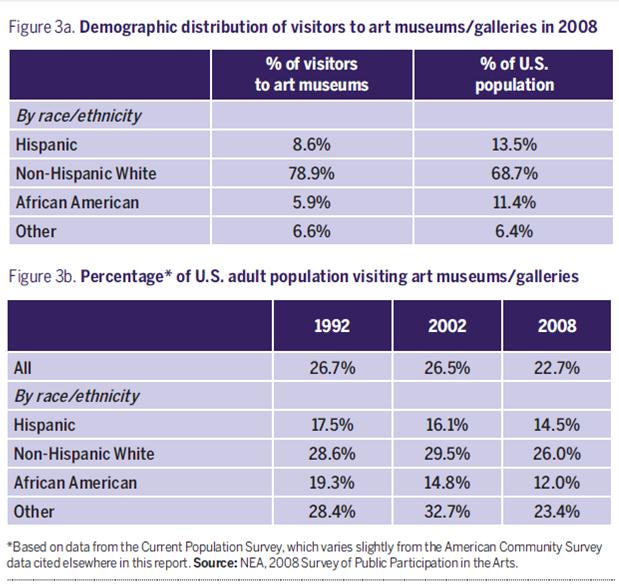
Who has traditionally been the art museum user? And who will it be? While the percentage of the U.S. adult population visiting art museums/galleries declined by 4% between 1992 and 2008, non-Hispanic whites, ages 45-54, are the predominant attendees. Consider this graphic:

If the forecast for the next four decades is correct and the current pattern in museum attendance remains unchanged, art museums and galleries will not serve the majority of the American population. There are economic, cultural, historic, educational, scheduling and interpersonal barriers to entry that affect an individual’s decision and motivation to attend; however, these barriers must be broken in order to create a more inclusive and inviting museum experience for the future America.

What can be done to increase museum/gallery attendance among diverse groups and reduce the great ethnic and racial disparities in museum participation? It is up to the museum administrators, managers, marketers, developers, programmers, educators and front-line personnel.

Know your audience. All of them. Know your neighborhood and community. Read the newest research. Many Urban Studies institutes have published reports on why specific demographics do or do not attend museums or visual art venues. For example,

…studies suggest that African Americans are more likely to attend events characterized by black themes and in which blacks are well-represented among performers, staff and audience members. This has been dubbed the ‘FUBU test’ –for us, by us.

Further research indicates African Americans and Hispanics are

More likely than others to list the desire to ‘celebrate heritage’ and support a community organization’ as a reason to attend arts and cultural events.’

Studies specific to Hispanics found

Hispanics with lower education and income levels tend to seek cultural activities that engage extended families and promote family unity, as well as providing broadly defined educational activities for children

The report features six brief case studies on museums  that have studied the composition of their audience and considered what the future of their audience and community will be. In response to their analysis, museum administrators and managers have implemented unique education programs and outreach activities to address the needs of a growing diverse community. Additionally, youth focus groups have helped to identify what deters younger ages from attending museums and what they would like the museum experience to be- their candid answers are published in the report.

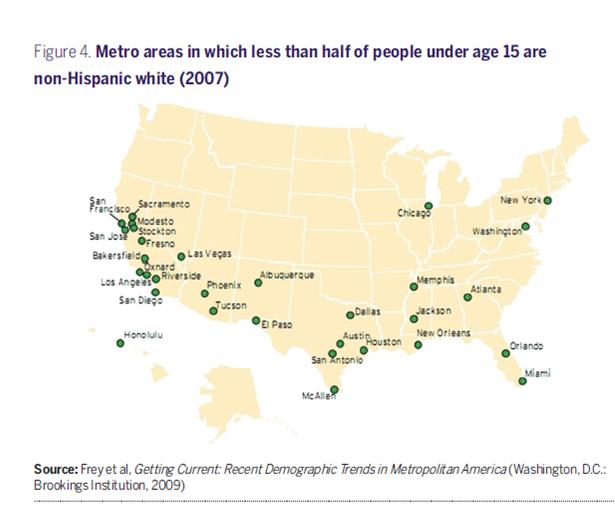
Perhaps the most telling graphic is this map of the United States indicating the metropolitan areas throughout the country in which non-Hispanic white children (defined as younger than 15) are now in the minority:

To quote the infamous Whitney Houston, "...the children are our future," and this map indicates just that- a future of great racial and ethnic diversity. As society's make-up changes, so must the institutions that serve it. Listen to the youth in the community. Not only will they be the future constituents of your museum but they also offer valuable insight as to what will get them to and through the door. And let's not forget the Millennials; a generation that cares more about a global community, participatory experiences (a la Nina Simon’s ‘participatory museum’) and engagement, than making distinctions of race and ethnicity.

As a result, their [Millennial] tastes and motivations may be previews of a future that is already taking shape. In this particular future, race and ethnicity may turn out to be less significant influences….What they [Millennials] want from museums are interactive, immersive, and participatory activities. They want to be more than outside observers looking in.

Still not sure how to address the Millennials' need for an interactive, engaging and participatory experience? Consider this standout suggestion for arts and museum managers: the report cites Jane McGonigal’s theory that museums should take a lesson or two from video games and game designers. Here’s what the report say

…museums can learn a lot from game designers, who know how to design attractive, even addictive experiences…unlike the best games, museums often fail to provide visitors with clear instructions or the feeling of having successfully accomplished something.

Looking forward, racial, ethnic and generational changes will require the museum to encourage new users to attend and to implement programming that is as varied as the community in which it exists. The future composition of the United States is vastly different from that of today. And if museums do not grow in reflection of the changing demographics and population, well, I will leave you with this graphic and you can decide what the future of museums in America will be…

Performing Arts Legacies Online

Recently the Merce Cunningham Dance Company shut down following the death of Merce Cunningham.  The action taken by the founder are somewhat unique in the world of the arts and there have been observations of what this means.  Meanwhile the content of the Merce Cunningham Company, at least in part can still be found online through various video projects and the archive left by the company through the Living Legacy Plan and maintained by the Merce Cunningham Trust.  The continued availability of this content is carrying on the legacy in the true spirit of its founder who frequently wrote of the transitory nature of his performance and was a student of Buddhist philosophy.

Further performances have resided online for years through projects like On The Boards TV which is currently celebrating its two year anniversary with a sale of online content.  The content can be accessed through one time rental, purchase, and through subscription and is high quality, having been shot on 4-5 hi-definition cameras.  Through content providers like On The Boards TV  and do it yourself online venues such as YouTube and Vimeo the amount of online performing arts content has grown significantly.  Artists are gradually recognizing that real content online is critical for accessing new audiences and maximizing market penetration.

Innovation in the field of dance and theater can go deeper than this.   Critics have noticed a trend at fringe festivals of micro-performances and intimate theater.    While artists seem to be taking advantage of physical spaces for the time being, the possibilities for using digital spaces are increasing everyday.  The idea of doing live performances online has certainly received attention.  The growth of services such as Skype make interfacing virtually and therefore using these same services as a performance venue more likely every year.


Public Works of Art Face New Challenges

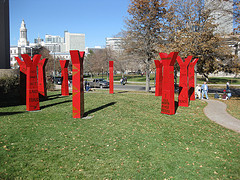
When looking at the great cities of America and the world, one of the things that give these places the kind of culture and character they are often known for is public works of art. These exhibits, often unique and memorable, provide a focal point for tourists and a sense of civic pride for residents. However, in these tough economic times, a new problem has emerged for cities everywhere: with cities struggling financially, these works of art are suffering from neglect, acts of vandalism and normal wear and tear, and often do not have the funds necessary to properly maintain them.

These kinds of problems are being felt in cities all across the country. In my hometown of Phoenix, a story last month in the Arizona Republic highlighted the struggle that cities are facing: public works of art are more popular than ever, but face neglect and lack of upkeep due to budget shortfalls and calls for budget austerity.

The problems associated with the upkeep of public works of art go beyond the usual wear and tear: vandalism, including graffiti, is common, along with the theft of metals and gems that are often a part of some displays. The cost to maintain and replace these works of art, especially older exhibits, can prove costly. In a citywide audit, the city of Phoenix found that dozens of public art pieces were in need of repairs, with the total renovation costs estimated to be over $1 million. While most projects were victims of vandalism or wear and tear, others experienced some unexpected problems: for example, an overpass exhibit needed almost $100,000 in repairs because of runoff water eroding parts of the project.

In November, I wrote about how public works of art were more important than ever in today’s climate of budget austerity, and the continued vandalism and destruction of these art displays adds another layer of difficulty when it comes to saving exhibits. While the upfront cost of public art displays often receive the lion’s share of attention and public outcry, the cost of vandalism and neglect often go unmentioned. The costs associated with restoration can ultimately have another impact as well: cities often have to cancel funding for new art projects to care for existing pieces badly in need of repair.

With cities facing decreased tax collections in recent years, the money to help maintain and preserve public works of art is severely lacking. Some cities, including those in the Phoenix metropolitan area, require a certain percentage of money from construction projects be devoted to public art, which in robust economic times provides a stable source of revenue for new art construction and upkeep. The problem, however, is that during tough economic times, less construction projects are taking place, which means that the funding for public art dries up. In a state like Arizona, which was devastated by the housing bubble, the impact can be quite substantial. As the Arizona Republic reported, the difference in funding levels can be quite severe: in the city of Phoenix, the budget for maintenance and restoration went from $63,000 in 2008-09 to just $29,000 in 2011-12. The problem was even more severe in Tempe, home to Arizona State University: the budget went from $90,000 in 2008-09 to just under $8,000 in 2011-12.

So with city funding for upkeep and restoration limited in these tough economic times, what kinds of solutions are available to save public works of art? One option is to raise money through increased taxes; while tax increases are often unpopular, they could be levied in such a way that the impact would be negligible on residents. Examples could include taxes on travel expenses, like car rentals and hotels, or on city services like utility bills. Another option is for cities to seek grants from non-profit and private sources; while most cities seek private funds to sponsor new works of art, efforts to help beautify existing works of art can help promote civic pride and improve areas already in use.

And while they certainly have access to more capital and resources, cities and local governments are not the only people that can have an impact. Residents and community groups are often getting involved as well; helping to “sponsor” an exhibit can often have just as much of an impact. By painting over graffiti, picking up waste or helping to raise money for upkeep, ordinary citizens can promote and protect their community’s works of art. As more and more pieces face neglect and vandalism, residents often feel the urge to protect the town they call home.

Public art projects often serve as a way to remind residents and visitors alike of the culture and history of that particular place. In these tough economic times, these exhibits and projects are in danger of being neglected entirely, damaging not only the art itself, but also the civic pride of residents all across the country.

(Photo: CC by Mal Booth)

Pollution and Art, Intertwined

In the world of public policy, change is often quite difficult. Stakeholders are often fearful of abandoning the status quo, reluctant to invest the resources necessary, or ignorant of the need for systemic change. With many economic development issues facing the emerging economies of countries like India, it’s often difficult to make important issues stand out. Sometimes, the most effective way to show the importance of a needed public policy change is through art. With more and more artists using nature as a way to draw attention to policy issues such as climate change and drought, a group of artists are using the Yamuna River, one of the most polluted rivers in the world, to draw attention to the affect that pollution is having on the environment and the people who count on the river for survival.

Located in northern India, the Yamuna is the largest tributary river connected to the Ganges, and serves as the primary water resource for millions of people. There have been numerous attempts over the years to cleanse the river, but to no avail: the Indian government has spent billions of dollars on restoration efforts, an Indian Supreme Court ruling ordered an extensive cleanup, but the river remains severely polluted. The reason for the pollution, many believe, stems from sewage treatment plants that line the river, and the government has done little to impose regulations or shut down plants. With the river currently supplying about 65 percent of the city of New Delhi’s water, this is a significant problem.

This is where the artists come in. Titled Project Y, this public art project is the brainchild of the Ministry of Culture in Hamburg, Germany. As part of the overall 60-year anniversary of diplomatic ties between India and Germany, a series of events, showcases and exhibits are taking place over a 14-month period, and Project Y is one part of that, offering a juxtaposition of two similar rivers under drastically different conditions: the Yamuna, and the Elbe River, located in eastern Germany.

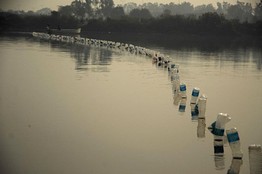
Earlier this month, both exhibits consisted of sculptures, multimedia presentations, and information about the rivers, showing in stark detail the contrasts between the two. At Yamuna, for example, one exhibit showcased rows of dirty plastic bottles as light holders; another simply showed a pig carcass, floating in the river for all to see. One of the technological exhibits of the Yamuna show was a fountain that pumped water from the river, purified it through five levels of filtration technology, and spurted the water in the air above the crowds.

The project also includes screenings of films meant to educate Indians about the Yamuna, and concerts that will be played on the banks of the river itself, featuring artists and performers from both Germany and India.

The idea behind the project is to show how pollution and neglect have left the Yamuna River in a dangerous state, and to raise awareness in the hopes that enough people will see the devastating impact that bad public policy can have on such a crucial part of everyday life. Organizers in Germany are focused on the idea of creating ecologically sustainable rivers in cities and urban areas, and as India grows in size and has to deal with the critical infrastructure and sanitation needs of millions of new people, a look at how governments and citizens in Europe have treated their habitat offers a stark reminder of the challenges ahead.

The co-creator of the project, Ravi Aggarwal, describes the thinking behind the project:

“We need to re-think ecology and rivers in the 21st century where questions about human sustainability and futures have become key. Art is the framework which allows diverse ideas and imaginations to coexist and helps in repositioning ourselves in relation to nature. The river is not ‘polluted’ or ‘clean,’ but is a beautiful landscape of the city, with many layers of aesthetic, social and political meanings.”

Reactions to the project have been mixed. While many have admired the exhibit’s brazenness and honesty, many remain skeptical that such a show can produce the type of change that is needed to purify the river. However, with considerable international media attention focused on the project, it is perhaps sending the right signal to lawmakers and stakeholders that enough is enough, and that the Yamuna, and the dozens of other rivers that make up the Ganges network, are far too important to India’s future to be treated as a dumping ground for sewage and waste.

Much like the intersections of art and technology have brought forth incredible and diverse works of art, it is the intersection of art and public policy that represents an exciting new area of possible change. With so many policy issues present in politics today, it often requires passionate individuals to think of new and exciting ways to raise public awareness. With exhibits like Project Y, one hopes that art can provide the visual nudge needed to start the process of fundamental systemic change.


Is it time to adopt 3D?

Today 3D cameras that deliver a professional grade product can now be bought for as low as $1,500. Most new TVs sold today are 3D ready. Game consoles and playback devices are also 3D enabled.  Is 3D a fad or is it a trend?  We can only speculate, but the fact of the matter is that this technology is now becoming affordable for individual artists and arts organizations.  So is it time for you to start recording in 3D?  Here are some advantages and issues to consider before taking the leap.
Pros:

1)  Market penetration is reaching a critical mass.  3D enabled devices now dominate the market and are poised to become a standard feature of home entertainment. 2)  The cost of buying 3D enabled devices has gone down.  TVs, playback devices (game consoles, dvr devices, etc), and cameras are more affordable than ever. 3)  3D Tech is now making strides into mobile devices with Nintendo, Google, and Motorola notably making devices and content for 3D mobile. 4)  The tech offers solutions to art forms that heretofor were previously poorly served by older 2D imaging technology (aka dance and opera)

Cons:

1)  3D on film has been linked to nausea and headaches and even in video there have been questions about eye strain although these problems only seem to afflict a small portion of audience members.  Evidently the trick is to not focus on out of focus images on the screen if you suffer from these problems. 2)  It will be a couple more years before the majority of TV’s and Mobile devices can run 3D  content.  As with any technology there is only a point to which it will grow as people are reluctant to buy a 3D enabled HD TV (or playback device) a year after they shelled out for a new HD TV set. 3)  There is the possibility that another breakthrough will be made in imaging that will make current imaging technology obsolete.  For now, however, the long-term outlook seems to be favoring the current technology’s dominance for the next 6-8 years. 4) You still need those pesky glasses (for now at least).

One could argue that 3D still has a ways to go.  The cutting edge of the field however offers the potential for much much more spectacular devices.  Now that it is becoming fiscally accessible some artists and organizations have waded in and started experimenting but the potential remains largely untapped. Whatever happens, it will pay to keep a watch on this technology

The Arts and the Race Against the Machine

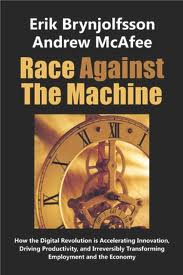
Will art ever be created by a machine? This is the question that is sometimes asked, late at night over a glass of wine. Perhaps it has been already. Authors Erik Brynjolfsson and and Andrew McAfee ask similar questions and explore the answers in their new book “Race Against the Machine: How the Digital Revolution is Accelerating.” Machines are playing an increasingly prevalent role in the work force and millions of jobs have been changed or replaced by computers or automated process. There is now a program called Stats Monkey that is being used to write about sports. Stats Monkey uses pattern recognition to generate summaries about sporting events. Although this program does not seem to be in usage by any major publication, it highlights the progress that has been made in the advancement of technology and the subsequent replacement of millions of workers by automated, computer controlled devices. For now, the arts world can sigh with relief. It seems as though most endeavors which require intuition are safe from encroachment by computerized processes. We can assume that artists of all stripes are considered “high-skilled” and are intuitive in the creation process.  Both of these characteristics make artists of all stripes the safest categories of workers at this point in time. The pursuit of making art isn’t simple. Artists of all kinds exist within a complex cultural context and react intuitively to it. This context also makes it extremely difficult for machines to interact. You could argue that Heather Knight’s Silicon Based Comedy is the first inroad on this front, but it still seems a bit far away. The complex human interactions intrinsic in the performing arts are a distant land from the world of automated tasks and promise to remain that way for quite some time.

Another barrier to program or automaton generation of art in all forms is the fact that there is a plethora of artists who are working in the market for little or no money.   From the standpoint of economics the lack of money in the majority of the arts field gives developers little reason to make inroads artistic process by replacing people with automation. Aside from the rockstar phenomena in the arts world, there simply isn’t the money in it to make it worth the time.

As technology speeds along we can be assured that these advancements will affect the arts. Already kickstarter promises to reshape the field of development in the arts by cutting out the administrative middleman and connecting artists directly to funders. Will increasingly sophisticated templates and design programs begin to make inroads into graphic design? Will marketing in social media be able to be automated? Will marketing in general be able to be automated. Certain facilities tasks are already being monitored by computers. Vacuuming lobby or gallery floors could be taken over by a fleet of roomba robots.

How will the future of technology manifest in the arts world? Surely at some point in time it is conceivable that a computer will generate a work of art and sell to some museum. This will inevitably make the news. This will spark controversy. Will actors be replaced through cgi? Well, the clear answer to that is not yet. Stage actors are even safer from replacement, but how about stage crews?

It is impossible to discern how exactly machines will interact with the arts. Watching the development of cutting edge technologies can gives clues. Possibilities to interact with our patrons lie largely untapped in the areas of 3d, holography, and new software applications. As with other industries, it is incumbent on artists to watch the horizon and harness technology as it comes into being, otherwise we end up being reactive and being blind-sided by change.

Facebook in the Arts: In Honor of Mark Zuckerberg's Visit to CMU

With the announcement that Facebook founder and CEO Mark Zuckerberg will make his first visit to Carnegie Mellon University (CMU) today, the Technology In the Arts team thought it would be appropriate to take a look back on the groundbreaking social media platform and the impact it’s had on how arts organizations engage their audiences. CMU is one of three campuses being visited by Zuckerberg during an East Coast college tour. While here, he will meet with faculty and students and give a talk to an invitation-only audience. He will be joined by Mike Schroepfer, Facebook's vice president of engineering.

Here’s a bit of Facebook Trivia to get us started:

  • More than 800 million active users
  • More than 50% of active users log on to Facebook in any given day
  • Average user is connected to 80 community pages, groups and events
  • More than 350 million active users currently access Facebook through their mobile devices
  • Facebook is also the most popular social network for all age demographics according to a Forrester Research Survey

One of the most interesting studies on how Facebook has affected arts and cultural organizations was conducted this past summer. ‘The Tangled Web of Social Media’ was a study commissioned by Theatre Bay Area in 2011. The study examined the social media habits of 207 diverse nonprofit arts and cultural organizations with the goal of understanding how social media was being used and what best practices emerged as a result. The study found that Facebook was by far the most popular social network used by these arts organizations. Another similar finding was that community members were eight times more active commenting on the Facebook posts made by arts organizations than mentioning those same organizations on Twitter.

Here are a few ways in which Facebook has revolutionized how arts organizations are engaging with audiences:

  1. Sharing Content: Arguably one of the most important ways Facebook has impacted arts organizations is the ability to share and distribute content. Devon Smith recently shared an important comment made by Adam Connor from Facebook during the High Impact Social Media Conference: History of the internet= Browse (Yahoo) –> Search (Google) –> Discover (Facebook). Whether it’s a special Halloween photo from MOMA or a series of intriguing videos from the San Francisco Ballet, arts organizations have the opportunity to share a variety of content with audiences.
  2. Giving Campaigns: Facebook has also impacted the way audiences can contribute financially to their favorite organizations. The Chronicle of Philanthropy recently published an article about a California boy, Paddy O’Brien, whose inspirational story about his struggle with bone cancer resulted in 1,000 donations to the Children’s Hospital who treated him via the Facebook Causes platform.
  3. Advertisement Campaigns: Facebook Ad Campaigns aren’t just for boosting numbers on fan or group pages. Many organizations have had success with attracting new fans to their events through successful ad campaigns. For further reference, Tech In The Arts published an article on best practices for running ad campaigns.
  4. Ticket Buying: Companies like TicketForce have made it possible for many artists and organizations to sell tickets directly through their brand’s Facebook Page. The client operates so that ticket buyers do not have to leave the Facebook Page in order to purchase tickets.
  5. Merchandise Sales: Facebook has also provided the opportunity for artists and organizations to sell merchandise on their pages.
  6. Building Communities through Facebook Groups: Many arts organizations have also been experimenting with hosting group pages as opposed to “regular” pages. Groups can provide an opportunity for fans to interact with each other on a more intimate level. Beth Kanter recently featured a guest post on her blog regarding best practices for nonprofits interested in building a group page.

There’s no doubt that this social media giant has had an incredible impact on the way arts organizations interact with audiences and will continue to do so. Ultimately, many of these organizations are finding creative ways to interact with existing fans and build new audiences in a manner that has never been done before.

How has Facebook impacted your organization, either positively or negatively?

The Evolution of Touch

In the 15th century, the Italian renaissance polymath, Leon Battista Alberti, wrote a famous treatise on painting titled De pictura. In his treatise, Alberti praised painting above other art forms such as sculpture because painting often went beyond the act of mere imitation and was able to create an illusion that could persevere through the centuries. Moreover, the art of painting was a uniquely visual experience and, unlike sculpture, it did not incite the desire to touch, for what we saw in a painting remained poetically out of our reach. This treatise postulated by Alberti during the period of the Renaissance is not entirely archaic and arcane to the world of today. We still take pleasure in the transitory ability to escape into the painted world we see before us, and we are in still in favor of preserving the the illusion we see before us. But have we become drawn to what was only considered possible in the realm of sculpture, the desire to touch a painting?

This question of touch is a thought provoking one because of a recent phenomenon that I like to refer to as the “slide to unlock”. Yes, this phenomenon is none other than our increasing desire to avail ourselves of the sense of touch. Apple has gently nudged us along into the wonderful world of touch through iPhones, iPads, and iPods. So, it suffices to say that in the technological realm, we have effectively and decisively entered into the era of the sensory. And this definitive entry into the realm of the sensory has led to the development of apps, some of which have enabled us to explore the world of art at our very fingertips.

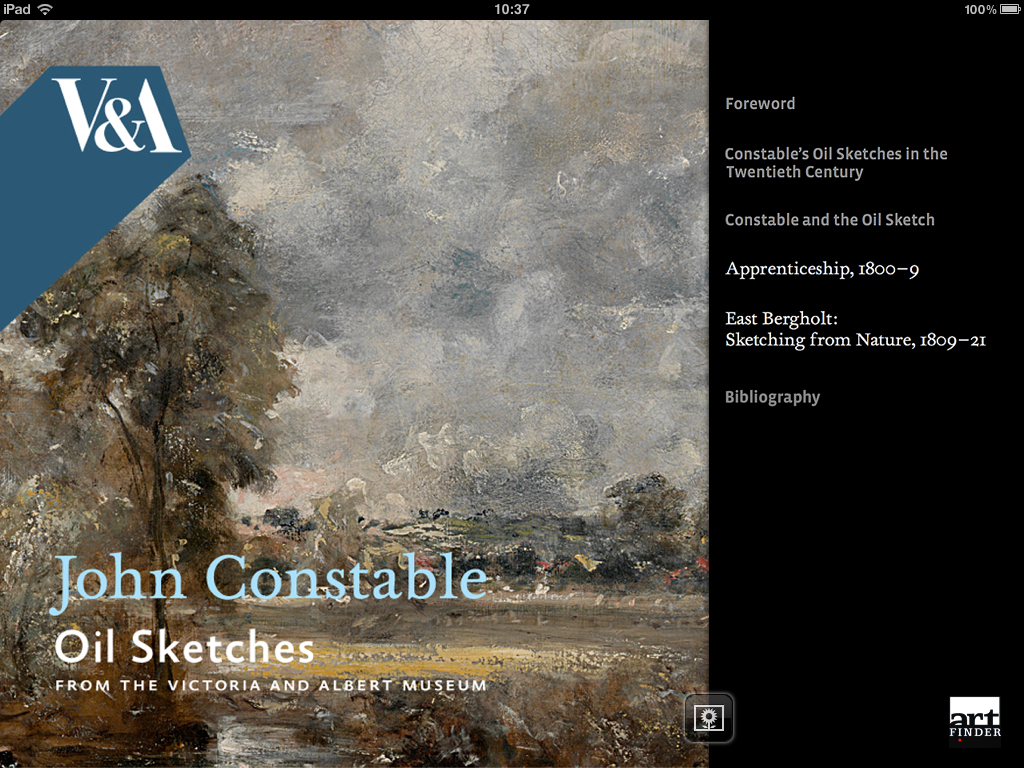
Nowadays, we can explore artworks using our sense of touch without compromising our moral integrity or damaging the artwork, and shattering the illusion before us. For instance, in Artfinder’s app on John Constable’s oil sketches from the Victoria and Albert Museum, we “can zoom to show each of the sketches in their incredible painterly detail, and follow Constable’s progress from Suffolk, to London and Brighton.” Artfinder has also collaborated with various other museums to create apps that augment and physically sensitize the viewing experience. As such, the way we engage with art may be undergoing a paradigm shift; a shift towards the touch.

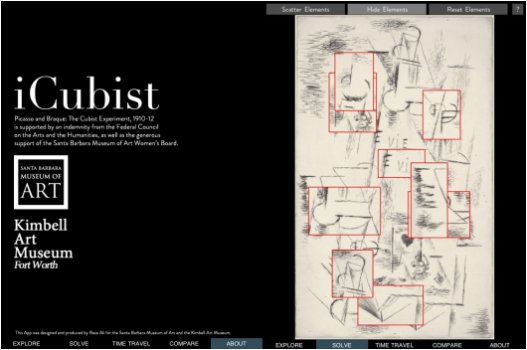
Consequently, more and more museums are now incorporating the sense of touch into what was hitherto seen as predominantly visual and contemplative experience. Earlier this summer, in the exhibition titled “Picasso and Braque: The Cubist Experiment, 1910-1912”, the Santa Barbara Museum of Art provided visitors with iPads that were “equipped with a specially developed iCubist application to scrutinize and delve deeply into four key paintings.” The app also allowed visitors to “deconstruct a cubist composition and attempt to put it back together.” The iCubist app developed for the Santa Barbara Museum of Art demonstrates how the sense of touch, in unison with the sense of sight, can help demystify a movement such as Cubism.

It is also interesting to note how the contemporary art world is evolving with the rise of the touch. For instance, artist David Hockney began painting on his iPhone in 2008 and last year he began using his iPad to create art. Using the Brushes app, Hockney would draw flowers, using just the edge of his thumb, and send them to his friends.  His oeuvre now includes landscapes, still life, and self-portraits all created by a sweeping touch, rather than a stroke, of creativity and ingenuity. Currently, his work is being shown at the Royal Ontario Museum in the exhibition titled “David Hockney’s Fresh Flowers: Drawings on the iPhone and iPad.

So is the art world moving in tandem with the technological world? Is it stepping into the realm of the sensory?

As artists such as David Hockney remain a rare few, the art of painting on tangible mediums such as canvas will most likely survive decades of technological progress. The modern day audience, however, may be more willing and receptive toward the introduction of touch into the viewing experience. This is because, as an audience, we may be drawn towards what can only be termed as a two-part deception; to make tactile, what in reality is untouchable, while reveling in a scene that in essence, is a grand illusion.


Hear Art Everywhere with Locally Toned

It’s a curse of our society. Modern innovation has led to the grotesque abomination, the “cell phone ringtone”. Obnoxious and pervasive at best, invasive and stupid at worst, you will hear them anytime, any place, and might hear one even now (you should get that – I’ll wait). Consider, though, what if cell phone ringtones were art? Sounds can be art, so why can’t the sounds coming out of your phone be works of art? T. Foley, a Pittsburgh based artist, tackles that question with her “public art/original ringtone creation project”, Locally Toned. Users can create and download unique ringtones for free from the Locally Toned website, and to date 11,103 ringtones have been downloaded. I had a chance to speak with Ms. Foley on her work with the ubiquitous ringtone…


Locally Toned Collaborator Krista Martin poses with a ringtone creator at the Uniontown Poultry Association's fall show

Can you speak a little on how your work democratizes art? Why is this important to you? How do you see the Internet as a component of it?

Thanks for visiting with me, Rachael.

I have a background in media literacy, so I’m interested in people having access to a wide variety of media, and the skills and tools that allow them to produce and analyze media for themselves. Locally Toned democratizes art because it’s produced with others and for others. I’m not an artist working alone in a studio producing ringtones to sell to others. I collaborate with people to turn sounds that are meaningful and/or interesting to them into ringtones. This past weekend I went to the Uniontown Poultry Association’s Fall Show in Fayette County to capture bird sounds with the help of that community. And I collaborate with technologists such as Deeplocal and other artists, Encyclopedia Destructica, to get the tones to the public/onto phones. Deeplocal  built the technology for the project; Encyclopedia Destructica helped me to design distribution techniques (the ringtone art cards). Unlike paintings or sculptures for sale in a gallery, which many people can’t afford, people may own and share these works free-of-charge.
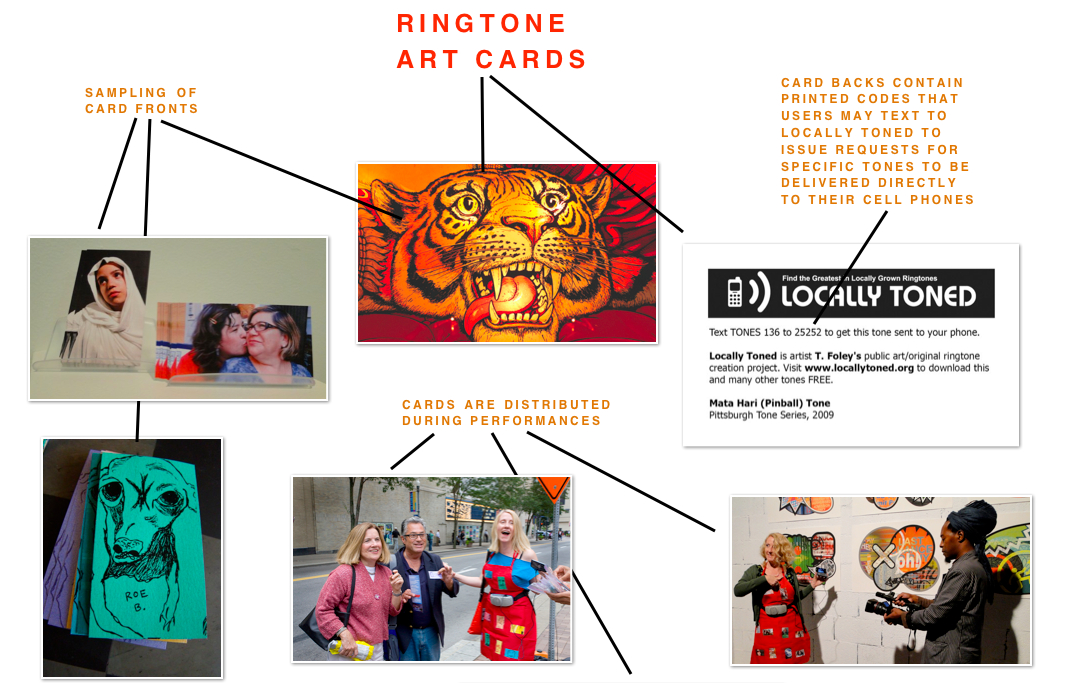
An example of the ringtone art cards

As conceptual artist Robert Smithson expressed in a 1972 essay entitled “Cultural Confinement,” for Artforum, some works of art, when placed in galleries, loose their charge. Locally Toned is that type of work--one may listen to the tones online, but the real audience for the project exists anywhere a user who’s downloaded the tones receives a call on his/her cell phone. The work performs itself at unexpected times and in unexpected places, outside traditional art spaces (galleries and museums).

My boyfriend likes to say that Locally Toned gives people a “sneak-attack” ability. When some of the more unusual tones go off in public, it creates a little scene. For example, the LRAD tone went off one day on my phone at Deeplocal. The CEO assumed it was a fire alarm and told everyone in to exit the building. I let them know it was a false alarm--I was just testing out the sonic canon ringtone.

The tones function as conversation starters. I often use tones from the Bayernhof Museum. When they go off in public, strangers ask me to identify the sounds. Then I tell them about the nearby museum for mechanical musical instruments. The conversation is usually short, but there’s an unexpected exchange that occurs as a result of the tones.

Ringtones are an invention of modern technology, what drew you to use them as a medium? Is there a benefit to using ringtones in your work as opposed to other technologies?

I had always wanted to make ringtones for my phone, and a “call for artists” from Deeplocal inspired me to develop this project. I was also motivated by a strong dislike for music industry and pre-installed ringtones on cell phones--I wanted to make tones that were more interesting or beautiful. Then I became curious about what other people would do if they had the opportunity to make ringtones. And with my media literacy background, I wanted to model that it’s possible to make and share homegrown ringtones.

I use technology to connect and share with others--recording equipment to make the tones, photography to document the sounds, the Web site to distribute the ringtones, and the Blog to promote the stories behind the sounds that are created. Technology helps to extend my work and ideas out into the world. I like what Lawrence Lessig says about on- and off-line sharing economies in his book Remix (http://remix.lessig.org/).

“Gifts in particular, and the sharing economy in general, are thus devices for building connections with people. They establish relationships and draw upon those relationships. They are the glue of community.”

Locally Toned is public art through service to the community—a series of production, promotion and distribution interactions between the public and myself. New social interaction spaces (physical and cyber) are developed around the making and sharing of these tiny aural documentaries, or soundscape snippets. The tones serve as audio identifiers for members of various communities. A person might identify as a cyclist and download Erok's Bicycle Bell Tone for use on his/her phone. The tones are also plotted on a ringtone map.

Do you see your work moving into other technologies in the future? If so, are there any technologies in particular you would like to explore?

I like to exploit tools that are easy for people to access and use. Recently I’ve created a live and online performance work with Hector, a shy ventriloquist dummy. In The Dummy Is Present, my re-interpretation of Marina Abramović’s The Artist Is Present, 2010, Hector appears on Chatroulette with an audience behind him. The audience appears in the work as spectators and as part of the show. People may sit behind us passively, watching Hector interact with others online (my computer is projected onto a big screen during the performance), or they may become part of the interaction. Some of the people we encounter online say, “Is this for real?!” Audience members respond by shouting or waving a hello, and they may applaud if the other party on Chatroulette performs for us. The performance has been described as voyeuristic, riveting, and magical--it’s all those things and more. I made the work because I wanted to draw attention to contemporary notions of public and private space, and to consider what it means to have an online presence. The Dummy Is Present is part of a larger body of work, Easy Pieces, a series of live and recorded performances featuring a ventriloquist dummy and myself. I’d like to find an interesting application for Twitter within the larger project, but I haven’t figured that out yet.

With Locally Toned and the work with Hector, I use a particular technology so that I may say something about our experiences with it. And I enjoy making work that evolves and changes over time. With both projects, I never know what’s going to happen next--and that’s really fun for me.
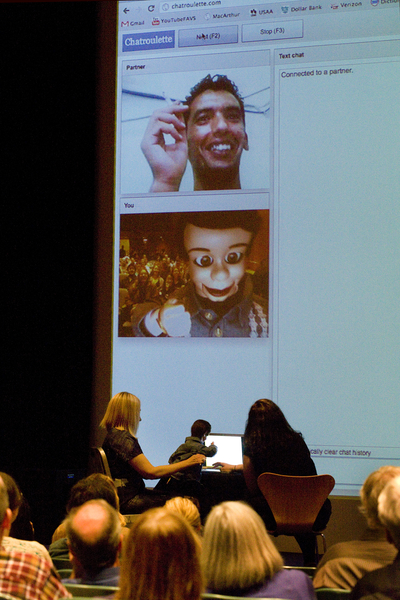
The Dummy Is Present - Photo by Larry Rippel

Do you think Locally Toned will ever reach a conclusion?

Locally Toned is an ongoing project. I’m not a Web developer, but I want to be a good shepherd of the project’s technology so that the archive will remain accessible to the public and so that I may add to the collection for years to come. I’m presently seeking funding to make improvements to the Web site, and to release all the tones in the iPhone format. Within the next year, I’d like to identify other cities to collaborate with. The tones are licensed under the Creative Commons Attribution-NonCommercial-Share Alike code, and they show up on other folks’ Blogs. It’s great to see people point back to Locally Toned, and see them re-tell stories about the origins of the sounds.

Ms. Foley is also looking for some Pittsburgh local help with her next project,

Who wants to make a ringtone? This month, I will receive a grant from The Fine Foundation to create a new series of tones from the Pittsburgh region. I’m looking for collaborators. People can contact me by email: locallytoned@gmail.com.

And if you thought her Chatroullete dummy performance sounded cool, Pittsburgh has another opportunity to see it live:

The next performance of The Dummy Is Present will take place at The Warhol Museum on the evening of January 6, 2012. More info can be found at the Ventwittoquisms Tumblr.

---

So what are you waiting for? Go customize your phone with some art!