In Case You Missed It - April 2012

April showers brought May flowers and some great articles here on Tech in the Arts. In case you missed it, here are some of our highlights from the month. We had the honor of featuring Kickstarter Art Program Director Stephanie Pereira in our speaker series, and offered our additional thoughts on her visit on the blog. We also took some time to reflect on how cities are thinking about art differently and Melissa Snoza of Fifth House Ensemble elaborated on how her organization thinks about art and technology. Since new technologies are constantly improving how organizations function, we took a look at Eventbrite’s Newest Ticketing system for your iPad!

The Google Art Project is often on our minds, and we took a look at its new home – The White House. It’s a global application, and we discussed it along with Art.sy as methods to help us understand our cultural universe. A universe that expanded into the realm of the internet with the BMW Tate Live.

What a month! As our school year draws to a close, we hope your May is as pleasant as those flowers we’ve been promised.

Playing by the Rules: Creating a Social Media Plan

Your organization has been using social media for some time now. But does the staff know all rules? How to handle and respond appropriately to negative comments and criticism? What they can and not write on the organization’s page? How to fix errors in posts without compromising the integrity of the content the public has already shared on that post? Are employees allowed to “friend” your organization using their personal accounts? How do you ensure your brand image is enhanced, not threatened by social media usage throughout the organization? A comprehensive, widely-circulated social media plan can eradicate these issues and guarantee all employees understand the procedures, policies, rules, and expectations for using social media to promote the organization’s brand.

A good social media policy will provide clear guidelines as to what staff should and shouldn’t do when posting and interacting with the community on a day-to-day basis, freeing them up to think more strategically. It’s also likely to help leadership feel more comfortable with the less-formal nature of social media by letting them establish boundaries for its use. -- from the Nonprofit Social Media Policy Workbook

If you do not have a social media plan, you are surely not alone. However, given this year’s projected estimate that Facebook will exceed 1 billion users and Twitter, 500 million, it’s time to protect what this SIZEABLE population has access to- your brand, your image, and your Facebook wall.

Above all, a social media plan is a LIVING document. As your organization experiments with trending social media platforms, faces new challenges, expands its presence online, or changes its online branding, the social media plan must reflect that growth. Below are guidelines, best practices, and resources to help you clearly define your social media objectives and policies in a complete and effective social media plan. And to clarify, an effective social media plan is not one that controls and restricts participation, rather, facilitates and encourages an open relationship with the public. I’m talkin' 24/7 PR.

1) Meet your new best friend: The Nonprofit Social Media Policy Workbook April 2012 (scroll down the page and click "Download the Report"). Download it. Swear by it. Love it. Be best friends with it forever. Thank you, idealware and Balance Interactive.

2) Determine if your social media plan will address policies for internal social media use (expectations for employee-to-employee use), procedures regarding proper usage and maintenance for PR purposes, and/or community guidelines for participation.

3) Facebook, Twitter and Linkedin are the Big 3. If your organization employs one or all of these, be certain the plan includes specific guidelines for each platform.

4) Video blogs, written blogs, podcasts, wikis, community forums, and on and on and on…these need to be considered as well. Perhaps the plan is not as developed for these various platforms, but nonetheless, expectations for their usage should be made clear if your organization/brand is the subject.

5) RESIST THE INCREASINGLY ATTRACTIVE URGE TO COPY AND PASTE YOUR PLAN, especially when you realize your organization not only uses the Big 3, but also has a YouTube, Pinterest, Tumblr, and Wordpress account…

As Chris Boudreaux, a social media consultant said:

What is important are the differences that are unique to your particular organization and circumstances, and should be based on your business outcomes and how you conduct your business. Just don't copy everyone else's policy and put it in your database of procedures.

6) TRANSPARENCY. How public are we talking? Will the entire world have access to this document (like the Smithsonian Institution and NPR have done), just your Facebook community (as AARP has done in its "Company Information" section), or will it be an internal document for office staff only? Knowing who will receive this information will determine the language you use and the direction you take with it.

7) Regardless of how public the document will be to the outside world- INTEGRATE IT. It should not be considered an isolated document. I’m going to be bold and take a wild guess that at least ONE person on your staff has a personal Facebook account, just one…Your organization's social media users need to know what is considered appropriate and inappropriate to say in reference of the organization, what copyright issues they may face when posting photos, when they can post things that are “off message” and who can friend whom. The social media plan should be included in the organization’s employee handbook- HR and the legal departments should be involved in making this document come to life, too.

8 ) What to say, what to say. The language you use should be clear, as this is a guide for staff and perhaps, the public. For a few examples on strong and clear language in a social media plan, check out this post from Nonprofit Tech 2.0’s blog.

9) Enjoy this cartoon/graphic by Rob Cottingham depicting the process of creating a social media plan.

10) Look at examples of social media policies (213 organizations listed here). Read social media plans that are inclusive of all social platforms. Read plans and guidelines that are specific to blogging or Pinterest. Browse plans of organizations of a similar size and much larger size, of a similar audience and larger audience, and of a similar or completely different mission. While copying and pasting their plan into your own template serves no one, referencing a model will make you aware of things you hadn’t considered, including policies you agree/disagree with and procedures you admire.

Let employees know what is expected of them regarding social media usage. Let the public know what the organization's expectations are for the social media pages themselves and for participation. Keep everyone in the loop, out of trouble, and participating-- with a social media plan.

Six Ways Arts Organizations Can Improve their Facebook Advertising

Guest blogger Erik Gensler is the President of Capacity Interactive, a digital marketing consulting firm for arts organizations. This fall Capacity Interactive is hosting Digital Marketing Boot Camp for Arts Marketers, a 2-day conference October 25-26 in NYC. Conference topics include: Marketing the Arts with Video, Mobile Marketing, Writing for the Web, Online Fundraising, and the topic of this blog post: Facebook Marketing. More information at http://www.dmbootcamp4arts.com

I'm calling for a moratorium on boring Facebook ads for the arts. As arts marketers, we have amazing products to sell -- live arts that provide moving experiences to audiences every night. We have beautiful sets and costumes, sexy dancers, and attractive actors. But what do most performing arts Facebook ads look like?

Headline: Show I've Never Heard of

Stock Production Photo

Come see <Show I've never heard of> at< theater I like>.

Starts April 5th. Tickets start at $25.

Snooze. We could do much better. Here are six tips to improve your Facebook advertising.

1.) Set goals. Before you begin, set goals for your campaigns. These can include things native to Facebook like: drive sharing, build fan base, drive event RSVPs, drive video views, etc. or drive visits to our website. One campaign can’t do everything to pick two to three goals and focus. I tend to think you can be most successful driving the native Facebook functions such as sharing, video views, RSVPs, etc. These are the easiest to track on Facebook and what the new ad formats are designed to do. I've also ran many campaigns that take users off of Facebook to a website. As Facebook builds more advertising options to keep users on Facebook and track their interactions, I think there are more benefits to running those types of ads.

Then review your advertising reports often. You can see what is working and what is not. Pause and replace the duds. Also make sure to closely watch for frequency. If your average frequency for any ad approaches 10 then you need to replace it to fight fatigue.

2.) Highlight benefits, not features. I see far too many Facebook ads laden with features and with zero benefits. Features are much less interesting. Features would include: At xxx theater, performances begin 4/25, comfortable seats. They are useful, but benefits make far more compelling ad copy. Strong quotes provide great benefits. "The most brilliant ballerina of her generation" or "You don’t just see an Ailey performance, you feel it." Tell a story. Build excitement.

3.) Use imagery that captures attention and change it frequently. As I mentioned earlier, we have the benefits of beautiful sets, costumes, sexy dancers, and attractive actors. For our dance clients, the Facebook posts that get the most interaction are ones with shirtless men and dancers in super-human poses.

Have your designer alter the images so they capture attention. Try adding borders or bright background colors. Or try to crop out the image and put it on a white background so it pops.

Also, if you ever ran a good ad on Facebook, you know your click-through rate (CTR) lasts only a couple of days. The only way to keep your CTR high is to keep your images fresh. So create lots of ads and rotate them often.

4.) Tighten your language. Is the language as tight as can be and under 90 characters? If not, cut nonessential words. Keep sentences short. Use active voice. Posts with fewer than 250 characters see about 60% more engagement

5.) Micro Target. Facebook allows you to slice and dice your audience in many different ways. Say, for example, that you are promoting the musical White Christmas. Determine all of the potential audience groups: people who like classic movies, people with kids, people who like Irving Berlin or his contemporaries, people interested in musicals, people who like tap dancing, etc. Then create unique ads for each interest with headlines that will grab their attention. For people with kids the headline should be "Family Holiday Entertainment" for those who like tap dancing "A Tap Dancing Delight," etc. It is best to create at least two headlines for each interest group to start. The more versions the better.

6.) Take advantage of the new ad types. There are many types of ads you can run on Facebook. The two types of ads I think are most useful in selling performances are:

  • Stories to build up your likes. This just shows the name of your organization and the name of a friend who likes it. Social ads, ones with the names of friends attached, get far more clicks than non social ads. Target these ads to friends of your current fans. Make sure to add the demographic targeting on top of these ads to target the type of audience you are after. For one client we only target college educated women over 30 since we know they purchase 80% of tickets.
  • Page Post ads. These allow you to select a recent post and promote it as an ad. This is the only way to get videos into your ads without purchasing a premium sponsorship (which starts at $25,000). Just save your video on Facebook and create a post about it. Then go to the ad interface and select your organization as the target, choose "a specific post on your organization," then choose the story you want to promote from the dropdown. Voila, a video ad. The other advantage of these types of ads is that users can like, comment, and share the ad. When a user “shares” your ad, you get thousands of endorsed impressions. Also consider RSVP ads where you build an event on Facebook and the call to action is for users to RSVP.

Want to learn more about Facebook advertising? Don’t miss the half day session on Facebook Marketing at Digital Marketing Boot Camp for Arts Marketers, October 25-26 in NYC. More information at http://www.dmbootcamp4arts.com.

White Space on the Broadcast Spectrum and Why We Should Care

The Federal Communications Commission (FCC) regulates every device that emits radio waves.  This means cell phones, radio, television, and wireless microphones.  In 2010 the FCC issued a rule that ordered users of wireless microphones to stop broadcasting at 700 MHz.  This resulted in the forced scrapping and purchase of tens of thousands of dollars of wireless microphones that broadcast on that length of spectrum.  Story over?  Not really.  Now, two years later the FCC is talking about 'repacking' the broadcast spectrum again. Any change of this type would result in tens of thousands of dollars of additional cost for every arts organization effected.  This is cost that was already borne out in good faith two years ago.  As congress moves forwards with legislation that would patch the budget with broadcast spectrum  auctions the arts community finds itself potentially under the gun in a time where budgets are already lean.

To give a sense of scope for this issue, there are an estimated 21,000 school theaters in addition to the thousands of professional theaters.  Combined, these facilities serve millions of patrons and students and contribute nearly eight billion dollars to the economy.

The problem is that the FCC hasn't formally recognized wireless microphones formally as a broadcast user of the spectrum.  As a result it is easy to give away the spectrum that they use.  For more information on this issue Theater Communications Group (TCG) has put together a list of articles on the subject.

Beautifying the City through Public Works of Art

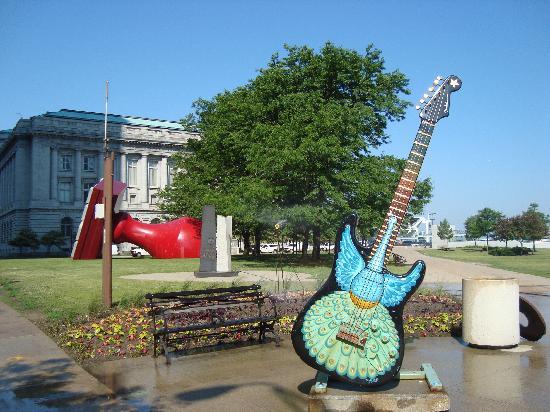
There may be no better way to beautify a city (or most cost effective way, in many aspects) than by using public works of art. As I have written about before, cities, especially cities that are losing population and/or facing severe budget shortfalls, are turning more and more to public art to revitalize areas and encourage more tourism. And as I wrote about last week, cities are turning more and more to what makes them unique, a significant change in focus from the tried and true method of trying to outdo or outclass your neighbors. Gone are the days (I hope, at least) of cities competing for visitors by building bigger stadiums or concert halls in an attempt to prove that they are, in fact, the most exciting city this world has ever seen.

In light of all this talk about urban renewal, green spaces, and new works of public art, what are some of the latest and greatest pieces of work on display? A number of outlets, including the New York Times, the Atlantic and others, have recently taken a look at works from across the world, and I have assembled them here for your viewing pleasure!

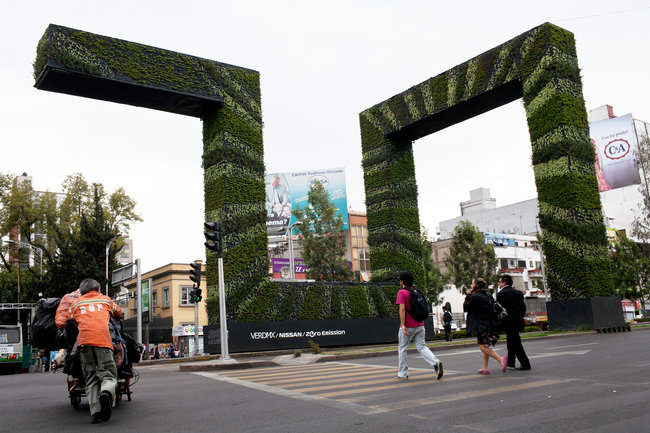
The New York Times recently took a look at a new project in Mexico City that seeks to provide both aesthetic pleasure and help the environment: a set of three “eco-sculptures” that comprise a sort of urban garden in the city. As you can see in the image above, these arches, comprised of thousands of plants each, are an attempt to beautify the city and help ease pollution in the large metropolis. Installed by a local non-profit, the sculptures are part of an overall effort to help green a city that is not particularly known for having a sustainable reputation; as the New York Times reports, these three sculptures are just a small part of a broader garden movement, and the attention these works of art have received are bound to make the effort that much more noticeable.

Over in Los Angeles, a new public art project has taken a little of bit of nature and transported it, visually at least, to an urban area. Artist Paige Smith has crafted little miniature geodes, crystals that form inside of some rocks, and installed them in unassuming places around the city: inside pipes, brick walls, or even the cracks of a wall. Smith has created little 3D sculptures made of paper to have the appearance of geodes, and the result is a unique little diversion from the normal city wall. She’s up to a dozen installations across the city, and you can see a full map of locations on her website.

(Photo courtesy of Paige Smith)

In St. Louis, public art is being used to help solve a problem: how do theatres make their patrons more efficient? In other words, is there a way to encourage patrons to stay longer and keep themselves busy, instead of just standing around waiting for the show to start?

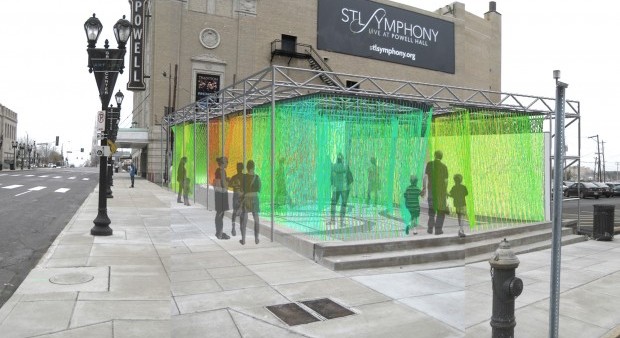
A piece is going up in the Grand Center neighborhood of St. Louis that is designed to encourage patrons and visitors to stay a while. Titled “A Chromatic Confluence,” it will be a mazelike sculpture made up of about 20,000 feet of different colors of string. The overall structure will be fairly large in size, about 25-feet by 65-feet, and will be lit up at night, as you can see below. Hoping to draw in patrons and foot traffic, it is an attempt to grab people’s attention and give them something to do before the show starts. The piece is the first of a planned series of public art projects in the St. Louis area, in an overall attempt to bring more culture and artistic pieces to the city.

(Photo courtesy of the St. Louis Post-Dispatch)

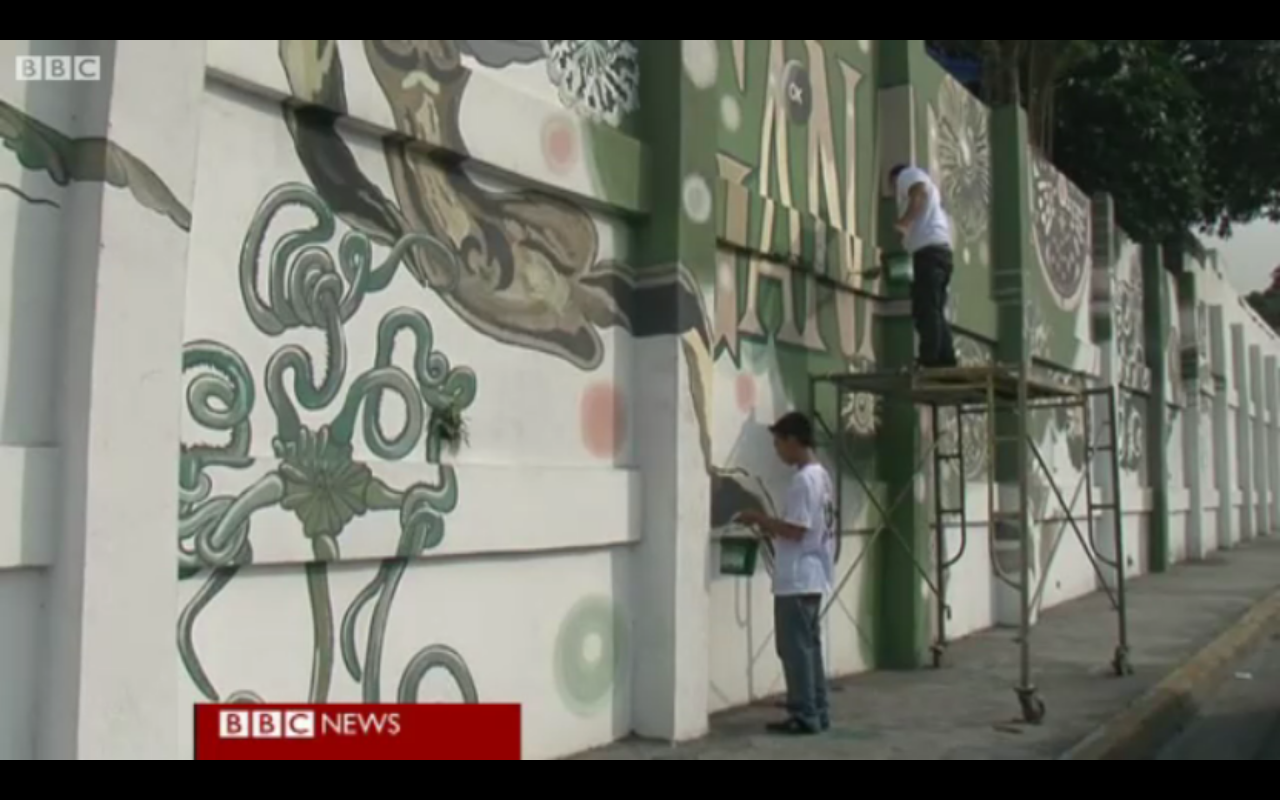
Overseas, the city of Manila is moving ahead with public art, but is doing so in an attempt to be as environmentally sustainable as possible. Manila has the distinction of being one of the world’s most polluted cities, and attempts have been made in recent years to help cut down on emissions and improve air quality.

Courtesy of the Atlantic, a local Philippine company has created a paint which it claims can help purify the air while being used, and since the discovery, murals have been painted all over the city in attempt to not only beautify areas of the city that been victims of neglect and destruction, but also help the environment as well. The BBC recently filed a report about the paint and the attempt to improve the city through public art.

(Photo courtesy of The Atlantic)

These are just a few of the examples of cities using public art to help improve the aesthetic quality of their cities. Many more projects are underway, popping up in cities all across the United States and the world. What are some of your favorite public works of art in your cities, or perhaps favorites you’ve seen in others? Feel free to comment below!

(Top photo courtesy of the New York Times)

Let's Talk About Tumblr: Part 3 [mini-nar]

Tumblr is one of those platforms I love to talk about - and this mini-nar is for those who love it too. I've got cool tricks and tips, but this mini-nar moves are a pretty good clip. If you haven't seen our other posts on Tumblr, maybe check those out before you watch this. We discussed the arts communities possible shift towards Tumblr, some of the recent updates, and last week - in the second part of this series - we had a mini-nar on the basics of creating a Tumblr. If you feel you've got all that down, here's a lesson in really engaging a Tumblr audience. http://youtu.be/HAqAO0VgukA

Newsweek and Anderson both have great Tumblrs, and I was excited to feature them this week. Call Me A Heinzer is a hilarious Tumblr (and personal fave, as Tech in the Arts is an initiative from the Master of Arts Management program of Carnegie Mellon University's Heinz College).

If you or your arts organization have a Tumblr, please let us know! Write a comment! I'd love to see what you're doing!

The O: Audience Engagement at the Museum of Old and New Art in Tasmania

A recent blog post by the Walker Art Center featured some highlights from the Museums and the Web Conference that took place in San Diego earlier this month. Among these conference notes, the audience engagement practices at the Museum of Old and New Art (MONA) in Tasmania were undoubtedly innovative. The 6000 sq ft privately owned museum, which has an “eclectic collection of 2210 antiquities and artworks,” has not a single wall label or sign to guide its visitors. Instead it relies on The O, “the first mobile interpretive solution designed to replace traditional wall labels and signage.”

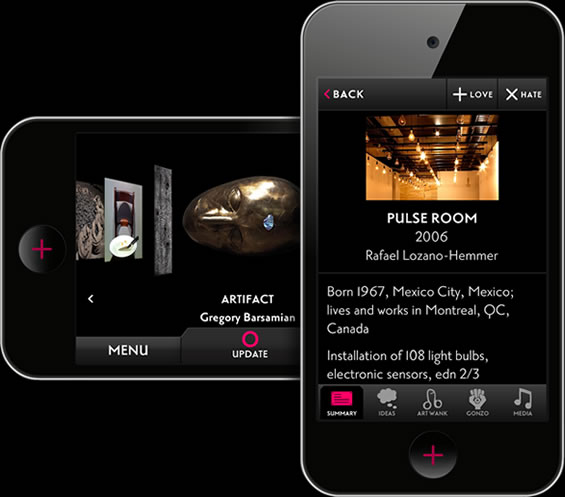
The O, a mobile device, equips a visitor with all the information they require including museum maps and cafe hours. Additionally, the O uses a visitor’s geo-location to suggest nearby artworks, allowing them to select the artworks they would like to know more about. It then goes on to provide them with curatorial information such as viewing notes and artist interviews. But even here, the approach is unique.

A visitor at the MONA recently wrote about her experience with The O and she mentioned how information on a particular artwork can be viewed in different styles. So Artwank presents you with information in “a formal curatorial style,” while Gonzo provides you with “personal musings on the art from MONA’s owner David Walsh.”

Besides curatorial information, The O lets a visitor interact with an artwork by leaving comments, tweeting about it, and sharing it on Facebook. It even has features that allow them to indicate whether love or hate it; art lends itself well to such extremes. Visitors also have the option of saving their O Tours and retrieving them the next day on MONA’s website. In fact, access to the museum’s online collection is reserved exclusively for those who saved their O Tours.

For the MONA’s curators and museum staff, The O unlocks a lot more than art. It provides them with a whole array of statistics that can be used to improve the visitor experience.The shuffled movement of MONA visitors using The O can provide stats on the most visited artworks,  the most visited rooms, artworks with most likes, the number of tours, museum traffic, repeat visitors etc. Yes, The O is for omniscient.

According to Art Processors, the creators of The O, the device is used at the MONA by over 40,000 visitors per month. Since the MONA’s opening in January, 70% of visitors have indicated that they prefer The O to traditional signage and 80% said that the device enhanced their museum experience.

http://vimeo.com/40188545

The O improves on the visitor experience in several ways. They no longer huddle around a single text panel, reading the description at unimaginable speeds. Their path through the museum is altered by The O’s suggestions, leading them in unexpected directions and towards unseen artworks. They can revisit their tour in 3D on the museum’s website.

Museums have much to benefit from a device like The O.  They may, at times, miss the reassurance of wall texts.  But they can rest assured that with a device like The O, visitors will have access to a lot more than curatorial text.  Conversely, the same visitors will leave behind a dotted trail that can be traced and analyzed by the museum. The O is for opportunity.

Lessons from the Bronx

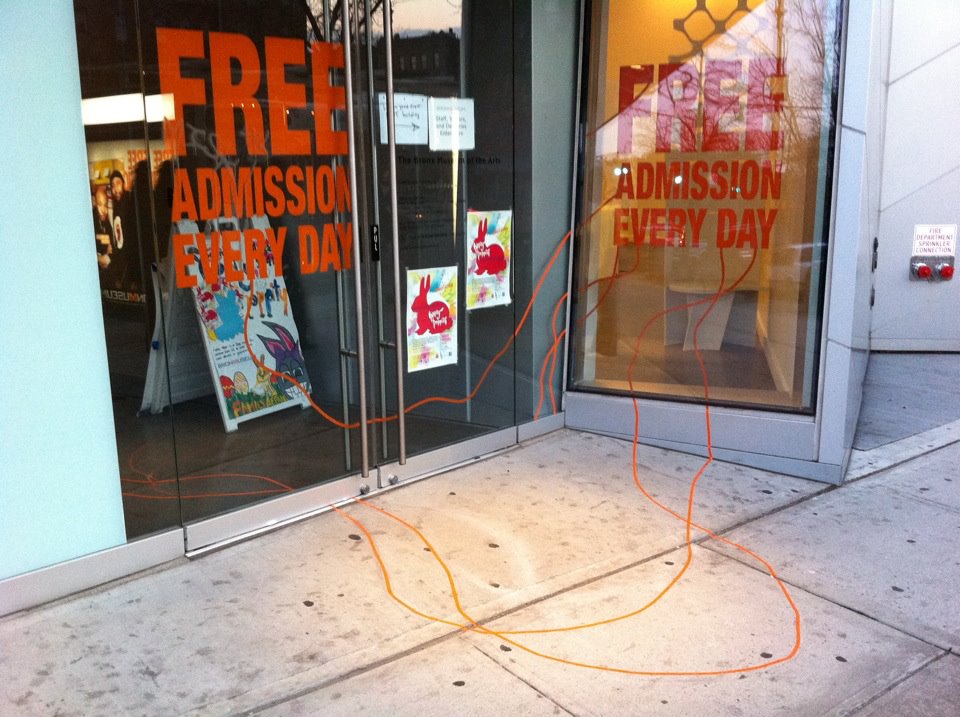
By now you may be aware of the Bronx Museum of the Arts' new ticketing initiative. If not, take a look at the Museum's Facebook status from March 30th: "Starting today, the Bronx Museum of the Arts will be Free to all. Thursday through Sunday, FREE! First Fridays! FREE. Whether you're 8 or 88, FREE! Getting Here: B/D train to 167th St (Unlike the Museum, the train fare is not free)." In celebration of its 40th anniversary, the Museum announced just last month it would offer free admission to guests-- this coming at a time when student discounts, twofer deals, good coupons, and gas below $3.99/gallon are at a premium. According to Museum Director, Holly Block,

With our immediate community being the poorest per capita in the nation, and at a time when many are struggling to pay bills…we don't want anyone to have to use (admission costs) as excuse not to visit us.

It is because of a grant from the New York Community Trust that the museum is able to offer free admission to the public- though the grant only covers admission costs up to 15 months. The Museum is hoping to secure a more permanent funding source to be able to continue to provide free admission to the public after those 15 months.

Not only does this reduce barriers of entry for Bronx residents, New Yorkers, tourists, and artists, but it also benefits the museum community at large. Many museums have implemented similar free admission pilot programs and have reported varying results. It will be interesting to follow up with the Bronx Museum at the conclusion of the 15 month, free admission period to review its attendance numbers and demographics during that time.

While snooping around for more information on the Museum’s new pilot program, I stumbled upon two special offerings at the Museum. How did I NOT know about these programs?!

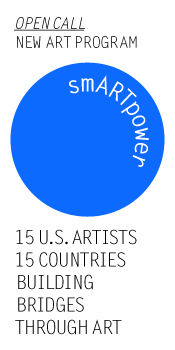
1) smARTpower: In conjunction with the U.S. Department of State’s Bureau of Education and Cultural Affairs, the Bronx Museum administers this cultural diplomacy program. The program funds and provides travel opportunities for 15 U.S. artists to create and work abroad on a community-based art project. smARTpower supports “the development and implementation of community-based art projects that engage youth and other local residents, including artists. The projects are strongly encouraged to create a tangible legacy of the work accomplished through smARTpower in a variety of visual arts media…” The program is open to professional artists only with U.S. citizenship.

2) Artist in the Marketplace (AIM): Established in 1980, the program seeks to provide “networking opportunities for emerging artists residing in the New York metropolitan area" and to introduce "their work to a greater audience.” Thirty-six selected participants attend weekly seminars led by a faculty of specialists. Topics covered in these sessions “address areas of practical concern to artists including: career management and gallery representation; exhibition and public art opportunities; grant writing, copyright law, and marketing.”

It is a hopeful sign, especially in these financially trying times, when a non-profit arts organization remains so concerned with serving its constituents- accessibility for its local audience, professional advancement for its arts community, and greater cultural understanding in diplomacy efforts.

How much are you worth to Facebook?

Now that Facebook is going public (reluctantly, due to a Federal Trade Commission rule) and is releasing financial statements we actually know how much money Facebook is making off of us:  about $1.21 a quarter according to Techcrunch.  This amounts to around $4.84 a year per user average.  This figure is of course only part of Facebook's income portfolio as it makes money off of advertising, investments, and licensing.  At times like these it is important to remember that Facebook is not ours, it is run for the profit of the shareholders.  The dozen or so iterations of Facebook that have been implemented over the last eight years have all had modifications that were put in place to maximize data mining and advertising sales. A worthwhile re-read at a time like this was done by a former blogger for this site.  Here are links to Amelia Northrup's social media analytic series:

http://www.technologyinthearts.org/2011/05/the-art-of-social-media-analytics-part-1/

http://www.technologyinthearts.org/2011/06/the-art-of-social-media-part-2/

http://www.technologyinthearts.org/2011/06/the-art-of-social-media-analytics-part-3/


Cities Thinking Differently, Through the Arts

The past couple of years have been rough on America’s cities. The recession, job losses, budget cuts, and more people moving to the suburbs have all resulted in less tax revenue and a sense of unease about their future. Through these struggles, the cities have to consider questions like: What steps can be taken to foster economic growth? How can we become a player in an increasingly competitive global marketplace? The cities of the Rust Belt, however, have had it a little worse. Unlike booming cities like Phoenix or Houston, cities like Detroit, Cleveland, and Pittsburgh are losing residents, with a fear that population losses will continue unless something drastic is done to “save the city.”

But instead of looking to traditional approaches like building an expensive sports stadium, performing arts complex or shopping malls, residents in cities like Cleveland and Detroit are taking a different route: embracing what Grist calls “Rust Belt chic,” the gritty, industrial, working class roots that embody and define the cities. One of the ways these cities are embracing this new dynamic is through the arts, and proving that having a thriving arts city doesn’t require investments or new arts venues: sometimes, all you need is to do is tap into what makes your city unique.

Much has been made about the struggles that face cities like Cleveland, Detroit, and Pittsburgh. This “Rust Belt chic,” first dreamed up by the “I Will Shout Youngstown” blog, based out of Youngstown, Ohio, can be best described by Governing magazine:

“A certain fascination with places that have fallen on hard times like the Rust Belt…has taken hold. Part of it is the scruffy, industrial look. It may also be a rejection of cities with gleaming condo towers, bistros and boutiques that were once so trendy yet now seem so frothy and fake.”

In other words, instead of trying to compete with the New York’s and LA’s of the world for visitors and potential residents, think different.

Cities all across the Rust Belt are taking this approach. But what many cities are doing is taking a low cost and high reward strategy towards economic development, which includes the arts community in a big way.

One example, as I wrote about in a recent post, is Detroit, who is embracing the arts community by providing tools and equipment to up-and-coming artists, fostering a sense of community for new artists moving into the city, even as thousands of residents leave every year. Detroit has the furthest to go of any city on this list, but businesses have started to move back to the city, young people are starting to move downtown, and its art scene has become home to increasingly diverse and eclectic artists, seeking to make a name for themselves.

Our home town of Pittsburgh is thriving (as any of us Pittsburgh residents would certainly tell you), and part of that is due to a thriving arts scene, which is frequently cited as one of the best things Pittsburgh has to offer. Much of the decay and abandoned buildings caused by the steel industry leaving decades ago has been taken over by the arts community and transformed into art spaces. What used to be an abandoned warehouse is now an art gallery; what used to be a factory plant is now a mixed use performance space.

It is because of this determination and grittiness, the drive to think differently and transform existing spaces, which makes Pittsburgh a perennial power in “America’s most livable cities” lists, often taking the top overall spot, as it did in 2010.

Cleveland is another case study. City leaders have struggled to come up with catchy slogans in an attempt to draw visitors, but local artists and arts venues aren’t focused on what Cleveland can do to “catch up” with other cities; they’re embracing what makes them different.

The Next American City recently looked at what it calls the “creative allure of urban grit,” focusing on cities like Cleveland. Because in cities like Cleveland and other across the Rust Belt, “you’re forced to accept that shit happens, and with that comes a freedom to creatively make sense of what’s happening. That’s art in a nutshell: the burn to make meaning out of failed plans and ruin.”

Some local artists are doing just that. The Next American City looked at Cleveland artist Amy Casey, whose paintings offer a unique and real look at the city. Housing vacancy and abandoned industrial plants a huge problem in Cleveland; Casey draws paintings where houses are connected together by ropes, or industrial areas are marked by decay.

One cannot help but to notice the economic strife and abandonment that has taken part in these cities; but while some would find such a sight depressing, others see inspiration. Casey’s paintings, and many others throughout Cleveland, seek to symbolize both the struggles it faces going forward, and the opportunity that awaits them.

Cities like Detroit, Pittsburgh and Cleveland all have many problems, and no one is here to suggest that the arts can save them on their own. But while all three areas, and dozens of others, create economic development plans and seek to spur investment and population growth to cities long forgotten by their neighbors, the arts is a way to provide a short-term boost to lift spirits, provide inspiration, and instill a sense of pride to communities.

We know it will be a tough and long road back for these cities. But at the same time, embracing what many call “rust belt chic” is a way for these cities to focus on what makes them different and unique, and offer a taste of what people can expect from these faded, but not yet broken, great American cities.

Let's Talk About Tumblr: Part 2 [mini-nar]

If you haven't heard about Tumblr, you haven't been reading Tech in the Arts. Tumblr just announced they will be including ads in their service soon, and has been making waves in the news. We've talked about the use of Tumblr for the arts communities, the latest updates to Tumblr, and now we're proud to present a mini-nar on how to use Tumblr. New technology can seem prohibitive, but this mini-webinar is designed to show you how simple Tumblr can be, and how other arts organizations are utilizing Tumblr. http://youtu.be/m8fT-RJhizc

Featured Tumblr blogs include SFMOMA, February 30th Productions, and Cave to Canvas.

Part 3 of our "Let's Talk About Tumblr" series will be posted next friday - but in the mean time, how are you using Tumblr? Is your arts organization reaching out to the community on Tumblr? Tell us about your success (or failure!)

Rivers of Ice: Exhibitions at MIT Museum and Everest Base Camp

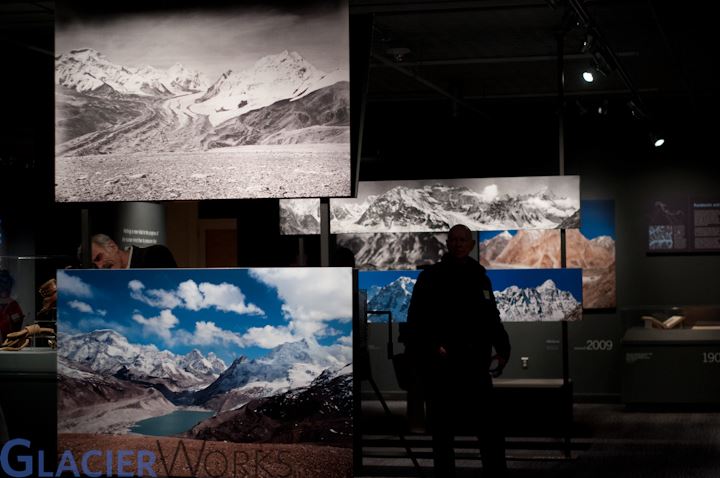
An exhibition at the Mount Everest Base Camp is no ordinary undertaking. The location itself is bound to generate a few shudders. But for an organization named GlacierWorks, no glacier is too remote a location to increase awareness about the potential impact of glacial loss on Asia’s water supply. Incidentally, for those far from the Himalayas but close to Massachusetts, their work is also being exhibited at the MIT Museum. GlacierWorks is an organization we have written about in the past because of their unique use of “art, science, and adventure” to document changes in the Himalayan glaciers. Through a process of matched photography, using images by 20th century photographers such as Vittorio Sella and Sir George Mallory, they are able to note the decrease in glacial mass that has taken place during the course of the century.  The results are presented in compelling photographic exhibitions that narrate a story of loss in the highest reaches of the Himalayas.

For an exhibition titled, Rivers of Ice: Vanishing Glaciers of the Greater Himalaya, the Everest Base Camp couldn’t be a more appropriate or beautiful location.  “Set against the magnificent backdrop of Mount Everest and the Khumbu glacier, Rivers of Ice presents visitors with a chance to admire the vast beauty of the High Himalaya while reflecting upon the profound changes taking place in this seemingly impermeable landscape.”

GlacierWorks stresses how some of the most important rivers in Asia (Indus, Ganges, Yellow, Yangtze etc.) rely on the Himalayan glaciers for “seasonal flow of fresh water”, and any change in that flow can affect millions of people downstream.

“Data collection in this vast and remote region is impossible for all but the most seasoned climbers, and each glacier has unique characteristics that prevent broad generalizations about the region as a whole. Nevertheless, scientists agree that there is a trend of melting beyond what can be expected to occur naturally.”

Since Everest Base Camp is a mountaineering mecca of sorts, Rivers of Ice is sure to affect the daring mountaineers who tread upon the very glaciers exhibited. Yet more importantly, the cause for concern is destined to wind its way down the Himalayas; to India, China, and the international community as a whole. Those with little to no inclination for steep inclines and frosty conditions can keep up with the exhibit via GlacierWorks’ Facebook and Google+ pages. You can also follow the exhibit on their Twitter, where it will be promoted using the hashtag, #icegallery.

If you wish to see their photographs in person but are daunted by the notion of a journey to the base of Mount Everest, you can make a far less taxing visit to the Rivers of Ice exhibit at the MIT MuseumRivers of Ice seeks to “trigger public dialogue as scientists and policymakers work to better understand the glaciers’ potential impact on the fresh water supply in Asia, and on global environmental issues in general.”

As the MIT Museum explains, the true plight of the Himalayan glaciers has led to a certain degree of controversy in academia. A scientific report earlier this year concluded that the Himalayan glaciers had in effect seen no decrease in ice between 2003 and 2010; the loss of glacial ice had been compensated for by an increase in ice in the caps. Understandably, the behavior of these glaciers confounds climate scientists. Yet they remain a rare, unexplained exception as the study shows that glaciers in Antarctica and Greenland are losing mass at significant rates. Globally, a total of 536 gigatonnes of ice have been lost between 2003 and 2010.

The MIT Museum goes on to say the following:

“As our thinking about Rivers of Ice evolved, we came to realize that the exhibition gives us an ideal platform for opening discussions about climate change, about water resources and, fundamentally, about how science works. Acquiring scientific knowledge is a back-and-forth, trial and error process. As the research continues, we hope for more clarity, but we're prepared for more disagreement about what exactly is happening to the glaciers in the Himalaya.”

GlacierWorks photographs are an excellent opportunity to delve into the conversation about climate change. And even as we wait upon clarity regarding the Himalayan glaciers, the broader trend of glacial loss could not be clearer. It’s easy to forget about climate change when you live under perpetually sunny skies.  But a trip to the Himalayan glaciers on GlacierWork’s website or the MIT Museum will definitely give you something to shiver about.

Motion-Capturing Conductors, Pianos & Landmines, and Facebook & Twitter Symbols

A roundup of my favorite applications of arts and technology this month: 1) Music and Gestures: Capturing the Movement of Conductors

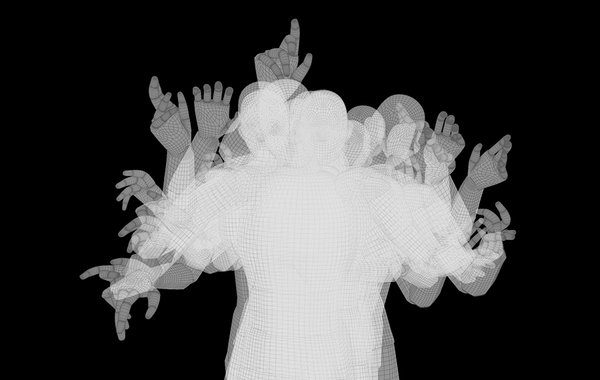
In “The Maestro’s Mojo,” Daniel J. Wakin of the New York Times interviews Alan Gilbert, the music director of the New York Philharmonic. The article discusses the importance of the conductor's form, gesture, and physical presence during a concert, breaking down the essential components of each movement: right hand, left hand, face, back, lungs and brain.

What is most revealing, not to mention beautiful, is the motion-capture sequence and interactive demonstration of Gilbert’s movement and gestures while conducting. Even if you view the interview with the sound on mute, the digital simulation of Gilbert conducting is worth your time. Captured in this digital transformation is the grace, the lines and the precision of a conductor at work. The digital transformation is both a work of art in itself and a fascinating study of the movements that perhaps, so nuanced, evade even the most cultivated and experienced concertgoer.

[embed]http://www.http://vimeo.com/40095898[/embed]

2) Pianos and Landmines

Did you catch this story earlier in the month? It’s about Marian Bechtel, a 17-year-old finalist in the 2012 Intel Talent Search competition. Bechtel presented her invention of a low-cost minesweeper that uses sound waves to detect explosives. A pianist, Bechtel applied her knowledge and expertise on the logistics of sound wave travel in music, to that of determining the location of land mines. Though her minesweeper prototype did not win her first place in the competition, Bechtel’s inspirational and innovative discovery is one that spans the fields of science, engineering, technology, warfare, humanity, and music- the juxtaposition of melodic beauty and peace, with war and destruction.

[embed]http://www.youtube.com/watch?v=nGW2qAHLJCc[/embed]

3) Not about music, but some good news about Facebook and Twitter Logos!

And last but certainly not least, proof that those little, cute, perfectly-square Facebook and Twitter symbols DO, in fact, generate traffic to the organization’s respective pages. According to a study conducted by the global consulting firm, Accenture (shout out to Technology Planning and Implementation),

Accenture found that, in the U.S, about a third of TV viewers have liked a show’s or brand’s Facebook page or tweeted about what they saw on TV after seeing one of these logos.

This implies that a television viewer, if not using his/her computer at the time the advertisement is viewed, will "like" or visit an organization's Facebook or Twitter page after the fact. If that is the case, are the benefits of including the logos in your organization's e-mails and correspondences with patrons even greater? Furthermore, the study indicated

…11% of viewers scanned a QR code while watching TV.

Given what we know about QR code usage in the US, and its slow-to-catch-on-if-ever status, 11% is a surprisingly high number.

Moral of the story? Be sure to include those Facebook and Twitter symbols in every e-mail blast, online correspondence, and virtual newsletter. Your Facebook or Twitter presence is important. Inserting the logos in an e-mail is quick, free (monetarily) and according to what you probably already knew and is now confirmed by this study, a crowd-pleaser. People will click, Tweet, post, Retweet, and follow.

Cash Mobs

According to Public Radio International, the first Cash Mob was started by a writer and engineer from Buffalo called Chris Smith to counter the growing culture of discounting (couponing and deals from Living Social as well as other deal sites).  Now in over a dozen cities in the United States and Canada Cash Mobs are getting significant media attention.  Organized online, the suggested rules are relatively simple and are centered around the concept that the business must be a local one and that a non-discounted product must be purchased for $20 or more by each member of the cash mob.

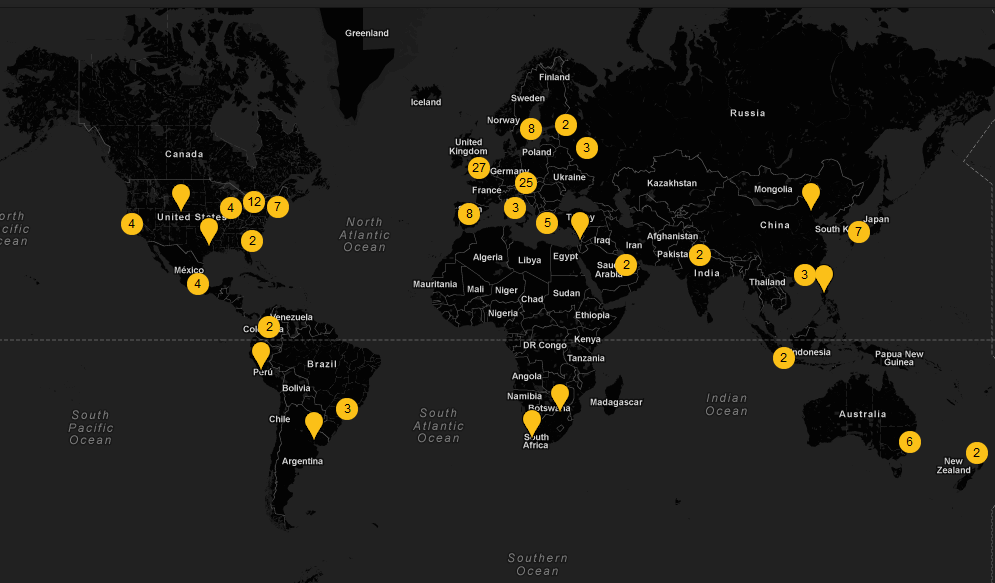
Cash mobs are most frequently organized through social media and can be found under the Twitter hashtag #cashmob  or on Facebook under cashmob and your city.  As of the international cash mob day last March 24th, 2012 Cash Mobs have been organized in 32 states and two Canadian provinces.  Growth of this movement has been swift with new cities joining cash mob lists every week and is sometimes linked with a buy local campaign.

The goals of many of these cash mobs are to save a local business who's sales have been low.  By all indications there has not yet been a cash mob for a theater or museum but it is only a matter of time.  As cash mobs are supposed to be social activities they would be well suited for many arts settings.  The social media context for these activities have made them extremely easy to measure metrics on as each cash mob elicits numerous check ins and photo posts.  The incentive for participation in these activities is a sense of community support.  Non-profit arts organizations are fundamentally community organizations ergo the arts should be obvious beneficiaries of this movement.  If anyone knows of a successful cash mob for an arts organization, please comment with the results and links if possible!

The 2012 London Olympic Games and the Role of the Arts

You may have heard: the 2012 Summer Olympics, the global 2-week spectacle that brings some of the best athletes from around the world to compete in over two dozen sporting events, is taking place later this summer in London, from July 27th through August 12th. But what you may not have heard about are all the exciting and unique events that are intended to showcase the cultural and artistic diversity of London, expressed through art, through a series of exhibits, performances, galleries and shows. The hope, organizers say, is to leave a “lasting legacy for the arts in the UK,” and with millions of tourists visiting the city for the festivities, and billions watching around the globe, there may be no better opportunity for that kind of exposure.

So while the games may receive the lion’s share of attention this summer, it is the British arts community that is hoping to have a more sustainable impact for years to come.

London’s art renaissance is comprised of two parts: the first, the London 2012 Festival, is taking place this year from June 21st through September 9th, and is largely centered on the Summer Olympics and the Paralympics that follows. It is part of a broader campaign, called the Cultural Olympiad, which is a multi-year effort that started in 2008 and is dedicated to showing visitors the best Britain has to offer in the worlds of art, dance, music, culture and more.

The London 2012 Festival is the more high profile project, and will be immediately noticeable to anyone who makes the trip to London for the games, as over 1,000 events are planned. Organizers are proclaiming that there are “10 million free opportunities to get involved,” and while the full list of events has yet to be revealed, there are already hundreds of shows and exhibits that have been announced. Perusing the website you can find such events as film festivals, comedy shows, concerts, carnivals, and fashion shows, some of which require tickets, but the majority of the events are free to the public.

One of the most notable events announced thus far is the Damien Hirst exhibition at the world-famous Tate Modern. In the world of film, a festival showing silent movies by home town director Alfred Hitchcock will be presented, alongside a live musical performance of the material.

My favorite part of the festival, however, and I imagine many others feel the same way, is the quintessential British playwright who will receive top billing. William Shakespeare will be in the spotlight, as the World Shakespeare Festival, which begins next Monday (April 23rd) and runs through September, will present almost 70 productions of Shakespeare’s plays in thirty different locations across the United Kingdom, including Scotland and Wales.

Organized by the Royal Shakespeare Company, organizers are calling it the “biggest celebration of Shakespeare ever staged,” with thousands of actors from around the world taking part in the project. In addition to the usual theatre presentations of Shakespeare’s work, there will be street performances and even amateur performances as well. The most ambitious part of the festival is the Globe to Globe project, where performers will act out all of Shakespeare’s plays, but each of them will be performed in a different language with different actors used for each performance.

It is important to remember that London is not only a sporting destination or the home to great museums and theatres: it is also what the Atlantic calls a “global cultural hub,” home to so many uniquely cultural people and neighborhoods. This cultural diversity will be on display through the festival as well, showcasing some of the best art from countries around the world.

One of the criticisms of the Cultural Olympiad and the upcoming London 2012 festival is the costs associated with such lavish productions, and estimates thus far for the total cost of both programs is about $154 million, no small amount for a country dealing with harsh austerity measures across the board over the last couple of years.

In addition to the overall government-wide austerity measures put in place by the British government, the games also come at a time of dwindling funds for the arts in not only just the UK, but all across Europe. I wrote recently about the impact that arts communities in Europe are facing, and while countries like Italy and the Netherlands have received the most attention, the cuts have hit the UK as well: as the New York Times reports, the British Arts Council saw its government funding recently reduced by 20 percent.

When the 2012 games were awarded to London, back in 2005, the economy was booming and expectations for both the games and the Cultural Olympiad were sky high, and lavish funding was promised. Of course, after the global economic recession hit in the fall of 2008, expectations were tempered, and both sides have adjusted accordingly.

One of the criticisms that critics have about the Summer Olympics is that it’s a sporting event that costs billions of dollars to produce, creates years of traffic problems and construction delays, and all the pageantry and spectacle that it comes with only lasts for two weeks, and then it’s gone forever (well, except for all the unused stadiums that come with it).

While the sporting part of the Olympics is only in town for those two weeks, it is the hope of organizers of both the London 2012 festival and the Cultural Olympiad that the impact that the arts community brings to the festivities, through art, dance, music, film, culture and so much more, has a lasting impact even after the games have ended and all the medals have been handed out. It may not be in place as long as a giant football stadium, but the impact on British culture is sure to last for quite some time.
The Google Art Project and Art.sy: Exploration Engines for Art

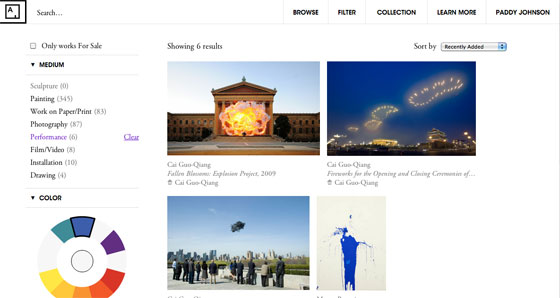
The complexity and depth of the world’s art and culture is incredible and incredibly incomprehensible. Incredible because it evades definition and is relentlessly dynamic. Incomprehensible because the individual knowledge, time, and resources required to explore this cultural infinity are all too finite. Thus in this ever expanding universe, it is all too easy to gravitate towards the black hole of ignorance. But fear not, recent developments in technology are here to help steer us away from that ill-fated course. The upgrade of the Google Art Project and the launch of Art.sy are helping us understand our cultural universe, one art work at a time. With Google’s integrated documentation of the world’s museums, our artistic past is both nearer and clearer (literally, with a 7 billion pixel Rembrandt!). And Art.sy’s role as a “dynamic inventory” of emerging artists is an opportunity to discover contemporary art without being at the center of the artistic universe (New York or London).

The second phase of the Google Art Project has seen a massive expansion in the number of museums available on view. “Since last year, the Art Project has expanded its reach: 151 museums are now partners (compared to 17 in V1) providing over 30,000 artworks, from 40 countries (compared to 9 countries last year).”

From the National Gallery of Modern Art in New Delhi to the Getty Museum in Los Angeles, a visitor can experience a significant portion of the world as seen through objects, artifacts, paintings, and sculptures. Its new features include the ability to create your own collections and place them in personal “galleries”. The site also includes an entire section on ways to educate and be educated! For the initiated visitor, it is an invaluable opportunity for art historical exploration!

In its broader implications, the Art Project is a window into national identities as created through heritage and can be viewed as a vehicle for cultural diplomacy. This notion may seem overly ambitious, given the sites’ hyper-virtual immersion in a country’s artistic wealth and apparent disregard of chronology. But it exists nonetheless, as a weaker current that may invoke some to pursue additional research, and even create travel plans!

Additionally, the countries represented benefit from showcasing the wealth of their museum’s collections on an integrated domain, alongside world-renowned museums such as the Met. In essence, the Google Art Project acts as a virtual art fair for the world’s museums. It can either be surveyed at a harried pace or explored with deliberation. Either way, you get to collect works and create galleries for no cost at all!

In a similar vein to the Google Art Project, Art.sy is helping the world discover contemporary art, a category that often transcends national boundaries and is increasingly difficult to keep up with, let alone understand! With Art.sy the difficulties of “discovering fine art” are eased with the development of the Art Genome Project, “an ongoing study of the characteristics that distinguish and connect works of art.”


The website recently launched its beta version and some of its remarkable features were highlighted by the lucky few who were given access. Essentially, Art.sy allows users to discover new artists and works based on a set of 800 characteristics or genes that are assigned to each work of art. Given a user’s interest in a work of art and the underlying genes that are encompassed within, it suggests additional work that may interest them. Users can also choose to follow an artist or a gallery and of course, contact the gallery if they are interested in making a purchase.

A review by BetaBeat praised the site for its ability to lead an average art appreciator “to artists like Sherin Guirguis, a young Egyptian artist whose abstract paintings resemble fractals and eyeballs.” At the same time, it was criticized for only having secured partnerships with the leading galleries of the world and effectively limiting the art on view.  Art.sy also retains an air of exclusivity, one that it may carry with it into the future.

Nevertheless, it would be remiss not to give the unique and brilliant workings of Art.sy a try.

In effect, both Art.sy and the Google Art Project are innovative discovery engines for art. The differentiation lies in that the former knows where you are headed even as you might not. The latter, in contrast, lets you meander your way to a destination unknown, an artwork unseen.

Americans are paying more for culture, opportunity looms on the technology front

New information out from the Consumer Price Index (CPI) indicate that Americans are spending more for both technology and entertainment (a catagory that includes cultural expenditures).  How can cultural organizations capitalize on this?  What does this mean?  Articles in both The Atlantic and NPR's Planet Money look at these trends from a more general standpoint but don't drill down on the idea for the arts.  The facts presented from the Atlantic indicate that 2007 Recreation expenditures are up by 1.7% over those from the US in 1947.  The  NPR article states that as a percentage of household income, expenditures on Entertainment rose from 5% of the total in 1947 to 6% in 2007.  This information along with the more current information from the CPI which had the Recreation Index gaining by .6% (driven in part by a 1.2% and 2.0% rise in admission to cultural events in Dec 2011 and Jan 2012) this last January give the arts sector some reason to look favorably towards the horizon.  These numbers mean recovery, and recovery means opportunity for change. The relative gains in the arts sector are paltry compared to the gains made on technology purchases in the same amount of time.  The number of personal computers in homes (worldwide), for instance, grew from 152 Million from 1993 to 2002.  The number of internet users in that same time frame went from 10.5 million to 716 million.  The growth of other tech is no less startling by most accounts.  The synthesis of the growth of technology has yet to be fully realized by the arts sector at large but this brief respite (where revenue is rebounding from recession) should be a moment where we rally to adapt.

What do these broad economic indicators mean?  Consumer confidence has been slowly recovering since the doldrums that it was in around 2008 and 2009.  As budgets start to recover and earned income from ticket and admission sales start to edge up, arts leaders will be faced with decisions about what to do with the money.  The temptation to return departments and programs to the pre-recession status quo will be strong; the opportunity, however, for transformation through technology to meet the larger changes in how people are consuming arts and culture should be the priority.

As many technologies are currently moving out of first generation and subsequently becoming less expensive the opportunity to develop interfacing content for them is also becoming less expensive.  Application development for mobile devices is, for instance, now within the fiscal reach of the arts sector.  Similarly simulcast capabilities in HD are coming into broader usage in peforming arts organizations across the country.  The time to identify and implement new technology is now.


The Google Art Project Welcomes You to the White House

Ever wanted to take a tour of the White House? Well now you have a chance, and you can do it all from the comfort of your living room. The Google Art Project, a site devoted to presenting high resolution photographs of hundreds of works of art and museum tours from some of the finest museums in the world, including the Palace of Versailles, the Van Gogh Museum and the Metropolitan Museum of Art, has unveiled its latest project, a captivating look inside the world’s most famous residence, the White House.

As part of what the White House calls its “commitment to opening the doors of the White House to all Americans,” the site primarily does two things. First, it presents images of dozens of paintings and works in art in stunning high resolution quality; and secondly, my favorite part, it offers a 360-degree view of many of the “public” areas of the White House, giving you your own personal tour!

The White House is the latest location added to Google’s Art Project website, which has steadily grown in recent months by adding some of the top museums in the world to its collection. It really is a site to behold and a must visit for arts lovers everywhere; by taking some of the world’s best collections and putting them online free of charge for the world to see, it really does represent one of the best ways to merge technology with the arts to generate enthusiasm and excitement for the stunning works of art that are now viewable in all their high definition glory.

For the paintings and works of art themselves, Google features what they call a “gigapixel” camera that offers an extremely high resolution look at some of the most famous paintings in the White House collection, including Gilbert Stuart’s famous portrait of George Washington. Viewers can zoom in and examine the paintings in EXTREMELY close detail, all the way down to the brushstrokes, just as you would if you were to view them in person, right?

You’ll find hundreds of paintings, sculptures, pieces of furniture, and more available for view. You’ll also find a portrait of almost every former president as well. Some of my favorite presidential portraits, which I have seen before on either book covers, in print or elsewhere, were immediately noticeable and fascinating to view up close and in so much detail. Some of my favorites include Aaron Shikler’s portrait of John F. Kennedy, John Singer Sargent’s portrait of Teddy Roosevelt, George P.A. Healy’s portrait of a sitting Abraham Lincoln, and last by not least, John Trumbull's portrait of my favorite founding father, Alexander Hamilton.

The coolest part of the site however, if you’re like me, is the virtual tour. In recent months, Google has made headlines by starting to take their Street View cameras indoors to start photographing businesses and places of interest to add to its Google Maps site. What Google has done here is to take those Street View cameras inside the White House and presented a “museum view” of the public spaces inside. Here is where you can walk around and give yourself a tour of two floors of the White House, seeing sights like the East Room (where indoor press conferences are usually held) and the China Room, where presidential china collections dating back to the 18th century are held.

Not everyone will have the chance to visit Washington and take the White House tour (which is a hard ticket to come by, and even if you can get on the list, usually requires a several months long wait), but thanks to Google, we now have the next best thing, viewing many of the sights you would see on a tour on your computer screen.

This may be one of the few things everyone can agree on when it comes to the White House: having an opportunity to view the magnificent works of art from the White House collection in such high resolution is a welcome treat, and worthy of praise. I encourage everyone to check out the site and go exploring!

BMW Tate Live: An Online Space for Performance Art

On March 22nd, Jérôme Bel, a french choreographer and dancer, performed in an unknown room at the Tate Modern to an equally unknown audience. Odd as it may seem, there was not a single audience member present in the room. Those who were watching the performance were watching it online, inhabiting a newly unveiled virtual space called the BMW Tate Live: Performance Room. BMW Tate Live bannerThe BMW Tate Live: Performance Room is an innovative series of performances broadcast viewable exclusively online around the globe, as they happen.

It is the outcome of “a partnership between BMW and Tate, which focuses on performance, interdisciplinary art and curating digital space.”  Jérôme Bel’s performance was the first in a series of five online performances that will run through July, featuring the work of artists Pablo Bronstein, Harrell Fletcher, Joan Jonas and Emily Roysdon.

The idea of an exclusively online performance is perhaps more innovative than the technology being used to showcase it, a Youtube channel and a single camera. Catherine Wood, the Tate’s curator of Contemporary Art and Performance, explained in article on Artinfo that they wanted to transmit the work in the “simplest means” and a single camera essentially acted as the “fourth wall” of the performance space.

Additionally, the integration of Twitter, Facebook, and Google+, allows the audience to write comments during the performance and later pose questions to the curators and artists. This allows for the creation of a virtual audience that is connected in real-time through reactions, thoughts, and the Twitter phenomenon, hash tags (#BMWTateLive). Access to these real-time reactions from around the world truly is phenomenal and wouldn't be possible in a traditional setting. The trade-off, however, could be the evolution of an audience that tweets more than it sees, and comments more than it listens.

When asked by Artinfo on whether this online medium may take something away from a live performance, Catherine Wood replied that there has already been much debate “about how much performance documentation is the work and how much it is a record of the work.” But she added that “Live-ness is inherently mediated by technology in the world we live in now. There will always be a place for just a person in a room and a live audience, but I think this is part of the evolution of performance art that we can't ignore."

http://www.youtube.com/watch?v=kf77fzBOoNo

For those afraid of testing the niche waters of contemporary performance art, the increased accessibility and chance to experience an unfamiliar genre through YouTube cannot be ignored. A few swells of interest, a little online momentum, and the waters of performance art will seem a lot less murky or impenetrable. As of the 4th of April, Jérôme Bel’s performance has been viewed 862 times, but that doesn't take into account the number of people who watched it live.

In order to participate in the ongoing conversation, a viewer must to tune into the Tate's website or YouTube channel as the performance is being broadcast. Since the remaining performances are scheduled to take place at 20.00 hours (London), they will be most accessible to audiences in North America (~15.00 hours) and Europe (~21.oo hours), with the exception of a few arty insomniacs in Asia (~1.00 hours). But for those who may be asleep or at work, each performance is archived and uploaded to YouTube.

The next performance is scheduled for April 26 and features Pablo Bronstein, an Argentinian artist who uses “architectural design and drawing to engage with the grandiose and imperial past of the built environment.” In his performance, Bronstein “will work with up to ten dancers to create a baroque trompe l’oeil stage set that exaggerates the perspective within the Performance Room.”

If time permits, tune in to BMW Tate Live for Pablo Bronstein! You may lose your sense of perspective, but find a deeper understanding and appreciation for performance art. If time doesn't permit, don’t miss out on the opportunity to watch these performances on YouTube at a later date.

How much should you trust your candidates for employment?

Verifying information on people online is cheaper and easier than it has ever been.  So why is it then that so many arts organizations don't use this technology to vet new employees?  The traditional method of calling a few references is relatively easy to foil and according to some studies up to 50% of all job applicants either outright lie on their applications or stretch the truth with regards to previous duties, length of employment, or reason for leaving (depending upon how you view lying).  According to MSNBC as many as 80% of for profit firms use background checks on new employees today (up sharply from 30% in 1996).  There were no figures available from the arts sector regarding this practice but anecdotal evidence indicates the numbers are much lower. There are innumerable firms that offer electronic background check services for around $20 per verification (word search for background or pre-employment screening returns hundreds of firms).  The service usually includes verification of education and employment as well as criminal records from local, state, and federal levels.  For additional money you can also get credit checks and driving records.  Studies have shown that employees that are under financial distress are multiple times more likely to steal from their employers and while that may not be an eliminating factor regarding hiring an employee it may help greatly to coincidentally bring in a credit councilor for an office wide employee training.

With funding competition at an all time high it is incumbent upon not-for-profit organizations to utilize every dollar as efficiently as possible.  When it comes to hiring however, some organizations set aside analytic tools and rely on an ad hoc collection of old human resource practices and intuition.

Concerns of privacy and respect deter many hiring managers from running background check, but the truth is that prospective employees expect to be checked out in this day and age.  Most prospective employees have already offered more personal information (although it is usually different in content) through their Facebook account than background screenings return in their findings.  Indeed some corporate employers are actually asking for access to employees Facebook pages.  While most would consider this a bit extreme it does raise a point:  what employees of an organization do in their personal lives sometimes has great impact on the perception of a not-for-profit in the eyes of the public.

The extent to which the arts sector vets its employees is a matter of personal or institutional value.  Even though these tools are available and inexpensive doesn't necessarily mean that it would make sense to each institution for every employee.  Hiring managers need to ask themselves the questions:  1)  What tasks do we need to be extra safe with regards to hiring for?  Examples of this criteria include employees with keys to the building or safe or employees who have contact with children or vulnerable populations.  2)  What degree of background check do we need?  There are very extensive checks out there and not all data is truly useful for accomplishing the goals that realistically need to be attained.  3)  What are our ethics with regards to what is private data and what is fair game?  Issues that can come up with regards to this question get into the territory of medical conditions, personal relationships, sexual identity, and so on.

The key to tackling these issues is to talk about them.  The ensuing dialogue within an organization will help define and address questions and define procedure.  Books and consultants can also help codify procedure and answer legal questions.  Consult an attorney for more information on the legality of asking for information from prospective employees.