
The 2012 London Olympic Games and the Role of the Arts

You may have heard: the 2012 Summer Olympics, the global 2-week spectacle that brings some of the best athletes from around the world to compete in over two dozen sporting events, is taking place later this summer in London, from July 27th through August 12th. But what you may not have heard about are all the exciting and unique events that are intended to showcase the cultural and artistic diversity of London, expressed through art, through a series of exhibits, performances, galleries and shows. The hope, organizers say, is to leave a “lasting legacy for the arts in the UK,” and with millions of tourists visiting the city for the festivities, and billions watching around the globe, there may be no better opportunity for that kind of exposure.

So while the games may receive the lion’s share of attention this summer, it is the British arts community that is hoping to have a more sustainable impact for years to come.

London’s art renaissance is comprised of two parts: the first, the London 2012 Festival, is taking place this year from June 21st through September 9th, and is largely centered on the Summer Olympics and the Paralympics that follows. It is part of a broader campaign, called the Cultural Olympiad, which is a multi-year effort that started in 2008 and is dedicated to showing visitors the best Britain has to offer in the worlds of art, dance, music, culture and more.

The London 2012 Festival is the more high profile project, and will be immediately noticeable to anyone who makes the trip to London for the games, as over 1,000 events are planned. Organizers are proclaiming that there are “10 million free opportunities to get involved,” and while the full list of events has yet to be revealed, there are already hundreds of shows and exhibits that have been announced. Perusing the website you can find such events as film festivals, comedy shows, concerts, carnivals, and fashion shows, some of which require tickets, but the majority of the events are free to the public.

One of the most notable events announced thus far is the Damien Hirst exhibition at the world-famous Tate Modern. In the world of film, a festival showing silent movies by home town director Alfred Hitchcock will be presented, alongside a live musical performance of the material.

My favorite part of the festival, however, and I imagine many others feel the same way, is the quintessential British playwright who will receive top billing. William Shakespeare will be in the spotlight, as the World Shakespeare Festival, which begins next Monday (April 23rd) and runs through September, will present almost 70 productions of Shakespeare’s plays in thirty different locations across the United Kingdom, including Scotland and Wales.

Organized by the Royal Shakespeare Company, organizers are calling it the “biggest celebration of Shakespeare ever staged,” with thousands of actors from around the world taking part in the project. In addition to the usual theatre presentations of Shakespeare’s work, there will be street performances and even amateur performances as well. The most ambitious part of the festival is the Globe to Globe project, where performers will act out all of Shakespeare’s plays, but each of them will be performed in a different language with different actors used for each performance.

It is important to remember that London is not only a sporting destination or the home to great museums and theatres: it is also what the Atlantic calls a “global cultural hub,” home to so many uniquely cultural people and neighborhoods. This cultural diversity will be on display through the festival as well, showcasing some of the best art from countries around the world.

One of the criticisms of the Cultural Olympiad and the upcoming London 2012 festival is the costs associated with such lavish productions, and estimates thus far for the total cost of both programs is about $154 million, no small amount for a country dealing with harsh austerity measures across the board over the last couple of years.

In addition to the overall government-wide austerity measures put in place by the British government, the games also come at a time of dwindling funds for the arts in not only just the UK, but all across Europe. I wrote recently about the impact that arts communities in Europe are facing, and while countries like Italy and the Netherlands have received the most attention, the cuts have hit the UK as well: as the New York Times reports, the British Arts Council saw its government funding recently reduced by 20 percent.

When the 2012 games were awarded to London, back in 2005, the economy was booming and expectations for both the games and the Cultural Olympiad were sky high, and lavish funding was promised. Of course, after the global economic recession hit in the fall of 2008, expectations were tempered, and both sides have adjusted accordingly.

One of the criticisms that critics have about the Summer Olympics is that it’s a sporting event that costs billions of dollars to produce, creates years of traffic problems and construction delays, and all the pageantry and spectacle that it comes with only lasts for two weeks, and then it’s gone forever (well, except for all the unused stadiums that come with it).

While the sporting part of the Olympics is only in town for those two weeks, it is the hope of organizers of both the London 2012 festival and the Cultural Olympiad that the impact that the arts community brings to the festivities, through art, dance, music, film, culture and so much more, has a lasting impact even after the games have ended and all the medals have been handed out. It may not be in place as long as a giant football stadium, but the impact on British culture is sure to last for quite some time.
The Google Art Project and Art.sy: Exploration Engines for Art

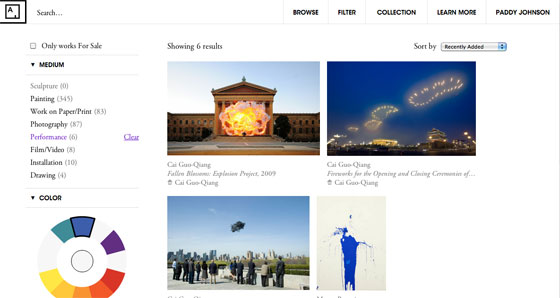
The complexity and depth of the world’s art and culture is incredible and incredibly incomprehensible. Incredible because it evades definition and is relentlessly dynamic. Incomprehensible because the individual knowledge, time, and resources required to explore this cultural infinity are all too finite. Thus in this ever expanding universe, it is all too easy to gravitate towards the black hole of ignorance. But fear not, recent developments in technology are here to help steer us away from that ill-fated course. The upgrade of the Google Art Project and the launch of Art.sy are helping us understand our cultural universe, one art work at a time. With Google’s integrated documentation of the world’s museums, our artistic past is both nearer and clearer (literally, with a 7 billion pixel Rembrandt!). And Art.sy’s role as a “dynamic inventory” of emerging artists is an opportunity to discover contemporary art without being at the center of the artistic universe (New York or London).

The second phase of the Google Art Project has seen a massive expansion in the number of museums available on view. “Since last year, the Art Project has expanded its reach: 151 museums are now partners (compared to 17 in V1) providing over 30,000 artworks, from 40 countries (compared to 9 countries last year).”

From the National Gallery of Modern Art in New Delhi to the Getty Museum in Los Angeles, a visitor can experience a significant portion of the world as seen through objects, artifacts, paintings, and sculptures. Its new features include the ability to create your own collections and place them in personal “galleries”. The site also includes an entire section on ways to educate and be educated! For the initiated visitor, it is an invaluable opportunity for art historical exploration!

In its broader implications, the Art Project is a window into national identities as created through heritage and can be viewed as a vehicle for cultural diplomacy. This notion may seem overly ambitious, given the sites’ hyper-virtual immersion in a country’s artistic wealth and apparent disregard of chronology. But it exists nonetheless, as a weaker current that may invoke some to pursue additional research, and even create travel plans!

Additionally, the countries represented benefit from showcasing the wealth of their museum’s collections on an integrated domain, alongside world-renowned museums such as the Met. In essence, the Google Art Project acts as a virtual art fair for the world’s museums. It can either be surveyed at a harried pace or explored with deliberation. Either way, you get to collect works and create galleries for no cost at all!

In a similar vein to the Google Art Project, Art.sy is helping the world discover contemporary art, a category that often transcends national boundaries and is increasingly difficult to keep up with, let alone understand! With Art.sy the difficulties of “discovering fine art” are eased with the development of the Art Genome Project, “an ongoing study of the characteristics that distinguish and connect works of art.”


The website recently launched its beta version and some of its remarkable features were highlighted by the lucky few who were given access. Essentially, Art.sy allows users to discover new artists and works based on a set of 800 characteristics or genes that are assigned to each work of art. Given a user’s interest in a work of art and the underlying genes that are encompassed within, it suggests additional work that may interest them. Users can also choose to follow an artist or a gallery and of course, contact the gallery if they are interested in making a purchase.

A review by BetaBeat praised the site for its ability to lead an average art appreciator “to artists like Sherin Guirguis, a young Egyptian artist whose abstract paintings resemble fractals and eyeballs.” At the same time, it was criticized for only having secured partnerships with the leading galleries of the world and effectively limiting the art on view.  Art.sy also retains an air of exclusivity, one that it may carry with it into the future.

Nevertheless, it would be remiss not to give the unique and brilliant workings of Art.sy a try.

In effect, both Art.sy and the Google Art Project are innovative discovery engines for art. The differentiation lies in that the former knows where you are headed even as you might not. The latter, in contrast, lets you meander your way to a destination unknown, an artwork unseen.

Americans are paying more for culture, opportunity looms on the technology front

New information out from the Consumer Price Index (CPI) indicate that Americans are spending more for both technology and entertainment (a catagory that includes cultural expenditures).  How can cultural organizations capitalize on this?  What does this mean?  Articles in both The Atlantic and NPR's Planet Money look at these trends from a more general standpoint but don't drill down on the idea for the arts.  The facts presented from the Atlantic indicate that 2007 Recreation expenditures are up by 1.7% over those from the US in 1947.  The  NPR article states that as a percentage of household income, expenditures on Entertainment rose from 5% of the total in 1947 to 6% in 2007.  This information along with the more current information from the CPI which had the Recreation Index gaining by .6% (driven in part by a 1.2% and 2.0% rise in admission to cultural events in Dec 2011 and Jan 2012) this last January give the arts sector some reason to look favorably towards the horizon.  These numbers mean recovery, and recovery means opportunity for change. The relative gains in the arts sector are paltry compared to the gains made on technology purchases in the same amount of time.  The number of personal computers in homes (worldwide), for instance, grew from 152 Million from 1993 to 2002.  The number of internet users in that same time frame went from 10.5 million to 716 million.  The growth of other tech is no less startling by most accounts.  The synthesis of the growth of technology has yet to be fully realized by the arts sector at large but this brief respite (where revenue is rebounding from recession) should be a moment where we rally to adapt.

What do these broad economic indicators mean?  Consumer confidence has been slowly recovering since the doldrums that it was in around 2008 and 2009.  As budgets start to recover and earned income from ticket and admission sales start to edge up, arts leaders will be faced with decisions about what to do with the money.  The temptation to return departments and programs to the pre-recession status quo will be strong; the opportunity, however, for transformation through technology to meet the larger changes in how people are consuming arts and culture should be the priority.

As many technologies are currently moving out of first generation and subsequently becoming less expensive the opportunity to develop interfacing content for them is also becoming less expensive.  Application development for mobile devices is, for instance, now within the fiscal reach of the arts sector.  Similarly simulcast capabilities in HD are coming into broader usage in peforming arts organizations across the country.  The time to identify and implement new technology is now.


The Google Art Project Welcomes You to the White House

Ever wanted to take a tour of the White House? Well now you have a chance, and you can do it all from the comfort of your living room. The Google Art Project, a site devoted to presenting high resolution photographs of hundreds of works of art and museum tours from some of the finest museums in the world, including the Palace of Versailles, the Van Gogh Museum and the Metropolitan Museum of Art, has unveiled its latest project, a captivating look inside the world’s most famous residence, the White House.

As part of what the White House calls its “commitment to opening the doors of the White House to all Americans,” the site primarily does two things. First, it presents images of dozens of paintings and works in art in stunning high resolution quality; and secondly, my favorite part, it offers a 360-degree view of many of the “public” areas of the White House, giving you your own personal tour!

The White House is the latest location added to Google’s Art Project website, which has steadily grown in recent months by adding some of the top museums in the world to its collection. It really is a site to behold and a must visit for arts lovers everywhere; by taking some of the world’s best collections and putting them online free of charge for the world to see, it really does represent one of the best ways to merge technology with the arts to generate enthusiasm and excitement for the stunning works of art that are now viewable in all their high definition glory.

For the paintings and works of art themselves, Google features what they call a “gigapixel” camera that offers an extremely high resolution look at some of the most famous paintings in the White House collection, including Gilbert Stuart’s famous portrait of George Washington. Viewers can zoom in and examine the paintings in EXTREMELY close detail, all the way down to the brushstrokes, just as you would if you were to view them in person, right?

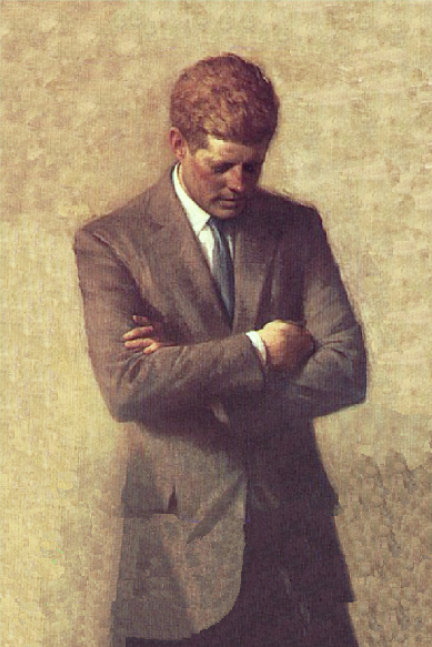
You’ll find hundreds of paintings, sculptures, pieces of furniture, and more available for view. You’ll also find a portrait of almost every former president as well. Some of my favorite presidential portraits, which I have seen before on either book covers, in print or elsewhere, were immediately noticeable and fascinating to view up close and in so much detail. Some of my favorites include Aaron Shikler’s portrait of John F. Kennedy, John Singer Sargent’s portrait of Teddy Roosevelt, George P.A. Healy’s portrait of a sitting Abraham Lincoln, and last by not least, John Trumbull's portrait of my favorite founding father, Alexander Hamilton.

The coolest part of the site however, if you’re like me, is the virtual tour. In recent months, Google has made headlines by starting to take their Street View cameras indoors to start photographing businesses and places of interest to add to its Google Maps site. What Google has done here is to take those Street View cameras inside the White House and presented a “museum view” of the public spaces inside. Here is where you can walk around and give yourself a tour of two floors of the White House, seeing sights like the East Room (where indoor press conferences are usually held) and the China Room, where presidential china collections dating back to the 18th century are held.

Not everyone will have the chance to visit Washington and take the White House tour (which is a hard ticket to come by, and even if you can get on the list, usually requires a several months long wait), but thanks to Google, we now have the next best thing, viewing many of the sights you would see on a tour on your computer screen.

This may be one of the few things everyone can agree on when it comes to the White House: having an opportunity to view the magnificent works of art from the White House collection in such high resolution is a welcome treat, and worthy of praise. I encourage everyone to check out the site and go exploring!

BMW Tate Live: An Online Space for Performance Art

On March 22nd, Jérôme Bel, a french choreographer and dancer, performed in an unknown room at the Tate Modern to an equally unknown audience. Odd as it may seem, there was not a single audience member present in the room. Those who were watching the performance were watching it online, inhabiting a newly unveiled virtual space called the BMW Tate Live: Performance Room. BMW Tate Live bannerThe BMW Tate Live: Performance Room is an innovative series of performances broadcast viewable exclusively online around the globe, as they happen.

It is the outcome of “a partnership between BMW and Tate, which focuses on performance, interdisciplinary art and curating digital space.”  Jérôme Bel’s performance was the first in a series of five online performances that will run through July, featuring the work of artists Pablo Bronstein, Harrell Fletcher, Joan Jonas and Emily Roysdon.

The idea of an exclusively online performance is perhaps more innovative than the technology being used to showcase it, a Youtube channel and a single camera. Catherine Wood, the Tate’s curator of Contemporary Art and Performance, explained in article on Artinfo that they wanted to transmit the work in the “simplest means” and a single camera essentially acted as the “fourth wall” of the performance space.

Additionally, the integration of Twitter, Facebook, and Google+, allows the audience to write comments during the performance and later pose questions to the curators and artists. This allows for the creation of a virtual audience that is connected in real-time through reactions, thoughts, and the Twitter phenomenon, hash tags (#BMWTateLive). Access to these real-time reactions from around the world truly is phenomenal and wouldn't be possible in a traditional setting. The trade-off, however, could be the evolution of an audience that tweets more than it sees, and comments more than it listens.

When asked by Artinfo on whether this online medium may take something away from a live performance, Catherine Wood replied that there has already been much debate “about how much performance documentation is the work and how much it is a record of the work.” But she added that “Live-ness is inherently mediated by technology in the world we live in now. There will always be a place for just a person in a room and a live audience, but I think this is part of the evolution of performance art that we can't ignore."

http://www.youtube.com/watch?v=kf77fzBOoNo

For those afraid of testing the niche waters of contemporary performance art, the increased accessibility and chance to experience an unfamiliar genre through YouTube cannot be ignored. A few swells of interest, a little online momentum, and the waters of performance art will seem a lot less murky or impenetrable. As of the 4th of April, Jérôme Bel’s performance has been viewed 862 times, but that doesn't take into account the number of people who watched it live.

In order to participate in the ongoing conversation, a viewer must to tune into the Tate's website or YouTube channel as the performance is being broadcast. Since the remaining performances are scheduled to take place at 20.00 hours (London), they will be most accessible to audiences in North America (~15.00 hours) and Europe (~21.oo hours), with the exception of a few arty insomniacs in Asia (~1.00 hours). But for those who may be asleep or at work, each performance is archived and uploaded to YouTube.

The next performance is scheduled for April 26 and features Pablo Bronstein, an Argentinian artist who uses “architectural design and drawing to engage with the grandiose and imperial past of the built environment.” In his performance, Bronstein “will work with up to ten dancers to create a baroque trompe l’oeil stage set that exaggerates the perspective within the Performance Room.”

If time permits, tune in to BMW Tate Live for Pablo Bronstein! You may lose your sense of perspective, but find a deeper understanding and appreciation for performance art. If time doesn't permit, don’t miss out on the opportunity to watch these performances on YouTube at a later date.

How much should you trust your candidates for employment?

Verifying information on people online is cheaper and easier than it has ever been.  So why is it then that so many arts organizations don't use this technology to vet new employees?  The traditional method of calling a few references is relatively easy to foil and according to some studies up to 50% of all job applicants either outright lie on their applications or stretch the truth with regards to previous duties, length of employment, or reason for leaving (depending upon how you view lying).  According to MSNBC as many as 80% of for profit firms use background checks on new employees today (up sharply from 30% in 1996).  There were no figures available from the arts sector regarding this practice but anecdotal evidence indicates the numbers are much lower. There are innumerable firms that offer electronic background check services for around $20 per verification (word search for background or pre-employment screening returns hundreds of firms).  The service usually includes verification of education and employment as well as criminal records from local, state, and federal levels.  For additional money you can also get credit checks and driving records.  Studies have shown that employees that are under financial distress are multiple times more likely to steal from their employers and while that may not be an eliminating factor regarding hiring an employee it may help greatly to coincidentally bring in a credit councilor for an office wide employee training.

With funding competition at an all time high it is incumbent upon not-for-profit organizations to utilize every dollar as efficiently as possible.  When it comes to hiring however, some organizations set aside analytic tools and rely on an ad hoc collection of old human resource practices and intuition.

Concerns of privacy and respect deter many hiring managers from running background check, but the truth is that prospective employees expect to be checked out in this day and age.  Most prospective employees have already offered more personal information (although it is usually different in content) through their Facebook account than background screenings return in their findings.  Indeed some corporate employers are actually asking for access to employees Facebook pages.  While most would consider this a bit extreme it does raise a point:  what employees of an organization do in their personal lives sometimes has great impact on the perception of a not-for-profit in the eyes of the public.

The extent to which the arts sector vets its employees is a matter of personal or institutional value.  Even though these tools are available and inexpensive doesn't necessarily mean that it would make sense to each institution for every employee.  Hiring managers need to ask themselves the questions:  1)  What tasks do we need to be extra safe with regards to hiring for?  Examples of this criteria include employees with keys to the building or safe or employees who have contact with children or vulnerable populations.  2)  What degree of background check do we need?  There are very extensive checks out there and not all data is truly useful for accomplishing the goals that realistically need to be attained.  3)  What are our ethics with regards to what is private data and what is fair game?  Issues that can come up with regards to this question get into the territory of medical conditions, personal relationships, sexual identity, and so on.

The key to tackling these issues is to talk about them.  The ensuing dialogue within an organization will help define and address questions and define procedure.  Books and consultants can also help codify procedure and answer legal questions.  Consult an attorney for more information on the legality of asking for information from prospective employees.

Some Additional Thoughts on Kickstarter and Arts Funding

Last Friday we had the pleasure of welcoming Stephanie Pereira, Art Program Director for Kickstarter, a site that we have profiled, examined and analyzed a number of times here on the blog, to Carnegie Mellon for a speaker series event for our Master of Arts Management program. Her presentation and Q&A session talked about how projects are started, the rules for the site, and a look at some of the more interesting projects the site has seen as of late. As a policy student, I am always fascinated by numbers and what trends are driving the dynamic changes we are seeing in the arts community. Before I go back to my usual beat of looking at how the worlds of art, technology and policy intersect, I wanted to pause this week and examine some of the statistics that were presented at Friday’s event, and what they say about the nature of giving in the art world.

As anyone who is familiar with Kickstarter can tell you, their growth in recent years has been nothing short of astounding. I recently looked at how their estimated funding level for 2012 is set to eclipse the entire annual funding for the National Endowment for the Arts (NEA), a federally funded arts program. That kind of grassroots energy, passion and dollar commitment is a testament to a real market for substantive funding for art projects at the national level.

Why has it taken this long for large scale arts funding to reach the national stage? Technology would certainly be one answer, as the world of social media has opened up other industries to new funding mechanisms and audience participation. And while there are other excellent crowdfunding resources on the web, Kickstarter remains the most visible, offering artists the best potential opportunity to ultimately create their projects.

Anytime you have a site like Kickstarter that changes the way the arts are funded here in the U.S., a look behind the curtain at some of the statistics is a welcome way of analyzing what exactly is responsible for its success.

One important stat to point out about Kickstarter: while the recent projects that eclipsed the $1 million mark receive most of the attention, the vast majority of successful projects fall in the $1,000-$5,000 range. The rewards offered for these projects pale in comparison to those of the more ambitious projects, but having such a low threshold naturally entices more people to commit dollars in the hope that a project they admire and want to see is successful.

Another important stat to point out: the average pledge amount is not, as I would have expected, in the $10-20 range. According to Kickstarter, it is actually $71, which shows people who are pledging money to these projects are donating more than a couple cups of coffee: these are real dollars being committed here, and it is of little surprise that with the thousands of projects being featured on the main page of the site over any given week, that so much money is being pledged to the wide variety of projects on display.

Perhaps the most interesting statistic, however, is what Kickstarter refers to as the “tipping point” for project success: once a project reaches pledges totaling 30 percent of its funding goal, it has about a 90 percent chance of reaching its target. This puts a lot of pressure on artists and project leaders to get their main support system at the outset (i.e., their friends and family) to commit funds in an effort to pass that threshold. While not a guarantee, it is fascinating to see how often projects reach their end goals when they pass a common threshold.

Finally, it may surprise you to learn that the three categories that receive the most pledges do not include paintings, or public art pieces, or video games: the top three categories consist of film, music, and design (with film being the winner by a large margin; dozens of films are now being released each year that were funded through Kickstarter, with many of them debuting at SXSW a few weeks ago).

These are just a few of the hundreds of statistics that Kickstarter has provided over the years. Their blog is a great resource for a look at the trends and figures that help explain the quantitative success behind the site, and is definitely worth bookmarking.

We love writing about Kickstarter here at Tech in the Arts, and as the site continues to grow in future years and brings to life thousands of art projects, we can’t wait to see what kind of ideas and projects come our way.

In Case You Missed It - March 2012

March was a delightful month, and I hope you also enjoyed that brief taste of summer we got here in Pittsburgh. We featured some great posts here, and if you missed them the first time around, here’s a brief recap:

We took a dive into the world of QR codes with QRpedia, then headed to Wikipedia with part one and part two of our interview with Lori Byrd Phillips, a Wikipedian in Residence. Not yet satiated, we took on Pinterest in a mini-nar and a work of art that will Tweet back at you.

There’s also a theoretical side to technology and the arts, and we heard from a Millennial about the death of telemarketing. However, people love to give to the arts through Kickstarter, and we had a great discussion on the role of the arts in economic development. Not all is well, and we took a look at the loss of public funding for the arts in Europe.

Carnegie Mellon hosted a lovely TED event, TEDxCMU, which had some artistic implications.

We have another installment to our speaker series today (March 30), starting at 12:30 EST – with the Art Program Director of KICKSTARTER, Stephanie Pereira. Hit us up on Twitter to follow along with the conversation @TechInTheArts

Dang, what a great month! Here’s hoping April is just as awesome. Enjoy your weekend, folks!

The Hello Cube at the Tate Modern: A Tweetable Installation

An interactive installation at the Tate Modern caused a wave of twittering and tweeting this past weekend. People often tweet about artworks but can one tweet at an artwork? And will the artwork tweet back? The Hello Cube, an interactive installation at the Tate, answered all of the above in no more than 140 characters. Even more twitterrific was how the dynamic installation continually changed its patterns and colors in response to individual tweets. The Hello Cube was the centerpiece for the Infinite Kusama Project, which  centered on engaging younger audiences (ages 16-25) with Kusama’s work.  Described as “a day of the immersive, the hallucinatory, and the expansive,” the project consisted “of a range of workshops designed to take you closer to Kusama's distinctive visual universe.”

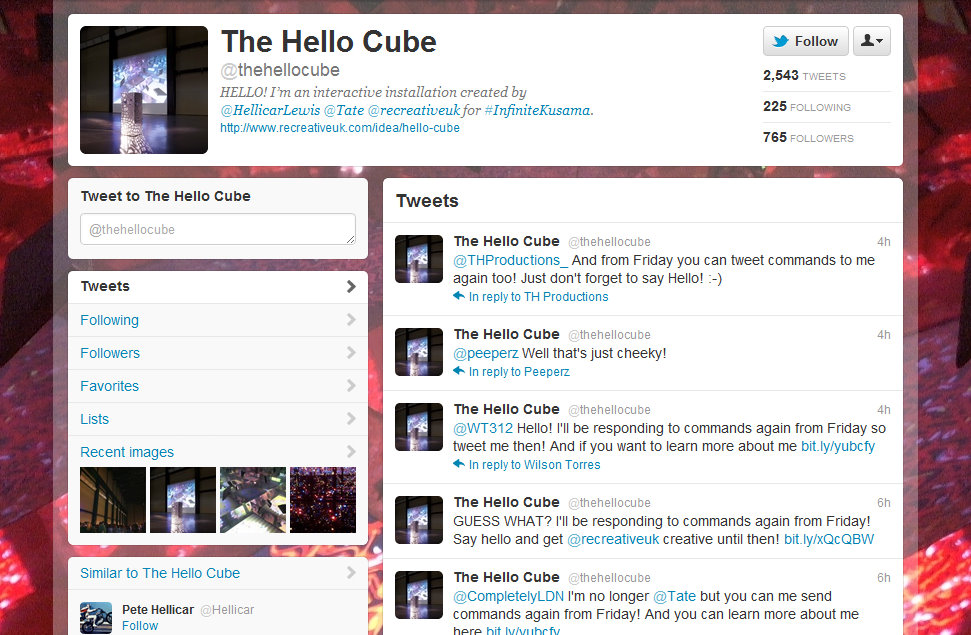
The installation got its very own twitter account where users were prompted to tweet at it with commands such as “red love pixelate” or “blue cells faster." I got a tweet response from The Hello Cube within seconds, accompanied by an image of the compositional changes that had occurred in its mirrored inside due to my somewhat imperative commands! Over the course of the weekend, The Hello Cube obliged several thousand tweeters/Kusama enthusiasts, always replying with additional commands that they could try, and created a sense of involvement regardless of, say, the number of miles between Pittsburgh and London!

For those at Tate Modern, the experience was far more insightful; not only did they get to see an amazing Kusama exhibition but they were in physical proximity of The Hello Cube! Besides being able to view the installation's constantly changing interior dynamics that were projected onto an adjacent wall, visitors could also interact with The Hello Cube by saying their hellos or anything else they thought fit to share with the cube (besides tweets, it was programmed to respond to external stimuli such as sound or voices).Visitors could even place their hands inside the cube and see their arm reflected unto infinity!

HelloCube

Hellicar and Lewis, the creators of The Hello Cube, describe it as “an installation that exists as a sculptural object that you can look inside, see patterns, and an infinity of reflections.” It takes inspiration from Kusama’s work titled The Passing Winter, but as noted by its creators, it differs from Kusama’s work in that it is capable of responding to people and to its environment.

The work of Hellicar and Lewis has been featured at The Creators Project and the duo are “interested in creating groundbreaking experiences that use art, technology and design to take people into the moment and impart lasting memories.” In an interview, they noted how they had undertaken a similar project in the past called The Hello Wall, a dynamic outdoor installation where users could control the projections on an external wall in Wembley by tweeting at it.

While Hellicar and Lewis have used Twitter's real time capabilities to foster a dynamic perpetuity and engagement that is both brilliant and unprecedented, the creation of Twitter personas for artworks in itself is intriguing. On Twitter, the inanimate, the intangible, and even the immortal can all lay claim to accounts; San Francisco’s Fog, the Bronx Zoo Cobra, and Voldemort are all suspiciously active! So why can’t art transcend notions of the self, at least on social media? Thus, not only was The Hello Cube an incredibly interactive installation, but its presence on Twitter essentially transformed it into an anthropomorphic object, increasing its accessibility in both a literal and psychological sense.

It would surely make an interesting experiment to see how people interacted with a painting were it to have a twitter account. Wouldn't it be fun if museums created Twitter personas around special exhibitions? What would Rembrandt tweet? How about an account for Abstract Expressionism? Of course, these accounts may have to be temporary but a lot could be learned in a series of short bytes of information. One sees a considerably twitterable future.

For now, we have the delightful The Hello Cube, which having been removed from the Tate, bade farewell to its visitors and declared that it was ‘time for a cube to enjoy the sunshine...” Of late, it was tweeted that The Hello Cube will once again start taking commands this Friday, but as the installation politely requests: "Just don't forget to say Hello!"

Engaging Technology: uCurate and uExplore at the Clark

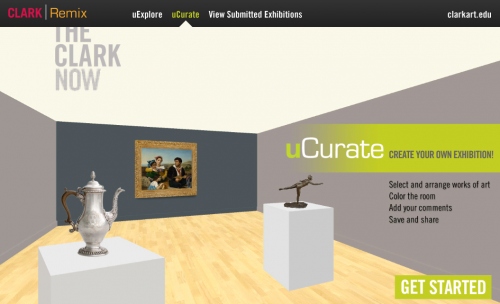
What’s going on at the Sterling and Francine Clark Institute in Williamstown, Massachusetts? Let’s see, there are iPads, tablets, interactive digital programs, touchscreens and kiosks throughout the galleries, the new exhibition, Clark Remix, and oh yes, new curators- YOU. In a February press release, the Clark announced its exciting new initiative to encourage visitor interaction and participation in its galleries. According to the press release, Clark Remix is "a dynamic salon-style installation featuring some 80 paintings, 20 sculptures, and 300 of the institute’s finest examples of decorative arts."

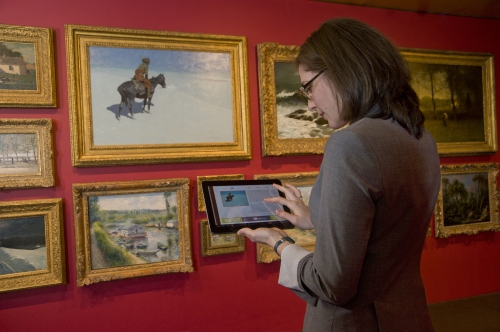
As part of the exhibit, the Clark has introduced the interactive, digital programs uExplore and uCurate. Both programs are accessible online, on the visitor’s own personal device, on touchscreens and kiosks throughout the gallery and on iPads and tablets provided by the Clark for use in the museum. Basically, the programs are EXTREMELY accessible and user friendly- I myself have spent all afternoon here in Pittsburgh exploring the Clark’s collection and building my own exhibition, instead of reading for class (ahh priorities).

The Director of the Clark, Michael Conforti explains the premise of Clark Remix,

Clark Remix represents one of many programs that the Clark is developing to engage audiences in exciting ways. Clark Remix allows us to present our permanent collection in an installation that is both beautiful and innovative. Our salon-style presentation provides a very different and intriguing perspective on many of the works that have become familiar favorites for Clark visitors. Adding virtual components to the exhibition allows us to reach new audiences and invite them to discover and interact with our collection.

It works like this. uExplore allows the visitor to learn more about the Clark’s collection in a visually stimulating, highly organized, and digitally oriented way. Items are grouped into categories (paintings, sculpture, glass silver and ceramics) to allow the user to navigate with ease through the extensive collection. Selecting an image of the desired object, a more detailed, but not overwhelming, explanation of the item becomes available. When appropriate, audio and video clips accompany the information.

It is a beautifully designed and easily navigable interface. uExplore’s presence in the gallery encourages visitors to delve more deeply into the history of the collection, while they are on-site.

The second digital application to accompany the exhibit, uCurate, gives visitors the opportunity to participate in the curatorial process. As the name implies, YOU, aka the visitor, plan and design a 3D virtual exhibition with the Clark’s collection. The participant makes all decisions, from what to include and how to arrange

the objects, to wall color selection and wall text. Users of the program have the option to submit their designs for consideration by Clark’s curatorial team AND to share their designs through social media channels (promoting the museum and the digital program). Submissions to the Clark will be reviewed regularly. Why submit your design for professional review by Clark curators? Because if selected, the virtual design will be transformed into an actual exhibition! The lucky designers will be invited to assist in their exhibition’s installation, in the decision-making process, in the creation of wall text and in writing the curator’s statement.

uCurate and uExplore were designed by the Clark in collaboration with Swim Design Consultants and Virtual Gallerie to afford the public a voice and role in the museum’s exhibition planning process. Allowing the public to suggest actual designs for implementation challenges what has been the accepted and traditional decision-making process in the museum. That is, all decisions are made internally; the public only receives, not contributes. But the Clark is trying something different. In a recent New York Times' article on the Clark’s innovative crowd-sourcing approach, Conforti said,

For generations, curators ran the show and told you what to believe. In a world of blogging and Wikipedia, we realized that we can learn from our audience, and from multiple interpretations.

This is Museum 2.0 in action. Where visitors become users and museums become, as Nina Simon explains, “dynamic platforms for content generation and sharing.”

So Kudos to you, Clark Museum. This is an engaging and relevant use of technology where the user AND museum win.

PIPS:lab Diespace, Interactive Multimedia Experience

PIPS:lab recently made its US debut during a festival featuring Dutch artists here in Pittsburgh.  The Amsterdam group has been performing together for about a dozen years.  The work that they performed was categorized as absurdist media theater and was a short evening length work without intermission.  The use of technology for this performing group is integral.  The performance itself was noteworthy for its innovation on a number of different levels.  It is worth noting, however, the problems that PIPS:lab had in functionally executing the performance due to glitchy technology. The performance, Diespace, was essentially an introduction to a fictional new social network site that audience members were encouraged to visit after they die (or die in order to visit).  The actors polled the audience about their opinions regarding whether or not there is life after (or before, humorously) death.  These polls were conducted with a cool audience participation tool of light capture setup where the audience essentially wrote on a screen upstage.

The other insertion of tech into the performance involved video/audio remixes of various clips taken of audience member during and before the show.  These clips were then edited in real time into the performance.  This, in turn, served to engage the audience but through a pretty controlled format.  The display of the video and audio taken from the audience drew laughter and made the audience excited and was a high point of the performance lending to greater investment from the collective.  Additional audience participate was to be had through a lottery during the show where the faces of the audience were put into a virtual tumbler on the screen upstage.  Three audience members won prizes with the grand prize being a premium account for Diespace (which included significant stage time for the audience member who won it).

The performance unfolded at a relatively brisk pace with musical interludes to cover moments where the technology and content was being prepped.  The problem with this was that the performers ended up being a bit un-invested in the music and as a result it was hard to be carried away by the performance.  It was easy to check out during these scenes through the distractions on stage.  It was the sense of this reviewer that there was only one true musician on stage, a fact that was born out by the program notes about the artists backgrounds.

At least three times during the performance there were loud warnings of a computer crash each time forcing the performers on stage to repeat a few moments to a few minutes of the action.  This in turn lent to a stutter stop feel to the performance.  Execution of Diespace did not look like it was easy and to be certain what PIPS:lab is trying to do is not easy in general.  They deserve applause for attempting to stitch together so many constituent elements in the moment.  It was fascinating at times to see the failures of the technology and there was rarely a moment where the audience did not have something that they could try to be engaged in.  The relative successes and failures of this performance reinforce the point that some technologies have a ways to go before they are both accessible to independent performing artists.

The innovation of groups like PIPS:lab hopefully will be the wave of the future and it is gratifying to see media artists take the stage with musicians and actors.  The combination of talents of stage was a rich soup and Diespace was a valuable experience for the insights that it gave with regards to generation of true multi-disciplinary live work.


Public Financing for the Arts in Europe Takes a Hit

Tell me if you have heard this one before. In the midst of an economic downturn, a country desperately searches for cuts in spending anywhere it can, as calls for budget austerity grow louder. In the end, it’s the more vulnerable programs that are hit the hardest, which often includes education programs, safety net measures, and the arts community.

While that above paragraph would describe the arts community in the United States in recent years, the trend is now playing out across Europe as debt-ridden countries turn to austerity measures in the face of the European debt crisis. While European countries spend significantly more on the arts than we do in the United States, the dangers of budget austerity in the coming years for the arts community in several European countries are very, very real.

I have been thinking a lot about this issue of arts funding in Europe vs. the United States over the past week, and two events in particular heightened my interest. First, this past Friday, we sponsored a Carnegie Mellon Master of Arts Management Speaker Series event with the Consulate of the Netherlands, who were in town for the annual Dutch Festival in Pittsburgh. We started talking about the difference in the way the arts are funded in a country like the Netherlands versus the way it is funded here at home. More on that in a minute.

The other item that caught my interest was a front page story in the New York Times yesterday about the fate of public financing for the arts in Europe. As I mentioned above, Europe is now going through the same kind of austerity measures that rocked the United States in 2009: debt is growing, calls for fiscal restraint are getting louder, and every program is being measured for its return on investment and how important it is going forward.

The numbers are striking: as the New York Times reports, in the Netherlands, the budget for arts and culture is seeing a decrease of roughly $265 million, or 25 percent. In addition to those cuts, the public is being asked to pay more to see shows and events, with increased taxes on tickets.

These cuts are hitting smaller venues, troupes, and companies the hardest: with less funding to go around, existing expenditures are being targeted at more established performers, forcing more unique acts, which may be struggling for audiences, to face an uncertain future.

And while some may feel that cuts to the arts in Europe would have little effect on the arts here in the United States, one of the expenses artists in Europe are cutting back on are trips and performances overseas, to countries like the United States. Artists are cancelling trips and forcing festivals to find alternative performers.

Another effect this is going to have on the American arts community is over the issue of fundraising. As we discussed with the Consulate of the Netherlands on Friday, there are different views towards art funding in Europe than there are here. In a country like the Netherlands, a resident pays higher taxes to pay for additional services like health care, transportation, and safety net measures. Another element of those increased taxes is funding for the arts; with the government taking a higher percentage out of every paycheck, many Dutch residents feel they are less inclined to donate their own money to the arts because they feel like the government is already doing it for them.

Here in the United States, the opposite is true: the National Endowment for the Arts (NEA) receives such a small percentage of overall government revenue (usually in the range of $150-160 million, compared to billions of dollars in several European countries) that the vast majority of funding for the arts comes from donations from individuals. Since Americans are taxed at a much lower rate, they have more disposable income, and thus more free to donate it to the art of their choosing. There are issues of whether a lot of this money is really going to where it is needed, but that is a discussion for another day.

With European governments cutting back on their arts funding, this is naturally going to lead to artists in Europe to seek alternative sources of revenue. As the New York Times explains, this includes going after their descendents currently living in America – who may be already donating to arts organizations in their communities.

So this presents a problem: a global recession and austerity measures in dozens of countries, all leading to a shift in the way arts are funded worldwide. It will lead to more uncertainty, a greater dispersion of artistic funding and increased competition for the individuals who provide a sizeable percentage of giving.

Is the current model, where American artists rely mostly on private donations and European artists rely on government grants, sustainable? For the United States, absolutely. With calls from some politicians to cut and even eliminate funding for the NEA and other culture programs, there is certainly little chance of seeing an increase in federal funds for the arts.

As for Europe? That is a different story. As the story goes, as the pond gets smaller (in this case, the pond symbolizing the amount of funding), the fish will get nervous, and perhaps seek refuge elsewhere, in the form of spending more of their time fundraising, at the expense of the very same art they are seeking to promote. With artists now having to listen to potential funders, who may have a different vision for what kind of art they want to see, the impact on what kind of art is made and performed is bound to be substantial.

In the short term, the effect is obvious: less festivals, traveling art troupes, and shows. Fewer jobs for artists in countries like Italy, Hungary, Netherlands and Greece. Fewer opportunities for tourists and residents to see the best of what each of these countries has to offer.

It really is sad, but perhaps unavoidable. As I have written before, we seem to find ourselves in the era of budget austerity, and even while the economy has shown signs of improvement in recent months, the desire to increase funding for the arts pales in comparison to support for other existing programs.

The promise and benefit of increased funding for the arts, both at the private and federal level, is well known to all readers of this blog. The New York Times piece describes Europe as the place “where art is life,” and while that is certainly true to anyone who has visited, the newfound austerity measures being put in place represent a significant threat to that very same life going forward.

iPad Retina Display and Art Apps

Not unlike the neutrinos that were scurrying through the mountains in Europe in hopes of undermining Einstein’s Theory of Relativity, the mountainous expectations for Apple’s new iPad had been travelling the tech circles at astonishing speeds. There was much speculation about the iPad’s features, which included, but were not limited to, Siri for iPad, the absence of a home button, faster processors, higher resolution, and the faint possibility of time travel. Like the neutrinos that were mistakenly recorded at speeds faster than those of light, false assumptions regarding some of the capabilities of the new iPad were quickly discarded with its release in March. There may not be a Siri to guide us through life’s uncertainties but even so, the device is something to behold!

The incredible retina display, with its 3.1 million pixels, truly makes it something “you really have to see.” And seeing is exactly what the art world loves to engage in through the various art apps that have been developed over the past few years! The increased display performance means that as pixels dissolve into digital oblivion, artworks can be viewed in crisp detail and in their entirety.

In fact, Art Authority, one of the top apps for viewing artworks, has already upgraded its resolution to match that of the new iPad. The app claims that with retina display, seeing art on the iPad is “as good as in a museum.” That, of course, is questionable since no app can truly replace a museum experience, and in our quest for high definition, one often forgets that life itself is free of pixels. We do not need an iPad to see the world, let alone artworks. Nevertheless, the increased resolution can only serve to improve the quality of apps such as Art Authority.

As for the apps that have not yet upgraded, the results are mixed. In an article in PC Magazine, the author stated that with the higher resolution screen, the New York Times app “appeared noticeably crisper” but the Wall Street Journal was somewhat distorted. The same sentiment was echoed in Mercury News; “Not everything looks better. Apps designed for the lower-resolution screen on the old iPad look less sharp on the new one.” Thus apps designed specifically for the older iPad will most likely need to be upgraded for a seamless, pixel free viewing experience.

So does the new iPad truly create a window of opportunities for art apps? Not necessarily, because the higher resolution doesn't augment the in-museum experience; one need only look up at the artwork displayed in the gallery to see it in all its detail. As such, apps for smart-phones, (where pixilation is besides the purpose) will remain the primary area of research when it comes to creating an active and participatory museum experience. What could, however, benefit from the new iPad is the in-home experience. With the higher resolution, apps such as Artfinder’s George Inness in Italy could be explored with a touch of retinal magnificence. Additionally, sites such as the Google Art Project would be even more staggeringly detailed! It’s a pity that there isn't an app for Google Art Project as yet!

With more and more app developers upgrading to the newer resolution, the digital world of the iPad will surely emerge as sharper, clearer, and more inviting. But let’s hope we won’t lose ourselves, along with our sense of sight, in its stunning display, and will remember to look up at the world, at real life, from time to time. Maybe give our retinas a glimpse of the horizon or better yet, a piece of art!

Facebook, Alternative Bands and Acoustic Sessions @ the MFA

To me, this just about sums up the 21st century Millennial: Facebook invitations, exclusive access to acoustic sessions, alternative bands, behind the scenes privileges, access granted only through social media and a little culture via the fine arts. To what pray tell could I be referring? Why, Boston’s Museum of Fine Arts’ (MFA) partnership with radio station WFNX, of course. Since May 2011, the MFA Boston has been showcasing nationally acclaimed acoustic bands in its galleries. Each month, an alternative band and 35-50 lucky winners are selected to participate in the exclusive Acoustic Sessions series.

How does one get selected to attend? Here’s where the Millennial wins. The concerts are announced on the MFA’s Facebook page and live on WFNX Radio (tune in on 101.7 FM in the Boston area). Interested followers can submit an entry form on the MFA’s Facebook page or call in to the radio station to be selected.

How does it work? The MFA’s upcoming Acoustic Series concert on March 27th is advertised on its Facebook page in the following post:

The MFA and WFNX have teamed up to present some of the best alternative bands, live in the galleries and Kasabian plays next on March 27. You can only see them by “liking” us and entering to win tickets here or listening to WFNX.

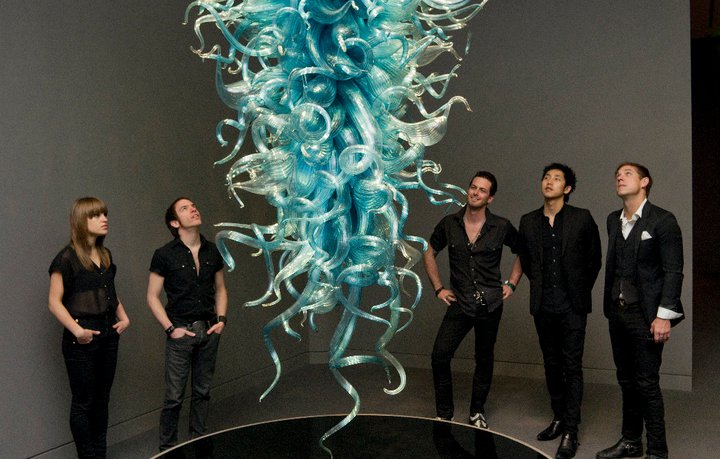
According the program’s press release, the artists perform in various galleries- from the European Paintings to the Contemporary American Art room. Their performances are sound and video recorded. They are then shared online, both on the MFA’s Facebook page and WFNX’s webpage.

Just when you thought it couldn’t get any more Millennial friendly, the MFA throws in this added exclusive- the performing musicians’ participate in the Museum’s “Art We Love”

program. The musicians select their favorite work of art in the museum, explain why they chose it or its significance to them and are then photographed beside the work. The photographs are uploaded to the MFA’s Facebook page for all to enjoy

and explore, providing unique insight and exclusive information on the musicians.

It is a perfect example of how the collaboration between social media, the visual and the performing arts can enhance the public's artistic experience and engage even those difficult Millennials. Originally from the Boston area, I am proud to share the MFA’s innovative programming with those from away. But I am sure other museums and galleries are up to similar projects. What other museums and galleries have similar, or completely unique, social-media driven, collaborative programs?

Creators Project in San Francisco

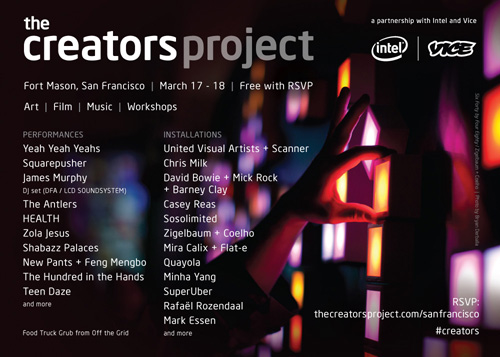
Last weekend the Creator's Project garnered significant attention from national media.  From the mission statement on the website "The Creators Project is a global celebration of art and technology." and "The Creators Project is a new kind of arts and culture channel for a new kind of world."   As an intersection between art and tech it seems appropriate that the blog weigh in and take a look at what they did, how they did it, and the implications.  The Creator's Project has major sponsorship from Intel Corp and VICE with significant online free content focusing on mostly short form interview of Creator associated artists.  This Project offers similar promise to other ventures to offering culture and arts online to ideas such as On The Boards TV and Jacob's Pillow Virtual Pillow but is already operating on a much larger scale than either of these.

The Creators Project offers arts and culture online at a scale that is extraordinary for such a young institution.  The levels of participation on information sharing that is happening through their website looks unparalleled and should be looked towards as a model for successful integration of technology and the arts.   The Creators Project was started in May of 2010 by VICE and seems to have two major interfaces with the public.  There is a exhibit/show that has toured around the world each year and an expanding web presence that now counts video downloads in the millions.  The content is broken out into six different categories:  Music, Film, Art, Design, Gaming, and Fashion and has engaged with artists from all of these areas to provide content online and for the annual festival.  They will be rolling out content collected from the event last weekend (March 17-19, 2012) in the coming weeks.

Current content on the website is a mind blowing array of new directions taken by artists in each of the fields.  One of the standout artists at the event last weekend was a new work from visual multidisciplinary artist Chris Milk.  The installation called the Treachery of Sanctuary incorporated user interaction with digital transformation to look at elements of flight.  Visuals of this can be found here.

Anther fascinating example that was found on the Creator's Project website was the Electronic Shadow from France.  Electronic Shadow uses imaging technology and software to generate interactive 3D maps of people places and objects.  These images then can be used and manipulated in artistic fashions.  The implication for this technology would, for instance, be a game changing one for other art forms such as dance.

Exchange of ideas such as Creator's Project bring together the bleeding edge of Technology and the Arts and as such should be a point of engagement for institutions that are looking to modernize and include new audiences (and younger audiences).  The artists involved have obviously successfully engaged these audiences already and by following the lead of these success stories arts leaders at more conventional organizations can find hope in a new direction in reshaping structure and content to address the demands of a more complex world.


The Role of the Arts in Economic Development

As it pertains to funding for local arts projects, the past few years have not been too kind to the arts community. Budget cuts, austerity measures and changing priorities have meant less funding, and with it less jobs for artists and fewer arts opportunities and events for communities all across the country. As the economy starts to grow (slowly) and optimism about future growth increases, state and local budgets are facing smaller budget deficits and the increasing likelihood of budget surpluses in future years. With these new resources comes the decision over how to spend resources in the best possible way to stimulate growth.

In recent years, the National Endowment for the Arts (NEA) and other groups have given out millions of dollars in grants to local arts groups to help foster economic growth and assist arts communities in struggling areas of the country. As the money available to these groups continues to grow, and cities and states pondering the decision to invest again in the arts, the question is: what role do the arts play in economic development, and how vital is it to future growth?

I have written before about the tough budget constraints that governments are dealing with at the local level and the pressure this is putting on existing arts programs. Unlike the federal government, cities, counties and states are often required to balance their budgets on an annual basis; if sales tax receipts or other forms of revenue are down from the year before, as has often been the case during this economic downturn, governments have to turn to existing programs for cuts or outright abolition. With tax increases politically unfeasible, it’s often the most vulnerable programs that face the chopping block, and this includes the arts community.

Those of us who study public policy and urban planning are cognizant of the effect the arts can have on a city or neighborhood. As much as art enriches our lives and provides a sense of culture, the economic impact is minimal; this is not to take away from the arts community, but is rather meant to illustrate the larger forces that are required for long term economic growth, like housing, higher education, health care and free trade.

The Next American City recently looked at an example of a rust belt city facing tough economic times, Detroit, and how the arts community is helping bring the city back. Through the help of groups like the NEA and ArtPlace America, Wayne State University launched the Detroit FAB Lab, a hub that provides artists with access to equipment and tools for their artwork, like metalworking and woodworking, as well as mentoring services like business coaching and networking. In essence, it provides a community for artists to come together and share their work, their advice and their love for the arts, all with the backing of community grants and support.

Few cities are in need of support like this more than Detroit. Designed to help support the struggling manufacturing base in the Motor City, the grants provide a small step in the overall push to diversify and grow Detroit’s economy as it starts to come back from the recession that took such a toll on the city’s population and well being.

The millions of dollars in funding that are being given out by groups like NEA and ArtPlace also present a series of questions: is this money well spent? If the goal of the money is to spur economic development and growth, is it better spent elsewhere?

We can all agree that funding the arts is crucial to fostering community and culture in cities all across the country. But is absolutely crucial to long term economic growth? That’s where it gets tricky: the list of public policy measures that rank above the arts community is quite long. If given the choice between an artistic redevelopment project and a new hospital or transit station, the physical and transportation needs of the city will win out.

But, as cities and municipalities invest in infrastructure, public services and needed resources, it’s always important to remember how the arts can add to the benefits being accrued. A city with no culture, no life, and no sense of vitality is vulnerable to losing out on the same kind of economic benefits that were desired when public officials decided how to spend resources in the first place. Investing in roads, schools and infrastructure is absolutely essential to an area’s long term economic growth; however, without a vibrant and committed arts scene, the desire of residents and tourists to experience the best of what the area has to offer will be diminished.

There are numerous examples of cities and local governments taking the time to invest in areas of their community and developing art districts. In my home town of Phoenix, the burgeoning Roosevelt Row district is home to First Friday art walk events and galleries showcasing the vibrant culture alive in the city. Other districts in Miami, Pittsburgh, and New York have also popped up in recent years to add vibrancy to formerly struggling areas of their respective cities.

As a policy priority, you will get no argument from me that the arts community ranks behind the essential public services that so many people rely upon on a daily basis. However, good public policy recognizes that the right balance, which involves providing those services and setting aside funding for arts programs that encourage innovation and creativity, along with providing a sense of culture for a given community, is preferable.

As ArtPlace America states, “art creates vibrancy and increases economic opportunity. It is all about the local.” We could not agree more.

Sweet Pantone Tarts

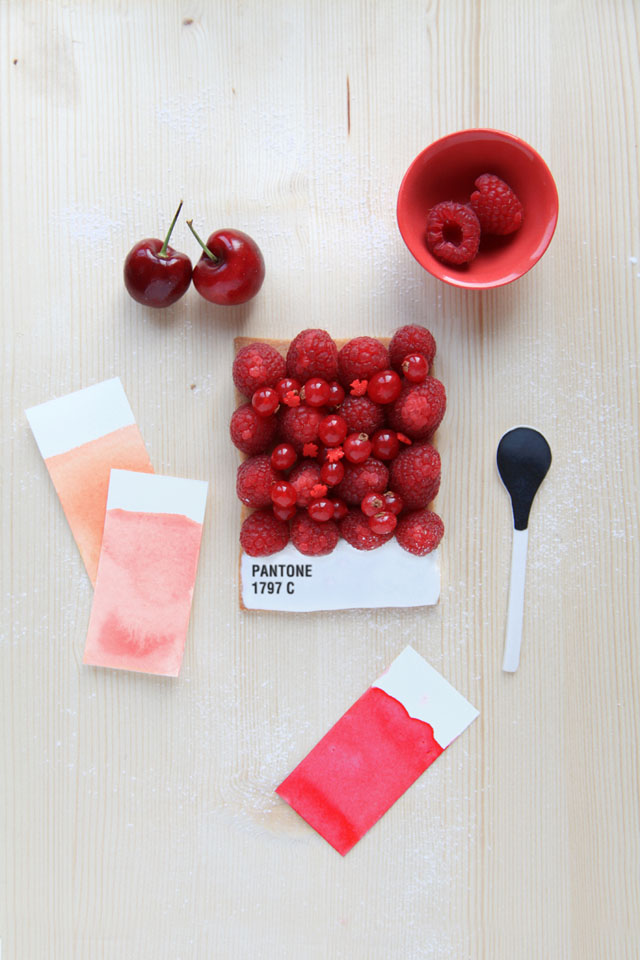
Spring seems to have sprung here in Pittsburgh, and having a week off on spring break makes everything seem lovely. It is under that guise I present this post to you purely for aesthetic reasons. Emilie Guelpa is a French artist/blogger/chef who has created these masterful (et très mignon) tarts inspired by Pantone colors. While I can totally imagine eating them in the café of an art museum, they were created for the magazine Fricote and posted on her blog Griottes. While the blog is currently French only, Guelpa promises an English translation version very soon. In the mean time, you can check out her Pinterest and dream about delightfully colorful tarts.

Well, that’s all I’ve got. I hope you have a great weekend planned and nice weather to enjoy it!


Cowbird, Balloons of Bhutan: Jonathan Harris and Real Life Storytelling

In the mountainous kingdom of Bhutan, nestled between China and India, happiness is no small measure and it’s surely not immeasurable. While its neighbors are under constant scrutiny for economic growth, the kingdom of Bhutan has opted, among other factors, to measure its growth in the well being of its people. As early as 1972, erstwhile King Jigme Singye Wangchuck introduced the concept of Gross National Happiness (GNH), and in 2005, the Royal Government of Bhutan “made the decision to develop GNH indicators in order to move the concept of GNH from the point of academic discourse to a measurable one.”

The government “developed a detailed questionnaire that measured key areas such as “psychological well-being, health, time use, education, culture, good governance, ecology, community vitality and living standards.” The results of this survey can be found on their website, but it suffices to say that the prayer flags in Bhutan flutter with the happiness of its peoples!

A few years later, in 2007, Jonathan Harris, an artist who combines “elements of computer science, anthropology, visual art and storytelling” set out to measure Bhutan’s happiness not in percentages, but in balloons!

Balloons of Bhutan chronicles his two week journey through Bhutan where he interviewed a 117 people and asked them how happy they were on a scale of one to ten. He would then proceed to give them the number of balloons corresponding to their happiness level, and thus increasing that happiness, if only temporarily. Harris’ interviews  provide an insight into the stories of each of these individuals; their identities, their happiest memory, their favorite jokes, and their wishes. In the end, he wrote down each person’s wish on a balloon in a color of their choice. Each of those balloons was “strung up at Dochula, a sacred mountain pass at 10,000 feet, leaving them to bob up and down in the wind, mingling with thousands of prayer flags.”

The website for Balloons of Bhutan, wherein lie a 117 short stories, provides a glimpse into moments of happiness and into the life and culture of Bhutanese people.

Stories rooted in reality and “collected in some unconventional ways” have always held Harris' fascination. In a TED talk in 2007, Harris spoke of his desire to eliminate the role of the narrator in his stories. One such example is his project titled The Whale Hunt, where he “spent nine days living up in Barrow, Alaska, the northern most settlement in the United States, with a family of Inupiat Eskimos, documenting their annual spring whale hunt.” The entire story-line can be divided into sub-stories based on context, characters, color, and moments of excitement and lull (a timeline akin to a heartbeat graph).

Another, more recent, of his projects centered on the idea stories from life and even crowd-sourced journalism is Cowbird, a place where people can “keep a beautiful audio visual diary” of their lives through stories.

Our short-term goal is to pioneer a new form of participatory journalism, grounded in the simple human stories behind major news events. Our long-term goal is to build a public library of human experience, so the knowledge and wisdom we accumulate as individuals may live on as part of the commons, available for this and future generations to look to for guidance.

On Cowbird, these stories can be categorized and read in numerous ways; by sagas or major news events, topics, cities, countries, tags, and people. If you enjoy creative writing, Cowbird is a neat way to share stories with the world and transform the site into a collective “witness to life.” Many will agree that social media content on sites such as Twitter or Facebook can, at times, lack forethought, even originality. (Yes Facebook ask us what’s on our mind, but if the posts on Facebook are indeed indicative of humanity’s contemplative tendencies, we may just be in trouble). Thus Cowbird is different in that it encourages thoughtful sharing of personal musings and ideas.

Jonathan Harris is an undoubtedly novel storyteller, but he desires more than an audience that will listen, he desires one that will engage in storytelling. He has built the foundations of a world that can be interconnected through stories that are his own and more importantly, theirs, the worlds. It is through these stories that we can listen in on a Bhutanese shop keeper talking about her love for Korean television or experience the melancholic evocation of an Islamic prayer call in old Jerusalem while overlooking the Great Dome of the Rock.

The Cloud

Moving your organization's data to a cloud server might be a good idea at this time.  There are several advantages to working off of a cloud server and a few drawbacks. Some advantages to going to cloud computing:

Accessibility is generally improved through cloud storage.  You can access data from anywhere that you have internet access.

Security on cloud storage services is up to the standard of where ever you have your cloud.  Google and Amazon have some of the best experts on digital security in the world for instance and using a cloud operated by them gives you a greater degree of safety for your data.

The Capacity of cloud storage is very flexible and is expandable with comparative ease.  The fact that cloud storage servers will never need to be upgraded or replaced does save you capital expenses as well as man hours.

The downside:

You don't own it and you have to play by someone else's rules.  If you are using a smaller company, please, make sure to check out their backup plans, security measures, and records regarding downtime and maintenance schedules.

It may be hard to use cloud servers with certain types of databases or other programs and as such may present an integration issue (ticketing systems, development programs, etc).  Make sure you have a plan to get the information from point A to point B if necessary.

In event that you don't have access to the internet you are completely cut off unless you back up to a physical source onsite.  It can be distressing for obvious reasons if your internet service goes sideways and you end up with multiple idle employees until it is restored.


Festivals Galore!

As the month of March rolls on, and the weather starts to warm up, two things immediately come to mind: vacation, and festivals. The gang here at Tech in the Arts is on spring break this week, so expect a lighter posting schedule as we take a (well deserved!) break from our studies. Having said that, I wanted to briefly check in and point out two festivals happening this week that are highlighting some of the best and most creative technology and arts projects occurring from across the country.

The first, South by Southwest, or SXSW for short, is currently underway down in Austin, Texas, as anyone with a Twitter account is well aware of by now. Having grown massively in size over the years, the show is divided between three festivals: film, music, and interactive. The interactive portion, including keynotes, speakers, presentations, shows, parties, events and so much more (it really is a sight to behold) is taking place this weekend and ends tomorrow, the 13th.

Tech in the Arts is live down in Austin covering the action; you can follow our Twitter feed (@techinthearts) for live updates and recaps of SXSW events, including the big bash that Carnegie Mellon held this weekend, along with one of our staffers, Terry Boyd, who is tweeting from his personal account (@boydleservice). We all wish we could be there this weekend, but those two accounts are representing us well!

We’ll also have a wrap-up of all the great action at SXSW following the conclusion of the festival, so stay tuned for that.

I’m typing this from beautiful San Francisco, California, and the second festival I wanted to mention is the 3rd Annual Creators Project, taking place this upcoming weekend (March 17th-18th) here in the Bay Area. Sponsored by Intel and VICE, the festival seeks to bring together the best of art, music and is “dedicated to supporting artists in realizing their creative visions through technology.” In addition to the works of art on display, there will be performances by the Yeah Yeah Yeahs, James Murphy, and Squarepusher.

The best part of the festival? It’s free with an RSVP! So if you’re in the Bay Area this weekend, definitely check it out.

Even if you can’t make it to either Austin or San Francisco this week, stay tuned as we’ll be posting follow ups to both exciting festivals and highlighting the best art and technology trends coming from both.