Wanted: Arts Managers

Those who have been following Technology in the Arts (TiTA) for some time may be aware that in the past TiTA, in collaboration with the CMU Master of Arts Management program, hosted a website devoted to job opportunities in the arts management field: http://artsopportunities.org/. Since its inception, an abundance of free online arts job resources have emerged, and so, this month we say adieu to our companion site. In its place we present here a host of resources that come with high recommendations as you pursue or advance a career in arts management: National Listings

American Alliance of Museums

Americans for the Arts Job Bank

Arts Education Partnership

Association of Fundraising Professionals

Association of Performing Arts Presenters

Dance/USA

Museums and the Web

National Alliance for Media Arts and Culture

National Guild for Community Arts Education

New York Foundation for the Arts

Regional Listings: East/MidAtlantic

Greater Philadelphia Cultural Alliance

Imagine Pittsburgh

Massachusetts Cultural Council

Emerging Leaders of New York Arts

Cultural Alliance of Greater Washington (D.C.)

Regional Listings: Midwest

League of Chicago Theatres

Chicago Artists Resource

Arts Wave (Cincinnati)

Cultural Alliance of Southeastern Michigan

Springboard for the Arts (Minneapolis/Saint Paul)

Regional Listings: South

Arts and Science Council of Charlotte-Mecklenburg (North Carolina)

Regional Listings: West

California Arts Council

Northern California Grantmakers

Oregon Regional Arts & Culture Jobs

Seattle Cultural Job Site

Western Arts Alliance

International Listings:

International Arts Manager

International Society for the Performing Arts


For Those of You Who Can't Stand It Anymore: A Homemade Cell Phone Jammer

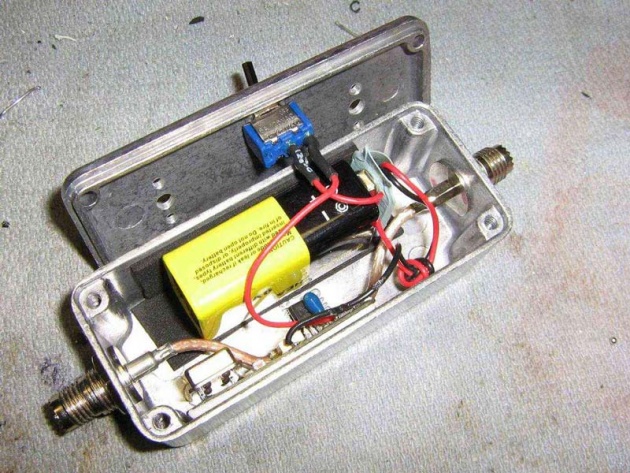
The invention of the cell phone and more specifically the advent of text messaging and smart phone technology have been disruptive to the traditional theatre environment.  For some, even now, the thought of being distracted by the light they give off, the sound of tapping keys, and the sound a phone on vibrate is enough to cause an altercation. Please note that actually building a cell phone jammer is against the law in the US and many other countries.  Having said that, Wired recently published instructions for how to create a device that broadcasts disruptive signals on the same frequency that cell phones use to communicate with towers.  These devices would be enough to disrupt a cell phone signal in a mid sized theater, thereby making the cell phone functionally inoperative.

The idea around cell phone jammers isn't new, but it does call to question whether or not the performing arts community has outgrown this idea of creating a quiet, even sacred, space for performance.  Innumerable performing arts institutions now give permission, even blessings, to smart phone users in some performances or in certain parts of the house.  Even more, however, still ask patrons to turn off all electronic devices before a show begins.

So, is it time for a cell phone jammer or is it time to bring smart phone seats to your house?

Looking at the Land: The Crowdsourced, Digital Exhibition from Flak Photo’s Andy Adams

He needs no introduction, but for new visitors to our site it is my pleasure to welcome back Andy Adams to Technology in the Arts. You may remember our conversation with Andy in May when we discussed the concept of Photo 2.0 and the role of Web 2.0 technologies in redefining the field of photography.

Andy’s newest success, “Looking at the Land: 21st Century American Views,” is a digital exhibition of 21st Century American Landscape photography. The exhibition, prepared in collaboration with the Museum of Art, Rhode Island School of Design, is a discussion (both in photographs and in interviews) with eighty-eight photographers on the practice and meaning of landscape photo-making in the 21st Century. On the website, Andy discusses the current status of the exhibition, including the presentation of twenty of the photographs in physical form at the FotoWeek DC 2012 festival.

Andy and I again had the chance to discuss the themes of photography and online-presenting, but this time focused on the process of organizing a digital exhibition, his experience with crowdsourcing creativity, and his thoughts on the effects of digital projection on viewing. While my full interview with Andy will be posted here on Technology in the Arts soon, I encourage you to view the online exhibition beforehand (available for viewing below).

[embed]http://vimeo.com/49855891[/embed]

Check back in next two weeks for more of Andy’s insight on the future of photography, digital exhibitions, and crowdsourcing creativity.

Redefining Participation: Notes from the Newspaper Industry

The Audit Bureau of Circulation (ABC) reported its latest figures on the American newspaper industry last week, noting that in the six-month period ending on 9/30/2012, circulation figures across the industry largely held steady. Sunday circulation increased by 0.6%, while daily circulation fell slightly, 0.2%. For an industry that has experienced a drastic nosedive over the last several years (some would point to the last two decades), these figures, especially when combined with those of the preceding six months, should come as a breath of fresh air. Leading the charge—if we’re feeling optimistic—is the sharp, ongoing rise of digital circulation, which now comprises 15.3% of the total mix (up from 9.8% the year before). That print editions continue to decline comes as no surprise, but what is striking is the degree to which digital gains are boosting overall circulation figures, in some instances resulting in tremendous increases for individual publications. A prime example is The New York Times. With a total average daily circulation of over 1.6 million, The New York Times expanded its reach by 40% since 9/30/2011—all of it digital. The nation’s leading newspaper, The Wall Street Journal, which began counting paid online subscribers in its circulation figures in 2003, experienced similar, if more modest, growth (9.4%), as did the Los Angeles Times (11.9%). So too in Newark (48.1%), Tampa Bay (30.4%), Honolulu (26.3%), Cleveland (20.5%)…the list goes on.

So what happened? Did Americans begin to read online newspapers en masse over the last two years? Likely not. Rather, ABC made significant changes in its reporting mechanisms to enable newspapers to more fully capture its “cross-media” audience instead of only its print circulation. The changes, which went into effect in late 2010, include metrics to audit and report digital newspaper editions that are accessed by readers on websites, tablets, and smartphones.  It’s taken the industry time to figure out both how to deliver its products to audiences in desired digital formats and how to track these multiple modes of participation. But with 24 months of that data now collected, “year-over-year” comparisons can begin to be made that produce a decidedly more nuanced portrait of the industry.

Whether or not that picture is more or less bleak than before is open to debate, certainly. For the arts, it might be an encouraging note as the industry wrestles with how to measure and evaluate online modes of participation. The most recent NEA Survey of Public Participation in the Arts (2008) inquired broadly about the subject; one question assessed online access of any performing arts (theater, music, or dance) and another the same for visual arts. As the authors of Beyond Attendance: A Multi-Modal Understanding of Arts Participation (2011) advocate, additional research is needed to gain a more detailed understanding of online participation; measurement systems likewise have to adapt. If the newspaper industry’s experience is any guide, when they do, the arts will be far better positioned to assess, and ideally to serve, its audiences.

Image Credit: Steelworkers reading the newspaper, Aliquippa, Pennsylvania, July 1938; Library of Congress, Prints & Photographs Division, FSA/OWI Collection, LC-USF33-002822-M2

Adapting to Changes in Technologies

As new technologies and software are released and older versions become antiquated or obsolete, it puts pressure on arts organizations to keep up.  Adapting to these changes and pressures isn't only a matter of finding the  budget to buy the most recent upgrade of a productivity suite, sometimes it is about fostering the change through your organization and making sure that the new technology is successful.  It also involves thinking strategically and tactically. The culture in any organization is a living thing.  To keep it healthy you have to be cognizant of what is happening:  is communication good/open?  Are new ideas welcomed?  Are concerns being addressed appropriately?  How is morale?  Understanding the health of your organization and working towards making it healthier can be intrinsic to having an efficient and productive organization.

Before approaching any technological implementation, first step back and ask the question:  "What does success look like?" Define the improvements in efficiency, accuracy, and outputted product at the outset and then set these expectations against real data.  If you know of another organization that adopted this technology, ask them what their expectations, roadblocks, and successes were.  Do research, look for reviews of the product and testimonials on both the positive and negative side and use these to help you form your expectations as well.

If you want the people who will be using the software to become adept at it, then it would be wise to ask them how they feel about the change, what questions they have, and if they have any concerns that can be addressed.  Talking with people is your second step after defining your picture of success.  Find out who is enthusiastic about the new tech and who is resistant.  Put the enthusiastic person to work as your champion and keep tabs on the resistor.  Your job is to convince the people who are neither enthusiastic nor resistant that adoption of the new tech is a good idea.

Addressing needs as they arise becomes important as the new technology is being implemented.  Frequently software does many of the tasks at your organization better and a couple of them worse.  Being aware of these eventualities and having handy work arounds or other ways to mitigate the pain will be essential for evangelizing individuals and departments that have minor doubts.  Further being able to show the benefits in other areas may help towards this end as well.

Change management is a good idea for large changes in an organization (migrating to a Customer Relationship Management System from several disparate systems is an example).  There have been extensive writings about organizational change.  A good one is from John Kotter, a professor at Harvard Business School, who put forward the eight-step idea around change management in his book "Leading Change."  Here are his eight steps below:

1)  Create Urgency

2)  Form a Powerful Coalition

3)  Create a vision for change

4)  Communicate the vision

5)  Remove Obstacles

6)  Create Short-term Wins

7)  Build on the change

8)  Anchor the changes in Culture

This Exquisite Forest: A Collaborative Project from Google Chrome and London's Tate Modern

Perhaps you played the French Surrealist game, ‘The Exquisite Corpse,’ in grammar school using the week’s vocabulary words or at a sleepover, where someone inevitably managed to take the game in an inappropriate direction (wasn’t me, I swear). If you do not recognize the creative exercise by its proper name, you will by its concept: a person begins a sentence or drawing on a piece of paper, covers their creation, passes the paper to the following person, and so the game continues until all participants have contributed. The final ‘masterpiece’ is often a comical, nonsensical, and potentially inappropriate, Dadaist anti-creation.

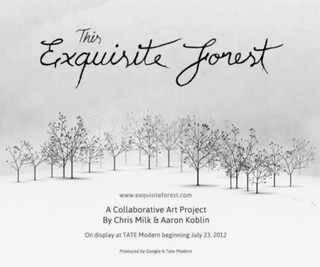
In July, Google’s Creative Lab teamed up with London’s Tate Modern Museum and launched the online collaborative project, “This Exquisite Forest.” Borrowing the game’s concept from the Surrealists, “This Exquisite Forest” enables users to draw or animate their own short animations (using Google Chrome browser) based on the initial “seeds” created by the artists Miroslaw Balka, Olafur Eliasson, Dryden Goodwin, Ragib Shaw, Julian Opie, Mark Titchner, Bill Woodrow, and Film4.0’s animators. One difference between the Surrealist’s version of the game and this project is the fact that online participants will have access to what was contributed before their own addition (as opposed to the Surrealist game where each participant's contribution is covered before moving on).

[embed]http://www.youtube.com/watch?feature=player_embedded&v=nnhJ1841K-8[/embed]

As users add their own animations and visual narratives using a web-based drawing tool, “the videos dynamically branch out and evolve, forming multiple new visuals.” From this idea- of initial videos or “seeds” planted by Tate’s artists- and the additional sequences branching out to create trees, this collaborative online project was coined “This Exquisite Forest.”

The project exists both in the digital realm and in the physical world. Large-scale projections of the best of the online contributions are displayed in the Level 3 gallery of the Tate Modern. In-house visitors have the opportunity to view the animations and contribute their own additions using digital drawing stations in the gallery.

“This Exquisite Forest” does three things expertly:

1) Allows museum-goers and web-users to become creators and curators, not just passive consumers of art

2) Provides a forum for the global, online community to collaborate creatively

3) Markets Google’s web browser Chrome, Google App Engine, and Google Cloud Storage

The physical installation at the Tate will run until January 2013 (approximately).

SEO Your Location on Mapping Programs

Locations on maps are subject to the similar search engine optimization algorithms that websites are.  Google, and other mapping programs take relevance, type of business, prevalence, tags and other metadata and other factors or order the representation of physical business on any map you call up.   Simply claiming your address on Google, Yahoo, Mapquest and other portals is the first step.  The algorithm that arranges addresses on any given maps search page takes into consideration over 100 different factors when delivering the results in the order they do.  Some you don't have control over and some you do.  Here are some suggestions for improving your address in search ranking on maps.

  1. Citations:  Linking the URL for the s page directly from other pages, preferably pages that Google and other search engines trust.  The more trustworthy sources that list the business address the more the impact will be.  Direct URL links to the map of the business should be available on all sites you control:  your website, wikipedia page, and social media.
  2. Reviews:  For instance a review of the business location on google will help with optimizing your google results, rinse and repeat for Yelp, etc.  (example:  if you plug "Georgetown Liquor Co, Seattle" into google maps, the business has 29 reviews).  Reviews need to be linked directly to the address you want to be found.  Caution:  faking reviews can backfire.  Most reviews a mixture of positive and negative, fake reviews are pretty obvious.
  3. User content:  Check in on Foursquare, Facebook, Twitter, etc.  Of course you need to claim the address listing for the map that the application uses.

In addition to these three things, standard usage of SEO best practices are applicable to mapping.  Use names such as 'Map to XYZ Theater Company' rather than 'click here for a map' as your link.  To quote a friend, Mark Gerth of the Washington State Arts Alliance (who first turned me on to SEO), 'click here' doesn't need help being found, you do.

If you have additional helpful suggestions for Geo SEO please leave them in the comments!

The Gelato Museum: I think a second visit is in order...

Ok, I’ll admit it; this post is probably less "best-practice" oriented than our typical Technology in the Arts publications. However, I guarantee it is more delicious, if that is of any consolation. Before heading to Bologna for the year, I crafted my list of “Must See and Do’s,” including both touristy and off-the-beaten track attractions. Occupying one of the top spots on my list (let’s just say it was either 1 or 2…) was the Gelato Museum Carpigiani. Yes, you read that correctly, a museum dedicated entirely to the history, culture and technology of gelato and gelato-making. Bliss. It is a brand new museum, opening three weeks ago just outside the center of Bologna in Anzola dell’Emilia. Carpigiani is a brand, one of the leading producers of gelato-making equipment (actually, two gentlemen on the tour, also American, use Carpigiani machines in their gelateria in Colorado). The company also founded the Gelato University, based in Bologna but with satellite campuses around the world (Argentina, Germany, Japan, Italy, Netherlands, China, USA, Scotland, and England). Students interested in learning the artisan craft of gelato making and managing a gelateria can enroll in a variety of courses. Have I already looked into the details? You betcha.

The Carpigiani Gelato Museum is a center of cultural excellence dedicated to the understanding and study of the history, culture, and technology of gelato and the expertise of the innovators who drove its evolution over the centuries.

Back to the museum- pristine, modern, and FREE for visitors. It also exhibits the history of gelato cone-making and features an enormous wall of gelato-related quotes from the world’s greatest literary, historic, and cultural figures (think Marcel Proust and Madame Bovary). Tours are available in English.

Carpigiani Gelato Museum, the first of its kind to delve into the history, culture, and technology of artisan gelato, a fresh, high-quality food that well represents Italian creativity and excellence throughout the world!

The following are a select few of the highlights from my tour:

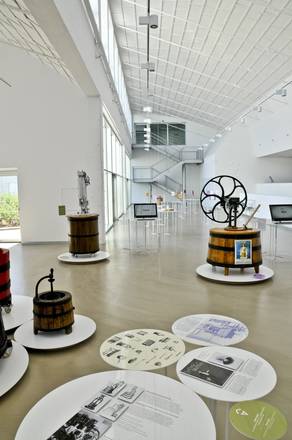
- The organization of the exhibition: The museum charts the history of gelato, from 12000 B.C. to modern day. It is organized into color-coordinated epochs, so it is clear as you move through the exhibition when/where you are in its history.

- The exhibition offers varied media- over 20 original gelato-making machines, historical images and documents, and multimedia presentations.

- The exhibition on the history of cone-making, complete with antique cone shipping boxes from various manufacturers, was one of those "I-have-never-thought-about-the-history-of-cone-making-!" moments of brilliance.

- Each epoch is clearly defined- they form small clusters throughout the room. Above each cluster, to aid in the visitor’s visual understanding of the history, are authentic recipes of gelato (or whatever the frozen treat was before gelato became gelato) from that time period. Moving through the exhibit, visitors come to understand the evolution of gelato from a frozen drink of snow and wine for the wealthy and noble (few hanging recipes) to the universal treat (significantly more recipes) enjoyed more ubiquitously. It is a visually effective technique to compliment and emphasize the evolution of the consumption and creation of gelato.

- And last but most certainly not least, sampling. The tour culminates in the Carpigiani Gelato Lab aka the gelateria. They have a beautiful offering, ranging from traditional and popular flavors to flavors unique to the lab and ancient recipes. You can also arrange to celebrate your birthday in the lab (subtle hint to my friends and family...)

Yes, I was most excited by the fact I was at a museum dedicated to one of my guiltiest pleasures. But what I quickly came to appreciate more was that the history of gelato, something I had never actually considered while indulging, is forever preserved and accessible to the entire world. Gelato, ice cream, soft-serve, you name it, is for many, just a fun, summer treat. But for Italy and Bologna especially, the history and consumption of gelato is so central to their cultural and culinary traditions. As we chatted with the chef in the lab and he encouraged us to “focus” as we sampled flavors, I was reminded just how precious museums are to preserving our cultural heritage.

What a Difference an “A” Makes: Moving from STEM to STEAM

It’s a hot-topic today, complete with nifty acronyms, but the great debate about the “Two Cultures” is hardly a new one. The movement to incorporate “Art” in the STEM (Science, Technology, Engineering, and Mathematics) program curriculum recalls the historic debate between the Sciences and the Arts (for more information on the debate, read C.P Snow's short essay, "The Two Cultures”). The irony of their supposed polarity is the fact they are completely interrelated. To say that the field of Engineering involves and is influenced by nothing more than “scientific” fundamentals is to say a peanut butter and jelly sandwich is made with nothing more than peanut butter. And we all know that is just plain silly, and only half the sandwich.

“The arts can no longer be treated as frill. Arts education is essential to stimulating the creativity and innovation that will prove critical to young Americans competing in a global economy.”- U.S Secretary of Education, Arne Duncan

Ask an engineer (go ahead, I did) if they have ever turned to creative problem solving in their work, prototype building, model-making, or taken a course in design as part of their program’s curriculum. A course in design teaches an engineer the artistic and creative fundamentals they then apply to engineering-specific projects and solutions. Need a second opinion? Ask the Chief Financial Officer (CFO) at any company if they have ever pulled out a dry-ease marker and taken it to the white-board to diagram the effects of a potentially risky investment or visualize projections for the next quarter. Visual studies and applications are an integral component of STEM professions.

“The idea that we must choose between science and humanities is false”- Dr. Alan Brinkley, in the article “Half a Mind is a Terrible Thing to Waste,” Newsweek

So let's take a look at two different schools representing both “sides” of the "Two Cultures" debate. Perhaps you will agree with me that these two fields are not as mutually exclusive as some have explained them to be. In fact, it appears they are, dare I say, mutually interdependent.

One of the world's premier design schools, the Rhode Island School of Design (RISD), is leading the discussion with the initiative, STEM to STEAM. What follows is a description of RISD's position as published on the school's webpage:

“RISD offers endless examples of how art and design education teaches the flexible thinking, risk-taking and creative problem solving needed to solve today’s most complex and pressing challenges – from healthcare to urban revitalization to global warming.”

[embed]http://vimeo.com/48817744[/embed]

Ok. So now let’s head to one of the world's leading institutions for technology studies: Massachusetts Institute of Technology (MIT). MIT’s position on the STEM verses STEAM debate, as published online by the school, is as follows:

“In the current moment of economic uncertainty, America is once again turning to innovation as the silver bullet that will guide us forward. Yet in the eyes of many leaders, innovation seems tightly coupled with Science, Technology, Engineering, and Math–the STEM subjects. We need to add "Art" to turn STEM into STEAM.

Artists and designers make information more understandable, products more desirable, and new invention possible through the project-based inquiry that has long been practiced in the art studio. By investing in art/science collaborations in research and education we can keep America at the forefront of innovation, ensuring our sustained global leadership and cultural prosperity in the 21st century.”

At this point in my academic and professional career, I simply cannot fathom how true innovation can result without art and design. Design in and of itself has become a differentiating factor for American products in the global and increasingly competitive marketplace. Incorporating art and design in the STEM program will create a new generation of creative thinkers, doers and problem solvers, capable of innovating in an interdisciplinary context and world. Be it the Opening Ceremony at the Olympics, the iPhone, or the chemist restoring frescoes in Florence, Italy, art, design, science, technology, engineering, and mathematics are constantly at work together- equal weight must be given to art and design in school curricula across the country. Need I remind you that the world's greatest scientists, thinkers, and mathematicians were also poets, painters, and musicians. As Rebecca Ryan (founder of Next Generation Consulting) so brilliantly included in an October 2012 article, "Why STEM Isn't Working" in Madison Magazine, “Einstein’s theory of relativity, for example, came to him when he was participating in what he called “musical thinking.””

“Artists and scientists both ask big questions; designers and engineers both provide inspired solutions. Together they are more powerful than apart.” - RISD

I am most likely preaching to the choir, I am confident our TitA followers are already on board with the STEM to STEAM movement. I ask you to take your advocacy one step further by sending a letter to your Members in Congress or by contacting an elected official asking them to co-sponsor H.Res. 319: Expressing the sense of the House of Representatives that adding art and design into Federal programs that target the Science, Technology, Engineering, and Mathematics (STEM) fields encourages innovation and economic growth in the United States.

Cutting-Edge Sound Research from One of Italy's Oldest Cities

Greetings from Bologna, Italy! Having completed the Carnegie Mellon portion of my dual-Master’s degree program, I am now enrolled at the University of Bologna’s Master’s program in Innovation and Organization of Culture and the Arts (GIOCA), aka Cultural Economics. While my blog postings will not be as regular as this past year, I hope to share with our TitA followers relevant news, trends, and projects from across the Atlantic, beginning with la Casa del Suono (House of Sound), in Parma, Italy.

The House of Sound focuses on the technological aspects of sound. It is an avant-garde artistic and technological project dedicated to everyone who listens to music and other sounds broadcast by technological instruments. - Published in a guide by the instituto per i beni artistici culturali e naturali

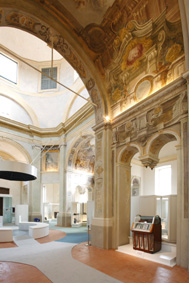
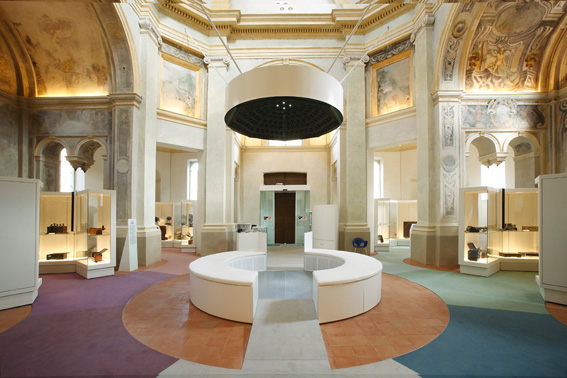
Housed in a restored church and managed by the city of Parma, la Casa del Suono opened its doors to the public in December 2008. It is a project produced collaboratively by the Casa della Musica and the University of Parma. La Casa del Suono serves as an educational space with a scientific and artistic collection exhibiting the technological evolution and social implications of sound reproduction and transmission; as a research center providing instruments for innovative and futuristic developments, projects, and technologies; and as a leader in scientific and musical activity. In this way, it serves as both a museum and a laboratory.

The three best things about the museum:

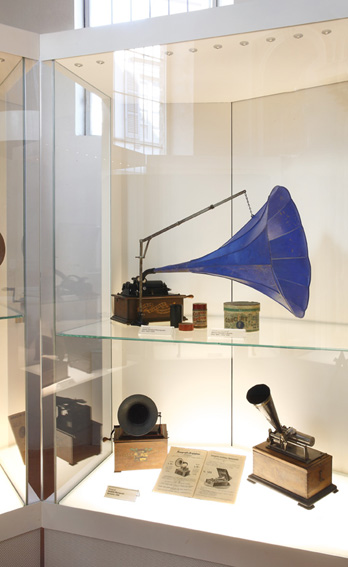
1) It is a stunning, modern and bright space with incredible movement and flow. Its collection and layout are neither overwhelming nor perplexingly organized. It is rather simple, actually. There are six “niches” or round rooms (at one time, chapels). Each highlights a stage in the evolution of sound reproduction and transmission. Each niche houses about 10-14 sound reproduction and transmission devices, ranging from different countries’ first phonographs and radios to portable devices such as the compact disc and the iPod.

The niches are: (1) Reproduced Sound: From the Phonograph to the Gramophone (2) Transmitted Sound: The Birth of the Radio (3) Sound at Home: A New Household Appliance (4) Pocket Sound: From the Mobile to the Portable and (5) Sound for All: New Consumer Goods and (6) New Sound: From Analog to Digital.

2) Each niche contains an interactive touch screen from which visitors can select one of the technologies on display in the room and then a song from a set playlist of typical music from that period. The selected song is played throughout the niche, audible to visitors inside the specific niche, but not beyond.

3) The culmination of the visit is a demonstration of the research and technological advancements taking place at the Casa del Suono. Two installations, the Sonic Chandelier and the White Room, apply the theory of Wave Field Synthesis. The Sonic Chandelier uses technology that creates virtual sounds sources that move in the space above the listener. In the White Room, visitors experience the sound quality and movement of 189 speakers positioned at the same height along the perimeter of the room, creating a two-dimensional sonic field and a TRUE surround sound experience.

The Casa del Suono, aside from its architecturally supreme space, extensive collection, and cutting-edge research, asks visitors to think beyond “History of Rock 101” and the evolution of music. It has viewers reflect on sound--how people have historically received sound; how the evolution of transmitting sound and music has transformed family life, politics, and society; and how electronic technologies continue to shape access to culture, art, and science.

If you find yourself in the Emilia-Romagna region of Italy, the Casa del Suono is definitely worth a visit. It is an off-the-beaten track gem. And while you are in Parma for the day, treat yourself to a dish of the region’s pasta covered in Parma’s own parmigiano reggiano cheese. It will be a day for the books; you can trust me on that one.

On Demand, In Vain?

By Katherine Schouten Rick Archbold recently published a piece in the Literary Review of Canada exploring the impact of self-publishing on the future of literature. The swift rise of print-on-demand technology (POD), which enables users to produce small print runs of titles through cost efficient means, has inaugurated a rush of unfettered works. Visual and textual, personal and professional, fictional and factual, literary and mundane, POD capabilities have empowered all those who possess the inclination to publish self-created goods.

As Archbold acknowledges, such access brings with it thorny issues, of which much conversation has been, and is being, had. (A thoughtful example from Christina Patterson can be found in The Independent.)  But his argument brings the quandary around to the other side: what work that ought to be considered “literature” is being passed over precisely because it’s not from mainstream publishers? What might otherwise be considered “legitimate,” if not for the stamp of “vanity publishing” currently affixed by the industry to volumes precisely because they are printed by the very authors who wrote them? More urgently to Archbold, what works of literary art may society lose because self-publication is deemed vain?

Underscoring these conversations is the dualistic role the medium of a book, physical or electronic, plays, both as a vehicle for art (i.e., literature) and as a dynamic tool of communication. It remains one of our most fundamental technologies; how we access it, and whom we allow or enable to produce it, is rapidly changing. But could it be that with this technological evolution we might reinvigorate the book’s latter role, as a tool? If so, arts organizations—indeed, nonprofits of all varieties—stand to benefit. Books self-published using POD carry the potential to serve as an effective means of promotion and commemoration, a revenue stream in the form of merchandise, a powerful platform to aid applications for grant and foundation funding, and an enticing incentive for tiered giving. Most providers (Blurb, Lulu, etc.)  are now compatible with Adobe InDesign, further aiding the integration process by enabling graphic designers to work in a preferred medium (rather than being limited to proprietary templates). They also now have ebook options, to deliver self-published goods to potential readers in their preferred format.

The conversations and concerns surrounding the implications of POD and self-publishing on the broader industry will no doubt continue. But the possibilities they hold for the nonprofit sector are palpable,  vanity or not.

For a primer on self-publishing, see Alan Finder’s recent article in the New York Times, “The Joys and Hazards of Self-Publishing on the Web.”

Why in the Arts World Don't You Have a Pinterest?

Haven’t you heard? Pinterest: Now Officially Better Than Yahoo and Bing* *Sort of.

The story dropped earlier this month: Pinterest referred more people to websites in August than Yahoo and Bing. What that means is that more people visited Website X by clicking on content (generated from Website X) that is on Pinterest, than people did by searching for Website X on Yahoo or Bing. Which is huge – the little-social-media-that-could topped industry giants, if only by a few decimal points.

The report came from Shareaholic, a social media tool for sharing websites, on just about every social media platform. They have tools for sharing pages from your browser, to putting buttons on your site to allow your visitors to share your content. The Shareaholic Analytics tool tracks who’s sharing your work, and how visitors are reaching you – which is where this report comes from. Shareaholic Analytics also points out that traffic from Pinterest has doubled in the past four months and “is now the fourth largest traffic source in the world”. Can that possibly be true?

Maybe. Search Engine Optimization is a tricky beast and there are a few drawbacks to the report. Shareaholic can only measure the websites currently using its tools – which is a network of 200,000 publishers, who reach 300 million people each month. While that sounds like a suitable sample size, it does depend on the makeup and content of each website, their level of SEO sophistication, etc, etc.

Of course, why am I telling you this? The arts community, while generally not on the bleeding edge, hasn’t been idle on the Pinterest front. The always-cool SFMOMA has boards upon boards of art. The Pittsburgh Irish and Classical Theatre boards give us a glimpse behind the scenes of their shows and soirees.  Heck, the Milwaukee Symphony Orchestra pins everything from fanmail and music jokes to gorgeous music halls and their musicians. The fact is, Pinterest’s layout and content lends itself to arts organizations. (But for real people, you can pin videos – and I have yet to see a performances board!) Shareaholic says that Pinterest is one of the best ways to send people to your website. Why don’t you have one yet?

It could be time, it could be money, it's probably a mixture of both. Maybe, like skeptics of this report, you need more time to make an assessment. There are larger implications here: that “sharing” is greater than “searching,” visuals more important than text, and that your friends know what you should look at better than some algorithm. This was still just one report, using one social sharing service, for one month, however, and only time will tell if these trends continue – but maybe you and your organization should take a closer look at Pinterest. We have tools to help you set one up.

Where We Are and Where We've Been - Annual Report

It has been almost a full year since I joined Technology in the Arts, thanks to the Master of Arts Management program at Carnegie Mellon University. As we enter another school year and prepare for a new group of research associates, we’ve got a look back at the past year. Research Associate Terry Boyd prepared this Annual Report with our highlights, summaries, and where we have room to improve.

If you're a fan of metrics, be sure to check out the report. Here are some of my favorites:

Highlights

  • Staff size! We added 5 authors last year!
  • Page views jumped by 63%
  • Visitor total increased by 78%
Social Media
  • Even though our Facebook page is only 2 years old, Facebook is our largest traffic source
  • Over 7,000 clicks from Facebook posts led to our blog posts last year.
  • Our Twitter account saw an increase of followers by 28%

There's plenty of room for improvement (always!) and we hope readers will join us in the next year! We also have a friendly, non-flash version of the report here.

Gaming or gamification: a tool for the arts

According to surveys done by Comscore, gaming online, on smart phones, and among women has been growing for years.  Likewise the number and quality of board games has exploded in the last twelve or so years.  The upshot of these phenomena is a clear indication that gaming and gaming culture is on the rise globally and all indications are that slow and steady growth will continue to happen in this sector. But how do the arts harness this phenomena?  Game dynamics can be used to attract attention, deepen interaction, and retain interest.  Games of course have always held interest in technology and examination of game mechanics regularly shows up on Tech literature.  Beyond the tech world gamification has also become a subject of interest in the corporate world in general.  Gaming and gamification holds promise for the arts.  Applications include game dynamics on websites to bringing game mechanics to your marketing or development efforts.


Roughly speaking game mechanics fall into a number of broader categories and smaller subcategories of stimuli and response mechanisms:

  • Achievement:  points, levels, rewards, recognition, and gifts.
  • Competition:  leader boards, envy, varying challenge from human interaction, and the human competitive instinct.
  • Cooperation:  altruism, social fabric, communal discover, commerce, and teamwork.
  • Ownership:  building something that is yours, loyalty, self-expression, and loss avoidance.

Before embarking on gaming or gamification it is wise to consider your brand, your audience, and your goals.   In order to motivate specific behaviors the right combination of mechanics and dynamics need to be in place and these can vary from audience to audience.  Indeed, high powered consultants at high powered firms can be hired to help with gamification but this isn't always necessary.  A simple, well planned addition of gamification can increase time spent on a website by two or three fold.  For instance, if a customer answers three questions correctly about your organization's history they get a 5% discount on their current purchase.  Will everyone participate?  Probably not, but it will deepen the experience for a number of people and potentially deepen their understanding and commitment to your organization.


The Graph of Ideas by Brendan Griffen

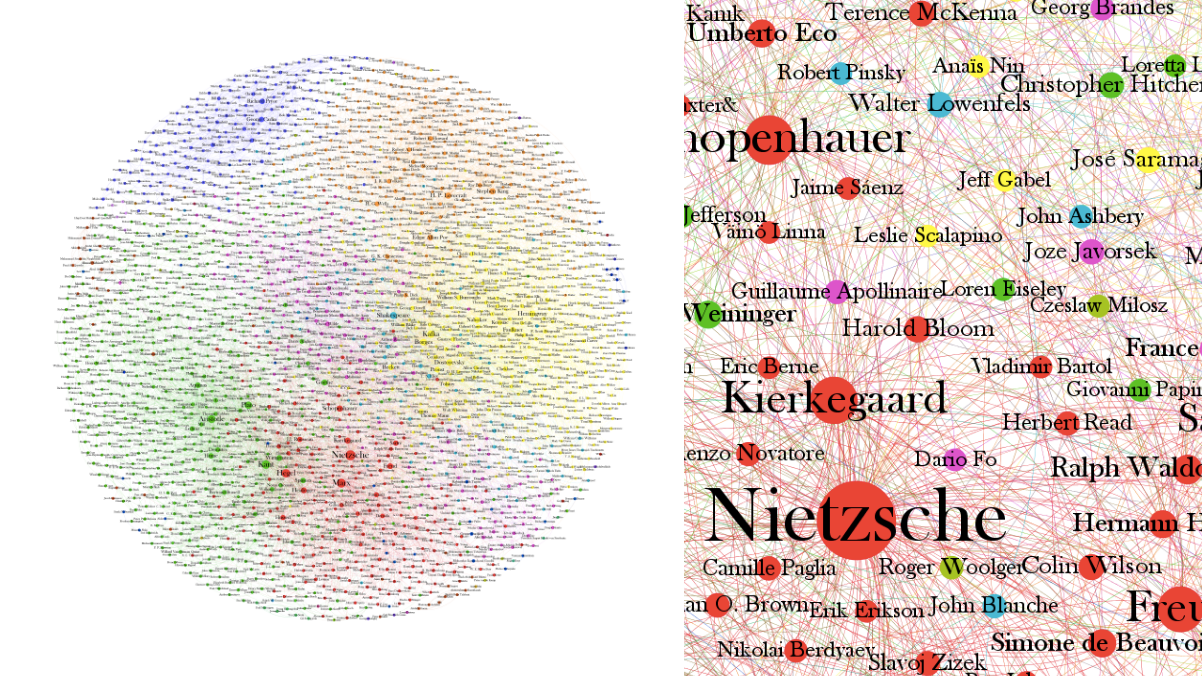
Two things I know are true: That Rachael Wilkinson's impression of SNL's Drunk Uncle rivals Drunk Uncle himself and that Art.sy’s Fan page is the best source on Facebook for wonderfully distracting food-for-thought. I recently came across yet another dynamic infographic of sorts- the "Graph of Ideas." It presents a beautiful, interconnected and thready web of “Every Big Idea, Ever.” According to Suzanne LaBarre in an interview with map creator Brendan Griffen,

Each node represents one historical figure, and the nodes are color-coordinated to represent specific eras or fields of expertise (red for 19th- and 20th-century philosophers; orange for fiction authors; purple for comedians; and so on). Like-minded people are grouped together, and linked to all their influences, as well as everyone who has influenced them. The more influential a person, the bigger his or her node.

Griffen includes in the map every profile on Wikipedia that has an “influenced by” or “influences” field. Though the map is well-stocked, some great thinkers are absent (athletes and sculptors for example) from it. Griffen explains in the interview,

“I was limited [by] the dataset. Most of the people are philosophers and authors primarily because these are text-driven endeavors. Presumably fans of philosophy and books have entered in the information which sort of makes sense given their overrepresentation in the graph. Sports fans are unlikely to enter these into Wikipedia and so they are underrepresented. Similarly with artists but to a lesser extent.”

Basically, it is a map of the people Wikipedia contributors care about/care to write about. Though this may be the case, it is no less fascinating to explore just how interconnected these great thinkers are. Griffen's final message is inspirational, retrospective, and forward-thinking:

"Everyone is the collective sum of everyone else. We often think great thinkers, scientists, and authors sit in isolation in some cloister waiting for that eureka moment to come to them in a lightning storm. The truth is, the process of discovery forces us to consciously or unconsciously draw on all of our known, and perhaps more significantly, unknown antecedents of knowledge and wisdom to come up with new solutions to the problems we’re facing today."

A Little Sun, Solar Power, and Electricity: Olafur Eliasson at the Tate Modern

A little sunshine can go a long way, or at least, that’s what artist Olafur Eliasson has set out to prove. His exhibition, Little Sun, at the Tate Modern revolves around “solar power, the global energy challenge, light and its importance in and for life.” But at the center of it all, lies not the Sun, but a tiny solar powered lamp called a Little Sun! http://vimeo.com/41830924

Eliasson explains the Little Sun as follows:

Light is for everyone – it determines what we do and how we do it. This is why Frederik Ottesen and I have developed the solar-powered lamp Little Sun. Little Sun is a small work of art with a large reach. One part of the artwork is the lamp and the activities it enables. The other is the successful distribution of Little Sun in off-grid communities, its journey from production to usage.

In some households, there will be a Little Sun that beams during the night. The lamp is also being sold at the Tate Modern and with every purchase, it will be made available at a lower price to those who do not have access to electricity. Furthermore, visitors will be able to create light graffiti using the Little Sun! Yet the luckiest will be those who participate in a blackout event in the Surrealism galleries and use their lamps to see the art!

http://vimeo.com/45573593

But once the lights are turned back on, it’s important to note that Little Sun is not just an exhibition, it’s a for profit company!  One that seeks to expand its distribution networks into the depths of darkness to bring electricity, prosperity, and economic growth to all.

Their business model is similar to TOMs in that they will provide a reduced price Little Sun to off-grid communities for every lamp that is bought. Some additional points regarding their business goals are mentioned below:

We will ensure that Little Sun is made available where typical commercial interests would not reach.

We will focus our energy on the point where the need is most: where electricity is unavailable, unreliable, unaffordable, or unsustainable.

We will drive profit to this point of need – far beyond where industry normally goes.

We will help create and nurture small sustainable businesses by supplying them with Little Suns and providing the support they need to create profit.

We aim to make light, energy, and profits available everywhere.

Little Sun is a stellar example of a project that spans the fields of art, science, and business! Here’s to a little sunshine going a long, long way!

A Data Visualization of Art & Money

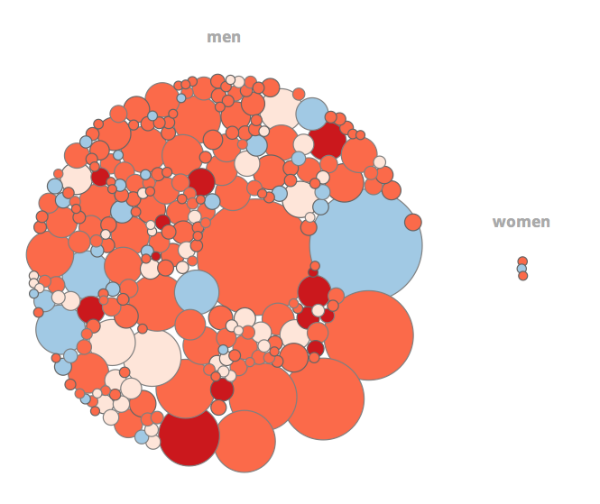
Looking for a well-worth-it distraction? Check out Art & Money, an animated art auction infographic by Jean Abbiateci. It visualizes metrics for the top 270 most expensive artworks sold in auction between 2008 and 2011.


Methodology: the radius of the bubbles is calculated on the amount of sales. Theses prices do not include the buyer's commission.

Data visualized includes the size of the artwork, the artist's nationality, date created, selling price, etc. The data is then sorted in different categories so viewers can explore the relationship between male and female buyers, a comparison between top-selling work of dead artists and living artists, a look at how the top auction houses compare, etc.


Any surprises? Share with us!


What the upcoming election mean for the arts

What will happen to arts, arts education, and arts agencies after the coming election?  If you are registered to vote then you hold part of the answer in how you decide to cast your ballot.  The coming election could very well decide whether or not there are numerous municipal, statewide, and national agencies that help support arts infrastructure and education. Americans for the Arts collects information on elected candidates based on their voting record and stated policies.  At the top of the ticket President Barrack Obama has gotten good marks from Americans for the Arts.  He has proposed and supported increasing funding to the National Endowment for the Arts and the National Endowment for the Humanities and has come out against cuts to arts education funding and the Corporation for Public Broadcasting.  Mitt Romney on the other hand has pledged to cut funding to the National Endowment for the Arts, the National Endowment for the Humanities, and the Corporation for Public Broadcasting.

Support for the arts, arts funding, and arts education doesn't split strictly on party lines though and it is incumbent upon us as voters to understand where our national, statewide, municiple and local elected officials stand on support the arts, education, and the creative economy.  Americans for the Arts has a handy tool that you can use to look up the positions of elected officials at all levels. 

Hype Cycle for Emerging Technologies: Distinguishing the Hype from the Viable

Making informed technology decisions means understanding the necessity, impact, and sustainability of the technology; the technology’s current and future relevance to the industry; and how it supports the organization’s business goals.

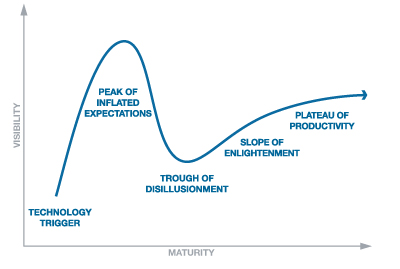
When new technologies make bold promises, how do you discern the hype from what’s commercially viable? And when will such claims pay off, if at all? Gartner Hype Cycles provide a graphic representation of the maturity and adoption of technologies and applications, and how they are potentially relevant to solving real business problems and exploiting new opportunities.

With new technologies emerging overnight, early adopters tweeting about them by your morning coffee, and six beta invites in your inbox by your evening commute, deciding which technologies will pay off, which are relevant and which will last, is by no means a simple project. Gartner, Inc., a leading information technology research and advisory company, produces Hype Cycles to help clients  differentiate the “hype” technologies from the viable technologies. These graphics, organized by industry and aggregated in the “Hype Cycle for Emerging Technologies,” provide clients with insight to the risk, opportunity, and viability of various technologies in specific industries.

"Hype Cycle for Emerging Technologies" targets strategic planning, innovation and emerging technology professionals by highlighting a set of technologies that will have broad-ranging impact across the business. It is the broadest aggregate Gartner Hype Cycle, featuring technologies that are the focus of attention because of particularly high levels of hype, or those that may not be broadly acknowledged but that Gartner believes have the potential for significant impact.-- Jackie Fenn, vice president and Gartner fellow, August 2011 Gartner press release

In the Hype Cycle, a technology’s life has five phases. These phases are (as defined by Garnter,Inc.):

Technology Trigger: A potential technology breakthrough kicks things off. Early proof-of-concept stories and media interest trigger significant publicity. Often no usable products exist and commercial viability is unproven.

Peak of Inflated Expectations: Early publicity produces a number of success stories—often accompanied by scores of failures. Some companies take action; many do not.

Trough of Disillusionment: Interest wanes as experiments and implementations fail to deliver. Producers of the technology shake out or fail. Investments continue only if the surviving providers improve their products to the satisfaction of early adopters.

Slope of Enlightenment: More instances of how the technology can benefit the enterprise start to crystallize and become more widely understood. Second- and third-generation products appear from technology providers. More enterprises fund pilots; conservative companies remain cautious.

Plateau of Productivity: Mainstream adoption starts to take off. Criteria for assessing provider viability are more clearly defined. The technology’s broad market applicability and relevance are clearly paying off.

Many Gartner clients use Hype Cycles as part of their technology-planning process, often drawing from multiple Hype Cycles, augmented with industry- or company-specific topics to create their own Hype Cycles and Priority Matrices. Technology providers use Hype Cycles as a way to understand the likely market reaction to their products and services based on the adopter community's expectations and attitudes. Investors watch for technologies that are on the rise in a Hype Cycle to try to catch them before the Peak of Inflated Expectations or at the beginning of the Slope of Enlightenment before they move into mainstream adoption. –Jackie Fenn

Gartner’s complete reports on technology trends and in-depth analyses of the Hype Cycles can be purchased online. But for now, take a look at the Hype Cycle for Emerging Technologies (as of July 2011):

To our followers across various industries--does or will this foresight affect your technology-planning strategy?

What’s Trending on Twitter this Week

Take a look at what caught our attention on Twitter this past week:

@MuseumNext A great presentation from @clairey_ross and @chrisspeed on QR codes, Smart Objects, Museums and Public Engagement.

@idealware Great introduction to Google Grants from @MRCampaigns- including the time it generally takes to set up ads & monitor

@sumojim The Digital Engagement in the Arts Framework from Jim Richardson

@sumojim I've been playing with the social media tool SocialBro for a few weeks, and I think it's worth checking out (it's free)

@HuffPostCulture Culture's biggest world record holders

@wikimania2012 Have you taken a look at our awesome schedule of workshops, talks, meetups, and events? Check it out

@youvecottmail When it comes to social media, are you following "the rule of thirds"?

@FracturedAtlas Check out 1.1, creating 1.1 million life-size images of kids, 1 for every child in a NYC public school.

@mashable 12 Essential Social Media Cheat Sheets

‏@HuffingtonPost FACT: For the first time in history, the US Olympic Team consists of more women than men

@HuffPostCulture Frank Gehry's crumpled opera design

Be sure to share with us what caught your eye by RTing to @TechInTheArts.