Are Bricks and Mortar the Best Use for Money in the Arts? The Overbuild of Cultural Facilities in the United States

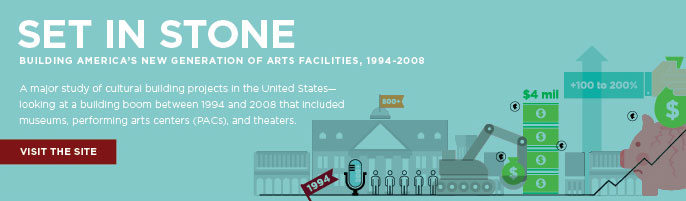
Recently, the University of Chicago’s Cultural Policy Center released the report, “Set in Stone: Building America’s New Generation of Arts Facilities, 1994-2008.”

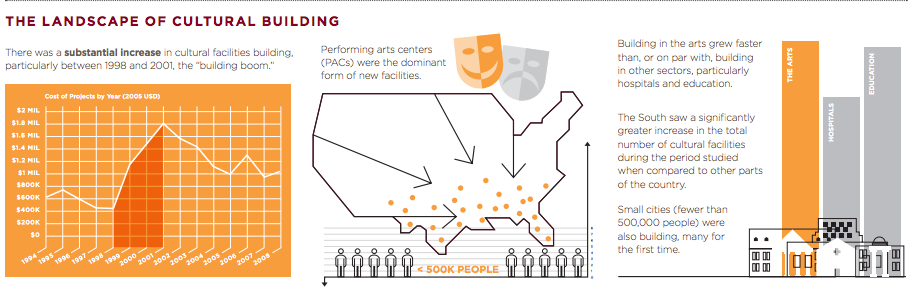
Summary: The research examines the boom of major cultural building projects (museum, performing arts centers, and theaters) between 1998 and 2004, specifically looking at the decade between 1990 and 2000. The findings indicate during that period, “the level of investment in bricks and mortar as a percentage of total revenue and assets was disproportionate.” The full report addresses the landscape of cultural building, the investment determinants of cultural building, the feasibility of cultural building projects, and the effects on communities. The report takes into account population change, the national trend in ratio of arts organizations to cultural facilities, the relationship between the number of existing facilities in an MSA and the population, GDP, economic climate, municipal spending on physical infrastructure, spending by type of project, education rates, median household income levels, distribution of costs of projects (by region), geographic considerations, and other factors affecting the supply, demand and sustainability of cultural building projects.

[embed]http://youtu.be/KwhG7SK9csc[/embed]

Case Studies: Four case studies, presented as teaching resources, portray complex, management situations students and professionals might encounter in the real world. The cases (comprised using internal documents , construction data, and first-hand accounts from administrators, board members and/or volunteers involved in each situation) emphasize the need for managers to make strategic decisions, weighing the benefits and risks of each potential course of action. These studies provide a platform for discussion about the strategic design of projects, potentially shaping future design and management practice.

The four case studies highlight issues of  strategic decision making, project design, expansion and management at:

1) the Art Institute of Chicago in Chicago, IL

2) the AT&T Performing Arts Center in Dallas, TX

3) the Long Center for the Performing Arts in Austin, TX

4) the Taubman Museum of Art in Roanoke, VA

Key Findings: The report and the findings show that (taken from the report)

- Cultural institutions and arts facilities were overbuilt during the boom years

- Performing Arts Centers were the dominant form of new facilities

- The building boom affected the entire country, but was concentrated in the South, which saw enormous increases in the total number of facilities

- Building in the arts grew faster between 1998 and 2001 than or on par with building in other sectors, particularly health and education

- Rising population and higher average levels of education and income help explain why some cities built more than others

- There is no clear pattern of spillover effects (negative or positive) of specific cultural building projects on non-building local cultural organizations and the greater community

- There was far less investment in traditional theater facilities than there was in museum and performing arts centers

- The New York-Northern New Jersey-Long Island MSA spent more on cultural infrastructure ($1.6 billion) building than any other MSA during this period

- Research shows that for every additional cultural facility a city had, it invested between $0.11 and $0.23 more per capita per year in cultural building projects

- What influenced how much a city invested in cultural infrastructure was not the size of a city’s population, but how fast the population was increasing or decreasing

[embed]http://youtu.be/76vN7mb9n6E[/embed]

Looking Ahead: Joana Woronkowicz, co-author of the report, summarizes the lessons learned from the study and how the arts industry should proceed in making building project decisions.

• What is the motivation for the project?

• Does it align with organization’s artistic mission?

• Is there a need for the project (not a want), but a need?

• Do I have the leadership in place to take the project from the beginning to the end?

• Does the building project respond to the needs of the community?

• How can I be flexible in controlling expenses and nimble in generating income?

Museum Laboratories and Chrome Experiments!

It truly is difficult to write about an experiment untested with a hypothesis unknown, and in a lab unseen. But I’ll make an exception because Google is the scientist behind it. All that we know about the Chrome Web Lab, we know because of a minute long YouTube video: http://www.youtube.com/watch?v=Bhs0YHUPV24

“See the magic of the web brought to life through 5 Chrome Experiments.

Open to the world online. Live from the Science Museum, London.

Launching in beta, summer 2012.”

Instead of making grandiose, naive, and most likely, faulty predictions, all I will say is that where there is Google, there is oodles and doodles of interesting innovation. So this participatory exhibition at the London Museum of Science is one to experience and experiment with.

Coincidentally, another equally experimental space, called the Laboratory for Museum Innovation, is in the works at the Dallas Museum of Art. Having secured $300,000 in funding, the lab will soon launch a  round of  pilot projects designed to address museological issues such as : Access to Collections; Visitor Engagement and Participatory Culture; Advancing Digital Scholarship; and Transformative Infrastructure. The following was mentioned in DMA’s press release:

“The Laboratory will mount a series of short-term pilot projects that will investigate and focus on enhancing educational resources for K-12 students and teachers; expanding data and information on its collections to aid scholars and visitors; deepening understanding of how visitors encounter works of art; and improving global distribution of content from the Museum and its audiences.”

It’s going to be a summer of scientific experimentation in museums. A fine meeting of cultural and statistical significance!

The Meta-Museum: A Work of Art Depicting Museum Visitors Admiring a Work of Art

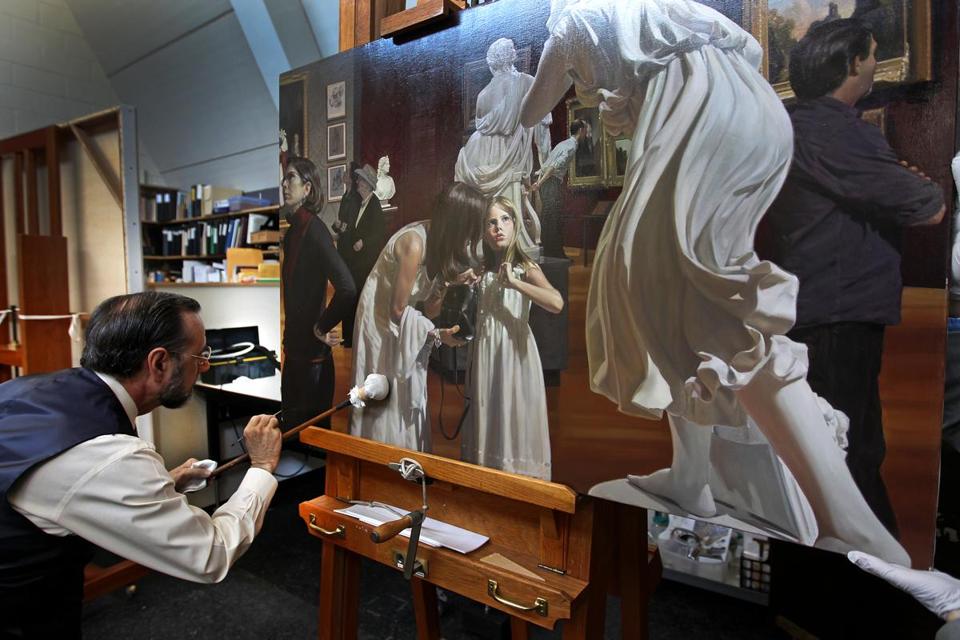
Before you head off on summer holiday, take a look at the newest addition to the Museum of Fine Art, Boston’s, Arts of the Americas wing. Warren Prosperi’s realist painting, “Museum Epiphany III,” depicts museum visitors amid the 19th-century paintings and sculptures in the Penny and Jeff Vinik Gallery of the Museum.

Those years I spent studying and copying at the MFA, I got to see the life of the museum. There’s different types of people who are always moving through the gallery. At one point I said, “All this vibrant life in the museum is a painting in and of itself.” So I started a group of paintings about the works of art, and the museumgoers, and their relationship to each other. - Warren Prosperi in a Boston Globe interview

“Museum Ephiphany I” and “Museum Ephiphany II” also feature specific locations in the Museum and were purchased by Museum trustee, David Croll. “Museum Epiphany III” will be one in a series of potentially 25 paintings.

What a turn of events when visitors become the subject of the art they view.

(Photo courtesy: David L. Ryan/Globe Staff)

Cultural Preservation: Future Concerns, Trends, and Hypotheses

The numerous civilizations of the past left behind numerous tangible traces of their heritage. Coveted or discarded, scattered or buried, broken or intact, these objects would soon become artifacts. Archeologists would study them, museums would acquire them, and the rest is none other than History. But what happens when the core activities of a civilization leave scarce amounts of tangibles? What happens when the pace of change is faster than that of preservation? We should start formulating a response, for this describes none other than the 21st century. We live in an age of information, of which a substantial amount now exists online, but is constantly in flux. The Economist described this phenomenon in an article titled History Flushed, where the author argues that archivists are limited in their activities of digital preservation due to anti-piracy legislation and software such as Digital Rights Management.
“As companies more fiercely protect their wares, contemporary digital artefacts run the risk of never being archived. Libraries have no mandate to collect apps, such as Angry Birds or Instagram, which form part of popular culture.”

In the same article, the author mentions how efforts are being made by governmental archives in the UK and the US, and non-profits like the Internet Archive. The latter is a truly comprehensive internet library that was founded in 1996 and has since become a vast collection of  “texts, audio, moving images, and software as well as archived webpages.” With so much of our culture now in digital format, will there be a shift in the responsibility of preservation, one from our museums to organizations specializing in digital archiving?

Yes, I believe so. Because our digital footprints are becoming bigger and more pronounced. And this seemingly unimaginable amount of information, along with our technologies and software, will most likely be preserved by various non-museum organizations; from tech giants like Google, to nonprofits like the Internet Archives, and even individuals (take a look at the Museum of Sounds).

So what of our museums? In a recent post on museum geek, Susie Cairns asked this very question. She wondered whether the plight of newspapers, and their subsequent shift towards digital content, heralds a change in museology. Especially in the way culture is preserved;

“Now is that time for museums. We still need the things that museums do. We still need to know how to select, preserve and disseminate, whether objects or information. What we don’t need is museums. If those same needs can be met by other means (digital or otherwise), the impact on museums will be significant. I think it’s important to keep this in mind as we look to the future, particularly as we see the effects of the Internet on other traditional institutions.”

While I agree with her to a certain extent, it's difficult to imagine a museum free future. The internet has definitely made it easier for us to access information about an object, but not the object itself. And even if the object can somehow be experienced remotely, it will still exist and so will the museum. Yet I can see how a technology such as augmented reality (or something not yet developed) may further separate the preservation of an object from the dissemination of its meaning to audiences. So much so that people need not visit museums.

But museums must realize this too because there have been some interesting collaborations between the tech and cultural world. Google’s work with various cultural organizations through its Cultural Institute, Nintendo’s collaboration with the Louvre, the recent 3-D printing event involving the Met and ScanBot are all examples of museums keeping apace with technology’s giant leaps. Hopefully, they will continue to make such leaps and stay wary of stumbling into obsolescence.

Three “How to…” Lists, One MuseumNext Conference, and a Letter to Museum Directors on Why Museum Websites Fail

The Guardian’s Culture Professionals Network reveals some of the best advice, best practices, and best tips from the arts management community.

1) 18 tips for managing your arts and heritage staff

2) How to recognize, prevent and deal with burnout in a creative job

3) 10 social media tips for arts organizations

And now, the international museum conference you must register for early! MuseumNext is Europe’s conference on social and digital media for the museum sector. For the third year in a row, registration to MuseumNext reached capacity long before the two-day conference rolled around this past May. Interested latecomers were placed on a waiting list.

What is the event about?

- Coverage of the hottest topics and technologies from the digital side of museums

- Packed schedule: keynotes, multi-track conference, workshops and more

- World class speakers and fresh perspectives from museums across the globe

- Unbeatable atmosphere: hundreds of museum geeks, networking and meet ups

- Great value: catering throughout the day, rewatch presentations online after the event and free high speed wifi.

This year’s conference was in Barcelona, Spain, with over 350 delegates from 34 countries across the globe. The topic of discussion: what’s next for museums? Speakers on this year's program included Nancy Proctor of the Smithsonian Institution (mobile strategy and revolutionary practices in museums), Tijana Tasich and Elena Villaespesa of the TATE (online metrics), Allegra Burnette of the MoMa (the Mobile Museum), and many other notable and forward-thinking figures in the museum world. To view videos of these lectures, visit MuseumNext's Facebook page.

The MuseumNext website is loaded with hot topics and insightful discussion in the arts management field. To get a feel for the scope of the content discussed, check out these articles:

[embed]http://vimeo.com/25552335[/embed]

The Space: A Summer of English Arts on a New Experimental Platform

This Olympiad summer, the arts in the UK will be consolidated onto a single online platform called The Space. What’s more? The content on The Space is being provided for free! There’s room, or more fittingly, seats for all, at venues such as the World Shakespeare Festival or Yayoi Kusama’s Obliteration Room at the Tate.

“The Space is a new way to access and experience all of the arts – for free.

Available on computer, tablet, smartphone and connected TV, The Space invites you to take part in the biggest summer of arts the UK has ever seen, whenever you want it and wherever you happen to be. ”

The Arts Council England in partnership with the BBC created The Space as a way for people from all over the world to experience the country’s rich and dynamic arts scene. In effect, a summer of English arts to all! (Albeit without the English summer and its cool Constable Skies).  So The Space is certainly something to look forward too because it will feature some of the UK’s best theatrical productions, dances, musical performances, art exhibits, poetry readings, along with content that has been specifically created for the platform.
Through the course of the summer, the performances staged in theatre, dance, film, and music will be showcased via recordings and live streaming while exhibitions at museums and galleries will be presented via behind-the-scenes footage, photographs, and interviews with artists and curators. The Space will also feature experimental and interactive digital art that can be experienced on the platform itself. Finally, for poetry and literature, there will be a variety of formats, including podcasts, poetry readings, and interactive audio-visual timelines such as the 60 Years in 60 Poems.

While live streaming and online exhibits aren’t entirely new to the performing or visual arts, the presentation of all the arts, all at once, and in one place, is certainly a novelty.  As such, The Space is truly remarkable because it is no ordinary task to fit an entire country’s arts scene onto a single platform! If other countries too made their arts available on interactive, well designed platforms, the internet would surely be a destination in itself. Perhaps the introduction of The Space suggests that it already is?!

The Space also signals another significant trend; the quality of arts being made available online continues to improve. Whether it is in opera, film, or even, educational art history, we are privy to some great material. At the same time, the problem with the online format is that there are times when our Google searches are less than serendipitous and our social networks less than social. On such days, we miss out on a lot of online events, projects, and experiments.

Yet on The Space, what will remain certain is most certainly the art. And at the end of each adequately sunny day across the Atlantic, the platform will be populated with new content for visitors to see, hear, read, and experience. Moreover, the content on this living library of the arts will be available until October. After that, it will be time, once again, to continue our search for the arts on the virtual infinity of the internet (The outer Space).

Best Practices in the Cloud: Creating Collaborative Communities in a Common Virtual Space

Slot Shelters is an international, design conversation between young students exploring the fabric and identity of their communities—and sharing their findings and designs with their peers across the globe.

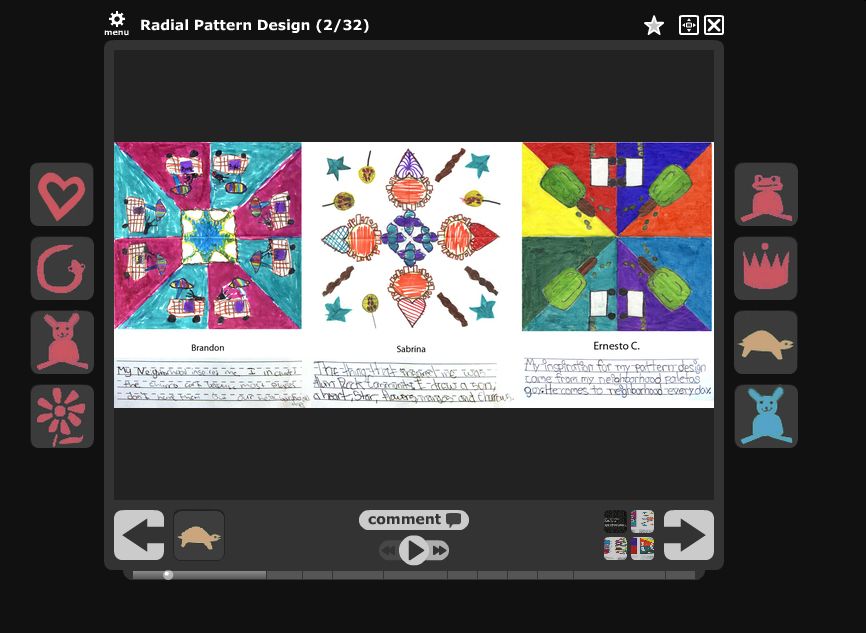
A youth building and design project leveraging traditional and online cloud tools to create a global dialog around pattern, community identity and local bus shelter needs. Locally in San Jose, the Slot Shelters project aims to instill a vision of aesthetic possibilities and anchor Silicon Valley with a sense of place.

Specifically, students address the needs of their local community's bus shelters. By creating models using cardboard and pattern cards, the students design patterns that reflect the identity, needs and environment of their community. These physical models are then transformed digitally and refined using Google SketchUp. They are saved to a Google SketchUp warehouse and shared internationally with other participating students and schools.

Why Bus Shelters? Bus stops are existing hubs in our communities. Sometimes they have shelters over them and sometimes they do not. How can you creatively re-envisioned shelters so that these waiting spots become something more for your community? How can the bus shelter you create address contemporary needs of your community?

In the process of creating and drafting these designs, students become more aware of their visual environment, more in touch with the needs of their local community, and more familiar with the design prototyping process. The digital component to the project includes 3D, digital bus shelters in a shared Google SketchUp warehouse, a downloadable online ISSUU Slot Shelters Kit, and a library of design/pattern cards for other users to print out and utilize in the and construction of their own structures.

[embed]http://youtu.be/zeonh6VKMvQ[/embed]

Currently, participating students are 4th, 5th and 6th graders from Azerbaijan, Hawaii, Utah, Washington State, San Jose and Cupertino.  In September, with the launch of the Seeking Shelter Design Challenge at the 2012 ZERO1 Biennial (a showcase of "contemporary work at the nexus of art and technology" in Silicon Valley), students will have the opportunity to submit their designs for official judging.

IMAGINE how a bus stop could be designed to renew, refresh, and connect people. Would you put in a mini community garden box? Solar cells? Bookshelves for informal book sharing? A small business kiosk?

BUILD your vision of a multipurpose bus shelter. Use slotted notecards. Use Google SketchUp.

SHARE your thoughts with us. Share concept physical models as images via Flickr or Picasa. Make a refined model in Google SketchUp and share to the “seeking shelter” 3D warehouse collection.

What does this project do so well and how can organizations learn from it?

-Collaboration and sharing: Google SketchUp (and other Google services) helps local and static projects become global and dynamic interactions

-Experiential learning in the physical realm: the Slot Shelters project begins in the physical realm, laying a foundation for the understanding of design principles and techniques before moving into the virtual realm

-Establishing communities in the virtual realm: As students build their bus shelters using Google SketchUp, they annotate each design decision. Shared online, students from across the globe involved in the product can add designs and more bus shelters to the virtual community to reflect the fibers and identity of their own environment

-Pragmatic design training: Students are given basic training with a tutorial on Google SketchUp, introducing them to the tools available, providing them with the appropriate design vocabulary and elevating their comfort level with building 3D structures in a virtual environment

-Application of project in the real-world: An installation of a conceptual bus shelter will be showcased at the 2012 ZERO1 Biennial. The public will have the opportunity to experiment with the design cards and design process by adding components to the model and working collaboratively.

Following the model of “imagine, build and share,” arts organizations can incorporate applications like Google SketchUp and VoiceThread in their educational programming and community outreach initiatives (click here for a beautiful graphic of the goals and outcomes for the project). By engaging the public in the cloud, projects and ideas become more dynamic, impactful and even international.

Love this project, love the dual-approach (physical and virtual design), and love the effort to increase awareness of the visual environment!

Canal Educatif: Art History Like You've Never Seen Before!

On YouTube, if you unearth past the layers of apocalyptic cats, nyan cats, evil cats, scary cats, and sneaky cats, you’ll find content that can actually educate you! A double rainbow for erudition! We have all heard about the instructional simplicity of Khan Academy and the brilliance of Ted-Ed, but there’s an equally fantastic channel for Art History buffs that truly deserves some viral appreciation: Canal Educatif à la Demande. Canal Educatif (educational channel) is a French co-operative project. Our aim is to produce a unique series of high-quality educational videos and make them available free of charge to young people and adults.

Since 2007, Canal Educatif (CED) has produced investigative-style documentaries on Art History, Economics, and Sciences and Innovation. Tristement, only the Art History section is available in English and it includes documentaries on works by Holbein, Delacroix, Poussin, and Rodin. But it is clear that the quality of these videos far succeeds their quantity! For example, in Delacroix’s Liberty Leading the People, the documentary explores why Delacroix, an aristocrat, would paint the very ideal he opposed and even feared? And why did Rodin leave his iconic sculptural gateway, The Gates of Hell, unfinished? Why was it never cast in bronze? These are just some of the questions answered in the highly informative series of documentaries produced by CED.

http://www.youtube.com/watch?v=yFu3aJgkYkU

The organization has also explored a new avenue in the dissemination of Art History; the Google Art Project. In a YouTube series called Art Sleuth, CED has created short, detective style explorations of some of the gigapixel paintings on the Art Project. In these clever, 10 to 15 minute episodes, the nitty gritties of close observation reveal that in art too, the devil is in the details ; what seems to be a touching portrait of Marie Antoinette and her children, can emerge as thinly veiled attempt at false benevolence and humility. Coincidentally, there are some works in which there is literally (and figuratively), a Devil in the details.

http://www.youtube.com/watch?v=gjcR90M8of4

To cover its production expenses, CED relies on micro-donations made to their website. So if you’d like to learn more about Manet’s A Bar at Folies Bergères, do make a contribution! Here’s hoping that Kickstarter will soon be launched in Europe because CED’s projects (Filmmaking) seem ideal for the crowdfunding platform. In the meantime, there’s a lot of content offered by CED on both YouTube and on its website. You certainly won't miss the repetitive babbling of nyan cats after having watched Manet’s In the Conservatory or Rembrandt’s The Prodigal Son. Let the sleuthing begin!

Pittsburgh's GoogleServe 2012

Technology solutions can be a challenge to any nonprofit. You're trying to do too many things with too little staff, and the last thing on your mind is how you're going to find room in the budget for an IT guy or gal. Thankfully, if you're based in Pittsburgh, there may be a solution.

GoogleServe 2012 is a full day of local Google employees helping nonprofits maximize their utilization of the products and services Google can provide.The event, now in its 4th year, will feature sessions for both the clueless and those who already have Google products in place at their nonprofits. GoogleServe is hosted by HandsOn Tech, Pittsburgh Cares, and, obviously, Google.

HandsOn Tech is a local nonprofit, seeking to help other Pittsburgh-area nonprofits with technology training and support. I had the opportunity to attend one of their workshops last month, about using Google+ for Nonprofits and really enjoyed the experience. If you have time to volunteer your tech skills, I highly recommend checking out their site.

Pittsburgh GoogleServe 2012 will be held Friday, June 15 at Google Pittsburgh in Bakery Square. For more information and to register, check out their website.

The Google Cultural Institute

Once a search engine for the curiously puzzled, the Google of today is not only a superior resource gateway but also a vast and interconnected information hub. When in doubt about your train of thought, just hop on aboard the Google express. Even for doubts verging on the impossible; search for walking directions from the Shire to Mordor on Google Maps and you are admonished that “one does not simply walk into Mordor.

The dangers of Sauron aside, today Google can just as easily claim that one does not simply stop googling. It is now a verb, a translation service, a virtual wallet, a communication and storage platform, a social network, and more recently, a cultural institute.

The Google Cultural Institute helps preserve and promote culture online. With a team of dedicated engineers, Google is building tools that make it simple to tell the stories of our diverse cultural heritage and make them accessible worldwide. We have worked with organisations from across the globe on a variety of projects; presenting thousands of works of art online through the Art Project, digitising the archives of Nelson Mandela and showcasing the Dead Sea Scrolls.

Of the initiatives of the Google Cultural Institute, the Art Project and the Dead Sea Scrolls have received the most amount of attention.  As such, we opted to take a look at some of the other projects that are changing the landscape (quite literally) of online cultural preservation.

Nelson Mandela Digital Archives Project In 2011, the Nelson Mandela Centre of Memory partnered with Google to digitize and disseminate the archives of Nelson Mandela. The collaboration has resulted in a visually engaging timeline of Nelson Mandela’s life, populated with photographs, diary entries, letters, and excerpts from his autobiography. The site  is worth a visit because it both explains and celebrates the enduring legacy of the South African statesman.
World Wonders Project The World Wonders Project is perhaps the next iteration of the Street View mode in Google Maps. In a partnership with UNESCO,  the World Monument Fund, and Getty Images, the project “allows you to navigate virtually around some of the most important, historical and beautiful world heritage sites through panoramic street-level images, experiencing these places almost as if you were there.” The project is an impressive window to the world but is perhaps most suited to educational purposes.

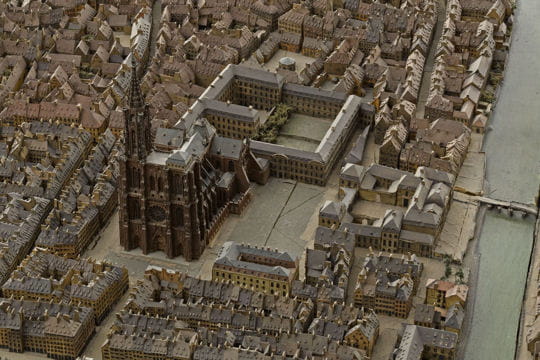
La France en relief When the Grand Palais in Paris organized an exhibition showcasing 17th and 18th century relief maps of fortified towns in France, Google helped render seven of those models in 3-D. As such, seven fortified towns in France were built anew, in all their artisanal detail, on Google Earth. Furthermore, the reach of the exhibition was no longer limited by the very concept being showcased; geography.

La Pavillon de l’Arsenal (Paris Center for Architecture and Urbanism) Just as Google re-envisioned the past at the Grand Palais, at La Pavilon de l’Arsenal, it envisioned the future. Visitors were given a chance to explore the urban landscape of Paris of 2020 through “the first ever 48 screen interactive Liquid Galaxy display, which featured “3D models of the buildings, designed but not yet built, by architects such as Patrick Berger and Jacques Anziutti, Jean Nouvel and Rudy Ricciotti.”

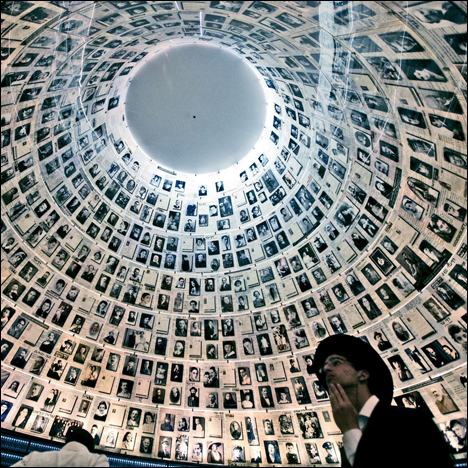
Yad Vashem Google has helped digitize the vast archives of Yad Vashem, which is “the world center for documentation, research, education and commemoration of the Holocaust.” Through a technique called optical character recognition (OCR), Google has enabled families to search for both documents and images belonging to their relatives. Here is an example given by Google: “To experience the new archive features yourself, try searching for the term [rena weiser], the name of a Jewish refugee. You’ll find a link to a visa issued to her by the Consulate of Chile in France.”
So there you have it, some of the Google's lesser known projects. Looks like culture is out there, quietly populating the internet. One need only google it.

iPhone vs. Android: What your Smartphone-of-Choice Says About You.

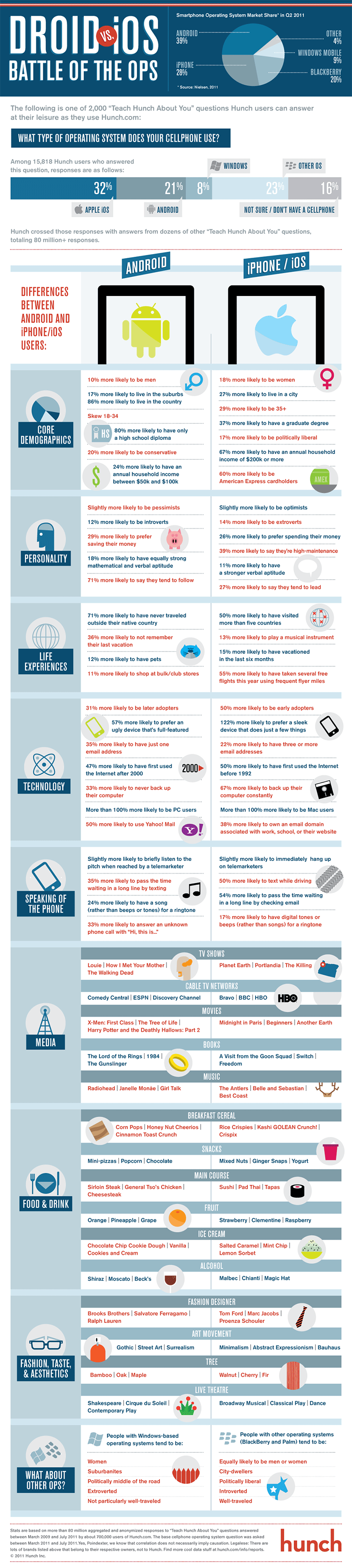
Based on over 80 million responses, Hunch blog has complied a rather…intriguing…analysis, and snazzy infographic, of smartphone users- highlighting the trends and differences between iPhone and Android users. What do you think? If you use a smartphone, do you relate to a smartphone-specific trend? How accurate/inaccurate are the findings?

Meta Data: What is it and How should it be used

The way that meta tags and meta data has been used by search engines has changed dramatically over the last dozen years.  Meta data, for those who are uninitiated roughly means data about data. Meta tags, in theory, are one of several tools that search engines and other clients use to return results in searches.  How much time should you spend on writing meta tags and meta data?  For the purposes of organization Meta will be divided into three categories:  Keywords, Tags, and Other Meta. Several articles about the demise of Meta Keywords have been written in the last couple of years. Google announced a while back that they no longer use meta tag keywords.  Bing and Yahoo do, however, use keywords as one of several hundred published criteria.  Key words are, by most expert assessments, the least valuable of meta data.  While they may assist in some search engine optimization, the best way to get your webpages in search engines is to use wording in the body of the email that contains they keywords that you would normally use in meta.  How much time should you spend on keywords?  Not much.  If you are low on time or energy this is the first thing that you should drop.

Tags are also meta data that is used in web searches.  They help to categorize your content much in the same way that keywords used to. Google has a great page for usage of these items that tell browsers and search engines what to do with the data that it sees on your web site.  You can leave instructions to not index information, not provide alternative descriptions, and not to cache your website.  You can also set up links for translation to other languages.

Title and description is essential meta data.  If you are using a WYSIWYG editor such as Word Press or Joomla the Title and Description are automatically embedded into your HTML as you fill out the handy fields that are provided to you.  The description of any page returned through search is displayed as a snippet in the results.  This text is sometimes truncated depending upon the search engine and settings on your computer and the length of the description.

For more information about Meta go to the W3 website.  In fact even if you aren't interested in Meta Data you should probably go to the W3 website and familiarize yourself with the content.  Anyone who has a website should be aware of W3 and the tools and information available.

An Uncontroversial Use of Cell Phones in Movie Theaters with This American Life Live

This American Life Live made us use our cell phones in theaters this last Thursday, May 10, 2012.  It was great.  In fact is was so engaging that we made music together.  The audience stomped and snapped their fingers along to music that OK Go was playing live. The instructions were:  if you have an iPhone or an Android you were to download the This American Life Live app before coming to the show.  The app was written in part by one of the members of OK Go to enable the audience to play a backup part to the music that the band was playing.  Those without smart phones had a role too.  They stopped and snapped their fingers.  The cues for this were scrolled down a split screen (with the band on the other half of the split screen) in a similar fashion to the cues for Guitar Hero or Rock Band (though actually a bit easier to read).  The warm up song was a hand bell version of Nirvana's Smells Like Teen Spirit followed by Ok GO's Needing/Getting.  The theater rang with music from over the speakers but was lent depth by the sounds generated by the mobile devices.  There was a palpable sense of excitement as people tried to keep up with the musical instructions and percussive stopping directions. It was easy to sense the engagement and the audience was giddy and laughter rang out after the collective performance.  All in all it was a great success.

The success of this event want predicated upon the idea that the rules will have to be broken.  Ira Glass stated during his introduction to the piece using cell phones that he, himself had to call the heads of two movie theater companies to clear the usage of cell phones in the theaters he was using.  The convention of not using cell phones helps to create a positive experience for other patrons during a regular show.  The usage of these devices as part of the show was a refreshing and creative way to break the rules and to let the cell phone juju out.  Interestingly after the cell phone piece no one in the audience ventured to use their phones.

Perhaps the best and most effective way to discourage cell phone use in a theater is to provide engaging and captivating content.  A sure sign that a performance is failing to engage is cell phone use which is an indicator that checking out is occurring.  A recap of the This American Life Live event has links and images of the performance including a Terry Gross and Mike Birbiglia short film which is priceless.

In Case You Missed It - May 2012

Things are slowing down here at Tech in the Arts as we prepare to enter our summer schedule. A decrease in posts does not mean a decrease in quality, however, and this past month we had some great articles.

Overall, a really great month. Here's to June!

American Association of Museums Trend Watch 2012

The American Association of Museums recently published a report titled Trends Watch 2012, Museums and the Pulse of the Future. According to AAM, the field of museology could beat to the rhythm of seven emergent practices in upcoming years. Namely, these are crowdsourcing, alternative social enterprises, public engagement, microgiving or crowdfunding, changing demographics, augmented reality, and new educational opportunities.  Of these trends, crowdsourcing, crowdfunding, and augmented reality will be explored in detail as technology fuels their very existence while the arts nourish their popularity. Crowdsourcing

Museums of 2012 should not shy from “harnessing the crowd”, especially when that crowd is more than willing to engage in unique tasks and activities. The report cites examples such as the Smithsonian Museum, which asked the public to vote on “which examples of video games to include in its “Art of Video Games” exhibit. As the PSFK reports, even the New York Public Library sought help from the public in its effort to overlay historical maps “onto the open, modern-day map, drawing from the library’s expansive map database that includes everything from maps of building types for fire insurance purposes to agricultural maps of droughts.” The report mentions Wikipedians in Residence, Digitalkoot project, and the Children of Lodz Ghetto Project as other examples of engaging the online world in content publishing and editing, archiving (through gaming!), and even historical research.

For museums, crowdsourcing is a novel way to increase volunteering while capturing the interest of experts and community members alike. Yet, not all tasks lend themselves well to the phenomenon; the crowd is best utilized when tasks are fun, meaningful, or interesting, and require large amounts of individual input. Additionally, while crowdsourcing speeds up the pace and broadens the scope of projects, “it also increases the burden of oversight and quality control.”

Crowdfunding    

When it comes to funding for the arts, not everybody (including the government) is willing to give a lot. But when a lot of people give a little, what emerges is the financially fantastic, win-win idea of crowdfunding. The report suggests that Kickstarter, Indiegogo, and Peerbackers can be used “to reach people who may never have heard of your museum and invite them to support projects ranging from acquisitions to exhibits to building expansions.”

The report also points to the possibilities of mobile giving with the introduction of Google Wallet and Card Case. Another fundraising initiative noted is Philanthroper, a start-up that helps raise funds for non profits via “an e-mail each day featuring a 501(c)(3) organization that subscribers can choose to support with donations of up to $10.”

For a successful crowdfunding initiative, an organization needs to think beyond the incentive of tax deductible donations. The most successful Kickstarter campaigns involve people in their creation send them tokens of appreciation (often the end products themselves). Thus personalized, fun, and unconventional incentives are key to appeasing to the masses.

Augmented Reality    

Reality limits the possibilities of what is, could be, and was. So augmented reality, in all its limitlessness, was introduced to help us imagine beyond what is. According to the report, “AR refers to a set of technologies that can layer digital elements—sound, video, graphics, even touch sensations—over real world experiences via mobile devices.”

One of the examples noted in the report is Streetmuseum Londinium, an app developed by the Museum of London which lets visitors explore Roman London and “ provides soundscapes to accompany scenes of Roman life superimposed on the modern city and encourages users to brush away dirt by blowing into their iPhones, “excavating” virtual artifacts in the process.” Another example of AR, not noted in the report, but cool nonetheless was used by the Science Museum in London. For its exhibit, Making of the Modern World, the museum created an app using a 3D avatar of Top Gear host, James May, who explained the significance of the objects in the exhibition.
Augmented reality certainly opens up possibilities but as the report notes, there is a fine line between engaging visitors and overwhelming or confusing them.  It also suggests that AR can be used to exhibit and exist beyond the walls of the museum. Layar, an app by The Andy Warhol Museum that lets “users to explore Pittsburgh and New York City through the eyes of Andy Warhol”, is one such boundary defying example.

Additional details and insight into all the other emergent practices can be viewed in the AAM report. While these trends may not necessarily define the future of museums, they certainly put them on the path to a new technological era. Museums, who says you can’t be both conservative and trendy?


Turning Around Education with the Turnaround Arts Initiative

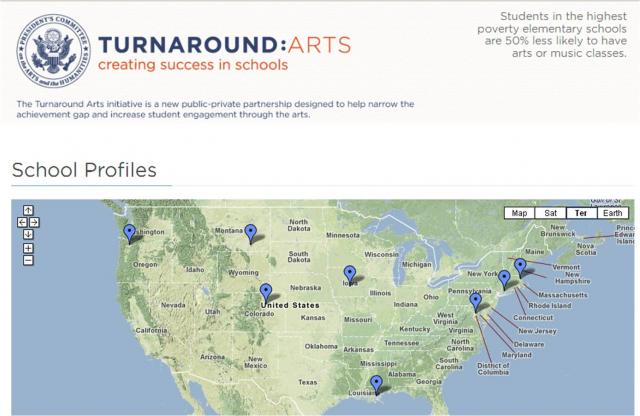
By now, you have probably read about President Obama’s Turnaround Arts Initiative in the paper, seen a segment about it on the nightly news, or heard about it on Entertainment Tonight  between cosmetic secrets of the stars at the Metropolitan Gala and celeb sightings of Blake Lively with Ryan Reynolds (Wedding plans in the works? You didn't hear it from me...). If you are still curious about the Turnaround Arts Initiative, then this post will provide you with a tidy summary of the program from a policy and arts education perspective. Unfortunately though, this post does not include details on Eva Longoria’s summer workout plan and how-to advice on beating the heat in Mila Kunis-esque summer dresses. Sorry.

“We are, as a country, engaged in a national conversation about how to fix our nation’s broken schools. We feel strongly that, while no one strategy alone is a silver bullet, art education should have a seat at the table. Turnaround Arts will test that theory, in addition to bringing effective arts education to thousands of our neediest young people and creating more access to the arts in our most underserved neighborhoods.”

The Turnaround Arts Initiative is:

• an arts education funding initiative in full swing as of April 23, 2012

• a public-private partnership designed to help narrow the achievement gap and increase student engagement through the arts (private partners include: the Ford Foundation, the Herb Alpert Foundation, Crayola, the NAMM Foundation, the Aspen Institute and Booz Allen Hamilton)

• a creation of the President’s Committee on the Arts and Humanities (PCAH), in coordination with the U.S. Department of Education and the White House Domestic Policy Council (other public partners include the National Endowment for the Arts, the Arts Education Partnership, the Council of Chief State School Officers, and the National Assembly of State Arts Agencies)

• testing the hypothesis put forward by the PCAH’s 2011 report Reinvesting in Arts Education: Winning America’s Future Through Creative Schools, that “high-quality and integrated arts education can be an effective tool to strengthen school reform efforts-boosting academic achievement and increasing student motivation in schools facing some of the toughest educational challenges in the country”

• directed at the nation’s lowest-performing elementary and middle schools across the country, known as “turnaround schools” (turnaround schools are in the lowest-performing 5 percent of their state and receive School Improvement Grants through the Department of Education)

• a pilot project at this point, schools have already been selected to participate

• a two-year project, results will be evaluated at that point, program expansion will be considered, and resources will be made available from which ALL schools can benefit

What will the Turnaround Arts Initiative do and how will it be evaluated?

• Provide the selected schools with arts education services, resources and materials to “increase the likelihood of successful school turnaround, engage their community, and raise the visibility of their achievements”

• The key to the program's success is fully integrating the resources into the curriculum, making effective, impactful and rigorous arts programming part of the school’s being

• The impact and effectiveness of arts education in advancing academic achievement, student and community engagement, and overall school performance will be evaluated and reported by Booz Allen Hamilton, a consulting firm, at the close of the two-year term

Why did Entertainment Tonight cover the Turnaround Arts Initiative? Eight under performing schools across the country were selected through an application process. These schools have each been “adopted” by celebrity artists who will remain involved in the school’s curriculum reform by participating in events, performances, and classes. Below is the breakdown of each parent artist and their adopted school(s):

• Chuck Close (award-winning visual artist), Roosevelt Elementary in Bridgeport, Connecticut

• Yo-Yo Ma (award-winning cellist), Orchard Gardens School in Boston, Massachusetts

• Sarah Jessica Parker (award-winning actress), Martin Luther King, Jr. School in Portland, Oregon

• Kerry Washington (award-winning actress), Savoy Elementary in Washington, DC

• Forest Whitaker (award-winning actor), Findley Elementary School in Des Moines, Iowa

• Damien Woetzel (arts leader, previous Principle Dancer with New York City Ballet), Lame Deer Jr. High School in Lame Deer, Montana and Orchard Gardens Schools in Boston, Massachusetts

• Alfre Woodard (award-winning actress), Batiste Cultural Arts Academy in New Orleans, Louisiana and Noel Community Arts School in Denver, Colorado

Is there opposition?

• Diane Ravitch, author and previous U.S. Assistant Secretary of Education under George H. W. Bush and Bill Clinton, says the Turnaround Arts Initiative is just a “teeny, tiny little band-aid on what is a giant, national, festering problem…And it doesn’t begin to address the needs of the schools.”

But we have to start somewhere, right? Many school systems and communities are eager to be included in the program as it offers promising opportunities and resources customized to fit the needs of each school. However, as a pilot project with strict parameters, the Turnaround Arts Initiative is currently focused on evaluating the impact and results of the program on the eight selected schools over the next two years. Meanwhile, schools and the general public can stay informed about the project, its progress, and resources made available by referring to the Turnaround Arts Initiative website, its Twitter feed, and the Arts Education Partnership’s webpage.

Stay informed about the Initiative, stay inspired by its intentions, and keep advocating for arts education funding on a local level.

A Recap of the Year We Spent Together

First, some sad news to share with everyone: this is my last post for Tech in the Arts, the quintessential blog looking at the intersection of arts and technology online. As a student here at Heinz College, it has been an honor to share with you on a weekly basis a look at different trends and topics at that very intersection, with a little bit of policy thrown in. For my final post, I wanted to take a look back at some of my favorite posts from the past year, and share with everyone what my thought process was when it came to writing about the important issues that affect the arts community on a daily basis.

Compared to the other writers here at Tech in the Arts, I have always tried to take a different approach – one that is centered on public policy, and how it impacts the arts community and arts lovers everywhere. As a Master’s student in public policy here at Carnegie Mellon, this is what I study on a daily basis and what I am passionate about, and I have been determined to include it in the overall conversation.

One of the topics I have written about frequently is the issue of funding for the arts, and the somewhat uncertain future it faces. Many cities and states, and even the federal government, are facing times of budget austerity, and cuts to the arts are happening at an alarming pace. I also wrote about the National Endowment for the Arts and its funding history, along with the new upstart on the arts funding block, Kickstarter. Arts financing in Europe has also been the target of deep cuts, and I finally looked at the debate surrounding what method of funding was the best for the arts in America. And in my very first post, I talked about how important it was (and still is!) to protect federal funding for the arts.

One of my favorite topics to write about was where arts and public policy intersected. One of my favorites to write was looking at where public policy lived through the eyes of the artists; another was a look at artistic revisions of the American Dream of buying a home. As we all know, the arts play a large role in economic development, which I wrote about, and I also took a look at how cities are thinking differently when it comes to development, often using the arts to differentiate them. Finally, I took a look at how cities are beautifying themselves through public works of art, as they face budget shortfalls and have to think creatively.

The most popular piece I wrote this year (and perhaps the most controversial, given some of the feedback and comments!) was looking at the debate over the most artistic city in America. The winner (as crowned by the Atlantic) was Santa Fe, but certainly cities everywhere can make their own legitimate cases for being the most artistic. Its topics like that are so much fun to write about; everyone has an opinion, wants to make their case for their own city, and it encourages discussion and debate.

I also enjoyed writing about an issue that doesn’t receive a lot of attention in the arts community, but is very important nonetheless, which is the issue of net neutrality. I wrote about how important the issue is, and also about how the issue is not going away anytime soon.

Finally, two of my favorite posts were about topics that don’t fit neatly within any of the above categories: My look at the Google Art Project and the White House, and also my look at the fall of Kodak and its effect on artistic inspiration.

It’s been a pleasure being a part of the fantastic and talented team here at Tech in the Arts for the past year. Thanks go out to everyone on the team for their help and support, and chiefly for the opportunity to write for all of you on a weekly basis. Thank you to everyone for reading, for being so supportive and for the kind comments and responses throughout the year.

For those so inclined, you can follow me on Twitter at @seanbowie, and can reach me by e-mail at seanmbowie@gmail.com. It’s been a pleasure everyone, thank you!

25 Best Kickstarter Tips for Creative Students

While blockbuster Kickstarter projects receive a lot of attention, it's important to remember that small projects have more success on the website than these massive funding campaigns. We talk a lot about the best ways for organizations and artists to utilize Kickstarter, but what about students who haven't entered the field yet? Fortunately a Tech in the Arts reader pointed us to this article on BachelorDegreesOnline.com's blog with 25 Best Kickstarter Tips for Creative Students. It's got some great tips that every Kickstarter project could benefit from. One of my favorite tips on the list is number 24:

24. Engage your audience

A neglected Kickstarter page is one that will likely go unfunded. Be careful not to simply set up shop and walk away. Rather, you've got to stick around, posting updates, answering questions, and interacting with the people who have put their faith and money into your project. Your backers want to be a part of what you're doing, and you've got to make an effort to let them do that.

After all, isn't engagement the ultimate goal of web 2.0? To read the rest of the tips, click here.


Confirmed by Nonprofit Quarterly: Generating online content is NOT optional

Just when you thought your nonprofit’s résumé was updated and accurate, it is time to add another job responsibility: publisher.

As recently reported by Joe Waters with Nonprofit Quarterly, “Nonprofit employees have always had to wear a lot of hats: fundraiser, marketer, grant writer, etc. Here’s one more you need to get used to wearing: publisher. Fortunately, this additional job has a real benefit, as it engages current and potential supporters with useful, interesting and credible information that directly drives donor support.”

The key to generating and publishing online content is to be timely, stay relevant, and to “inform, educate and inspire.” Unlike an advertisement, online content allows followers to interact with the information, contribute and hear/see/participate in the organization’s story.

While many of our followers have already identified and addressed the publishing aspect of their nonprofit work, Nonprofit Quarterly offers three reasons why generating and publishing online content is no longer an option for small nonprofit organizations.

1) “It’s part of being a top nonprofit brand”

Build community around your brand and cause by publishing engaging, inspiring, visually compelling and relevant content (and just to clarify, that is NOT your monthly newsletter).

2) “You need to stand out”

It’s a dog-eat-dog world out there. We are all on Facebook, we all have Twitter accounts for our organizations, many organizations maintain blogs—it’s time to step up your online content, videos, podcasts, links, downloadable and free content, etc. Simply having an online presence is no longer enough. Though we prefer to think we are not competing with other nonprofit organizations, the truth of the matter is, we are.

“With more and more nonprofits coming online each year, content is a key tool in separating your nonprofit from the pack. This is especially important as people search for your nonprofit on Google, Bing and Yahoo. Several factors are important in how search engines rank and deliver search results, but one thing is clear: if you don’t produce high quality content and links, online searchers won’t find you. Period.”

3) “You can’t just do good work anymore”

Nonprofit to nonprofit, many of us share similar, philanthropic visions for our organizations. Because of this, the general public has its pick of relevant, benevolent, and noble organizations to support and fund. So now that you can’t claim your work is MORE important or MORE charitable than the next nonprofit’s, how do you get that donor’s attention and dollar? Answer: tell your story in a compelling way, manipulating the resources the web provides. Facebook photo albums, Twitter contests, IncenTix by ShowClix, Pinterest, podcasts, infographics – these and the resources we feature here on Technology in the Arts can help you do just that.

Am I suggesting all nonprofits abandon the newsletter and print medium in this competitive, nonprofit landscape? Of course not. YouTube channels and 140-character-Twitter-contests are wasted on my parents. They look for the newsletter in the mail every month (but continue to impress me when they sign up to receive them by e-mail…way to go, Mom and Dad, makin' me proud).

Publishing online has become increasingly dynamic, visual, and allows for a voice in 3-D; a voice that speaks louder, in more colors, and more emotionally than the traditional newsletter printed and mailed for years and years. Storytelling has moved online with a worldwide audience waiting to feel emotionally compelled, connected, and stimulated by the content your organization generates and publishes.

Up for Debate: What is the Best Way to Fund the Arts in America?

It is a topic that we have covered extensively here at Tech in the Arts over the past couple of months: what is the best way to fund the arts in America? With the National Endowment for the Arts seeing budget cuts, Kickstarter growing in popularity, and increased austerity measures around the world forcing large cuts to the arts, the topic has received a fair amount of attention in recent months. Last week, the New York Times, as part of its perennial “Room for Debate” series, asked the question I mentioned above, along with some others: What can we do to stabilize funding? Can we learn from the experiences of other countries? What can be done to improve effectiveness?

The Times gathered eight individuals from the artistic, non-profit, and political sectors, asking them what they believed were the best ways to fund the arts. Their answers might surprise you.

The eight respondents in the series tended to gravitate towards two positions: either the government needs to do more to fund the arts and various programs, or the government needs to get out of the way and the responsibility should rest on individuals instead. Like most policy debates, the question naturally comes back to what role the government should play; while some would argue too little is spent on funding (for example, the NEA received $147 million last year, a tiny, tiny fraction of the overall federal budget), others would say that instead of the government using taxpayer dollars to fund programs, it’s better left to the private sector and individuals to decide what programs should be funded.

Going through the eight responses, it was interesting to see how each person eventually gravitated towards one of these two areas. Some were more explicit and forward than others, but it’s this tug of war between more government investment and less government involvement that always seems to come up when debating any kind of public policy. The arts are no exception.

I encourage everyone to read the entire discussion, but I will summarize the eight viewpoints below.

Beth Nathanson, director of development at Playwrights Horizon, is quick to point out America’s “culture of philanthropy,” and says the following:

“It is a misconception that corporate or government support has ever provided the majority of arts funding. Each United States citizen pays about the cost of one postage stamp in taxes to support national arts and arts education programs. And those corporations that fund the arts primarily fund prominent organizations serving a high number of people. The real stars of arts giving are individual donors. They provide the lion’s share of support across the country, and on average, give more to arts than corporations and government entities combined.”

Nathanson points out that the arts are a fundamental part of our daily lives, and encourages individual investment in the arts, instead of government involvement. She, and many others, point to the Brazil model, which is a sort of public-private partnership that raises funding for the arts through payroll taxes. Everyone can certainly agree that “the arts should be an integral part of our lives,” the question becomes, in the end, how is that managed and developed? While taxes are certainly one way, personal responsibility, through giving, is another possibility as well.

David Boaz, of the Cato Institute, a libertarian think tank based in Washington, takes the individual model a bit further, and says that all arts funding needs to be separated from the government, because the government has too much control over where the money is spent. Better to let individuals and the private sector handle the responsibility instead, Boaz writes:

“People should not be forced to contribute money to artistic endeavors that they may not approve, nor should artists be forced to trim their sails to meet government standards.”

Boaz goes on to mention Kickstarter, an outlet for individuals to direct money to programs they explicitly support. This approach, Boaz argues, is preferable to the NEA’s approach, which is to take money from all taxpayers and then direct it to programs the agency support.

Robert Lynch, CEO of Americans for the Arts, disagrees. Instead of spending less on the arts at the federal level, we should be spending more, and seek to start a “national dialogue” on the importance of arts funding. Lynch writes:

“Last month, 800 advocates were in Washington to defend to Congress the 47 cents per person that America spends on the National Endowment for the Arts. This amount should be much more but despite its seemingly small percentage, government support leverages billions in matching dollars, increases access — especially for the underserved — and encourages new voices, ideas and expressive endeavors that have kept the U.S. at the vanguard of creativity and innovation.”

Lynch writes about America needing to have the “creative will” to move past the issue of why funding is so important and start talking about how we should do it. Lynch, and many others, believe government revenue is the best way to do that.

Sergio Munoz Sarmiento, an artist and arts lawyer, takes issue with “mandatory funding,” the idea that everyone contribute to the same pot and those funds have to be spent each year:

“Arts funding should be encouraged, yet voluntary. Mandating government and corporate subsidies for the arts raises a few concerns for me. Will mandated art subsidies affect the quality of artistic production? Will this type of funding encourage a passive artistic community? And finally, will it create a curatorial practice on behalf of granting institutions?”

In other words, a program where funding is guaranteed does a disservice to artists, who will not be as entrepreneurial or imaginative if funding is a certainty. Better to have more competition and uncertainty, which will lead artists to become more daring, creative, and/or original in their works.

Clyde Valentin and Kamilah Forbes, of the Hip-Hop Theater Festival, focus on the reliability of arts funding, and maintain that a stronger commitment to the arts will encourage more collaboration and certainty among artists and arts groups:

“The experience of the Hip-Hop Theater Festival is that where our funding is most reliable, our programs have the most impact. In Washington, for example, our partnership with the D.C. Commission on the Arts and Humanities has enabled our organization to produce the D.C. Festival for little or no direct cost to the public. The festival draws an unprecedented audience annually to some of D.C.’s most prestigious arts institutions, reaching thousands who get to experience art they would never otherwise have an opportunity to see.”

Michael Royce, executive director of the New York Foundation for the Arts, is another defender of federal funding for the arts. In addition to greater federal funding, he encourages greater incentives, through federal tax policy, for individuals to donate to the arts as well:

“The U.S. model has traditionally given incentives for private support, usually through tax deductible donations. Likely the most efficient method of increasing private funds is to strengthen those incentives. For example, the current cap on tax-deductible contributions is 10 percent of taxable income and could be raised for arts contributions, perhaps to 15 percent. Smaller companies, through cash grants or in-kind donations, can make vital and targeted contributions to specific artists' projects. On the individual level, tax forms could allow for earmarked donations to the arts.”

Royce, and many others, agree that the problem is that there simply isn’t enough funding for the arts at this time. Through greater federal investment, and tax incentives, Royce argues for a new model.

Finally, Stacy Palmer, editor of the Chronicle of Philanthropy, talks about how little of the money donated to charitable causes in 2010 went to the arts community: only five percent. The majority of the money went to places like universities, religious groups, and hospitals. She also points out the myth that most arts funding is donated by the wealthy:

“It's a myth that the rich are keeping the arts alive; while many are to be commended for their huge donations, America's millionaires and billionaires provide a small portion of the money that flows to cultural causes.”

Palmer points out that it is time to “rethink” how everyone, including the public and private sectors, individuals, and arts organizations steer money towards the arts, which is something I think all of us can agree on.

Taken together, the New York Times series was a fascinating look at the different perspectives towards how arts should be funded in the U.S. All of us can agree on the problem: the arts need more funding. The question, going forward, is how to best do so.

Whether it is continued federal support towards groups like the National Endowment for the Arts, more of a focus on private alternatives, like Kickstarter, or some kind of combination of the two, the debate is sure to continue.

After reading the different responses, where do you stand? How should funding for the arts be developed in the United States, and what steps can we take to get there?