This article explores how extended reality (XR) - including augmented, mixed, and virtual reality - is reshaping acting training by layering immersive technologies onto long-established methods like Stanislavski-based technique and the Method. Drawing on examples from Basrah to Juilliard and Odin Teatret, the piece shows how XR can deepen character work, expand dramaturgical research, and personalize feedback through data-driven simulations. At the same time, it raises urgent legal, ethical, and social questions around biometric data, FERPA and HIPAA protections, digital Blackface, and harassment in virtual spaces. Rather than treating XR as a magic solution, the article argues that thoughtful pedagogy, clear institutional policies, and equity-minded design are essential if these tools are to support - not replace - human-centered theatre education.
This article analyzes Ireland’s emerging position as a global cultural policy case study, focusing on the Basic Income for the Arts (BIA) program and its place within the national framework Culture 2025. While Ireland’s consensus-driven political system, strong arts advocacy networks, and history of support for artist income have enabled an ambitious, research-oriented basic income pilot, the article highlights deeper tensions within cultural policymaking. Drawing on Stephen Hadley’s concept of “cultural policy realism,” it argues that Ireland’s policies—despite their novelty—remain rooted in traditional, instrumentalist views of culture as an economic engine and national branding tool. By contrasting democratization of culture with cultural democracy, the piece situates Ireland’s model between innovation and reversion, emphasizing the need for sustained experimentation, critical evaluation, and more genuinely democratic approaches to cultural support.
This study advances Part II by translating Scopely’s strategy into an execution plan across three tracks - NPC innovation, intelligent monetization, and ethical LiveOps - supported by new evidence from a 1,159-response consumer survey, nine expert interviews (developers, influencers, and experiential professionals), and secondary industry research. Part I established the market context for AI’s disruptive potential and identified three priorities: live operations evolution, commerce optimization, and advanced player analytics. The goal of this phase is to pinpoint the highest-leverage AI applications that deepen gameplay engagement, convert payment resistance through demonstrated value, and safeguard community trust. Accordingly, Part II outlines actionable playbooks (context-aware NPCs and adaptive narratives), platform tactics (purchase-aligned mobile personalization and cross-play integration), and operational models (behavior-based matchmaking and transparency protocols) designed to drive scalable, technology-led growth while preserving the integrity of shared human play.
This study provides a comprehensive analysis for Scopely to enhance its position as a leader in interactive and mobile gaming, focusing on AI integration in live operations, in-game commerce, and player analytics. The research reveals the urgent need for gaming companies to navigate accelerated AI adoption and evolving player expectations for personalized experiences. The goal is to identify the most impactful AI applications over the next three years and strategies that maximize engagement and monetization while maintaining player trust. Significant to this goal is balancing innovation with ethical considerations, including data privacy and transparency, while recognizing AI's potential to enhance storytelling and create immersive experiences. Employing a mixed-methods approach with industry interviews, a survey of over 1,000 U.S. gamers, and secondary research, Part I establishes the foundation for understanding AI's transformative impact - setting the stage for Part II's empirical findings and strategic recommendations.
A daylight robbery at the Musée du Louvre in mid-October resulted in the theft of eight priceless pieces from the French Crown Jewels housed in the Galerie d’Apollon. The incident now serves as an in-depth analysis for arts leaders globally to confront not only external threats, like highly organized professional thieves, but also the complex, internal risk of compromised staff and the urgent need to re-evaluate their security posture, technological investment, and institutional accountability.
While reading over the Arts Marketing Blog Salon entries this week, particularly David’s entry on the rise of the citizen critic and Ron Evans’ post on online reviews, I was reminded of an experience I had a few years ago when our local paper cut its classical music and dance critic. I had a meeting with many of the marketing directors in the city, who were understandably upset about the firing and convinced that their success was inextricably linked with newspaper coverage.
Should we adapt to new technology before we adopt it for our own uses?
Many of these people had been in marketing for 30 years. When they first started out in the business, the primary marketing channels were TV, radio, and newspaper (and maybe billboard, telemarketing, or fax.) When a new medium was introduced, it might take a while to master, but that was fine. The learning curve was viewed as an investment because you knew that medium would still be around in five years.
Compare that to now. We have new, “must-have” technology platforms coming out nearly every 6 months to a year. Today, we are being pushed toward mobile apps for phones and iPads, geolocation social media like Foursquare, and more. We are not sure if these technologies will still be popular in three months, let alone five years down the road. Combined with the slow-but-steady demise of many of the “classic” marketing channels, it leaves us constantly wondering: how quickly should we adapt and adopt, when it comes to new technology?
Specifically relating to citizen critics, these two issues come head-to-head. Firstly, we have the citizen critics adopting new media platforms for distributing their reviews. Then, we as arts managers must decide if and how we will adapt to them—ignore them, embrace them, meet them on their own turf with a social media friendly press release, etc.? How do we decide?
When I studied communications technology in undergrad, one of the first things we talked about was Moore’s Law, the principle that the capacity of new technologies doubles every 18 months to two years. It applies not only to the memory size on a new laptop or the number of pixels in digital cameras, but it also describes the exponential rate of change we are experiencing as a society. I find myself thinking about this principle every time I hear that arts organizations “should be using” this new platform or that new tool.
Even though the capacity of the technology may have increased or the new platform may have reached critical mass in usage, my workload capacity typically has not increased nor has my motivation to take on one more task reached critical mass! Chloe Veltman’s post does a wonderful job in relating this back to arts managers, speaking to both a difficulty in adapting to the demands of social media (particularly Twitter) as well as a resistance towards adopting it as part of audience engagement.
So, typical of this age in which we are often left with more questions than answers, I leave you with two questions to mull over when planning your marketing strategy: What are the signifiers that it is time for your organization to adapt to a new technology? Which signifiers indicate that your organization should adopt the use of a new technology?
During last week's Arts Marketing Blog Salon, Mary Trudel advocated connecting with audiences via mobile technology. CTIA, the international association for the wireless telecommunications industry, recently revealed that mobile phone market penetration in the United States reached 93% for the nation’s total population in June 2010. With usage numbers like that, there is no doubt that arts organizations should be investing in mobile engagement.
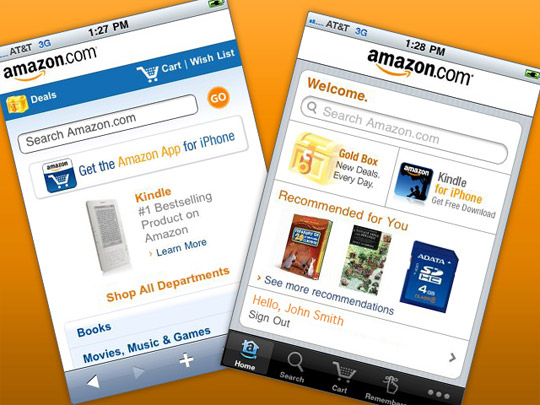
Amazon can afford to have both an app and a mobile site.
But which should you choose if your budget is more limited?
The dilemma lies in whether to invest in a mobile website or a mobile application. If your organization’s budget allows you to invest in both, then you need not read any further. Congrats! However, if your organization’s budget dictates that you choose between investing in a mobile website or a mobile app, then here are some things to consider.
User base: While 93% of U.S. residents have mobile phones, the U.S. market penetration for smartphones is 31%. This means that 62% of the U.S. population uses mobile phones for which they cannot download mobile applications.
Connectivity: Whereas mobile websites require users to be connected to the internet, many mobile applications do not require an internet connection once they have been downloaded to your smartphone. This may be important for patrons who are trying to engage with your organization but are in an area where wireless service is not available.
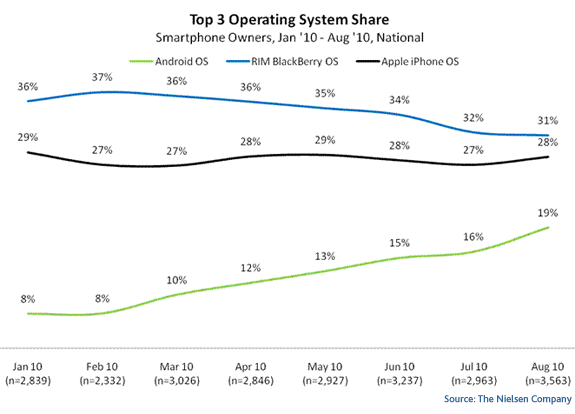
Platforms: Mobile websites are accessible from all types of mobile devices. Mobile apps, however, are tied to specific types of devices. For example, a patron with an Android smartphone cannot use a mobile app designed for an iPhone. Now, you may be saying to yourself, “Yes, but iPhones are the most popular smartphones on the market, so we should just design apps for iPhones.” If so, then you will be surprised to learn that Blackberry has 31% of the U.S. smartphone market share compared to the iPhone’s 28% and Android’s 19% according to The Nielsen Company.
Price: Mobile websites are less expensive than mobile apps, because they usually lack the design elements and functionality that make mobile apps interactive and appealing.
Expectations: What do your patrons want from their mobile experience? Have you asked them? If your patrons simply want information (hours, directions, descriptions of work, etc.), then a mobile website is entirely sufficient. If you are looking to provide your patrons with an interactive, one-of-a-kind mobile experience, then you’ll need an app for that.
In a recent New York Times article, Edward Rothstein took a look at a number of mobile apps developed by museums and concluded:
I have used museum apps to help me navigate museums. But I have generally felt used along the way, forced into rigid paths, looking at minimalist text bites, glimpsing possibilities while being thwarted by realities… It is best to consider all these apps flawed works in progress.
In a response to Rothstein’s article, Brooklyn Museum’s Chief Technology Officer Shelley Bernstein shared:
I had mixed feelings about the article – I mostly agree that these apps all leave much to be desired, but I disagree that we shouldn’t be trying. Experimentation without perfection is a good thing…Each and every visitor walking in our doors is likely to expect something different from an app, and every visitor is going to respond differently to what we provide. My point is that it is our responsibility, collectively, to try new approaches and provide as many entry points into content and the museum as possible.
So, mobile website or mobile app? Personally, I believe that a mobile website should be phase one in any arts organization’s mobile engagement plan. Okay, I hear you asking, “Why? Won’t the phone’s browser just show my desktop website?” The best way to answer that question is to try it.
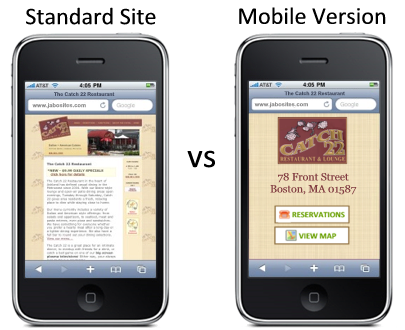
Go ahead. Take out your phone. Go to the menu, and select the internet option. At the prompt, enter your organization’s web address. Try it on several different devices. You will quickly notice that your standard website looks unusable on every phone. The one exception to this may be an iPhone, but even it will require the user to point, pinch and slide their way to your information.
Even if you have an iPhone, standard websites are not as easy to navigate as mobile sites.
Mobile websites are designed and optimized with the mobile user in mind. They cut to the chase and present content that is relevant for mobile users. They present the content in a way that is optimized for mobile phone screens. But most importantly, mobile websites allow your patrons to access pertinent web content from any mobile device – not just an iPhone.
Still not convinced that your arts organization needs a mobile website? Morgan Stanley’s global technology research team recently released a report projecting that mobile internet usage will surpass desktop internet usage in 2014. If you do not have a mobile website, then the steadily increasing number of internet users who attempt to access your information via mobile devices will get the wrong content, presented in the wrong order, with a slow and costly download, and with an ill-adapted layout.
Don’t let this happen to your patrons. Even if you do not have room in your budget for a custom-designed mobile site, there are a number of resources available for converting your current website into a mobile-friendly site.
The world of arts management is changing, as all industries are changing, with the proliferation of technology. Especially with the increasing popularity of online media, we as arts managers have had to reconsider the way we see our performances. Is online video footage merely a vessel for our product? Or is it, in fact, our product? Or, can it also be a means to an end?
Many see social media and its democratization of internet content as the tool that will restore relevance to the arts, which critics claim is no longer present.
In recent weeks, we’ve seen changes in the social media landscape that make the issues surrounding performance footage all the more relevant. Twitter is adding video embedding capability. YouTube will soon be able to handle streaming video for content partners. These are signals of a trend that is already in progress—a movement of online video footage becoming not only accepted, but commonplace. Like it or not, online video is here to stay.
It was for this reason that I assembled a panel of experts on the rise of streaming video, and its interaction with our union relationships to speak at the NAMP Conference this November. It will be an opportunity to talk about the challenges that we face, as an industry, when it comes to video footage.
As an employee of an arts service organization and an arts management student at Carnegie Mellon, I’m in a unique position to examine performance footage in social media. Instead of having a vested interest in what would be best financially for a given organization, I can look at what is best for the arts industry as a whole and where the industry stands on these issues.
Over the past year, I’ve been looking at intellectual property issues as they pertain to performance footage. This research will culminate in an upcoming white paper for the Center for Arts Management and Technology. I’ve talked to unions, I’ve talked to organizations, and I’ve talked to artists. It’s fascinating to listen to their positions and how they perceive “the other side.”
Artists sometimes view online distribution of performance footage as a sort of Pandora’s Box: releasing their performance footage means relinquishing control of it and monetization of the content. They see organizations as trying to take advantage of their skills, or reducing the value of their work. Although they understand that organizations are struggling, they are struggling, too.
Organizations, on the other hand, are struggling with the realities of the economic downturn, as well as a decrease in newspaper circulation and in the general effectiveness of advertising in traditional media. They see new media as a lifeline, and take it on in order to secure their organization’s future. Some perceive that artists don’t equate saving the organization with saving the artform and the artist’s own career. This assumption leaves them puzzled and unsure how to proceed.
Although these positions seem diametrically opposed, both artists and organizations have common interests. In choosing and chatting with my panelists, who come from all different disciplines and affiliations, it seemed like there might be some fundamental conflicts between them. However, during our first conference call, I was amazed at how willing we were to listen and how much we genuinely wanted to understand each other’s viewpoints.
More often than not, I’ve found that we are all striving for the same thing—increased attendance, our own ensured success, and in turn, a bright future for the arts in America—we sometimes just have different ways of going about it.
This post originally also appears as part of the Arts Marketing Blog Salon hosted by Americans for the Arts.
For years, I have heard the lament for the rise of “citizen critics” –individuals who use blogs, social networks and other social media tools to share their reviews of performances, exhibitions, films, etc. I have listened to a number of artists, directors, curators, and other arts managers bemoan the replacement of “true” cultural critics in traditional media with these self-published citizen critics. The complaints typically revolve around a perceived lack of credentials and lack of understanding for the discipline.
While I, too, bemoan the loss of criticism in much of today’s traditional media, I must point out that citizen critics are not new. In fact, they have been around for as long as there has been art about which to have an opinion. To be blunt, we are all citizen critics. Have you ever told someone your opinion about a work of art, a concert, a performance, etc.? Of course, you have. We all have. And more of us are sharing our opinions with each other (and the world) thanks to rise of the social Web.
In August, a brouhaha erupted online between two bloggers and an actor from Canada’s Teatro la Quindicina in Edmonton, Alberta after one of the bloggers wrote a critical review of a play in which the actor appeared. Aside from serving as a case study in how NOT to deal with citizen critics, this online fracas brought to the surface a disdain held by many artists and administrators.
The reality is that citizen critics are not going away. So rather than lash out at them or quietly complain about them, why don’t we identify ways in which our organizations can cultivate them?
Theatre blogging is a niche pursuit. But then going to sit in a darkened auditorium and watch people speak – or in the case of opera, sing – someone else’s words multiple times a month (or some times a week) is also a niche pursuit. The internet, in all its multifaceted joy, allows a niche to flourish. Like attracts like (or compels like). It not only cements tendencies (that of reading about theatre, of continuing going, of knowing more than you could ever keep in your head), it also allows tendencies to grow. Knowing there is a community of people out there doing the same thing – theatre-going is a tribe as much as anyone else. Of course not all repeat theatre goers blog but, in 2010 with the ease of Google, I’d be surprised to find a repeat theatre-goer (who wasn’t directly involved in the industry*) who had never read a theatre blog. These people – the people whose names might otherwise be simply one in a marketing database – should be hugely valued (and respected).
How can you embrace citizen critics? Here are a few initial ideas to consider:
Send press releases optimized for social media to citizen critics whom you’ve identified in your community.
Host “meet-ups” for local online critics, where they can interact with each other as well as directors, performers, writers, curators, etc. There are proponents of hosting these “meet-ups” prior to the artistic experience and others who prefer to host them as follow-up events.
Draw inspiration from programs like the Broward Center for the Performing Arts’ Teen Ambassadors and encourage young audience members in your community to write reviews and share them with their peers through online social networks?
During intermission, encourage the audience to pull out their mobile phones and send status updates or tweets with their impressions of the performance.
Consider using tools like Talkbackr to actively encourage your audience to provide you with feedback.
As a writer for the Technology in the Arts blog, I am constantly thinking about which topics will appeal to which artistic disciplines, which specialty, which skill level… and on and on. But the more I have to think about the segmentation of the arts management audience, the more I realize how broad many of the issues we discuss are.
A few months ago, I interviewed Alan Cooke of the e-fundraising company Convio, and we talked at length about the problem of organizational silos. In arts organizations, as in any company, conflicts often arise between different departments and may develop into an “us against them” mentality. As arts organizations become more prevalent in the social media space, it becomes easier to see which organizations have truly good internal communication between marketing, communications, box office and development departments.
We also tend to think that orchestra problems are unique to orchestras, theatre problems unique to theatres, and so on. For example, a few months ago I was at an opera conference listening to a presenter from another artistic discipline, when a colleague leaned over and whispered, “Ok, but what does this have to do with opera?” Unsure how to respond, I sort of nodded in agreement, but later, I couldn’t stop thinking about it. True, it didn’t have much to do with opera, but, I would argue, the point of the conference was to learn new things, not to be told about things we already know.
Working in the non-profit world, we usually don’t pay attention to discussions and proposed solutions going on in the corporate world. We don’t think that their solutions will work for us. I’m in a class right now entitled Social Media Analytics, where the students are split up into teams and assigned a major corporation as a client. At first, I expected that the corporations would have a pretty good handle on their social media presence, in terms of who they were reaching, who they were converting and how they were making money from their social media sites. What I found, however, was that the for-profit companies involved in the project are asking a lot of the same questions that I see posted by non-profit arts companies all the time. How do we track audience engagement? How do we convert brand awareness to sales?
Technology, especially social media, is an industry in high flux. It’s easy to think that there’s someone out there with all of the answers, but the truth is we’ve only begun to understand, let alone master the seismic shift in online behavior and the potential of these new tools. We still struggle to find tools that will accurately “read” sentiment from user comments and accurately extract what people are really saying about our brand. We question whether our tracking of sales due to social media is accurate. We wonder how much effort, which platforms, and which campaigns are really worth our time.
One of the things I am looking forward to most at the NAMP Conference is getting this broad perspective across artistic disciplines. Learning from each other is one of the most important things we can do, and I’m looking forward to seeing how arts marketing, as a specialty, has developed in the past year.
In a world where we are bombarded with thousands of marketing messages every day, our society has grown hyper-aware (and hyper-wary) of advertising in all its mutated forms – from magazine ads to product placement in television shows, from celebrities dropping brand names during interviews to Facebook pages used solely to increase ticket sales. When it comes to using social media, motivation is a key factor in forecasting whether an organization’s efforts will succeed or fail.
With motivation, I’m talking about the “why” not the “what.” Often we confuse the question “why are you using social media” with “what do you hope to achieve with social media.” Our answers tend to revolve around increases in attendance, ticket sales, registrations, donations, etc. Many of us mistakenly perceive our desired outcomes as the reasons motivating our social media participation.
I say “mistakenly,” but for some people there is no motivation for using social media beyond increasing the bottom line. Now, I know it is counterintuitive for me to proclaim this, but here goes. Social media sites are not marketing tools, they are engagement tools. (Wait! Don’t call me a heretic yet.) When social media sites are used with a motivation for engagement rather than self-promotion, they often lead to those desired marketing outcomes of increased sales and brand awareness.
When I think of social media superstars like the Brooklyn Museum, what stands out for me is the sincerity of their motivation. I truly believe that the Brooklyn Museum cares about community and the visitor experience. Why? Because they walk the walk. Very rarely do I receive blatant marketing messages from them through my social media accounts. Instead, I receive interesting content related to current exhibitions and the permanent collection, as well as opportunities for me to connect and interact with others who share my interests in the museum.
Okay, I’m as cynical as the next guy. So I know some of you might be thinking, “Yeah, right. Don’t be fooled, buddy. They want to increase the number of attendees as much as any other museum.” Of course they do, but that is not “why” they chose to pursue building and engaging audiences through social media. It is, however, an outcome of their efforts.
In light of recent research indicating that adults ages 50 and older are participating more and more in social media, arts organizations should be thinking about what they are doing to communicate effectively across the diverse demographics of their online communities.
Online collective buying platforms Groupon and Living Social have taken the Internet and local markets by storm. Each day both companies feature deals on a wide variety of products and services across the country that consumers can opt-in to purchase. These daily deals are exclusive to certain areas and are not available in some local markets. Since both companies publicize their daily discounts and offers via extensive email lists, loyal Twitter followers, mobile phone apps and Facebook pages, there is an unprecedented opportunity for local businesses to reach and engage new audiences.
Groupon and Living Social have made quite an impact in the arts and cultural sector, as a wide array of organizations across the country have run online discount campaigns. Chicago’s prestigious Joffrey Ballet, Arlington Arts Center, the Carnegie Museum in Pittsburgh, Port Discovery Children’s Museum in Baltimore and the Pittsburgh CLO are only a few examples of such organizations.
The rising popularity of Groupon and Living Social among arts and cultural organizations raises a number of questions about incorporating these services into arts marketing strategies. While bloggers Chad Bauman and Drew McManus have both explored some of the benefits and drawbacks of using online discount services, I decided to pose a few questions to cultural organizations who have used these services.
Can this service be useful for reaching new audience members?
If so, how can organizations efficiently track these new customers?
What if current subscribers and regular audience members decide to take advantage of these lower ticket prices?
Or what if current subscribers resent that others purchased their subscriptions at a substantial discount?
Could online discounting actually backfire and decrease revenue?
Most of the arts and cultural organizations I approached with these questions evaluated their online discount campaigns to be successful. None reported a significant loss in revenue and most reported that the majority of their Groupon & Living Social customers were entirely new to their organizations. Those that had a positive outcome tended to carefully track customers by collecting their information during the ticket redemption process and entering this information into their database.
Mairin Petrone at the Pittsburgh Irish Festival reports that their recent Groupon campaign resulted in almost 700 people purchasing tickets for the festival.
The Pittsburgh Irish Festival initially decided to use Groupon because of the PR we would receive and because we love to get tickets sold before our festival even starts. When approached by Groupon, it seemed like we would be silly not to take advantage of an e-blast that would go out to almost 100,000 people in and around the city of Pittsburgh and cost us next to nothing. Our hope was that we would reach people who wouldn't have otherwise heard of the festival. I would evaluate our Groupon campaign as successful.
Similarly, Pittsburgh CLO's Cindy Opatick had positive feedback on using Groupon.
Since the CLO Cabaret only seats 250, it is hard to get word of mouth going on a new show and a title that may not be familiar in the marketplace. The Groupon offer has allowed us to get a larger audience in the first week of a show, which in turn helps with word of mouth for the run of the show.
Although most of the organizations I contacted reported using Groupon to run online discount campaigns, Living Social is proving more viable for organizations who want more flexibility in their marketing. Here is a quick comparison of both platforms:
Demographic Category
Groupon
Living Social
Gender
77% Female
60% Female
Age
68% 18-34
36% 18-34
Education
50% Bachelor’s Degree 30% Graduate Degree
44% Bachelor's Degree 15% Graduate Degree
Income
29% $100,000+ 19% $70K-$99K 21% $50K-$69K
32% $100,000+ 36% $60K-$100K
Groupon
Living Social
Exclusivity Clause
:
Can’t run any other deal on similar websites (Living Social) for 90 days
No exclusivity clause
:
Organizations are free to use other services while running a Living Social Campaign
Can’t change the fine print
:
Groupon employs a staff of 70 writers to create the text of all its group deals.
More Flexibility with ad content
:
Living Social is generally more flexible about what organizations can include in the fine print and ad content
Lower Revenue?
Since tickets are offered at a steep discount, it’s quite possible to lose money from people who might have paid full price.
Lower Revenue?
Generally the same drawbacks as using Groupon. Living Social typically only offers deals that are a minimum of 50% off the current price for a company’s services or products
Costly to Businesses?
Groupon takes a cut of all products or services sold although there are no upfront costs associated with running a campaign
Costly to Businesses?
Living Social also takes a percentage of all products or services sold. Also no upfront costs associated with running a campaign. Businesses receive a pre-paid check for all customers who bought 10 days after the promotion is finished
Even though both platforms have their drawbacks, there is overwhelming evidence to indicate both do a stellar job of reaching the ideal arts consumer demographic and compelling them to action. Jack Fishman, President and CEO at San Antonio Symphony, points out that traditional advertising channels like newspaper and radio are not nearly as effective as they once were in reaching and compelling arts consumers to action. In fact, 86% of Groupon's clients believe the service to be more effective than print advertising, while 94% evaluate it as more effective than broadcasting advertising.
Since online collective buying platforms are relative newcomers to the scene, it will be interesting to see if more arts and cultural organizations adopt these tools into their evolving marketing strategies and online mass discounts will contribute to sustainable audience growth over time.
For most people in the Northern Hemisphere, summer ended last week. But for those who run artist training programs in the summer months, next summer has already begun. In case you are not in the artistic department of your org, newsflash: It’s audition season, folks!
Today I have an interview with Julie Baron, General Manager and one of the founders of YAP Tracker. For those readers not familiar with the field of opera, a "YAP" (Young Artist Program) is a training program for young singers, usually with a large opera company which hires the singers for the season and provides them with small roles in the opera, coachings with staff pianists, and the opportunity to perform in educational outreach programs. The singers have usually graduated fairly recently from a Masters or Artist Diploma program and are trying to launch their singing career.
Having left a career in technologysolutions consulting and training to pursue her passion for the arts, Julie Baron earned her Master of Music degree in Vocal Performance from the Manhattan School of Music in 2004. She enjoyed a career as a mezzo-soprano singing with many companies throughout the United States and abroad, but her unusual affinity for both technology and the arts ultimately guided her to create the popular website YAP Tracker.
YAP Tracker was created in 2005 and has quickly garnered tremendous acclaim for its comprehensive, worldwide list of opportunities and online application service. We've talked about online application and review tools in the past on the Technology in the Arts blog, but YAP Tracker is truly unique in its industry specificity and the fact that it provides organizational features for singers, teachers and company administrators alike.
"We’re so grateful for the support that we’ve gotten from both companies and singers alike and we hope to be around for many years to come to help people find auditions," Julie said. Julie is also a frequent guest speaker at schools, programs and conferences on the use of technology in the arts, including the 2010 Opera America Conference.
How did you come up with the idea for YAP Tracker?
The site began in 2005; I was singing with the Opera Colorado Outreach ensemble and I competed in a competition there locally, the Denver Lyric Opera Guild competition, and placed well. I was really excited about it and I wanted to find other opportunities to compete. I started looking and I couldn't believe how much was out there—so much that it was difficult to keep track. So, the site was designed with this in mind.
It was originally designed for me actually to use and my friends were incredulous that such a thing existed and so I became willing to sell it to them. So, now we have about 8,000 members worldwide and we list 2,500 auditions a year. They come from everywhere—I think we even have some singers in Guam and Congo—places that I wouldn’t have even realized that there was a need for the service, but apparently there is.
What experiences that you’ve had personally as a singer informed how you created the interface and how you do business as a company?
That’s an interesting question. My background is sort of unusual because I have both a technology and a musical background. Before I went back to school for singing, I actually worked as a technology solutions consultant for PriceWaterhouseCoopers. It was important to me that the site be very user-friendly because generally the use of technology is frightening for everyone, so it was important for the site to be able to cater to every level of singer no matter what their technology background. I think that having a higher level of technology background was a good place to start from—to go from the ground up.
So, say I’m a singer and I’m looking for an audition. I find one that’s perfect for me, on YAP Tracker. Where do I go from there?
Generally you start a few steps before that. When you subscribe to YAP Tracker, you receive alerts to let you know about new and interesting opportunities that are coming up. They’re interesting because the site is designed in such a way that you filter before you ever receive opportunities that you know will not be of interest to you. So, anything with a particular age limit, if you know that you’re not interested in doing competitions or auditioning in Europe, those opportunities are filtered out for you automatically.
If you see something in the alerts that you do like, you go to the site, you click an icon to say "put this in my queue and remind me of all the important details about this opportunity." As the deadline approaches for that opportunity, you’ll receive additional alerts through the site and through our email alert system to let you know that things are coming up. Once you’ve actually sent your application, you click another icon to say “I’ve sent it; stop bothering me” and it goes into another queue.
At that point, once you receive notification that you have an opportunity for an audition or that you don’t have an opportunity for an audition, you enter that information and that enters your audition queue. It sort of helps you through every step of the process to make sure that it’s on your mind, that you’re remembering the information that you sent in, and that you’re not surprised when the next date approaches.
You said that you had over 2500 listings. Do you cull the listings yourself or do organizations and competitions enter them or send them to you?
Both—there are a lot of opportunities that I find and I contact the organization to let them know that we’ll post it or there are plenty of opportunities where the organization will write to us to say, "could you post this for me?" and they’ll send us the information. Then there are also organizations that have accounts with us and list the information themselves.
Auditioning can be an intimidating and exhausting process. How does YAP Tracker streamline that and take the mystery out of the audition process?
Well, we can’t. It’s the one thing that we can’t do. We cannot make auditions themselves any easier for singers. It’s a difficult process, the preparation for auditioning. I will never regret that I’m not doing that anymore because that is the hardest thing that we, as singers, do. And singers do it forever, unless they’ve attained a certain level--which God love them, those who do.
The one thing that we can do is make the rest of the process easier. One of the things that we say is “you sing well and we’ll take care of the rest.” We try to take the incredible ordeal out of keeping track of applications, which for many singers is a tremendous organizational feat. I remember when I was doing it myself before the existence of YAP Tracker, I would have this elaborate Excel spreadsheet to make sure that everything was lined up in date order so that I would send things in on time. Now we actually also offer an online application service, which some companies use, which makes the process even easier, so singers can apply to things with the click of a button.
I think that if singer have confidence going into an audition knowing that they know what songs they’re going to sing, since they’ve kept that information in the site materials. They can refer to what they sang for that organization last year, because we never remove anything from the site. That’s the best we can do. Singers have to do the rest.
You said that you have artistic staff at opera companies using the program. Tell me a little more about that.
Some organizations like to send us their audition information, but others prefer to list the information themselves. Companies can sign up for a free company account, which gives them access to list their opportunities. Other companies use the online application service, which is a fee-based option. Most companies still use a paper-based system; this is frustrating for singers in that it takes a long time to compile and combine and send it off. It can be very expensive to reproduce materials or FedEx, if you’re the type of person who does things at the last minute. They’re also a pain for organizations, when you’re dealing with 800 packets, as companies do, if there’s one headshot missing or if there’s a singer who’s missing a material, etc. A couple of years ago, we developed an online solution to help streamline the process, both for companies and singers alike. And the people who use it have been extremely positive about it, because it helps reduce their workload significantly.
What's one of the most popular features you would like to highlight?
There’s so many good features—one of the most popular features that singers like is the section of the site geared towards accompanists, that allows for accompanists to indicate their availability to play for auditions. So, if you’re going to Cincinnati and you don’t happen to know anyone and you’re required to bring your own accompanist, there may actually be a pianist who’s indicated that they’re available to play, so that’s something that a lot of singers and accompanists are happy about.
We also offer audition swapping functionality, which is great if you happen to not be available during the time that you’ve been given or if you’re a not a morning person and you’ve been given a 9:05 audition timeslot, there’s a place that you can go to change that. We also have a lot of new features that we’re looking forward to releasing soon, so I’m not going to talk about them until they’re ready, but we’re hopeful to have a new release on the site for 2011.
With all of the buzz around Groupon lately and reports that Living Social is an up-and-coming alternative, we want to take a moment to find out which services our readers are using to promote discounts online for arts and cultural offerings?
How to Make the Most of Your Facebook PageTuesday, October 19, 2010
2:00pm-3:30pm Eastern
Register today for $25
Presenters: Maryann Devine and Jacquelyn Kittredge
You've probably heard a lot about Facebook in the media this past year, and you may have a lot of unanswered questions. You may be hesitating taking the plunge, for a variety of reasons -- it takes too much time or loss of brand control, for example.
In this webinar, you'll learn:
Why you should consider creating a Facebook presence for your arts organization, even you've already got a great web site or blog, even if you're using other social media tools like Twitter.
Why it DOES make a difference whether you create a personal profile, a group, or a page on Facebook.
Why your organization may be invisible even to fans of your Facebook page, and what to do about it.
Why it's important to engage with your Facebook fans -- beyond the usual clichés about 'conversation' -- and how to do it.
What is a 'landing tab' and why it gives you an advantage.
How it's possible for even the smallest organizations to use Facebook applications like contests and advertising without breaking the bank.
Maryann Devine is a teacher, blogger, and consultant who helps arts people and connect with their biggest fans. She was director of marketing and public relations at The Academy of Vocal Arts before starting her own company, smArts & Culture. There she has worked with arts organizations large and small, as well as individual artists, and created classes and e-courses especially for people in the arts who have little time to spare, but a passion to learn. She has taught audience development and technology courses for Drexel University's graduate program in arts administration.
Facebook maven Jacquelyn Kittredge created her company, e-bakery, to help small businesses mix social media into their marketing strategies. A consultant with a checkered past, Jacquelyn has been a programmer, corporate trainer, user documentation specialist, middle school teacher, and fundraising organizer (as well as a gift-wrapper and surf-shop chick!). Her teaching and training experience helps her keep the technical information people-friendly and easy to learn. To that end, she recently created the online course, "Facebook Contests for Arts Organizations." Formerly the Director of Marketing and the Chief Evangelist for a healthcare start-up company, VoiceCode.net, Jacquelyn lives in Alexandria, Virginia with her husband, one dog and their three (wild) boys.
Last week YouTube did a two-day test to preview streaming capability, a move that would place them directly in competition with streaming sites such as livestream, ustream, and justin.tv. Streaming capability was available to four select YouTube partners — Next New Networks, Howcast, Young Hollywood, and Rocketboom for two days. Like the existing streaming sites, YouTube will allow for real-time comments and, eventually, embedding in widgets and archiving old streams.
In all of YouTube’s communications , they only address giving this capability to their “content partners” anytime in the near future. YouTube content partners are people and companies that post regularly to the site and apply to YouTube in order to monetize their content with ads and rentals, obtain better quality for their uploads, and use YouTube’s Insight analytics tools. (Note: YouTube has a special program for non-profit partners. Check it out.)
Evan Rosenberg of Anaheim Ballet, a member of YouTube’s nonprofit program, produces the series “Anaheim Ballet: More Than Dance…” (See below for an excerpt.) He described the company’s hopes for its channel.
“YouTube has made it possible to not only showcase ourselves (Anaheim Ballet), but ballet in general to a global audience to the tune of over 24 million views. We look forward to using this additional tool (live streaming) in our continuing effort to spread the art of ballet across cultural, age, and economic boundaries.”
What are the implications for performing and performance arts organizations as streaming video becomes more and more ubiquitous? As a company or an artist, live performance is our product. Thus, we have faced issues with online video platforms since their rise in popularity:
We wonder if capturing that artistic product and distributing it online dilutes the aesthetic appeal.
We wonder if we should side with our artists and unions who deserve credit, payment, and a future in their industry, or with the insistent board member who says we must post video to capture the elusive younger market segment. We wonder if these interests are indeed in conflict.
We wonder if it cannibalizes box office revenues. And we wonder if we should give our audience members more credit; we know the difference between live performance and video, and so do they…right?
Online video is here to stay. This announcement is one more step in a long staircase of live streaming video becoming the norm. Fifteen years ago everyone had to have a website. Four years ago everyone had to have a Facebook page. Last year, everyone was going to mobile apps. With YouTube’s announcement, it’s easy to see performance footage moving from the movie theatre and the ballpark to laptops, phones, and iPads.
Amelia is working on a follow-up to her article from last year on the London Symphony Orchestra's use of their interactive, online season brochure. While her follow-up will focus on the success and challenges that the LSO faced with this pursuit, we wanted to check in with our readers to see how you are sharing your season brochure information with your online visitors. Please, take a moment to respond to the following poll:
Alan Cooke knows arts donors. This opera-lover also happens to be a master marketer (formerly with Hewlett Packard) and he puts his passion and his skills to good use at fundraising software company Convio, specializing in systems for non-profit organizations across the spectrum.
Convio’s most visible campaign is likely the Susan G. Komen Race for the Cure team fundraising efforts. (They have also done a fantastic job with Pittsburgh’s own Carnegie Museum.) However, Convio provides a range of different tools—at the core is Convio online marketing, which is a collection of tools—email marketing, website design, platforms for peer-to-peer fundraising, etc.
I recently interviewed Alan after seeing his presentation on online fundraising at the Opera America Conference in June.
Arts organizations, more often than other non-profits, have two messages that they’re getting out there. They’re asking people to buy tickets and on the other hand, they’re asking for a donations. How do you find that different from your other non-profit clients when you’re working with performing arts organizations?
The ticket-selling organizations are a little bit different from the majority of our organizations which only have contributed income. I think that, in terms of opera companies, many people really don’t understand the economic model of an opera company very well. I certainly did not understand that when I was an occasional single ticket buyer for the opera.
Perhaps one of the things that needs to happen is that organizations need to do a much better job, first of all, of making the case that simply selling tickets is not going to cover the cost of the productions. A lot of that is just education. You can make that case pretty well on your website and also through your communications with people, but you do need to make that case. Secondly, there’s the question of where you want to start. In the case of ticket-selling organizations, it’s logical to optimize your website for ticket purchases. There are things that you can do after someone has actually purchased a ticket where you can start to move them down a path and start to make your case--really simple things, like when they buy a ticket give them the option of making a small donation or trying to get people on a monthly plan where they’re giving a relatively small contributions every month. It’s automatic, you don’t have to worry about it and typically the lifetime value of those donors is very, very high.
One of the things that I have seen with digital communications in arts organizations is that you have the marketing department… And then you have the development department. Sometimes they play together very well, but sometimes, you’ll see accounts that are very obviously controlled by one or the other, and not a lot of overall relationship building. Your thoughts?
This problem of silos is a very common problem throughout the whole non-profit world. I think we have marketing departments that have their own agenda and their own tools and then you have a development department that has their own separate tools and they don’t talk about it to each other very much, which causes all kinds of confusion. Breaking down those organizational silos is easier said than done. Often smaller organizations have an easier time because they have fewer people, but as organizations get large, those walls sometimes can become very, very strong. It’s true that there is a lot of marketing chatter, which often doesn’t have very much to do with relationships. I think we’re starting to figure out how to build relationships the way that the development people have always done—you can do those same things online.
A lot of organizations are getting people’s email addresses after they’ve attended one performance and then they get an email asking for, for example, a $150 donation. Marc Van Bree has made the point that that’s like asking someone to marry you after the first date.
That’s right. It’s all about relationships. The online world is not dramatically different from the real world. You need to ask permission and you need to build a relationship with somebody before you start hitting them up for money. That’s a simple thing to do but there’s a surprising number of people who don’t do that.
Then how do you build that relationship and making the case for support to new pools of donors? In your Opera America session, you mentioned the concept of a welcome series.
So, the idea of a welcome series is that when somebody takes that step of raising their hand and saying, “I am interested in what it is that you have to offer” by giving you their email address, at that point you can’t just ignore them. You can’t just take it for granted and then immediately start asking them for money. Just like you would in a normal face-to-face relationship, you need to welcome that person to your community and you do that by seeking out some spaced email communications thanking the people for getting to know your organization and giving them some background information. Gradually, as you move down what we refer to as the relationship pathway, you give them more and more ways to become involved and to get more deeply embedded in the culture of the organization.
One of the very good things about using a technology platform is that you can automate all that, so you don’t have to write these things every time. It can be completely built out beforehand and automated. And we have found that by doing that, by making sure that as soon as someone joins your list, they get put into that communication stream. Not only are the open rates higher, but the conversion rates are much higher. And once they actually convert and donate, becoming a financial supporter of the organization, you can take them out of that stream and put them in a different stream. All of that can be automated and set up quite easily.
One of the ways that you mentioned non-profit arts organizations could combat the current economic climate is to reposition themselves as a community resource. How can an organization do that via digital means?
This came out of a conversation that I had with the general manager of my local opera company in Austin and I think that what they had said was fascinating. The difficulty that they encounter, especially in a medium-sized market like Austin, Texas, is that it’s not easy to sell opera. There is a relatively small audience for opera in that kind of a city and particularly in times of recession, it’s difficult to make the case. So this was an enormous struggle for the opera company in Austin, as I feel it is for many opera companies.
What they decided to do, which I thought was very clever of them, was they built an excellent music school on the premises right next to the concert hall and they started to garner quite a bit of attention in the city because of the quality of the music education that they offered to children. They had promoted that pretty heavily on their website and they have started to build a whole new pool of supporters for the opera who are people who would have never been on their list before—parents of children who now go to the school at the opera. It’s a completely new donor pool for them and it’s a donor pool that is amenable to different techniques, so they have started to do a fair amount of online fundraising to that audience, and that’s been pretty effective. They are obviously younger people and people who are not perhaps as familiar with the opera as the traditional audience. It’s basically given them a new pool of donors.
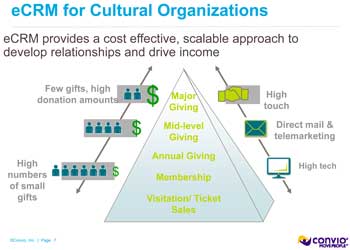
I heard that you recently added a database component to your collection of online tools. Tell me about that.
The database component an interesting new development for us. There are obviously a lot of vendors out there that sell databases to non-profit clients, but it became apparent to us that a lot of clients didn’t only want a set of on-line tools. They wanted a set of online tools, but they also wanted an entire CRM [Customer Relationship Management] system, where everything worked together. I think we have done a pretty good job in the past of integrating with programs like Raiser’s Edge. Data flows back into the master database and flows the other way. But it became apparent that a lot of those database tools were expensive and were relatively complex and that there was an opportunity for us to build a more integrated system together, and that was really the approach that we took.
What we decided to do rather than actually building something from scratch ourselves is we partnered with Sales Force. Sales Force has what they refer to as a non-profit template, which is a kind of a database for non-profits based on their commercial product. We built on top of that core piece and we built a product which is called Common Ground™. It’s a database specifically for non-profits, which talks to our online pieces.
So, if I were a development director, sending out emails and getting fine return on investment, but I really want to take my fundraising to the next level, what’s the first thing I should look into from Convio?
Rather than even looking for a tool, Convio is known for extremely interesting and high-quality research. For someone who is just thinking about how to get to the next level, I think they are thought-provoking. Obviously, they are not going to get you there automatically, but there very interesting. For a technology company, we do a lot more research than many technology companies and I think that’s one of our great assets. It depends on who you are; if you are a small organization, I would hope that you are really at the point where you are strongly thinking about bringing in technology to help you get to the next level, I would hope you’d look at product tours, which are short. They are a pretty good way to see what’s possible.
Welcome to the first installment of the Social Media Spotlight, our monthly feature focusing on arts organizations’ social media strategies.
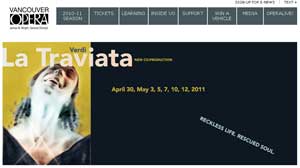
Vancouver Opera’s social media presence, headed by photography/fashion buff and technology maven Ling Chan, goes where few opera companies have gone before. In order to achieve their goal of increasing brand awareness and facilitating two way communications with their followers, the $9 million opera company has launched initiatives like manga (a traditionally Japanese style of comic) and an annual animation contest, for instance. Currently on the company’s blog is a serial feature written in the voice of the main character of their world premiere opera, Lillian Alling.
Vancouver Opera takes ideas that many non-profit arts companies might deem risky or unsustainable and, through a combination of sheer creativity, thorough execution and diligent tracking, have made the Vancouver Opera social media sites vibrant, interesting, and unique.
Social Media Manager Ling presented her work this summer at the Opera America Conference. I caught up with her to chat:
Everything in the Vancouver Opera social media presence looks so vibrant. When you first set out, what were your goals for your organization and your audience?
Thanks! Vancouver Opera is a vibrant and innovative company that loves to engage with our community. When we first started out with social media, our goal was to put a face on the organization as well as increase awareness of the art-form of opera through educating and entertaining our tech savvy, minimally to moderately engaged supporters.
Vancouver Opera was one of the first arts organizations to really use social media tools. From the start, we were committed to reaching the next generation of opera lovers using the media of the times and integrating it into our marketing/PR mix.
Your summer blog features keep your readers captivated during Vancouver Opera's off-season. Tell me about Opera Mania 101 and the other summer blog features.
During the summer months, we needed to come up with ways to keep our followers engaged, so we came up with some regular features for the blog.
• Operamania 101 is a feature I came up with and thought would be helpful for the opera-curious. It’s opera education from a pop culture perspective. Everyone’s heard snippets of opera in movies, TV shows, cartoons and commercials and yet people might think they don’t know opera. They are more familiar with opera than they think.
Some other blog features have included:
• Bizarre Opera Videos where we post odd, unusual, or notable performances of opera found on YouTube.
• Tuesday Trivia where we come up with opera themed quizzes.
• Top Ten Lists where we invite readers to vote for their #1 choice. For example: Top 10 Villains, Top 10 Opera Tearjerkers, Top 10 Fantasy Operas
• Other features: 20 Questions with an Artist, Everyone’s a Critic, Lunchtime Poll, Opera Props
Lego Carmen, one of the "Bizarre Opera Videos" posted by Vancouver Opera to keep interest in opera during the summer months
You have a background in photography. Was this the impetus for Flickr Fashion at the Opera? What are the goals of the program and what inspired you to create it?
I love taking pictures and I have always had a passion for fashion. I went to fashion design school years ago and worked as an assistant stylist on a couple of magazine and music video shoots.
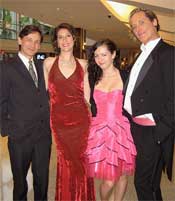
While working down at the theatre during Eugene Onegin in November 2008, I couldn’t help but notice how many young people went all out, dressing themselves “to the nines” for our operas. It wasn’t all just formal wear either. Our audiences mixed dressing up with elements of street, punk and preppy fashion, bringing a whole new flava to the world of opera.
The people who dressed up for our operas inspired me to come up with Fashion at the Opera, which you can find on our Flickr.
Describe Blogger Night at the Opera. How did it engage new audiences? Did it show an increase in sales?
Our very first Blogger Night at the Opera was in January 2009 for our Carmen opera. A prominent local blogger named Rebecca Bollwitt, aka Miss 604, came to our Eugene Onegin that previous fall and she ended up blogging about the experience on her own personal blog. We got to talking and she suggested we coordinate a blogger night, which we did and it has since became so wildly successful that other opera companies started calling us to find out how to set it up for themselves.
We invited bloggers who were opera newbies to join us, blogging pre-show and during intermission their thoughts on the opera and the whole experience of being at the opera. We gave them backstage tours and also invited them to mingle with cast, staff and guests at the post-show party on opening night.
We live streamed their web links on our VO blog, so that our readers can follow along in real time. This was great exposure for us and a way of getting the next generation interested in opera. Most of their readers have never been to the opera. But after reading about Blogger Night at the Opera, they became excited about our operas and what we’re doing with social media and bought tickets to the next performances. I had a few of them seek me out on the theatre floor to tell me they were here because of Blogger Night at the Opera.
What's Opera Ninja and how did you come up with the idea? How do other people in the organization feel about giving control of their communications over to (basically) a volunteer?
Opera Ninja evolved from Blogger Night at the Opera. We had blogger night on Opening Night. What should we do for dress rehearsal? We came up with Opera Ninja March 2009 for our Rigoletto dress rehearsal.
It was inspired by Welsh National Opera when they tweeted 12 hours in the life of the Welsh National Opera's The Marriage of Figaro, including a live relaying of the performance (also translated into Welsh).
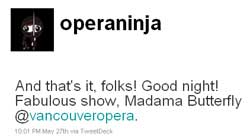
On our dress rehearsal nights, the Opera Ninja would live tweet. Followers were engaged with seeing an event unfold and have an insider view of what was going on behind-the-scenes. The tone of Opera Ninja is cheeky, fun, irreverent. We didn’t necessarily want it to be a play-by-play of what was happening on the stage. Instead it could be the Opera Ninja’s reactions to what was going on. Our followers have found this entertaining and fun. They would add comments and also re-tweet our tweets to their own followers.
I was the original Opera Ninja but have since invited our bloggers to take on the character in their own voices. I give a lot of freedom to our Opera Ninjas in what they tweet because I trust them. They are high-profile and active Twitter users. They know the etiquette, the advantages and the drawbacks of Twitter. They understand that they can have fun as the Opera Ninja but as they’re also representing VO for the night, they have to be professional too.
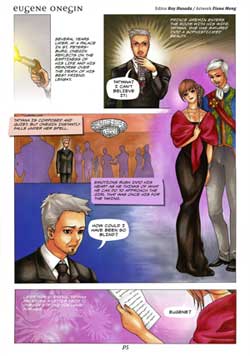
Vancouver Opera has started publishing manga, a comic book based on the opera. Manga is sort of an unusual foray for an opera company to take. What inspired you to take the stories of operas to this new medium?
It may sound like a strange combination but the partnering of opera and manga has worked extremely well for us. We were approached by Vancouver artist & editor Roy Husada of Rival Schools four seasons ago with the idea of “manga-nizing” our operas. It started out in black & white and written in Japanese, but has evolved into colorful mangas in English. The mangas are eye-catching and it helps give readers an idea of what the opera is about, thus sparking their interest in coming to the opera. Our mangas have proven to be very popular with our followers.
By my count you have at least four Twitter accounts for Vancouver Opera. Why? What are the advantages to have many accounts? And how do you track and get a good picture of your audience?
We have 4 Twitter accounts:
1. Vancouver Opera which is our main Twitter account where I tweet daily. It's the one with the most followers and the most activity, so it’s this account where I keep track and measure all our questions, responses and re-tweets.
2. Operabot which was started for our Operabot contest, an animation contest for our Golden Anniversary season. Professional and student animators were challenged to create animated shorts of one of the four productions last year. The tweets posted to Operabot related to updates on the contest, the submissions received and any fun or wacky robots related links.
3. Opera Ninja – We wanted a dedicated Twitter account just for our exclusive “behind the scenes” tweeting during dress rehearsals.
4. Where’s Lillian – For our upcoming world premiere, we wanted to introduce our Twitter followers to Lillian Alling as she makes her epic North American journey from Ellis Island to the wilds of British Columbia. She travels on foot in search of a man named Josef. We have someone taking on the persona of Lillian Alling and tweeting in their own voice the adventures and hardships that the real Lillian Alling might have encountered. From these tweets, we hope that followers will become intrigued with Lillian Alling and want to come to the opera.
Each Twitter account serves a different purpose and we wanted to have a dedicated account for the audience who wanted just Operabot updates or just Opera Ninja updates. Also it frees up our main VO Twitter stream by not bombarding our followers with too many tweets or random-sounding trains of thoughts.
What have been the results of all of these programs for Vancouver Opera? Many times it is difficult to track the effects of social media programs. How have you been tracking your initiatives at Vancouver Opera?
Our social media initiatives have garnered a lot of positive attention from newcomers to opera, opera lovers, our peers in the industry and the media.
I track and report data to measure the impact of our social media efforts in various ways:
• Blogger – Google analytics, Like This / Tweet This buttons
• Facebook – analytics
• I use the Bit.ly shortener for our tweets to see how many people click on our links
• Through promo codes in our Tessitura software, I can find out how many tickets were purchased whenever a sales offer was put forth on our social media channels.
Any initiatives for the 2010-2011 season that you'd like to preview for us?
I have some exciting things planned but it’s a surprise. Everyone will just have to stay tuned to Vancouver Opera.
In other news, Amelia Northrup is back from her summer in Washington, DC! On Thursday, she and Corwin Christie presented a TITA webinar on creating and using online video. If you missed the webinar, you can check out the recording here.
Last year around this time, we launched our Technology in the Arts webinar series. To keep this service relevant to the needs of our online community in the coming year, please share with us the topics and types of webinars you would like for us to offer. Type your ideas directly into the box below and click on "Finish Survey" - it's that easy. Thank you in advance for your thoughtful responses!
This afternoon, I had the pleasure of working with Jerry Yoshitomi on a conference session dedicated to grassroots fundraising for the attendees of The Association of American Cultures (TAAC) conference in Chicago. Below are the slides for each of our presentations.
Jerry's presentation on grassroots fundraising:
Crowdfunding websites are a simple way for artists to solicit and accept donations online. One of the best-known sites is Kickstarter, which hosted the record-breaking crowdfunding of Diaspora.
With Kickstarter, you set a fundraising goal and have three months to achieve it. If you reach your goal within three months, you keep the cash. If you don’t, the funds are returned to your backers. You design a menu of rewards to motivate backers to give. And, you keep 100% of ownership over your project -- an important consideration for artists dealing with copyright and distribution issues.
Helen DeMichiel, who funded a series of webisodes with Kickstarter, says the all-or-nothing structure is a great motivator. “You have to hustle,” she explains, and your backers get caught up in the excitement.
A previous project backer and current project starter, Tirzah DeCaria points out that most projects are funded largely by backers within the artist's existing network. She advises artists to look at Kickstarter as an opportunity to consolidate and mobilize your network rather than as a tool for reaching large groups of new fans.
Of course, Kickstarter isn’t for everyone. The site is curated, and in addition to an application process, projects must have a U.S. address and a U.S. bank account. And there are the guidelines.
In a quick scroll through Kickstarter’s current projects, I came across many projects posted by individual artists or small groups, as well as projects by a design studio, a non-profit performance company, and a video game developer. Kickstarter clearly doesn't exclude businesses, but established organizations aren't the primary users. If your organization is considering a project, Joe's post on micro-donations has some good thoughts and advice. And, again, consult Kickstarter's guidelines.
Other crowdfunding sites for artists:
Projects on IndieGoGo can be based anywhere in the world. Unlike Kickstarter, the site isn’t curated, so projects cover a broad spectrum -- creative endeavors, causes, and entrepreneurial work. And, IndieGoGo is not an “all-or-nothing” enterprise. You can keep any funds you raise along the way. IndieGoGo also has several innovative partnerships, including a fiscal sponsorship program through Fractured Atlas and the San Francisco Film Society.
RocketHub is another “all-or-nothing” crowdfunding site geared toward artistic and creative projects. RocketHub is not curated, though projects must be legal and “in good taste.” You must have a PayPal account to start a project.
What is your experience with crowdfunding art? Should established organizations stay out of it or join in the fun?
Has the spark gone out of your relationship with your audience?
Thursday, September 2, 2010
2:00pm-3:30pm Eastern
The Quick and Dirty: Making a VideoPresenters: Amelia Northrup and Corwin Christie
Register today for $25
Video technology is a cost-effective way to promote your work and engage your current (and potential) audience through channels that are widely accessed and have a broad reach. Arts organizations can effectively harness this technology to improve their visibility, attract new audiences, and find exciting ways to tell their story. This webinar will help you identify ways in which a video might best be used by your organization and discuss the tools you will need to physically produce and promote your video.
In this 90 minute webinar, you will learn:
Strategies for using online video - identifying the message as well as your goals for using video.
How to produce online video content in an affordable manner - assessing the available hardware and software to identify the best tools to meet your needs.
Case studies and best practices - examples of arts organizations currently using online video to promote their work.
PresentersAs the Web & Social Media Assistant at the Center for Arts Management and Technology, Amelia Northrup writes for the Technology in the Arts blog and has been featured on numerous podcasts. She has worked on numerous social media and multimedia projects with Kansas City Repertory Theatre and Wolf Trap Opera Company. Amelia is currently researching a white paper about the legal issues involved in the use of video footage from performances.
L. Corwin Christie graduated from Oberlin College before moving to Denver and founding a theatrical production company. Her work in development and marketing inspired her to attend Carnegie Mellon University's Arts Management graduate program. She recently worked as the Social Media Assistant at the Center for Arts Management and Technology, and is the current Marketing Director of Future Tenant Artspace in Pittsburgh.






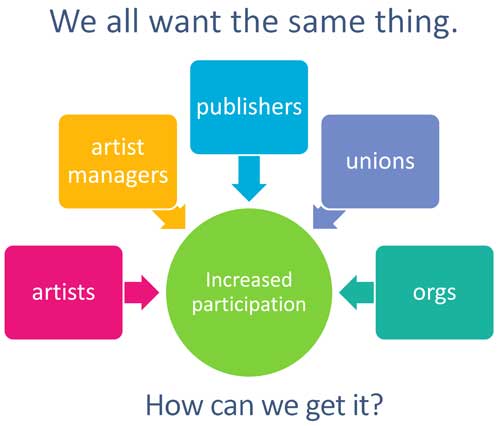 The world of arts management is changing, as all industries are changing, with the proliferation of technology. Especially with the increasing popularity of online media, we as arts managers have had to reconsider the way we see our performances. Is online video footage merely a vessel for our product? Or is it, in fact, our product? Or, can it also be a means to an end?
 For years, I have heard the lament for the rise of “citizen critics” –individuals who use blogs, social networks and other social media tools to share their reviews of performances, exhibitions, films, etc. I have listened to a number of artists, directors, curators, and other arts managers bemoan the replacement of “true” cultural critics in traditional media with these self-published citizen critics. The complaints typically revolve around a perceived lack of credentials and lack of understanding for the discipline.
 In a world where we are bombarded with thousands of marketing messages every day, our society has grown hyper-aware (and hyper-wary) of advertising in all its mutated forms – from magazine ads to product placement in television shows, from celebrities dropping brand names during interviews to Facebook pages used solely to increase ticket sales. When it comes to using social media, motivation is a key factor in forecasting whether an organization’s efforts will succeed or fail.


 So, the idea of a welcome series is that when somebody takes that step of raising their hand and saying, “I am interested in what it is that you have to offer” by giving you their email address, at that point you can’t just ignore them. You can’t just take it for granted and then immediately start asking them for money. Just like you would in a normal face-to-face relationship, you need to welcome that person to your community and you do that by seeking out some spaced email communications thanking the people for getting to know your organization and giving them some background information. Gradually, as you move down what we refer to as the relationship pathway, you give them more and more ways to become involved and to get more deeply embedded in the culture of the organization.
 The database component an interesting new development for us. There are obviously a lot of vendors out there that sell databases to non-profit clients, but it became apparent to us that a lot of clients didn’t only want a set of on-line tools. They wanted a set of online tools, but they also wanted an entire CRM [Customer Relationship Management] system, where e
 As the Web & Social Media Assistant at the
  L. Corwin Christie graduated from Oberlin College before moving to Denver and founding a theatrical production company. Her work in development and marketing inspired her to attend Carnegie Mellon University's Arts Management graduate program. She recently worked as the Social Media Assistant at the Center for Arts Management and Technology, and is the current Marketing Director of