Social Media, Funding & Prom Queens

American Express recently started a grant program funding arts organizations through online voting instead of traditional non-profit success metrics. Quality of art, financial stability, and community impact were not the deciding factor in who received a $200,000 grant this summer, votes were. In a scene reminiscent of American Idol or Dancing With the Stars, arts organizations compete for the grand prize. Twitter, Facebook, and E-mail, took center stage as organizations launched their online campaigns. A competition was born and America voted to determine the winner.

American Express’s use of the high school prom queen method to choose a winner evokes many new questions for funders and fundraisers alike:

  • Does the idea of a contest remove art from arts funding?
  • Is the best organization being rewarded?
  • Is this a popularity contest or a social media war?
  • How do you send a message for support without degrading the integrity of your opponents?
  • How will social media be affected through this type of funding?

Galloping ahead of many traditional forms of communication, technology and social media have taken the arts community by storm over the last few years. This contest adds yet another facet to their use: fundraising. With the voting apparatus hosted online, social media makes perfect sense as the advertising weapon of choice, but is this a good choice for the arts?

Building communities, starting conversations, and sharing information top the list of ‘the best ways to use Social media.’ Advertising and sales lead the least effective uses. In an attempt to gain votes, organizations risk alienating their supporters through using inflammatory messaging or hyper focusing on their votes and forgetting the online communities they created.

Bashing the competition, touting superiority, or focusing on why one organization ‘needs the money more’ represent strategies and messaging that could easily be adopted. These messages are uncomfortable for many people and can fracture the arts community. However, without competitive messaging the prize would simply go to the organization with the highest online presence, essentially starting the contest on an unfair playing field.

Assuming an organization crafted an effective campaign without causing any damage, the biggest question still remains unanswered. Should grants be determined by popular vote?

On one hand supply and demand compose the framework of the funding structure. The organization with the highest public demand receives a reward to create more art. On the other hand, many see this as a popularity contest with the biggest flashiest organizations gaining a clear advantage. Unfortunately, art comprises no part of either approach. This funding model is not based on the organization, what they do, who they do it for, or why they do it: a counterintuitive approach in my opinion.

While increased online support and a focus on technology use to reach constituents could provide benefits in this funding model, the prom queens method of distributing support should probably be left where it belongs: high school. This model has no way of insuring the best organizations reap the rewards or that the most efficient and effective programs receive funding. Popularity does not always equal quality, but it will always decide the winner in this funding model.
Baby Boomers, Facebook, and the Australian Example.

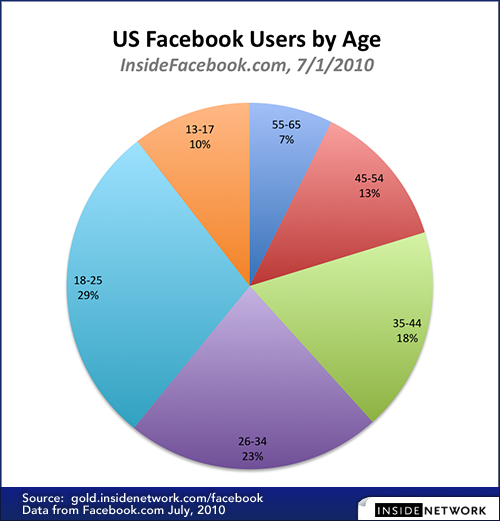
Reluctance to embrace social media as an appropriate avenue for reaching arts patrons has often been blamed on the demographics of the user base. Many people look at sites like Facebook and immediately write them off as platforms only representing a younger generation. Not any longer. US-Facebook-Users-by-Age-7.1.10In 2010 educated adults over the age of 40 comprise the fastest growing demographic on Facebook, the age group 55+ grew by over 900%, and 40 million Facebook users in the US are now over the age of 40. This exposition of established professionals opens up the world of social networking even wider and begs the question: Are we properly using social media in the arts?

With 10 million Facebook users over the age of 55, Baby Boomers are staking their claim in the world of social media. This new demographic is college educated, professionally employed, and comprised of over 60% women. If that sounds familiar, you might be recalling the audience profile for the average arts patron in the U.S. The fastest growing segment on Facebook matches the traditional arts patron in the United States almost perfectly.

Other social media platforms have experienced similar growth outside of the traditional 18-34 age bracket. Currently users between 35 and 55 comprise the largest age bracket on Twitter. LinkedIn’s primary constituents are over 50 and MySpace continues its strong hold on original members now between the ages of 30 and 50.

These statistics along with the growing momentum around interactive websites, electronic outreach, and digital networking make social media the next frontier for audience development in the arts.

Innovations in social media within the arts have already sprouted around the country with great success:

  • Characters from plays now have their own Facebook accounts to entice theatre goers to interact with them before and after the show.
  • Interactive confession booths in galleries across the country load videos directly online for audiences to view and interact with.
  • Viral online marketing is playing a larger and larger role in making buzz around productions and increasing web traffic.

But is it enough?

We can look to Australia for a prediction. Australia adopted social media faster that the US, UK or mainland Europe, with the highest user rates per capita in the industrialized world and the highest percent of users over the age of 35. Arts organization in Australia use Social Media to interact with patrons before, during, and after performances/exhibitions.

In the article Geeks, tweets and bums on seats, Elissa Blake discusses the adoption of social media in Australia and its affects on the arts. In the article, she writes about a production of King Lear where a woman asked permission to tweet during the performance. When asked why she did so, her response was:

It's about sharing your emotions and your experience of the show. You might have a favourite scene or a line that you love and you want to share it instantly. I thought King Lear might be dry, but it was really interesting, and I wanted my friends to go and see it...

Many Australian arts organizations and artists see social media platforms as a way for audience members to interact with companies, individual artist and each other. This interaction builds new passions for attending live performances as friends that could not attend receive enticing updates through their Twitter feed. This free viral marketing increases audience participation and makes Australia a leader of innovation in social media for the arts.

Fee Plumey, the digital program officer at the Australia Council for the Arts stated:

If arts companies want to attract new audiences, they have to jump in and chat about the minutiae of what's going on, Audiences are not just interested in a celebrity on stage. They really want to know how the show works, how the set was made, how it was cast, who's doing the lighting and what goes wrong… [social media provides that outlet].

Australia is a great case study for how social media can affect the arts. Now it is time for the US to see how social media can be creatively applied in audience development within our own country.

Tips for arts organizations working with web developers

What should arts organizations expect when working with web developers?

  • Most web developers approach their work in a logic-driven, sequential manner. The structured nature of their work demands this of them. Correspondingly, developers will want to have all of the functionalities for a project locked-in prior to beginning the work. If changes are made after the start of the work, then the logic for the site may change, and the developer may be forced to redo all of his or her work.
  • Arts organizations should expect their web developers to deliver the completed project as articulated in the project agreement. Be sure to walk through the project agreement verbally with the developer to make sure that you both have the same understanding of the deliverable.
  • After your organization tests the deliverable, the developer should be willing to fix any errors in the code.  These are often referred to as "bugs."

How do you know the difference between a bug and new work?

  • When there is an error in the website’s code that prevents it from working, then the site has a bug. Most developers will fix bugs within six months of a project’s completion date. It is good practice to make certain that this is articulated in the development agreement. Since bugs can develop over time, it is also good practice to consider adding maintenance or ongoing support to the development agreement or as a separate annual agreement.
  • If the website’s code is functioning properly but you would like for it to do something that wasn’t articulated within the development agreement, then this is likely to be considered “new work.”
  • Many clients have difficulty understanding why their developer would charge them more money to make the project do what they want it to do. (And if everything is spelled out in detail, then the developer should not charge extra for making it work.) As mentioned above, making a change once the project has begun may require the developer to redo all of the work that they just completed.
  • If you are vague or uncertain about what you want the final deliverable to do or how you want it to function, then you should brainstorm with the developer and hammer out these details prior to signing the agreement.
  • If you have already signed an agreement and start asking questions that begin with phrases like “Would it be possible for it to …”, then you are most likely talking about new work.
  • General rule of thumb: If it is broken or simply not working, then it is likely to be a bug. If you would like for the site to do something differently, then it is probably new work. This can be very frustrating for visually oriented people who have difficulty mapping everything out theoretically in advance and prefer to give feedback on something once it is “already up and running.” If you know that you will need to be able to give feedback and make changes (within reason) once a project is in the testing phase, then you should probably increase the budget for the project beyond the developer’s estimate by 20-30%.

How do you handle a situation when a developer stands behind the hours allotted to a project vs. standing behind the deliverable?

  • Make certain that all of your development agreements are based upon deliverables and not estimated hours spent on the project.
  • Pay no more than 50% of the project’s total cost prior to completion. This will give you more leverage in possible negotiations than if you pay for the majority of the work at the outset.
  • Be certain that you haven’t changed the scope of work during the course of the project. If you did alter the scope of work, then you need to be flexible about the added burden placed upon the developer.

Animoto: Create videos without a video camera

Many arts organizations have experimented with using “trailers” to promote upcoming performances or exhibitions. But what if you don’t have the time, equipment, or expertise to film and edit a video?  What if all you have are photos? Enter Animoto, a free tool that lets you quickly create short videos using a combination of photos, text, and/or video clips of up to five seconds in length.  You can choose background music from Animoto’s library or upload your own.

To try it out, I created this 30-second promotion for Misnomer Dance Theater's performance back at our 2008 conference.   It took about 20 minutes, including the time I spent actually finding the photos on our Flickr account.

The process is a pretty straightforward drag-and-drop design. You can add text and choose particular images to “spotlight” with extra screen time. Once your elements are arranged, one click mixes them together into a flashy 30-second video.

Other than changing the order of your elements, though, you don’t have a lot of control over the final product. Because Animoto automatically mixes the elements together for you, there’s no opportunity to fine-tune individual transitions. This is great if you’re looking for something quick and easy, but it can be a real downside for the more detail-oriented user.

Throughout the process, there is a strong push to upgrade your account, which can get a little annoying. If you’re with a 501(c)3 organization, you can request a free Pro account (normally $250/year), which allows you to make full-length, high resolution videos that are downloadable. The Pro account also includes a commercial-use license.

What have you created with Animoto? Do you have other favorite video tools?

Digital Art Has A New Home With Adobe. Virtually.

adobemuseumNo guards. Always open. And I assume you won't have any alarm surprises. Welcome to the latest frontier in arts meet technology: Adobe Museum of Digital Media, the world’s first virtual museum.

What is a virtual museum? This is not simply a museum website where you can view the collections by clicking an index. Nor is this a museum placed in a virtual world such as Second Life (which interestingly enough has a thriving art scene).

The mission of the AMDM is to “Showcase and preserve digital work and illustrate how digital media shapes and impacts society.”  Adobe "has changed the world...and we wanted to celebrate that,” says Rich Silverstein, Museum Director.

Keith Anderson, Creative Director, says the main question asked when developing the idea was, "how would this work in the real world?" Architects and designers were hired to create a museum that could theoretically be placed in any city in the world. There is an outside atrium, gallery space, and towers where the archives will be housed.

eye

So how do you walk through this virtual space? There are no avatars. Instead, a sea-jelly-meets-futuristic floating machine eyeball is your guide to the space (complete with cute old-school-computer-takes-an-underwater-journey sound effects).

One of the greatest aspects of this new space is the freedom to create work that would be impossible to show in a traditional museum. Often, digital pieces are printed out on paper, or projected, and depending on the artist, a lot of the meaning behind the piece is lost (not to mention quality). It's like taking a Polaroid of The Birth of Venus. Sure, the photograph might turn out amazing and some people could like it better than the original because it has a neat 1960's quality to it... but I doubt that was the image Sandro Botticelli had in mind in 1486.

I’m excited and a bit hesitant at the prospect of this museum. Yes, I think a virtual museum will have enormous potential for artists who work in digital media. Images of many artists’ work do no justice to their pieces. However, I am someone who likes to be physically immersed in a museum. It is an escape from the real world into another universe: sometimes confusing, sometimes controversial, sometimes just beautiful, but always refreshing. It’s the same comfort as getting lost in a good book. I worry that, personally, I will not get the same satisfaction exploring the very cool looking structure from the 15-inch screen of my MacBook. But then again, I am also one of those people who refuse to use a Kindle because I like to physically hold a book. So who knows, it might be a heavenly solution to dealing with crowds and the hassle of checking your coat. And the fact that you never have to worry about hours or off days is pretty great.

What do you think? Is this where we are headed? Will virtual museums help create demand for the arts by allowing everyone to have access from the comfort of their homes?

The first show is entitled, "The Valley," and is curated by Tom Eccles. It will feature work by Tony Oursler, an amazing video artist who has already been pushing the boundaries of what digital media should look like and how it can be displayed (Did anyone catch his recent show at the Mattress Factory?).  Oursler tends to highlight the strangeness of humanity in his work, and the medium of the internet and how it reflects society will obviously play a role in this new show.

Other upcoming exhibits will feature John Maeda and Mariko Mori.

Membership is free and just takes an email address. I am curious to see where the Adobe Virtual Museum goes from here. Will there be any social aspect to the museum? Will they ever partner with real life spaces for exhibits? Will they try to place a version of the museum in Second Life?

Opening night is August 2, 2010! I expect to see all of your sea-jelly-machine-eyeballs there so we can crack open a bottle of cyber wine and toast to the latest in technology meets museums!

Screen shot 2010-07-12 at 12.37.35 AM

Audience 2.0, Part II: Thoughts for the Future

Check out Part I for an overview of the NEA’s recent report Audience 2.0: How Technology Influences Arts Participation While Audience 2.0 gives some useful statistics on technology and media participation in the arts, the report does not provide the answers or the data that I am looking for regarding arts participation and technology.

  • How does arts participation through one technology affect participation in other technologies?  For example, how does participating through television affect web participation?
  • What impact has social media had on arts participation?
  • How do people participate in the arts digitally and online?  What are they doing on the web when they are participating?
  • Has participation in the arts via technology affected online giving to arts organizations?

Audience 2.0 draws into question the timeliness of national arts research, the vehicle being used to conduct this research, and the understanding of where arts audiences are heading in the future. This report was a useful audience analysis for 2008, but the survey upon which Audience 2.0 bases its analysis lacked a sense of forward motion as well as the ability to predict future arts participation through rapidly changing technologies.

The data used in Audience 2.0 was gathered three years ago before many current technologies were available and before many new technology users had invaded the digital market.  In his blog post Back To The Future, on Danceusa.org, Marc Kirshner states that:

Since the beginning of the 2007 survey period [for the 2008 report]:

  • Four generations of iPhones have been released [and the Android network has been launched]
  • Facebook’s user base has grown from 20 million to 400 million users
  • The entire book publishing industry has been turned upside down by e-readers, such as the Kindle, Nook and iPad
  • Millions of set-top boxes, Blu-ray DVD and home theater PCs have connected televisions to broadband Internet
  • Hulu launched its online video service to the public
  • More than 300,000 people viewed simulcasts and encores of the Metropolitan Opera’s Carmen
  • The first 3-D network began broadcasting

The three year time gap between data collection and report publication created a lack of focus on many forms of new media and social networking platforms currently leading many technology discussions in the nonprofit arts industry today. Correspondingly, the relevance of the report in our current environment is brought into question, and we must remember that the report represents a snapshot in time more than a study of current habits. Due to the speed with which technology advances and its usage changes, traditional forms of data collection and publication no longer appear as useful for tracking these trends.

The survey asks about participation in the arts through technology, but Audience 2.0 does not provide answers about specific actions and their effects. The survey does not ask participants if electronic and digital media makes them more or less likely to attend a live event, but the report draws based upon a perceived correlation in the participation data. Without causality data, this correlation leaves us with a “chicken or the egg” dilemma.  Does electronic/digital/online participation in the arts lead to an increase in live participation, or are participants in live arts events simply more likely to participate in electronic/digital/online arts events?

I would like to see more direct questions being asked of people who responded that they participated in the arts through electronic and digital media. Obtaining this next level of understanding will provide us with a deeper understanding of the effects of electronic and digital media on arts participation.

Audience 2.0 raises more questions than it provides answers, but it does show a commitment on the federal level to assess the impact of technology on the arts. I am hopeful that future reports will delve deeper into the seemingly symbiotic relationship between technology and arts participation by focusing more specifically on the  digital/online arts participant.

Want to Save Your Online Data? There's an app for that...

In May, I participated in a webinar hosted by the National Assembly of State Arts Agencies that focused on creative technology strategies for state arts agencies.  One of the issues that came up during the Q & A was backing up communications from social media platforms.  As entities within state government, many state arts agencies are required by law to retain copies of their communications.  But how do you archive communications that take place on social networking platforms like Twitter and Facebook? backupify-small-logoOver the past two months, I have been using a potential solution.  Backupify provides daily online backup for your social media and software-as-a-service data.  They are the only online backup and storage provider to seamlessly back user data to the Amazon S3 cloud with its strong security and data duplication policy.

So here are the pros and cons of my experience with Backupify...

PROS

  1. Backupify provides a centralized backup location for a number of online services, including:  Flickr, Facebook, Twitter, Google Docs, WordPress, Basecamp, Gmail, and many more.
  2. Businesses utilizing Google Apps can back up all of their data at relatively low cost.
  3. Quick and easy setup.
  4. With the free account, you are able to backup one account per online service.  The premium account level backs up an unlimited number of accounts per service for just under $60/year.
  5. Users are able to choose whether their accounts are backed up daily or weekly.
  6. Users are also able to opt for a daily email notification of backups, weekly email notification, or no email notification.
  7. The system maintains a backup history identifying when accounts were backed up, whether or not the backups were successful, and how many files were backed up per online service account.

CONS

  1. There is no standardized format for backups because the backup file type is determined by the service providers.  For example:
    • Facebook photos are backed up on the site as photo files, but other Facebook elements (friends, statuses, links, notes, and events) are stored as an XML (Extensible Markup Language) file - which I view using Microsoft Excel.
    • For Twitter accounts, users can download a PDF workbook containing the following data:  profile, updates, received direct messages, sent direct messages, favorites, and mentions.  Users may also download XML files for each of those individual data pieces as well as an XML file containing information about the user's Twitter followers.
    • WordPress blogs and websites are backed up as a MySQL database in the sql.gz format.
  2. Currently, users may backup their personal Facebook profiles but not fan pages.  I asked Backupify CEO Rob May if there are plans to add backing up Facebook fan pages to the service's offerings.  He informed me that they are working with Facebook on this functionality over the next two weeks, so this option should be available in the very near future.

My personal experience with Backupify over the past two months has been a very positive one.  Once the service adds the capacity to backup Facebook fan pages, it will be even more useful for arts organizations and governmental agencies using social media.

Audience 2.0 - Condensed, Part I

Report50-coverIn part I of this two-part post,  I summarize the findings of Audience 2.0, while tackling the problems, questions and lack of answers in part II. Audience 2.0: How Technology Influences Arts Participation, the newest study released by the National Endowment of the Arts gives empirical quantitative data to support how technological trends affect arts participation, the health of the arts in the US, and the ways that arts patrons use electronic media to engage in the arts.

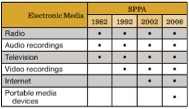
Audience 2.0 takes data from the NEA’s 2008 Survey of Public Participation in the Arts and the three other SPPA studies from 1982, 1992, & 2002 and “examines how Americans participate in the arts via electronic and digital media.” The media platforms: Radio, Audio recordings, Television, Video Recordings, Internet, & Portable Media Devices were tracked, but there is not consistant data available from every study.

NEA

The study cited three main conclusions:

  • Technology is not going to be the downfall of live performances, the arts or culture in our society,
  • Technology provides a new outlet for people to experience the arts who may not otherwise have participated at all.
  • Participation in the arts through electronic and digital media actually spurs participation in live arts performances and exhibitions.

The study found that “people who engage with art through media technologies attend live performances or arts exhibits at two to three times the rate of non-media arts participants.” This statistic should quell many of the concerns arts organizations have about digital media replacing them and help arts institutions embrace technology as a way to reach enrich their patrons. The study shows that technology provides a way for people to interact with arts and culture outside of the traditional venue, but it does not replace attending the physical arts or event space.

“53% of US adults used TV, radio, CDs/DVDs, computers or portable media devices to view or listen to arts performances, programs about artists, art works, museums or programs about literature.” Far more people participate in the arts as a whole than those who physically attended arts events.  This shows a greater interest in arts and culture from Americans than many people had previously thought.

“For every arts performance outlet besides theater, adults were more likely to view or listen through electronic media than to attend live events.”  This statistic has many people concerned about the impact of technology on the arts, however; the data shows this to be a good thing because a majority of the participants who make up the media only category represent people who would never have attended an arts event in the first place. The NEA then draws the correlation that these people would not participate in the arts at all without media and electronic technology outlets. Technology helps to widen the breadth of reach for the arts and allows people to participate in the through new portals.

Adults who used electronic media and technology only to participate in the arts had a higher likelihood of lower-than-average household incomes, residing in rural residents, belong to racial and ethnic minorities, belonging to that age group 75+, and/or having achieved no more than some college in their life. This profile directly mirrors the profile of people who do not participate in benchmark arts events at all.

The big picture of this survey is that it really just repeated many of the SPPA findings from the past three decades through the lens of technology. Overall, Education still has the greatest weight in determining arts participation, racial and ethnic minorities participate less than non-Hispanic whites, and racial and ethnic minorities tend to participate more frequently in arts event that are associated with their heritage.

This study leaves more questions than answers and those will be tackled in part II of this series.

Links roundup

This just in: Audience data from 2008There have been plenty of reactions to the Audience 2.0 report released last month by the NEA.  In his article on the Dance/USA blog, Mark Kirschner of TenduTV reminds us that since May 2007, the beginning of the survey period, Apple has released four generations of the iPhone and Facebook's user base has grown 20-fold.  Marc Van Bree digs into what we can learn from the report, even though the data can’t be easily compared to data from earlier iterations of the study.  And Jennifer Edwards and Sydney Skybetter read the report as a call for dance artists to start engaging audiences online.  What is your reaction?  Is this report useful?

Reality, only better ReadWriteWeb’s report on a new augmented reality textbook reminded me of this story from Art21 on the Louvre-DNP Museum Lab.  And also this AR version of BP’s logo.  What is your favorite example of augmented reality?

Newspapers are over In an interview with the Guardian, Clay Shirky, author of Cognitive Surplus: Creativity and Generosity in a Connected Age, predicts that the traditional print newspaper is doomed and that Rupert Murdoch’s experiment in charging for online content will fail.  On a related note, the internet is over as well.  How is your marketing team taking the news?

Wait, iPods used to come loaded with Pong? This and nine other fun facts about Apple, courtesy of Mashable.

Guggenheim + YouTube = Awesome Biennial

Video may have killed the radio star, but it has done wonders in shifting the paradigm of visual art.

Since the 1960s, video art has been challenging preconceived notions about how art was supposed to look. At the time, these video artists had to fight to be recognized as worthy enough to be hanging in the same space as Monet or Picasso. And nowadays, you cannot walk into a contemporary art museum without some type of video art installation. Barriers were successfully broken down. Hooray!

Let’s take a quick look at the opposite end of the art world spectrum. A magical little land on the internet where hours (and probably days) at a time can be spent: YouTube.

With the dawn of YouTube, absolutely anyone can have his or her two minutes of fame.  There is everything from a rapping weatherman to the music of Windows XP, Daft Hands and the post-it Mona Lisa… and seriously? Can you even imagine life before this guy? I know I can’t.

So we have the art world, which is harder to crack than a walnut frozen inside a glacier, and then YouTube, which could not be easier.

What happens when these two worlds join forces? YouTube Play. A Biennial of Creative Video

The premise is to receive video art submissions from around the globe by people who may or may NOT consider themselves artists.

New. Exciting. Different. Weird. Animated. Confusing. Anything.

“We’re looking for things we haven’t seen before,” says Nancy Spector, deputy director and chief curator of the Guggenheim Foundation.

No pressure.

So what happens after videos are submitted? A panel will review all of the videos and narrow it down to 200. From those 200, 20 will be selected to show in the first Biennial of Creative Video at the Guggenheim Museums. Yes, museums. The show will be simultaneously running at the Guggenheim in New York City, Berlin, Bilbao, and Venice. All 200 finalists will have their videos shown on the YouTube Play Channel.

Partnering with the Guggenheim and YouTube, is Hewlett-Packard, who will be providing all the equipment at the museums to display the videos, as well as online tutorials about video basics such as editing and lighting.

So even if you know absolutely nothing about videos or video art, your work could be shown in one of the most renowned museums in the world. Interesting. And exciting. I think.

What are your thoughts? Will this produce great art worthy of showing in Guggenheim museums around the world? Is that even the point?

Now there is a question worth exploring… In this rapidly changing world where absolutely anyone with a camera, phone, or computer can create “art,” how do you define what is museum worthy anymore?

I think there are two schools of thought on the matter. On the one hand there are the purists who think the art world should remain an elusive and elite club that few artists ever manage to penetrate. Unfortunately, these limitations of access are crippling to the sustainability of our field. Which is what the focus should be, according to the second group. Yes, the art world must educate, question, and preserve beautiful and interesting things, but if you can’t get people to walk through the doors then what is the point? Keeping today’s audience engaged with art, regardless of the means, has become a focus for both visual and performing arts organizations. Technology is a great entry point, because everyone understands it and uses it on a daily basis. The same holds true for artists. Almost every artist I am friends with uses technology in some fashion to produce their work. They are creating amazing things, but the likelihood of top curators and critics ever hearing about them is slim to none. Which is why YouTube Play is such a great concept.

Obviously, there will be no way of creating installation style pieces similar to Bill Viola’s piece for the 2007 Venice Biennale, Ocean Without a Shore. But in this case, that is ok. Unknown artists get to show their work, interesting pieces will be created, and the museum doors will be as convenient as your computer screen.

The other day, we talked about crossing into different genres of art than you are used to… well here is your chance! Everyone is an artist.

Interested? Absolutely anyone in the world can apply by uploading your video (less than 10 minutes and created in the last 2 years) to the YouTube Play Channel. The deadline is July 31, 2010, so start creating!

Learning from PS22 Chorus, 2010 Webby Artist of the Year

PS22 Chorus’s 5 word acceptance speech.

They’re cute, they sing pop songs, and they made Tori Amos cry (in a good way).

And they have over 18 million views on YouTube.

On June 14th, the Webby Awards named PS22 Chorus its 2010 Artist of the Year “in recognition of their online contributions to music, popular culture and the online medium itself.” PS22 Chorus, a 5th grade chorus from a public school in Staten Island, joins the ranks of previous winners such as Trent Reznor and the Beastie Boys.

Formed in 2000, the chorus began to gain online popularity in 2006, shortly after choral director Gregg Breinberg (AKA Mr. B) started posting videos of the chorus. Celebrity blogger Perez Hilton started promoting the PS22 Chorus videos, and their legions of fans grew.

While your organization may not yet have celebrity fans -- and your work may or may not involve dozens of adorable children singing pop music -- it’s worth taking a closer look to see what other strategies worked for this group:

Take advantage of YouTube’s channels. PS22 Chorus customized their YouTube channel to create a look all their own. And by encouraging subscriptions, they could notify interested viewers whenever they posted new content. With more than 27,000 subscribers (as of 6/30/2010), there’s an opportunity for new videos to viral.

Promote across platforms. PS22 Chorus embedded YouTube videos on their blog, increasing their view count without having viewers leave the site. And, their YouTube channel prominently links back to the blog.  With your own online presence, consider how easily followers can access your content from different platforms.

Consider giving your unconventional marketing ideas a shot. PS22 Chorus’s fame was, as New York Magazine writes, accidental.  Mr. B mentioned on a Tori Amos fan message board that he was teaching her songs to his students.  He followed up with video posts.  Amos was charmed, and months later the chorus performed for her in person.

Don’t be afraid to have a personality. PS22 Chorus’s energy and excitement come across in their online presence. Finding your organization’s own voice can help you connect and engage with followers.

• And finally, update regularly with fresh content.

What else is PS22 Chorus doing right?  Which Webby Award winners are inspiring you?

The arts industry, beyond genres

FenceJune is conference month for arts managers. We all know the drill: sit through sessions, hobnob, and think about trying to new things that you may or may have the guts to try when you get back to your desk. I attended one of these conferences and have been listening to everyone’s feedback on the conferences they’ve attended and have come to the non-earth-shattering realization: we’re all having the same conversations.

The conversations that I had and heard about social media at Opera America were nearly identical to conversations that I've had with my friends in the non-profit theatre and orchestra industry. Yet when we try to have cross-disciplinary conversations, people start putting up walls—“Well, he works in with an orchestra. Tell me how that research relates to MY patrons.” Many of our problems are shared, we just don't get together to talk about them. Although we have the technology to collaborate, find conversations and have discussions—many of us simply don’t.

In the same sense, conferences bring us together, but they also isolate us. They affirm labels and barriers in some cases, and in others, break them. When we stand strong as orchestra managers, are we still standing strong as arts advocates? When we are united as arts marketing professionals, are we still loyal to our own organizations?

One of the sessions from the Opera America stuck with me. The session, New and Unusual Opera (a play on words with “cruel and unusual”?) was about new ways to think about opera as an art form--thinking outside the boundaries of our industry. Opera industry vet John Conklin started the session by playing "Nessun Dorma" sung by none other than Aretha Franklin. (See below.) Of course, that got the expected chuckle from the audience. But Conklin went on to make the point that, for the majority of the American public, that’s opera. If people can embrace this music on their own terms, what are we doing putting up a barrier against their entry point? Why are we so against the crossover of pop music and opera, or opera market research and orchestra market research, or the marketing and development departments within our own organizations?

Challenge for this week: Have an experience in an industry outside your own. Subscribe to a development blog if you're a marketer. Follow an opera company if you work at a museum. New ideas spring from new experiences. Start having new conversations and start breaking down those barriers for yourself and for the arts industry.

Foursquare: Helping You Find Your Favorite Playground

foursquare logoFoursquare is one of the newest social media platforms to be embraced in the last year and one of the most promising new applications for businesses. According to the website, foursquare is “a mobile application that is a cross between a friend-finder, a social city-guide, and a game that encourages users to explore their neighborhoods and rewards them for doing so.” The point of the application is to help users explore their surroundings, discover new things and share their experiences with others. Foursquare uses micro-blogging similar to twitter and interfaces all of the check-ins (posts) with a virtual map. In doing this, users tag locations, businesses and events that they are currently attending for their friends to see and read about. It is a way to share knowledge, play a game and receive promotions and rewards from businesses simultaneously. Due to the mobile aspect of the application, most Foursquare users interact with the site through smart phone applications.

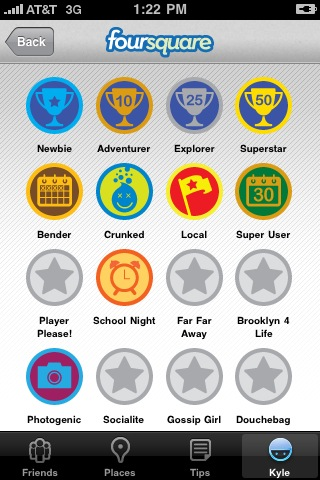
badgesThe game portion of Foursquare is what sets it apart from other applications that allow users to tag locations with their posts. In foursquare, a user gets points and earns badges for checking-in at different locations, the frequency of their check-ins and the uniqueness of where they travel. An example would be the Starbucks honorary barista badge. If someone checks into five different Starbucks locations, they become an honorary barista and earn the barista badge. Starbucks is tying this badge into their customer loyalty program and offering promotions and discounts to their honorary baristas.
Collecting badges has become very trendy in many urban settings and adds a fun aspect of competition to social media. Badges are just one option that Foursquare is offering for businesses to promote themselves on the site.

Many businesses are using:

  • Mayoral specials – specials unlocked by foursquare to the person who has checked-in most frequently over the past 60 days
  • Frequency specials – specials that are unlocked by foursquare to users every ‘X’ number of check-ins
  • Check-in specials – a one time special unlocked by foursquare after ‘X’ number of check-ins or for checking-in at a specific time or date
  • Wildcard specials – not managed by foursquare, but verified by the businesses staff

Once a business sets up an account with Foursquare and tags its location on the Foursquare map, users can click on the location to receive a brief description and a To-Do list. The To-Do list is a list of recommendation that the business and other user have provided for the location. A museum might add an exhibit, event or activity to their to do list along with whatever recommendations other users have added. This along with check-in based promotions adds a new level to social media marketing and community building technology for arts organizations.

How businesses can utilize Foursquare:

  • Tag the location and business on the Foursquare map
  • Add a brief description of the location to the map
  • Link twitter account to Foursquare to increase activity
  • Add items and recommendation to the To-Do list of the location
  • Integrate check-in and badge based promotions
  • Use Foursquare as a part of a customer/patron loyalty program

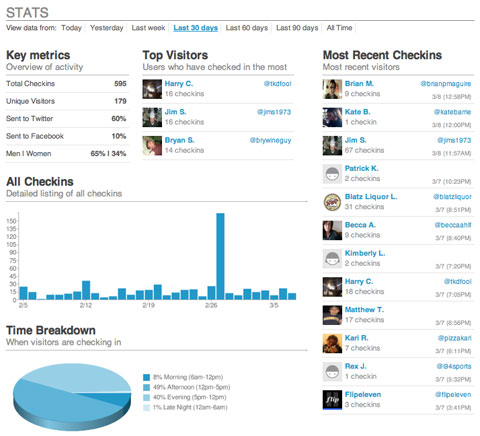
Foursquare is also providing an analytics system for businesses. Foursquare analytics has a personalized dashboard for each business that shows which users are checking-in at their locations most often, what time the location has the most Foursquare traffic, and how many check-ins are being linked to other social media plat forms. It gives a demographic breakdown of their Foursquare patrons and provides information such as total check-ins, total unique check-ins, and statistics based on daily, weekly, monthly and annual traffic. This type of data is priceless to organizations and adds a way to track profitability, return on investment, and patron use.

foursquare stats

Foursquare is less than two years old and already has over 500,000 users. The integration of social media, entertainment and business prowess makes this company a very promising investment for the arts community. Foursquare has shown enormous potential and incredible growth. It has the possibility of becoming the next Twitter and is offering much greater potential for businesses to harness the power of social media while creating a new outlet for promotions, marketing, and community building.

Technology Needs Assessment Survey - Deadline Extended

If you work at at arts organization in any capacity, we would like to learn more about how you use technology in your organizations and how you find help when you need it. Join over 180 of your colleagues who have already responded to the Technology Needs Assessment Survey. Take the survey here: http://www.surveymonkey.com/s/techhelp

Please feel free to share this link with any other arts managers or administrators who you know. We've extended the deadline until July 16, 2010 and we'll be posting the results of the survey on our blog in August.

Emergency Preparedness for Artists, Part II: Is Your Organization ArtsReady?

Nobody ever wants to be in an emergency situation, but let’s face it, they happen. Hurricanes, floods, fires, terrorism, I.T. failures, and even epidemics are a real concern in today’s world.  Last week we talked about disaster planning for artists, but what about the organizations? Almost every for-profit organization in the country has some type of emergency preparedness plan and training for staff members. But for some reason (money, time, human resources), arts organizations are a little behind this vital curve. Which is where ArtsReady comes in! This initiative was developed several years ago by South Arts as a way to help organizations with emergency preparedness.  As you probably know at this point, developing strong management practices regarding emergencies is becoming a national conversation. (Read the Green Paper published earlier this year!)

ArtsReady Program Director, Hannah Leatherbury, explains that, “We want arts organizations to start thinking about a readiness plan like they think about a strategic plan.”  We conducted an interview with Hannah last September, and the podcast gives some great information about the history of the organization and importance of continuity planning.

There are three main components to ArtsReady:

(1) “Be ArtsReady” awareness campaign, which provides resources and guides for organizations to create “what if?” plans. Join the campaign!

(2) In-progress development of community source software, which will be a web-based tool to help arts organizations be more resilient after both minor disruptions or major crisis.  It will allow organizations to assess their risks, have a secure backed-up location for readiness documentations, and be connected to other arts organizations to share resources and stories. Check out the demo presentation for this online tool.

(3) Membership in the Coalition for Artists’ Emergency Preparedness, a voluntary task force which is committed to organizing a nationwide support system (resources, education, advocacy) for artists and arts organizations before, during, and after disasters. **Be sure to check out, "When Disaster Strikes, Are You Prepared?" a workshop they are conducting during the Americans for the Arts Half Century Summit on June 26th at 4:00pm.

What experience have you had with emergency preparedness? Does your organization have a plan in place? We love to hear what you all are doing !

We Have A Castle, Write Us An Opera!

Every good castle needs an opera company, or so the Savonlinna Opera Festival of Finland would lead you to believe.  They have been performing at St. Olaf’s Castle in Savolinna, Finland since 1912.  The festival took a 50-year Hyades between 1917 and 1967, but since its re-inception in the 60’s has been known for its cutting edge works and operatic premiers. Starting in their 2010 season they have decided to push the envelope of innovation even further. The Savolinna Opera Festival is crowdsourcing an opera for its 2012 season through a new project: Opera By You 2012

They are asking the public to write an opera from beginning to end for their 2012 season. They want the world to create everything from the story, set design and costume design to the music and libretto. Savolinna is providing the performers, the crew, and an orchestra; the public is providing the opera.

To my knowledge this has never been done before in Opera and certainly not to this extent. The Savolinna Opera Festival is taking advantage of wreckamovie.com to host their crowdsourcing forum. The site was originally set up for crowdsourcing movies, but also seems to be working well for opera. The only major problem I could find was the lack of music sharing technology on the site. It is still not clear how the composers will collaborate on the score for the opera.

Currently, members are working on the plot synopsis for the opera within the online forum. There are ideas ranging from aliens to sea monsters and insurance salesman to princesses, a true amalgamation of creativity. The opera is still in its early stages of creation and nothing has been set in stone yet.

I was a little frustrated that I could not find any information on how they are going to decide which ideas to use. It is not clear from the website if the management is making those decisions or if the public is going to vote. I am personally a fan of putting as much ownership on the collaborators and public creators as possible. The idea that an opera company would forgo control and perform whatever the public wants to see is very exciting.

Opera By You 2012 has the potential to change the world of opera and set a new benchmark for the use of technology in the ‘high arts’. This project is breaking many of the stereotypes typically associated with this art form and opening opera to a much wider audience. Opera By You 2012 is not about tradition or ‘the classics’, it is about making new art and opening up an opportunity for the masses to interact with opera.

Technology is helping this arts organization reach out to the world and break down some of the barriers that keep many people away from the classical music realm. Crowdsourcing taps the collective creativity of everyone involved and creates a product that is not only designed for an audience, but by them. This type of innovation is what keeps the arts current in our society. It will be very interesting to see how this opera materializes and the impacts that it will have on the world of opera.

Emergency Preparedness for Artists, Part I: Cover Your A's

"Emergency preparedness is possibly the only topic in the world that is both terrifying and boring," quips Studio Protector's Craig Nutt. Disaster planning is easy (and risky) to put off for another day.  As we enter the Atlantic hurricane season, now is a good time to consider your own emergency preparedness.  In this two-part series, we will look at resources that can help arts and culture organizations both prepare for and recover from flood, fire, and other disasters.

One resource specifically designed for artists and artisans is Studio Protector, an information toolkit created to help you "cover your A's: Art, Assets, and Archives."

Studio Protector goes beyond general preparation tips to include advice relevant to artists working with a wide variety of media.  For instance, after a flooding disaster, the "First Aid for Your A's" section explains that freezing wet items can buy time, but that not all materials are okay to freeze:  textiles and books, yes; paintings and ivory, no.  This kind of information can help you prioritize your time in a salvage situation.

The idea for Studio Protector grew out of lessons learned by artists during and after Hurricane Katrina.  Visual artists developed the tool in partnership with the Craft Emergency Relief Fund (CERF+), which provides direct grants and loans to artists who need help in emergencies.

Studio Protector is comprised of two parts:

(1) The Wall Guide contains tips and checklists that help you start small and build your disaster response plan incrementally.  Five subject-specific pullout guides, which can be easily taken off site in the event of an emergency, focus on topics such as evacuation, clean-up, and salvage.  The entire kit is the size of a calendar and is designed to hang on your studio wall.  The online video demonstration is a good introduction to what the guide looks like and how it works.  The kit is currently available through CERF+ for $16 plus shipping and handling.  Profits from the sale of the Studio Protector Wall Guide go towards CERF+ programs.

(2) The Online Guide* is designed as a supplement to the Wall Guide, with artist-to-artist videos and links to additional resources.  Because it contains a lot of basic information as well, it is a good first stop when working on your emergency plans -- or when beginning the recovery process.  The Online Guide is available for free on the Studio Protector website.

Although it is geared for visual artists and studios, Studio Protector has advice and tips that can also be useful for performing arts organizations -- particularly those with a large investment in costumes, scenery, stage equipment, or digital archives.

*Web development for Studio Protector's Online Guide was a project of Center for Arts Management and Technology, home of this blog.

Technology Needs Assessment Survey

The Center for Arts Management and Technology, the group that brings you the Technology in the Arts blog and podcast, is considering offering a new service to help arts  organizations with technology challenges.  If you work at at arts organization in any capacity, we would like to learn more about how you use technology in your organizations and how you find help when you need it. Please take a few moments to fill out our survey.

http://www.surveymonkey.com/s/techhelp

Please feel free to share this link with any other arts managers or administrators who you know. If we get enough responses, we'll try and share some of the results with everyone on the blog. Thanks in advance!

Four free online tools you should know about

Roving arts management reporter, reporting for duty! I’m taking a brief break from my summer gig at Wolf Trap Opera Company to resume my TitA duties and re-cap the delights of the Opera America Conference this week in Los Angeles. Conferences are great places to exchange ideas. I always come away with a list of things to check out. Here are a few great free tools on my list:

  • Box.net—Simple online file sharing. Can be used instead of a share drive, OR as a way to upload your season brochure for easy patron download.
  • Pitchengine.com-the social PR platform—Make fuss-free digital press releases with easy links to multimedia. No coding, no WYSIWYG editor screwing up what would otherwise be a reasonable task.
  • Twitalyzer.com- Does a slogan like “serious analytics for social relationships” take the fun out of Twitter? No way! Track your impact through hard data, not just anecdotal evidence.
  • Polleverywhere.com-create polls that audience members can answer via SMS text messages, Twitter, or the web. Some great advanced features for a little extra money, too!

[And I won’t assume you don’t know about Foursquare.com. If you’re not offering people who check in (or your “mayors”) something cool, look into it.]

And I must mention one that is not free (but cheap): Wildfireapp.com is ideal for setting up campaigns, coupons, and sweepstakes. Great way to capture data on your patrons.

Also, this is pretty sexy: operabyyou.com

Look for conference interviews by yours truly coming up on future Technology in the Arts podcasts!

Thanks to Ceci Dadisman and Palm Beach Opera for many of these sites!

How to Opt Out of the Facebook Mistake

Facebook’s privacy settings and the wave of controversy they caused have created a new level of user awareness when it comes to personal information on web-based technologies. The Palo Alto giant decided to roll out a new program where people were automatically opted in to share their personal information across the web that they had saved on Facebook. Facebook coupled this roll out with a poor explanation of what it was, who it was affecting, and how users could manage it. The convoluted privacy controls and constitutionality were hit hardest, but they were not the real problem in this case. The actual problems here lie in communication and choice. I agree with Mark Zucherburger that a more open Internet is a better Internet and that the more people share, the more social the Internet will become. Unfortunately, sharing ones personal information needs to be a choice and users need to understand how and why they are sharing their information. “Because it’s good for you” is not an acceptable answer for most people.

Arts organizations in the US need to take this Facebook quagmire and use it as a case study for their own e-marketing and e-mailing policies. Communication and choice will lead to stronger web based support and a happier constituency.

Things arts organizations should keep in mind:

  1. E-mail and e-marketing should almost always be opt in for supporters
  2. Organization should explain why and how they will be contacting people
  3. If possible, users should be able to customize what they receive
  4. Opting in and opting out should be very easy and take little effort
  5. Safety measures on how the organization will protect a users personal information and contact information should be clearly stated on the website and reiterated in the first e-contact

Opt in policies are generally the most effective and considered to be best practice. This is where Facebook made their fatal mistake and where arts organizations need to ensure they are excelling.  Organizations only want people to receive information that want to receive it. By allowing people to opt in to programs, the organization is letting the individual take responsibility and targeting individuals who want more contact with the organization.

Once someone has opted in to e-marketing and/ joined the e-mail list for an organization, they should be able to choose what they want to receive information about. Maybe they only want information on ticket sales or a certain type of programming. Maybe they only want the annual report and education programming. Being able to customize what information they receive will help keep them more engaged with the organization and make them less likely to opt out or stop reading e-blasts.

Finally, people should feel safe giving an organization their e-mail address and personal information. With all of the information sharing, spamming and possibilities for profit, consumers are very wary of giving away any contact information these days. Post on your website and in the confirmation e-mail how you are protecting their identity and their personal information. These practices will help any organization build a strong e-mailing list and e-marketing campaign.