
Marketing

When They Don't Notice: The Implications of Omitting the Arts from General Interests

Tom H.C. Anderson of Anderson Analytics was kind enough to respond to my request to speak to him regarding his company's survey on social media demographics. This was the survey that suggested that the arts are not important to social media users. We talked for a while, and Anderson was helpful and informative. On some level the information that he provided was a comfort, but ultimately it left me upset. It is not the survey's conclusions that imply that "social media users just don't care about the arts." It was the survey's very design which indicates that the arts aren't considered among the things that people might find interesting. Anderson explained that the respondents on the survey were online panelists who signed up to take the survey. 1,000 individuals were surveyed every month for eleven months, and then 5,000 were surveyed in May, prior to the data analysis and subsequent release. Respondents were aged 13 and up. The survey was designed to assist all Anderson Analytics clients (i.e. for-profit, commercial businesses) in target marketing via social media, and used past client-specific surveys as a loose template.

The survey was divided into three categories, each of which asked respondents to rate activities and interests based on how much time these individuals spend investigating them online.

Initially my reaction was "Great! This does not mean that these people are UNINTERESTED in the arts, but they may not consider the web as the best way to get their information." Personally, I would rate my interest in theater as quite high, but if I were to consider how "much time I investigate it online," that rating would be much lower.

Then I thought, ok, well let's look at how the arts were presented to these respondents, and see what specific interests they were rating.

Here is the extent to which art of any kind made it onto the survey. Under the heading "Hobbies" were the choices Photography and Arts and Crafts. Under the heading "Entertainment" were Music, Movies, TV and Theater/Concerts.

...And that's it.

Okay, ignore, for a moment, the upsetting fact that Theater is considered equivalent to Concerts or that Photography is only considered a "Hobby."

Where is Dance or Opera or the Symphony or Museums or Galleries or Painting...just to name a few?

Not to mention that lumping Theater and Concerts together is as absurd as if Anderson Analytics had combined, under "Health and Wellness," the headings Golf and Spa or Sex (yes, a choice on the survey) and Tennis. I doubt that Golf and Spa would ever be a category on such a survey--because people "get" that they could love golf while not being a big spa fan. Apparently, it is not so obvious that I might attend a theatrical production on a weekly basis despite not having seen a live musical concert since April of 2008. Does that mean that I have to take an average of the two "interest" levels? And if I don't, my interest in Concerts is going to rate falsely high. (As a side note, 21% of Twitter users expressed interest in Theater/Concerts compared to 16% of LinkedIn, 15% of MySpace, and 14% of Facebook users.)

It is important to bear in mind that the purpose of the survey was to benefit Anderson Analytic clients (who include Unilever and Intercontinental Hotels Group) by identifying the demographics of specific social media sites. Knowing that LinkedIn users tend to be older, have more money, and like online poker, and that bloggers and coffee-drinkers tend toward Twitter, means companies can tailor their advertising and promotional placement to best target their potential customers.

As we spoke, Anderson unintentionally summed up the most unsettling implication of the survey when he remarked that, if a certain site is most used by 18-year-olds and young adults (who have their own interests), that site isn't a great place to advertise theater. Additionally, if you want to market an opera you should use LinkedIn because the demographic is older and wealthier on average.

There it is, folks. The arts are for the older and richer. THIS is the perception (or reality) that we have to change. While yes, we absolutely need to have a better grasp on who is using social media in order to identify our target demographic and generate the best ROI, ultimately we really need to change the too-often-held belief that arts are so esoteric they doesn't count as an "interest" of the general public (unlike golf...or entertaining...or travel). Why wouldn't a hotel group want to know what level of interest potential clients have in local performances? Or whether it would be worthwhile to establish a gallery space in the hotel?

So, organizations, artists: social media isn't going to magically make audiences out of people who don't care about what we do. Doing the same thing on a different platform doesn't make the people who weren't listening before suddenly perk up and get excited.

On every level we must engage younger audiences, or generate interest in our work from the sex-having golf-playing movie-going tv-watchers. We can't force them to come to us, but we can't keep burying our heads in the sand. Let's RECOGNIZE this challenge, and be realistic about it. Things won't change overnight; but we must whittle away at the overarching lack of interest in who we are and misinformation about who we serve. The arts are for everyone. But it only counts when EVERYONE knows that.
One Route, Two Guides -- Part 1: Rebecca Coleman's "Getting Started"

"Signpost" by JMC"Signpost" by JMC Photos

With social media have come social media experts--usually self-taught, who have learned what works because they have done it themselves. As more organizations turn to these explorers to lead the way, it seems natural that the pathfinders would begin to document what they have learned to enable information dispersal.

Rebecca Coleman, a successful theater publicist in Canada, has released a social media instructional that she conceived for "artists or arts organizations that see the value in participating in social media, but are unsure about how to begin." "Getting Started with Social Networking for Artists and Arts Organizations: A Guide to Creating a Marketing Plan Using Social Media," is one part marketing basics, one part "what's what" encyclopedia of the tools available, with a dash of strategizing tools in a "get you thinking" worksheet series. Turning a self-described "hobby" of theater promotion into a full-time job led to Coleman's slow "foray into Social media. I think that’s the way to go. I started by joining Facebook, then about a year later I started blogging as a guest on someone else’s blog. After nearly a year of that, I started my own blog, and began Twittering. I took all of that experience and put it into my book. It’s like a shortcut. " Her e-book, which she is marketing almost exclusively online, is a great tool for beginners. For those who find the prospect of figuring social media out daunting (let's face it, many of us have spent a good bit of time in conferences, webinars, reading blogs and just getting hands-on experience in order to get comfortable with navigating the social media waters, and it can be exhausting), this e-book does a great job of putting it all in one place. Coleman obviously writes from experience, focusing on what she thinks is important based on her own adventures. But, for those of us who don't consider ourselves novices, it is more likely to be a reference than something providing new insights and information.

The strengths of Coleman's book are her meticulous detail (though this may also be overwhelming to a social media novice) and her integration of true marketing components. She reviews fundamentals of marketing and explains how Web 2.0 can enhance the marketing experience. Her own experience, moving into social media after already having a strong and successful offline presence, may not reflect that of her readers, who may be struggling arts organizations hoping that by integrating social media into their marketing plans they will turn their frustrations around. I think that this is where the marketing emphasis may assist companies that might otherwise spin their wheels into the ground.

"(Social media) requires time to create and maintain, which can be a huge challenge for many underfunded, understaffed arts organizations. But this is where having a plan can really help." This belief manifests as the most interactive, arts-geared component in the guide: a series of worksheets at the end of the e-book that take the reader and prospective social media user through a process of reflection and planning.

Coleman is passionate about what she has created, and though the arts are her forte, this guide is certainly one that would be useful for non-artistic small and financially-strapped businesses. I couldn't resist picking Coleman's brain to see what she felt successful use of social media is, at the end of the day. Her guide is a great start, but what would she consider being the best result?

Coleman: For me, successful social media is: engaging your audience or potential audience, one-to-one being able to solve problems for your audience/potential audience creating an online community that is supportive and passionate about the same things you are and, yes, selling tickets! For example, if you are having a slow night, reservations are low, send out a Tweet or a message to your Facebook fan group saying that the first 20 people that show up at the door and say a secret password get in for half-price. Sure, you’re selling tickets at a discount, but at least you are getting people in through the door. And word of mouth is always your best form of marketing!

By having it in electronic form, she ensures that any updates can be made to keep the guide current and relevant for its readers. But because she is marketing it almost exclusively online, she must rely on a lot of real-world word-of-mouth to get the truly "untechnological" to take note. Because Coleman is the first to admit that real-world relationships and online relationships reflect and enhance one another, I suspect that people who find her e-book online will have heard about it from her obviously supportive offline network.

A final thought from Coleman: I think a lot of people find it very challenging to make the shift from the old ways to new media. I often see people trying to graft old media ideas onto new media. You can’t just send a press release to a blogger. I mean, you can, but the press release will carry a lot more weight if the blogger knows that you have been reading their blog, and are familiar with them. Social media is about personal relationships. In the past, I think we maybe have hidden a bit behind “the business model.” . . .Our audiences want to see the face behind the company. That’s what’s interesting and compelling—the people who are pouring their passion into these art projects. In my experience, passion is attractive, and will get people in through the door.

Arts a Tough Sell for Social Media Users?

The shift to using social media by non-profit organizations is ever-gaining momentum, new tools and guidelines, resources and round-tables. There are constant questions being asked about efficacy, ROI, and best practices, and a wealth of people trying to provide answers that may or may not work for a particular organization. Anderson Analytics has released some data that will likely be of interest to those who are either dabbling or firmly entrenched in the world of social media. It identifies the most common traits and interests of populations using the most popular social media sites, and can help brands more deftly target likely consumers.

But will this survey aid arts organizations trying to target potential audiences? I think it may, but only if used creatively. The survey gives a clear (and occasionally surprising) breakdown of the "demographics and psychographics" of the folks who are logging in (and even those choosing to keep their social life offline). While some of the conclusions are to be expected (LinkedIn users are more focused on business and have a higher average income than those of Facebook, Twitter, or MySpace), there are others that are less self-evident but arguably more important. (For example, LinkedIn users will probably spend their money on electronic gadgets, and their leisure time on sports activity or health/beauty, and use the web to look up gambling and soap opera information.) There was, in the information I read, a noticeable lack of arts-related interests expressed across the board. TV, movies, and music registered as interests of some social-networking users and non-users, but there was no report of interest in "live performance" or "museums." Now, I don't know if these were simply not choices on the survey, or if we are facing a much more serious problem.

The non-users, identified as either "time-starved" (and interested in exercise, entertaining, music and movies) or "concerned about security" (and more likely to be older) may most heavily comprise the audiences we already get coming out to support the arts. As the population of the U.S. increasingly participates in social media, there is an increase in online shopping and generally using the web as the portal for information, news, and entertainment. So by the many users of social media, who we want to convert into our supportive audiences, our work (and the act of leaving the house to experience art) may be perceived as irrelevant.

If social media users are less likely to spend their offline time seeking entertainment, how can we as organizations, using social media as we attempt to grow audiences, supporters, and participants, hook these users in and then urge them out (to our shows and events)?

Thoughts?

Tech + Art + Mobile + Money = A New Hope for Artists and NPOs?

<a herf=http://startmobile.net>Start Mobile</a> offers 18 Mobile Art GalleriesSTART Mobile offers 18 Mobile Art Galleries

Wouldn't it be great if you could spend a small amount of money to get something cool, and at the same time both support an artist AND the non-profit that supports them?

For example, you could hop on iTunes and look up your favorite museum, your alma mater, your child’s school, your favorite ballet company, and download a gallery of images relating to or by the organization. You could purchase it for less than a buck, and pat yourself on the back for making a donation (when really you were just buying something for yourself).

Thanks to START Mobile, that possibility is rapidly becoming a reality.

Started in 2005, START Mobile’s mission, as described by founder and CEO John Doffing, is to bring “NEW ART to the mobile medium. From the beginning, our vision was one of 'Art for Everyone & Art for Everywhere.’” At the moment, START Mobile is "a bootstrapped startup" that has launched 18 mobile galleries for the iPhone, including one which contains Shepard Fairey's now-controversial Obama image, and promises to launch applications for other platforms in the next few months.

“Technology can facilitate a lot of outside the box thinking relative to the marketing, ownership and appreciation of fine art, and this is a significant part of what START Mobile is trying to accomplish," says Doffing. "[I]t introduces a decidedly egalitarian ethos into an art world that has become inaccessible to the vast majority of potential art lovers.”

A longtime advocate of the arts, Doffing also founded San Francisco's START SOMA Gallery and the Painted Rooms at the Hotel des Artes. He is fierce in his conviction that artists retain the rights to the work that START Mobile licenses, and that they be paid for their work. "There is no charge to the artists that we work with to 'mobilize' their content," explains Doffing. "ALL our artists receive the same commission (and this goes for ALL our art projects): 50% of our net. Or about 10 times what is typically paid to artists to license their work. How much can they make? Depends entirely on how many are sold!"

Apple charges 99¢ for an individual to download one of START Mobile’s artist galleries (a gallery contains multiple images) onto an individual’s iPhone. Apple makes 29¢ off the sale, and the remaining 70¢ is equally split between START Mobile and the artist. Thus, the artist is paid every time anyone, anywhere, downloads the gallery.

Doffing again stepped "outside the box" when he approached Kathy Hanlon Sampon, art teacher at his alma mater, Wisconsin’s Catholic Memorial High School, whose art department was struggling for funds. “During our talks, we discussed [the CMHS art] department’s progress in digital media,” explains Hanlon Sampon. “Since [Doffing] was already developing the program for the app, it would be easy (relatively speaking) to drop our students' work into one of his programs and make it available to the general public – worldwide.”

Hanlon Sampon chose the work that would be included in the CMHS Gallery, digitized the pieces, sent them to Doffing, and START Mobile did the rest--including donating all revenue to the CMHS art department (CMHS is a Catholic non-profit organization). But Hanlon Sampon appreciates more than financial benefits, and says her students now "understand much more about marketing of artwork, the prospect of global visibility, PR, and how technology can be used to not only create art but also to share it.”

START Mobile subsequently released the Pride Gallery by artist Samala (START Mobile Creative Director Christina Samala), who donated her work to raise money to NPO The Courage Campaign. As with CMHS, START Mobile gives 100% of revenue to the Courage Campaign. Though in neither case do the artists directly profit from their work being used, the implications of START Mobile undertaking a project like this are huge.

At this time START Mobile would not be able to sustain itself if every gallery operated like the CMHS and Pride mobile galleries. But perhaps there are artists that would collaborate with non-profits for an equal share of the traditional revenue of 35¢ (after START Mobile takes its cut). START Mobile could become the go-to company for arts organizations wishing to make some money for themselves, the artists, and increase exposure. Galleries could have mobile shows, private schools around the world could have a program like CMHS’s (perhaps public schools could get in on the action if the profits went toward the Booster Club, or were differently packaged). Doffing's long-term goal is "to get our business stable enough that we can do a few dozen apps each month for non-profits that our team supports."

Doffing is optimistic about the potential for artists and organizations to really profit from the galleries, though START Mobile doesn't release sales figures. "If we can manage to crack the top 100 apps in our category on iTunes, sales numbers increase by an order of magnitude. . .There are currently quite a few iPhone wallpaper applications available via iTunes that are selling several thousand units globally per day at 99¢ each - generating several thousand dollars a day in revenue."

"When the CMHS iphone app started getting some press, we received inquiries from around the world wanting to do something similar, representing everything from art museums to non-profits to high school and college art departments. We don't have the resources to do them all, and I have been talking to some folks about automating the process so we can just launch as many of these things as possible [in the future]."

His enthusiasm is contagious, and his positive outlook gives me hope for all of us who have been lamenting the sacrifices that both artists and non-profits make daily. When I told him that I believe many people, like myself "would love the opportunity to support favorite organizations AND get nice wallpaper AND support artists," his reply made me smile:

"Mobile + small-dollar transactions + application model for content delivery enables this for the first time EVER. Pretty exciting."

Yes, it is.

What You Do Isn't Worth Paying For: The Message Google Sends to Illustrators - Part 1

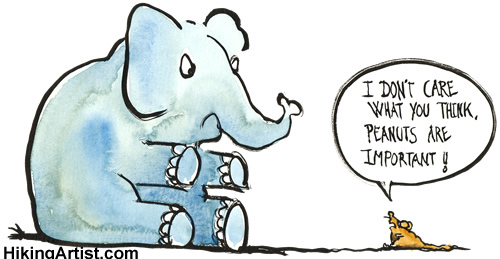
peanuts-important Recently there has been some high-profile buzz about Google's latest endeavor to unite arts and their internet products by having Google Chrome skins designed by prominent illustrators. The catch? Google will pay the artists nothing, offering exposure instead.

Understandably, many illustrators are incensed by the "offer." Though last year's iGoogle artist theme design campaign was highly successful, according to Mark Frauenfelder (an iGoogle artist), in that instance Google donated a significant amount of money in his name to a charity of his choice. This year Google is soliciting prominent illustrators ("prominent" meaning that these are illustrators whose work is already recognized and commissioned by high-profile companies that both pay and provide great exposure) and offering them no compensation. I think this is a slap in the face to the arts world.

Some very good points are discussed by Stan Schroeder at Mashable and Douglas McLennan at Arts Journal. I recommend reading their thoughts about the online community's responsibility for devaluing artists' work, seeing this as an opportunity to encourage higher levels of craftmanship, and the value of a relatively unknown artist to gaining exposure and consequently future work that would pay.

I, however, would like to address two issues that I have when a situation such as this occurs. I will do so in this and a following post.

First of all, I posit that most people who identify themselves as artists wish to make a living producing art. They do not WANT to have a desk job to enable their work. They would, ideally, be able to support themselves by producing work in their medium of choice. I am not talking about the people who happily admit to being designers "on the side," or who create art "as a hobby" and are content so doing. I am not talking about the people who, unasked, flood the web with their work free of charge. I believe that people who IDENTIFY as artists want it to be their vocation, their profession, their primary source of income, and guard it closely, hoping always that someone else will value it equally (and in concrete dollars).

It is offensive that Google, a company whose first-quarter profits saw an 8% increase over last year's (to $1.42 billion, according to the New York Times), would specifically select artists because they are well-known and well-respected and offer to pay NOTHING. It would be a different story altogether had Google held an open call for submissions, explaining at the outset that there would be no pay for the chosen designs, and allowed illustrators to decide for themselves whether they wanted to participate. (Note: even the 12-year-old winner of "Doodle for Google" received a decent-sized award for her winning drawing.) But to carefully hand-pick prominent illustrators and ask that they be a part of the project in return for exposure, shows how little art is respected by big business (and is, in my opinion, condescending). The fact that Google is SELECTING them in the first place suggests that these are artists who no longer need exposure, are at the top of their field, and should be considered valuable enough to earn a standard rate for their work.

Google's new skins are akin to packaging an unexciting product in an appealing way, something that marketing experts get PAID to do. Google would expect to pay someone to spruce up its image. Despite the positive impact these artist skins would have on Google Chrome's marketability (Chrome doesn't make my short list of browser choices), Google doesn't believe that the illustrator's work is worth a financial investment.

And if Google, a company worth billions, isn't willing to pay for top-of-the-line illustrators, what good is exposure? (Not to mention the fact that Google Chrome is not necessarily the best way to reach these illustrators' potential clients, since it depends on an individual's interest in downloading the browser to start with.) If a company knows that an illustrator is willing to work for Google for nothing, why would it want to pay the illustrator?

When Google thinks art isn't worth paying for, it is little wonder that legislators across the country question the value of arts funding.

Incidentally, I considered that this may be Google's reaction to Bing's attractive "decision engine." I contacted the provider of the stock photography that is used by Bing in an attempt to find out if they get paid for Bing's use of photos. The response I got from Jonathan, a representative of Danita Delimont stock photography, wrote: "I'm glad you like our photographers' work! Microsoft does indeed license the images they display on the Bing home page. We applaud Microsoft's decision to provide copyright information for the photos they use on Bing."

Google Local Business Center - A Great Free Tool

Thanks to Webware's item about Google's Local Business Center--it got my gears turning on how to effectively use a great free tool for arts organizations. As a Google girl (it's my current search engine of choice, but I'm giving Bing a shot), it brings to mind the number of times that I have attempted to find a gallery or theater by searching the web.

But for YOU, the lister, Google has added a slew of new dashboard tools that could prove very useful free feedback. With the new Local Business Center, the lister is provided insight into who is out there searching for their organization, and how much information they want. For example, does the person just look up the map? Find the number? Check out the website?

This could be very useful for arts organizations to gather more data about audience location, the amount of information that those using the web desire, and tailor marketing to target these audiences.

And yes, it's FREE.

What do we Generate if not Discussion?

There's a lot being said right now about the efficacy of utilizing social networking sites for fundraising efforts.  A. Fine's blog brainstorms some real-world strategies, musing about organization/donor relationships, and how to encourage financial support. She notes that giving circles can be a place for discussion that may generate interest in other causes, raise awareness, and thereby encourage future donations. As social media changes and abets our causes, is our "audience" tuning out? Online, are our attempts to network as organizations being perceived as pitches? Sure, there are innovative ways to raise awareness, but is it just more of the same spiel? Do organizations that simply use the web as a way to market cross a line in our networking expectations that if you lead, you will also follow?

Those are my thoughts...what are yours?

Another thing to consider when using the internet to find money: I came across this article, urging caution when using the internet to find investors.

Facebook for Arts Organizations - Webinar Series

Due to the high level of interest in all things Facebook, Patron Technology has announced a webinar series designed to take you beyond the basics, with detailed instructions, tips and examples of what other organizations and brands are doing successfully. Patron Technology clients: Free registration (click here to register) Non-clients: Session 1 is free.  Session 2, 3 and 4 are $45 per session or $99 for all three (click here to register)

Session descriptions:

Fans Are Better Than Friends (Encore Presentation) Thursday, June 4 | 2:00-2:45PM EDT

This session will give you a broad overview of the options for arts organizations (and other businesses) on Facebook, and some essential tips about what you should be doing.  This is an "encore" presentation of a session originally presented in April.

Are You Content with Your Content? Tuesday, June 16 | 2:00-2:45PM EDT

The most important part of maintaining a Facebook Page is making sure to update it frequently, with new and interesting content. But, that doesn't mean you have to spend all your time taking photos and writing new blog posts! There's plenty of shareable content on the web already, all you need to do is gather it and share it with your Fans. In this session you'll learn:

  • What makes an engaging status update
  • How to share photos and links
  • How to "listen" and find content to share on your Page

Apply Yourself! Tuesday, June 30 | 2:00-2:45PM EDT

Not all Facebook Applications are just for playing Scrabble and throwing sheep. There are some really useful apps that have been designed specifically for Facebook Pages. In this session you'll learn:

  • How to find and add useful Facebook apps
  • How to direct new visitors to a specific section of your Page
  • How to add your own content to your Page using a "blank slate" HTML app

Fan-ning the Flames Tuesday, July 14 | 2:00-2:45PM EDT

Once you've put all this time and effort into getting your Page set up, how can you aggressively attract more fans? We'll look at some ideas that work, and I'll share one case study of an org that went from having 600 fans to eight THOUSAND fans-in one week! In this session you'll learn:

  • How to link to your Page from your Web site and e-mails
  • How to create Facebook Ads to attract more fans
  • How to understand the stats and analytics that Facebook provides

Rethinking ROI for Social Media

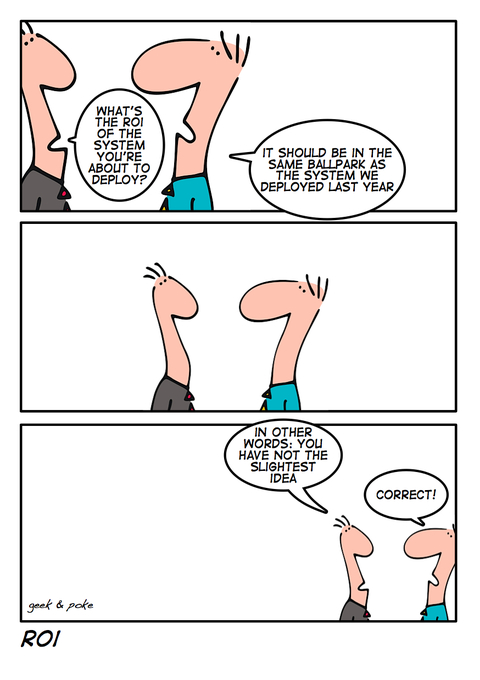
roi For many arts organizations out there right now, this is how we seem to be calculating the ROI for Social Networking and Media.  Everyone seems to be groping in the dark to boil down a simple monetary answer to this question of, "What is *your organization here*'s return on investing in Social Media?"
While there are solid(ish) ROI calculators for Social Networking out there, and they do provide cells for number of friends added, and amount of donors added to your email lists vs. amount of volunteer/employee time and money spent, I feel like somehow they all miss the point.

Yes it is nice to have quantifiable data to back up the decision to dedicate precious and dwindling time and money to a project.  However, the main source of return from social media simply isn't quantifiable.  We're talking about trying to quantify human interaction and communication.  And we are also talking about laying the groundwork to adapt to how the world is changing, and how our audiences are staying informed/using the internet.  The worth of these tools, and the time spent cultivating relationships with our audiences does not exactly have a set monetary value.

We can begin by monitoring click through rates, and number of new "friends" on Facebook and weighing this against how much time and money is being spent, but this doesn't exactly give a complete picture of what is going on.

If an organization is really committed to utilizing social networking not just for marketing and revenue generation, but for communicating and engaging their target audience and creating a community of individuals that are interested in the core values and beliefs of that organization then how on earth can they boil that down to a Return On Investment.

As of right now, the amount of direct donations that non profits are receiving from their social network sites is arguably marginal.  Admittedly there are some outliers who are able to generate significant returns from their social networks, the Brooklyn Museum's 1stfans springs to mind.  However, as a communication tool for promotion and engagement, a method of gathering email-ing lists, and for managing and maintaining positive feedback about the organization, social networks are proving to be invaluable pretty much across the board.

The overwhelming problem of course is that once your organization has developed this online social network, simply having a static page isn't enough.  A Facebook page is less a Billboard than it is a Soapbox, so you have to treat it like one.  It might be ok for your organization to have an unpaid intern managing some of your social media because they are by and large in the Heavy User demographic and know all the ins and outs, but without some sort of direct executive insight and direction you now have a 20-something basically dictating the brand identity of your organization and running a large part of your marketing department.

So I guess that's another way of looking at the ROI, what would happen with no investment of time and resources?  The whole "If not X" senario.  As the world slowly begins to adopt social networking as a standard means of communication and the source for their daily information, we may see an increase to the direct donations to organizations through these social networks.  I mean, if politicians (read old rich people) are already doing it, then how far behind the curve are we if we aren't?

Really Alternative Exhibition Spaces

Deviating from my usual blog posts about new technology's influence on the Art world, today I would like to talk about alternative exhibition spaces and some of the issues surrounding Marketing escalation.

I've mentioned in the past that the Younger than Jesus crowd has a general disdain for excessive marketing and that we simply do not like being sold to.  We Tivo the shows we want to watch to remove the adds, and we employ as many add-ons as we can install into our web browsers to reduce the amount of online advertising we are subjected to.  We have a certain amount of immunity to advertising, our eyes glaze over and we cease to pay attention to billboards, print adds, junk mail, spam, pop ups, and recently even most viral marketing has become groan worthy.

Some marketing companies like NPA outdoor have been upping the ante by advertising on billboards that are erected without permits.  An intrepid group of artists took it upon themselves this past weekend to appropriate 120 of the over 500 illegal NPA outdoor owned billboards as alternative exhibition spaces.  Some amazing images, and more information about the project Here, and Here. This project is a really interesting look at the debate over public space, and the ubiquity of advertising.

hifive

Not to say that there aren't innovative and interesting marketing campaigns out there.  This add, for instance, probably sold more Cat Power and David Bowie songs on Itunes than it did Lincoln MKS's.  (on a side note, if anyone knows where to find the full version of this cover, please post it in the comments) And this one shows how versatile Vimeo is more than it inspires me to buy a Honda Insight.

One thing that all of these projects, and even some of these advertisements point out is that there is still a deep appreciation for art out there, which bodes well for those of us making a living in the art world.

Does this make you think of how you can approach marketing an arts organization differently?

The MoMA recently received some blow back by hiring The Happy Corp to "mashup" their subway advertising campaign.  But were their intentions in the right place?

Let us know what you think.

New Media Opportunities part 2

This time it's Personal

die-hard-2

Last Wednesday I touched upon four readily available social platforms that Arts Organizations can use to maintain relationships with their audiences.  Today we'll look at some more online tools that may have been overlooked.

Linked In:

LinkedIn is a professional social network that allows you to connect with peers in the field.  Much like Facebook, organizations are able to create a LinkedIn Group with the ability to post discussion topics and aggregate blog posts into the News Feed.  However, your audience within LinkedIn is generally different than your audience in Facebook.  This also means that the content and tone of your discussion posts should be differentiated as well.  Your Facebook fans will generally consist of audience members and people interested in your organization, where as LinkedIn will primarily consist of professionals in the field.  Discussion topics will be more focused on the day to day nuts and bolts of the organization, and it provides a good platform to ask questions like,

"I had a question for folks working within arts organizations.  What ticketing software are you using? Are you satisfied with your solution? Thanks!"

Google Alerts:

Depending upon the size of your organization, it may be a good idea to set up some Google Alerts that keyword search for articles about your organization, and artists or performances that you are presenting.  It is a really convenient method of gathering information about what is being said about your organization online, and alerts are available as an email or via an RSS Feed.

Flickr/Youtube:

These are a bit obvious, but some arts organizations still are not taking advantage of these two media sharing sites.  Keeping up with a Youtube channel can be quite a bit of work for an arts organization, especially if you are trying to maintain a constant stream of new videos to keep your audience engaged.  However, by releasing videos that revolve around a significant event such as a performance or opening it can be more of a one time thing.  There is a great article about the marketing power of video Here.  I feel like The Soap Factory in Minneapolis has done an excellent  job producing videos that grab the audience's attention without giving away too much.   Flickr is also a great way to present images of events and performances online, and allow your audience to tag and upload their images of your organization as well.

Last.fm:

Ok, so Last.fm, ILike, and Pandora are relatively in the same boat when it comes to social networked internet radio sites, but Last.fm seems to be the most popular (this week).  Users are able to create profiles that allow them to search for friends and groups that may have the same taste in music and create personalized "stations" and playlists that others can listen to and discover.

Orchestras are able to claim their profile on Last.fm, post basic information about the organization and upload music that listeners will be able to stream online.  Your organization will also be able to set up a group much in the same way as Facebook and LinkedIn, that will allow your fans to participate in discussion and comment about your organization.

This is also a great forum to post information about upcoming concerts and events.  Users are notified about events based on their proximity to the venue, and you can add direct links to ticketing sites.  This site isn't just for Orchestras and indi rock bands, if your arts organization hosts performances during openings and other events it may be a good idea to start a profile, and post event information about the artists that will be playing your event.

More More More:

This is by no means a comprehensive list of everything that is out there.  There are an innumerable amount of social networks cropping up specifically for artists.  For instance, Peter Vikstrom commented on Wednesday's post about Cultgrid, which I haven't had the chance to explore fully, but looks like an good performing arts social network.  There are Blogs such as the SITI group blog that are an excelent source for information pertaining to performing arts.  And this awesome thing called CrowdFire, that just boggles the mind.

If you have come across a valuable source of information or an interesting social network pertaining to the arts, please feel free to leave a link in the comments below.

Yet another reason to own an iPhone

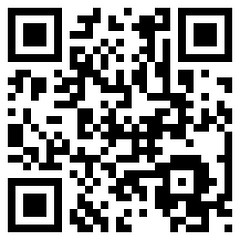
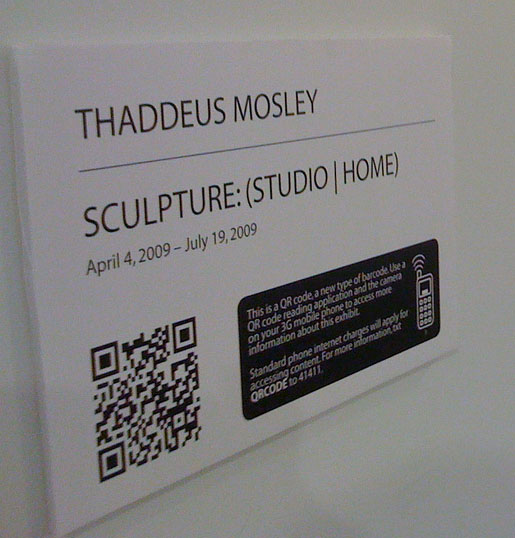
Quick Response bar code at the Mattress Factory If you have been to the Mattress Factory recently to see the new Thaddeus Mosley exhibition, you may have noticed that the title cards and some of the minimal signage have these intricate symbols on them. What you're seeing is a two dimensional bar code called a QR code that can be used to access information via your mobile internet enabled devices such as an iPhone or Blackberry.

The code on the image above for instance, contains a link to a Youtube video of Thaddeus Mosley discussing the placement of large scale works within the gallery space.

Once you are in the gallery you can text QRCODE to 41411 to receive a simple walk through that tests to see if your phone is compatible with the suggested reader. The BeeTagg reader supports over 50 types of mobile devices and is available as an iPhone application as well.

After you have the reader installed you can access information from signage posted throughout the gallery space. Much like the guide by cell program, there is no proprietary equipment for the museum to pay for beyond the fabrication of the signage and developing the web content. However unlike a guided tour, this allows visitors to explore the space and access information that they are interested in when they want to.

Director of PR + Social Media, Jeffrey Inscho was kind enough to give me a guided tour on Thursday and pointed out some of the kinks that he is still working out. While most of the QR codes bring up URLs on your mobile device, some of them are text only which makes the codes much more dense. This can make it more difficult to take an accurate enough picture for your phone to recognize and decode the data. The smallest that the QR codes can be printed and still be read by most of the camera-phones on the market is about 1.5" square. So the text only cards may end up being replaced with a URL of the text to help ensure that they can be read. Shadows also tend to cause some issues while taking pictures, so you have to watch where you stand.

For the recent Predrive event, before they had installed the signage in the gallery, the Mattress Factory included a QR tag on their advertisement in the City Paper and received around 72 hits, which was more than Jeffrey had expected. Over the course of the exhibition the Mattress Factory will be able to monitor which tags receive the most hits, and get a feel as to how people are using the signage when visiting the museum.

qr1

As of right now, the Mattress Factory is the only museum in the United States that is currently using QR tags within the exhibition space, but the Powerhouse Museum in Sydney Australia has been using them for a a while and have outlined many of the issues that have cropped up in an amazingly detailed step by step guide.

Jeffery stressed that this was an experiment and an effort to help reduce the amount of printed gallery guides they use. It is not a permanent replacement for the printed material, but as the technology becomes more prevalent the QR codes will provide more in depth interaction and information to the visitors.

As of right now the Mattress Factory plans on continuing to use this new technology for future exhibitions and already has some just flat out amazing ideas on how to incorporate it into their Annual Garden Party but I don't want to spoil the surprise.

Best arguement thus far as to why I should update my phone from the bottom of the line Nokia I'm using.

More Proof - "Free" Can Have Value

11816532_5ca1075282_bI've stated on our blog and podcast many times that you can offer your content for free without devaluing that content. Frequent followers will recall two interviews with independent musician Jonathan Coulton (podcasts #38 and #55), who has given most of his music away and still manages to make a decent living. (I cannot define "decent" exactly, but I imagine he does quite well for himself.)

Well, thanks to Amazon's 2008 best-selling albums list, I have even more proof that free does not equal worthless. According to ReadWriteWeb, the best-selling album in Amazon's MP3 store for 2008 was Ghosts I-IV by Nine Inch Nails. Interestingly, that same album was available for free (and legally!) in March via BitTorrent under the Creative Commons Attribution-Noncommercial-Share Alike license.

This means that either: A) People ignored the fact that the album was available for free and opted to pay, or B) people downloaded the album for free and paid after listening because they felt it was worth the money. A third option, of course, is that people were just too dumb or lazy to figure out how to use BitTorrent. This, however, is unlikely. After all, this is the fan base for Nine Inch Nails we're talking about here... not Frankie Valli and the Four Seasons.

This is not to say that opera companies should start giving away tickets. I'm simply saying that arts organizations might consider lightening up a bit when it comes to offering content online.

("Free LSD" photo courtesy of corypina's Flickr stream.)

Home Page Call To Action Survey

Though it might be debatable, it's a commonly held belief that the home page is the most important page of a Web site. A home page must quickly communicate the soul of an organization to a visitor and provide a visitor with easy access to relevant information. Often, it is the most vital and heavily trafficked piece of real estate on your organization's Web site. We recently wondered: how effectively are performing arts organizations in the field using their home pages?

We conducted a survey that examined three common calls to action that we believe all performing arts organizations should have prominently placed on their home page:

  • ordering and purchasing tickets
  • donating or contributing money
  • joining or subscribing to a mailing list or newsletter

These are three actions that most performing arts organizations want their Web site visitors to be easily take. So, just how easy are their home pages making it?

We were also curious to see how many organizations were still using splash (Flash introductions or animations, slide shows, etc.) or landing pages that delay the visitor from getting to the actual home page.

Click past the jump for more information on how we conducted the survey and for the results.

Methodology In all, we looked at 450 home pages of performing arts organizations across the United States. All 50 states and the District of Columbia were represented. There was a mix of dance, theatre, musical theatre, opera, symphony, and choral companies.

We asked two different people to review each home page for links or areas relevant to the three calls to action described above. They then scored each call to action using a scale of 0 - 5:

0 - Not on home page 1 - Hardly noticeable 2 - Somewhat noticeable 3 - Noticeable 4 - Very noticeable 5 - Immediately noticeable

We also asked reviewers if there was a splash or landing page prior to the home page. Finally, we gave the reviewers an opportunity to provide any general comments or thoughts on the home page and its design.

The Reviewers We used workers on Amazon.com's Mechanical Turk service to perform the reviews. 44 unique workers participated in the survey responses. At least two unique workers reviewed each home page.

I'll be talking about our experience with Mechanical Turk in a later blog post. To summarize, Mechanical Turk is a service that allows you to set up and pay workers for completing repetitive, simple tasks, such as a survey, that can be accomplished by a human computer operator.

Because of this crowd-sourcing approach, we manually reviewed the resulting data. We investigated and eliminated some data points due to inaccuracy or due to large discrepancies between to the two individual reviews for a home page. Ultimately, we ended up with valid reviews for 429 of our 450 home pages.

Results The detailed results are below. I was surprised at how well performing arts organizations are doing at making tickets available online. The results are quite strong in that area. The fact that 4.9% of organizations still have splash pages makes me cringe a bit, since I am completely against them. (Why make your users work harder to get to the information they care about?)

Another area where the results surprised me was the reviewer comments. The comments were optional and required that the reviewers spend some additional time to complete their response; given the nature of working as an Amazon Mechanical Turk, time equals money. Some of the comments were really in depth and revealing. This might be a reflection on the quality of the Mechanical Turk service, but it could also be due to the reviewers being excited about contributing and giving feedback to performing arts organizations.

If anyone has any questions about the results or would like any additional information about the methodology used in this survey, please post a comment.

Download Raw Call To Action Survey Data (CSV)

Overview
# of Home Pages Reviewed 429
Splash Page
% of Sites with Splash Page 4.90%
Ordering and Purchasing Tickets
Average Score 3.0
% of Home Pages with a Score of 0 16.8%
Donating or Contributing Money
Average Score 2.5
% of Home Pages with a Score of 0 21.9%
Joining or Subscribing to a Mailing List or Newsletter
Average Score 1.6
% of Home Pages with a Score of 0 38.7%
Reviewer Comments
% of Reviews with a Reviewer Comment 36.60%
% of Comments that were Positive or Neutral 54.1%
% of Comments that were Negative 45.9%

Will You Go? New Patron Facebook Tool

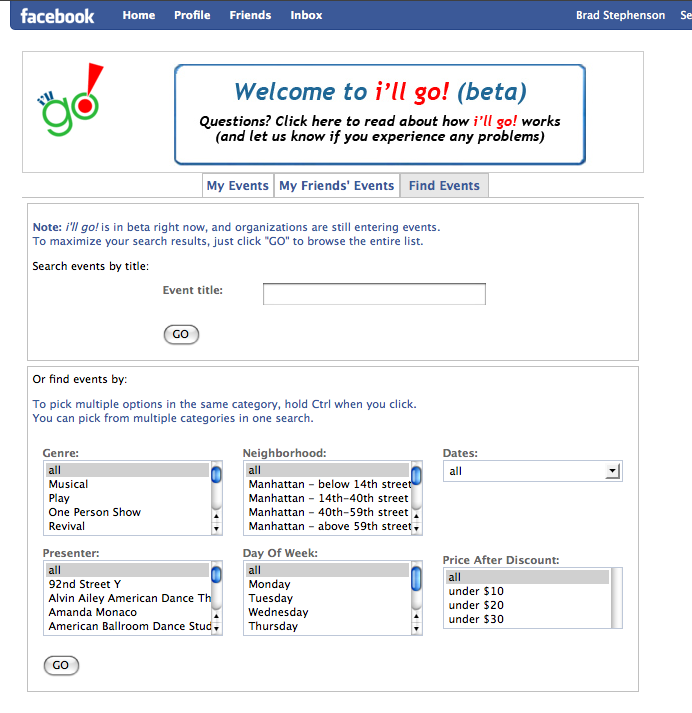
Gene Carr, founder and president of Patron Technology, recently blogged about his company's new Facebook app for New York arts groups and audiences. The app, i'll go!, is a free downloadable tool that provides users a way to connect around events and organizations a way to encourage first-time attendance through Facebook-only discounts.

See a screenshot of the event search interface after the jump.

Searching for an event using the Facebook 'i'll go!' app.

As this app is in beta, I'd strongly encourage New York organizations and audience members to install it and give it a go. If the app catches on, Carr says Patron will expand the tool to include other cities.

Find our more about i'll go! at the app's Web site.

Google Ad Planner

Google has opened access to their Ad Planner to anyone with a Google account. This is news of note for any arts marketing manager or coordinator and might be worth a few minutes of exploration. Ad Planner is a tool that helps you identify Web sites that your target audience is visiting by aggregating tons of search and site visit data. You can narrow your focus by demographic (gender, age, household income, education), by geographic region (country, state, metro regions), or by sites or keywords searched. You can select target Web sites and create a "Media Plan" and explore that plan through aggregate demographic data and interactive charts.

How Google collects this data in the first place is a mystery to me and still subject to discussion, and the limitations of the data can be felt when trying to use Ad Planner to get really specific about your target audience. While playing around in Ad Planner, I found that attempting to drill down too much resulted in, well, no results.

Trying to filter by keywords searched can be particularly problematic. For example, when I search for sites visited by people who search for the keyword "art," and no other demographic or geographic filters applied, I get a large number of results. Searching for people searching for "art" and who are in my hometown of Pittsburgh, or even my home state of Pennsylvania, returns no results. Does this mean that no one in PA is searching for "art?" No. It means that Google Ad Planner, like almost all of Google's products, is still a BETA release that has a long road of improvement ahead of it.

Does this mean that Ad Planner is useless? Not completely. I was still able to get pretty good results searching for demographic and geographic information at the same time (it's just those darn keywords that seem to throw things off). Would I create an entire Web advertising campaign based on the Ad Planner's advice? No. But would I take a look at it to gain some additional perspective and potential targets? Absolutely.

Get Your Phil...

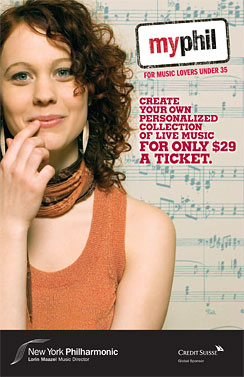
The New York Philharmonic has created a subscription series that allows people under age 35 to build their own season package for only $29 per ticket. Subscribers using MyPhil, as the program has been dubbed, get the best available seats in the house at the time of purchase, so the value of the discount fluctuates depending on the seat(s) one is able to secure. Create a flexible plan with MyPhil.

The subscription plan offers extra tickets throughout the season for guests for just $29 and also provides scheduling flexibility should a conflict arise on the date of your ticketed performance. In addition, MyPhil subscribers get a free one-year subscription to Time Out New York magazine.

This is just another example of an arts organization recognizing the unique needs and habits of the 18-35 set. I'm 31 years old, and the thing I appreciate most about plans like this is the ability to select alternate performance dates should a conflict arise. Young people are less and less likely to plan ahead, as we like to keep our social calendars flexible in the off chance that a better opportunity presents itself.

Confession: I have no social calendar. But if I did, I'd like to keep it flexible.

Web 2.0 Expo: Day Two

The highlight of my day was interviewing Eileen Gittins, the founder, president and CEO of Blurb, an online publishing service that provides print on demand tools for the general public. With Blurb's book layout software, BookSmart, users can create books using their own text and images and upload them to the Blurb server for purchasing, printing and delivery. Like Lulu.com (see Josh Futrell's recent blog post), Blurb empowers writers, photographers, graphic designers, and other artists to control the publishing of their work.

Gittins is a passionate entrepreneur who truly understands her client base. (She started Blurb based on her own frustrations with the publishing industry.) Blurb and the related project Photography.Book.Now exemplify what is truly phenomenal about the power of the Web.

No more spoilers. You can listen to my interview with Gittins (and a few other Web 2.0 Expo players) on Technology in the Arts Podcast #51 on Friday, September 26. (Go ahead and subscribe already, you slouch!)

I also digested this morning some tips on viral marketing during Jonah Peretti's Web 2.0 Expo session, Viral Marketing 2.0. Peretti, known throughout Web circles as a guerilla media guru, is the co-founder of HuffingtonPost.com and BuzzFeed.

Peretti explained that, contrary to popular opinion, a message doesn't become viral because of influential users. Rather, a message spreads because of the network that supports it. For instance, he explained, a fire spreads when the conditions are perfect and not because the spark that ignited it was special.

"Facebook created a network that would make the driest forest possible so the fires would spread," said Peretti.

The network Peretti highlighted today is what he calls the "Bored at Work" network, which is a huge people-powered network comprised of distracted corporate employees. However, he explained that a big problem with trying to spread a viral message is the "radical unpredictability" of the Web. There is no way to know who will make something popular or what will become popular.

So how can Peretti possibly offer any advice on delivering messages that will succeed in a viral way? He admitted that he didn't have a perfect answer. Still, considering his repeated success at gaining viral acclaim (see The Contagious Media Project for a list of his online exploits that have blown up), there is a great deal of cred behind the tips he offered.

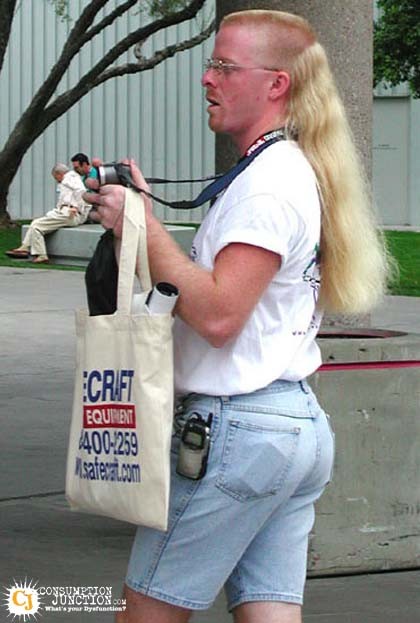
For instance, may absolute favorite of Peretti's techniques is one he dubs "The Mullet Strategy." As most people know, a mullet is a hair style that features a short, professional front-end with a long, flowing rear. Peretti compared this "business in the front, party in the back" approach to marketing. Since the most contagious media is often silly, fun and even shocking, it isn't always appropriate for that content to live on the front page of a Web site. However, if there is a "party in the back" and people are enjoying and sharing that party, it will most definitely drive traffic to the other areas of your site.

Like a Moth to a Podcast

I've just discovered and started listening to The Moth podcast. The Moth, for those of you who don't know, is a non-profit storytelling organization that brings in people - actors, playwrights, comedians, poets, personalities, and the average Joe - to tell a story from their own lives. No notes. Just a performer, a story, a microphone, and an audience. The Moth has several different live performance series and programs around the country. Now, The Moth has been around since 1997, but I'd never heard of them until a few days ago. Why? Because 1) I live in Pittsburgh, instead of New York or LA, 2) I'm not hip, and 3) I often struggle to get my recommended daily allowance of culture.

Point is: I found them eventually. I found The Moth through iTunes. I found them through their podcast.

And now? I know for a fact that I will continue to listen to the podcast. I've enjoyed their podcast so much, I'm considering buying CDs and other schwag through their site. I’m writing a blog about them. I’ve told two friends about them. And so on...

It is so very important to have as many points of entry into your organization and its services as possible, and a quality podcast can be one. We’ve got a podcast tutorial here on Technology in the Arts. There are tons of resources and guides out there. It is worth the effort, the equipment, the navigation of the waters of rights and copyright, and the time to create a new point of entry to your organization to gather fans you never knew you had, like moths to a flame.

Desktop Wallpaper As Art

I got bored with my standard, gray desktop today, so I went out in search of something new.  I found some great computer wallpapers that can only be described as art. The beauty I ultimately ended up plunking down on my desktop was at Smashing Magazine.  Every month, they have a new set of wallpapers, available for free download, that have been submitted by artists and designers from around the world; artists such as Vlad Gerasimov, who has created an online studio teeming with his digital artwork.

Along the way, I also found a blog called Kitsune Noir, run by Bobby Solomon, which recently concluded the Desktop Wallpaper Project where artists submitted their works (some great stuff there).  And, I found out that deviantART has a section devoted to artist submitted desktop images.

This got me thinking.  I found all of these great places where individual artists were translating their work (or developing work exclusively) for computer desktops as a way of getting their art out there.  Were any arts organizations doing the same?

I did some searching and almost drew a complete blank.  The only case I could find was the Tasmanian Theatre Company.  Are any arts organizations out there providing desktop wallpapers on their sites? I would have to think that it's a way to keep your organization and its brand in front of computer-bound patrons.