Marketing

Technology Adoption and Implementation in Arts Organizations

ArtsIT

Technology in the Arts has just published the results of a  survey regarding technology adoption and implementation in the arts and cultural field. (Access the PDF publication here).

In order to uncover emerging trends and differences in the use of technology amongst arts and cultural organizations, we asked arts managers to provide us with baseline information as well as a self-assessment of the role of technology in their organizations.  Respondents shared information about where they are now, which technologies they hope to adopt in the coming year, and how they find the resources they need to implement and maintain technology.

This report, which includes responses across a broad spectrum of arts and cultural organizations representing a variety of disciplines in the United States and Canada, reveals a snapshot of how the field approaches technology.

What did we discover?  Here is a small sampling of the findings that emerged:

  • Over three-quarters of organizations with annual budgets of less than $500,000 spent under $5000 on technology in the past year, while half of organizations with budgets of $5 million or more spent over $100,000.
  • Nearly half of organizations with budgets between $2.5 million and $5 million have no full-time technology staff, and that figure jumps to 82% for organizations with annual budgets of less than $500,000.
  • Organizations with annual budgets of less than $500,000 currently use static websites at a higher rate than dynamic websites, while all larger organizations are more likely to have already moved away from static websites.
  • A large percentage of respondents, regardless of organizational budget size, did not respond with any specific technology plans for the next year--which may indicate an overall lack of planning for future technology.

Want to find out more?  Check out our report and see how your organization compares.

Social Media Spotlight: The ToonSeum

Welcome to the fifth installment of the Social Media Spotlight, our monthly feature focusing on arts organizations’ social media strategies.

How to allocate time and money towards both social media engagement and online marketing is different for every arts organization. To get a different perspective Technology in the Arts decided to talk with a smaller organization, the ToonSeum, about how they achieve their social media and online marketing goals with a limited staff. I had a chance to chat with Joe Wos, Executive Director of the ToonSeum, about his approach:

joespic

So Joe, what is the ToonSeum?

The ToonSeum is Pittsburgh’s Museum of Cartoon Art. It is one of only three museums in the country dedicated to the cartoon and comic arts. We offer rotating exhibitions covering all aspects of cartoons and comics, from animation and anime, to comic strips, comic books, editorial cartoons, illustration and much more. We also offer ongoing workshops, screenings and lectures.

It really is one of the most unique museums in Pittsburgh. Every city may have a version of a children’s museum or traditional art museum, but there are only three cartoon art museums! New York, San Francisco and Pittsburgh. We take great pride in our unique place in Pittsburgh.

What kind of marketing and PR challenges does the ToonSeum face?

Our number one challenge as with any small non-profit is budget. We are a small museum up against juggernauts! We are up to the challenge.  If anything, budget limitations have led to creative thinking. You aren’t going to see us investing a lot in “traditional” advertising.  Being a smaller museum also eliminates a lot of the fear of change you see from larger venues. We don’t have a huge investment in outmoded technology or ideas, so we are more inclined to let go and move forward to embrace new ideas in both marketing and tech.

We have been very lucky, the media both locally and nationally has been very supportive.  Part of that attention is because of our approach to marketing. We use online marketing to create interest in “real world” experiences. We innovate new ways of reaching out. How many museums can say they had their own beer? Illustration Ale was a great success. We didn’t mail out postcards we used facebook.

In February we will launch our own themed hotel room in partnership with the Wyndham Grande downtown. It’s all about immersive experiences, translating virtual experiences we enjoy in gaming and through cartoons into the real world. That’s the kind of creative thinking we embrace.

A limited budget forces truly creative thinking.

Why did you choose to go with social networks/online marketing as a solution?

We are a fan-based museum. It’s a new approach to museum management, marketing and even exhibitions. Comic and cartoons by their very nature, are a fan-based medium. We embrace that. Just look at San Diego Comic Con, why is every major movie launching there? Because of the power fans have via social networks. We tap into those same fans. We are a geek museum, and proud of it. Our audience is very tech savvy, early adopters who can market virally better than anyone.

We know that the ToonSeum is a real world extension of a fan based virtual world. We are a museum of characters, icons and avatars. We want to become a real hub for comic and cartoon fans, and the only way to do that now, is through creating online connections and then inviting them to join us at the ToonSeum. Once we get them here, we know, they will tell their friends, strangers, tweet, blog, post, and tell the world about us.

We also recognize that it can’t be just virtual, you have to take it to the fans! We have booths at major Comic Cons, from San Diego to New York. We also host Blogger events and Tweet Parties at the ToonSeum. If we can get the word out to them about our exhibits and programs they will help us spread the word.

Beyond the standard social media efforts, such as a Facebook page and a twitter account, what other types of online efforts are the ToonSeum trying?

I worked for twenty years with a museum that had a real aversion to technology, it took a decade for them to come around. The ToonSeum is the opposite. We want to be the first. We were the first museum in Pittsburgh to have an I-Phone App. We may still be the only one! MailChimp, EventBrite, every new social marketing tool that comes out we give it a try. We were among the first to participate in KickStarter (we were even featured in the New York Times in an article about it.) I attend the Consumer Electronic Show in Las Vegas just because I know we need to stay at pace with the public. The technology in most museums is outdated, kids can do more advance and exciting interactions at home. So we reach out, we are a Beta Test museum. We put ourselves out there to new technology and say, let us try this out first!
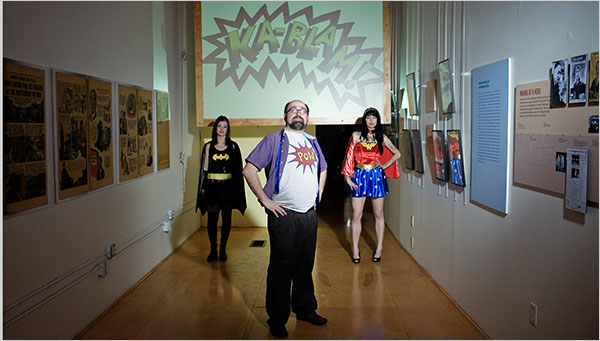
Image via the New York Times

We have an ipad docent at the entrance. Any guests who wants to experience more online while in the gallery can use it as a tool.

For light up night we launched lights in our windows that can be controlled from the outside via an iphone. The guest has control over their experience before they even enter the door.

I am a self-professed geek and nerd, I attend the Consumer Electronic Show in Vegas every other year, I attend the Toy Fair in New York. I bring those innovations and ideas back to the ToonSeum and find ways to integrate them. So the ToonSeum has a giant screen projection in the center of our ceiling that loops cartoons. It is of course blu-ray 3d as well.

We have worked with Behar-Fingal to integrate QR codes into all our exhibitions. This allows guest with smartphones to link to additional content online. Whether it is a wikipage entry on the artists, or video we provide of the cartoonist at work. This is a great tool to take our exhibits beyond our walls and is also cost effective. People are walking around with access to all the information they need. In the future museums won’t need placard after placard of explanatory text. They will just need to provide a link. Their curiosity will take them beyond your walls. Each and every work of art is a potential jumping off point to a world of discovery in the world wide virtual museum.

We know that the traffic has to flow in both directions. A museum should be a destination from those on the web looking for real world experiences, but a museum must also be a gateway to curiosity that can be infinitely explored in new and exciting ways online.

Despite our using technology in so many ways, the ToonSeum is still ultimately about art on the walls. Because we have integrated ways to put the technology in your hands we don’t have to use a lot of monitors and computers. It makes it an individual experience, which is something we learned from social marketing. Everyone wants to interact on their own terms.

I know you operate on a small staff, how does this affect how you manage your various online efforts?

We have a social marketing intern whose only job is to tweet and post. That’s a must! The museum has to have a presence online that allows for immediate interaction. So we respond to every tweet that mentions us, every facebook post. It’s time consuming but it is the most important aspect of social marketing… being social!

All of our staff also has access to post to our various accounts. So we are updating daily. More important though is the fact that our fans are out there, retweeting and posting everything for us. It gives us a much bigger presence.

They also know to speak with the ToonSeums voice. It’s always connected to our mission and not personal. I have seen top-notch museums whose official facebook page has post about their kids getting the flu! Unless there is an epidemic of every kid visiting your venue getting the flu, how does a museum have kids that get sick? It doesn’t. Your venue has to have a virtual identity, a voice that your fans can interact with and it has to be consistent.

This is all easier to accomplish with a small staff. There are no committees, no approval process, no budget meeting, we identify what needs done and do it!

Does your staff size affect how you track the success of all of your online projects?

Every guest that comes in is asked how they heard about us, and their zipcode. We track every single opened email and clicked link. That data is all placed into a matrix we use to measure our success. It doesn’t take a big marketing firm, it just takes a commitment of a few minutes each day.

Can we talk about the Bloggers Blast? What is the event and why focus on bloggers?

I was at the Consumer Electronics Show in Vegas and attended about 5 after parties. What impressed me was they were all geared toward bloggers and social media. I knew this was something the ToonSeum had to do in Pittsburgh.

Traditional press is great, we love them! But today even they are pulling content from bloggers. Bloggers have fans, just like we do. It comes back to embracing a fan-based culture. So we wanted to let those bloggers get a sneak preview at our upcoming exhibitions and programs for 2011. We have special guests, a preview of the art, prizes and every single blogger will get a flash drive filled with all our press releases, promo art and more. If you are reading this and are a blogger, contact joe@toonseum.com for your invite.

We will be following this with tweet parties, where everyone is admitted free if they tweet about the exhibits.

You have mentioned that the ToonSeum was one of the first Pittsburgh museums to develop an iPhone app. What does the app do and what was the development process like? Has there been a good response?
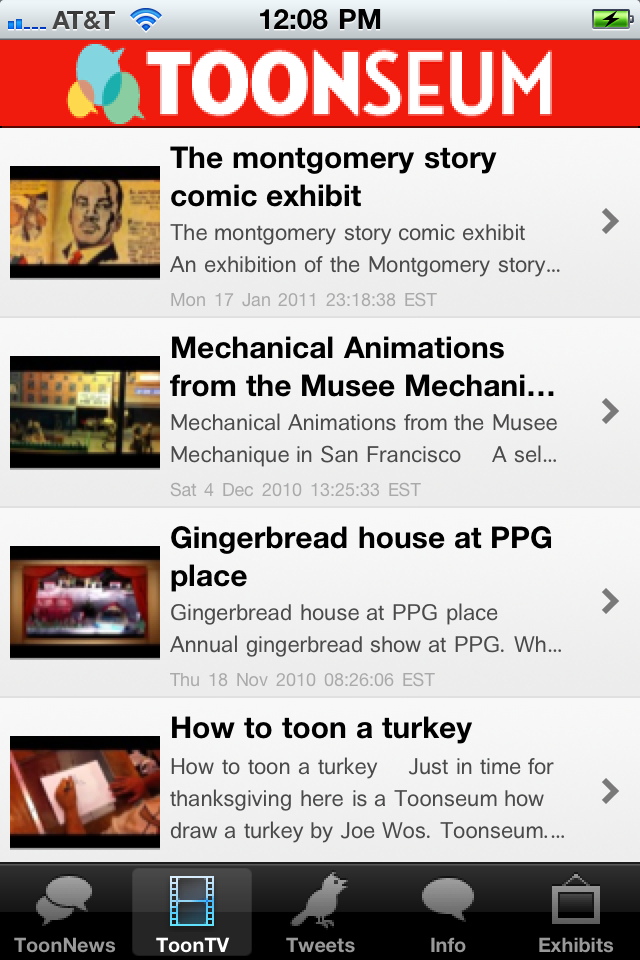
A screen shot of the ToonSeum App

Going to back to my previous experience with another museum, I was often frustrated by the phrase “we’ll look into it.” I began to realize that phrase meant, we don’t know how to do it and aren’t willing to learn. Forget the yellow pages, the phone book is dead. It’s all about web and apps. We knew we needed an iphone app. It provides immediate access to enhance the guest experience. It also goes a long way to legitimizing you to tourist. It’s one of the first things I do when I visit a venue in a new city, I check them out online and then download their app.

Creating an app can be an expensive prospect, thousands of dollars. That was out of the question for our budget. So, I just learned to do it myself. I applied for an apple developer license, found a great site that would allow me total control over the creation of the app, submitted it for approval and that was it. Total process took about five hours, not counting waiting for approvals, which took three weeks. I used rss feeds so that info on our hours and events could be changed on the fly. I created a framework that would allow our youtube videos to be viewed from within the application. As a cartoonist it was easy to do most of the graphic design work myself and there you go. It’s done. Our social marketing intern can update it from anywhere. I can even update from my iphone when I am out of town.

If I am going to run a museum I should know how to do every job. I better know how to market, run the register, curate an exhibition and even mop the floors. I can then have a better understanding of how difficult a task is and more important I can lend a hand when it is needed.

I am working on an android app right now and we are doing a complete web overhaul in spring.

We are geeks, we love this stuff.
Rise of the Masters

As the controversy surrounding internet piracy continues brewing, music industry officials and musicians continue to find new ways to promote and profit from their work. Digital downloads are one tool that make it easier for musicians to connect with and cultivate a fan base globally. The Recording Industry of America reports that there are more than 400 authorized digital music services worldwide offering more than 12 million songs. Digital sales compromise nearly one half of total revenues for the music business in the United States.

Digital downloads aren’t just for "current musicians", however. Apple’s recent acquisition of The Beatles music catalog resulted in 450,000 copies of Beatles albums and two million individual songs being sold in the first week alone.

Another exciting entry into the digital download market is Europe's leading digital label, X5. The label licenses music, acquires various catalogs and refines the material for high end products. This process has allowed them to form exclusive partnerships with and distribute music to companies like iTunes, Amazon, Rhapsody, Napster and Spotify. Since their formation in 2006, X5 has become the best selling classical label in the United States, with a product portfolio of over 200,000 titles. Spotify's principal owner, Northzone Ventures, is also investing 7 million Euro in the label.

In December of 2010, the company launched their latest classical music series entitled Rise of the Masters. Rise of the Masters is unique in that it highlights the works of twelve of history’s greatest composers, including Mozart, Beethoven and Bach. The recordings feature some of the world’s greatest orchestras including the City of London Simfonia and the Amsterdam Sinfonietta as well as soloists Freddy Kempf, Torleif Thedeen and Monica Hugget. The downloads are available via the iTunes Store and all other major online retailers. X5 has also launched a Twitter account, Facebook page and iPhone app to promote the series.

While digital downloads are certainly helping the music industry to regain a bit of financial ground, series like Rise of the Masters seeks to accomplish a more important goal. The music label aims to "animate the digital custom base and reinvent digital  music worldwide." X5's use of social media, modern artwork and mobile apps to promote the series are engaging a new generation of listeners and hopefully encouraging these new listeners to patronize their local arts organizations.

Top Technology Trends: What’s Ahead for Arts Marketers in 2011

This post also appears as a featured article on artsmarketing.org, hosted by Americans for the Arts.

In this tough economy, most of us have encouraged ourselves and others to look ahead to brighter times. But, what exactly lies ahead in the next year for us? How can we make the most of our future?

In 2010, technology influenced our field tremendously. Some predicted trends, like Google Wave and Google Buzz, failed to take off, and many unexpected trends, like group-manipulated pricing and Ask a Curator, flourished. The following are some major trends that have gathered momentum in the past year and/or are poised to take off in 2011:

Group discounts and group-manipulated pricing Group discount sites exploded in popularity in 2010. While many organizations have a group sales manager or special deals for groups, these sites allow people to opt in to a deal that will only go live if enough people opt in, encouraging people to sell to their friends. Groupon now boasts 35 million subscribers and 18 million Groupons sold in North America. However, marketers question their ability to attract repeat visitors. Now that the initial novelty has worn off, hopefully the knowledge we’ve gained will result in smarter offers. I recently heard from a colleague about a ballet company that didn’t cap their Nutcracker offer and lost revenue on their offer.

Since the advent of these group-buying applications, many variants have cropped up. For example, Uniqlo’s Lucky Counter makes clear to the consumer the advantage of group buying, by lowering the price on the offer in real-time as more people sign up. Arts organizations also started implementing dynamic pricing, similar to the way in which airlines price their tickets.

iPhone sunset in the Andes by Gonzalo Baeza Hernández via Flickr.

Go mobile or go home: mobile app development and mobile ticketing In 2010 Wired reported “The Web is Dead”, meaning that the way people use the Internet is moving away from web access on a desktop or laptop computer to mobile applications. Arts organizations have started asking themselves if their website is mobile friendly and, along with companies like InstantEncore and Pop Media, have started to develop apps.

Pop Media has developed Cloudtix, which uses Tessitura to sell tickets in real time through mobile apps and download a scanable ticket to their phone.

Bill Predmore of Pop Media compares the rise of mobile apps this year to website development in 1997.  “Arts orgs started out with a ‘brochure site’ and slowly began to evolve as they realized their capabilities. Things will happen a lot more quickly this time.”

So if the web is dead, which is worth more investment: mobile websites or mobile apps? And if you are going to develop an app, which platform do you develop it for? While Apple’s iOS devices (including iPad, iPhone, and iPod) still outnumber Android devices, Android phones have overtaken iPhones in terms of market share.

Predmore advises companies to begin to look into all three: iOS, Android and mobile websites. “Things are changing rapidly and it’s difficult to know what’s going to be there a year from now. For this reason, many organizations are reluctant to make an investment. But patrons are going to expect you to be there and if you’re not, there’s a problem.”

Changing media consumption At the same time that Internet usage is shifting to mobile devices, the way audiences consume entertainment is changing. The introduction of tablet-style devices like the iPad  and 4G-capable phones running on Android means more people are consuming mobile entertainment, especially video , than ever before. iPad users are also more likely to complete video ads (63%) than desktop video viewers (53%).

In the past several years, performing arts organizations have started taking their performances outside of the theater and concert hall with initiatives like the Met’s Live in HD, San Francisco Opera’s Opera in the Ballpark, and most recently, L.A. Phil Live. In 2010, we saw a shift to more online streaming video. Sites like Tendu TV and classicaltv aggregate video of performances. Streaming on platforms like Livestream has become more commonplace, notably Chris Elam’s efforts with Misnomer Dance Theatre.  Recently YouTube announced that it would offer live streaming to its content partners, several of which are arts organizations.

Are you in the cloud? Photo: James Jordan via Flickr.

The privacy debate Consumers are becoming increasingly aware of how they are being tracked by marketers. At the same time advertisers are under more pressure than ever monetize their online investments as they cut offline budgets. Last year was notable in that two major companies have made privacy faux pas: Facebook over profile information and Google over Buzz. These controversies as well as the rise in location-based apps and ever-nichified Facebook ads have made people more aware of exactly how much information marketers have about them. (If you want to know how much personal information marketers know about you, check out rapleaf.com .

How does this apply to arts orgs? At the same time these privacy concerns have surfaced, arts organizations are being persuaded to move to shared service models, in which databases may be shared by multiple organizations, or have started using other platforms which use cloud computing (where the organization’s data is stored on outside servers). As patrons become more aware of where their information is stored, employees also worry about the security of cloud computing. At the same time, they wonder how secure their database was in the first place. Bottom line: arts organizations should remember that it is crucial to be transparent about their privacy policies to patrons.

Rise of location-based social media No discussion of arts and technology in 2010 would be complete without mentioning location-based platforms like FourSquare, GoWalla, Facebook Places, and Google Latitude. Foursqaure was up 33.2 million users in 2010 from 12.3 million users in 2009.
Arts organizations, most of which position themselves as serving local community, are starting to understand the potential for hyper-local platforms like this. Location-based applications are increasingly attracting young, urban influencers with disposable income—precisely the audience many arts organizations are trying to attract. People connect to geolocation apps primarily to “get informed” and “obtain promotions” rather than “to compete” to become mayor of their favorite locations.

2011 will likely determine which “check-in” application will dominate. As of November 2010 Facebook Places had 7 times more users than FourSquare, but Places users utilize the service less frequently. So, which platform will win out? Independent companies like GoWalla and FourSquare, or platforms emerging from established networks and services like Facebook and Google?

What do you think were the biggest trends in arts marketing in 2010? What do you see ahead for 2011?

10 Arts and Culture Mobile Apps from 2010

Merely half a day away from the end of the year, today is a great day to reflect on all the different happenings in 2010. One of the big things I have been looking back on is the growth of useful mobile apps for arts and culture audiences and managers. Here is a look at ten of these apps from the past year selected by the Technology in the Arts team and you, our lovely readers:

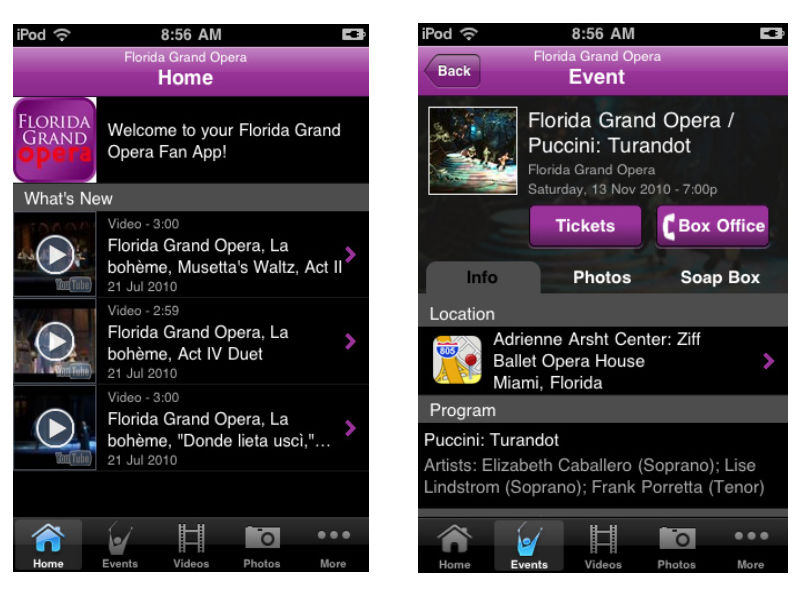
The Florida Grand Opera | FREE

Available for: iPhone, AndroidFGOThe Breakdown: A great app for the Opera lover in us all, the Florida Grand Opera app offers news about the company, events updates, listings of upcoming performances, and streaming audio of the 2010-2011 season. One aspect of the app I really enjoyed was the videos section, containing a multitude of interviews and performances from the FGO. The only real complaint I have about the app is the necessity to sign up for updates from FGO before being allowed access into the app.
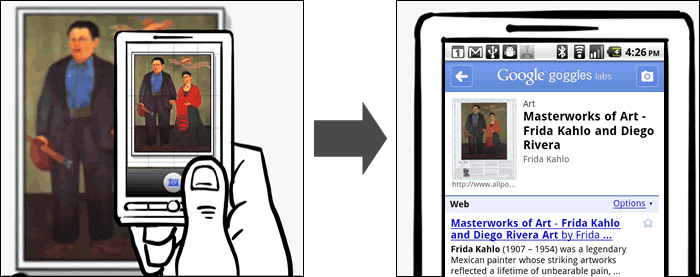
Google Goggles | FREE

Available for: iPhone, Android

goggles_artwork

The Breakdown: Google Goggles is a visual search engine built into a mobile app. It utilizes your smartphone's camera to capture and scan an image, object, or landmark and perform a search online to provide information on it. This is a very fun app to play around with and can be very helpful when trying to identify an artwork without a clear label or an unknown landmark. The app is still in beta though and cannot identify anything that is not already currently online in some form.

The L.A. Phil | FREE

Available for: iPhone, Android, & Blackberry

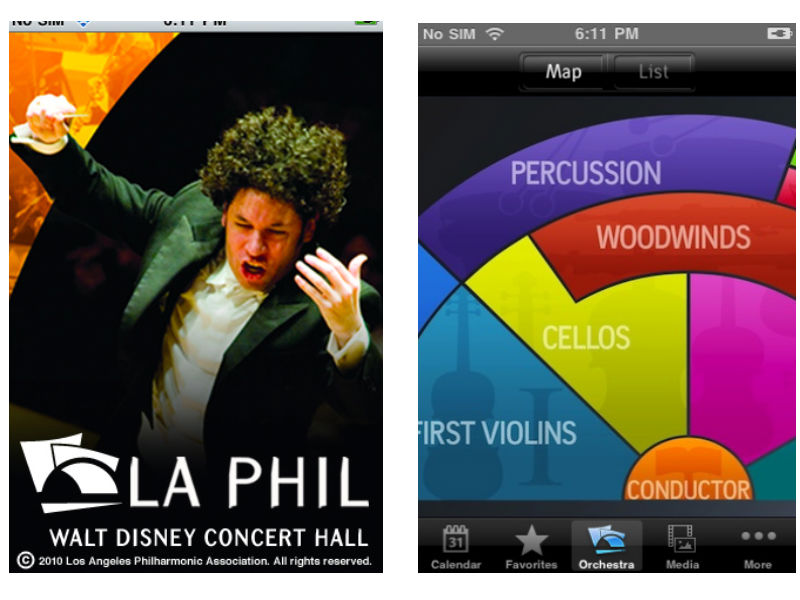
laphilThe Breakdown: The LA Philharmonic app has a lot of same offerings as the Florida Grand Opera app in terms of news, media, and listings of events. What sets this app apart is the interactive Orchestra map, laying out the different groups of muscians in the LA Phil. When a user taps on a section of the orchestra, such as First Violins, they are directed to profiles of each musician with in-depth biographies. This app is packed full of great content and an excellent way to learn more about classical music and the people that perform it.
AMNH Explorer | FREE

Available for: iPhone

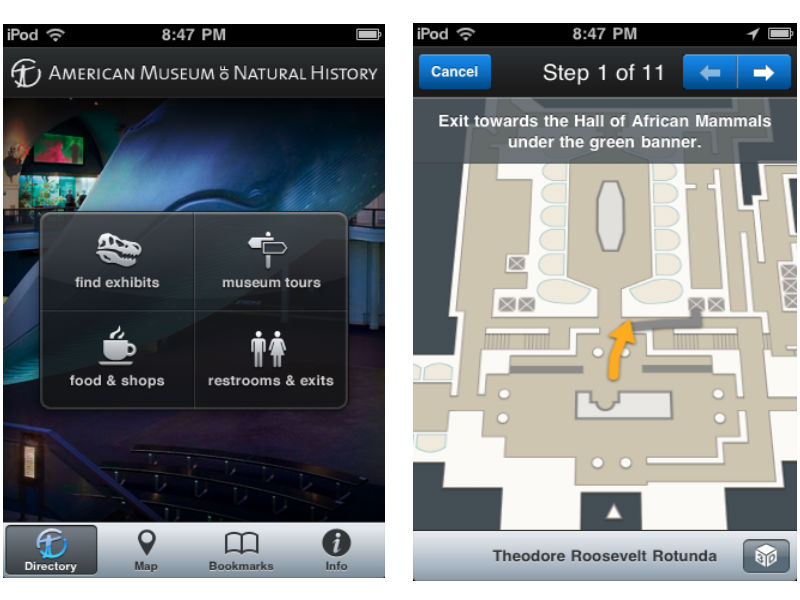
AMNHThe Breakdown: The Explorer app from the American Museum of Natural History is a great guide for navigating a very large museum. The app acts as a personal in-museum GPS, finding your location and providing information on the exhibits within that area. The app can not only find your location, but provide turn-by-turn directions from one exhibit to the next. This may go against some museum purists love of getting lost within a museum, but on a busy day in a museum packed with visitors this app could be an incredible advantage.
Is This Art? | FREE

Available for: iPhone

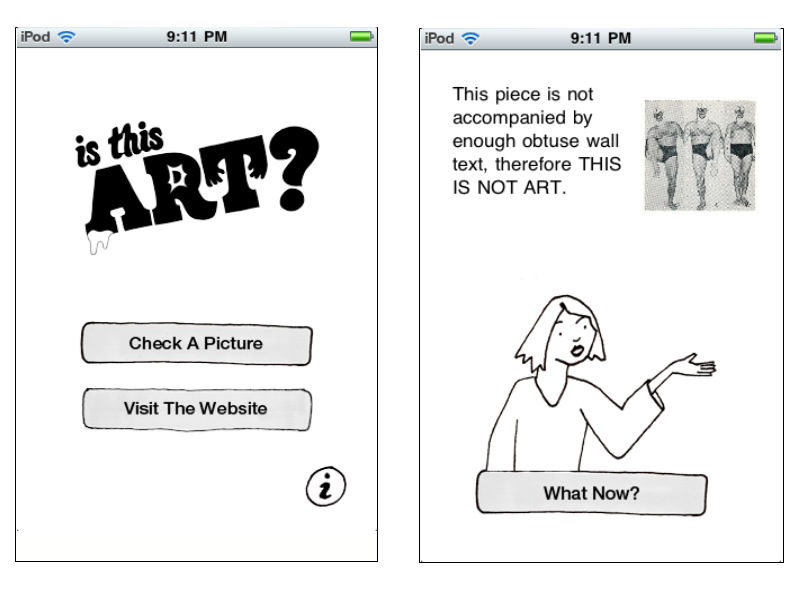
IsThisArtThe Breakdown: A fun app from the folks at Deeplocal and the Mattress Factory, Is This Art? is one way to win those age old arguments about what is and isn’t art. Users snap a picture of the art in question and open it within the app to test its validity in the art world. The explanations the app gives are often hilarious such as, "This makes me feel intellectually inferior, therefore THIS IS ART" and, "This piece is not accompanied by enough obtuse wall text, therefore THIS IS NOT ART". All of the images users put to the test can be uploaded to the project's ongoing blog.
Brooklyn Museum Mobile | FREE Available for: iPhone, Android, & Blackberry bklyn

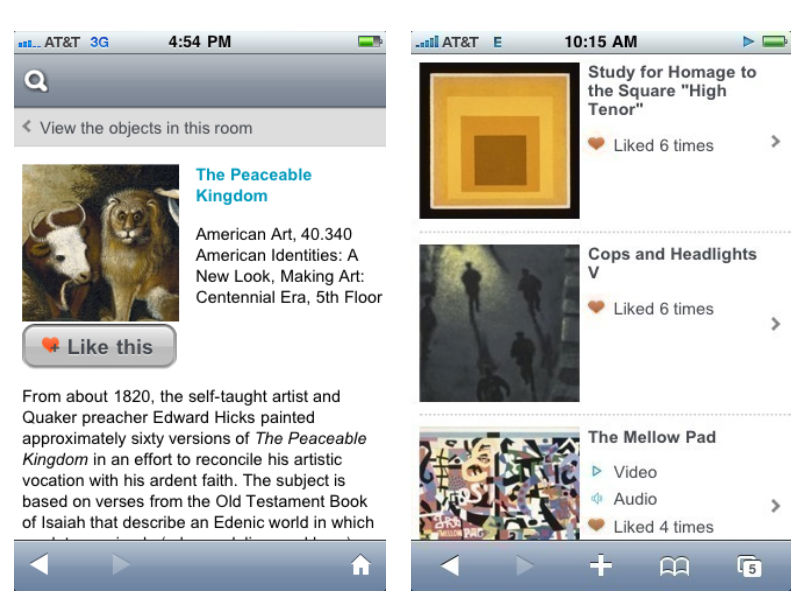
The Breakdown: Another great app for a large museum, Brooklyn Museum Mobile has less of a focus on navigation and more on community and interaction. The app brings in aspects from social media by inviting users to add descriptive tags and/or "like" artworks from the collection. This acts as a recommendation system for other visitors and encourages a more participatory experience. The aspect I like about Brooklyn Museum's offering is that the app runs off of a mobile website, meaning that it is not device exclusive and anyone with a web-enabled device can join in the fun.

The Lighting Handbook | $4.99

Available for: iPhone

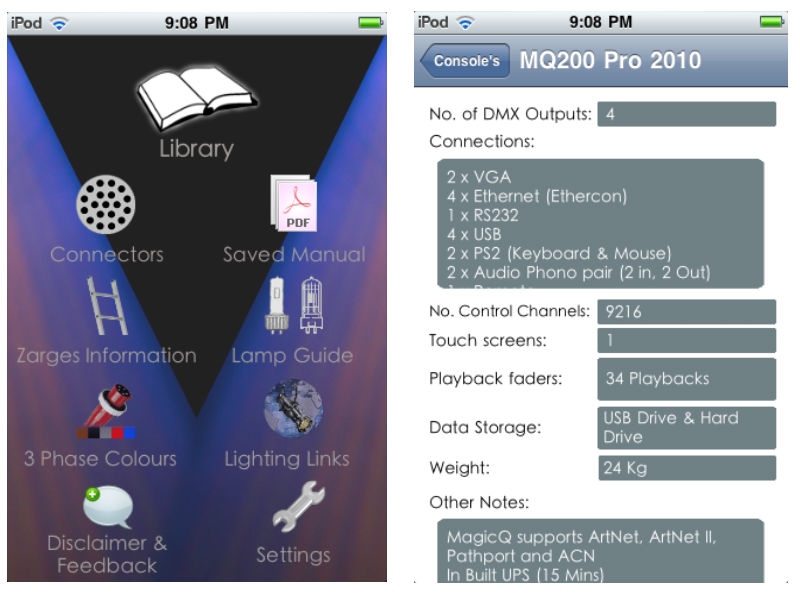
LightHandBookThe Breakdown: This is a great app for all of you theater techies. The Lighting Handbook is exactly what it sounds like, an in-depth guide to all things lighting, conveniently in your pocket.
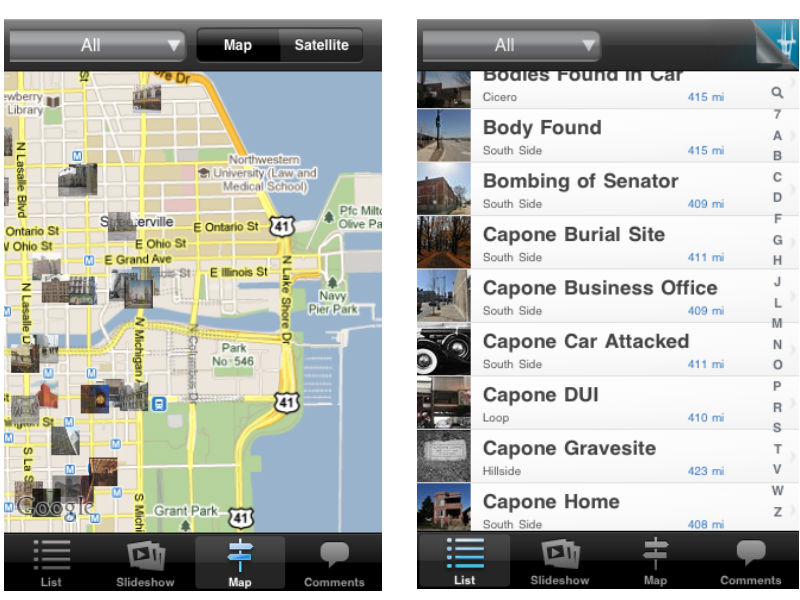
Chicago Gangland Tour | $2.99

Available for: iPhone

Capone

The Breakdown: Ever wanted to walk in the footsteps of famous gangster Al Capone? That's exactly what the Chicago Gangland Tour app helps you do, integrated with google maps to give users a handheld guide for a historical walkthrough of Chicago's mafia history. This app provides info on all the different sites historical relevance and invites users to add their own comments. My favorite aspect of the app is the drop-down menu where results can be sorted by subjects like murders, shootouts, and gangster hideouts.

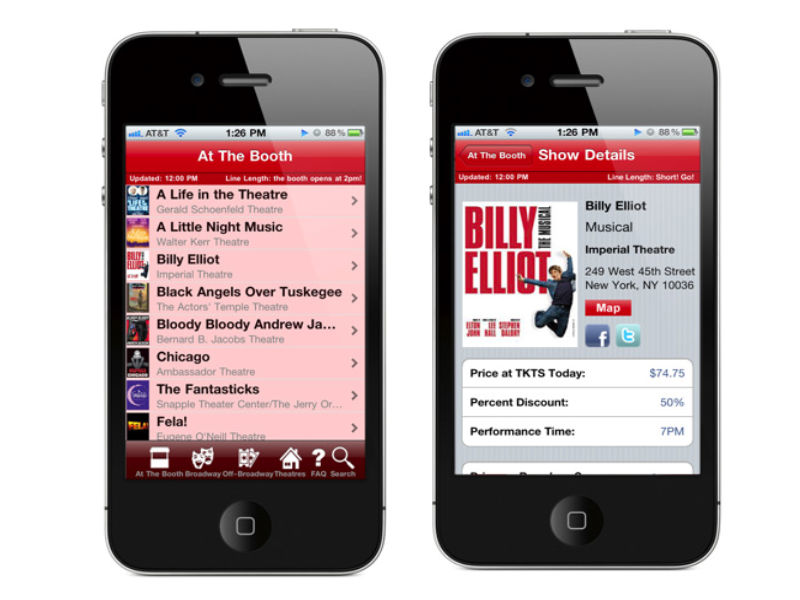
At The Booth | $0.99

Available for: iPhone, Android

atboothThe Breakdown: At The Booth is a full-service app for attendees of Broadway and Off-Broadway shows in New York City. The main page updates with every launch of the app and includes the latest shows and theater locations. For each show the app provides info on the showtimes, ticket prices, discounts, synopses, links to reviews and videos, and nearby restaurants. Listings will appear with a pink undertone to let users know if there are long lines at the theater. The only real complaint I have about the app is that the listings are only viewable in list form, whereas a map option would really assist in seeing all that is available in the immediate area.
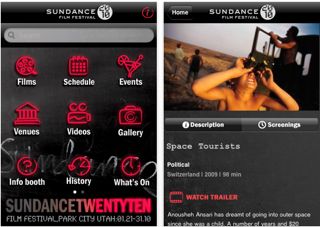
The Sundance Festival 2010 | $4.99

Available for: iPhone

Sundance-iPhone-screenshot-small-738392

The Breakdown: The Sundance Festival app acts as an online brochure for the annual film festival. In addition to offering videos and reviews on films being shown, the app gives festival attendees real-time updates as to what is happening with the film fest's various events and screenings. The one feature that this app lacks is a way to create custom schedules of screening times and events. This would be invaluable at a festival where multiple things are being offered at once and making the most of the your time requires a lot of planning.

Fill in the ________: A New, Social Entertainment Website

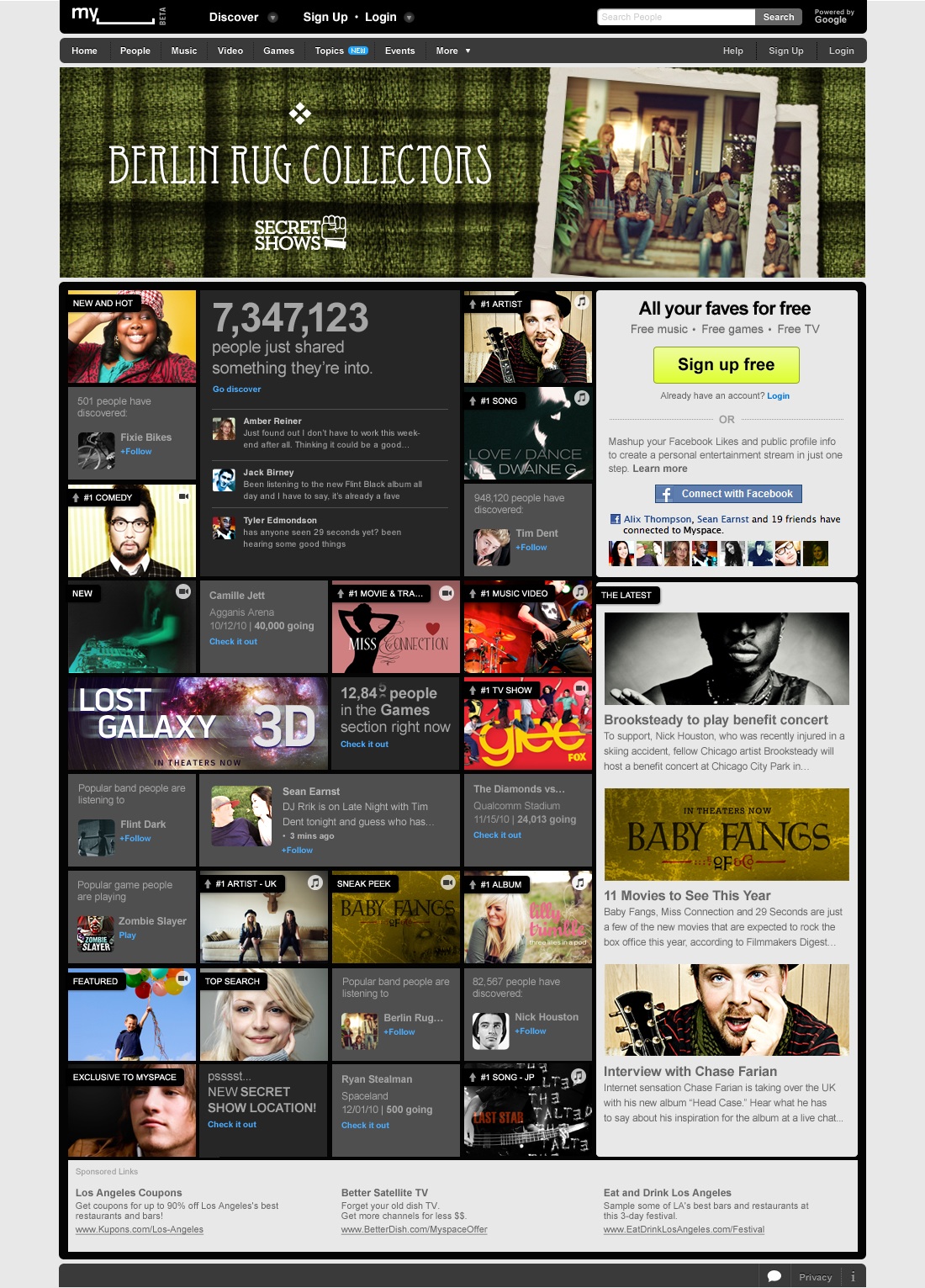
myspace-logo-225MySpace, the original social networking site, has relaunched and re-branded itself as My_______ ,the world's first “Social entertainment” website.  The purpose of the website has shifted from a social networking site motivated by the slogan “a place for friends” to a site intent on “becoming the leading entertainment destination that is socially powered by the passions of fans and curators.” Essentially, the new My_______ focuses less on people and more on media and digital content sharing. The sleek new site combines the most popular features of Facebook, Twitter, Foursquare, and Youtube into a single media focused platform. Users can now follow artists and organizations on topic pages, similar to Facebook fan pages, while receiving real time updates on the music, videos and content being heard, viewed, or uploaded by them (very reminiscent of Twitter).

In this way, members will be able to see what music their favorite opera company is listening to as well as what they are posting. Users will be shown the media that their friends are consuming, not just the media that their friends and topics are posting. It opens a new opportunity for media recommendations, community building, viral marketing, and content sharing.

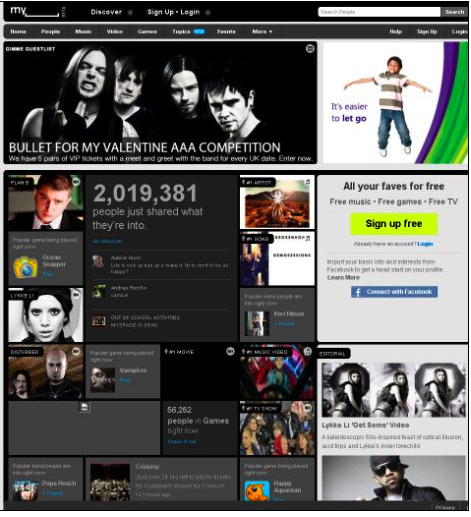
These updates appear on the new homepage now referred to as the dashboard which can be viewed in three modes: list, grid, or full screen.

The list mode looks almost exactly like a Facebook news feed.  The grid view integrates watchable videos, playable songs, pictures, and micro-blogs in a chronological collage of media tiles, and the full screen mode allows users to experience their media updates in an interface similar to iTunes coverflow.

Picture 3

My_______ has combined multiple features from across the web  that have never been offered in tandem before - creating a unique media viewing and sharing experience.  Some of the other new features include: interactive games, karaoke (Opera?), free music playlists creation (competing with Pandora?), and media trending.

The new interface and combination of features could prove very useful to cultural institutions and arts managers if the user base is willing to readopt a floundering platform.

The largest obstacle for the new My______ is the old MySpace.  The relaunch comes after one of the worst years in the company's history.  MySpace lost 50% of its user base between 2009 and 2010, a critical hit for the organization and a terrible loss for its functional use as a communications tool and social network.  The new My________ is much more in line with Internet usage interests and behaviors of Millenials, but it is not yet clear if they will return to the site.

Connect with FacebookIn order to make the transition smoother and help regain customers, My______ has paired with Facebook to create what they are calling a mashup, in which My_______ takes all of a user’s profile information, friends, and likes from Facebook and imports them into a My_______ page; making the process of setting up a new functioning account much quicker and helping users grasp the changes and full functionality of the site much faster.  This partnership bodes well for My_______ and provides a clear focus away from social networking and onto new media and digital content sharing.

For arts organizations and non-profits that are currently tweeting links to content on Twitter, uploading videos to YouTube, and sharing pictures and events on Facebook, the new My_______ offers a single platform that will combine all three. A one-stop shop for all of your social entertainment and digital media needs. The ability for pictures and videos to appear directly in a news feed like Twitter but with a usable interface like Facebook is very desirable and something that I believe has huge potential.  Pairing the interface with the content and media focus allows for a more streamlined experience that is not diluted by the social aspect of Facebook and Twitter.  The New My_______ is definitely trying to steer away from content that does not surround music, media or artists in some way.

The ability to create opera karaoke, post audio excerpts from a concert, or share video from a stage production or event that are instantly previewable and clickable in a media focused feed that is more graphic than Twitter, less convoluted than a YouTube subscription, and easier to deliver than Facebook is very enticing.  If users begin to adopt the new My_______, it seems only natural for organizations to follow. Only time will tell if this snazzy new facelift will take off, but the potential is definitely real.

Tracking Direct Marketing with GURLs & PURLs

Direct marketing campaigns are notoriously difficult to track in terms of ROI and effectiveness.  It’s hard to know which of your organization’s communications best reaches your audience, the artfully designed postcard and brochure or the large billboards and posters placed throughout your area. Organizations usually have to rely on methods such as surveys and historical estimates to track the effectiveness of their marketing campaigns. One possible solution to this tracking problem is to utilize customized URLs with your organization’s marketing efforts. When someone clicks on a custom URL, they are directed to a custom landing page seperate from your organization's main site and specific to your marketing campaign and can be individually noted using online analytics. There are two types of custom URLs currently available for marketing campaigns (and also great for puns): GURLs and PURLS

PURLs or Personal URLs will include both a message specific to your marketing campaign and the recipient’s name inside the URL. They are totally custom and best fit for E-mail and direct mail campaigns. PURLS contain the recipient’s name generated from your organization’s mailing list and leads to a custom landing page that can offer content specifically tailored for that person. For example, if Technology in the Arts were to have a membership campaign, our PURL would look like this:

www.ThomasHughes.JoinTechnologyInTheArtsToday.com

GURLs or General URLs are the more generic version of a PURL, usually including just a campaign name, but offer the same advantage with tracking. The landing pages are also more generic and the ability to customize the offer based on who clicks the link is lost. GURLs are a better fit for marketing efforts like signage, billboards, and print advertisements. For instance, say I wanted to use a custom URL for a newspaper advertisement for our website’s membership campaign; the GURL would look like this:

www.YourTechnologyInTheArtsMembership.com

If your organization decides to try out utilizing either GURLs or PURLs, or both, in its next direct marketing campaign, here are a few things to consider when choosing a service:

Cost – According to easypurl.info, the cost of a PURL can range from 4 cents to 12 cents per purl. The price varies based on the amount needed. For example, a campaign using about 10,000 PURLs can average about 10 cents per PURL.  This is a case when you might want to go with a less personal, but less expensive, GURL. For both PURLs and GURLs, there is usually a setup cost for both the template and landing pages to which the custom links are directed.

Lifespan – These custom links won’t last forever, so this is an important question to ask when choosing a service. GURLs tend to have a longer lifespan that PURLs, which contributes to them being better for instances like billboard and signage where you are trying to reach a less specific audience.

An example of the PURL analytics data taken from getsatisfaction.com
An example of the PURL results and ROI tracking data taken from getsatisfaction.com

Data – What kind of tracking abilities comes with the URL service? In a recent post, we discussed the advantages to using custom URLs for tracking a variety of metrics using Google Analytics. Check into the kind of metrics that are offered and how well you can import, export, and integrate the data into your current database.

7 Steps to a Successful Facebook Ad Campaign

Finding new sources of traffic for a website or social media profile can be a challenging task for both novice and experienced web marketers.  Facebook Ads are powerful, yet often-overlooked, tools for internet marketing campaigns. Here is a quick overview of Facebook Ads' benefits:

  • Increased Exposure: Facebook continues to be the #2 ranked website in the world for web traffic according to Alexa.com.  Of the top 5 highest-traffic websites in the world, users spend more time on Facebook than any of the others.
  • Increased ROI: Facebook Ads are 25-50% of the cost of running a Google Adwords campaign.  A Google Pay-Per-Click campaign can sometimes cost $1 per click.  A typical conversion rate (from clicking to taking action) would be 2%.  Spending $3,000 for 3,000 clicks therefore, may only result in 60 people taking action (opting in for your email list, purchasing tickets to a show, making a donation, etc).  A similar campaign on Facebook Ads would cost around $10 for 1,000 clicks. You can also choose to run a CPM campaign which calculates a cost based on how many 'impressions' you want to make on users. Impressions are geared more for marketers who want to raise awareness about their brand. The Search Engine Journal provides more insight into this topic. Here's a great visual from their article.

Note: Geo= Geographical Segmentation and Keywords= the word or phrase a user types directly into a search engine. Facebook Ads can only target what someone has already indicated they are interested in (theatre, live music, art galleries, etc).

  • Targeted Demographics:Facebook Ads provides a precise way to segment your market. From musical interests to relationship status, there are an endless amount of ways to run a market segmentation. Here is a detailed listing of your targeting options.
  • Less Competition: Facebook also has an advantage when it comes to your levels of competition. Facebook has an estimated 1/20th of the advertisers that Google has. Here are some other fascinating statistics from the internet marketing blog HubSpot.

If you're considering running a Facebook Ad campaign or are struggling with your current campaign, here are seven steps to help you make the most of your efforts:

1. Run More Than One Ad: As Robert Gore discussed in our latest podcast, it's a great idea to run 5 or more ads for each market segment you choose. Test each ad's performance to see which one has the highest success rate.

2.Choose a Compelling Image: Keep in mind that, unlike Google, the Facebook audience generally isn't logging on to shop for products or services. You must engage a user from the start. This process begins with your headline and image. Here's a great image from an ad run by the Pittsburgh Public Theater. The image conveys high energy and enthusiasm and raises curiosity about the show.

3. Direct Traffic to a Relevant Landing Page: Make sure that the landing page users are directed to after clicking through on your ad is relevant to what was being advertised. Consistency is key. It's up to you to select the most appropriate landing page. It could direct traffic to an outside website or to your Facebook Fan Page. Landing Tabs on your Facebook page can be particularly effective. For more information on creating a Landing Tab, you can refer to Facebook's Help Section or listen to our webinar recording on making the most out of your Facebook page.

4. Optimize Headlines: Marketing Experiments blog author, Hunter Boyle, suggests that the objective of your headline is "not to sell but to connect with your reader." Here's a great article that expands on this principle. One of the best ways to engage your reader is to pose a question in the headline.

5. Consider Your Targets Carefully: In the first tip, we recommended running more than one ad. It's a great idea to test your ads on different market segments too.

6. Make a Compelling Offer: If you are more concerned about click-through rates as opposed to impression levels, then you should consider making a compelling offer in the body of your ad. Just be sure that the landing page follows up on this offer.

7.Track Your Results: Some internet marketing experts, like Ryan Deiss, suggest you should delete any ad with a  click-through rate below 2% after a week of running it. This may not apply if you're more concerned with making an impression. Always be mindful of your campaign's goals and re-calibrate your strategy accordingly. Small business expert and author, John Jantsch, suggests using Google Analytics and Google's URL builder tool to monitor the effectiveness of any ads that direct people to a link outside of Facebook.

Update: 

For a step-by-step video on making a Facebook Ad, check out our mini-nar: Making Facebook Ads and Diving into Analytics.

Google URL Builder - Deeper Tracking for Your Analytics

Google Analytics has emerged as the industry's leading tool when it comes to web analytics.  The platform's easy installation process, in-depth reporting features  and user-friendly interface make it a marketer's best friend.  Among the many reporting features in Google Analytics is the ability to chart where your website's traffic is coming from. Google URL Builder is an often overlooked platform in the Google toolbox that can help organizations measure the effectiveness of their web presence. URL Builder is primarily tailored for tracking internet campaigns that fall outside of the pay-per-click or Adwords realm.

Here's a quick overview of URL Builder:

  • Works in conjunction with Google Analytics to provide advanced metrics for measuring the performance of a specific URL that you will “build”.
  • Allows you to  chart the traffic for particular pages within your website and determine which communications channels provide stronger traffic per page.
  • Allows you to enter tags for detailed tracking, particularly Campaign Source, Campaign Medium, and Campaign Name.
    • Campaign Source indicates the originating source of the traffic.  Does it come from your organization?  Is another organization promoting a web link on your behalf?
    • Campaign Medium is useful for charting how much of the campaign's traffic comes from different locations.  Did the traffic come from e-mail, web ad, Facebook, Twitter, etc.?
    • Campaign Name is a short description for the campaign - often one to three words and often a distillation of the link's page title.
    • Google processes this information and provides you with information about the performance of your unique URL including its bounce rate and conversion

For example, here's the information that we will assign to a URL campaign for the article you are currently reading:

  • Campaign Source: tita -- We use "tita" to indicate when Technology in the Arts is the originating source of the traffic.
  • Campaign Medium: twitter -- The medium area is where we indicate if a link will be shared on Twitter, in an e-mail, on our Facebook page, etc.
  • Campaign Name: GoogleURLBuilder -- Typically, we use a shortened version of our article titles as campaign names for analytics.

Let’s consider some practical applications:

Web Content: It could be very helpful to see how fans and followers on your social media profiles compare and contrast in terms of their interaction with your blog posts, event listings, etc. Simply build a URL for each campaign medium to which you distribute your web content links (Facebook, Twitter, LinkedIn, etc.) and see how your links perform across various sites.

Email Announcements and Newsletter Campaigns: Another useful application could be for tracking the performance of URLs in your email announcements and newsletter campaigns. You would simply enter ‘newsletter’ into the campaign source option. For smaller organizations or independent artists who do not utilize broadcast email service providers (like Constant Contact), Google URL builder could prove to be a viable alternative for tracking traffic deriving from e-mail communication.

Helping Others: When conducting an interview or mentioning another link on your blog or website, consider contacting that person and asking them if there is a specific URL you should use in your post (in case they have a campaign name established for that page). This will make it easier for them to track how much exposure their blog, website or the interview received based on your posting it.

If they do not have a customized URL for you to use, it is still a great idea to create your own.  Because the web page is being tracked within their Google Analytics data, the campaign data (source, medium, name, traffic information) will appear in their reports.  If you share multiple links from the same website, then using URL Builder for each link you share will allow the organization to see if particular links were more interesting to your communication recipients and site visitors.

Google URL Builder Best Practices

  • Always take time prior to setting up a campaign to consider your ultimate goals. Which sources and media will you need to track?
  • Reach out to other organizations and bloggers prior to posting a link to their information in your post.  They may provide you with a customized URL designed for their Google Analytics campaign reports.
  • Consider if any adjustments should be made in your email, social media and overall web campaigns as a result of the data you collect.
  • Spread the word! Share URL Builder with your colleagues to make sure that everyone on staff uses the correct URLs when sharing links.

Want to learn more? Check out our mini-nar:

Using Google URL Builder to Track Your Website's Traffic

.

NAMP 2010 - Day Three - Chip Conley and Providing the Peak Arts Experience

To conclude the 2010 National Arts Marketing Project Conference, Chip Conley delivered an inspired closing plenary to encourage arts organizations to provide "peak" experiences based upon their audience's hierarchy of needs. Conley is the author of Peak: How Great Companies Get Their Mojo from Maslow, an arts lover, as as the founder and CEO of the Joie de Vivre Hospitality. In his address, Conley shares his unique prescription for success based upon Maslow's classic Hierarchy of Needs. Conley illustrates how audiences are ultimately motivated by peak experiences and discusses how arts organizations can give those experiences to their audiences. Americans for the Arts streamed Conley's presentation live via Livestream. The recorded version is embedded below. (Skip to the 16 minute point to get to Conley's presentation.)

NAMP 2010 - Day Two - Recap Discussions

David, Corwin and Amelia report out on Day Two of the 2010 National Arts Marketing Project Conference. Items discussed: disembodied panelists, Vimeo analytics, the Audience Engagement Platform, the value of quantifying intrinsic impact, and more.

NAMP 2010 - Day One - Recap Discussions

David, Corwin and Amelia report out on Day One of the 2010 National Arts Marketing Project Conference. Items discussed: keynote by Chip Heath, breakout sessions (pros and cons), designing conferences for people with varied experience levels, social media rock stars, and more.

On the Way to San Jose & NAMP 2010

namp-2010Corwin, Amelia and I are heading out to San Jose for the National Arts Marketing Project (NAMP) Conference this weekend. In addition to presenting a panel on using performance video to motivate audiences and leading roundtables on Twitter and search engine optimization (SEO), we will be interviewing various presenters and arts marketing superstars for upcoming podcast episodes.

We will also be chatting with conference attendees to find out what useful information and experiences they will be acting upon when they go home.

If there are particular people whom you would like us to interview or particular questions you would like us to ask conference participants, then drop a note in the comments area below.

If you are on Twitter, you can read our thoughts about the conference by following TechInTheArts.  You can also follow the #NAMPC10 hashtag on Twitter to read the chats taking place during the conference.

Stay tuned for more from NAMP 2010 in San Jose!

What you need to know about viral video and the law

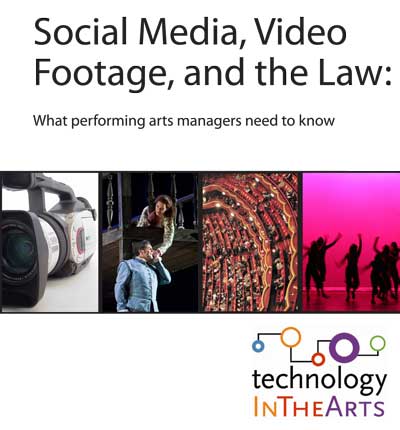
Social Media, Video Footage and the Law report from Technology in the ArtsTechnology in the Arts has just released a publication reviewing legal issues surrounding using video footage online. (Access the PDF publication here.) Whether you are in marketing, development, education or operations, chances are that you will encounter some kind of contract or legal issue involving performance footage, either online or offline.  This white paper serves as a survey of current industry trends and practices, as well as a guide to those exploring the ever-changing landscape of online media and the intellectual property and union issues associated with it. While nothing can replace the advice of a good lawyer on legal issues, this guide can alert you to potential problems while you are planning online media campaigns involving performance footage.

Do you have a story about issues you've had distributing performance footage online? Please share below.

Focus on the data: LSO's Digital Season Brochure

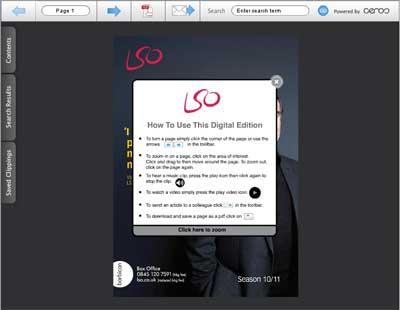
LSO brochure

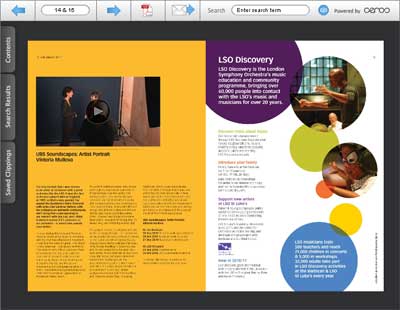
A page from the 10/11 LSO brochure. Click image to see the whole brochure.

Last year I wrote about the London Symphony Orchestra’s digital season brochure. As technology and environmental concerns cause more printed pieces to go online, the arts industry will see more season brochures go digital. According to a recent Technology in the Arts poll, 56% of arts organizations already have their season brochure online in some form (PDF or interactive).

Last season was the first that they made the brochure, launching it in February of 2009 with their season announcement. Based on its success, they have released another brochure this year with plans to distribute it more widely. Today I have a follow-up with Digital Marketing Manager Jo Johnson about the success of last year’s brochure.

The marketing team at the London Symphony Orchestra chose to make last year’s season brochure after deciding to plan the online and offline elements of our season campaign together.  Jo said, “we had produced films to illustrate the season's themes, but it was a few months after the season had first gone on sale, and so felt rather like an afterthought. Also we had decided that we were going to put our season on sale online before we opened to telephone booking, so turning to online channels (email, web and social networks) to send info out to the bookers felt natural. A digital brochure was the obvious choice.”

LSO brochure

The first page of the brochure created by Ceros includes an instruction window for newcomers.

For newcomers to the digital brochure, it may be hard to know where to get the technology to make the brochure, as well as how much lead time to allow for it. This year symphony again used interactive publication platform Ceros to create their season brochure, complete with audio and video. Other platforms that were suggested in our poll included Issuu and Yudu.

According to Jo, after the art and copy was approved for the print brochure, the digital brochure only took about two additional weeks. “[The print version] needs to be made suitable for online readers (adding some buttons, changing some bits of text to make it obvious that their links, making the images 16:9 ratio so that you can embed a video over it). That's about a week. Then because I don't have Flash skills, the digital brochure company did all the Flash work for me. They were pretty quick, but leave time for changes, testing and sign off. That was about another week.”

Jo found that the brochure was driving traffic primarily to concert pages (where tickets can be purchased). “The top 20 clicked links are all to concerts, with the season opening concert on 20 September being the most clicked.” Using Google Analytics, Jo determined that roughly 1 in 5 viewers played a video, and viewing figures correspond to page numbers (i.e. the least viewed video is last in the brochure). Viewers stayed on the digital season brochure an average of about four minutes.  Overall, the 2009/10 digital brochure was viewed 10,870 times. Based on the data she pulled she concluded that the amount of revenue directly from the brochure covered its costs, but that the brochure “played a more of a role in decision making than direct purchasing." She said:

On the financial side, I could see purchases made on our website that had come directly from the digital brochure. Added up, the income was just over the figure it cost to make the brochure. But as with all marketing, I'm also interested in the purchases that were made as a result of someone having the digital brochure, but not directly. At the LSO we talk about multi-channel marketing and CRM, whereby we allow the customer to make his own decision on which method to use to make the final purchase. So although the brochure had embedded links back to the LSO website where tickets can be bought, a customer may have browsed the brochure, seen a concert they like, gone away to chat to a friend about going together, made a decision a week later, and then gone back directly to the website to make the purchase, or called the box office on the phone. In this case I would not have seen the income from his ticket in the analysis I did on the brochure; and this is what I meant when I said 'It's likely it plays more of a role in decision making than direct purchasing.'

When taking on these technological innovations, it’s difficult to know how to measure success. As Jo said in our conversation, “This is the challenge marketers face every day--how to track customers as they hop through our available channels.” Your outreach program or social media site may have paid for itself in tickets, but how do we measure things like brand recognition? Social marketing experts like Charlene Li and David Berkowitz have come out with suggestions, some of which go beyond mere revenue. Jo saw two huge benefits to producing the brochure, beyond its break-even point.

The very fact that we had produced one at all gave the LSO a huge amount of coverage. It was passed around as a 'novelty' item, which people enjoyed looking at, turning the pages, watching the videos, just to see what it did. This is the same kind of benefit as social media brings an organization--people talking about your group. They might be on the other side of the world, they might not come and buy a ticket, but the fact that you have come to their attention is almost as valuable as a ticket sale - in our case it may eventually assist in ticket sales when we go on tour, or on sales of our CDs (our own label). Unfortunately, the "buzz" isn't really trackable in any meaningful sense, other than clicks and views and Retweets. But it still counts.

Lastly, the digital brochure brought a small environmental benefit. We reduced the number of brochures we printed, since we sent it out to people on our database that had email addresses instead of the print in the post. We also used the digital brochure in the information we emailed out to journalists at the season launch, instead of posting them one. Our Managing Director likes to email the digital brochure to prospective festivals and venues abroad as our "flagship" publications, thus saving more paper and postage. I'm sure the effects are negligible in the bigger picture, but any boost to our green credentials helps!

So, is investing time and money worth it for your company? Here are Jo’s thoughts:

Probably the most useful thing I can offer is some thoughts into whether others should follow suit and produce a digital brochure. Here's some:

  • A digital brochure should never replace your printed one, but should be complementary to it. A good marketing campaign should have all the online and offline elements planned in together at the same time.
  • Personally I think the key to it is to have good content which makes it worthwhile - video content is the obvious one. There are plenty of free options for making a digital brochure out of your PDF, but mostly these don't offer the rich media content like embedded videos and soundclips.
  • Make sure you have the mechanisms and a plan in place to market the digital brochure - which can only really be done online. Social networks are ideal, but don't ignore your own website! There's no point in having one if you don't market it - people will not stumble upon it randomly.
  • Ideally the digital brochure should be designed with online usage in mind - and possibly independently from the print version. We weren't able to do this wholesale though because of the cost of the designers! We chose the route of adapting the printed version.

Are You Getting the Most Out of Twitter? - November Webinar

twitterGetting the Most Out of Twitter

Thursday, November 18, 2010 2:00pm-3:30pm Eastern Register today for $25 Presenter: David Dombrosky

As the ninth most popular website in the world, Twitter has quickly grown into a formidable communications platform. But what can you really do with 140 characters or less? How can arts managers make the most of this increasingly useful tool?

In this webinar, you'll learn:

  • Who uses Twitter, and why they want to engage your organization.
  • What aspects of Twitter distinguish it from other social sites, how your organization can use these aspects to communicate more effectively.
  • The 70-20-10 rule for engagement, and how you can use it to your advantage.
  • Best practices for arts organizations using Twitter
  • What third party applications can arts managers use to share media, expand your reach, and much more.
  • What analytic tools exist to help you chart your Twitter success

dd_100pxDavid Dombrosky is the Executive Director of the Center for Arts Management and Technology (CAMT), an applied research center at Carnegie Mellon University investigating ways in which arts organizations can use online technology to more effectively meet their goals. He frequently presents technology and social media workshops for arts conferences – most recently for The Association of American Cultures, Performing Arts Exchange, Chorus America, Opera America, College Art Association, and Grantmakers in the Arts.
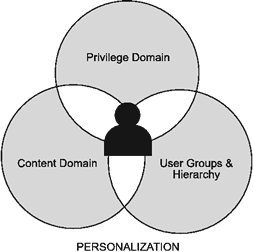
True Personalization: Don't Get Filtered

PersonalizationResearchers from Georgia Tech University recently published their first annual Future Media Outlook, an interactive online publication through nxtbook. Future Media Outlook tackles the concepts of information, technology and media in the future by focusing on "the trends that will fundamentally transform how content is created, distributed, and consumed..." The publication focuses on six main concepts, one of which (arguably the most interesting) is true personalization - the ability to manipulate, personalize and filter a personal data stream. These manipulations change the information that is available or presented to a person based upon their previous actions and settings. True personalization will affect our consumption of products and services as well as how we spend our ever shortening leisure time. The click of a button or the modification of a setting could alter advertising, attendance, and data distribution for companies and organizations in incredible ways.

Due to the Data Tsunami created by the vast amount of information in this projected future, personalization will be required to focus content and allow people to navigate their own networks. Recommendation engines that compile our habits with our preferences will tailor our shopping, leisure and social experiences. People will know what events are going on, what food is being served, where meetings are happening, and where they most likely want to be at the touch of a screen. While this technology will show them exactly what they want to see, it begs the question : will they care about the information they are not receiving?

FirewallFor arts organizations, this could lead to new levels of advertising, event management and customer service, but it will also require new levels of tech savvy and strategic media planning. Data is powerful and no organization wants to be on the wrong side of a filter.
Personalized recommendations, advertising, and marketing have already been implemented on sites like Google, Groupon, and Facebook. An individual's habits and data input affect the advertisements presented to them and the ways in which  services are provided. In the future, this technology will become even more sophisticated and less conspicuous. The digital wave of news and information will manifest itself in total customization and intuitively targeted marketing.

Data input and manipulation could become a new burden for many  institutions. In a world of customized lives and filtered data experiences, the arts will need to create their own space, partner with other industries and stake a claim in the entertainment and cultural markets. Being able to track events by location, recommend performances from purchasing habits and cultivate new donors from restaurant choices are wonderful concepts that could arise from this technology, but they will need to be created and managed by the arts institutions themselves.

A world with true personalization focuses on providing services to fill a customer’s needs. Having a clear understanding of the market, the service being provided and the correlations that must be made will be integral to navigating a world of filters and preferences. This new world of data will be based on research, correlations and the value of time and information.

Georgia Tech does a compelling job at forecasting the current trends and focusing on where technology is leading us. This trend is real, and I believe it will manifest itself in the not-so-distant future. A world where patrons require automatically updated calendars, events and performances synced with their Google calendars, and interactive donor plans is just around the corner. Recommendation engines, geolocation-based event maps and social event feeds are quickly moving from the future to the present. It will be interesting to see if these predictions become reality and how the arts and cultural sector reacts to this new world of filters and data.

Social Media Spotlight: New York Theatre Network

Welcome to the second installment of the Social Media Spotlight, our monthly feature focusing on arts organizations’ social media strategies.

The global trend of participation in social networks and social media is one to which arts managers have been paying a great deal of attention. With over 500 million active Facebook users, 55 million tweets being sent per day and over 133 million active bloggers in the United States alone, arts organizations and arts managers are growing increasingly interested in identifying ways to engage their audiences and connect to new audiences via social media.

One of the more recent example of the intersection of social media and audience development is the creation of the New York Theatre Network (NYTN). Launched on September 28, NYTN seeks to be “your hub for what’s happening on New York City Stages”. The network focuses specifically on theatre events in New York City, and while any theatre fan can check out the latest happenings, only member theatres are able to upload content about their organization onto the website.

NYTN is unique in that it was designed to be an interactive social network as opposed to a static directory and listing of information. Its Facebook Connect feature enables users to find out what their friends are ‘liking’,  ‘attending’ and/or ‘recommending’ and also allows users to make their own recommendations.

Theatres are also encouraged to interact with audiences as they are able to upload YouTube videos, their Twitter stream, blog posts and an event calendar onto their pages. A gracious sponsorship from Flip Video’s Spotlight For Good Program made it possible for member theatres to record video and upload this content onto their page.

NYTN is the result of a cooperative effort between The Alliance of Resident Theatres/ New York and theatre industry website Theater Mania.  A.R.T. New York Executive Director Virginia Louloudes was inspired by a keynote speech delivered by Diane Ragsdale of the Andrew Mellon Foundation two years ago in which she addressed the decline in arts participation and examined possible solutions for this dilemma. One suggestion was for arts organizations to consider becoming “arts concierges” and help consumers find shows and performances based on their individual tastes.

Louloudes saw an opportunity to create a site that would serve as a “one stop shop” for theatre fans,  encourage a new level of interaction between theatres and audiences, and introduce fans to new theatres and upcoming shows they may not have been aware of.  The project was an extensive one and called for outside funding, workshops with member theatres, and a partnership with Theater Mania for technological support. While such an ambitious project may not be feasible for all arts organizations, Louloudes hopes that the creation of NYTN will encourage arts managers to develop their own social media strategies, especially since most platforms are free.

Those interested in further reading on NYTN's marketing efforts should also consult the following blog articles from Devon Smith, who served as project manager for NYTN and frequently blogs about social media:

Advertising ROI: a case for Facebook Ads

New York Theatre Network: it's launch day!

Are You Making the 5 Biggest Facebook Mistakes?

facebook_mistakesIn preparation for next week's webinar How to Make the Most of Your Facebook Page, I asked Maryann Devine from smArts & Culture and Jacquelyn Kittredge from e-bakery social media to share with us the 5 biggest mistakes that arts organizations make on Facebook.  Here is their reply: 1. Using Facebook as a broadcast channel rather than interacting with your fans. If your aim is to become invisible to your fans, this is the way to go. Facebook determines where you show up in your fans' default Top News stream based on the interactions of the fans and their friends with your page, and the kind of content you put up. Less interaction means your page is less visible to your fans -- the very people you want to reach.

2. Using the same voice on Facebook (and other social media) as you do in your traditional marketing. Many arts managers have trouble making that leap, and it's understandable. They're used to communicating with their patrons in a particular style -- it's hard to shake that off. The reality is that using the same voice on Facebook as you do in your ad copy is just not going to work, and you'll likely be ignored. Social media spaces are more personal, like a backyard barbeque or the kitchen table, and you need to adjust your tone accordingly.

3. Forgetting that the page is for your fans, not for your organization. As Jacquelyn often points out, fan pages harken back to fan clubs. Fan clubs were all about giving special access and fan-club-only perks to the most loyal enthusiasts. Research shows that most people 'like' Facebook pages for discounts and special offers. Keep that in mind as your interacting with your group's fans.

4. Creating a personal profile or group for your arts organization rather than a fan page. Fan pages allow you to analyze stats on how people interact with your page AND the demographics of your fans. Personal profiles and groups can't do that. Fan pages can have an unlimited number of fans. Personal profiles are limited to 5,000 friends. Most importantly, Facebook is indexed by Google and your page can improve your Google ranking -- it may be easier to find your fan page through Google than your own web site.

5. Not having a Facebook Page at all because you already have a website. People are spending more time on social networks and less time on static websites, so Facebook allows you to meet your fans where they are already are.

In addition to addressing these common mistakes, Maryann and Jacquelyn's webinar will discuss:

  • Why your organization may be invisible even to fans of your Facebook page, and what to do about it.
  • Why it’s important to engage with your Facebook fans — beyond the usual clichés about ‘conversation’ — and how to do it.
  • What is a ‘landing tab’ and why it gives you an advantage.
  • How it’s possible for even the smallest organizations to use Facebook applications like contests and advertising without breaking the bank.
  • The webinar is on Tuesday, October 19th from 2pm-3:30pm EST.  Registration is $25. Click here to register today.

    What should we adopt? How can we adapt?

    This post also appears as part of the Arts Marketing Blog Salon hosted by Americans for the Arts.

    While reading over the Arts Marketing Blog Salon entries this week, particularly David’s entry on the rise of the citizen critic and Ron Evans’ post on online reviews, I was reminded of an experience I had a few years ago when our local paper cut its classical music and dance critic. I had a meeting with many of the marketing directors in the city, who were understandably upset about the firing and convinced that their success was inextricably linked with newspaper coverage.

    Should we adapt to new technology before we adopt it for our own uses?
    Should we adapt to new technology before we adopt it for our own uses?

    Many of these people had been in marketing for 30 years. When they first started out in the business, the primary marketing channels were TV, radio, and newspaper (and maybe billboard, telemarketing, or fax.) When a new medium was introduced, it might take a while to master, but that was fine. The learning curve was viewed as an investment because you knew that medium would still be around in five years.

    Compare that to now. We have new, “must-have” technology platforms coming out nearly every 6 months to a year. Today, we are being pushed toward mobile apps for phones and iPads, geolocation social media like Foursquare, and more. We are not sure if these technologies will still be popular in three months, let alone five years down the road. Combined with the slow-but-steady demise of many of the “classic” marketing channels, it leaves us constantly wondering: how quickly should we adapt and adopt, when it comes to new technology?

    Specifically relating to citizen critics, these two issues come head-to-head. Firstly, we have the citizen critics adopting new media platforms for distributing their reviews. Then, we as arts managers must decide if and how we will adapt to them—ignore them, embrace them, meet them on their own turf with a social media friendly press release, etc.? How do we decide?

    When I studied communications technology in undergrad, one of the first things we talked about was Moore’s Law, the principle that the capacity of new technologies doubles every 18 months to two years. It applies not only to the memory size on a new laptop or the number of pixels in digital cameras, but it also describes the exponential rate of change we are experiencing as a society. I find myself thinking about this principle every time I hear that arts organizations “should be using” this new platform or that new tool.

    Even though the capacity of the technology may have increased or the new platform may have reached critical mass in usage, my workload capacity typically has not increased nor has my motivation to take on one more task reached critical mass! Chloe Veltman’s post does a wonderful job in relating this back to arts managers, speaking to both a difficulty in adapting to the demands of social media (particularly Twitter) as well as a resistance towards adopting it as part of audience engagement.

    So, typical of this age in which we are often left with more questions than answers, I leave you with two questions to mull over when planning your marketing strategy: What are the signifiers that it is time for your organization to adapt to a new technology? Which signifiers indicate that your organization should adopt the use of a new technology?