

Arts & Technology

Hey, Choir, Listen Up!

Talking to Myself by FALHakaFalLin and Mlle Franny

I read a lot of blogs. Blogs about arts, marketing, non-profits, arts management, arts education, technology, and so forth. I read great posts on a weekly basis about selling tickets, working within the new economy, raising interest, and strategizing an online presence.

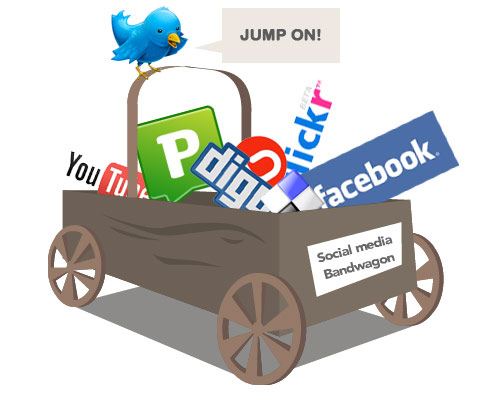
There is a glut of online advice, musings, guidelines, reflections, and discussions about organizations hopping onto the social media bandwagon and embracing Web 2.0. And I can't help but wonder: are we just preaching to the choir?

If you are on here reading this, I suspect that you are already, in some way, connected to this issue. You already browse the web, you probably already have a profile on at least one social media site. Your organization likely has a website, and, I venture to guess, you are already diligent about trying to keep that website presentable, navigable, and current.

You probably frequent the same sites that I do. Your RSS reader might even have a roundup of many similar resources. You are aware of the possibilities that Web 2.0 offers for the new connectivity of organizations. You want to engage people online AND in the real-world, and believe that by strengthening your online position you will experience a positive correlation in the strength of your real-world operations.

I recently read a post from a for-profit marketing perspective, iterating that when we establish our online presence what we want are a small group of strong, loyal supporters, rather than a large number of filler fans. The principle is that these informed, dedicated followers will spread the word personally to their friends, increasing the likelihood that their friends will take their recommendations seriously, and be more likely to check us out as a result.

But it seems to me that in this niche of arts organizations and technology, we are all following, and being followed by, each other. We talk to each other, echo one another's concerns, make suggestions, offer encouragement. We are the ones listening, we are the ones talking, and ultimately it begins to get a little schizophrenic.

I have come across some great bloggers (who are transparent in their affiliation with arts organizations) writing insightful, informative posts--but don't link to their organization's website and aren't linked from there. If an audience member does get online with the hope of learning more about an organization via its website, wouldn't the blog of its communications manager, or artistic director, or someone else on staff, be of interest to them?

If our audiences continue to be people who are unlikely to go online to seek out their arts information, who are comfortable with the ever-smaller blurbs in the papers and the mailings sent to their homes, why are we doing all of this work online? And if we are doing all this work online to find new audiences, but it isn't transferring to our organization's presence in the real world, something needs to change.

We are not going to bridge the chasm between the online and offline supporters if we keep telling people who are already doing what we think they should be doing (because it's what we are doing!) to do what we recommend everyone do.

I love that Project Audience exists precisely to address the best way for arts organizations to attract online media users who may be new to the arts, and to brainstorm ways to stop doing the same things repeatedly simply because it's what is comfortable, or understood, or widely accepted. Additionally, Joe Solomon guest-blogs on Beth's blog, asking the very important question: "How can your online community also support events in the real world?"

I hope that this daunting chasm is a misconception on my part, and that all of what we are saying to ourselves here is really making the leap to the real world, to ticket and art sales, to increased donations and support. I hope that people from outside are plugging in to get more information, and that dialogues are happening among artists and organizations and audiences as never before, facilitated, enabled, by Web 2.0.

But if it isn't a misconception, we need to be open to change and aggressively seek innovation to this model of organization/web interaction.
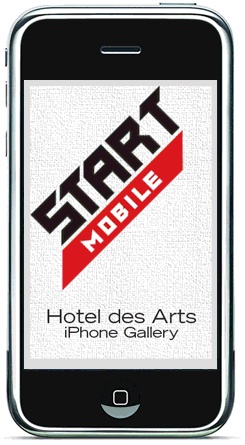

Tech + Art + Mobile + Money = A New Hope for Artists and NPOs?

<a herf=http://startmobile.net>Start Mobile</a> offers 18 Mobile Art GalleriesSTART Mobile offers 18 Mobile Art Galleries

Wouldn't it be great if you could spend a small amount of money to get something cool, and at the same time both support an artist AND the non-profit that supports them?

For example, you could hop on iTunes and look up your favorite museum, your alma mater, your child’s school, your favorite ballet company, and download a gallery of images relating to or by the organization. You could purchase it for less than a buck, and pat yourself on the back for making a donation (when really you were just buying something for yourself).

Thanks to START Mobile, that possibility is rapidly becoming a reality.

Started in 2005, START Mobile’s mission, as described by founder and CEO John Doffing, is to bring “NEW ART to the mobile medium. From the beginning, our vision was one of 'Art for Everyone & Art for Everywhere.’” At the moment, START Mobile is "a bootstrapped startup" that has launched 18 mobile galleries for the iPhone, including one which contains Shepard Fairey's now-controversial Obama image, and promises to launch applications for other platforms in the next few months.

“Technology can facilitate a lot of outside the box thinking relative to the marketing, ownership and appreciation of fine art, and this is a significant part of what START Mobile is trying to accomplish," says Doffing. "[I]t introduces a decidedly egalitarian ethos into an art world that has become inaccessible to the vast majority of potential art lovers.”

A longtime advocate of the arts, Doffing also founded San Francisco's START SOMA Gallery and the Painted Rooms at the Hotel des Artes. He is fierce in his conviction that artists retain the rights to the work that START Mobile licenses, and that they be paid for their work. "There is no charge to the artists that we work with to 'mobilize' their content," explains Doffing. "ALL our artists receive the same commission (and this goes for ALL our art projects): 50% of our net. Or about 10 times what is typically paid to artists to license their work. How much can they make? Depends entirely on how many are sold!"

Apple charges 99¢ for an individual to download one of START Mobile’s artist galleries (a gallery contains multiple images) onto an individual’s iPhone. Apple makes 29¢ off the sale, and the remaining 70¢ is equally split between START Mobile and the artist. Thus, the artist is paid every time anyone, anywhere, downloads the gallery.

Doffing again stepped "outside the box" when he approached Kathy Hanlon Sampon, art teacher at his alma mater, Wisconsin’s Catholic Memorial High School, whose art department was struggling for funds. “During our talks, we discussed [the CMHS art] department’s progress in digital media,” explains Hanlon Sampon. “Since [Doffing] was already developing the program for the app, it would be easy (relatively speaking) to drop our students' work into one of his programs and make it available to the general public – worldwide.”

Hanlon Sampon chose the work that would be included in the CMHS Gallery, digitized the pieces, sent them to Doffing, and START Mobile did the rest--including donating all revenue to the CMHS art department (CMHS is a Catholic non-profit organization). But Hanlon Sampon appreciates more than financial benefits, and says her students now "understand much more about marketing of artwork, the prospect of global visibility, PR, and how technology can be used to not only create art but also to share it.”

START Mobile subsequently released the Pride Gallery by artist Samala (START Mobile Creative Director Christina Samala), who donated her work to raise money to NPO The Courage Campaign. As with CMHS, START Mobile gives 100% of revenue to the Courage Campaign. Though in neither case do the artists directly profit from their work being used, the implications of START Mobile undertaking a project like this are huge.

At this time START Mobile would not be able to sustain itself if every gallery operated like the CMHS and Pride mobile galleries. But perhaps there are artists that would collaborate with non-profits for an equal share of the traditional revenue of 35¢ (after START Mobile takes its cut). START Mobile could become the go-to company for arts organizations wishing to make some money for themselves, the artists, and increase exposure. Galleries could have mobile shows, private schools around the world could have a program like CMHS’s (perhaps public schools could get in on the action if the profits went toward the Booster Club, or were differently packaged). Doffing's long-term goal is "to get our business stable enough that we can do a few dozen apps each month for non-profits that our team supports."

Doffing is optimistic about the potential for artists and organizations to really profit from the galleries, though START Mobile doesn't release sales figures. "If we can manage to crack the top 100 apps in our category on iTunes, sales numbers increase by an order of magnitude. . .There are currently quite a few iPhone wallpaper applications available via iTunes that are selling several thousand units globally per day at 99¢ each - generating several thousand dollars a day in revenue."

"When the CMHS iphone app started getting some press, we received inquiries from around the world wanting to do something similar, representing everything from art museums to non-profits to high school and college art departments. We don't have the resources to do them all, and I have been talking to some folks about automating the process so we can just launch as many of these things as possible [in the future]."

His enthusiasm is contagious, and his positive outlook gives me hope for all of us who have been lamenting the sacrifices that both artists and non-profits make daily. When I told him that I believe many people, like myself "would love the opportunity to support favorite organizations AND get nice wallpaper AND support artists," his reply made me smile:

"Mobile + small-dollar transactions + application model for content delivery enables this for the first time EVER. Pretty exciting."

Yes, it is.

Make Thee a Social Media Handbook, Organization!

"Point" by <a href=http://www.flickr.com/photos/dm-set/>Sarah G.</a>Photo by Sarah G.

The American Red Cross has issued a comprehensive Social Media Strategy Handbook, which Beth Kanter rightly lauds as excellent.

The ARC's slideshow notes that the Handbook "is not just for communicators and marketers it's for anyone who: spends online and is a Red Crosser." To make that transition, the Red Cross encourages its associates to play around with social media personally, and then make the leap to representing the ARC online. It's telling that the ARC social media page says, "The Red Cross belongs to the American people. You fund it, you donate your blood, you prepare for and respond to disasters, you take and instruct first aid classes. You make the Red Cross what it is today, and you hold the keys to its future."

So for the ARC, an organization that defines itself as being BY and FOR you, it makes sense that social media would be the same. Is this a practice that more non-profits should adopt? An 87-slide presentation (with additional links), the Handbook contains a complete outline of the who, how, what, and why of the ARC's social media presence. It strongly emphasizes serious contemplation and hard work developing a solid, organization-wide social media strategy. It then goes on to outline how the most popular tools can best be employed, and what interacting with (on? through?) them looks like. It also, very explicitly, gives "fundamental principles" and states in no uncertain terms that, "we’re a 501(c)(3) organization, so you must not join any political or religious advocacy groups."

I think that what the ARC's Handbook does so well is that it combines the practical advice that newbies might need as they venture forth into the world of social media while still including solid, program-specific information that more advanced users will need when creating sites that conform to the ARC standards. I think it very clearly addresses issues that I raised before about the fuzzy area between a personal and professional online presence, and the importance that a person managing social media to be invested in the NPO's mission. It leaves very little wiggle room on the basics, but encourages individuals to find ways to be creative within the ARC's expectations.

One thing that could be emphasized at greater length, however, is the time commitment that such a project can be, and what this might mean for someone who already has a full plate. (Slide 85: have someone dedicated to checking your photos once/day.)

As anyone who spends a portion of their workday dealing in social media knows, social media can be fun, engaging, and has an uncanny ability to sucks hours out of a day. It is both constantly, easily accessible (on your phone, iPod touch, laptop, home computer, work computer...) and, sometimes, frighteningly inescapable. It becomes easy for things to slip through the cracks (an email checked on the fly, a couple of days working on the road, a misplaced note-to-self to update a page and approve new fans), and, conversely, easy to get pulled into in such a way that suddenly half the workday has gone by and your non-social-media responsibilities have suffered. I found this out firsthand, when I took a self-imposed four-day Independence Day Holiday from my technological tether, and felt both refreshed and vaguely alarmed that there were discussions, tweets, articles, emails and so forth that I wasn't getting to. Just because I took a break didn't mean that there wasn't someone, somewhere, expecting a response.

Thus, I would recommend that any organization pursuing a guide like the ARC's consider what I feel to be the two most fundamental components to social media presence: WHY (see slides in the 30s) and WHO. Who is going to do this? And what are the time commitments and expectations are of those developing their presence? If you are going to build it, you need to maintain it, and you must have a clear idea of what that maintenance looks like. I find few things as frustrating as outdated NPO sites, or unmonitored NPO-associated accounts. It can be difficult to separate your personal social media activity from your professional, and a person's social media presence can become inextricably connected to their professional work, meaning that s/he can no longer just "pop on Facebook" for a minute to check in on friends without getting caught up in page maintenance. How many people are going to contribute to the online presence, and how much communication will they have with one another?

As the Handbook cautions, there is a lot that is out of your control, but what is within your control is something you must be willing to keep up with. Creating a clear, written-out guideline can be a great help for getting everyone on the same page and enabling constructive social media growth.

And Now for Something Completely Different

I thought I'd share some of the interesting, and hopefully heartening, things that I have come across recently and wanted to share. (Please note, I am not endorsing any of the services or products herein.) Talenthouse, an online networking tool for artists from many disciplines, encouraging exposure, collaboration, and audience engagement globally. (Thanks to Dana Oshiro at ReadWriteWeb for the tip)

Start Mobile whose Art for Everyone iPhone wallpaper art has been used to benefit non-profit organizations. (A more in-depth story to come)

Tele_Trust, a piece by artistic duo Lancelmaat (with the technical development of V2_ Institute for the Unstable Media), uses technology to analyze real-life socialization (instead of moving socializing onto a virtual platform). Though authorities have been alarmed by the full-body cloak, filled with sensors and circuitry, it's a neat reminder of how "in our changing social eco-system we increasingly demand transparency; while at the same time we increasingly cover our vulnerable bodies with personal communication-technology."

And much thanks to NTEN for highlighting this: iWith's third annual photo competition, "Documenting the Digital Divide."

Protected? Online Content, and its Abuse

399047242_b2952292f5photo by Brittney Bush Bollay

Years ago, while editing a free-press magazine, I found that the closely-guarded text of a mediocre article that the Publisher himself had submitted as his own (and rejected my suggestions to improve) was a verbatim reproduction of a local business' website copy. I confronted the Publisher, who told me I was overreacting, and that the site owner "would never know."

I resigned that month. (The magazine closed its doors shortly thereafter, due to mismanagement.)

So imagine my reaction when I read Waldo Jacquith's Virginia Quarterly Review blog post demonstrating that Wired editor Chris Anderson's latest book, Free, is full of paragraphs that appear to be lifted, verbatim and without attribution, from Wikipedia. [Though Jacquith is careful not to accuse Anderson explicitly of plagiarism, Edward Champion has no such scruples.] While the actions of my previous employer were inexcusable, this much more extreme indiscretion by a well-respected editor of a major magazine, whose book is being published by Hyperion, is far more alarming.

Jacquith's column sparked a heated debate among its readers, some praising Anderson's "admission of guilt" (essentially, "Oops! I had footnotes but the publishers didn't like how it looked and I didn't know the best way to properly cite in a different way, and then I forgot to change it,"), others leveled harsh criticism against Anderson, who really should know how to cite a source.

But at the heart of the matter, it seems, is the "confusion" that surrounds using content available online to substantiate and support an author's arguments. Some Anderson defenders commented that, as an encyclopedia, Wikipedia did not need to be cited (and I urge them to read The Creative Commons Deed--which covers Wikipedia content and states "You must attribute the work in the manner specified by the author or licensor [but not in any way that suggests that they endorse you or your use of the work.]") Others, like Zito van Dijk, commented, "If a 'taking over of words' is very long and substantial, wouldn’t that mean that Chris Anderson does not quote, but takes part in the Wiki writing process? According to GFDL, this makes his book to be copyleft, and everyone has the right to copy it freely?"

Ahhh, the GNU Free Documentation License. Like the Creative Commons Attribute, or the Educational Community License, it is a legal guideline to enable public works to retain the original author's integrity. The thing that always worries me about Creative Commons and the like is that, to the layperson, these licenses may seem esoteric (and, consequently, not very important--like the "I have read and Agree to the Terms" checkbox, that minor inconvenience you check so that you can get to the good stuff). Thus arise situations like the now-notorious lawsuit against Virgin and CC, the result of someone online not understanding what it was, exactly, that the license was permitting.

Interestingly, I was just in the midst of playing with a couple of online tools that carry either Creative Commons or Educational Community licenses. The first of these tools is Ficly, the second incarnation of Ficlet, a sort of online writing group. On this site anyone can contribute writing samples, poems, etc., have them read by others, modified, and responded to. The second is Sophie, described by creators as a tool whose "goal is to open up the world of multimedia authoring to a wide range of people, institutions, and publishers. In so doing, Sophie redefines the notion of a book or academic paper to include both rich media and mechanisms for reader feedback and conversation."

Great resources both, each offers participants (or even audiences) the opportunity to receive a lot of information, engage in vibrant discussion or creation, truly collaborate. So who, at the end of the day, gets to walk away with "ownership?" Is there the potential for significantly increased licensing breaches as there are ever-proliferating ways to get the public at large involved in sharing ideas, words, video, photos, etc? And though I believe that anyone involved in publishing anything to the web should arm himself with knowledge about his rights regarding that content, I believe that most people don't really know what their rights are.

I think most of us learned about plagiarism in high school or college. But for those of us who are either older than the internet or who had only limited access to it during our time as students, there appears to be a massive gap in our collective understanding of what governs web content. In schools I hope that curriculums have been updated to address various online licenses that apply to work that they will encounter. For the rest of the populace, I think it's vital that anyone out using the web is able to access a comprehensive source, like CC's fantastic primer, before using sites like YouTube or copying a Flickr picture into a PowerPoint presentation. It's too easy to generate, borrow, modify, and distribute without really knowing the implication of these actions. A person can sign up and start posting content without ever realizing that they may have given permission for anyone to use their work, as long as they are given credit for having generated it. There are no doubt many people using others' work without attribution, blissfully ignorant of the fact that they are technically breaking the law. (Though, of course, there are many who do it knowingly, as this artist's experience attests. This blog has linked to her in the past, in an article about the dangers and benefits of Print-on-Demand.)

We need to hold high-profile individuals (especially, considering that their audience is much broader!) to the same standards that we hold the little people, and not accept a mere apology. Look at Jammie Thomas-Rasset, whose (ignorant or fully-informed) online lawbreaking has been made a serious example. Why shrug off Anderson's disregard for an equally binding law, and accept Hyperion's unwillingness to alter the book release date to correct the "mistakes" in the hard copy?

And for goodness sake--if you are going to use a source like Wikipedia as the foundation for an argument, CHECK YOUR FACTS. Don't do like Anderson, and paraphrase incorrect information. Ouch.

Addendum: Article in the Guardian that both reviews Anderson's book, addresses the phenomenon that allows Google to pay nothing for art, and touches (too lightly, I feel!) on Anderson's liberal unattributed-quoting.

What You Do Isn't Worth Paying For: The Message Google Sends to Illustrators - Part 1

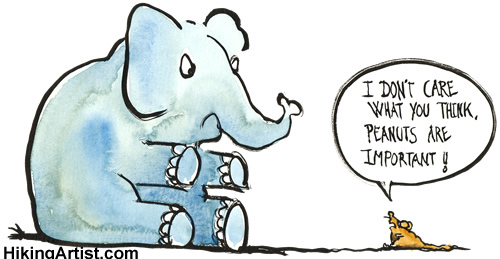
peanuts-important Recently there has been some high-profile buzz about Google's latest endeavor to unite arts and their internet products by having Google Chrome skins designed by prominent illustrators. The catch? Google will pay the artists nothing, offering exposure instead.

Understandably, many illustrators are incensed by the "offer." Though last year's iGoogle artist theme design campaign was highly successful, according to Mark Frauenfelder (an iGoogle artist), in that instance Google donated a significant amount of money in his name to a charity of his choice. This year Google is soliciting prominent illustrators ("prominent" meaning that these are illustrators whose work is already recognized and commissioned by high-profile companies that both pay and provide great exposure) and offering them no compensation. I think this is a slap in the face to the arts world.

Some very good points are discussed by Stan Schroeder at Mashable and Douglas McLennan at Arts Journal. I recommend reading their thoughts about the online community's responsibility for devaluing artists' work, seeing this as an opportunity to encourage higher levels of craftmanship, and the value of a relatively unknown artist to gaining exposure and consequently future work that would pay.

I, however, would like to address two issues that I have when a situation such as this occurs. I will do so in this and a following post.

First of all, I posit that most people who identify themselves as artists wish to make a living producing art. They do not WANT to have a desk job to enable their work. They would, ideally, be able to support themselves by producing work in their medium of choice. I am not talking about the people who happily admit to being designers "on the side," or who create art "as a hobby" and are content so doing. I am not talking about the people who, unasked, flood the web with their work free of charge. I believe that people who IDENTIFY as artists want it to be their vocation, their profession, their primary source of income, and guard it closely, hoping always that someone else will value it equally (and in concrete dollars).

It is offensive that Google, a company whose first-quarter profits saw an 8% increase over last year's (to $1.42 billion, according to the New York Times), would specifically select artists because they are well-known and well-respected and offer to pay NOTHING. It would be a different story altogether had Google held an open call for submissions, explaining at the outset that there would be no pay for the chosen designs, and allowed illustrators to decide for themselves whether they wanted to participate. (Note: even the 12-year-old winner of "Doodle for Google" received a decent-sized award for her winning drawing.) But to carefully hand-pick prominent illustrators and ask that they be a part of the project in return for exposure, shows how little art is respected by big business (and is, in my opinion, condescending). The fact that Google is SELECTING them in the first place suggests that these are artists who no longer need exposure, are at the top of their field, and should be considered valuable enough to earn a standard rate for their work.

Google's new skins are akin to packaging an unexciting product in an appealing way, something that marketing experts get PAID to do. Google would expect to pay someone to spruce up its image. Despite the positive impact these artist skins would have on Google Chrome's marketability (Chrome doesn't make my short list of browser choices), Google doesn't believe that the illustrator's work is worth a financial investment.

And if Google, a company worth billions, isn't willing to pay for top-of-the-line illustrators, what good is exposure? (Not to mention the fact that Google Chrome is not necessarily the best way to reach these illustrators' potential clients, since it depends on an individual's interest in downloading the browser to start with.) If a company knows that an illustrator is willing to work for Google for nothing, why would it want to pay the illustrator?

When Google thinks art isn't worth paying for, it is little wonder that legislators across the country question the value of arts funding.

Incidentally, I considered that this may be Google's reaction to Bing's attractive "decision engine." I contacted the provider of the stock photography that is used by Bing in an attempt to find out if they get paid for Bing's use of photos. The response I got from Jonathan, a representative of Danita Delimont stock photography, wrote: "I'm glad you like our photographers' work! Microsoft does indeed license the images they display on the Bing home page. We applaud Microsoft's decision to provide copyright information for the photos they use on Bing."

Yakkity Yak, Please Talk Back

"COMMUNICATION: LIVE" BY KONRAD WYREBEK AT SAATCHI GALLERY, LONDON

It wasn't long ago that I was your average internet user. More proficient than many, but not nearly as tech-savvy as some, I averaged a couple hours of every day online. I relied on the internet for everything from "catching up" passively with friends through their updated statuses and blogs, reading the news of the world, checking email, updating my blog and Tweets, shopping, and looking up interesting upcoming events. But among all of that, I tended to either ignore or delete the clutter generated by the various organizations that I demonstrably supported via my social networks and email-list affiliations.

Always happy to support by joining a group or becoming a fan, my participation stopped there. I rarely checked the list of updates on my Facebook homepage, or weekly inbox-fillings of "Last Two Weeks of Show! Get Tickets Now!" urgings. Unsolicited updates from these organizations and groups were of little interest to me--if I wanted to know something, I took it upon myself to seek it out.

When my production company established a group on Facebook, our personal friends became our fans--even if they were across the country, unable to attend our shows, and unlikely to donate money. It was, again, a show of support, solidarity, rather than a genuine interest in receiving electronic communication from us. There were no discussions being had, perhaps an occasional "can't come to the show this weekend" or "great performance!" but in general the group seemed little more than a space full of virtual warm bodies.

So why does it surprise (and yes, frustrate) me now that, as administrator of groups on a couple of social networking sites, I see that none of the fans or members seem eager to participate in discussions? The majority of fan- or member-generated content appears to be self-promotion or the occasional specific question (usually going unanswered by other members). Open forums asking for member input to guide administrator-generated content so that it is more pertinent and interesting to the group members have reaped little to no response. One of two comments to a call for feedback included this: "I haven't yet posted because I haven't yet seen anyone with similar interests."

Oh the irony.

Unless this user is sifting through the 640 other profiles of group members, he presumably is waiting for this like-minded stranger to make himself known. How? Probably by starting a discussion or posting a news item.

As I am becoming all too aware, that isn't likely to happen. In the occasional instance when there is a member-posted news item or discussion, the number of views it receives tend toward the single-digits (out of, I remind you, 641 members).

So why do organizations have hundreds of passive fans? Why do groups have thousands of silent members? Are these people hoping to be spoon-fed information in the manner of an RSS reader (and if so, why are they not viewing news items)? Are they overwhelmed by irrelevant postings (e.g. the self-promotional posts that verge on spam)? Intimidated because they are actually not quite clear whether what they have to contribute will be judged as valuable or not?

I can understand those individuals who accepted invitations to join and as a show of support or because they didn't want to turn down a friend and seem rude, but what about the others who find the organization or group of their own accord, request to join, and THEN lie dormant? Are they just individuals who have their own social media product, like a blog, or website, and hope that their affiliation with another group will generate more traffic for their own project?

And what does this lack of interaction mean for the buzz about social media being a non-profit organization's new best friend?

Please, weigh in!

Arts Advocacy via YouTube

Check out the inspiring video from Pittsburgh Filmmakers entitled "Arts and Citizenship":

It feels particularly appropriate today as Pennsylvania's House Appropriations Committee discusses (and potentially votes) on the Senate's proposal to zero out arts funding within the state's budget.

Twitter Art...or yes, ok, Tw-art.

Artists are using Twitter to create art in both online and real-life ways.

In The Murmur Study #1(above) and Installation1, the online platform generates what becomes "real world" art. The Murmur Study is a collaboration among Christopher Baker, Márton András Juhász and the Kitchen Budapest, and uses a thermal printer to print out microblogging correspondence in real time on multiple continuous sheets. In Milwaukee, Installation1 prints out follower's tweets on translucent pieces of paper and piles them on the floor daily, allowing anyone (that means you!) following @Installation1 to collaborate with their 140-character-or-less thoughts.

In some cases, the online platform is completely removed from the equation, but is referenced in our offline reality. This is seen in Questionmarc's Twitter Street Art, which generated a good deal of online buzz there for a minute.

I have to say, though, my favorite intersect of art and twitter has to be Jenny Holzer's Twitter feed. Holzer is a conceptual artists who has been using text as her medium of choice for over three decades. Her work focuses on public spaces, and appears as projections of words onto buildings and other surfaces, or words running along an LCD screen, street posters, and plaques. And now you can get her tweets directly.

Google Local Business Center - A Great Free Tool

Thanks to Webware's item about Google's Local Business Center--it got my gears turning on how to effectively use a great free tool for arts organizations. As a Google girl (it's my current search engine of choice, but I'm giving Bing a shot), it brings to mind the number of times that I have attempted to find a gallery or theater by searching the web.

But for YOU, the lister, Google has added a slew of new dashboard tools that could prove very useful free feedback. With the new Local Business Center, the lister is provided insight into who is out there searching for their organization, and how much information they want. For example, does the person just look up the map? Find the number? Check out the website?

This could be very useful for arts organizations to gather more data about audience location, the amount of information that those using the web desire, and tailor marketing to target these audiences.

And yes, it's FREE.

What do we Generate if not Discussion?

There's a lot being said right now about the efficacy of utilizing social networking sites for fundraising efforts.  A. Fine's blog brainstorms some real-world strategies, musing about organization/donor relationships, and how to encourage financial support. She notes that giving circles can be a place for discussion that may generate interest in other causes, raise awareness, and thereby encourage future donations. As social media changes and abets our causes, is our "audience" tuning out? Online, are our attempts to network as organizations being perceived as pitches? Sure, there are innovative ways to raise awareness, but is it just more of the same spiel? Do organizations that simply use the web as a way to market cross a line in our networking expectations that if you lead, you will also follow?

Those are my thoughts...what are yours?

Another thing to consider when using the internet to find money: I came across this article, urging caution when using the internet to find investors.

Social Media Intern: A Risk?

As social media gains momentum, both non- and for-profits are encouraged to give their web presence more attention and employ an Online Community Manager in their offices, thereby freeing up other employees whose job descriptions do not include "Update Blog," "Monitor LinkedIn Group Activity," and "Tweet." Image by Matt Hamm Image credit by Matt Hamm

In this economy, however, hiring for a new position is a financially daunting concept for non-profits. The name of the game is simplicity, streamlining, and enabling the most efficient, cost-effective business model.

Solution? Putting interns and volunteers to the work of managing an organization's online presence.

Ahh, internships. I remember my first summer internship as an undergraduate, with a very successful Chicago-based theater company. I was given stacks of brochures, testimonials, subscription forms, and shown "the right way" to put them all together. For three months I assembled press kits and marketing folders, cleaned up the files and archives, and ran menial errands. Had I been somehow incompetent, irresponsible, or destructive, there was little damage I could have done with my limited responsibilities.

But an intern charged with maintaining the online community of an organization, or managing social media--that intern has a LOT of power. For organizations lacking a strong online presence, there are great guidelines for making the most of a social media intern. If you do a quick search for the position online, job descriptions, in addition to managing Facebook pages and blogs, include "providing copy for our website," "developing the online marketing of a new documentary," and often seek an individual who is "self-motivated," and "works with little direction."

One concern about entrusting this responsibility to an intern is explored here by Heather Gardner-Madras. While Gardner-Madras questions whether "social media [will] become so important that current experimental forays will come to haunt their organizations...[will they] regret not making a serious investment in this part of their communications now or will they be glad that they were smart enough to take advantage of the skills and smarts of low budget resources while getting under way?"

In my mind, this is secondary to what I believe is a more immediate concern: who are we letting behind the wheel when we allow an intern with a short-term investment manage the direction of our organization's social media development? A non-profit's mission and goals are often shared by its long-term employees. The carefully-selected hires who toil over databases and grant-writing efforts, one hopes, are working for a mission in which they believe on a personal level. But an intern, eagerly snapped up by an organization looking for enthusiastic, cheap labor (and there's nothing wrong with that) may seek experience over idealism, want to find new, funky ways to use the tools of the web, and build a resume, rather than save the world or promote the arts. Is this student acting with your organization's best interest in mind?

I don't think it's a stretch to assume that a theater's intern is less likely to identify himself by his internship than the theater's Artistic Director--the intern's personal identity is stronger than his or her professional identity. The longer that intern holds the position, or the more s/he is paid for it, the greater his or her committment to the organization rather than simply the work.

So, this intern, who is less concerned about professional identity, is entrusted to represent your organization across the internet, and is associated with the operations of the organization. When s/he posts a blog, or updates a group, s/he is attributed with ownership, and the connections between your organization and that intern's online presence (personal blog, flickr account, Facebook page, etc.) are forged. S/he fields the discussions and questions that come through these social channels, and is the point of contact for your online audience. If that intern doesn't feel the same connection to your organization, are you missing out on the power of social media by not being represented by someone as deeply committed as you?

What if your organization is devoted to preventing animal cruelty, and your intern has a public photo album of a weekend hunting trip? Or your organization targets a more conservative, moneyed audience, and your intern has borderline-explicit photos and comments posted to his or her Facebook page? Certainly, these may be extreme examples, but what happens in this case? Are these grounds for giving ultimatums (block your profile while employed here)? What if that intern is not getting paid? If there is not a direct and obvious link between the intern's personal online identity and the work done on behalf of the organization, does it matter what the intern does online on his or her own time?

I don't know if there's an answer to the risks involved in intern-sourcing social media, and I certainly can't say that this is necessarily going to be the case with every intern. I am, after all, an intern myself.

Facebook for Arts Organizations - Webinar Series

Due to the high level of interest in all things Facebook, Patron Technology has announced a webinar series designed to take you beyond the basics, with detailed instructions, tips and examples of what other organizations and brands are doing successfully. Patron Technology clients: Free registration (click here to register) Non-clients: Session 1 is free.  Session 2, 3 and 4 are $45 per session or $99 for all three (click here to register)

Session descriptions:

Fans Are Better Than Friends (Encore Presentation) Thursday, June 4 | 2:00-2:45PM EDT

This session will give you a broad overview of the options for arts organizations (and other businesses) on Facebook, and some essential tips about what you should be doing.  This is an "encore" presentation of a session originally presented in April.

Are You Content with Your Content? Tuesday, June 16 | 2:00-2:45PM EDT

The most important part of maintaining a Facebook Page is making sure to update it frequently, with new and interesting content. But, that doesn't mean you have to spend all your time taking photos and writing new blog posts! There's plenty of shareable content on the web already, all you need to do is gather it and share it with your Fans. In this session you'll learn:

  • What makes an engaging status update
  • How to share photos and links
  • How to "listen" and find content to share on your Page

Apply Yourself! Tuesday, June 30 | 2:00-2:45PM EDT

Not all Facebook Applications are just for playing Scrabble and throwing sheep. There are some really useful apps that have been designed specifically for Facebook Pages. In this session you'll learn:

  • How to find and add useful Facebook apps
  • How to direct new visitors to a specific section of your Page
  • How to add your own content to your Page using a "blank slate" HTML app

Fan-ning the Flames Tuesday, July 14 | 2:00-2:45PM EDT

Once you've put all this time and effort into getting your Page set up, how can you aggressively attract more fans? We'll look at some ideas that work, and I'll share one case study of an org that went from having 600 fans to eight THOUSAND fans-in one week! In this session you'll learn:

  • How to link to your Page from your Web site and e-mails
  • How to create Facebook Ads to attract more fans
  • How to understand the stats and analytics that Facebook provides

Who I Am...or, Who Am I?

As summer commences (and let's face it, it's difficult to pretend it's still spring in these temperatures) I am here to introduce myself as your newest blogger. I could tell you about myself, my work history, and so on. You could proactively seek out online articles about or by me, or see my connections on LinkedIn, or, with my "permission," follow @Corwin82 on Twitter. Or, if your RSS feeder has just the right combination of words, you may already be following my "personal" blog.

Leading me to muse about the blurred relationship between online personal and professional identities. I am aware that this is not some groundbreaking topic, but the regular complexities of managing our personal/professional identities include unique challenges when the job in question is in the non-profit sector. Nobody, truly, can ever act with complete impunity.  Yet somehow, when acting in cyberland, the user is instilled with a sense of anonymity and security while simultaneously exposing him/herself to EVERYONE else online.

Historically, people have always had to worry about the affect of out-of-office behavior on their professional life. The degree of real-world self-disclosure or choice of actions might take into account the place, time, and audience. An individual bitching about a coworker might choose to do so to her husband, or a close friend over coffee. Likely not in an inter-office memo, or a radio broadcast, or to the coworker's best friend. Similarly, a person dealing with an addiction might discretely go to a support group 25 miles from home and not have to fear being exposed on the front page of the corporate newsletter.

But now we are provided the internet.

You may believe that your blog will only be viewed by trusted friends (so you can vent about your job, boss, financial situation, custody battle, and so forth). You can choose to allow certain people to see your Facebook page, follow your Tweets, and access the photo album of your latest trip to Vegas. You "control" your channels of self-expression, and thus, you feel safe communicating as indiscriminately as you would face-to-face with close friends.

Conversely, you may feel safely anonymous online, believing that your clever handle, pseudonyms and codes for people and places, and cryptic profile ensure your blog will only be viewed by strangers (so you can confess infidelity, "secret" desires, the self-gifted bonus you finagled by skimming a little off the top). After all, in the tangled web of the wide world of cyberspace, what are the chances that someone you know in REAL life will learn anything more about you than what you would disclose face to face? There's no danger in your tennis partner learning about your secret loathing for him, or your boss finding out that you want her job at all costs, or your recent, devastating prognosis that could impact your insurance eligibility or ability to find work. Because you feel safe, you don't feel the need to censor your thoughts.

The internet isn't your bosom buddy, nor is it the complete stranger you meet while traveling and share many shots of ouzo, too much information, and nothing else. It's not the privacy of your bedroom, and it's not your cubicle. It's not strictly personal, nor strictly anonymous. There's no clear delineation of where "you" in your secret, most personal self ends and "you-as-representative-of-your-work" begins. The internet is a sphere that conflates all representations of ourselves into a strange new beast that is, ultimately, accessible by anyone, anywhere. There are entire companies devoted to managing how we come across online, new tools to decide who is allowed to know what, and a lot of very interesting discussions being held (online!) about this conundrum.

I would argue that people who work in academia and politics, for the most part, have long been cautious about what is documented and where. But as younger, more web-reliant generations enter the workforce, and an online presence supplements, and replaces, other media outlets, the question of how we present ourselves (and are perceived) online becomes increasingly imperative. Web expression is no longer dominated by angst-ridden teenagers blogging about broken hearts. Those former teenagers are now working online on behalf of corporations like Domino's Pizza (to counteract the damage done by angst-ridden teenagers), the Pope, and the White House.

As artists, or professionals in the arts, who use the internet to muse, pronounce, declaim, advertise, and in other ways reach out, what are we to do to delineate who we are as professionals from who we are as people? Is there a difference? Must there be? How does this influence how our work is perceived/received? There are the channels that we identify as more "professional," like LinkedIn, an organization's own website with its own blog, podcast, etc. What about the ones we identify as mainly "personal," such as Facebook (increasingly used by organizations, companies, and causes)? And the ones that are something of a crossover, like Twitter? Must we always be conscious of representing our organization? What if I am employed by an organization that is involved in practices which are in conflict with my personal beliefs? What if as an individual I engage in activities which conflict with the mission of the organization for which I work? And, as we, as arts non-profits, look for ways to cut costs and bring in more outside help to manage our organization's online presence, are we taking a risk by entrusting this job to volunteers and interns, whose online power may equal (or surpass) our own?

Each question leads to additional questions, so I will do my best to approach these over the next few posts.

(And it's nice to meet you!)

And Thanks for all the Fish!

so_long_and_thanks_for_all_the_fish_cover

So this will be my last blog post for Technology in the Arts.  My federal student work study allotment has run its course, and I am now foraging in the desert of uncertanty of this horrible job market.  So to quote Baudrillard, "Welcome to the Desert of the Real." or wait, was that Morphious?  Anyway, I thought I'd post some more Friday Fun Links for those of you still paying attention. First up, is this amazing Cellist pulling a Nick Zinner with some effects pedals and a Macbook Pro.

And then there's my favorite plot summary site.

My New favorite Photographer

My Old favorite Photographer

My Favorite Street Artist

and I leave you with something Beautiful

If anyone out there is interested in hiring a tech savvy, hard working recent Graduate from Carnegie Mellon with a mild addiction to coffee and contemporary art, feel free to contact me or have David pass on the news that you are looking for someone to fill the position of awesome.

Thomas Vannatter

Rethinking ROI for Social Media

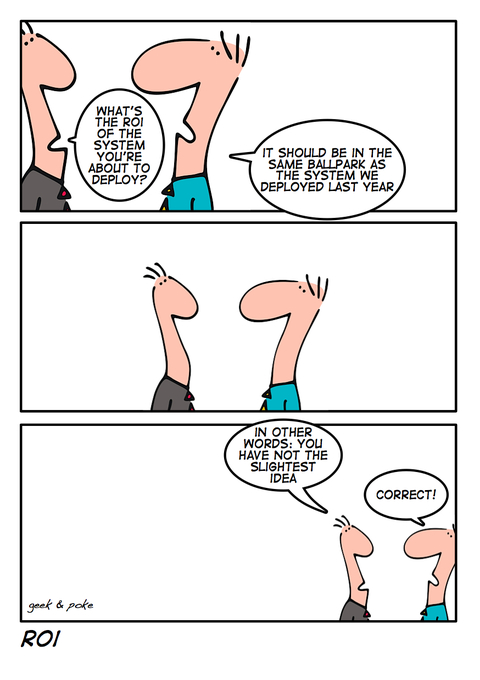
roi For many arts organizations out there right now, this is how we seem to be calculating the ROI for Social Networking and Media.  Everyone seems to be groping in the dark to boil down a simple monetary answer to this question of, "What is *your organization here*'s return on investing in Social Media?"

While there are solid(ish) ROI calculators for Social Networking out there, and they do provide cells for number of friends added, and amount of donors added to your email lists vs. amount of volunteer/employee time and money spent, I feel like somehow they all miss the point.

Yes it is nice to have quantifiable data to back up the decision to dedicate precious and dwindling time and money to a project.  However, the main source of return from social media simply isn't quantifiable.  We're talking about trying to quantify human interaction and communication.  And we are also talking about laying the groundwork to adapt to how the world is changing, and how our audiences are staying informed/using the internet.  The worth of these tools, and the time spent cultivating relationships with our audiences does not exactly have a set monetary value.

We can begin by monitoring click through rates, and number of new "friends" on Facebook and weighing this against how much time and money is being spent, but this doesn't exactly give a complete picture of what is going on.

If an organization is really committed to utilizing social networking not just for marketing and revenue generation, but for communicating and engaging their target audience and creating a community of individuals that are interested in the core values and beliefs of that organization then how on earth can they boil that down to a Return On Investment.

As of right now, the amount of direct donations that non profits are receiving from their social network sites is arguably marginal.  Admittedly there are some outliers who are able to generate significant returns from their social networks, the Brooklyn Museum's 1stfans springs to mind.  However, as a communication tool for promotion and engagement, a method of gathering email-ing lists, and for managing and maintaining positive feedback about the organization, social networks are proving to be invaluable pretty much across the board.

The overwhelming problem of course is that once your organization has developed this online social network, simply having a static page isn't enough.  A Facebook page is less a Billboard than it is a Soapbox, so you have to treat it like one.  It might be ok for your organization to have an unpaid intern managing some of your social media because they are by and large in the Heavy User demographic and know all the ins and outs, but without some sort of direct executive insight and direction you now have a 20-something basically dictating the brand identity of your organization and running a large part of your marketing department.

So I guess that's another way of looking at the ROI, what would happen with no investment of time and resources?  The whole "If not X" senario.  As the world slowly begins to adopt social networking as a standard means of communication and the source for their daily information, we may see an increase to the direct donations to organizations through these social networks.  I mean, if politicians (read old rich people) are already doing it, then how far behind the curve are we if we aren't?

Arts Video Site

Play Art Loud! ArtBabble.org

I've been wanting to write something about this site for a while now, but I've had a hard time figuring out what exactly to say about it beyond just describing what it is, who's involved, and what they do.

ArtBabble is more than just another collection of videos about art.  Each video comes with a sidebar of notes and more information that the viewer can dive into in order to explore more aspects of what the video is presenting.  At times this sidebar can be a distraction, and other times can lend more depth to something like an Art21 video about Jenny Holzer that you've seen a few times.

The bulk of the videos come from MoMA, SFMoMA, Art21, The Indianapolis Museum of Art, The Los Angeles County Museum of Art, The New York Public Library, and the Smithsonian.  By and large, the content is geared towards the art novice, but there are some incredibly poignant videos for arts managers on the site, like the Museums and the Web 2009 video posted below.

So far my favorite video series has been the Behind the Scenes at the MoMA, but all of the videos I've watched are really high quality and very informative.

In an Update, last night ArtBabble won a Gold Muse award from the AAM for best online presence.

Really Alternative Exhibition Spaces

Deviating from my usual blog posts about new technology's influence on the Art world, today I would like to talk about alternative exhibition spaces and some of the issues surrounding Marketing escalation.

I've mentioned in the past that the Younger than Jesus crowd has a general disdain for excessive marketing and that we simply do not like being sold to.  We Tivo the shows we want to watch to remove the adds, and we employ as many add-ons as we can install into our web browsers to reduce the amount of online advertising we are subjected to.  We have a certain amount of immunity to advertising, our eyes glaze over and we cease to pay attention to billboards, print adds, junk mail, spam, pop ups, and recently even most viral marketing has become groan worthy.

Some marketing companies like NPA outdoor have been upping the ante by advertising on billboards that are erected without permits.  An intrepid group of artists took it upon themselves this past weekend to appropriate 120 of the over 500 illegal NPA outdoor owned billboards as alternative exhibition spaces.  Some amazing images, and more information about the project Here, and Here. This project is a really interesting look at the debate over public space, and the ubiquity of advertising.

hifive

Not to say that there aren't innovative and interesting marketing campaigns out there.  This add, for instance, probably sold more Cat Power and David Bowie songs on Itunes than it did Lincoln MKS's.  (on a side note, if anyone knows where to find the full version of this cover, please post it in the comments) And this one shows how versatile Vimeo is more than it inspires me to buy a Honda Insight.

One thing that all of these projects, and even some of these advertisements point out is that there is still a deep appreciation for art out there, which bodes well for those of us making a living in the art world.

Does this make you think of how you can approach marketing an arts organization differently?

The MoMA recently received some blow back by hiring The Happy Corp to "mashup" their subway advertising campaign.  But were their intentions in the right place?

Let us know what you think.