Arts & Technology

Building online community: sketchcrawl.com

Seven years ago Enrico Casarosa, an artist working for Pixar went on a pubcrawl. He writes that the spirit of community inspired him to create a community for visual artists that he called Sketchcrawl. The first Sketchcrawl happened in 2004 in over 20 locations in six countires. Since then, there have been 33 Sketchcrawls and the event has grown to almost a hundred locations in over 20 counties and now has a website sketchcrawl.com.  The community now has over 3000 members and is still growing.  At first, only Enrico was moderating, but Sketchcrawl has since grown to have numerous other worldwide administrators organizing participation and the community has strong leadership in both Asia and Europe as well as in North America.

A Sketchcrawl is a day predetermined thoughout the world, where artists young and old, professional and amateur pledge to sketch for anywhere from 20 minutes to 8 hours.  The results of the event day are posted online for the whole worldwide community to see.  There are  some true gems in these online galleries. Participants speak of both the reward and difficulty of committing to draw for an entire day.  They recount the lucidity that comes from a full day of observation and moving from subject to subject.  They also comment on the difficulty of focusing their attention for so long. Side by side, these artists are creating a community through a shared experience and their love of art. Alongside their peers the collection of images lead us through a sense of movement throughout the day and objects and people that once were ignored as mundane become visible and interesting.

This community, built through a mutual love of the arts, is a strong sign of the growth of the arts online and should give the arts community at large hope for the future in the face of declines elsewhere.  The next Sketchcrawl is on January 21, 2012.  It is easy to sign up and there are also multiple social network sites for the community at large and for individual city groups.

In Case You Missed It - October 2011

The leaves have fallen down and the air has begun to crack with cold – October is ending! Here’s a look back at some of the big topics our we tackled this month. Not only does Technology in the Arts recognize the need to protect federal funding for the arts, we also took a look at how artists can protect themselves and their digital intellectual properties.

From there, we took a look at how the arts and business can cohabitate peacefully with the BMW Guggenheim lab.

We gave everyone some insight about into up-and-coming demographic, The Millennials, and how your organization can reach them.

Of course, all work and no play makes this a boring blog. We discussed how arts organizations can utilize a game dynamic, as well as took a closer look at the mobile app game integrated into the experience of the Tate Modern.

We had loads of great articles this month, and I hope you take some time to check out them all. Enjoy the weekend and have a fun and safe Halloween!


Crowdsourcing Creativity

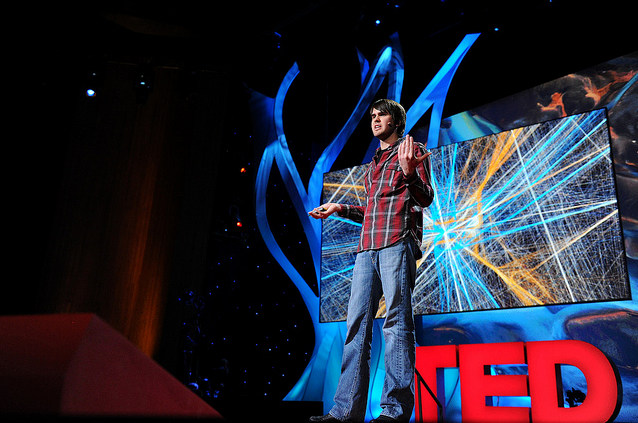
At a TED talk earlier this year, Aaron Koblin, an artist “specializing in data and digital technologies”, began his talk by drawing attention to a tweet from a media theorist: “19th century culture was defined by the novel, 20th century culture by cinema, the culture of the 21st century will be defined by the interface.”
I need this blank space
Now let’s deter ourselves from contemplating how we live in a world where tweets have become the new medium for philosophic aphorisms. Instead, let’s contemplate the interface, which means “a common boundary or interconnection between systems, equipment, concepts, or human beings.” Some thoughtful seconds later we can begin to comprehend the importance of the interface and how it has provided the world with numerous platforms for communication, the most important of them being the Internet.
Space
 need this blank space
And this overwhelming ability to interact and communicate has given rise to another interesting phenomenon; crowdsourcing. Essentially, crowdsourcing is a means of relegating a specific problem or a task to members of the public and it provides access to something that was virtually impossible in the pre-Internet, pre-interface era; the collective brainpower of the wired world.
I need space
So what does a digital artist like Aaron Koblin create in the era of the interface? How does Koblin proceed when it dawns on him that he can explore the creative processes of the online world? He proceeds by surrendering his own paintbrush and easel but providing a whole host of individuals electronic canvases, paints, and paintbrushes; Koblin crowdsourced his art, he crowdsourced creativity.
Space
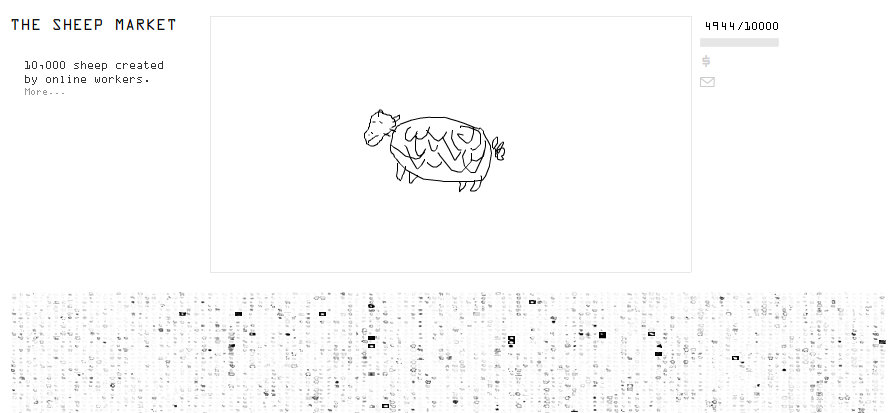
More specifically, he used the crowdsourcing capabilities provided by Amazon’s Mechanical Turk to create art. For his first project, Koblin created a drawing tool and paid people 2 cents to draw a sheep facing the left. And thus he began collecting sheep, drawings and drawings of sheep, 10,000 sheep. At the end of the project, he created a website called thesheepmarket.com, where he sold a block of 20 sheep as a “one-of-a-kind plate block of lick-able adhesive stamps.”
Space
pace
And technologically acute, brilliant artists, such Koblin do not crowdsource just once, they crowdsource again, and again. Some of his other incredible projects are Ten Thousand Cents and a Bicycle Built for Two Thousand, both of which demonstrate the extent and power of human collaboration made possible today, notwithstanding the lack of context and monetary gain.
Space
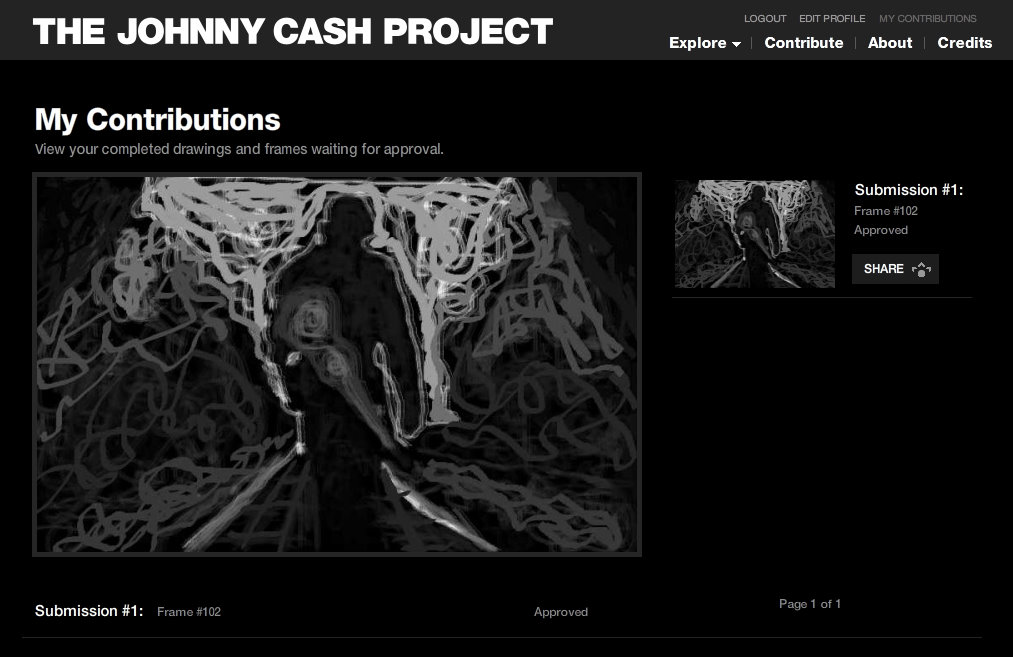
The most recent of his pursuits is The Johnny Cash Project; “ a global collective art project”,  where people from around the world can contribute to making the music video for the song, Ain't No Grave, which was Cash’s final studio recording. In collaboration with a host of people, archival footage of Johnny Cash was used to create a video for Ain't No Grave, which was then cut into several different frames. More specifically, the footage was cut into eight frames per second, leaving people with an ample number of frames for, albeit mouse-driven, creative expression.
Space
pace
As such, anyone anywhere in the world, could, and still can, re-create and render a frame from the footage using the drawing tools provided to them on the website. All of these frames become inter-weaved and form a final video homage to the great Johnny Cash that is cohesive yet disjointed, anonymous yet personal.
Space
Crowdsourcing, of course, is not limited to the field of artistic creation, for it can spark, even set ablaze, inspiration and innovation in almost any field.  Earlier this year, we read about how an entire opera production was crowdsourced! And ever since, the phenomena has only led to more sighs of delight, awe, and more recently, exclamations of eureka!
Space
The concept behind fold.it, a website where users “solve puzzles for science”, is none other than that of crowdsourcing. An article in the Smithsonian magazine takes note of some of the other organizations that have used crowdsourcing; NASA, Harvard researchers, and the European Space Agency. Yet another article in the Washington Post mentions how the Dead Sea Scrolls project by Google opens the door for “amateur detectives to seek clues that elude scholarly academics.”
Space
Even museums can no longer hide, not even behind their impressive forest of columns in the Ionic order, from the phenomenon that is crowdsourcing. The Concord Museum in Boston recently celebrated its 125th anniversary with the exhibition titled  “Crowdsourcing a Collection”, which was “curated by 25 selected individuals drawn from literary, arts, or political circles.
Space
For arts organizations, crowdsourcing is a innovative way to engage, communicate, interact, and participate with your audience. So when faced with a vexing problem or task, why defer from asking the wired world to aid and guide you? If you were waiting for a call from the savvy technological beyond, here it is; crowdsource creativity, crowdsource innovation.

What Makes Me, innovation from Down Under.

There’s a project going on in Australia that is the largest online digital storytelling project in the country. The project invites people to tell stories about what has made the arts special to them and how they’ve been touched by the arts. They tell their stories through audio, video and writing. The cool thing about it is, anyone in Australia can do it.  As of today, it has several thousand entries. The project was launched in July of 2010 and the results are aggregated into a into a giant, growing testimonial page with search-able contents by genre.

This website is called “What Makes Me”. There are three different sections: What Makes Me, What Makes You, What Makes Us. Each person claims a cube, a cleverly designed multimedia enabled object online and they decorate it with their images, video, and audio files.  Each one is very different. The first twelve entries talk about why each individual loves a certain art form or forms - whether it be dance, circus arts, graffiti or something else.  All of them are touching and told from the heart.  There’s a retired nurse that found out her next door neighbor was a circus performer and has since fallen in love with the circus. There’s a professional rugby driver who drives around looking at the graffiti all over the city. There’s a professional cook who while catering a party, discovered dance for the first time and has since developed a personal relationship with the choreographer.

The common thread that runs between most of these testimonials is the personal connection built with a specific artist or the arts in their neighborhood. It’s about relationships, rather than facilities, and community as the key to these relationships.

The idea around this project was to counteract the perception that the arts in Australia are “associated with images of snobbery and inaccessibility”.   The project is run by a company called Wanted Digital and initiated by the Australia Council for the Arts.  The participants of What Makes Me are cooperating to build something together- it’s a game.  A game that is getting the attention of philanthropic organizations in the US.  Wolf Brown recently used this interactive project as an example of participation in the arts in their recent study commissioned by the Jame Irvine Foundation “Getting In On the Act - How arts groups are getting opportunities for active participation”.

What Makes Me is worth taking a second look at. The project engenders enthusiasm that isn’t created from simply being a spectator.  Anyone in Australia can be a part of it and there is a hefty presence on the site from diverse populations with Aboriginal people, the disabled, and immigrant communities being well represented. Participants post links to their cube, to their facebook, to their twitter, to other social media sites. The individual act of creation combined with the community have a ground swell effect and foster even deeper love for individual artists and the arts contributions to the community.

Art Meets Technology in New York City

For many of us in the arts community, especially in cities that feature a wide variety of art opportunities to explore, we are often tasked with a dilemma: what is the best way to find not only events that are close to me, but also events that my friends and I will enjoy the most? As is often the case, this is where technology comes in. The New York Times reported yesterday on a group of young arts professionals in New York City who are using social media to not only find those very events that are the most appealing to them, but also to organize like-minded individuals to join them at the newest buzz-worthy art gallery opening or museum exhibit. The tools and tactics these arts professionals are using can serve as an excellent model for artists and art lovers in any city where the arts are appreciated.

For those who are looking for more targeted art opportunities, there are a number of social media outlets where you can discover more information. The first is Meetup.com, a website where millions of people have created and found scheduled events in their communities. A good section of the site to bookmark is museums.meetup.com, where you will find dozens of groups and thousands of members all across the country who meet regularly and advertise upcoming arts events. For example, here in Pittsburgh one of the many great arts groups is the Pittsburgh Cultural Arts Group, home to 550 members who organize regular arts-related events and shows.

Organizing events and participating in MeetUp activities is not only a great way to find out about upcoming shows; it also serves as a place to meet fellow arts lovers and make contacts in the arts community. Especially for those young people who are either in school or new to a particular city, MeetUp can serve as a conduit to meeting others who share their unique interests. Instead of attending that upcoming exhibit you were looking forward to alone, you know have the opportunity to share the experience with people who share your passion and interests.

So meeting and befriending fellow arts lovers is the first step. Once you have found a group of people committed to discovering the latest and hottest events, what’s next? Instead of using more general platforms like Facebook or even text messages, the young professionals profiled in the NYT piece and many others have used Twitter to share news and events not only with their friends, but with the entire world as well. They use the hashtag #artstech to promote events, share tips and/or links to more information. The great thing about this technology is that it is completely open to everyone: searching for #artstech on Twitter will show you all recent postings by anyone who tweets using that hashtag, whether you follow them on Twitter or not.

The hashtag is one of the most important tools Twitter offers, and you can tailor it to your group’s interests. Are you involved with a small group of museum lovers in Cleveland? Start using the hashtag #ClevelandMuseumLovers when tweeting about local museum events, and as more and more people view the tweet and re-tweet, the more ubiquitous it will become, especially if you have a large Twitter following (for example, one of the hashtags we use here at Technology in the Arts on our Twitter page is #TechArtsReads to share interesting stories about the intersection of arts and technology with our thousands of followers).

But perhaps the best part about using technology and social media to discover new and exciting arts opportunities and events is the ability to use these tools to facilitate and improve the offline relationships that are so important to us. Social media is merely the first important step: meeting new people and developing new contacts is integral to our personal and professional lives, and is bound to open up exciting new opportunities that may not have been available before.

With many museums, arts organizations and galleries using social media to reach out to art lovers, there has never been a better time to use some of these technology tools to better organize and share the exciting new events and opportunities in your area.

What tools do you use to learn about art events in your community, and how do you share this information with fellow arts lovers?

(Photo: CC by Emilio Santacoloma)


Hear Art Everywhere with Locally Toned

It’s a curse of our society. Modern innovation has led to the grotesque abomination, the “cell phone ringtone”. Obnoxious and pervasive at best, invasive and stupid at worst, you will hear them anytime, any place, and might hear one even now (you should get that – I’ll wait). Consider, though, what if cell phone ringtones were art? Sounds can be art, so why can’t the sounds coming out of your phone be works of art? T. Foley, a Pittsburgh based artist, tackles that question with her “public art/original ringtone creation project”, Locally Toned. Users can create and download unique ringtones for free from the Locally Toned website, and to date 11,103 ringtones have been downloaded. I had a chance to speak with Ms. Foley on her work with the ubiquitous ringtone…


Locally Toned Collaborator Krista Martin poses with a ringtone creator at the Uniontown Poultry Association's fall show

Can you speak a little on how your work democratizes art? Why is this important to you? How do you see the Internet as a component of it?

Thanks for visiting with me, Rachael.

I have a background in media literacy, so I’m interested in people having access to a wide variety of media, and the skills and tools that allow them to produce and analyze media for themselves. Locally Toned democratizes art because it’s produced with others and for others. I’m not an artist working alone in a studio producing ringtones to sell to others. I collaborate with people to turn sounds that are meaningful and/or interesting to them into ringtones. This past weekend I went to the Uniontown Poultry Association’s Fall Show in Fayette County to capture bird sounds with the help of that community. And I collaborate with technologists such as Deeplocal and other artists, Encyclopedia Destructica, to get the tones to the public/onto phones. Deeplocal  built the technology for the project; Encyclopedia Destructica helped me to design distribution techniques (the ringtone art cards). Unlike paintings or sculptures for sale in a gallery, which many people can’t afford, people may own and share these works free-of-charge.
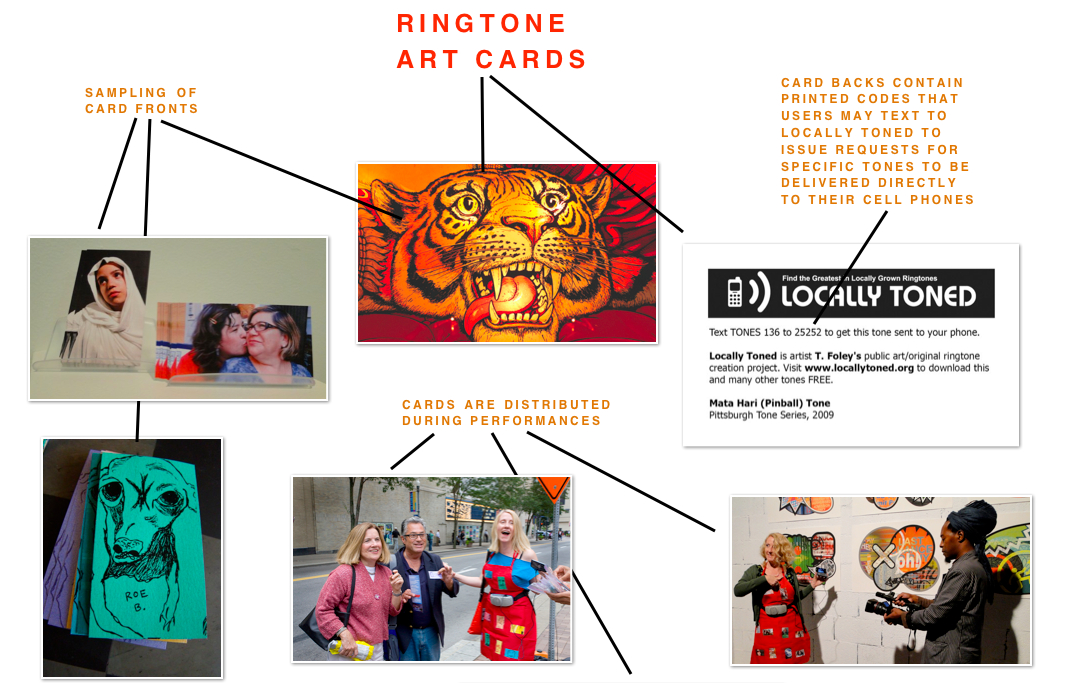
An example of the ringtone art cards

As conceptual artist Robert Smithson expressed in a 1972 essay entitled “Cultural Confinement,” for Artforum, some works of art, when placed in galleries, loose their charge. Locally Toned is that type of work--one may listen to the tones online, but the real audience for the project exists anywhere a user who’s downloaded the tones receives a call on his/her cell phone. The work performs itself at unexpected times and in unexpected places, outside traditional art spaces (galleries and museums).

My boyfriend likes to say that Locally Toned gives people a “sneak-attack” ability. When some of the more unusual tones go off in public, it creates a little scene. For example, the LRAD tone went off one day on my phone at Deeplocal. The CEO assumed it was a fire alarm and told everyone in to exit the building. I let them know it was a false alarm--I was just testing out the sonic canon ringtone.

The tones function as conversation starters. I often use tones from the Bayernhof Museum. When they go off in public, strangers ask me to identify the sounds. Then I tell them about the nearby museum for mechanical musical instruments. The conversation is usually short, but there’s an unexpected exchange that occurs as a result of the tones.

Ringtones are an invention of modern technology, what drew you to use them as a medium? Is there a benefit to using ringtones in your work as opposed to other technologies?

I had always wanted to make ringtones for my phone, and a “call for artists” from Deeplocal inspired me to develop this project. I was also motivated by a strong dislike for music industry and pre-installed ringtones on cell phones--I wanted to make tones that were more interesting or beautiful. Then I became curious about what other people would do if they had the opportunity to make ringtones. And with my media literacy background, I wanted to model that it’s possible to make and share homegrown ringtones.

I use technology to connect and share with others--recording equipment to make the tones, photography to document the sounds, the Web site to distribute the ringtones, and the Blog to promote the stories behind the sounds that are created. Technology helps to extend my work and ideas out into the world. I like what Lawrence Lessig says about on- and off-line sharing economies in his book Remix (http://remix.lessig.org/).

“Gifts in particular, and the sharing economy in general, are thus devices for building connections with people. They establish relationships and draw upon those relationships. They are the glue of community.”

Locally Toned is public art through service to the community—a series of production, promotion and distribution interactions between the public and myself. New social interaction spaces (physical and cyber) are developed around the making and sharing of these tiny aural documentaries, or soundscape snippets. The tones serve as audio identifiers for members of various communities. A person might identify as a cyclist and download Erok's Bicycle Bell Tone for use on his/her phone. The tones are also plotted on a ringtone map.

Do you see your work moving into other technologies in the future? If so, are there any technologies in particular you would like to explore?

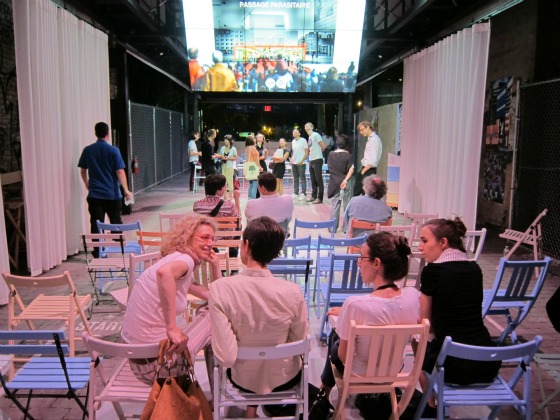
I like to exploit tools that are easy for people to access and use. Recently I’ve created a live and online performance work with Hector, a shy ventriloquist dummy. In The Dummy Is Present, my re-interpretation of Marina Abramović’s The Artist Is Present, 2010, Hector appears on Chatroulette with an audience behind him. The audience appears in the work as spectators and as part of the show. People may sit behind us passively, watching Hector interact with others online (my computer is projected onto a big screen during the performance), or they may become part of the interaction. Some of the people we encounter online say, “Is this for real?!” Audience members respond by shouting or waving a hello, and they may applaud if the other party on Chatroulette performs for us. The performance has been described as voyeuristic, riveting, and magical--it’s all those things and more. I made the work because I wanted to draw attention to contemporary notions of public and private space, and to consider what it means to have an online presence. The Dummy Is Present is part of a larger body of work, Easy Pieces, a series of live and recorded performances featuring a ventriloquist dummy and myself. I’d like to find an interesting application for Twitter within the larger project, but I haven’t figured that out yet.

With Locally Toned and the work with Hector, I use a particular technology so that I may say something about our experiences with it. And I enjoy making work that evolves and changes over time. With both projects, I never know what’s going to happen next--and that’s really fun for me.
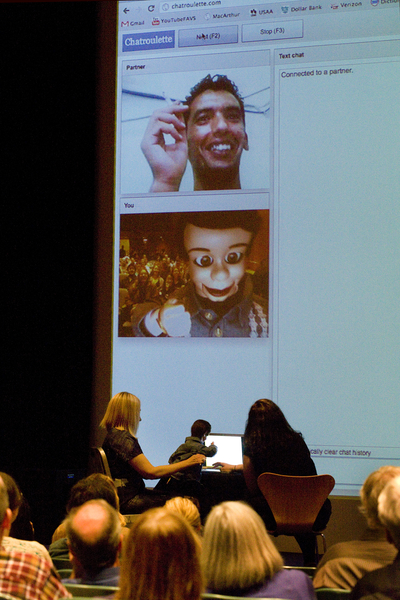
The Dummy Is Present - Photo by Larry Rippel

Do you think Locally Toned will ever reach a conclusion?

Locally Toned is an ongoing project. I’m not a Web developer, but I want to be a good shepherd of the project’s technology so that the archive will remain accessible to the public and so that I may add to the collection for years to come. I’m presently seeking funding to make improvements to the Web site, and to release all the tones in the iPhone format. Within the next year, I’d like to identify other cities to collaborate with. The tones are licensed under the Creative Commons Attribution-NonCommercial-Share Alike code, and they show up on other folks’ Blogs. It’s great to see people point back to Locally Toned, and see them re-tell stories about the origins of the sounds.

Ms. Foley is also looking for some Pittsburgh local help with her next project,

Who wants to make a ringtone? This month, I will receive a grant from The Fine Foundation to create a new series of tones from the Pittsburgh region. I’m looking for collaborators. People can contact me by email: locallytoned@gmail.com.

And if you thought her Chatroullete dummy performance sounded cool, Pittsburgh has another opportunity to see it live:

The next performance of The Dummy Is Present will take place at The Warhol Museum on the evening of January 6, 2012. More info can be found at the Ventwittoquisms Tumblr.

---

So what are you waiting for? Go customize your phone with some art!
IBM: A Century of Avant-Garde Thinking

If asked whether data can be beautiful, many of us in the art world would give the questioner a quizzical look. We would then proceed to answer along the lines of “In the art world, we do not ponder over the beauty of data.” But if we were to pose the same question to IBM, they would nod affirmatively. And it bodes well for us to listen to those at IBM because after a century of trial and error, they have agreed to share some of the reasons behind why data is not only beautiful, but also powerful and astonishing. In celebration of a century of avant-garde thinking, the aptly named IBM THINK exhibit is on display at the Lincoln Center in New York. One of the most striking displays is found at the entrance itself; an incredibly beautiful, 123 foot, digital data wall that “visualizes, in real time, the live data streaming from the systems surrounding the exhibit, from traffic on Broadway, to solar energy, to air quality.”

The IBM Think exhibit is on display at the Lincoln Center in New York until October 23

Once inside the exhibit, which is a veritable visual feast, visitors watch a 12 minute film about “awe inspiring stories of the past and the present”; in essence visitors learn about how the advancements made at IBM have shaped the technological course of the 20th century and the opportunities that lie for “making our world better, today.”

The exhibit concludes with an interactive experience, where visitors can delve into the collective knowledge of the scientific and tech world, from “clocks and scales to microscopes and telescopes, RFID chips and biomedical sensors”, on 40 seven foot screens. Through its data visualization techniques and compelling interactive experiences, the IBM THINK exhibit achieves a rare balance between data analysis and beauty.

http://www.youtube.com/watch?v=JVrXAsYd1Wk

But the overall theme of the exhibit is not limited to the dissemination of data, rather it poses a grandiose and rather formidable question; how do we use the breakthroughs in the fields of science, technology, and leadership to make the planet a smarter place? So while the BMW Guggenheim Lab experimented with making metropolises better, IBM’s sets its sights on the well-being of the entire world. Is that an audacious quest? Not quite, because if IBM were a person, they would have on their resume, a century of experience in changing the world, written under qualifications.

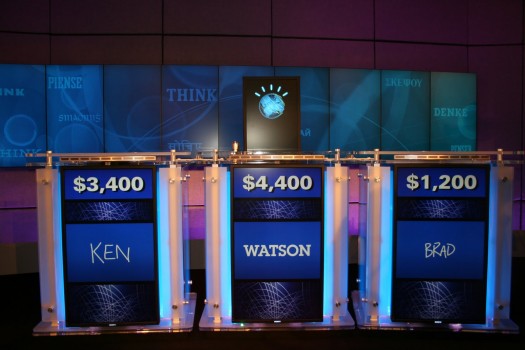
In fact, not only has IBM propelled the world into the 21st century, it continues to build up storms in the ever restive sea of our scientific and technological present. For instance, it’s hard to ignore Watson, the IBM self–contained computer system that proves that computers too are capable of placing themselves in jeopardy.  This is because Watson can process natural language and hypothesize between answers, until it arrives at the right answer through weighing different algorithms and determining its confidence level. And Dr. David Ferrucci, the Principal Investigator for the Watson project, is convinced that computer has potential to transform industries such as business and health care.

Let’s also take a look at a technology that may not have created a storm, but perhaps ripples in the much smaller lake of the art world. Earlier this summer, IBM helped the Metropolitan Museum of Art make quantum leaps in art preservation when it installed wireless environmental sensors called Low-Power Motes. These sensors will help the Met monitor the micro-environment through real-time 3D data that will “measure temperature, humidity, air flow, contamination levels, door positions, light levels, and more.” The sensors will help the museum scientists develop correlation models between environmental conditions and the reactions they have on works of art, eventually leading to better models for art preservation.

So in the end, let’s not move forward but backwards. Let’s rewind our clocks back to the year 1911, when IBM’s successor the Computing Tabulating Recording Corporation sold products such as employee time keeping systems, punched card equipment, and of all things, automatic meat slicers! Compare meat slicers to Watson or Low-Power Motes and we can begin to appreciate the beauty of data analysis techniques and technological advancements. We can finally begin to nod in unison with IBM.

The Millennial Generation: We’ve got the power

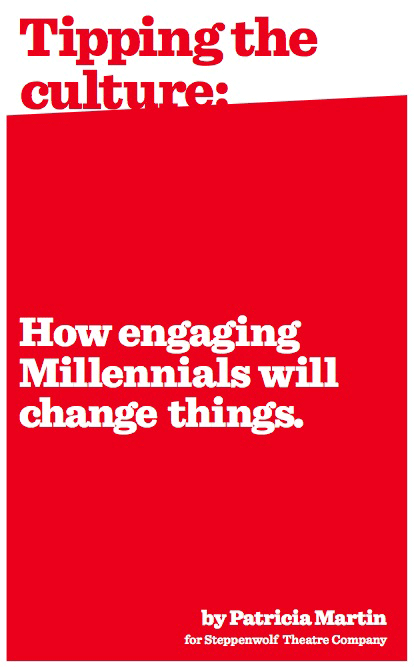
redbookCommissioned by the Steppenwolf Theatre Company, author and culture analyst Patricia Martin recently published the report “Tipping the culture: How engaging Millennials will change things.”Her extensive research on marketing to the generation “eclipsing Boomers and GenX” boils down to the following: the Millennials, those between the ages of 15 and 31, are more networked than any other generation and thus have the power to influence and determine the success and future of an organization. Between blogs, Facebook, MySpace, Twitter and smart phone applications, the Millennials are here, there, everywhere, with everyone, and telling you about it. Because of this, if you can catch them and grab their attention, they will market your product for you. But this is not news. The folks here at Technology in the Arts have offered compelling reasons beyond the obvious (marketing advantages) why not-for-profit arts organizations should tap into these viral networks.

Martin takes a look at the big guys, companies like Google, Ford Motors, and J. Crew, to uncover how they successfully snagged the Millennials. How has J. Crew managed to attract and maintain the 22 to 30 year old Millennials? How did Starbucks gain such a loyal following of 15 to 30 year olds? What techniques are these large, for-profit firms using to advance their brand and secure their position in the future marketplace? Using these case studies, Martin provides insight on marketing to this powerful group of young-adults, divulging what attracts them, how to include them, what they are thinking, what they want and how to engage them.

In her easy-to-digest exposé, Martin sheds light on a generation that seeks to both create and consumer content; a generation that is less interested in sitting passively in the audience than being engaged and having their input heard in the creation of the production. Martin offers the not-for-profit arts sector strategies for effective marketing to Millennials through personalized and engaging social media interactions.

So how do Starbucks and J. Crew do it?

1) Making Millennials the priority, then the brand

2) Increasing the firm’s emotional and lifestyle appeal

3) Creating a sense of belonging for customers through participation

What exactly does this mean to a not-for-profit?

Millennials crave connection, whether through broad networks and communities or through exclusive access to content that creates a sense of intimacy.

Translation: Open your backroom doors by posting video footage to Facebook of a “Day-in-the-life” of your museum director, reveal your “behind-the-scenes” preparations for an upcoming exhibition through Facebook status updates and photo uploads, or tweet from back-stage actors’ excitement moments before the opening act. For those of you theater connoisseurs, break the “fourth wall” to show Millennials you understand their desire for access to content and knowledge. Give Millennials the opportunity, through social media, to discover on their own what you are about. Martin describes this as an “egalitarian social model,” where you (the not-for-profit) and the Millennial become connected as friends and collaborators.

Once you have established a relationship with your users online, your work is only half complete. If you encourage participation online, be sure to reinforce your commitment to the Millennials and their contributions on-site by referencing user generated content in your play-bills, gallery maps, and museum guides.

There is a reason why the Broadway musical Rent and primetime TV shows such as CSI and Gossip Girl have gained momentum among Millennials: they are emotionawhatdotheywantlly charged and engage Millennials in meaningful ways. Creating meaning for Millennials in your not-for-profit could begin with a blog. This forum allows for informal discussion, emotional content, and most importantly, participation. Have your blogger pose questions of substance that encourage meaningful and emotional responses in reaction to a performance or exhibit, such as “Do you agree?”, “What do you think?”, “Tell us how you feel” or “Which character did you relate to most?” By giving Millennials the unadulterated freedom to share their perspective and voice in a dynamic forum, they will have a more personalized experience with your organization.

Fulfilling the emotional desire of Millennials to be connected, heard, and have meaningful experiences will increase the retention rates for this generation in your organization. It does not require the marketing budget or quarterly revenue of J. Crew or Pepsi, just greater attention to the entire customer experience of your cultural brand (think witty videos for downloading, thought-provoking quotes for Millennials to tweet and a survey to remind them they have a stake in your future).

To the Millennials out there, what social media and technological marketing strategies have won you over? And to the not-for-profit arts organizations, how do you use technology and social media to effectively connect with them?

Faster Than Sound: Pushing The Boundaries of Contemporary Music

While conducting the first round of research for my white paper on online audience development, I stumbled across an exciting development in the world of music. I was first introduced to the genre of contemporary music when I noticed the growing trend of string players and, what sounded like, a classical music influence in many popular indie rock bands. Even though I have background primarily in jazz, both classical and jazz worlds share the same audience development woes. It was both promising and exciting to hear so many young musicians take classical music to new territory. Upon further exploration and research, I discovered that the work of many of these musicians and composers is being labeled as 'contemporary' or 'modern' music.While it can be tricky (and at times unfair!) to attach a definite label to these types of projects, it's important to recognize this growing movement, especially as it pertains to the intersection of arts and technology. Faster Than Sound is yet another great example of this type of project. Faster Than Sound, produced by the UK based Aldeburgh Music, is an experimental and cutting edge series that blurs the boundaries of classical and electronic music. There is a strong emphasis on commissioning new works, artists participating in residencies and innovative collaborations. There is also an emphasis on emerging technology, and all of the artists involved share a common goal of embarking on new musical adventures together.

Earlier this month, composer and visual artist, Christian Marclay, came to the series to develop a specially commissioned work entitled, Everyday. For this endeavor, Marclay collaborated with other musicians including Steve Beresford, John Butcher, Mark Sanders and Alan Tomlinson. Their ensemble also worked with a local marching band and employed the use of turntables. The work was not just limited to music, however. Everyday also combined found film footage sampled from old movies.

The next event in the series, Fall Back will feature a specially commissioned new work that will be created during a week long Aldeburgh Residency. The work will premiere on Saturday, Octover 29 at 8 pm. British dubstep artist, Roly Porter, will be joined by Cynthia Miller for a very special collaboration. The improvisation between these prolific exponents in one of the oldest and one of the newest forms of electronic music is sure to push genre boundaries, and create a truly unique musical experience. The music will be partnered by Rod Maclachlan's epic archaic visual projections.

For a small taste of what the series is like, check out the video above, and visit their Youtube channel! And stay tuned for a special podcast featuring some of the participating artists and creative director.

The Warhol: Art – An App for Droid, iPhone, and iPad

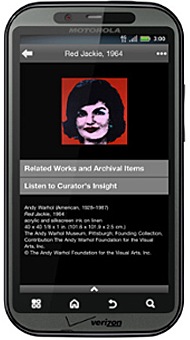
I don’t want to shock anyone, but since my last post, another art museum has released another app. The Warhol: Art is a production of the Andy Warhol Museum and Toura, and perhaps the sarcasm was unwarranted. It shouldn’t come as a surprise to anyone that a museum dedicated to such an influential part of pop culture stays on top of the latest pop culture mediums. Andy is a Carnegie Mellon University alum, so I plopped down my three bucks on the Droid Market for this application (available on the Droid, iPhone, or iPad) and proceeded to check it out. This is the Andy Warhol Museum’s third app, and The Warhol: Art is focused on informing the users about the life and art of Andy Warhol, as well as helpful information about the museum itself. The app is useful for those who would like obscure information about Andy’s life (such as his Carpatho-Rusyn heritage) at a moments notice, and great for art history buffs. The Warhol: Art is described as a “behind-the-scenes glimpse” at some of the Warhol’s works of art, especially pieces which are lesser known. Users can explore the life and times of Andy Warhol through sections divided by years in his life. Each section comes with a selection of related art works that he created during the time period. There's a neat "Favorites" function that allows users to star the pieces they like best from these sections. The starred items list can be accessed easily from the first screen of the app, allowing users to check out their favorite pieces quickly. A few select pieces have curator commentary buttons, which I really enjoyed. The Warhol: Art commentary buttons, however, do not actually appear on the pieces that they describe. For example, while viewing Mao, 1972, I clicked on “Curator’s Insight”, only to hear a curator discussing Warhol’s Hammer and Sickle series.
Yes, I see and understand how those pieces are related. Yes, I enjoyed the commentary on the piece because I am a huge art nerd. Practically speaking, however, were I a museum patron standing in front of Mao, 1972, hoping to hear more about it, I would be disappointed and perhaps upset to receive commentary on a completely different piece.

I believe mobile applications are quickly becoming a new way to encourage museum patrons to interact with the art, and I applaud the Warhol for encouraging this effort. The Warhol: Art is an informative app chock full of information and great art, including many lesser known and not on display pieces. However, I found some features tedious (see above), while others just did not work (none of the videos would play for me, and I could not zoom in on any of the works – this is could be due to user error).

Overall, this app is great for those who’d like to learn more about Andy Warhol in an informal setting. The Andy Warhol Museum certainly is not alone is releasing an app for art history fanatics, which begs the question: is the next wave of art history coming through our smart phones? Is this the future of education? What do you think?

A Collaborative Affair: When Art Meets Business

One doesn’t often find commonalities between the world of art and luxury automobile technology. While it is common for businesses in different industries to create partnerships, joint ventures, or mergers, the idea of collaboration between businesses and art organizations was often dismissed on the grounds of artistic and monetary differences. But in a world of ever increasing  intersections and interconnections, this notion is fast becoming obsolete and arts organizations are no longer insular entities that are oblivious to their formidable counterparts in the business world. The mutual desire for collaboration between the art and the business world is becoming stronger because one can provide business acumen and technical expertise while the other can leverage its strengths in creative thinking and critical analysis. Hence, when the world of art opens the doors of collaboration to different industries, the results can be unexpected, intriguing, and just plain extraordinary.

A museum that is clearly benefiting from strategic partnerships with companies in the world of business and technology is the Guggenheim. It made headlines in 2010 when it collaborated with YouTube, Intel, and Hewlett-Packard to create A Biennial of Creative Video. Essentially an homage to the world of online video, the biennial enabled Guggenheim to showcase extraordinary videos created by ordinary people in the YouTube community.

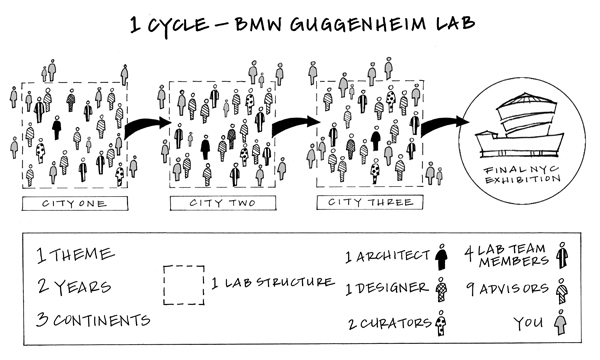
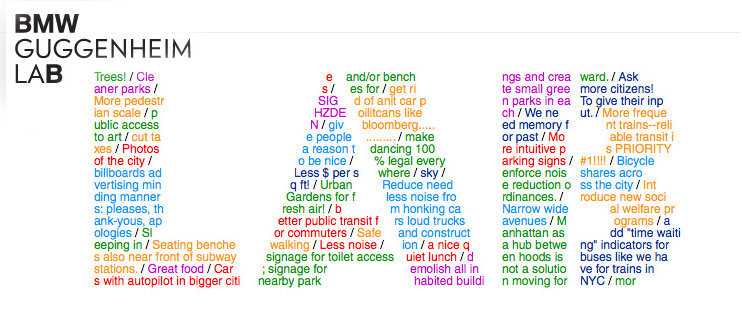
A year has passed but the Guggenheim is not one to take an innovation vacation, it has recently partnered with BMW to create the BMW Guggenheim Lab. The lab’s name may lack inspiration but the crux of its efforts will most certainly revolve around the axis of innovation. In fact, the lab is “a mobile laboratory travelling around the world to inspire innovative ideas for urban life.”

Over a period of six years, a team of interdisciplinary vanguards “in the areas of urbanism, architecture, art, design, science, technology, education, and sustainability” will travel to a total of nine cities in an effort to resolve the issues surrounding urban life. The lab will center around a specific theme for each two year cycle, the first of which is Confronting Comfort. The journey has already begun in New York City, where the lab has been hosting a series of free programs and experiments designed to help the public not only confront but also improve comfort in the quintessential metropolis. Next it will travel to Berlin and finally, Mumbai, concluding the first two year cycle with an exhibition at the Guggenheim in 2013.

If you do not happen to live in a sprawling metropolis, you can still play Urbanology; an online game that helps you ideate your dream city after asking you a series of questions that will gauge your societal, moral, and sustainable compass. You can also follow all the events on their blog and read intriguing posts such as “ten tips on using your city as an engine for joy” or “your brain on commuting.”

Apart from the games and interesting events, let’s hope the initiative’s denouement will result in change, both inside and outside the realm of the Guggenheim, because we all know that the power to act on issues that arise in metropolises, such as those of transportation or pollution levels, rests primarily in the hands of the government.

Doubts aside, the Guggenheim BMW lab certainly is a novel and unique project that exemplifies the synergies that arise when two unlikely organizations team up. Earlier this year, an article in the Economist argued that businesses have much to learn from the world of art and the opposite is no less true, the possibilities for mutually beneficial relationships are endless. As for the many arts organizations and corporate businesses that regard each with an air of mere acquaintanceship, it’s time they sat down to have a cup of tea.


Not Your Grandmother’s Arts Directory

Take a look at a current report on the state of your local creative economy. The research presented will without a doubt emphasize the power of leveraging yellow pagesthe arts on a community’s economy. Knowing this, how do we make intelligent use of the services creative individuals and organizations offer and ensure they are not wasted? How can we best connect an artist with an opportunity, the arts with our community? How do we maximize the abundance of creative talent available? Step one of one: free and easy-to-use online directories, cultural marketplaces, creative economy databases, and yup, you guessed it, social media. Utilizing online directories, artists can expand their networks virtually to an audience within and beyond the physical boundaries of their local community. Community members and those searching for creative talent can be easily connected to a musician, visual artist, performer or arts organization. Below is a sampling of online directories and registries developed to promote the arts, build networks, and create meaningful connections between artists and arts patrons.

  • Pittsburgh Artist Registry: Free to join and use, the Pittsburgh Artist Registry features multidisciplinary, Pittsburgh artists and organizations. Though the registry includes only artists and organizations native to Pittsburgh, its reach is far greater, exposing artists to curators, businesses, developers and organizations worldwide.
  • Matchbook.org: New England’s cultural marketplace with the end goal to ‘MATCH artists with the presenters that BOOK them.’ Get it?! A platform for a creative exchange of sorts, Matchbook.org has a user-friendly interface and a growing directory cataloging New England’s performing and visual artists, organizations, and creative venues. Those doing the booking can restrict their search using such criteria as art discipline, price range, and audience type.
  •  2 Degrees Portland: Moving to Portland, Maine? Relocating a creative business? Are you an artist, inventor, performer, designer? Need help securing a place? Want more information about school districts, studio availability, or local arts grants? 2 Degrees Portland, an initiative of Creative Portland, was designed to connect creators that are soon-to-be-Portland-residents with the people they need and want to know. 2 Degrees Portland utilizes Facebook and online surveying to connect and welcome new creative residents to the city. Without a doubt, a better “Welcome to the Neighborhood” gesture than a fruitcake.
  • Brooklyn Arts Council Registry of Brooklyn Artists: This expansive registry organizes Brooklyn artists across disciplines, providing both artists and consumers of the arts access to unique opportunities. For artists, registering for a listing includes membership to the online discussion community and access to the bi-weekly newsletter. For community members, educators, curators, collectors, city officials, and the general public, we can search, discover, book, hire, and love that Brooklyn talent. Additionally, users can search the Brooklyn Arts Council Directory of Organizations for a listing of Brooklyn based arts organizations (galleries, presenting institutions, performing arts schools, historical societies, etc.).
  • ArtsConnection Engine: A free service of IndianaArts.org, ArtsConnection Engine (ACE) is Indiana’s cultural portal connecting artists, businesses, arts organization, and arts patrons. The site allows a user to search by artist, organization, classified listing, or event. Each category is then divided by sub-categories, for a more refined and exact search.
  •  Americans for the Arts, Arts Services Directory: A national directory for use by both artists and patrons of the arts. Unlike local directories that match artists with those looking to be connected with their talent or service, Americans for the Arts provides a comprehensive listing of companies, organizations and resources to advance a community’s cultural and creative economy. The directory offers a range of search options, such as Program Area (i.e. cultural tourism or grantmaking) and Organization Type (Consulting or Regional Arts Agency) to facilitate your search.

From Portland, Maine to Pittsburgh, Pennsylvania and beyond, cities and towns are brimming with creative individuals and organizations that enrich our day-to-day lives, strengthen our economies, and revitalize our communities. Resources such as online directories and creative marketplaces provide a platform for artists and communities to connect- a mutually advantageous opportunity.

Plus, searching an online directory is nowhere near as cumbersome as flipping through the yellow pages, a la Grandma. And that’s the beauty of the intersection of technology and the arts.

How do you identify and connect with the artists in your community? How might technology better serve this connection?

Can the arts successfully have a game dynamic?

Play button A game dynamic simply put is an element of a game:  levels of achievement or rewards, economic systems to exchanging rewards or credits, cooperative and/or competitive aspects, design layers that change dynamics from one episode to another, and even a series of collectibles can be represented as game dynamic. Game dynamics have recently contributed towards solving medical mysteries, namely the gene folding break-through made on the fold.it puzzle game online.

Now this remarkable game is being put to use to solve the gene folding challenges of Parkinson’s disease among others.  Additionally, there have been arguments that game dynamics are what make sports sectors of the economy flourish.  Sports use a game dynamic that creates cooperation through competition. It is easy to see the potential between game dynamics and the arts but adoption of this idea has yet to garner a widespread support. Check out the previous blog: Planning for Engagement for how cell phone voting is being used at the Indianapolis Symphony Orchestra.  As another example, The AWARD show at the Joyce SoHo presents a level of competition driven by reward - in this case cash prizes for the winners of  voting contests.Some artists have ventured, guns blazing, into game dynamics; the show Best Before by Rimini Protokoll, for instance: “Pulls the multi-player video game out of the virtual realm and rewires it for an intimate theatre setting.”

The answer to the original question posed “Can the arts have a game dynamic successfully?”  is yes. Few creative artists or institutions choose to engage audiences through game dynamics whole-heartedly.  Through utilizing game dynamics, the arts world can overcome certain aesthetic hurdles and adopt  game dynamics for its potential for growth. The result could have an immense impact.

The tools to create these dynamics in the performing and visual arts are available at both high and low technologies, and can be relatively inexpensive. Cell phone voting systems can be purchased from vendors for under $100. At a small scale, usage of http://www.scvngr.com/ allows for a geographic based scavenger hunt and is relatively cost effective. Immediate interaction with audiences can be had by using audience response systems, which are shown to increase attentiveness in schools.

There are rewards at certain institutions for arts patrons who commit to a level of involvement.  There is the relatively common backstage pass, open rehearsal, or meet the artist offerings for subscribers or high-level donors, but these rewards carry with them seemingly little appeal to younger audiences in general. (Of course this is with exceptions.)  In the philanthropic world, voting contests abound to great success. In the coming months I will be using this blog to explore technological tools for implementing game layers in a variety of different ways.  I look forward to the conversations that I hope to have with everyone on this topic!

The Future of Net Neutrality and What it Means for the Arts Community

Of all the public policy issues relating to the intersection of arts and technology, arguably none is more important and vital to our continued freedom and success than net neutrality. A slew of recent changes and lawsuits have the potential to fundamentally change the way we use the internet, and the arts community stands to be greatly impacted. The idea behind net neutrality is simple: keeping the internet open and treating all data equally. The word “neutrality” means strictly that: whether you are searching for information on Google, streaming video on Netflix or using social networking tools, all of those data “packets” are treated equally and allowed to proceed at the same speed. This is the very idea of the “open internet” that so many in the arts community advocate and support, and it has helped foster innovation and evolution in many different fields, including the arts.

Many of the projects we have highlighted here on the blog in the past week, including art.sy, the Google Art Project and the Tate Trumps iPhone app, are made possible in part because of the freedom that net neutrality provides. Whether it’s an artist finding new outlets for their creativity, using the internet to connect buyers and sellers, or arts organizations using social media to find new fans, the increasing merger between the arts and technology communities is absolutely dependent on the idea that the internet should be free, open and neutral. Doing away with the concept, or diminishing that freedom, would have a severe negative impact on the arts community.

Thankfully, some recent changes have been put into place to strengthen net neutrality. Recent regulations approved by the Federal Communications Commission (FCC) are set to take effect November 20, 2011. These regulations include prohibiting broadband providers from blocking lawful web traffic, requiring a greater deal of transparency from broadband providers regarding their network practices, and, most importantly, requiring that broadband providers not discriminate in transmitting lawful network traffic over consumers’ internet service. You can read more about the new regulations on the FCC’s openinternet.gov website.

While the regulations are not perfect, and do not go as far as many open internet advocates would have liked (for example, there is still some ambiguity regarding the regulations surrounding wireless networks, which the FCC claims is a newer technology and requires more time to appropriately measure how much regulation is required), they are a welcome step in the right direction.

Before we get to November 20 however, several lawsuits have been filed in the past few months, seeking to block these regulations. And to no one’s surprise, it has been the telecommunications companies that have sought to block the regulations from being put into place, while at the same time claiming that they are the true parties interested in keeping the internet “open.”

The most recent lawsuit comes from Verizon, one of the largest telecommunications companies in the country, who are claiming that while they are committed to an open and secure internet, they object to what they call “sweeping” regulations that apply to the entire telecommunications industry. This is not the first time Verizon has filed suit against the new regulations; they also sought to remove the new regulations earlier this year, but the case was thrown out in April because the regulations were not published in the Federal Register until this past August.

The lawsuit is pending, and whatever decision is reached by the courts will have a lasting impact on the future of internet freedom. Even if the FCC and open internet advocates prevail, the fight by the telecom companies against the new regulations will surely continue, as they seek to continue their years-long crusade against the open internet and restrict whatever types of internet data they see fit.

We here at Technology for the Arts have long advocated for net neutrality and communicated why we feel the issue is of vital importance, and as the fight over the open internet heats up, it’s important that when we talk about issues of arts advocacy and what issues are at the top of our agenda, that we include net neutrality. While the recent regulations approved by the FCC are a welcome step forward, there is a still a lot of work to be done to make sure that the future of the internet remains open and neutral. You can find out more about net neutrality at openinternet.gov, and we encourage you to share the information with others in the arts community.

The arts community has long benefitted from net neutrality, and the continued innovation we have seen in recent years is dependent on it staying that way.

(Photo: CC by markrabo)

Playing with Art: Tate Trumps iPhone App

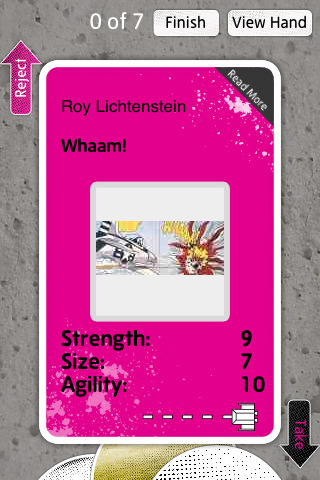
Screenshot of Tate TrumpsIt’s no secret that there are apps for everything and art museums are no exception. The Mattress Factory lets you ask is this art and subsequently allows you to answer that question. The Andy Warhol Museum lets you put yourself into a painting with their D.I.Y. POP app. The Tate Modern has Tate Trumps to let you battle your friends with works of art. Yes, that’s right. Released in June of 2010, Tate Trumps is an application designed to increase viewer interaction with the works within the Tate Modern with a “bloody fight to the death”. Unlike the aforementioned apps, which allow users to interact with art anywhere, Tate Trumps only works within the confines of the Tate Modern.

Described as a “digital card game”, Tate Trumps is a free iPhone app for up to three players, which encourages users to travel the museum and collect points by looking at works of art. Players collect seven works of art and no work of art can be collected twice. A game of Tate Trumps has a minimum time requirement of a half hour, though there is no maximum time limit. Users meet up at the end of their adventure and play a game of trumps against each other, using the works of art they’ve accumulated.

Tate Trumps includes three modes. Battle Mode has users judge how useful a work of art would be in a fight, if it were to come to life. Players search for works of art that are exhilarating, menacing, or absurd in Mood Mode. The final mode, Collector, is for players that “wish they had a gallery of their own”, as they search for pieces that are famous, recently produced, or practical to house.

The viral video for Tate Trumps promises that “galleries will never be the same again”, which incites the question, do galleries need to change? Tate Trumps is a fun, light-hearted way to look at art with the intention of increasing viewer interactivity with the pieces. Does it accomplish this, or is this application trivializing the experience of the museum?

There aren’t any easy answers, and there may not be a right answer. I feel that Tate Trumps has strong potential to accomplish its goal of connecting the viewer with the works. The time limit and inability to repeat pieces in a game means that in a full game, players will spend at least a half hour looking at a minimum of twenty-one works of art. The different modes force the player into critically analyzing the works of art, on multiple levels. The idea of this application may not be appropriate for every museum setting, but could it work for you? Would you play an app game in an art museum?

(Photo: Screenshot from Tate Trumps)

Leveraging the Virtual and the Real

The art world is experiencing a virtual boom. A boom that began with the advent of the street view technology used by Google, which has now forayed into the world of art. Within the last two years, the Google Art Project has photographed, digitized, scaled, and organized some of the most famous artworks in renowned galleries and museums such as the Tate, the Uffizi Gallery, and the Palace of Versailles. Moreover, this digitization of famous artworks is not any mere reproduction; rather it is a reproduction of the grandest or perhaps the smallest of scales: gigapixel images.

Photograph by Amantini Stefano/4Corners Images

This technology has revolutionized the way we interact with art even though it can in no way be deemed an equal alternative to the real experience. The digitization of museums and galleries has captured their tangible and physical aspects, but not their essence. A visit to the Palace of Versailles will never compare to visiting a website. So the question begs to be asked whether this virtual experience guides, develops, and enhances our real experience. Does the virtual help the real? And what can arts organizations gain from this insight?

Detail from Sandro Botticelli’s Birth of Venus (from the Uffizi Gallery, Florence)

A visitor recently set off an alarm, a really loud alarm, in a museum in Basel when she got too close to an artwork. This encounter illustrates how a public viewing experience within the confines of a gallery or a museum can act as a barrier. More often than not, we are afraid to get too close to painting, even though we want to (with the exception of the aforementioned visitor, of course). We also feel the need to constantly move from one painting to the next until we reach a point of complete and utter visual saturation, perhaps even visual exhaustion.

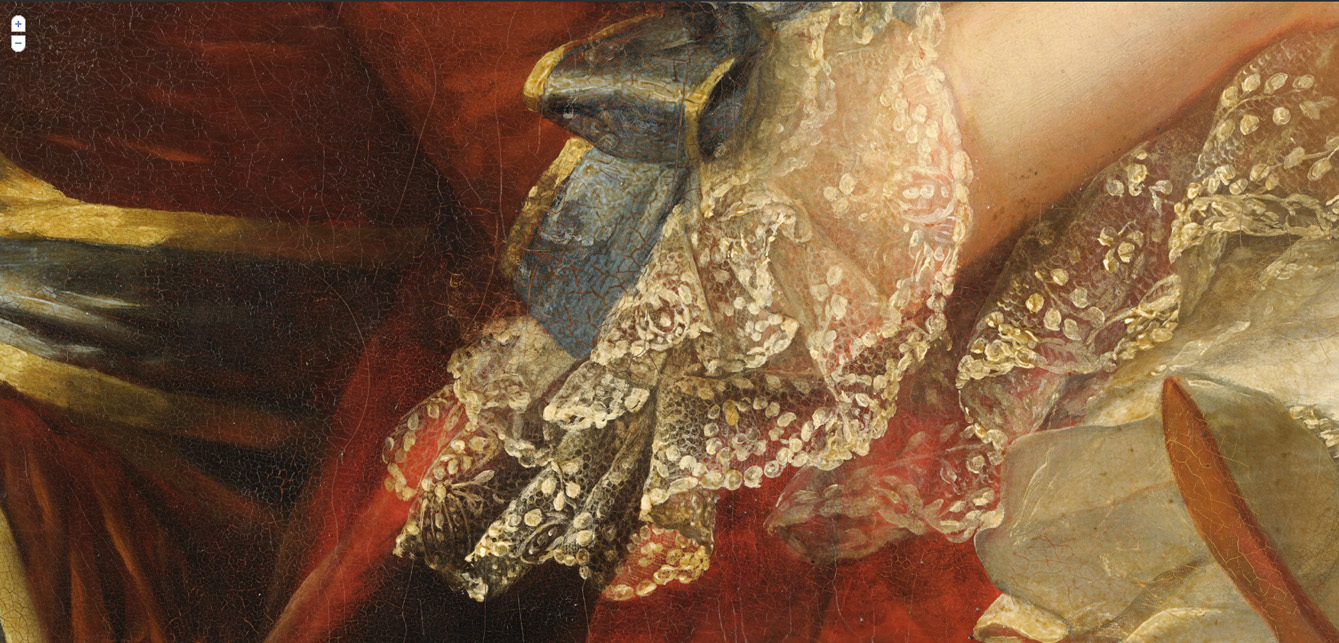
In the virtual confines of the Google Art Project, we can get eerily yet brilliantly close to our favorite artworks on our very own laptops. We can see details that could not have been physically possible under any circumstances in a museum setting. We can also pause for as long we please and we can leave and return as we please. On a whole, a virtual art world as powerful as that of the Google Art Project enriches and builds upon our real experiences.


Detail from Louise Elisabeth Vigée-Lebrun’s Marie-Antoinette de Lorraine-Habsbourg, Queen of France, and her children (from the Palace of Versailles)

Yet, however exquisite and detailed the world of the Google Art Project may be, unlike the masterpieces it virtually showcases, it cannot boast of having attained perfection. An article in the Daily Beast highlights the fact that while the Google Art Project has enabled us to view artworks in a manner that is unprecedented, it is not clear whether we are seeing better.

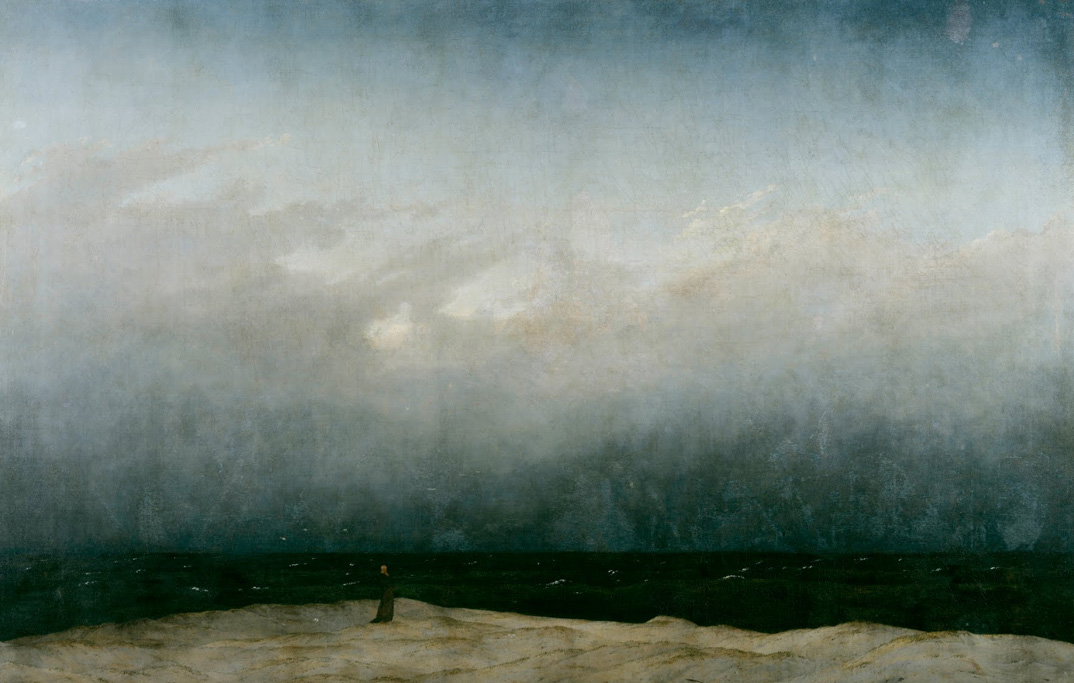
In the same vein of thought, the author of a blog post in Freize argues that by bringing us closer to works of a bygone era, such as Caspar David Friedrich’s The Monk by the Sea, the Google Art Project has ignored the dynamism of the art world, where the concept of a masterpiece and the artist genius are constantly evolving. The post also mentions how Google is guilty of not explaining to us why certain artworks were, and still continue to be, worthy of the title of a masterpiece.


The Monk by the Sea, Caspar David Friedrich (from the Alte Nationalgalerie, Berlin)

For arts organizations looking to create a virtual experience, let’s analyze the advantages and the disadvantages. A virtual experience can create a longing and desire for a real, physical experience. The aforementioned article in the Daily Beast provides an interesting insight from the Director of MoMA about virtual outreach: the virtual presence and proliferation of art works housed at the MoMA actually compelled the true lovers of art to seek out the real. Consequently, the MoMA has had a twofold increase in attendance over the last ten years.

Another big advantage is increased accessibility to audiences around the world. But accessibility alone is not adequate and arts organizations should be wary of becoming just another collection of images on the World Wide Web. The aim is to educate people and generate interest, not pander to their aesthetic appetites. A virtual experience that is no different from a collection of images limits the potential of technology as a vehicle for education, discussion, thought, and reflection.  Thus, arts organizations should look further than the potential of the online world as a visual cache because only then will they truly be able to leverage the virtual and the real.