

By: Ananya Gokhale, Taylor Lien, Michael Loguercio, Alejandra Mantilla Diaz, Rui Wang
In Part II, this research moves from market context and prior literature to empirical analysis and actionable strategy. While Part I established the streaming landscape, reviewed existing research on Gen Z and millennials’ consuming behavior, Part II presents findings from the online survey and interviews with industry experts. Synthesizing these primary insights with our secondary literature review, we identify what drives and what undermines the subscriber loyalty among 18–34 age group, and conclude with six recommendations for Roku across its SVOD, FAST, and AVOD platform ecosystem.
Research Questions
We examined the behavior of consumers regarding loyalty in streaming, focusing on the demographics of Gen Z and young Millennials aged between 18 and 34 years old. Our research question that motivated the study was: What factors influence user decisions about subscribing to or canceling streaming services, particularly regarding brand building, pricing structures, and content offerings?
Introduction of Methodologies
Survey
Our survey was designed to capture quantitative insights into adults aged 18 to 34 based in the US and their consumer engagement patterns, streaming habits, and platform preferences. The survey was distributed online via social media and university networks. The instrument, created in Qualtrics, included multiple-choice and open-ended questions that were analyzed to reveal trends in brand building, pricing sensitivity, and premium content.
Interviews
To complement the survey data, we conducted interviews with industry experts from diverse professional backgrounds, including research and analytics, distribution and marketplace insights, as well as content development and programming. These experts provided insights into topics such as platform strategy, content acquisition, and the evolving dynamics of consumer behavior.
Secondary Research
Our study also included a range of secondary sources, including published reports, academic articles, and industry commentaries. These sources provided contextual background on generational streaming habits, pricing flexibility, and bundling.
Limitations of the Study
This study faced several important constraints. The sampling methodology for the survey, which relied on online distribution through social media and university networks, introduced potential bias and may not fully capture the broader 18-34 demographic. The time-bound nature of the secondary sources means that findings may become less relevant as streaming technology and consumer preferences evolve. However, the study's mixed-methods approach, incorporating surveys, expert interviews, and secondary research, helps mitigate these limitations and provides a more comprehensive understanding of the research questions.
Survey Process and Results
We conducted an online survey to research the habits and preferences related to the user experience of AVOD, SVOD, and FAST services. The survey, open from January 22, 2025, to February 22, 2025, targeted participants aged 18 to 34 who are current users of a streaming service and reside in the United States. Anyone who was under the age of 18, not a current subscriber, or not living in the United States was filtered out of the results. Our survey had a total of 212 respondents. Of these respondents, 65% were female and 31% were male, with 4% falling under other or prefer not to specify.
60% of respondents cited television as their primary platform for watching streaming content. Respondents subscribed to Netflix in the highest numbers, with Amazon Prime Video, Disney+, and Hulu following in second, third, and fourth place, respectively. The distribution was relatively even between those who canceled a subscription in the last five months and those who did not cancel during that period. This suggests a higher level of consumer loyalty than previously believed.
Our results also suggested lower price sensitivity than anticipated; further research may clarify whether this reflects proper elasticity or is influenced by factors such as password sharing. Concerning the price for a single service, 22% of our respondents indicated they would be willing to pay between $11 and $15 per month, as seen in Figure 1 below.
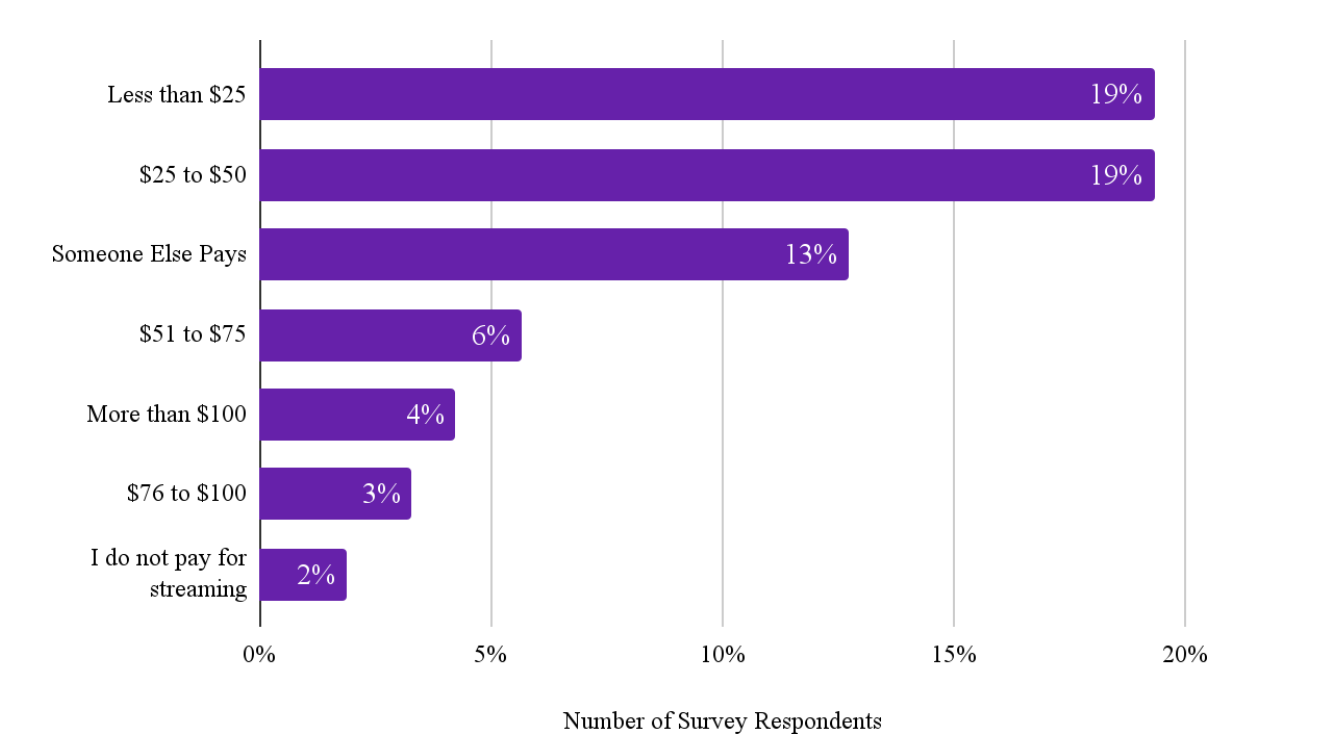
Figure 1: Aggregate Streaming Budgets. Source: Figure reflects survey data based on question about monthly aggregate streaming budgets.
As pictured above, less than $25 and between $25 and $50 a month were the most popular responses for an aggregate streaming budget, suggesting that there is less consideration for the price of an individual service, and more price sensitivity to streaming budgets overall.
According to our survey, the primary deciding factor for subscribing to a streaming service was a specific show or title with 82% of respondents indicating this preference. Once they subscribe to those services, they are often unlikely to cancel, with 95% of respondents stating they maintained at least one subscription in the long term, which we defined as longer than five months.
When asked what caused respondents to remain subscribed, many cited the content library in addition to new releases. One respondent stated, “Mostly the vast libraries of content that I know I enjoy, some are better than others at this, but most have enough that I can watch whatever I want.” This was a common theme amongst survey respondents. These results align with current understandings of consumer behavior and usage patterns of streaming services. These observations form the foundation for our recommendations on how our stakeholders and the industry can inspire consumer loyalty among individuals ages 18 to 34.
Interviews
We interviewed several industry executives from Apple TV+, Disney Entertainment Television, Hulu, Cineverse, and Lionsgate to get their perspective on entertainment streaming. This section synthesizes their insights on three core tensions: the premium content paradox, brand identity in a saturated market, and price sensitivity coupled with strategic bundling.
The Premium Content Paradox
Today’s competitive streaming market presents platforms with a clear challenge: how to attract new subscribers with compelling content while retaining existing ones over time. Success relies on balancing immediate appeal with sustained engagement. Max Aronson, a development executive at Apple TV+, explained their strategy of prioritizing universally relatable stories over trends: "Severance works because hating your job transcends generations – it’s visceral, not algorithmic" (M. Aronson, personal communication, February 1, 2025). While Apple TV+ focuses almost exclusively on original shows with a small library, most streamers in this increasingly saturated landscape require robust content libraries to address persistent retention challenges tied to content lifecycles, market saturation, and evolving viewer habits (Parrot Analytics, n.d.).
In response, platforms acknowledge that churning and then resubscribing with television release patterns is natural consumer behavior. Disney’s Stephanie DiVito contextualized this, “We’re not fighting churn anymore. We’re managing cycling– optimizing how often subscribers swing back to us between tentpole releases" (S. DiVito, personal communication, February 15, 2025). DiVito reframes subscription churn as "cycling," meaning subscribers aren't permanently lost; they're temporarily disengaged but likely to return when presented with a compelling reason, such as a major content release (S. DiVito, personal communication, February 15, 2025).
Shifting viewer habits are reshaping how streaming platforms define premium content. Platforms now evaluate content across a broader digital ecosystem encompassing subscription video-on-demand (SVOD), user-generated content (UGC), social media, gaming, music, and podcasts (Deloitte Center for Technology, Media & Telecommunications, 2025). DiVito acknowledges the transition amid competition from TikTok and YouTube, "Quality is in the eye of the beholder... Grey’s Anatomy and a creator’s TikTok series now occupy equal mental real estate" (S. Divito, personal communication, February 15, 2025). This shift broadens the scope of premium content to encompass works that drive engagement, spark cultural relevance, or build audience resonance – moving beyond traditional markers like high budgets or A-list talent to prioritize raw cultural impact.
Live programming exemplifies this shift of premium content. Platforms increasingly use live events to create urgency, cultural immediacy, and shared viewing experiences. Platforms include more live events like sports, award shows, or influencer streams not just as ephemeral spectacles, but as premium experiences that command attention in an oversaturated market. For example, Netflix’s live Jake Paul vs. Mike Tyson fight—which drove 1.4 million new U.S. subscribers (Meaney, 2025)—demonstrates how live content merges mass appeal with scarcity, transforming fleeting moments into subscriber acquisition engines.
Critically, the impact of these events hinges on pairing them with strategically programmed follow-up content to convert one-time viewers into loyal users. As Lee Hollin, Executive Vice President of TV and Head of Current Programming at Lionsgate, explains: “Events like the Oscars and the Super Bowl turn content into rituals that drive long-term engagement” (L. Hollin, personal communication, March 3, 2025). Here, live programming and on-demand catalogs work hand in hand: the former creates spikes of attention, while the latter makes viewers stay (L. Hollin, personal communication, March 3, 2025). For instance, Netflix’s Tyson-Paul fight viewers receive recommendations for Cobra Kai, turning event-driven curiosity into habitual viewing.
Brand Identity in a Saturated Market
As the entertainment industry evolves, streaming services face a critical decision - target broad audiences or focus on niche markets. This choice influences content investment, user experience design, and long-term viability. Generalist platforms benefit from economies of scale by appealing to broad audiences with extensive content libraries, like Netflix. However, their vast focus risks diluting brand identity, which research links to higher churn rates than niche competitors (Kadence, 2025). Users may also experience decision paralysis due to overwhelming content choices, necessitating intuitive navigation and curation tools (Index Exchange, 2024). Niche platforms like Shudder (horror-focused) and BritBox (specializing in British TV) strategically curate hyper-specific libraries to leverage genre loyalty and cultural resonance in a saturated market (Brown, n.d.). This targeted approach enables them to sustain churn rates below 2%, outperforming many generalist competitors (Kadence, 2025). Emma Fryd, Senior Manager of Programming at Cineverse,, described the Dove Channel’s strategy, “They don’t want ‘general’ content. They want a safe zone — a Hallmark without surprises. We’re not for everyone, but for our audience, we’re indispensable” (E. Fryd, personal communication, January 29, 2025). However, niche platforms face growth limitations and vulnerability to shifting consumer preferences such as the rise of AI-driven content recommendations (CacheFly, 2024). Ultimately, success hinges on balancing audience reach with distinct value propositions, adapting to evolving viewer expectations in a fragmented digital landscape.
Price Sensitivity and Strategic Bundling
The streaming industry increasingly adopts psychological pricing tactics and strategic bundling to retain subscribers. Many platforms have introduced ad-supported tiers. Disney's DiVito describes the effectiveness of ad tiers, "Ad tiers aren't just cheaper—they're psychological safety nets. Users feel savvy, not poor"
Platforms position pricing tiers as rational consumer choices rather than budget compromises (S. DiVito, personal communication, February 15, 2025).
Bundling strategies extend this approach. Stacy Nagata from Apple TV+ compares contemporary bundling strategies to an evolved iteration of the traditional cable TV model, emphasizing the necessity for more strategic integration to meet modern consumer expectations (S. Nagata, personal communication, March 16, 2025). However, cross-platform bundles such as Disney+, Hulu, and ESPN+ risk diluting brand value, a concern underscored by Elizabeth Tillman, a Hulu marketing executive, who cautions that such bundling is more likely to be a short-term solution as it can reduce the effectiveness of targeted marketing (E. Tillman, personal communication, April 8, 2025).
Some platforms bundle streaming services with lifestyle offerings like fitness apps, cloud storage, and retail partnerships. Yet, these innovations introduce vulnerabilities. Aggregators like Amazon Channels reduce brand loyalty by rendering content interchangeable, a risk underscored by Fryd of Cineverse, “Amazon Channels make cancellation frictionless. If your content isn’t habit-forming, you’re disposable” (E. Fryd, personal communication, January 29, 2025). Platforms combine engaging content with essential lifestyle bundles to counter these risks.
Tillman emphasizes Amazon’s gamified shopping interface, which integrates purchasing features into sports live streams, noting its effectiveness in establishing self-feeding loops (E. Tillman, personal communication, April 8, 2025). Nagata warns that modern bundling must avoid repeating cable TV’s pitfalls like fragmented access (e.g., requiring separate add-ons for sports or movies), confusing pricing (hidden fees, expiring discounts), and bloated packages (bundling unwanted channels) by instead prioritizing clear value through transparent, audience- centric models (S. Nagata, personal communication, March 16, 2025). Together, these strategies underscore the industry’s pivot toward hybrid models that blend entertainment, utility, and personalized experiences to sustain relevance in the market.
Industry insights and survey data pinpoint critical subscriber retention challenges. For Roku, these demands are balancing FAST platform agility with viewer-centric innovation to convert fleeting engagement into sustained loyalty. The following section outlines actionable strategies for Roku’s FAST and broader streaming ecosystems, prioritizing scripted content, personalized experiences, and community-driven features tailored to Gen Z and Millennial audiences.
What the Data Shows: Final Analysis
Our data offers new insights and strengthens industry assumptions. Utilizing this research, we created recommendations for Roku across the SVOD, FAST and AVOD platform landscape.
Brand Building
Our survey results showed that Netflix and Amazon were the two most subscribed to services which mirrors similar consumer surveys (Butts, 2024). The resemblance of our survey to research targeting a broader age demographic indicates that no streaming brand is outperforming among Gen Z and Millennials. Furthermore, our target demographic shows little attachment to media providers based on their legacy brands, referring to Figure 2.
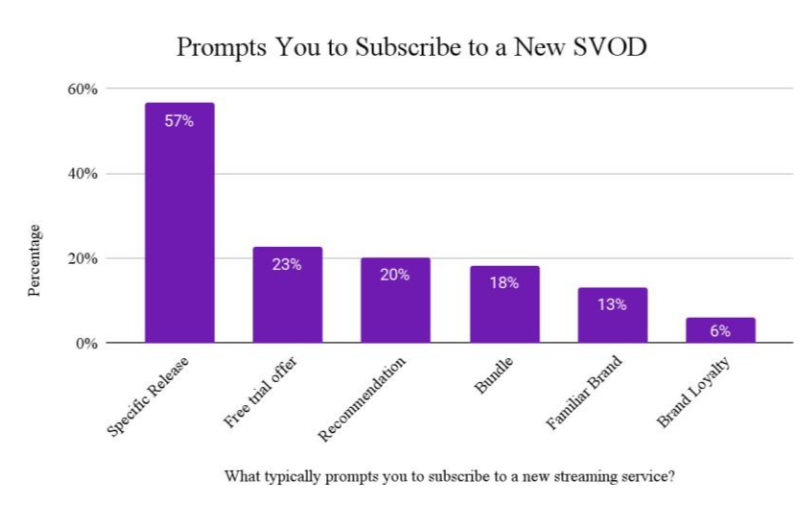
Figure 2: Prompts You to Subscribe to a New SVOD. Source: Data from the author’s survey. Note: This figure illustrates the reasons respondents decided to subscribe to a new SVOD. Each respondent was allowed to select multiple options.
As seen above, only 6% of respondents indicated brand loyalty as a motivating factor. Additionally, just 13% said they subscribed due to brand familiarity. This suggests that major players in the market are not establishing a strong identity that consumers perceive as a quality signal.
Price Sensitivity
Our analysis shows that consumers aged 18-34 are looking for good deals but are motivated to seek out multiple avenues of content. Most respondents use three or more services and are willing to pay $25 or more per month for all their platforms. This suggests that these consumers find value in having access to multiple streaming services and in having many different sources of content. Yet, these consumers are also deal-hunters and are looking to utilize free trials and bundles to increase the platforms they have access to, even if it is only temporary. In essence, the 18-34 consumers are a contradictory demographic; they are willing to spend on content but are tuned into promotions and willing to churn after finishing the title that made them subscribe. Our target demographic is less price sensitive than initially anticipated, but specific deals could highly influence their decision to subscribe.
Premium Content
The survey illuminated that new and library scripted content is the most significant factor in influencing streaming decision-making among people ages 18-34. Overwhelmingly, the reason why people stayed or subscribed to a new service was to watch or rewatch specific content. Yet, while streamers are clamoring to get sports rights, only 7% of respondents said they subscribed to a streaming service for live sports, with 73% saying they subscribed for scripted shows. Therefore, even with streaming platforms evolving into one-stop-shops for a large variety of entertainment, it’s clear that narrative assets that prove to be rewatchable should still serve as the foundation. The importance of scripted entertainment provides an interesting perspective on loyalty when combined with consumer churn behavior. Our respondents were highly likely to unsubscribe after watching a specific show, illustrating that while content is paramount to consumer acquisition, it does not consistently lead to consumer loyalty among Gen Z and Millennials.
Six Recommendations
The following six recommendations were informed by analyzing survey data, industry interviews, and previous secondary research. The survey addressed the challenge of loyalty faced by our client and streaming platforms in today’s media landscape.
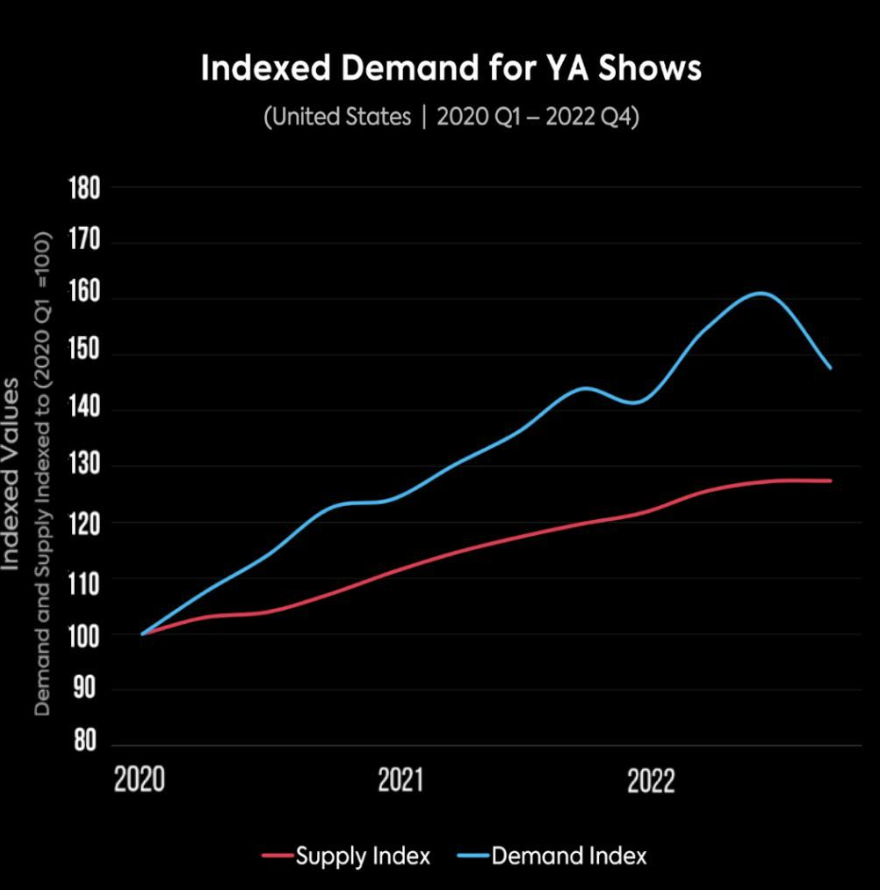
Figure 3: Indexed Demand for YA Shows. Source: Data from the author’s survey. Note: Demand and supply growth for YA Shows. Adapted from “Adult Animation data reveals demand growth far outpacing supply” by Parrot Analytics. (2023, December 6).
Increase the Supply of Young Adult Content
First, we recommend increasing the amount of “YA content” as well as genres popular with this demographic, as it can help increase both subscriptions and retention for this age group. The main factor driving subscriptions is access to a specific piece of content, be that a film or a series. However, the young adult demographic is currently being underserved. As you can see from Figure 3, the gap between demand and supply for this genre has increased considerably since 2020.
As indicated in Figure 3 above, there is a significant gap between the demand and the supply of young adult content, defined here as content aimed at a demographic under 23 years old (Parrot, 2023). Between 2020 and 2022, the demand for young adult content grew by 47%, meanwhile the supply only increased by 29% (Parrot, 2023). For this reason, there is an opportunity to bridge this gap by producing more content for young adults that can motivate subscriptions and feed the different platforms’ content libraries to reduce churn.
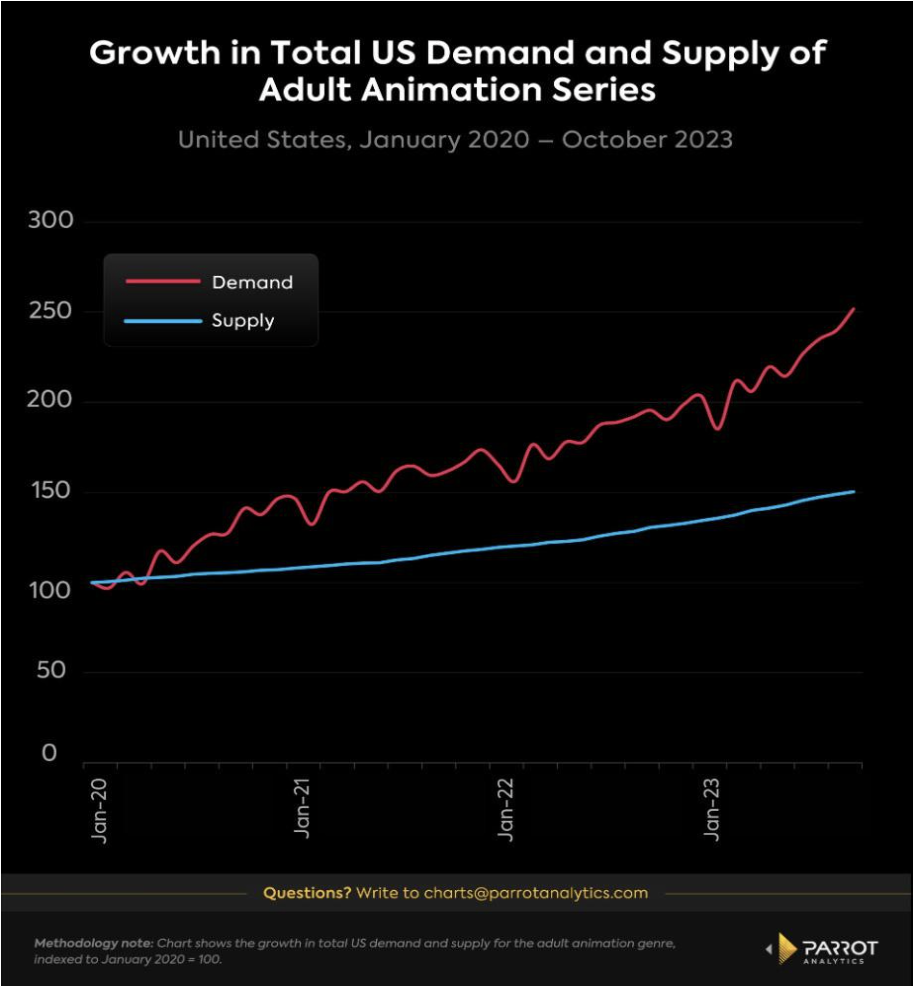
Figure 4: Growth in Total US Demand and Supply of Adult Animation Series. Source: Data from the author’s survey. Note: Demand and supply growth for the Adult Animation genre. Adapted from “Why young adult programming is key to the future of streaming platforms in the US” by Parrot Analytics. (2023, February 28).
We propose focusing on genres that are popular amongst the Gen Z demographic, such as Comedy, Animation, Romance, and Thriller. Animation is especially noteworthy, as Gen Z significantly over-indexes in the genre’s audience share for movies (Parrot, 2024). As seen in Figure 4, this trend is further reflected in the demand for adult animation, which has grown by a whopping 151.6% between 2020 and 2023. This demand is not being met, which creates market inefficiency (Parrot, 2023).
As Figure 4 indicates, bridging the gap between demand and supply for genres that are popular amongst the Gen Z audience is essential for both attracting and retaining this audience.
Emphasize Live Programming
Secondly, we recommend implementing a scrolling calendar guide that will inform users of upcoming live events such as concerts or awards shows in the form of a timeline along the top of their home page.
As previously mentioned in our interview with Lee Hollin from Lionsgate, live content creates habitual activity amongst audiences and, therefore, has become increasingly important for retention. Roku is very aware of this, as they have already emphasized its importance with the addition of a Live TV channel and their Sports Now Zone (Roku, n.d.). Yet, despite live content’s significance, our survey results showed that live events and sports ranked low among features worth a premium price. Preferred by 23% of respondents, live events ranked fourth after no ads, offline downloads, and quality content. As a result, it is imperative Roku highlights specific live programming that will resonate with this age demographic and, ultimately, attract their attention, building those habits and keeping them on the platform longer. With the addition of a live programming guide, highlighting content such as Coachella main stage performances, The Oscars Live, or the iHeartRadio Music Awards Live, this will bring content to a user’s attention much faster, making them less likely to get frustrated and switch off the TV.
Reduce Decision Paralysis
Expanding AI investment to create innovative, personalized streaming experiences, such as custom linear programming, can reduce the stress of finding and navigating content. This, in turn, improves user experience and fosters brand affinity. With the amount of content growing yearly, navigating decision-making on streaming platforms has become increasingly complex. According to Nielsen, 20% of people report switching to a different activity after being unable to decide on a show to watch (Nielsen, 2023). This issue of decision paralysis affects not only the time users spend on the platform but also their overall experience.
Taking inspiration from Spotify, streaming platforms could use AI to curate content programming, similar to Spotify’s AI DJ. Imagine visiting your favorite streaming service and instead of spending countless minutes scrolling through titles, you discover a 24/7 programming tailor-made for you. A tool like this can help streamline decision-making by creating a continuous flow of content, freeing users from having to decide what to watch when they access the platform and after each episode or film. Personalization has become an expectation in digital experiences, especially among Gen Z and Millennial demographics (Singer, 2024). Therefore, returning to the simplicity of linear programming, but in a personalized format, could help overcome some current hurdles of the streaming experience.
In addition to personalized channels, AI could use gamification to enhance recommendations. Roku can implement a gamified polling system to improve its show recommendations for users. HBO Max already uses a “Buzzfeed” like poll to provide targeted show suggestions based on selections, where choosing a favorite character can lead to a specific recommendation (Eco Consultancy, 2022). Roku can implement a comparable questionnaire, making the user experience more interactive and distinctive from other platforms. As Ciara Byrne mentions in her research article about enhancing customer engagement, Buzzfeed and similar social media quizzes work so well due to their innate combination of two elements: shareability and popular topics of discussion (Byrne, 2023). This encourages people to want to participate, naturally urging them to spend more time on a webpage and, in turn, increasing retention.
Remodel the Interface
While Roku already has a user-friendly interface, we recommend taking this one step further by implementing scripted show notifications. In today’s media landscape, the lack of ease of use is a significant deterrent to consumers. In fact, based on Deloitte's 2024 Digital Media Trends Report, which collected a total of 3,517 online surveys from both Gen Z and Millennial audiences, 50% reported that they spent too much time simply looking for content to watch (Widener et al., 2024). This is a blatant ease of access problem but also gives room for opportunity.
While Roku did have a similar feature, known as the “My Feed” page, where users could see the latest episodes of their favorite TV shows, this attribute was removed with their 2022 operating system update (Newman, 2024). It was replaced with a less sophisticated “Save List,” which removed the alert system altogether and placed the responsibility of searching for new content in the user’s hands (Newman, 2024). Additionally, when it did exist on the platform, the “My Feed” feature was entirely ignored by many audiences, leading to an underwhelming user uptake (Pot, 2017).
By creating a simple notification programmed to appear on the Roku platform at any time while in use, audiences will be alerted to any new episodes of their favorite scripted shows, with the options to either watch the episode now or save it to a personalized linear channel to watch at a later time, as stated in our previous recommendation.
Build Community
The personalization of the platform experience, which allows users to create custom profiles and follow influencers, is also an essential consideration for Roku. In a study conducted by marketing firm InMobi, 61% of Gen Z preferred user-generated content (UGC) over streaming content. TV came in last, with music/podcasts and gaming, respectively, behind UGC (Grothaus, 2023). To retain their attention, it is crucial that Roku meets Gen Z where they are, by formatting platforms to mimic social media. By providing viewers with a scrolling feature, the ability to view preview clips of shows, a screenshot tool to repost their favorite television moments to their personalized Roku account, and a customizable avatar with their name and bio, users can begin building their own like-minded communities on the platform, similar to that of TikTok or Instagram, keeping them engaged and coming back for more conversations.
Another benefit of including a social media dynamic on streaming is leveraging the credibility of influencers to improve content recommendations. A majority of Gen Z and Millennials report receiving better recommendations from social media than from streaming ads (Deloitte, 2025). Likewise, 59% of Gen Z consumers say they watch a show after seeing it recommended on social media (Deloitte 2024). By incorporating influencer profiles into streaming platforms, users can follow curators whose taste they trust, thereby improving the reliability and effectiveness of recommendations. We suggest including influencer recommendations directly on the platform to streamline the recommendation process. By creating a dedicated space- similar to a digital video store, influencers can conveniently share their top shows or monthly picks, and users can avoid the extra steps of going to a third-party app like IMDb or Letterboxd. This approach can improve the user experience while building a sense of community.
Data Sharing
Finally, we suggest developing campaigns that provide data to consumers in an engaging and shareable manner. Providing users with insights such as the most-watched genres, favorite actors, and viewer personalities can foster brand affinity by leveraging personalization and tapping into social media’s viral nature to create cultural events centered around the brand.
A prime example is Spotify Wrapped, which has successfully leveraged data collection to connect with younger audiences. These campaigns are effective because they personalize the user experience, giving individuals insights about themselves that they can share with their social circles (Murray, 2023). Moreover, 79% of Americans are at least somewhat concerned about companies’ use of data collected from customers (Brooke Auxier, 2019). Giving users a fun report on their engagement gives them a sense of ownership over their data, shifting the narrative away from concerns regarding data privacy and misuse, and transforming the practice into a positive experience.
Conclusion
In the current streaming landscape, there must be an innovation in how content providers serve their audiences. Having one or two hit titles does not create notoriety for a platform or keep consumers from churning, and thus, streamers need to find unique and personalized ways to create brand identity. Crafting easy-to-navigate user interfaces, implementing more Gen Z specific content, and personalizing the watch experience are just a few ways platforms can establish their brand in the contemporary marketplace. While Gen Z and younger Millennials are thoroughly entrenched in free UGC spaces, our research shows they are still willing to pay for higher-quality content. It is up to platforms to create a new form of brand identity that matches the streaming medium to keep customers subscribed.
-
Adgate, Brad. 2024. “Reducing SVOD Churn Should Be the Next Priority with Media Companies.” Forbes, April 1, 2024. https://www.parksassociates.com/blogs/in-the-news/parks-prime-video-has-lowest-churn-rate.
Apple TV+: Potential for Growth. 2023. Parrot Analytics, November 7, 2023. https://www.parrotanalytics.com/insights/apple-tv-potential-for-growth/.
“Basic vs. Premium Cable.” n.d. Fiveable. Accessed April 6, 2025. https://library.fiveable.me/key-terms/television-studies/basic-vs-premium-cable.
Blake, Sarah. 2024. “The State of Digital Content Piracy in 2024.” CordCutting.com, April 23, 2024. https://cordcutting.com/research/content-piracy-study/.
Auxier, Brooke, and Lee Rainie. 2019. “Americans Concerned, Feel Lack of Control over Personal Data Collected by Both Companies and the Government.” Pew Research Center, November 15, 2019. https://www.pewresearch.org/internet/2019/11/15/americans-concerned-feel-lack-of-control-over-personal-data-collected-by-both-companies-and-the-government/.
“Bundling.” n.d. Fiveable. Accessed April 6, 2025. https://library.fiveable.me/key-terms/television-studies/bundling.
Butts, Tim. 2024. “Parks: Prime Video Has Lowest Churn Rate.” TV Technology, May 30, 2024. https://www.tvtechnology.com/news/parks-prime-video-has-lowest-churn-rate.
Byrne, Claire. n.d. “How Quizzes Boost Your Content: The BuzzFeed Quiz Phenomenon.” Involve.me. Accessed April 6, 2025. https://www.involve.me/blog/how-quizzes-boost-your-content-the-buzzfeed-quiz-phenomenon.
CacheFly. 2024. “Exploring the Opportunities and Challenges of Niche Streaming Services.” July 3, 2024. https://www.cachefly.com/news/exploring-the-opportunities-and-challenges-of-niche-streaming-services/.
Deloitte. 2024. “Social Media and Creators Drive Viewers to TV Shows, Movies, and Games.” Deloitte Insights, November 13, 2024. https://www2.deloitte.com/us/en/insights/industry/technology/digital-media-trends-consumption-habits-survey/2024/online-creators-and-the-impact-of-social-media-on-entertainment.html.
Deloitte. 2025. “2025 Digital Media Trends: Social Platforms Are Becoming a Dominant Force in Media and Entertainment.” Deloitte Insights, March 25, 2025. https://www2.deloitte.com/us/en/insights/industry/technology/digital-media-trends-consumption-habits-survey/2025.html.
Eco Consultancy. 2022. “HBO Max Boosts US Engagement and Viewing with Interactive Fantastic Beasts Campaign.” Accessed April 6, 2025. https://econsultancy.com/case-studies/view/hbomax-boosts-engagement/.
Forrest Brown. n.d. “Criterion Channel Part 1.” Accessed April 6, 2025. https://www.forrestsbrown.com/criterion-channel-part-1.
Grothaus, Michael. 2023. “Older Millennials Prefer Streaming TV, while Gen Z Opts for User-Generated Content.” Fast Company, July 27, 2023. https://www.fastcompany.com/90929341/older-millennials-vs-gen-z-streaming-tv-likes.
Index Exchange. 2024. “Improving Content Discovery in Streaming TV: Plex.” May 22, 2024. https://www.indexexchange.com/2024/05/22/improving-content-discovery-streaming-tv-plex/.
Kadence. 2025. “Top 4 Trends Set to Disrupt the Media Industry in 2025.” Accessed April 6, 2025. https://kadence.com/top-4-trends-set-to-disrupt-the-media-industry-in-2025-2/.
Kelly, Colin. 2024. “Tubi Refreshes Brand to Build on Momentum with Young, Diverse Audiences.” Marketing Dive, February 29, 2024. https://www.marketingdive.com/news/tubi-brand-refresh-avod-streaming-wars/708882.
Meaney, John. 2025. The Impact of Live Event Programming on Streaming Platform Growth. Media Insights Press.
Meaney, Matt. 2025. “Netflix Is Signing Up More People to Watch Its Live Sports, but That’s Only Half the Battle.” Business Insider, February 27, 2025. https://www.businessinsider.com/netflix-live-sports-streams-acquire-millions-subscribers-charts-2025-2.
Murray, Conor. 2023. “Spotify Wrapped 2023 Comes Soon: Here’s How It Became a Viral and Widely Copied Marketing Tactic.” Forbes, November 28, 2023. https://www.forbes.com/sites/conormurray/2023/11/28/spotify-wrapped-2023-comes-soon-heres-how-it-became-a-viral-and-widely-copied-marketing-tactic/.
“Navigating the World of Streaming: Understanding FAST, AVOD, SVOD and TVOD.” n.d. NewscastStudio. Accessed April 6, 2025. https://www.newscaststudio.com/2024/02/29/navigating-the-world-of-streaming-understanding-fast-avod-svod-and-tvod/.
Netflix vs. Everyone with Content Chief Bela Bajaria, Part 1. 2025. Puck, podcast audio, February 13, 2025. https://podcasts.apple.com/us/podcast/netflix-vs-everyone-with-content-chief-bela-bajaria-part-1/id1612131897?i=1000692087173.
Newman, Jared. 2024. “The Brilliant Roku Feature That Time Forgot.” TechHive, January 5, 2024. https://www.techhive.com/article/2192717/the-brilliant-roku-feature-that-time-forgot.html.
Nielsen. 2023. “Data-Driven Personalization: The Future of Streaming Content Discovery.” Nielsen, August 8, 2023. https://www.nielsen.com/insights/2023/data-driven-personalization-2023-state-of-play-report/.
Parrot Analytics. 2023. “Growing Demand for Adult Animation.” December 6, 2023. https://www.parrotanalytics.com/insights/growing-demand-for-adult-animation/.
Parrot Analytics. 2023. “Why Young Adult Programming Is Key to the Future of Streaming Platforms in the US.” February 28, 2023. https://www.parrotanalytics.com/insights/why-young-adult-programming-is-key-to-the-future-of-streaming-platforms-in-the-us/.
Parrot Analytics. 2024. “What Are the Most Loved Movie Genres for Each Generation?” October 6, 2024. https://www.parrotanalytics.com/insights/movie-genre-preferences-each-generation-millennials-genz-genx/.
Parrot Analytics. n.d. “Streamer Strategies for Audience Retention without Prestige Linear Series.” Parrot Analytics Academy. Accessed April 6, 2025. https://www.parrotanalytics.com/academy/streamer-strategies-for-audience-retention-without-prestige-linear-series.
Pattison, Sandra. 2024. “35 Streaming Services Statistics You Need to Know in 2025.” Cloudwards, July 7, 2024. https://www.cloudwards.net/streaming-services-statistics/.
Pew Research Center. 2017. “About 6 in 10 Young Adults in U.S. Primarily Use Online Streaming to Watch TV.” September 13, 2017. https://www.pewresearch.org/short-reads/2017/09/13/about-6-in-10-young-adults-in-u-s-primarily-use-online-streaming-to-watch-tv/.
Pot, Justin. 2017. “How to Use Roku Feed to Keep Up with New Episodes of Your Shows.” How-To Geek, April 14, 2017. https://www.howtogeek.com/300362/how-to-use-roku-feed-to-keep-up-with-new-episodes-of-your-shows/.
Purdy, Suzanne, and Emily Wills. 2023. “Consumers Loyal to Streaming, but at What Price?” KPMG Media Consumer Survey. https://kpmg.com/us/en/articles/2023/consumers-loyal-to-streaming-what-price.html.
Rand, Stephanie. 2024. “Gen Z Media Consumption 2025: Social Media & What’s Next.” Attest, November 15, 2024. https://www.askattest.com/blog/research/gen-z-media-consumption.
Rizzo, Lillian. 2024. “Netflix Ad-Supported Tier Has 70 Million Monthly Users Two Years after Launch.” CNBC, November 12, 2024. https://www.cnbc.com/2024/11/12/netflix-ad-supported-tier-70-million-monthly-users.html.
Roku. n.d. “What Is Roku – How the Roku Experience Works.” Accessed May 1, 2025. https://www.roku.com/what-is-roku.
Singer, Michael. 2024. “Personalizing Growth.” Deloitte Digital, June 11, 2024. https://www.deloittedigital.com/us/en/insights/research/personalizing-growth.html.
“TV & Streaming Video Advertising Glossary.” 2022. AudienceXpress, June 9, 2022. https://audiencexpress.com/insights/blog/premium-video-advertising-glossary/.
Vinikas, Ieva. n.d. “Linear TV: All You Need to Know.” Kaltura. Accessed April 6, 2025. https://corp.kaltura.com/blog/linear-tv-all-you-need-to-know/.
Vorhaus Advisors. 2024. “Canceling Streaming Subscription: Reasons U.S. 2024.” Statista, May 2024. https://www-statista-com.cmu.idm.oclc.org/statistics/1290078/reasons-video-service-subscriptions-cancellation/.
Westcott, Kevin, Chris Arkenberg, Jana Arbanas, and Jeff Loucks. 2024. “Streaming Video at a Crossroads: Redesign Yesterday’s Models or Reinvent for Tomorrow?” Deloitte Insights, March 20, 2024. https://www2.deloitte.com/us/en/insights/industry/technology/digital-media-trends-consumption-habits-survey/2024/customization-and-personalization-lead-the-svod-revolution.html.
Widener, Chris, Jana Arbanas, Doug Van Dyke, Chris Arkenberg, Brandon Matheson, and Brooke Auxier. 2025. “2025 Digital Media Trends: Social Platforms Are Becoming a Dominant Force in Media and Entertainment.” Deloitte Insights, March 25, 2025. https://www2.deloitte.com/us/en/insights/industry/technology/digital-media-trends-consumption-habits-survey/2025.html.
Winslow, George. 2024. “If Bundling Is Back, What’s the Ideal Bundle?” TV Technology, May 17, 2024. https://www.tvtechnology.com/news/if-bundling-is-back-whats-the-ideal-bundle.