
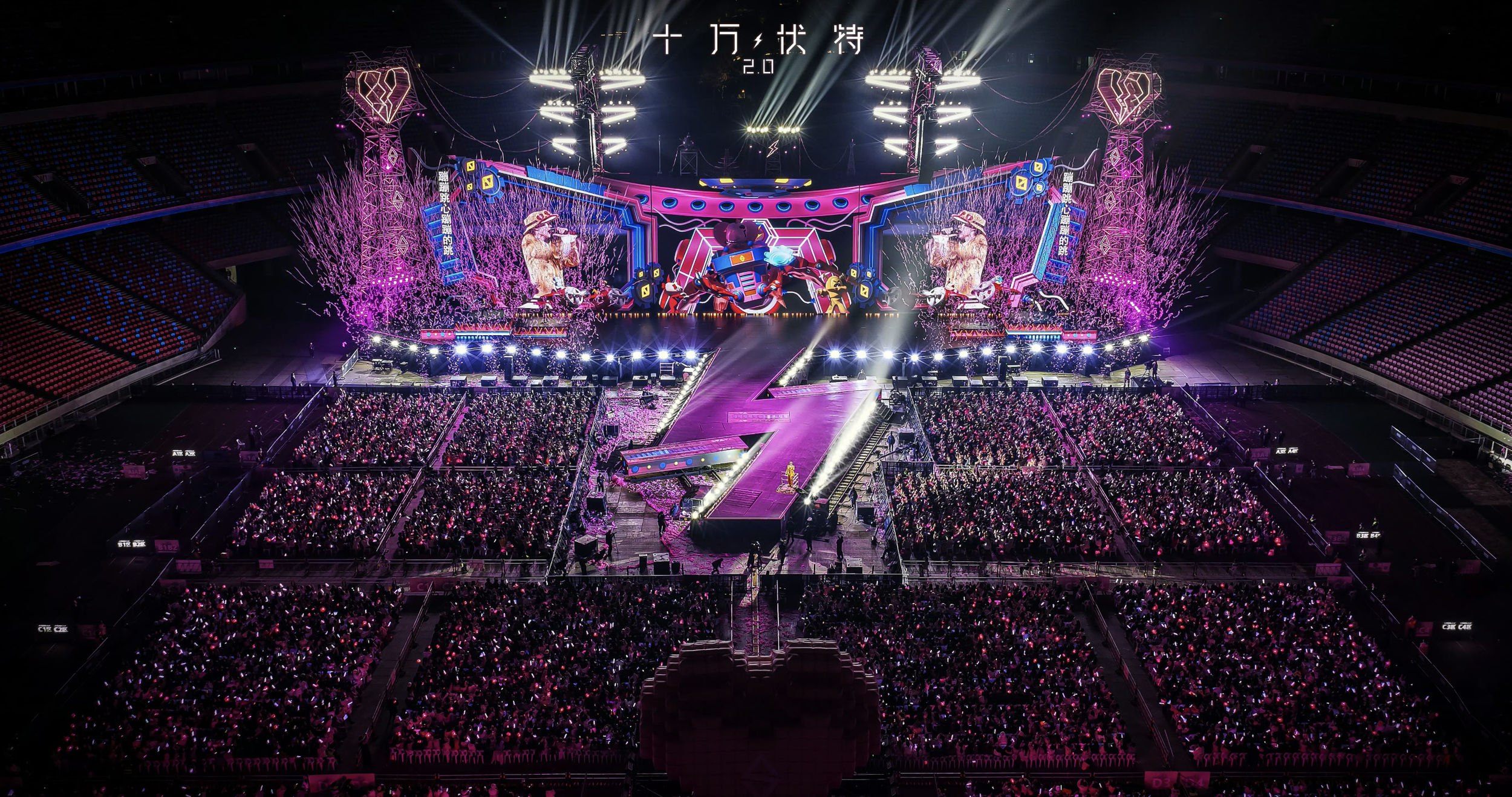
Amid the post-Covid era, concerts have maintained their high popularity. The myriad styles and themes of stars continue to spring up everywhere. In the U.S. market, RKMA estimates that spending on musical concerts across the United States will reach $9 billion in 2026. Within China’s concert market, live performances continued to gain popularity in 2024, with the number of commercial performances increasing by 10.9% nationwide year-over-year. In particular, concerts with over 10,000 attendees saw a remarkable increase of 84.4% (Weibo and Sina Entertainment, 2025), In 2025, the number of commercial performances nationwide increased by 6.6% year-over-year and reached 640,000 (Weibo and Sina Entertainment, 2026).
In the global concert marketplace, musicians value brand-driven engagement while relying on “participation through fandom” via their concerts (Baym, 2018). While in the last two to three years, concerts in the Chinese market have seen artists developing concert-based concepts around various themes, allowing audiences to follow and immerse themselves in the concert’s theme led by stage design and production arrangements.
For example, singer Roy Wang used a stage design with a sense of “wrap-around” at his concert to echo the “cosmic” concept he established in his “Under Universe” tour, thereby emphasizing the “healing” and “inclusive” experience of the concert. Jolin Tsai’s “PLEASURE” tour features visual elements inspired by Hieronymus Bosch’s painting The Garden of Earthly Delights, incorporating installations such as a 30-meter-long mechanical python and the “Book of Truth” into the stage design to immerse the audience in the conceptual themes portrayed within the artwork. Joker Xue’s “Evolution” tour features visual designs such as beast-bone staircases, steel jungles, and cage-like structures, echoing his exploration of the “law of the jungle” and guiding the audience to form their own perspectives on the interplay between animal instincts and humanity.
Looking beyond the level of conceptual themes or the design of concert experiences that branch out from a central concept, this article looks at a new paradigm established in singer Silence Wang’s “One Hundred Thousand Volts” tour, where he positions his concerts as sites of world-building. Access to this world is not limited to the concerts themselves; rather, it extends through its narrative framework and IP an undefined imaginary realm that can be entered before, during, and after the shows. Drawing from traditions more commonly seen in literature, film, and video games, world-building helps audiences engage not just with a performance, but with a coherent ‘extensional’ narrative world, made of all the entities that objectively exist in the fictional world.” (Bell and Ryan, 2019)
Research Overview
This research examines worldbuilding strategies drawn from film and television, game design, and transmedia storytelling, exploring how they can be effectively applied within the context of a live music concert to enhance the audience experience. Supported by examples from established IP such as Disneyland and Harry Potter, mediated works such as The Shadows, and world and ecosystem building in game design, it analyzes the world-building strategies present in this case study across the following dimensions: the visual and physical elements embedded in set and concept design (including stage design, light sticks, and related materials), the musical arrangements and adaptations, and the collective elements that contribute to penultimate world-building. This article also provides an overview of the IP expansions launched by the artist‘s team as extensions of the concert experience, including the world’s first XR-based interactive concert film and the first “Concert Artbook” within the context of Chinese-language popular culture, both of which will be examined in greater detail within the following chapters. This article also draws on the art book as its primary conceptual reference for “One Hundred Thousand Volts.
Among pop music artists, Silence Wang stands out for the depth of integrating such elements in his concert, in which he blends together narrative, visual design, musical arrangements, and IP expansion into a cohesive world that audiences can not only follow but mentally inhabit and find identity in.
Understanding this shift is critical not only for professionals in performance and media to better understand what makes a concert successful, but also for practitioners in the cultural industries to identify new approaches for meeting audiences’ growing desire for more “participatory music performance” experiences in the digital age. (Wu, Zhang, Bryan-Kinns, and Barthet, 2017)
Case Introduction – One Hundred Thousand Volts and “Romance City”
The “One Hundred Thousand Volts” Tour by Silence Wang (including both 1.0 and 2.0 versions, spanning from 2024 to 2025) presents a compelling case of how concerts are evolving beyond mere musical performances and bringing in album-based world-building and multi-dimensional experiences into the concert. By constructing the fictional setting of “Romance City,” Wang transformed his concert tour into a conceptual world embedded with an immersive narrative. Starting from February 27, 2026, Wang launched the “Rise of Romance” World Tour, which functions as a preface to the narrative established in One Hundred Thousand Volts. As Rise of Romance marks the beginning of a new phase in this evolving world-building approach, this study focuses exclusively on the One Hundred Thousand Volts 1.0 and 2.0 tours, where the foundation of Romance City world-building was first constructed and introduced.
According to statistics, the tour covered 23 cities in China and featured 72 performances, with concert tickets achieving a 100% sell-out rate within seconds. The number of Maiseat (primary ticketing platform) “wishlist” users in 2025 reached 20.165 million, second only to Jay Chou, the King of Chinese Pop, who already possesses immense international influence. Silence Wang’s concert also appeared on Weibo’s Hot Search list 378 times and the Entertainment Hot Search list 513 times in 2025, ranking second among the top ten most-searched concerts on Weibo that year. Additionally, the stage design for “One Hundred Thousand Volts 2.0” was recognized with iF Design Award, one of the world’s most coveted competitions featuring creative excellence, affirming the high quality of its concept and production design.
This tour also successfully drove significant growth in Silence Wang’s online presence in 2025, with over 1.8 million new followers on Weibo(excluding other platforms), more than 60 million discussions related to the tour, and over 2.5 billion views for the hashtag #汪苏泷十万伏特2.0巡回演唱会# (Silence Wang One Hundred Thousand Volts 2.0 Tour) (Weibo and Sina Entertainment, 2026).
Within the context of Chinese-language popular culture, Silence Wang is the first musician to systematically introduce the concept of the “Concert Artbook.” This research draws on this art book as its main conceptual reference for One Hundred Thousand Volts.
World Building Frameworks
““It should not be merely a performance venue, but rather a dynamic, fully constructed new world.” ”
World building, as introduced by Henry Jenkins; “a fictional universe that will sustain franchise development, one that is sufficiently detailed to enable many different stories to emerge but coherent enough so that each story feels like it fits with the others.”
The 2025 Weibo Entertainment White Book described Silence Wang’s concert as “a full-chain approach with diverse and creative co-creation strategies, breaks spatial boundaries, and integrates online and offline experiences to build a closed loop of immersive engagement, setting a new trend in co-creation between artist and fan for concerts.” In fact, the ability to achieve such a closed loop of immersive experience stems from the narrative that Wang constructed for the concert.
The title of the tour, “One Hundred Thousand Volts,” shares its name with Wang’s album released in the same year (2024). The decision to frame the concert venue as “Romance City” extends from Wang’s earlier album 21st Century Romance (2022) and his tour “Party of the Century” (2023) afterward, which reflects on how the contemporary world is filled with uncertainty, with individuals constantly navigating between multiple unknowns. In response, the album cover presents the image of a virtual city, symbolizing a romantic imagination of modern emotions and relationships. Everything that once appeared solid and constant now seems increasingly fragile. As a result, “romance,” as a luxury within human society, has become more precious. Though often subtle and easily overlooked, Wang still envisions romance as a sense of reconnection, to the world and to others, and of encouraging individuals to reflect more on the relationship between the self and the broader world.
An Immersive Storyworld With Closed Artist-Fan Loop
The concept of the “storyworld” in narrative and literary studies, brought out by Marie-Laure Ryan, refers to a “global mental representations enabling interpreters to frame inferences about situations, characters, and occurrences either explicitly mentioned or implied by a narrative text or discourse (David, 2009)”. Within this framework, “Romance City” is meant to be conceived as “not merely a performance venue, but rather a dynamic, fully constructed new world (Wang, 2025),” with a castle as its core architectural and visual element, serving as a cue to support and advance the narrative.
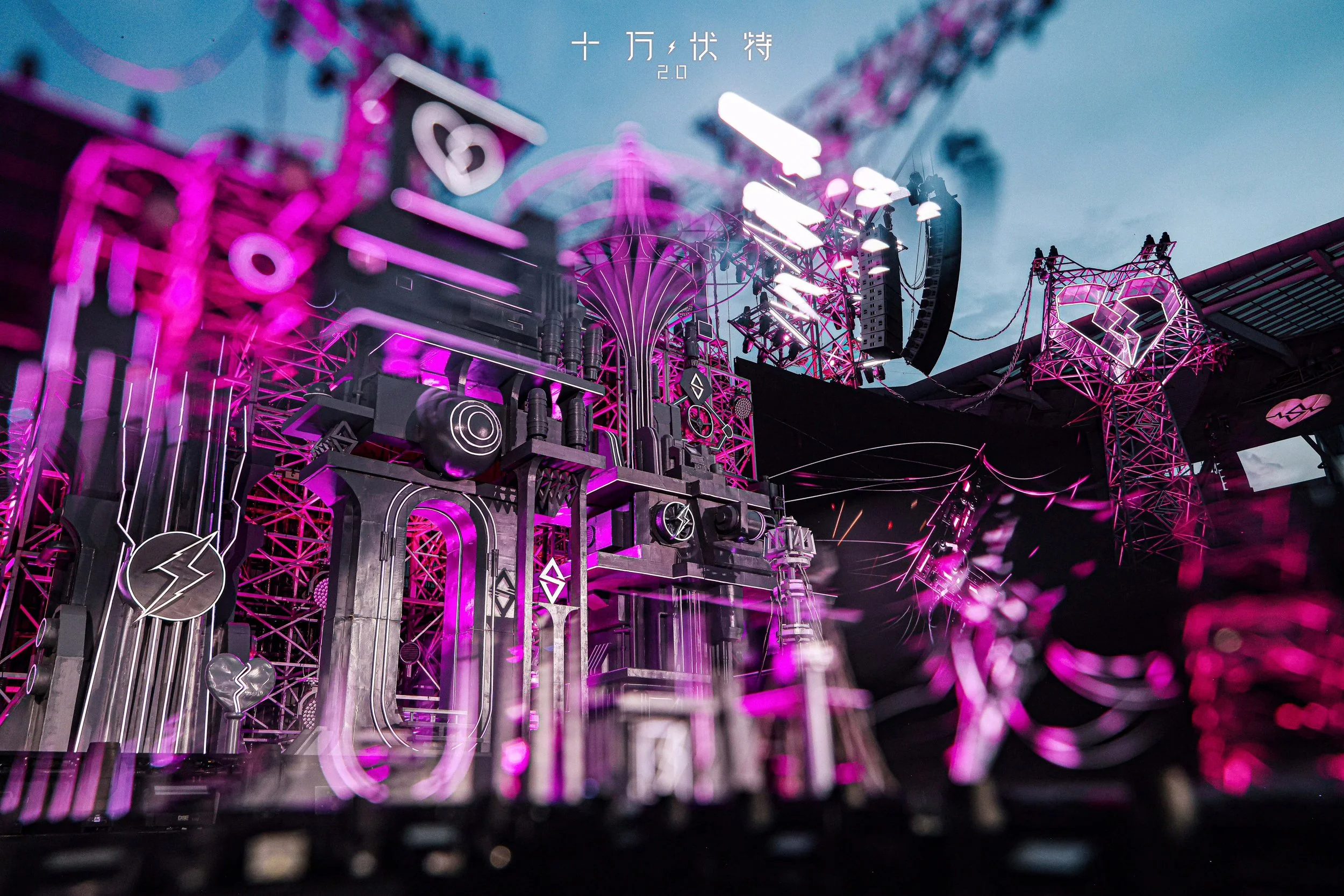
The castle in Romance City, also as the stage design for the beginning and ending part. Image source: @Silence Wang Studio. Weibo. September 11, 2025.
The objective scale of a storyworld and the established ways of entering it do not need to be fixed. As Ryan notes, “the size of a storyworld is a function of the amount of information it gives about the world it purports to describe.” Romance City’s cityscape features neon lights and flowing traffic and is inhabited by 22 “little monsters” who, together with the audience, are positioned as residents of Romance City.
Each monster is given a name contributed by fans, along with a corresponding personality developed through this participatory process. Therefore, any expansion of Romance City, such as characters, does not depend on physical scale but rather on the artist (Silence Wang), who is also the Castellan, continuously enriching the experience of the world through multiple forms, such as concerts and leading online interactions. This expansion is manifested through the addition of narrative, symbolic, and experiential details that collectively construct the world for the audience.
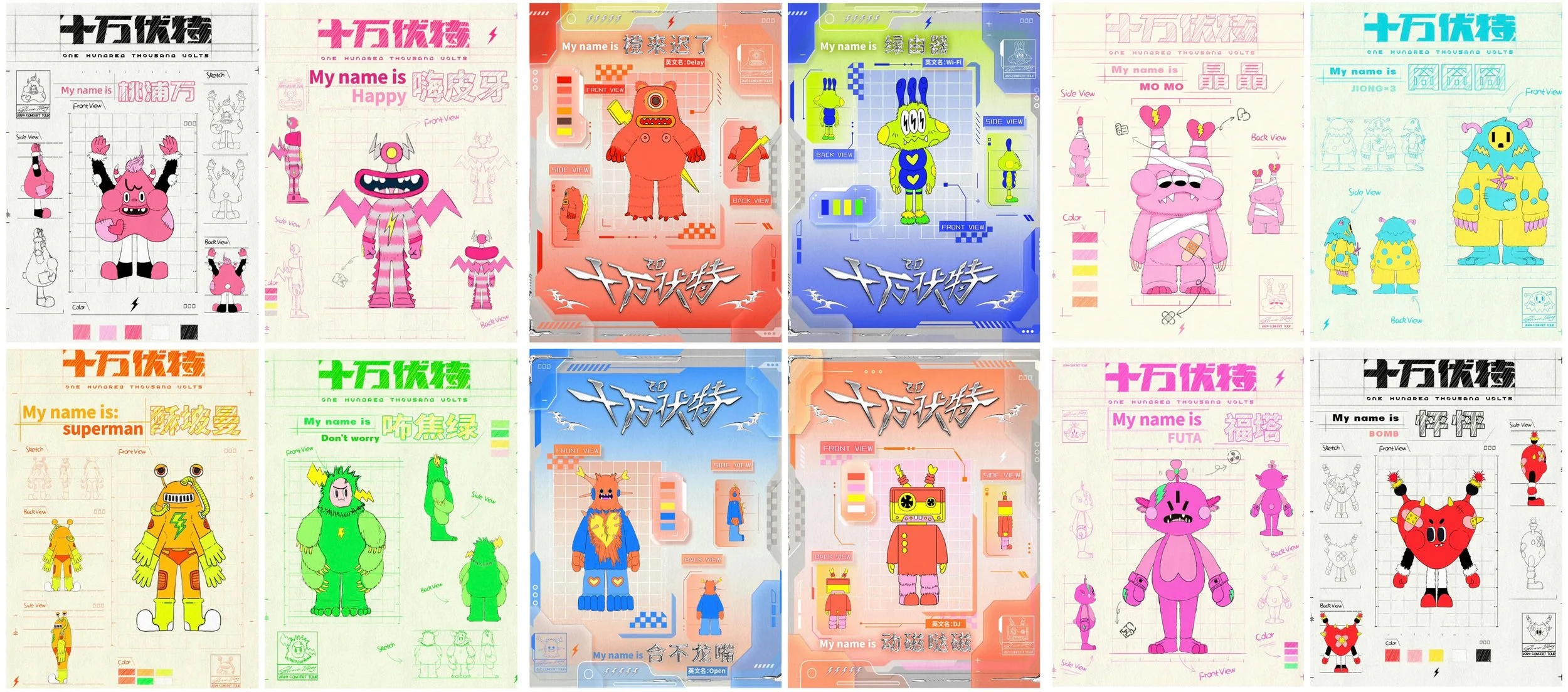
Some “Monster Characters.” Image Source: Weibo, @Silence Wang Studio.
In terms of stage visual language, Xiaojing Zhu, the Chief Director of the tour, noted that “what was ultimately presented gave audiences the feeling that fans had their own ‘Disneyland,’ with a distinct style of their own.” The worldbuilding of Disneyland has long been interpreted as “envisions a balance between fantasy and reality, the imaginary and the real.” Disneyland creates immersiveness where “consumer enters into the world of the story (e.g. theme parks),” broken down by Matthew Freeman, “while Disney itself was “grounded in […] the real, physical world [but] moved unmistakably not toward realism but toward a more convincing form of fantasy.” Romance City indeed successfully interpreted this concept. In its stage design, many elements are at a scale comparable to real life, such as castles and electricity towers (which will be analyzed in more detail in later sections), creating areas of overlap between reality and this constructed fantastical world.
Walt Disney himself defined the effect to be “the plausible impossible.” Yet, “Disneyland became the living embodiment of the plausible impossible—an immersive blend of the real and the imaginary into a single leisure space.” Such a framework is particularly applicable to themed environments, where a designated space is assigned with its own narrative identity and spatial logic. Audiences, who simultaneously as tangible participants in the real world, enter these environments and experience narrative structures that would otherwise remain fictional. However, while these themed spaces create a strong sense of immersion, the entities within them, for instance, “Mickey’s Toontown,” “Radiator Springs”(in Cars), or Arendelle in Frozen, do not exist as tangible spaces outside of their constructed context where they could function as narrative elements to guide audience perception and engagement.
The concert Video Journey in Romance City context, played exclusively on the final stop of the tour also noted that “Romance City is not on any known map, it exists only because we believe it into being (Wang, 2026)”. By echoing Disney’s perception on worlds and spaces, the fantastical storyworlds constructed within Romance City function as immersive environments beyond the theme park. It introduces a similarly structured logic into the domain of concert performance, representing a notably forward-looking and innovative practice.
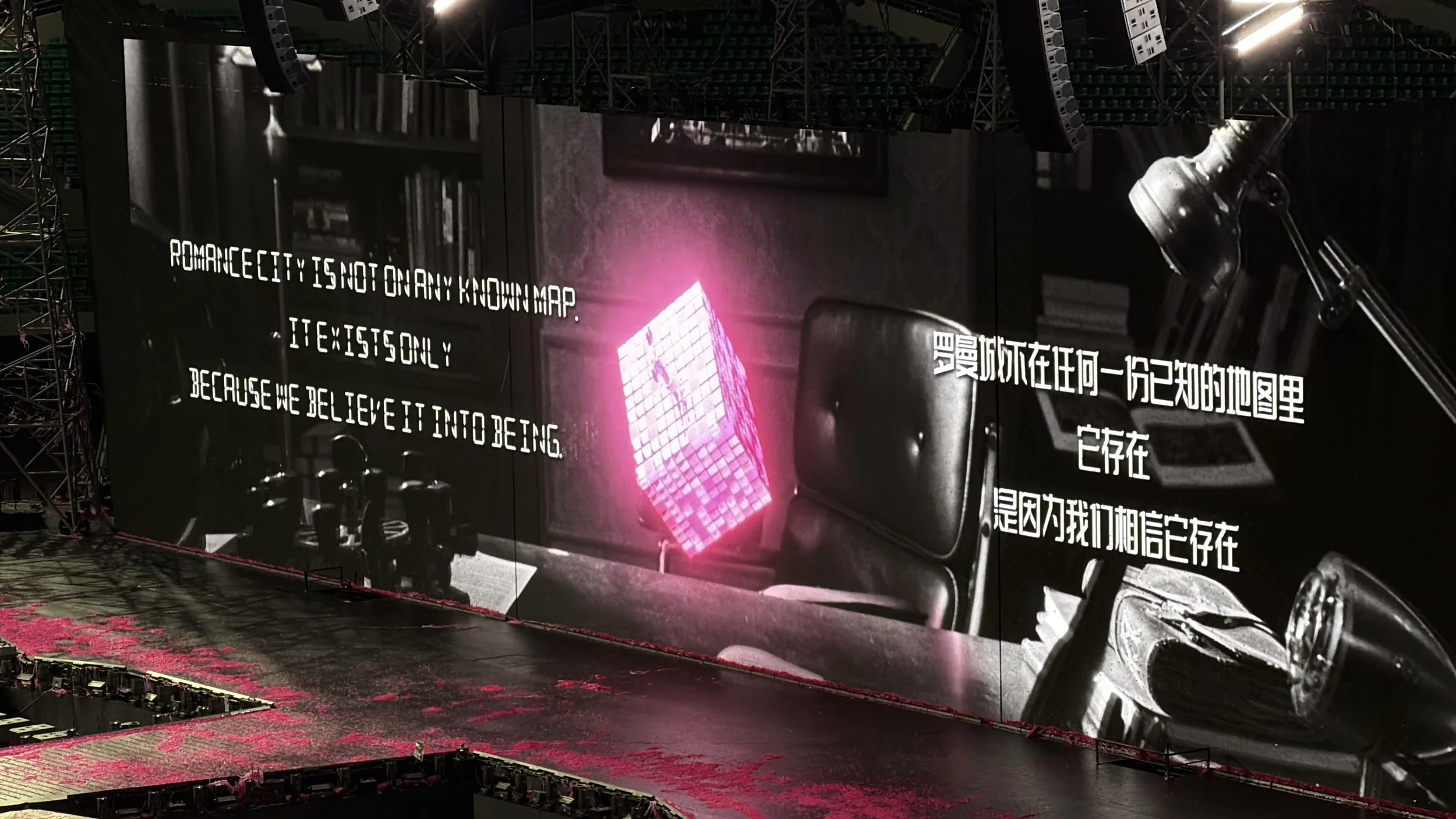
The concert video journey during the final performance. Image from the author. January 2, 2026
Non-Constraint But Exclusive Space
Following the idea of blurred boundaries within a storyworld, Platform 9¾ in Harry Potter provides a compelling example. As described by J.S. Morin, “arcane merchandise is sold openly because no one but wizards can find it. This is a common theme in Harry Potter. Whenever the wizard and muggle worlds are abut, there is something that keeps the muggles unaware of just how close they are to magic (Morin, 2015).” What truly separates the two worlds is not the so-called King’s Cross platform, but the wizard’s ability to distinguish themselves from Muggles and thereby enter another space that exists within their consciousness – wizards know it exists.
The entrance to Romance City can be viewed as the entrance to every concert venue, yet it is not a physical “city entrance.” Instead, those who believe in its existence naturally enter this imaginary city brought to life by Wang through this entrance.
Because this entry is psychological rather than strictly physical, there is no fixed moment when the experience begins. Instead, the transition from the Primary World to the storyworld is a gradual process of “fictional recentering (Bell and Ryan, 2019),” demonstrating when participants construct fictional worlds, they “fill in the gaps… by assuming the similarity of the fictional world to their own experiential reality,” while they “minimize such distance” between the contextual fictional world and the real (Ryan, 1991). In that case, the audience’s attention is shifted through a series of sensory and narrative cues.
The activation of this world logic is manifested through specific spatial and performative cues within the concert. Each concert begins and ends with the rotation of the castle from backstage to facing the audience, which functions both literally and symbolically as the opening of a “media window” into this larger fictional world (Wolf, 2014). In doing so, the performance follows a “logic of unfolding,” through which “a fictional narrative opens itself” to audiences according to its own pattern and pace (Bell and Ryan, 2019).
Similarly, the pattern and pace of Romance City is not defined in a fixed way, which allows for multiple points of entry and modes of engagement. Audiences may concentrate their experience within the three-hour concert duration, or from entry to exit, or engage with the narrative at other moments, whether through online participation or at any point when their attention is drawn into the unfolding storyline. With such a mode of entry without a fixed starting point, the experience is no longer constrained by objective spatial or temporal boundaries.
Traditionally, worldbuilding has been most extensively explored within literary contexts, where textual narratives allow expansive room for imagination and subjective interpretations. However, when extended into audiovisual and spatial forms, the question shifts from how a world is described to how it is constructed and experienced. It is notable that Romance City, in this context, offers a compelling forward-thinking example of how such a transition can be realized within the domain of concert performance.
Mediated Worldbuilding Core Principles
Breaking it down further, Mark J.P. Wolf identifies that for a world to be believable and interesting, it will need to have three properties: “Invention, Completeness, and Consistency.”
It is worth noting, however, that these properties are typically discussed in the context of film and television. What makes this case distinctive is that as a concert, these properties are incorporated through elements that are already embedded in the audience experience — objects as commonplace as light sticks, the stage and control area design that's easily seen upon entry, and the video journey series. These elements offer the audience unintentional access to the world, naturally shifting their attention into the narrative.
Beyond the concert itself, Silence Wang’s team launched an XR interactive concert film project and the Concert Tour Artbook, serving as extensions of the world-building. These expansions further demonstrate the completeness of these three properties and the coherence of the overall approach, making the framework not dispersed though across multiple channels (physical objects, visual elements, etc).
Inherently, live performance differs from a screen media experience, specifically in the narrative tools available to the medium and the amount of dialogue it contains. Thus, its ability to achieve a comparable depth of world-building is what makes this example particularly pioneering.
Invention
Invention refers to the degree to which default assumptions based on the world we are living in have been changed (Wolf, 2014); to the extent of different realms. Romance City majorly focuses on “nominal” (new names are given for existing things); “cultural”(new objects, artifacts, customs, ideas,) and some “natural” realm (“new species and races of creatures, for example, the Hobbits in The Lord of the Rings or the sandworms in Dune.”) (Wolf, 2014)
In addition to architectural elements such as castles, the graphic and visual design materials portray Romance City as an inhabited urban space, featuring pedestrians, traffic flows, and surrounding buildings. The city is further populated by the castellan (the artist), the audience, and a unique biological inventory consisting of 22 “little monsters,” conceived as unique life forms that “transform its emotional fluctuations into a source of energy that powers the city (Silence Wang Studio, 2025) .” Each of their names and personalities are derived from human emotions and were developed through interaction with audiences on social media. Furthermore, the city’s physical and energy systems extend from the basic electrical framework of our real “primary world” into a transformed system (Wolf, 2014), in which the Heart-shaped Crystal functions as an energy collection station and Electricity Towers enable the transmission of “electricity,” defined as a form of musical energy that generates happiness (Wang, 2025). At the same time, during the concert, the audience’s relationship with such energy is concretized through the design of the lightstick – the “Heartbeat Fanlight Stick” – of which the lighting colors and patterns are centrally controlled during the concert.
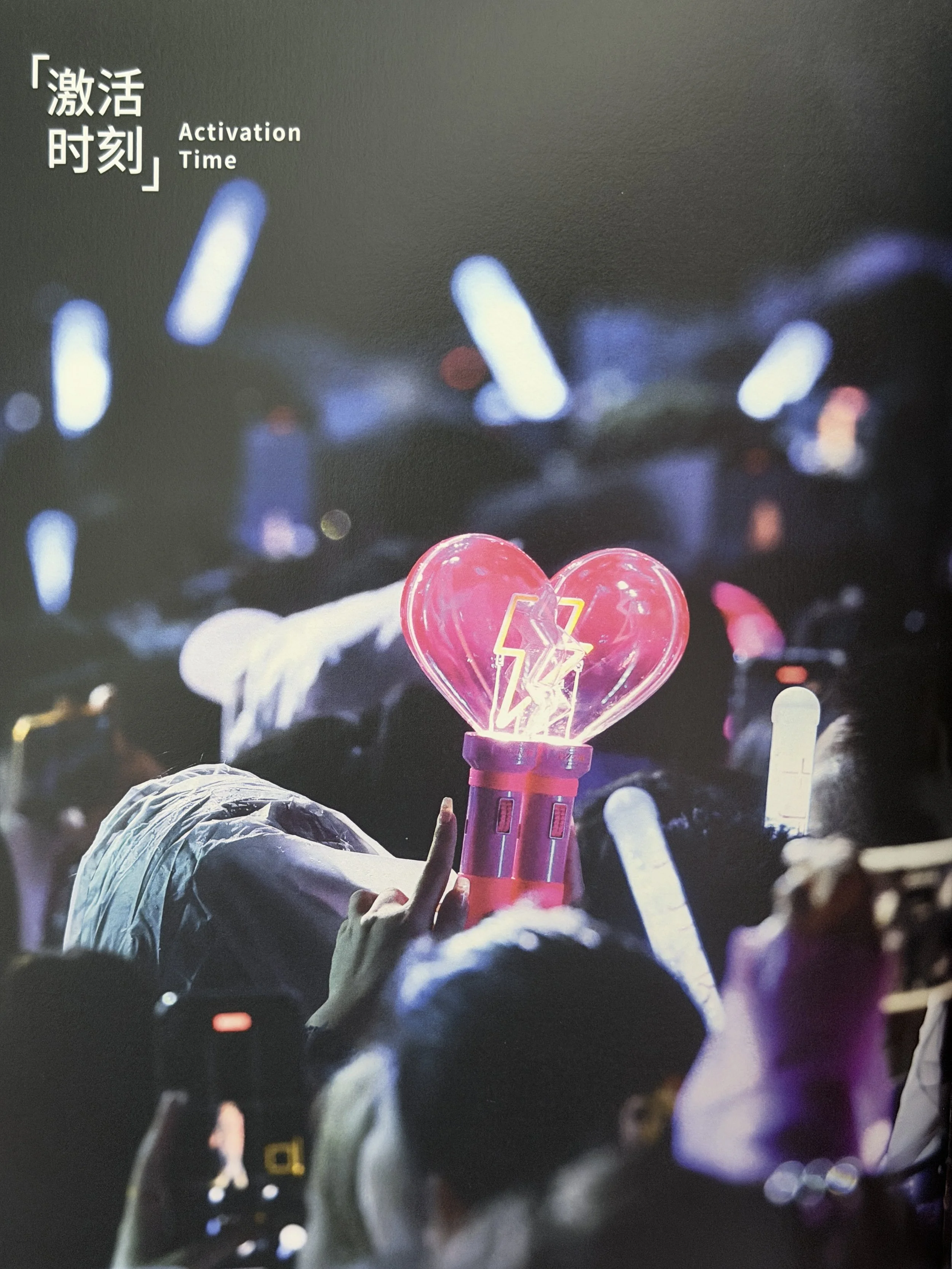
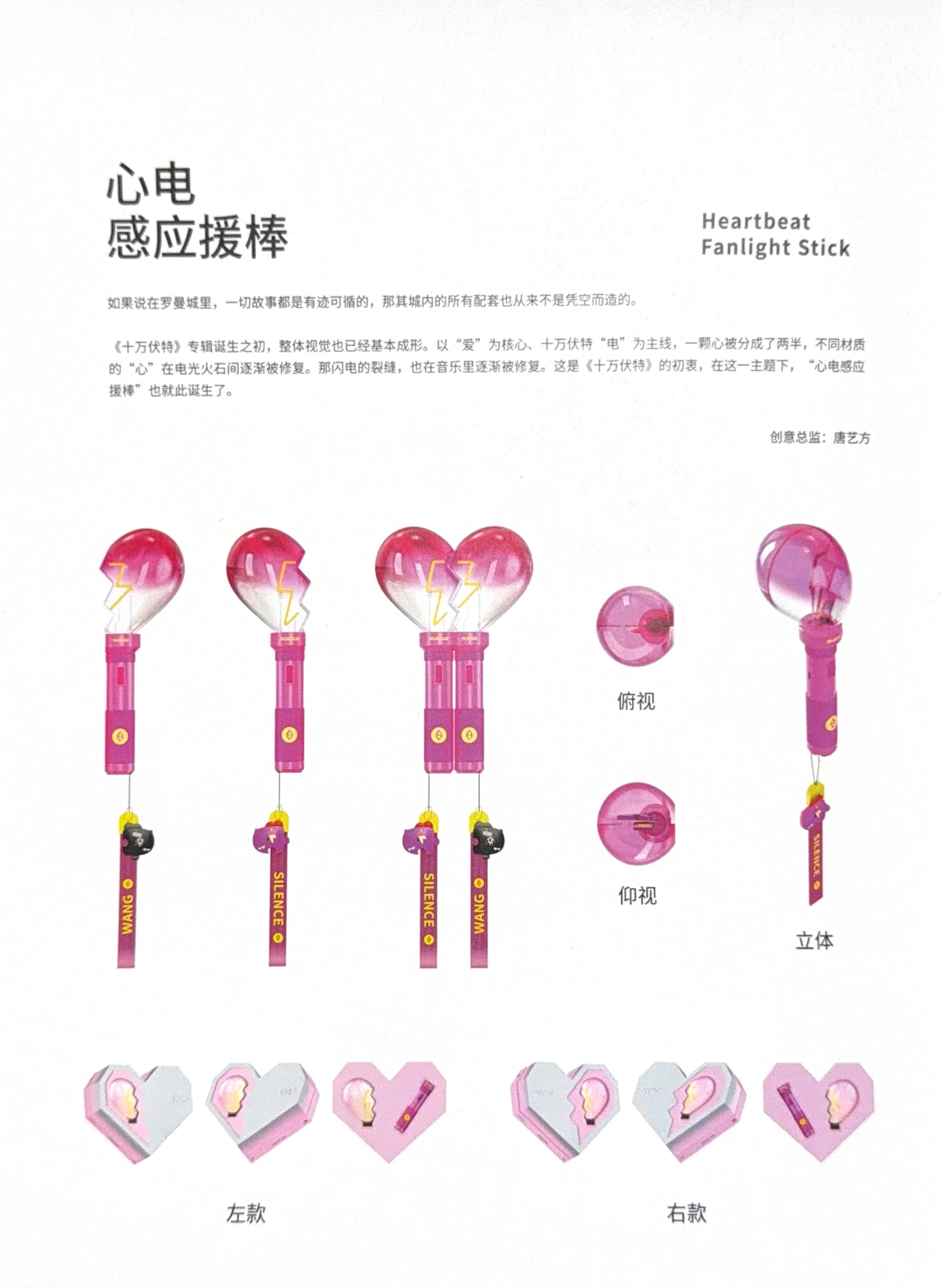
“Heartbeat Fanlight Stick” design, Source: Artbook inside pages, Silence Wang Studio.
This system reconfigures the biophysical defaults of our world by converting human emotion and musical energy into a tangible force, echoing the theme of “100,000 Volts,” while establishing a unique “world logic” where happiness powers the infrastructure of the city (Wolf, 2014). Through these invented elements, either tangible or conceptually accessible, the audience are positioned as active participants within Romance City itself, with the chance to experience the “electricity system” within Romance City on their own.
Completeness
Completeness refers to “the degree to which the world contains explanations and details covering all the various aspects of its characters’ experiences [and] background details which together suggest a feasible, practical world (Wolf, 2014).”
To satisfy the audience’s “‘encyclopedic impulse’ for explanatory interludes (Wolf, 2014);” which in literature contexts typically includes “descriptions of landscapes, peoples, customs, backstories, and philosophical outlooks (Wolf, 2014),” Romance City’s complete ideation sketches, set designs, characters, and Castellan’s archives (artist’s stage outfits) are fully presented in the art book launched by the team (Silence Wang Studio, 2025). (Details will be explained in later sections.) Overall, the project introduces an infrastructure that exists beyond the concert itself, offering audiences a way to understand Romance City even while not watching the concert.
By assembling the elements into an “illusion of completeness, as well as the audience’s engagement in the world (Wolf, 2014). ” The artbook thus functions as a compelling example of filling narrative and conceptual gaps within the storyworld particularly where live stage performance lacks the temporal and structural capacity to fully convey the “well-rounded multi-dimensional characters and sufficient backstory to explain motivation” (Wolf, 2014) and the creative process from ideation to realization. Rather than merely illustrating what the world is, it also explained how the world is made. This reinforces the internal credibility of the world, while expanding audience engagement from simply consuming narrative content to developing a deeper understanding of the creative process, as well as greater empathy and immersion in the interrelationships between its elements.
Consistency
Consistency stands for “the degree to which world details are plausible, feasible, and without contradiction (Wolf, 2014).” It holds disparate pieces together to maintain the “inner consistency of reality”(Wolf, 2014). This is exemplified by franchises such as Star Wars, which keeps its database of “over 30,000 entries on all the characters, places, weapons, vehicles, events, and relationships from the Star Wars universe” to be consistent both in style and information across its expansive world (Wolf, 2014).
Across all media associated with the concert — video (concert video journey), three-dimensional installation (stage and set design), two-dimensional physical presentation (Artbook), immersive gamified experience (XR project), and online promotional materials — all visual signals are maintained consistent with the same core elements appearing throughout. A specific example is that a heart-shaped crystal lies at the heart of the city, and functions as an energy collection station. The heart-shaped crystal retains a coherent function, narrative role, and visual identity across these platforms. This consistency is preserved even as the world “grows in size” (Wolf, 2014): as new monster characters are named by the audiences’ interactions and officially introduced as Romance City inhabitants, their character roles remain structurally parallel. While individual characters may be distinguished by different personalities and backstories (such as working in the city’s electricity department) (Wang, 2026), their profiles and narrative functions still remain internally consistent.
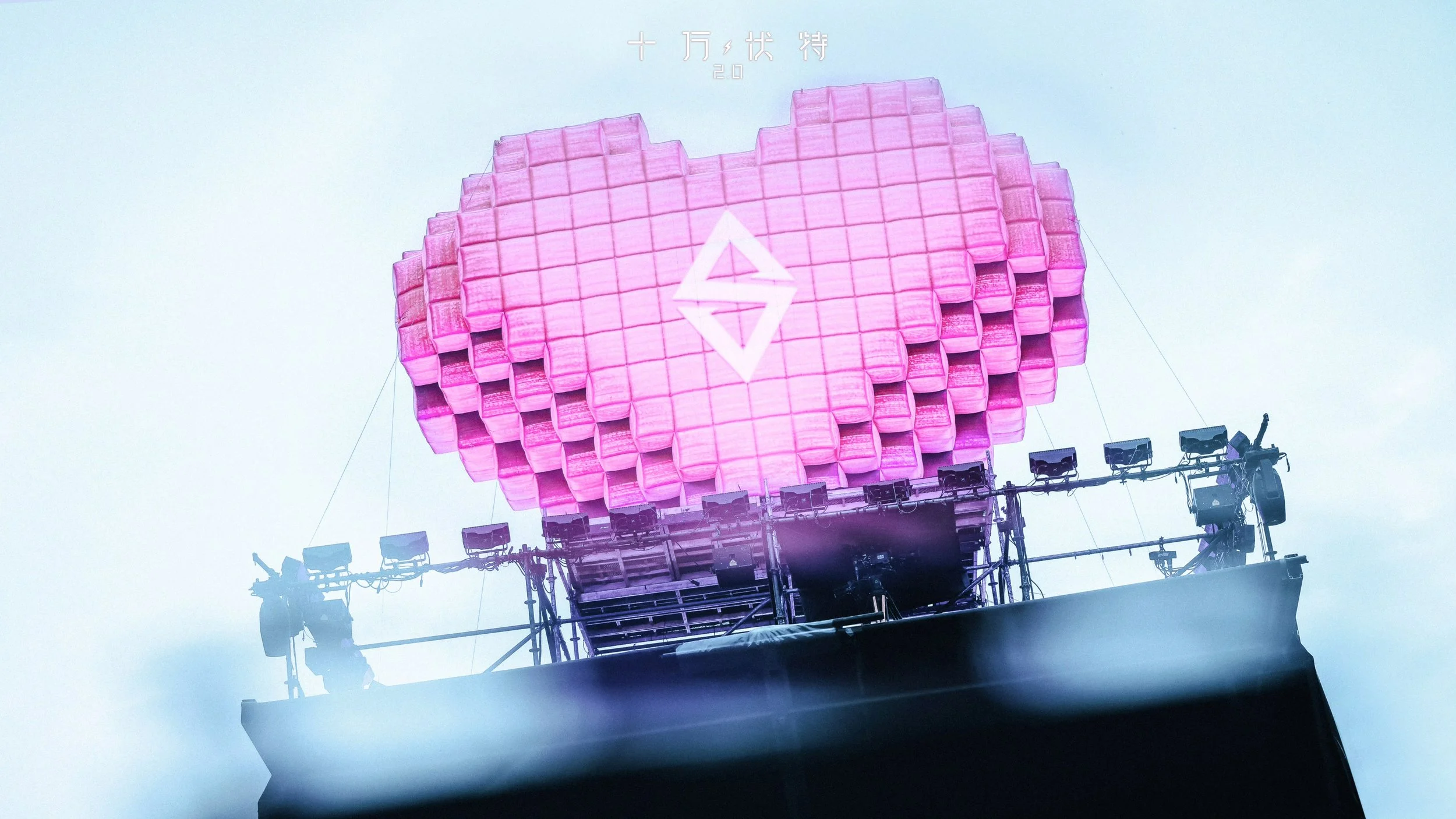
Heart-shaped crystal. Image Source: @Silence Wang Studio, Weibo. September 11, 2025
Moreover, the core elements that drive significant narrative shifts also benefit from this consistency. Continuing on the heart-shaped crystal example – in the final show of the tour, the physical heart-shaped crystal installation collapsed. Its shattering, signifying the destruction of the entire city, generated substantial discussion across social media, with audiences expressing a profound sense of loss and emotional weight surrounding the collapse of the world. This reaction, rooted in the immersive quality of the concert experience, was made possible by the crystal’s sustained presence throughout the narrative, which gave its transformation a genuine emotional impact.
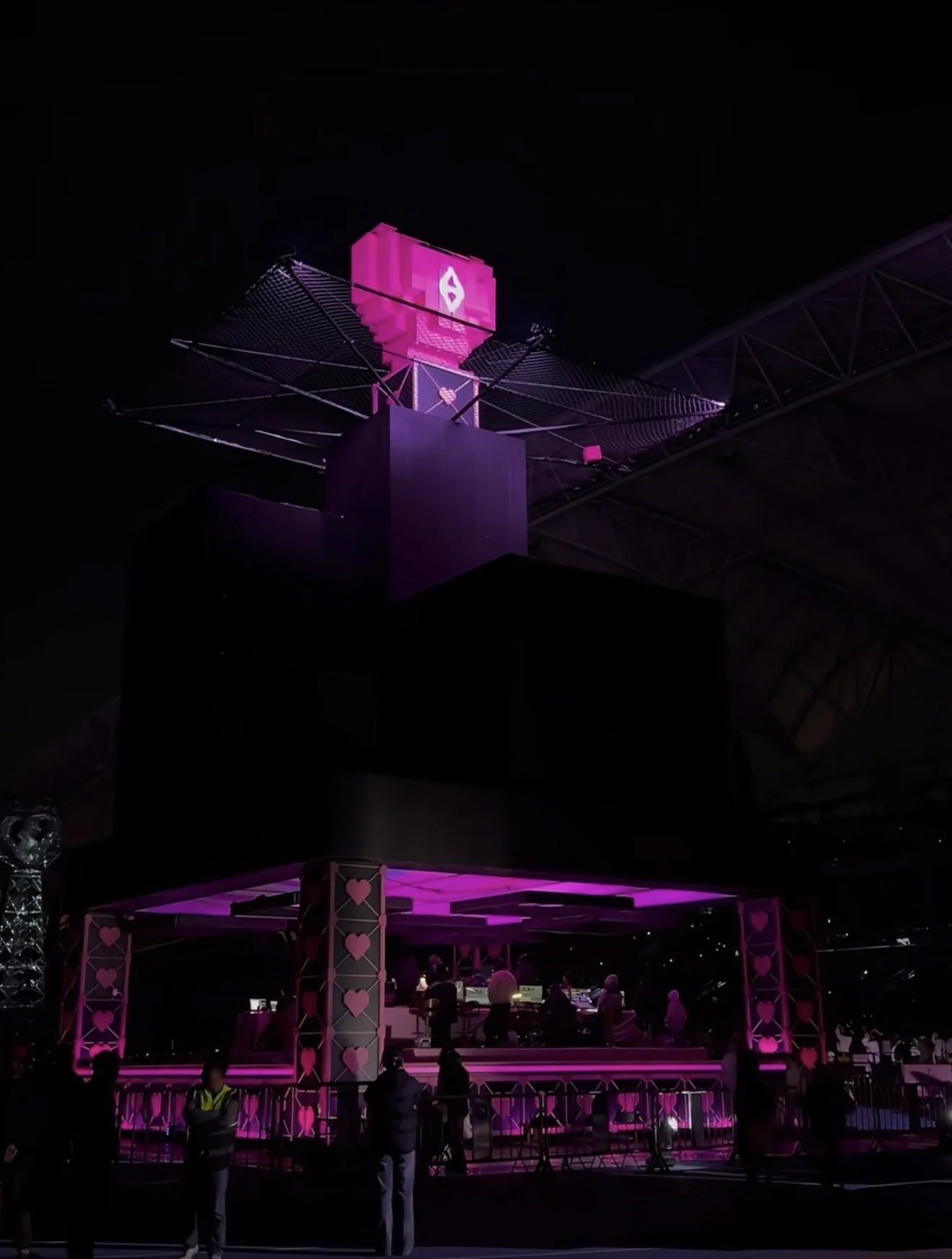
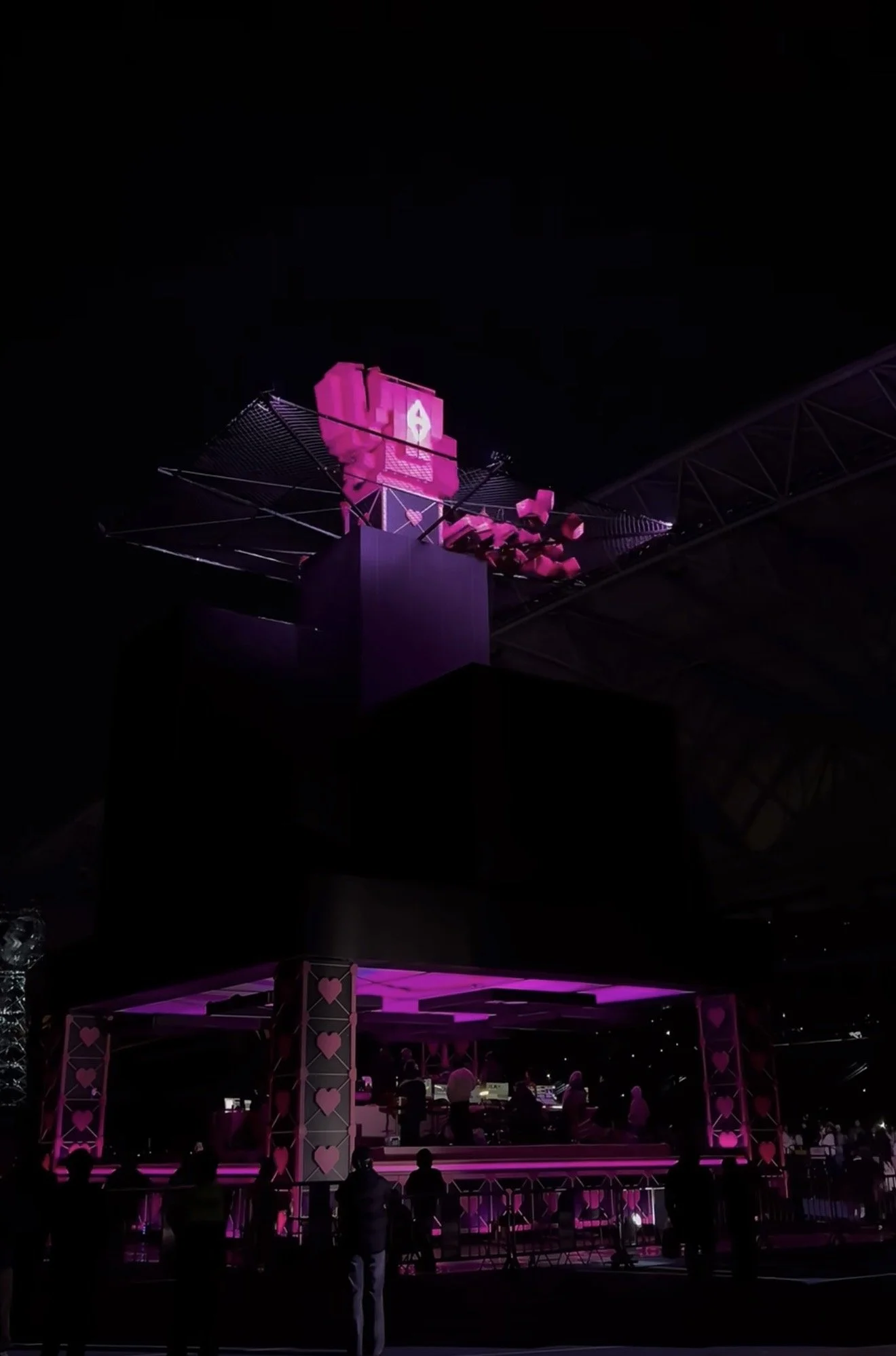
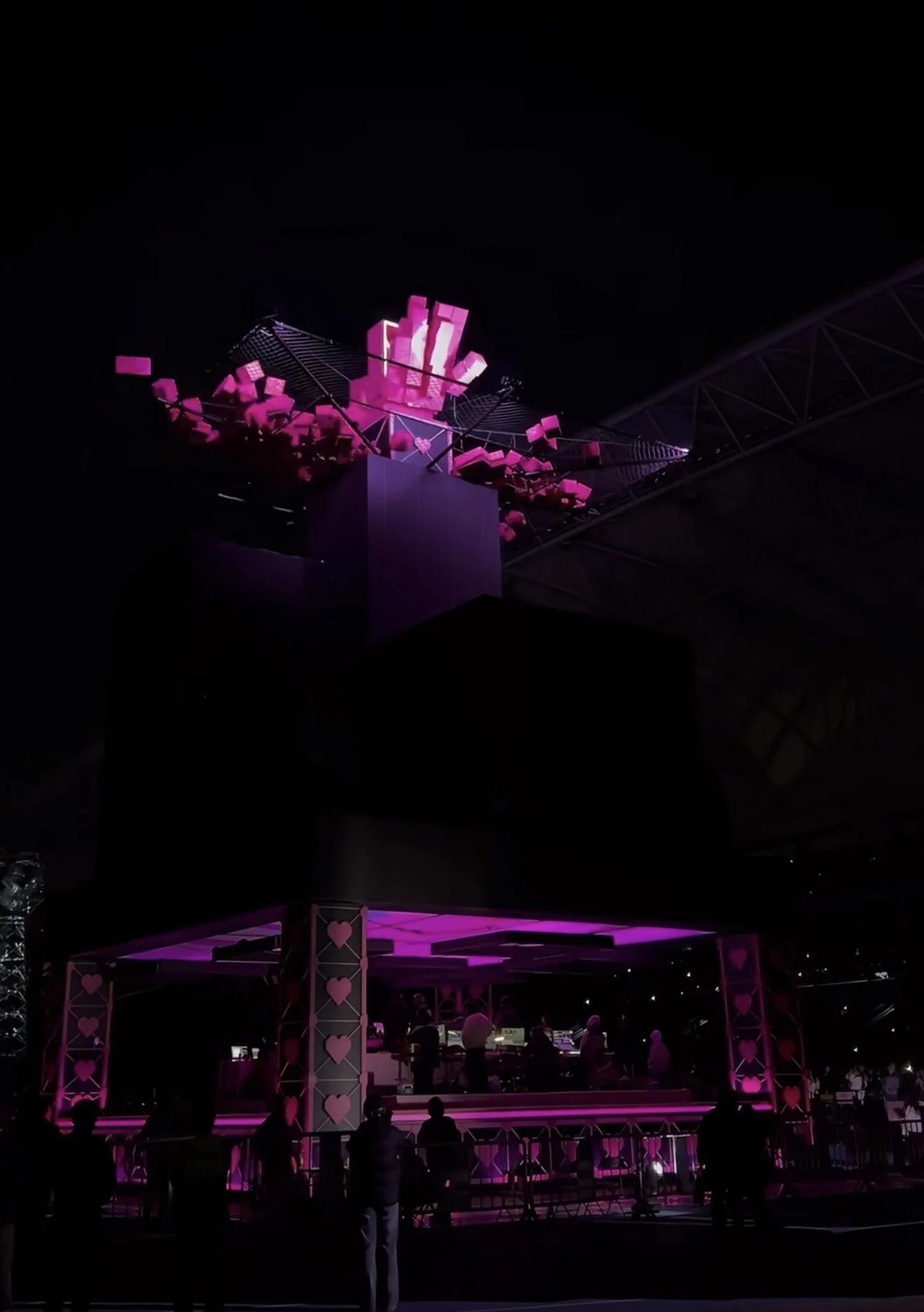
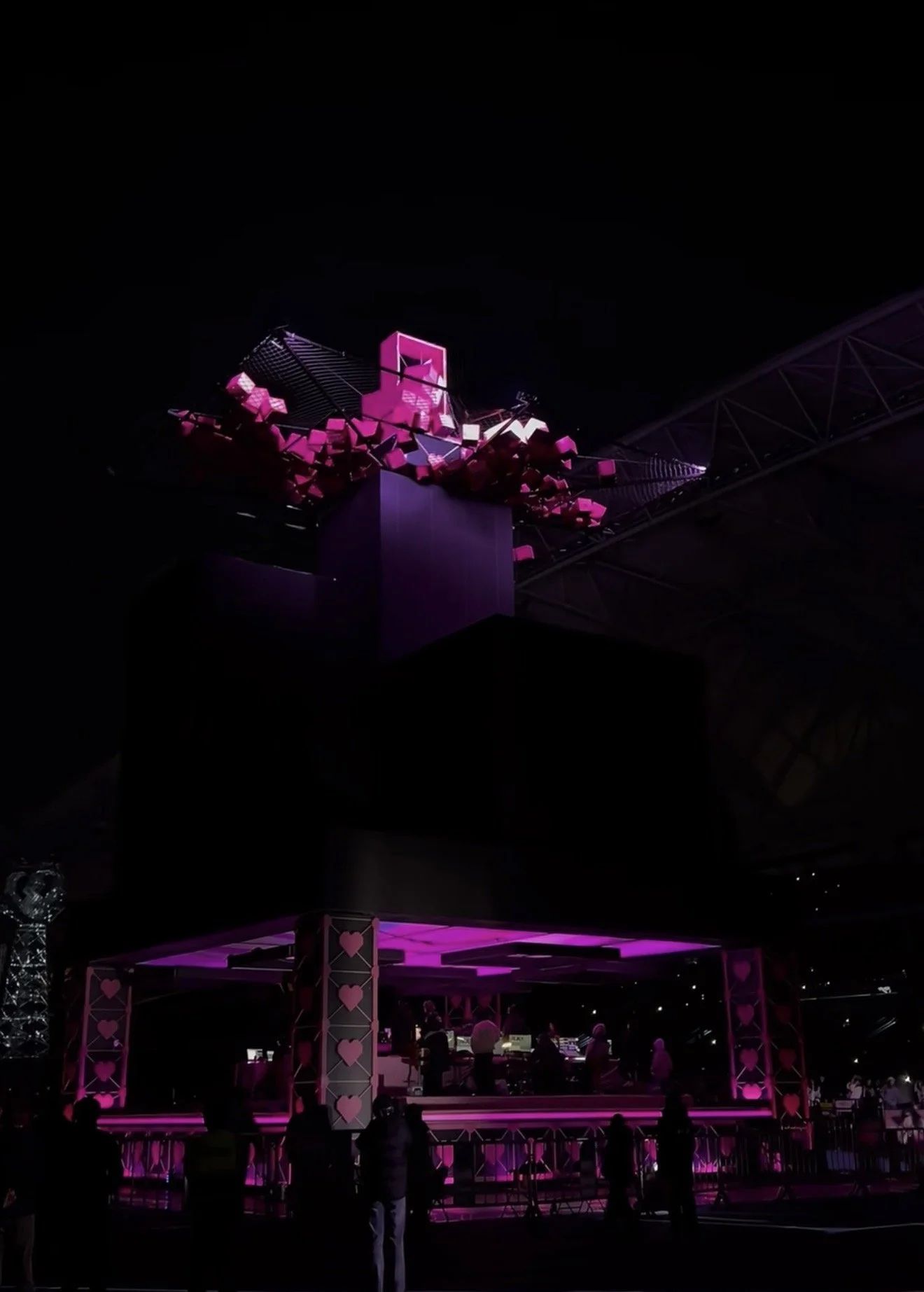
Video stills, The collapsing of heart-shaped crystal, @洪波(Hongbo Li, director for stage art design), RedNote.
Game Worldbuilding Reference – Socio-Ecological Systems
“Electricity towers, closely resembling those found in real life, were installed on both sides, allowing the audience to quickly recognize the core concepts of “One Hundred Thousand Volts” and power generation. We also incorporated extensive wiring and light strips throughout Romance City, creating the impression of electricity being continuously transmitted into the city.”
Stage design also matches how the “power” transfers: lightsticks - stage lightings - electricity towers - power stations. Source: Video from the author. January 2, 2026
Besides the core properties of a world, the structure and processes of its system give rise to a socio-ecology. Among these,“the changes that occur in those components and the relationships among them over time are the processes characteristic of the system.” (Raser, 1972)
Under the context of Romance City, the energy collection station is the heart-shaped crystal, as mentioned earlier. Once fully charged, it supplies power to the city through heart-shaped Electricity Towers. This mechanism directly echoes the concert’s title, 100,000 Volts, encapsulating its core message: “to make everyone feel happy” and to “summon the musical energy within each person, allowing it to flow throughout the body (Silence Wang Studio, 2025).”
During the encore session of each concert that takes place while the artist changes outfits, the interactive narrative continues. As fans chant the artist’s name, the Video Journey(VJ) visuals shows the heart-shaped crystal gradually accumulating energy. When the energy level reaches 100%, the encore is successfully unlocked, triggering the next phase of the concert. In this case, the heart-shaped crystal (structure) and the flow of energy (process) function in a “two-way feedback loop in which a change in one subsystem can impact the other, and vice versa (Weines and Borit, 2022),” where human emotion (social factor) impacts the energy station (biophysical factor). This makes the world feel like a “coherent system of biophysical and social factors (Weines and Borit, 2022).”
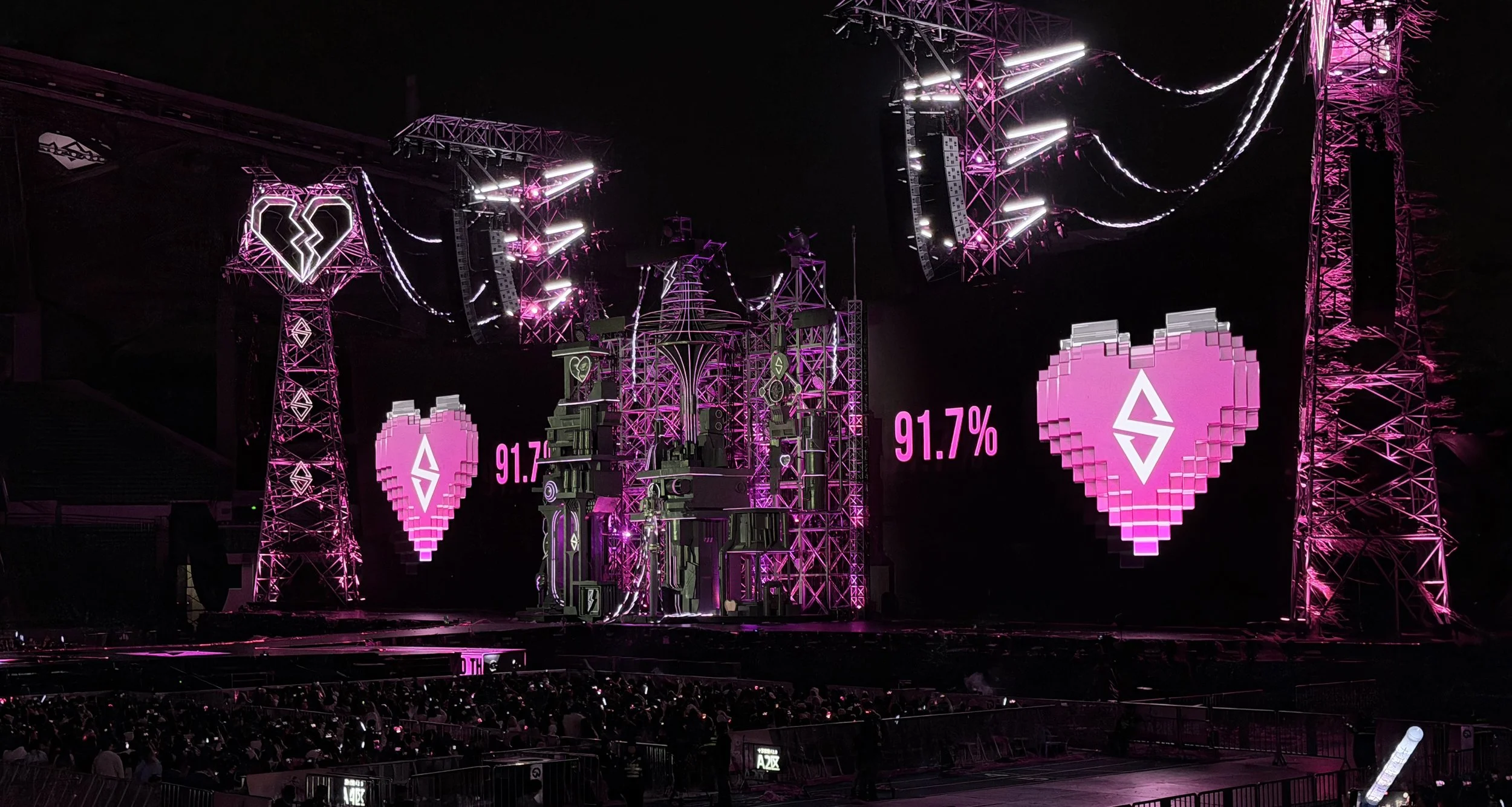
The screen of the concert during the encore section. Image from the author. January 1, 2026
During the final show of the tour, when the physical heart-shaped crystal installation collapses in step with the concert VJ, the castle also ceases to exist (Wang, 2026). The VJ narrative reveals that an antagonist has detonated Romance City, leaving the storyline unresolved and intentionally ending the concert narrative on a cliffhanger.
Within the storyworld of Romance City, the interconnections among its elements continuously reinforce the logic of the world’s construction, echoing the foundational ideas behind world-building and coordinated with the construction, development, and eventual decay of elements within Romance City.
What’s Next
While this part primarily introduces world-building concepts related to visual narrative elements and their application in “Romance City,” Part II will continue to explore the role of sound and IP expansion. This will include further details on the world-building impact of Disneyland’s character parades and the arrangement of related songs, as well as how Silence Wang’s concert echoed these approaches. It will also delve into details regarding the world’s first XR interactive concert film and the first-ever “Concert Artbook” within the context of Chinese-language popular culture, launched by Silence Wang’s team.
Additionally, the full report is available in our reports section, containing a more thorough breakdown of world-building concepts and detailed sources.
-
Baym, Nancy K. Playing to the Crowd: Musicians, Audiences, and the Intimate Work of Connection. Postmillennial Pop 14. New York: New York University Press, 2018.
Bell, Alice, and Marie-Laure Ryan, eds. Possible Worlds Theory and Contemporary Narratology. Lincoln: University of Nebraska Press, 2019. https://doi.org/10.2307/j.ctv8xng0c.
Breuleux, Yan, Bruno De Coninck, and Simon Therrien. “The World Building Framework for Immersive Storytelling Projects.” SHS Web of Conferences 64 (2019): 00003. https://doi.org/10.1051/shsconf/20196400003.
Brown, Kristen. “Why The Name Bruno Is Used In Both Disney's Encanto & Pixar's Luca.” Screen Rant, February 19, 2022. https://screenrant.com/pixar-bruno-name-encanto-luca-use-meaning-reason/.
Day-O’Connell, Jeremy. Pentatonicism from the Eighteenth Century to Debussy. Rochester: University of Rochester Press, 2007. ProQuest Ebook Central.
Dietz, Betty A. “Art Institute Gives Key to Disney's Mickey Mouse.” Dayton Daily News, June 28, 1959, 30.
Disney Wiki. “Arendelle.” Accessed March 22, 2026. https://disney.fandom.com/wiki/Arendelle
Disney Wiki. “Cars” Accessed March 22, 2026. https://disney.fandom.com/wiki/Cars#:~:text=Directed%20by,More
Fairy, Ticket. “Game On: AR and Gamification Strategies to Engage Venue Audiences in 2026.” Ticket Fairy Promoter Blog, January 22, 2026. https://www.ticketfairy.com/blog/game-on-ar-and-gamification-strategies-to-engage-venue-audiences-in-2026.
Fast, Karin, and Henrik Örnebring. “Transmedia World-Building: The Shadow (1931–Present) and Transformers (1984–Present).” International Journal of Cultural Studies 20, no. 6 (2017): 636–52. https://doi.org/10.1177/1367877915605887.
Fernandes, Melanie, Nicole Mallmann, and Sangwoo Shin. “The Rise of Augmented Reality in Live Music Events: The Cases of Snapchat and Gorillaz.” Business Communication Research and Practice 7, no. 1 (2024): 58–63. https://doi.org/10.22682/bcrp.2024.7.1.58.
“从‘引进演出’到‘周边运营’:一场演唱会之外的‘IP生意’ (From ‘Bringing in Performances’ to ‘Merchandise Operations’: The ‘IP Business’ Beyond a Single Concert).” 澎湃新闻 (The Paper), April 10, 2026. https://www.thepaper.cn/newsDetail_forward_32934219.
Gass, Zach. “10 Disney Characters Made Famous By A Song.” Screen Rant, September 30, 2022. https://screenrant.com/disney-characters-made-famous-by-a-song/.
Green, Ben. “Splendour XR: Place, Experience and Liveness at a Virtual Music Festival.” Leisure Sciences 47, no. 5 (2025): 958–75. https://doi.org/10.1080/01490400.2023.2171519.
Herman, David. Basic Elements of Narrative. Malden, MA: Wiley-Blackwell, 2009.
Hill, Clareese. “Speculative Black Feminist Epistemologies of Worldbuilding for XR.” Frontiers in Communication 9 (May 2024): 1371081. https://doi.org/10.3389/fcomm.2024.1371081.
Hobbs, Harry, Philip Hayward, and Robert Motum. “Cyber Micronations and Digital Sovereignty.” Digital Society 2, no. 3 (2023): 44. https://doi.org/10.1007/s44206-023-00069-9.
Hodge, Matthew. “Disney ‘World’: The Westernization of World Music in EPCOT’s ‘IllumiNations: Reflections of Earth.’” Social Sciences 7, no. 8 (2018): 136. https://doi.org/10.3390/socsci7080136.
Holian, Heather Lynn. “‘Becoming a Fine Art’: Walt Disney and The Art of Animation Exhibition, 1958–1966.” The Journal of American Culture 47, no. 2 (2024): 143–57. https://doi.org/10.1111/jacc.13560.
“iF Design - About iF Design.” Accessed February 10, 2026. https://ifdesign.com/en/about.
“iF Design - Silence Wang: ONE HUNDRED THOUSAND VOLTS 2.0 Tour.” Accessed February 10, 2026. https://ifdesign.com/en/winner-ranking/project/silence-wang-one-hundred-thousand-volts-20-tour/739375.
Jiang, Jinli, and Prakaikavin Srijinda. “Semiotics Analysis of Music Communication in Disney’s Animated Films.” 2024.
Julian, Brian. “I Am Moana!” Thinking in the Light, December 1, 2020. https://www.thinkinginthelight.com/i-am-moana/.
Kaufman, J.B. “The Heir Apparent.” In Funny Pictures: Animation and Comedy in Studio-Era Hollywood, edited by Daniel Goldmark and Charlie Keil, 51–68. California: University of California Press, 2011.
Lehman, Frank. Hollywood Harmony: Musical Wonder and the Sound of Cinema. Oxford: Oxford University Press, 2018.
Miller, Richard K., and Kelli Washington. Consumer Behavior 2026. RKMA Market Research Handbook Series, 19th ed. Loganville, GA: Richard K. Miller & Associates, 2026.
Morin, J.S. “Worldbuilding in Harry Potter.” September 29, 2015. https://www.jsmorin.com/2015/09/worldbuilding-harry-potter/.
NPR. “‘Moana’ Actress Grew Up With The Polynesian Myth That Inspired The Movie.” November 23, 2016. https://www.npr.org/transcripts/503066811.
Peña, Ernesto, and Kedrick James. “A Framework of Transmediation.” Convergence: The International Journal of Research into New Media Technologies 30, no. 5 (2024): 1610–24. https://doi.org/10.1177/13548565231220325.
Pisaturo, Sue. “‘Magic Happens’ Parade at Disneyland Park Fact Sheet.” Small World Vacations, February 2, 2024. https://smallworldvacations.com/magic-happens-parade-at-disneyland-park-fact-sheet/.
Raser, John R. Simulation and Society: An Exploration of Scientific Gaming. Boston: Allyn and Bacon, 1971.
Ryan, Marie-Laure. Possible Worlds, Artificial Intelligence, and Narrative Theory. Bloomington: Indiana University Press, 1991.
Silence Wang Studio (@汪苏泷Studio). “十万伏特最终站「广州」向你投递了一则「发电战报」💞…” Weibo, January 13, 2026. https://weibo.com/5523180767/5254626468954445.
Silence Wang Studio. Silence Wang One Hundred Thousand Volts Concert Tour Artbook. Beijing: People’s Fine Arts Publishing House, 2025.
Stripple, Johannes, Alexandra Nikoleris, and Roger Hildingsson. “Carbon Ruins: Engaging with Post-Fossil Transitions through Participatory World-Building.” Politics and Governance 9, no. 2 (2021): 87–99. https://doi.org/10.17645/pag.v9i2.3816.
Tencent Music. “21世纪罗曼史 (21st Century Romance).” Album information for Silence Wang. Tencent Music, October 28, 2022.
Top Music Charts (@TOP音樂風雲榜). “【2024腾讯娱乐白皮书】年度明星演唱会门票秒光榜…” Weibo, December 25, 2024. https://weibo.com/1695976033/P6CbplAmF.
VR陀螺. “《消失的法老》之后的超级爆款, PICO视频揭秘《罗曼城·唤醒计划》背后的技术魔法.” 知乎 (Zhihu), January 20, 2026. https://zhuanlan.zhihu.com/p/1997262959475450684.
Wang, Silence. One Hundred Thousand Volts 2.0 Tour. Live performance, Guangzhou University Town Stadium, Guangzhou, China, January 2, 2026.
Weibo and Sina Entertainment. 2024微博娱乐白皮书 (2024 Weibo Entertainment White Book). 2025.
Weibo and Sina Entertainment. 2025微博娱乐白皮书 (2025 Weibo Entertainment White Book). 2026.
Weines, Jørn, and Melania Borit. “Better Game Worlds by Design: The GAS Framework for Designing and Analyzing Games Based on Socio-Ecological Systems Thinking, Demonstrated on Nusfjord (2017).” Games and Culture 17, no. 2 (2022): 262–83. https://doi.org/10.1177/15554120211027109.
White, Daniel. “‘A Magic Beyond All We Do Here’: Musical and Sonic Worldbuilding at Harry Potter Tourist Attractions.” InMedia: The French Journal of Media Studies, no. 9.1 (January 2021). https://doi.org/10.4000/inmedia.2799.
Wolf, Mark J.P. Building Imaginary Worlds. New York: Routledge, 2014.
Wu, Yongmeng, Leshao Zhang, Nick Bryan-Kinns, and Mathieu Barthet. “Open Symphony: Creative Participation for Audiences of Live Music Performances.” IEEE MultiMedia 24, no. 1 (2017): 48–62. https://doi.org/10.1109/MMUL.2017.19.
Young, Jacob, Stephen Thompson, Holly Downer, et al. “TeleFest: Augmented Virtual Teleportation for Live Concerts.” ACM International Conference on Interactive Media Experiences, June 21, 2022, 69–78. https://doi.org/10.1145/3505284.3529968.
Zeller, Matthew. “Klangfarbenmelodie in 1911: Timbre's Functional Roles in Webern’s Opp. 9 and 10.” Music Theory Online 28, no. 1 (2022). https://mtosmt.org/issues/mto.22.28.1/mto.22.28.1.zeller.html.
@Depressed Essendon Fan. “Cars: out town.” YouTube. April 17, 2019. https://www.youtube.com/watch?v=1XfBJ0dFuuw
@LiveMusic现场. “汪苏泷「十万伏特」正式收官,横跨两年23座城市72场300万人…” Weibo, January 4, 2026. https://weibo.com/2099868183/5251384511302744.
@洪波. “罗曼城💖…” RedNote. January 2, 2026. http://xhslink.com/o/2znD8LTUN5n
@罗曼城唤醒计划 (Romance City: The Awakening). “【罗曼城·唤醒计划】Romos已抵达广州塔!...” RedNote. January 4, 2026. http://xhslink.com/o/5a6OfOjEQlS
@晴佚. “恭喜 @汪苏泷…” Weibo, January 9, 2026. https://weibo.com/7720846104/5253272948444148.
@娱情舆理. “谁家演唱会开场有小怪物巡游啊!泷圈有了自己的‘迪士尼’...”. Weibo. January 1, 2026. https://weibo.com/5785520323/5250348546524511