

I am a big fan of turn-based gameplay: board games, RPGs, roguelikes, TCGs. Carefully analyzing the game state, working out a plan of moves to make over the next few turns, and adjusting the plan in response to my opponent(s) is a style of gameplay that I find enormously satisfying and rewarding.
To my great dismay, however, the average computer opponent in most turn-based video games is, bluntly, quite bad. Bad in very different ways, but usually bad. Most often, computer opponents in these games will either choose their moves randomly, or follow a simple flowchart to decide what moves to make. While there's potential for a more reactive form of gameplay on the human player's part in the latter system, neither type of AI[a] reacts effectively to what the player does, and additionally knowing how the AI chooses its moves can enable the player to exploit it and nullify much of the game's challenge.
These examples raise a broader question: if current turn-based game opponents often rely on simplistic decision-making, would players actually prefer more intelligent AI opponents? And if so, how practical would such systems be for real-world game development?
Key Terminology:
[a] "AI" is the historical term for the algorithms that determine a computer-controlled opponent's behavior. This term, as of time of writing, is often conflated with machine learning ("ML") and generative AI ("genAI") technologies.
[b] This status removes the party member from the battle, without the ability to revive them.
Case study: Final Fantasy X's Seymour Natus
Some number of years ago I played Final Fantasy X: HD Remaster (2013). There is a midgame boss called Seymour Natus which uses a fixed, but flawed deterministic AI to battle the player. I think it's an excellent example of the limitations of a fixed, flowchart-like AI. Let's examine it in closer detail.
Seymour begins the fight using only damage-dealing elemental spells, nothing too threatening, but, as the player attacks him, he will begin adding in more dangerous techniques: the petrify-causing Break spell and the highly damaging Flare spell. Nothing crazy here, and this setup will ensure that Seymour provides an increasing amount of challenge as the fight progresses. There is additionally a second enemy in the fight called Mortibody, who also has elemental spells, but also a physical attack that will eject[b] a petrified party member. Mortibody can't be defeated and will steal HP from Seymour if its HP goes to 0.
The key problem lies in one particular phrase I used: "as the player attacks him". Seymour won't change his behavior if he's not attacked. This would normally be fine, if not for the fact that Seymour is also vulnerable to poison, which will drain his HP over time and not count as attacking him. The easiest and safest strategy, it turns out, is to stall him out: inflict poison, then defend and heal the party until the poison slowly defeats him. Alternatively, the player can grind until they have access to Reflect, a protective spell that returns all magical attacks to their sender. Since the majority of what Seymour and Mortibody do is magical, this will shut them down and prevent them from doing much harm to the player. Seymour won't recognize that the player has Reflect up either, and will happily attack into it and hurt himself.
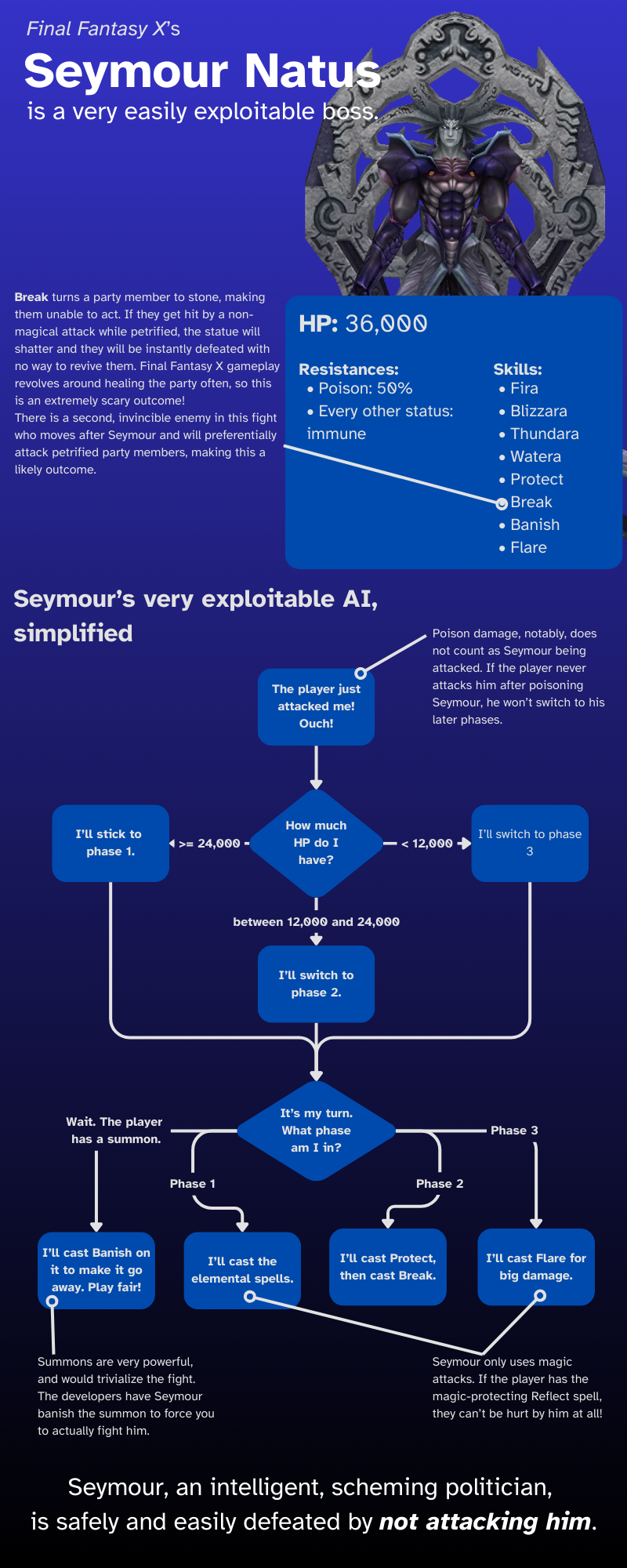
Figure 1: Simplified flowchart of Seymour Natus’s scripted decision-making process in Final Fantasy X, illustrating how fixed phase transitions and deterministic behavior create exploitable strategies such as poison stalling and Reflect-based counterplay. Source: Author-created diagram based on Seymour Natus’s battle behavior documented on the Final Fantasy Fandom Wiki and verified through gameplay testing.
The end result here is an unsatisfying fight for a player who takes the time to study Seymour and the Mortibody's behavior. Doing next-to-nothing for many turns is not a particularly engaging way to defeat a boss, and the easy exploitability of the boss undermines his narrative role. Seymour is a recurring, personal antagonist to your party member Yuna, and he is portrayed as an both an intelligent, scheming politician and as a skilled fighter. But if Seymour is both intelligent and skilled in combat, surely he would understand battle tactics well enough to recognize that the player could do this and act preemptively to prevent it? Apparently not.
While there's some satisfaction in the moment the player recognizes that this strategy works on Seymour, it's undercut by the boss's poor intelligence. Outsmarting a dumb brute doesn't feel nearly as rewarding as outsmarting a brilliant tactician, and the end result is that the boss battle can be reduced down to whether the player knows the trick to beating him or not. Knowledge checks like this are also greatly diminished by repeat playthroughs or watching friends or content creators play the game, as the player will already know the trick and can pass what was supposed to be a test of skills with no effort, and such I advocate that bosses not be designed this way.
What does this mean?
While the prior example is a particularly egregious case of the AI in RPGs not being able to respond to the player, more subtle cases exist as well. Turn-based RPGs, especially more traditional RPGs, tend to "challenge" the player to make a sustained attack and defense against a foe with inflated HP. For example, the aforementioned Seymour Natus has 36,000 HP. If you tried to fight him without exploiting his AI, you would largely be trying to make as many strong attacks against that large HP total while keeping the party healed up until his HP hits 0. Seymour, it turns out, is boring either way: he's either a big sack of HP like most other RPG bosses, or he's an easily exploitable knowledge check.
But once the player has learned how to make that sustained attack, that strategy works over the rest of the game's runtime. I played through the rest of Final Fantasy X, and most of the game's bosses are beatable by just keeping up a steady pace of your highest-damage attacks. There's not much progression! Only rarely are bosses designed so that they can't be beaten this way, and these tend to be either very simple or the intention is to pull a Seymour-style exploit on their AI. Bosses like these are more often considered "gimmicks" since, much like casting Reflect in front of Seymour, they're knowledge checks: once you know how to beat them, it's pretty easy every time.
There are, however, players who genuinely appreciate getting to use tactical thinking in turn-based games! Broadly, it seems that these players are underserved by traditional RPGs. Deckbuilder roguelikes like Slay the Spire (2019) and grid-based tactical RPGs (TRPGs) seem to be doing a good job at providing strategic gameplay. Still, their traditional counterparts seem to be lagging behind, instead trying to create engagement through real-time action commands like in Super Mario RPG: Legend of the Seven Stars (1996) or Clair Obscur: Expedition 33 (2025). Action commands help, sure, but I don't think that means you can't have strategy too.
I, like potentially many other players, would like a traditional, turn-based RPG that promotes interactive, strategic gameplay, in which both the player and the AI actively try to progress towards their win condition while disrupting their opponents' attempts to make progress. I believe it's possible! Why? Because there are turn-based games designed for multiplayer formats, and that's exactly the type of gameplay that emerges in those environments.
That said, AI opponents in turn-based games *with* multiplayer also tend to be disappointing. Let's look at one such case:
Multiplayer case study: Pokémon Trading Card Game Live
Pokémon Trading Card Game Live (2023), or PTCGL for short, is a video game for Windows, macOS, iOS, and Android that replicates the gameplay of the titular paper Pokémon TCG. So, not a traditional RPG, but multiplayer play is the core focus of the game.
For players of the physical game, PTCGL is quite popular among both new players for its tutorials and among competitive players for allowing them to test their decks and get extra practice for competitive events. That latter group of players, in particular, would highly benefit from a more advanced CPU opponent that better reflects the quality of competition they would be likely to run into in tournaments.
For the purpose of this research, I want to focus on a new feature recently added to the game called the Learning Lab. This is a guided series of in-game lessons intended to teach new players both the basic rules of the game and concepts essential for success playing against other players in multiplayer matches. As part of the game's lessons, there are battles against Professor Fir, the game's tutorial character. Unfortunately, Professor Fir's AI is extremely inept and does not teach by example, making obvious mistakes that I think even new players would spot.
To better understand exactly what's going wrong, I replayed the game's Standard Lesson 5: Practice Battle multiple times and took screenshots of multiple instances of Professor Fir making mistakes. Let’s see what’s going wrong…
Professor Fir's AI: What's he doing?
Priority 1: If Professor Fir is able to play a card in his hand, or is able to use an Ability of a Pokémon he has in play, he will almost always do it immediately, even if that card actively makes it more difficult for him to do more with his turn or if that card won't have any usable effect this turn.
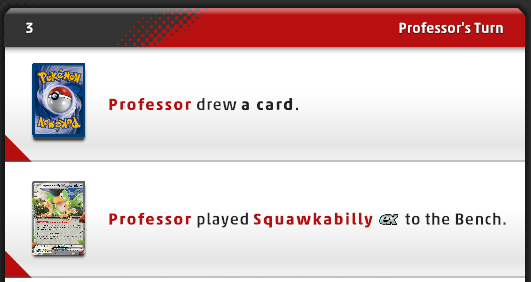
Figure 2: Professor Fir’s AI benches Squawkabilly ex on turn three despite its primary Ability no longer being usable, occupying Bench space that could otherwise be allocated to a higher-value option such as Fezandipiti ex. Source: Screenshot captured by the author in Pokémon Trading Card Game Live (2023).
There is an exception made for cards with wheel effects such as Lillie's Determination, Squawkabilly ex's Squawk and Seize, and Professor's Research. Professor Fir will wait to use these types of effects until he has no other options left.
It is highly possible that, besides waiting to use wheels, he is choosing the order to use these effects randomly, because there doesn't seem to be any discernible pattern. I'm more willing to forgive this since the tutorials up until this point haven't yet covered sequencing.
Priority 2: When playing a card, Professor Fir will also choose the maximum number of options for that card, even if they are detrimental to him.
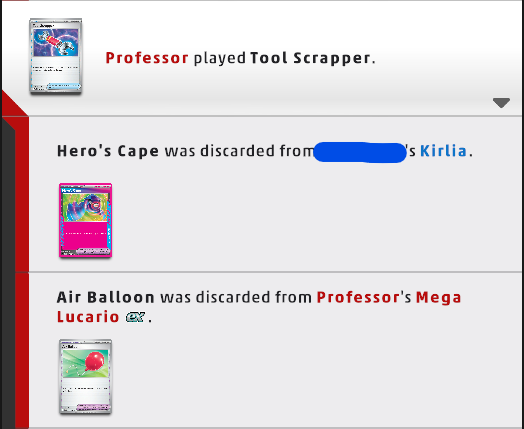
Figure 3: Professor Fir’s AI uses Tool Scrapper to discard both an opponent’s Tool card and its own Air Balloon despite the latter providing a beneficial effect. The example illustrates a target-selection strategy that prioritizes maximizing the number of legal targets rather than evaluating their strategic value. Source: Screenshot captured by the author in Pokémon Trading Card Game Live (2023).
Priority 3, or lack thereof: Fir does not prioritize attaching Energy to and then attacking with Mega Lucario ex, the primary attacker and namesake of his deck.
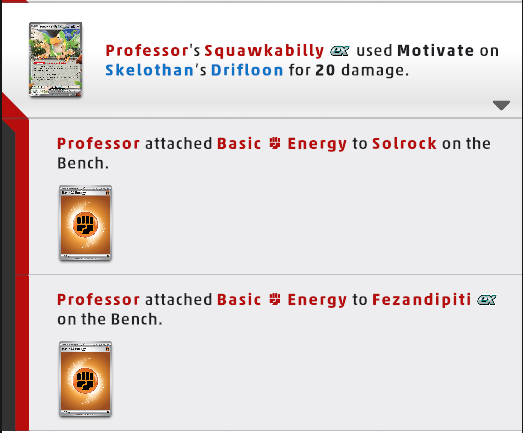
Figure 4: Professor Fir’s AI attacks with Squawkabilly ex and allocates additional Energy to Solrock and Fezandipiti ex instead of supporting Mega Lucario ex, the deck’s primary attacker. This decision illustrates the AI’s failure to identify and prioritize its most effective offensive strategy. Source: Screenshot captured by the author in Pokémon Trading Card Game Live (2023).
That last priority is especially egregious because the exact same deck is used by the player in prior lessons, and attacking with the Mega Lucario is specifically emphasized in those lessons. Fir’s play patterns actively contradict a lesson previously taught to the player.
The end result of these priorities is that Fir, trying to make as many moves as possible, will both make unnecessary moves that actively make his position worse and will make obviously suboptimal moves that the player will know are bad because the prior lessons demonstrated what he should have been doing instead. The Professor playing like this undermines his role as a capable instructor and calls into question the quality of the previous lessons. A more capable AI would be better able to demonstrate good play patterns to a new player.
One might argue that this battle isn't supposed to be challenging. I agree, but even if this lesson is meant to be easy, there's still no reason for Professor Fir to play this badly. The player is given a deck with an extreme advantage against Fir's in this scenario. So long as the player has learned the basic rules of the game, they should be just fine regardless.
An even more capable AI would be able to demonstrate higher-level concepts than what this lesson covered, and, if sufficiently strong enough, could be used by bot players in the match queue during low traffic hours in order to reduce queue times. Is it feasible to create one? Well, there's been a lot of work done on trying to create super-smart opponents in other games. Let's look at those.
Prior Work On Highly Intelligent Turn-Based Game AI
Highly intelligent AI for turn-based games have been created before. Chess is a famous example, with many chess-playing algorithms created since the 1950s. Chess engines soon eclipsed human players in ability and began to be used by beginners and grandmasters alike as study aids. Other algorithmic projects aimed at analyzing more complicated games were also developed around this time, such as Mogo for Go and Quackle for Scrabble and similar crossword games.
Chess engine development then pivoted to produce the strongest possible engines. Machine learning technology was a driving force behind the strongest developments, revolutionized turn-based game AI, and this is where my research interest lies. AlphaZero arrived on the scene in 2017 and soundly defeated the then-best chess engine Stockfish in over 100 games. Another AI of particular note is Future Sight AI, trained on Pokémon Sword and Shield (2019) single battles, as an example of this approach working in a turn-based RPG format.
Some intelligent turn-based game AIs have been created for academic purposes as well. Models have been trained on small recreations of existing TRPGs such as Final Fantasy: Tactics (1997) and Fire Emblem Heroes (2017) as a means of studying how players react to more intelligent opponents in games. More on them later.
It should be noted, however, that all of these video game examples were trained by third parties and were not involved with the original game's developers. Actual implementations in games appear to be rare. The only specifically machine learning approach I have found that involved a collaboration with an original game's developer was this paper describing a Chinese-only mobile game called StoneAge 2 (石器时代). This paper is mostly concerned with the ML model's performance, but it does claim that the model was productionized in the game with the intended goal of having it cover for a human player in the event they disconnect from their opponent. This isn't quite filling the role of a competent computer opponent, but it's certainly a step in the right direction.
Conclusions and lingering questions:
There are two main research questions to be answered:
1. Do players find intelligent CPU opponents more fun?
The papers mentioned earlier that were studying player reactions to intelligent TRPG opponents, while fairly preliminary, show early promising signs. The Fire Emblem paper trained the AI to mimic their human opponents' tactics, which, despite some participants recognizing what was going on, was overall considered to be more engaging than the algorithmic AI in the control.
The Final Fantasy Tactics study instead aims to ask the question of whether an AI can be trained to mimic its opponents' skill level in order to keep the player engaged. The resulting model was able to keep pace with its opponents... but its opponents were only other computers, so it's more of a study of technical feasibility than enjoyment. On the board game side, there is also Allie, a chess engine specifically trying to mimic human play patterns instead of maximizing winning chances, which appears to be a popular opponent on Lichess.
As all of these cases cover short bursts of play in clearly board-game like settings, this leaves a notable gap in the research: do players continue to find intelligent CPUs as engaging opponents in a longer-form, narrative RPG setting? Can intelligent enemy behavior enhance the narrative appeal of a game? Would players get fatigued by having to fight against highly competent opponents frequently over a long period of time? These questions remain unanswered.
2. How flexible would such an AI system be to rule changes?
This question has a few specific goals. If our hypothetical turn-based game AI were able to adjust to changes in the game environment, it would enable us to make balance patches to a game after release and have the AI adjust to those changes with minimal retraining. If the AI can be trained early, it could also be possible to use it as a tool to identify game balance problems during development and adjust accordingly.
The StoneAge 2 research team, in their own prior research, found that most of the prior AI systems were highly specialized at a certain task, and as a result set out to build a more flexible model. The paper does not discuss balance patches, so it's unclear to me whether their model is resilient enough to still function well under such conditions.
On the board game side, current iterations of the Stockfish chess engine (historically an algorithmic chess engine) use an ML-based approach. Stockfish has a variant called Fairy-Stockfish that is specialized in playing chess variants such as fairy chess (unusual pieces), atomic chess (captures destroy nearby pieces), regional variants such as shogi, and more. It's possible to define custom variants that Fairy-Stockfish will play effectively with no retraining, suggesting that it is somewhat resilient to additional rules. Hopefully, a similar approach could be taken with an AI for turn-based RPGs.
Next Steps
I'm an engineer at heart: if I want to see something made, I should build it myself. So, the next steps should involve making a traditional turn-based RPG prototype, and to simultaneously create a machine learning model that can interface with said prototype, analyze the game state, and then choose a move. Such a prototype would enable the exploration of the above research questions. If results are promising, the prototype could become a framework for a publishable game! If not, shucks — but at least we'll have a better understanding of what shortcomings need to be overcome to get smarter opponents in traditional RPGs.
-
aed3. “Future Sight AI.” Smogon Forums, August 16, 2020. https://www.smogon.com/forums/threads/future-sight-ai.3668916/.
Bolding, Jonathan. “After a Decade of Stale Turn-Based Tactics, Menace Is a Breath of Fresh Air.” Strategy. PC Gamer, February 24, 2026. https://www.pcgamer.com/games/strategy/after-a-decade-of-stale-turn-based-tactics-menace-is-a-breath-of-fresh-air/.
Chess.com. “AlphaZero.” Chess.Com. Accessed March 1, 2026. https://www.chess.com/terms/alphazero-chess-engine.
Edwards, Benj. “A Brief History of Computer Chess.” PCWorld, May 6, 2013. https://www.pcworld.com/article/451599/a-brief-history-of-computer-chess.html.
Ferrero, Álvaro, Jose Barambones, and Juan Cano-Benito. “Exploring the Integration of Large Language Models and Monte Carlo Tree Search in Team Formation for Turn-Based Games: A Case-Study with the VGC AI Competition.” IEEE Transactions on Games, 2025, 1–11. https://doi.org/10.1109/TG.2025.3613232.
Fichter, Fabian. “Fairy-Stockfish.” Fairy-Stockfish. Accessed March 1, 2026. https://fairy-stockfish.github.io/.
Google DeepMind. “AlphaZero and MuZero.” Accessed April 7, 2026. https://deepmind.google/research/alphazero-and-muzero/.
Katz-Brown, Jason, and John O’Laughlin. “Quackle - Kwak!” Accessed March 1, 2026. https://people.csail.mit.edu/jasonkb/quackle/.
“MoGo at Sensei’s Library.” Accessed April 7, 2026. https://senseis.xmp.net/?MoGo.
Mystereave. “*Spoilers* Is Such a Fun Fight, Honestly. - Shin Megami Tensei V.” GameFAQs Forums, July 19, 2024. https://gamefaqs.gamespot.com/boards/204211-shin-megami-tensei-v/80813236.
Potisartra, Kittisak, and Vishnu Kotrajaras. “An Evenly Matched Opponent AI in Turn-Based Strategy Games.” 2010 3rd International Conference on Computer Science and Information Technology, July 2010, 42–45. https://doi.org/10.1109/ICCSIT.2010.5564451.
Sapio, Amanda and Carnegie Mellon University. “Allie, an AI Chess Bot, Learns to Play like Humans from 91 Million Lichess Games.” TechXplore, August 17, 2025. https://techxplore.com/news/2025-08-allie-ai-chess-bot-play.html.
Smid, Yanna Elizabeth, Peter van der Putten, and Aske Plaat. “Mirror Mode in Fire Emblem: Beating Players at Their Own Game with Imitation and Reinforcement Learning.” Version 1. Preprint, arXiv, 2025. https://doi.org/10.48550/ARXIV.2512.11902.
Square Enix 1st Production Department and Virtuos. Final Fantasy X/X-2 HD Remaster. Square Enix, released April 16, 2019. Nintendo Switch.
Stockfish. “Stockfish 16.1.” February 24, 2024. https://stockfishchess.org/.
“Supercomputer Beats Go Professional.” 2008. https://web.archive.org/web/20090101023512/http://www.cs.unimaas.nl/g.chaslot/muyungwan-mogo/.
The Pokémon Company International. Pokémon Trading Card Game Live. V. 1.35.0. The Pokémon Company International, released 2023. Windows, Android.
Zhang, Like, Hui Pan, Qi Fan, Changqing Ai, and Yanqing Jing. “GBDT, LR & Deep Learning for Turn-Based Strategy Game AI.” 2019 IEEE Conference on Games (CoG), August 2019, 1–8. https://doi.org/10.1109/CIG.2019.8848103.