
This is part 2 in a two-part series on digital engagement and experience design in museums. Part 1 explores the Museum of Old and New Art (MONA) in Tasmania, Australia as a case study for visitor engagement.
As museums seek to increase engagement in both the physical museum space and across digital platforms, many are striving to create more personalized experiences that differentiate the museum visit and increase engagement with the institution and its collection. These two case studies—the Museum of Old and New Art in Tasmania, Australia, and the Cooper Hewitt Smithsonian Design Museum in New York—are examples of hybrid museums that successfully demonstrate how bridging the physical and virtual in the museum visitor experience can increase the length, breadth and depth of engagement.
Case Study II: Cooper Hewitt, Smithsonian Design Museum
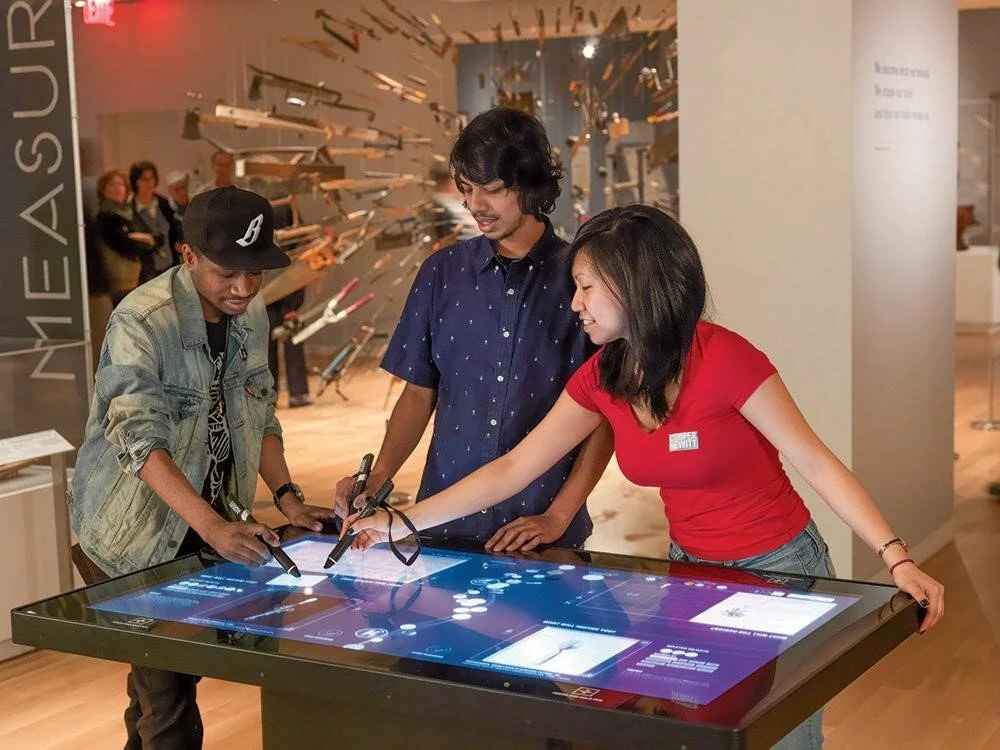
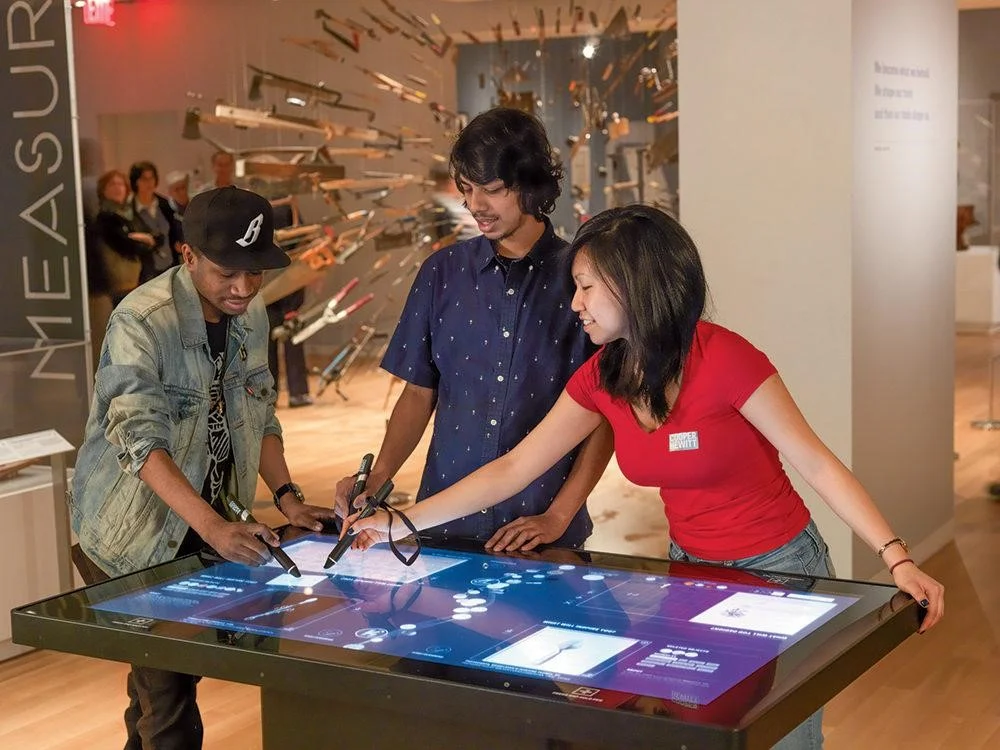
Visitors using The Pen with an interactive screen at the Cooper Hewitt Museum. Source: https://www.artinamericamagazine.com/news-features/magazines/the-public-as-producer/
Founded in 1897, the Cooper Hewitt, Smithsonian Design Museum—more commonly known as Cooper Hewitt—is the only US museum focused exclusively on historical and contemporary design. Located in New York City in the historic Carnegie Mansion on Fifth Avenue, Cooper Hewitt’s mission is to educate, inspire, and empower people through design. The museum owns a collection of more than 210,000 objects spanning 30 centuries of design history in four curatorial departments—Drawings, Prints and Graphic Design, Product Design and Decorative Arts, and Textiles and Wall Coverings—all fully digitized and available online.
Much has been written and made available about Cooper Hewitt’s transformation between 2011 and 2014, where the museum spent $81 million to expand and renovate its physical space while also integrating new interactive technologies that have made it a pioneer in digital museum strategy. Prior to the project, the museum had struggled with a lack of adequate space in its historic building, allowing it to display less than one percent of its entire collection at any given point in time. Additionally, despite its affiliation with the Smithsonian and status as a national design museum, audience research in 2010 showed that the average visitor to the Cooper Hewitt was a 55-year old woman who lived within two miles of the museum (interview with Seb Chan). Low attendance rates, coupled with the architectural limitations of the building, had given the museum a reputation as “a sleepy institution hampered by its setting in the ornate turn-of-the-century Carnegie Mansion (The New York Times).”
Fundraising for a capital campaign to expand and renovate the museum’s Fifth Avenue campus began in the mid-2000s. In 2010, Bill Moggridge, co-founder of the design firm IDEO and best known for designing the first clamshell laptop, became director of the Cooper Hewitt. Under Moggridge’s short tenure (ended tragically by his sudden death in 2012), renovating the museum became an opportunity not only to solve the museum’s challenges through architectural expansion, but also to explore the possibility of opening it up to the digital space.
Accordingly, in 2011, the museum formed a Digital & Emerging Media department with Sebastian Chan as its director. Chan’s prior experience creating open access through digitization, while Head of Digital, Social and Emerging Technologies at the Powerhouse Museum in Sydney, Australia, informed his approach to Cooper Hewitt’s digital strategy. Like Moggridge, Chan saw the opportunity to approach the issues the museum was trying to solve—expanding the museum’s capacity and increasing audience access to the collection—through the lens of connecting the physical museum experience with the digital collection. “The physical museum had a very limited capacity to tell stories or to evoke narrative or learning across the breadth and depth of the collection,” says Chan. “The ideal museum experience—be it in the digital or physical space—is one where the visitor gets to grasp, in a multisensory way, meaning, story, and purpose.”
Initial inspiration for a digital engagement solution came from the Museum of Old and New Art. In 2012, David Walsh and the Art Processors team met with the Cooper Hewitt staff to discuss MONA’s approach to the museum experience and the process that had led to the development of the O. Despite initial eagerness around the O as a potential solution, the Cooper Hewitt ultimately chose to work with architecture and design firms Diller, Scofidio + Renfro and Local Projects to apply key lessons learned from the O to the Cooper Hewitt’s needs.
Chan credits Local Projects’ founder with making the case that “when you’re in the building of the Cooper Hewitt, you want people to be doing the design, not just looking at it.” As a design museum that was founded to inspire and teach design students and professionals through its collection, any engagement tool developed for the Cooper Hewitt needed to empower people to become designers themselves. “The purpose of the museum isn’t just to look at important works of design and decorative arts from the past, but [to] inspire visitors to become designers, to have a different appreciation of design, to build a design literacy,” says Chan. For Cooper Hewitt, the goal of introducing interactive technology was “to honor that mission in a digital sense [by making] everything you did in the museum and with the collection itself useful, and to inspire people to make things from it.”

Hewitt Coopers process for designing The Pen. Source: https://mw2015.museumsandtheweb.com/paper/strategies-against-architecture-interactive-media-and-transformative-technology-at-cooper-hewitt/
After three years of development, prototyping and testing, that solution became The Pen. Rolled out in 2015, the Pen is a tool that allows users to “collect” objects throughout the museum and save them to a virtual collection that can be accessed during and after the visit using a unique code issued with the Pen to every visitor to the museum. Visitors can also use the Pen to draw on interactive touch-screen tables placed throughout the galleries, which use Netflix-style search and manipulation algorithms to connect drawn lines and shapes to related items in the collection. In the Immersion Room, visitors can explore the museum’s unique wallpaper collection, or create their own wallpaper patterns, and project them onto the historic mansion walls. Through the Pen, the visitor becomes the designer, collecting inspiration and creating designs digitally in a way that honors the museum’s mission and the original intention of the physical collection.
Behind the Pen is an entire digital infrastructure developed by Chan and his team to connect the visitor’s physical experience of the museum with its digital collection. All of the museum’s digital touchpoints—collecting objects using the Pen’s RFID (radio frequency identification) technology, browsing through the entirety of the museum’s collection of objects on the touch-screen tables—are made possible by the museum’s in-house application programming interface (API). The API connects the museum’s collections, ticketing system, and customer relation management database to enable access to just about everything in the museum through a variety of different platforms, from the website on your laptop to the in-gallery screens. Thanks to Chan’s 18 month-long mass digitization process, this means access not just to the works on display, but to all 210,000 plus objects in the entire collection.

Application programming interface (API) is central to the whole system. Source: https://labs.cooperhewitt.org/2014/the-api-at-the-center-of-the-museum/
As a digital engagement tool, the Pen demonstrates many of the lessons learned from the MONA O. Like the O, the Pen is included with a ticket to the museum and has a reported up-take rate of 96% across all age groups. This gives the museum further insight into visitor engagement, including the average length of time per visit (110.63 minutes), the percentage of visitors that didn’t collect objects (23.8%) and which works are most (or least) collected. Additionally, the museum reports that 30% of visitors access the unique URL issued with their ticket, where the objects collected using the Pen are saved for further online exploration. The museum also notes a drop in average visitor age from 57 years in 2011 to 27 years in 2014, which, as noted in a 2018 article by Slate, “is significant given that most museumgoers fall in the 45-54 range.” Interestingly, however, older visitors have also shown great interest in the Pen due to its simplicity, making it more approachable than a mobile app.
As with the O, measuring the impact of the Cooper Hewitt’s digital engagement strategy goes beyond the numbers. Bridging the physical and digital enables the museum to fulfill its mission to educate, inspire and empower its audience through design because “that process of taking inspiration to make something new is integral to the technology,” explains digital strategist Desi Gonzalez. In her 2016 article on the museum’s digital transformation, Gonzalez writes, “[t]he Pen not only facilitates the act of design, but encourages viewers to assume the mind-set of a designer (Art in America).” Even without eschewing traditional didactics as MONA did, the Pen transforms the visitor relationship with the museum by providing a unique experience that facilitates connections beyond the physical, tangible space. Chan refers to this as creating “a magic circle where visitors attain superpowers,” a recurring theme in his work in museum experience design.
Since 2015, the museum has upgraded its touch-screen tables, and there are rumors that the Pen may not be around for much longer. Chan says the Pen was designed to last two to three years, but it’s hard to imagine the museum without the stylus as an integral part of the experience. Yet despite the massive critical success of the Pen and the way it put the Cooper Hewitt on the map nationally and internationally, Chan says that change was always part of the plan to continue improving the concept underpinning the Pen of bringing the physical and digital spaces of the museum together in a way that plays to the strengths of both sides. Although the original members of the Digital and Emerging Media team that Chan assembled have all since moved on, that idea has remained core to the museum’s mission. After Chan left to return to Australian and join the Australian Center for the Moving Image as Chief Experience Officer, Cooper Hewitt hired its own CXO, Carolyn Royston, to lead the museum’s digital strategy and experience design into its next iteration.
Resources
Brown, Alan & Rebecca Ratzkin. Making Sense of Audience Engagement, 2011.
Gonzalez, Desi. “The Public as Producer.” Art in America, September 28, 2016. https://www.artinamericamagazine.com/news-features/magazines/the-public-as-producer.
“Using Interactives in Museums.” Museums + Heritage Advisor, February 21, 2014. https://advisor.museumsandheritage.com/features/using-interactives-in-museums/.