Philanthropy, giving and grants are at the front of everyone’s minds in the arts and nonprofit sectors as the holiday season approaches. November and December bring many financial opportunities for organizations, and as AI becomes more incorporated into how nonprofits run, it becomes critical to understand the role of AI in the giving season. Beyond finance, it is important to recognize other ways AI can support the arts. Researchers at CMU have developed a local AI Authentication tool that may influence how artworks are evaluated and authenticated by historians and auction houses in the future.
Giving Tuesday in the age of AI
Source: GivingTuesday
The days following Thanksgiving have slowly evolved over the years to make way for a series of financially-centered festivities. Black Friday, Small Business Saturday, and Cyber Monday lead into the non-profit focused Giving Tuesday on December 1, 2026. While many nonprofits benefit from the campaign, AI has been changing the landscape of fundraising and Giving Tuesday is not immune.
Giving Tuesday, established as a movement in 2012, has evolved into being organized by a non-profit of the same name and encourages giving to nonprofits, community organizations, mutual aid associations, or personal causes. GivingTuesday provides resources to organizations looking to participate in 2026, including their TechSoup AI Corner which aims to encourage nonprofits to use AI in their Giving Tuesday planning process. Among the other resources on the 2026 GivingTuesday page, this AI Corner is the first tab, and while it acknowledges the wide-spread hesitation that some nonprofits may feel about using AI in their organization, the centricity of the tab on the site indicates just how key the GivingTuesday nonprofit believes it to be as a part of fundraising this year.
Small teams, limited resources, and difficult time allotments are just a few of the struggles that nonprofits may face when planning for Giving Tuesday and the November to December push for year-end giving efforts. Campaign organization for nonprofits can be complicated, especially on the larger than average scale that Giving Tuesday provides the opportunity for. Use of artificial intelligence in organizing these campaigns may be appealing to nonprofits, assisting with tasks such as drafting email sequences, organizing social media content, and donor segmentation and outreach.
Giving Tuesday saw approximately $4.0 billion in donations across the United States in 2025, while Anthropic, Google, and OpenAI announced discounts to nonprofits looking to use their services on the same day. From external encouragement to internal need, the 2025 Giving Tuesday season saw the steady growth of AI’s role in the movement, with uses in donor communications, volunteer management, and program support. Forbes shared insights from multiple leaders within the nonprofit sector that shared why they chose to incorporate AI into their Giving Tuesday approach in 2025, and many of the gaps these organizations sought to fill still appear among nonprofits this year. These leaders named demand surge outpacing human ability, energy investment required for data entry, and time investment required for addressing donor questions as just a few areas they have seen AI incorporation be of use.
Thus, AI is changing what fundraising over the holidays and Giving Tuesday specifically looks like for organizations, from internal planning to strategizing for an organization to appear in a generated AI summary. To wit, Blackbaud found in May 2025 that over 80% of the surveyed nonprofits use AI in some capacity, and as efforts such as Giving Tuesday encourage further, structured adaptation of AI as a support tool, it becomes clear that use of AI is now becoming a significant aspect of the fundraising and development process for nonprofits.
Grant Writing for Artists & Non-Profits

Grant writing can be an extremely strenuous and drawn-out process for artists and nonprofits seeking funding and support for their work. With the rise of AI, conversations surrounding use of AI and local LLMs as grant writing tools quickly arose due to the appeal to many artists and nonprofits to save time and money while directing their staff’s efforts to other areas of the organization.
While general AI and local LLMs can serve similar purposes for grant writing, local LLMs are a proposed alternative for those in the arts and nonprofit sector at a lower cost and with more localized security. Knowledge barriers can be a challenge, especially for independent artists or small nonprofits with limited staff, however once a plan is made and the system, whether it be a trained AI model or a local LLM, is set up, the result can be worth the time invested.
The benefits to using these systems for grant writing do come with their fair share of caveats. Use of AI in the grant writing process should be addressed as a tool rather than a full team member replacement. Intentionality and human review are emphasized by many of those in the fields as required steps in the use of AI tools for grants in order to ensure that the end product is still up to the organization’s standards.
Funders have their own approaches and levels of acceptance regarding the use of AI and LLMs for grants applications. While some allow use with disclosure, others will not consider a grant application with any degree of AI use in the process. This variation can make it challenging for those applying for grants to use a consistent process from application to application, and is an additional demonstration of the continual need for human review and participation in the process of grant writing even for organizations using AI tools.
Artists and nonprofit organizations considering starting to use AI beyond forecasting and data analysis, be it a foundational model or a local LLM should carefully evaluate how the use of this tool will be incorporated into their processes. Funders often look for substance and uniqueness in applications, and these aspects of grant applications should remain a priority, AI use or not. There can be many benefits for AI use in the grant drafting process, however those using or looking to use it should plan out their own organization’s approach and ensure that their values and goals are still being upheld as new AI processes are adopted.
AI Painting Authentication Developments by CMU Engineers
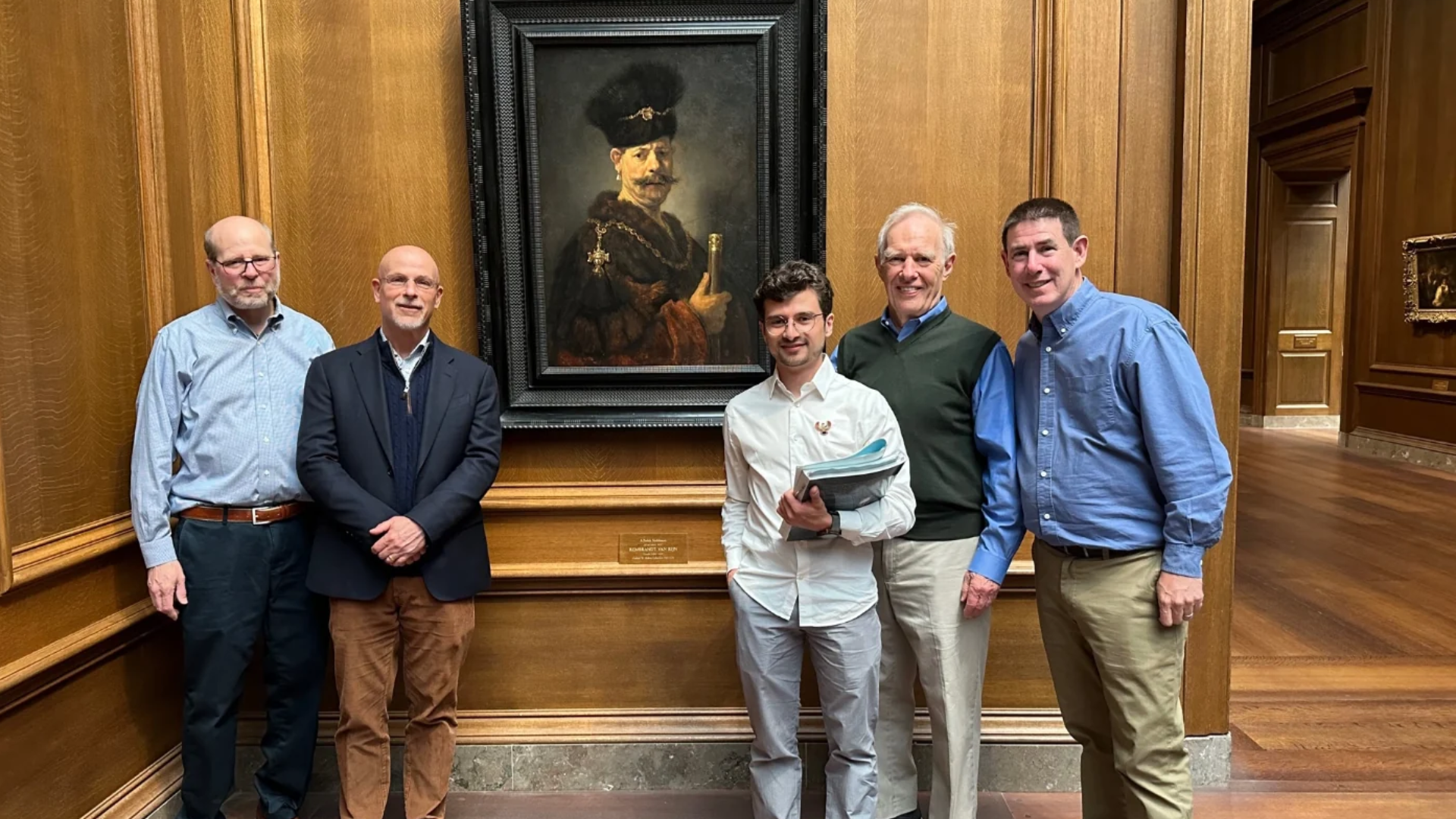
At the end of October, researchers at Carnegie Mellon University developed an AI framework that can analyze patterns in paintings related to Rembrandt to help finalize determinations of authentication. Mechanical Engineering Professors Phil LeDuc and Jon Cagan worked with alumnus Andrés Arias-Rosales and Arthur Wheelock Jr, a Rembrandt scholar, to create this AI framework and address the issue of authentication that can arise with artists such as Rembrandt whose paintings are often difficult to authenticate with confidence.
AI authentication of artwork has been a large topic of conversation for art historians and auction houses in recent years. In 2018, AMT Lab highlighted ReMasterpieces, an academic research project meant as a search database and art recreation tool for art missing due to Nazi-confiscation during World War II. Years later, 2024 saw the first AI-authenticated artworks sold in auction, three works authenticated by Art Recognition. Germann Auctions, the auction house selling these artworks, expressed confidence in the authentication service and shared that use of AI did not put off potential buyers.
Art Recognition and similar services have been in the market for years, however over time there has been no lack of controversies surrounding AI authentication. With Art Recognition charging around $2,200 per work authenticated, AI authentication can often be popular as an affordable option. Auction houses and buyers are still hesitant about AI authentication use in sales, however more and more cases are appearing where services such as Art Recognition are playing a role in records, sales, and how authentication is approached.
Algorithms can be complicated, and calculation of accuracy is vital to developing confidence levels around results. In order to build a more confident model, the researchers at CMU worked with Wheelock and studied the paintings themselves as a part of the process, digitizing 311 authenticated Rembrandts that were used in the AI framework. A key piece of this new authentication process is the exposure of how the AI is making determinations about the works. By highlighting which aspects of the painting draw the most analytical attention and reporting confidence scores, researchers are then able to understand the process of the AI. The team emphasizes that the AI tool is meant to be used in addition to X-rays, historical research, and other authentication methods to ensure confident results.
-
Arias-Rosales, Andrés, Arthur K. Wheelock, Jr., J. Kenneth Moritz, and Jonathan Cagan. “Rembrandt through the eyes of the machine: Toward explainable Human–AI collaboration in painting attribution.” PNAS, October 26, 2026. https://www.pnas.org/doi/10.1073/pnas.2626989123.
Blackbaud. “The Status of Fundraising 2025: Global Research Insights on Fundraising in the AI Era.” June 19, 2025. https://blog.blackbaud.com/the-status-of-fundraising-2025/.
Brahami, Lyna. “Can AI Authenticate Art? What an Algorithm Can and Cannot Verify Before You Bid.” LLB Auction, November 5, 2026. https://www.llb-auction.com/insights/the-saleroom/provenance-and-condition/can-ai-authenticate-art-what-an-algorithm-can-and-cannot-verify.
Colone, Terri, and Colleen Engelbrecht. “Grant Writing And Pickleball: Don’t Get Called For A Fault.” The NonProfit Times, November 3, 2026. https://thenonprofittimes.com/npt_articles/grant-writing-and-pickleball-dont-get-called-for-a-fault/.
GetGrant. “AI in grant applications: what funders allow and prohibit in 2026.” October 31, 2026. https://getgrant.ua/en/blog/ai-in-grant-applications-funder-rules-2026/.
GivingTuesday. “About GivingTuesday.” Accessed November 12, 2026. https://www.givingtuesday.org/about/.
GivingTuesday. “Frequently Asked Questions.” Accessed November 12, 2026. https://www.givingtuesday.org/about/faq/.
GivingTuesday. “Generosity Sweeps the Globe: Participation and Donations Rise on Another Record-Breaking GivingTuesday.” December 3, 2025. https://www.givingtuesday.org/blog/2025-results/.
GivingTuesday. “Get ready for GivingTuesday 2026.” Accessed November 12, 2026. https://www.givingtuesday.org/participate/.
Landram, Kaitlyn. “Seeing Rembrandt through the eyes of a machine.” CMU College of Engineering, Accessed November 12, 2026. https://engineering.cmu.edu/news-events/news/2026/10/26-seeing-rembrandt.html?utm_id=using+AI+to+uncover+patterns+hidden+in+centuries+old+paintings.
Lawson-Tancred, Jo. “First A.I.-Authenticated Artwork Sells Big at Auction in ‘Pivotal Test Case’.” Artnet, December 5, 2024. https://news.artnet.com/market/first-a-i-authenticated-artwork-sells-big-at-auction-in-pivotal-test-case-2580910.
Mason, Joshua. “AI for Year-End Giving: How Nonprofits Use AI to Run a Stronger Giving Tuesday and December Campaign.” Faithline AI, October 30, 2026. https://www.faithlineai.com/blog/ai-year-end-giving-nonprofits.
McLennan, Morris. “How Can Artists and Non-Profits Use Local LLMs to Save Time with Grants?” AMT Lab, November 10, 2026. https://amt-lab.org/reviews/2026/1/artists-nonprofits-grant-writing-llms.
Pande, Janaki. “Was it Rembrandt or his student? AI tool offers clues to an old art mystery.” The Print, October 27, 2026. https://theprint.in/science/rembrandt-student-ai-tool-old-art-mystery/3082614/.
Perlo, Jared. “Anthropic offers nonprofits discounts for Giving Tuesday.” NBC News, December 2, 2025. https://www.nbcnews.com/tech/tech-news/giving-tuesday-ai-anthropic-offers-nonprofits-discounts-rcna246770.Rosica, Chris. “What Nonprofits Need To Know About AI-Powered Grant Writing.” Rosica, Accessed November 12, 2026. https://www.rosica.com/2026/11/05/what-nonprofits-need-to-know-about-ai-powered-grant-writing/.
Wingard, Jason. “AI Agents Took Over Giving Tuesday. Here’s What Comes Next.” Forbes, December 3, 2025. https://www.forbes.com/sites/jasonwingard/2025/12/02/ai-agents-took-over-giving-tuesday-heres-what-comes-next/.