
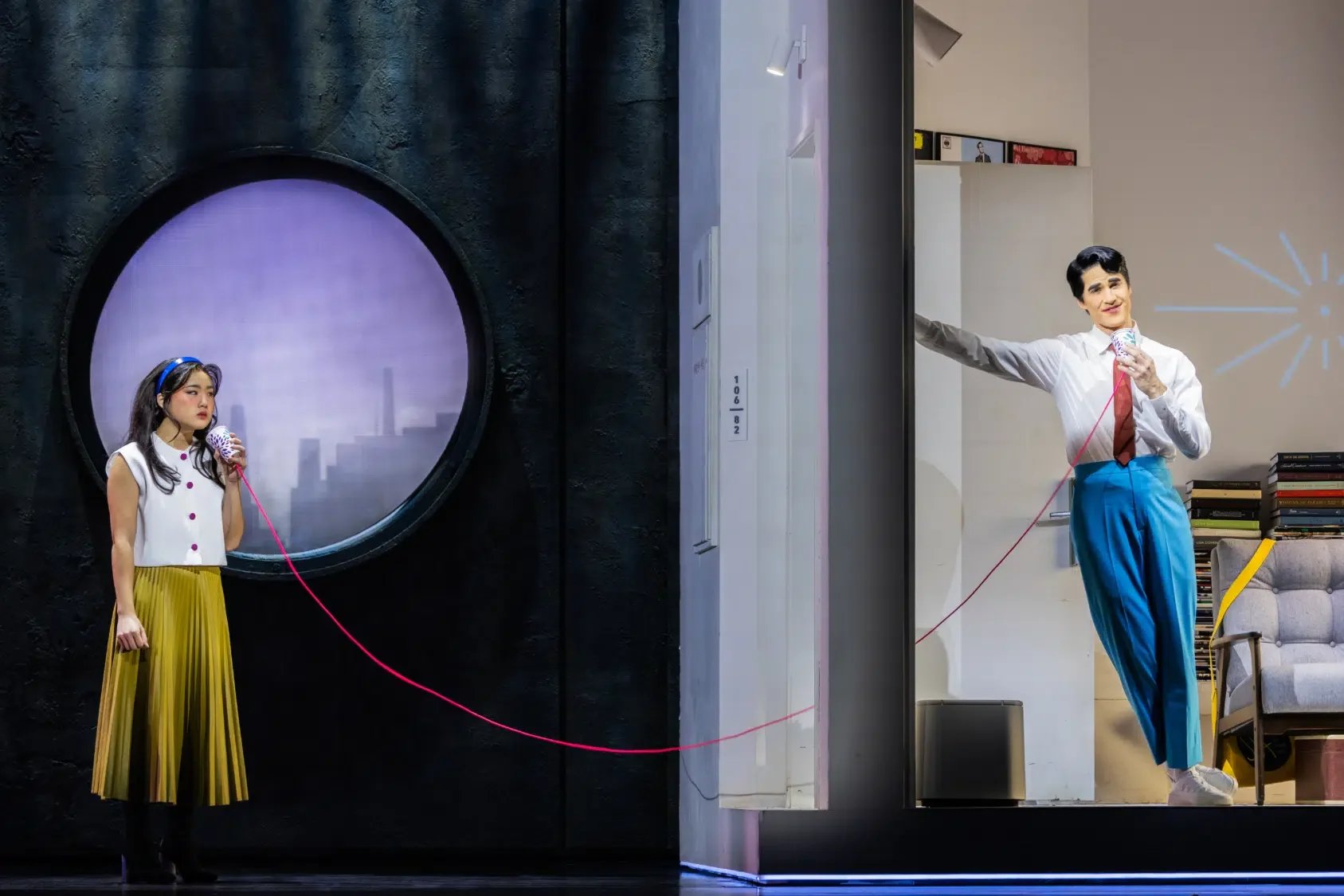
What does it mean to be human? This is the question that theatre tackles as an art form. Theatre is an expression of the human experience and, in most cases, a reflection of society that explores the tangible and intangible realities of our world. This is also the framing around the rise of technology as narrative in both the theme and practice (through video and media design) on Broadway.
How can Broadway embrace technology as both a dramaturgical and production practice to mirror the evolving digital era? This study explores how it can and should be directly tied to a show’s dramaturgical context.
As a commercial industry, Broadway primarily looks to create a spectacle that resonates with audiences. Today, audiences live in a digital world. However, in order for theatre to truthfully explore the complexities of the digital era, the story itself must, or at least often, require media technologies to emphasize its message and play a role within its dramatic action. Therefore, to ensure these technologies are not all for spectacle, the industry and its artists must find a balance between utilizing high-tech in production and conveying its dramaturgical purpose in the context of a theatrical work, be it a play or musical.
To understand how technology should function in theatrical storytelling, it is necessary to review what the foundations of digital media are in the theatre space, how theatre makers have portrayed aspects of the digital era, and what the ongoing discourse within the industry is on this topic.
The perspective of theatre makers is especially vital to understanding the motivation behind the practice of technology as narrative. This research includes ideas and direct quotes from an interview with Kolton Cotton, a professional video and media designer, who recently worked on Eureka Day at City Theatre.
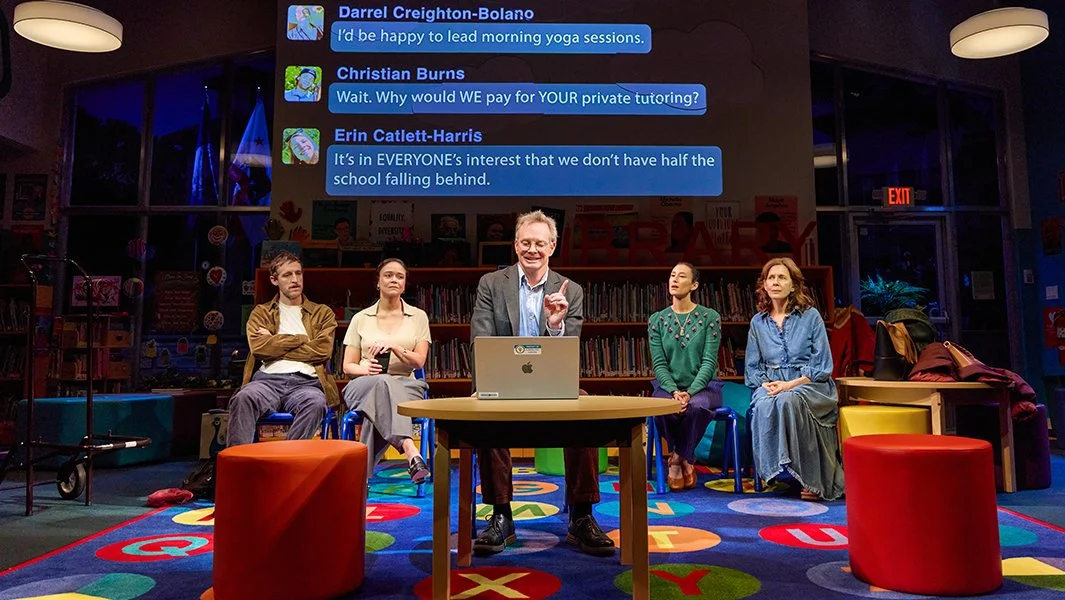
The Broadway production of “Eureka Day” by Jonathan Spector at the Samuel J. Friedman Theatre.
Photo by Jeremy Daniel.
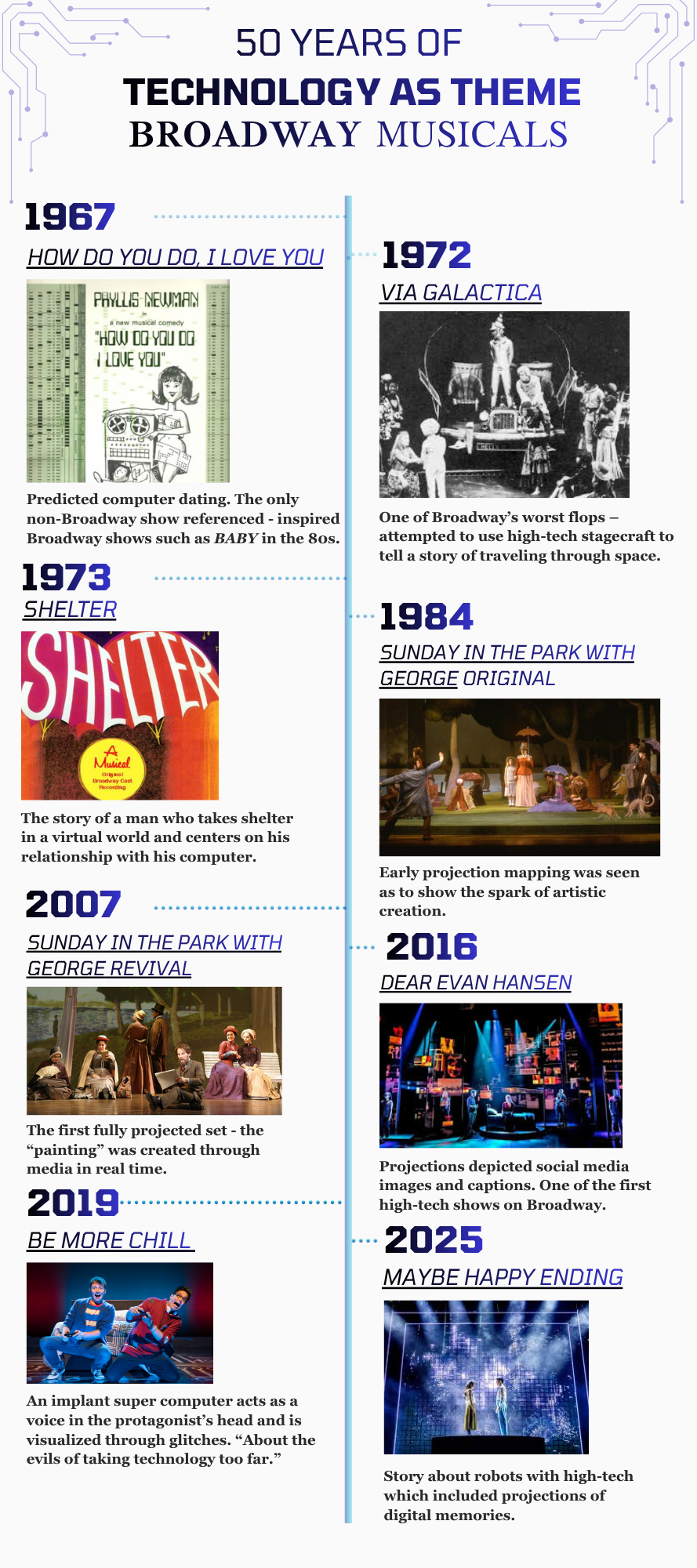
An infographic depicting the evolution of technology as theme on Broadway, specifically in musicals, since 1967 and leading up to 2025. Photo sources are included in the bibliography.
This research also analyzes productions that have successfully aligned dramaturgy with technology’s presence on stage, including three case studies of Broadway shows that opened within the past seven years: Dear Evan Hansen, McNeal, and Maybe Happy Ending. Two of the productions are from last season (2024-2025), and one is from 2018-2019. These case studies include a dramaturgical analysis of the respective productions and the ways in which each incorporates technology as narrative.
HIGH-TECH ON STAGE & ITS SURGE ON BROADWAY
Video and media design in performance has existed since the 1920s, such as Erwin Piscator’s early use of projected videos in the background of his staging. The integration of technology in performance has evolved over the past century, but there was a notable increase in digital media beginning in the 1970s, spearheaded by the era of rock concerts. Much has changed for Broadway in the 50 years since then. From 2007 to 2010, digital media began to be officially recognized as a theatrical practice by unions and universities. Now, over 15 years later, Broadway is consistently utilizing this technology not only as a component of design, but also as a narrative tool.
Currently, the Tony Awards do not have a category for digital media and projection designers and many of these artists need to “negotiate” to be “jointly eligible with the scenic and lighting designers” (Paulson, 2025). There has been a petition from designers for this to change, and a letter to the Tonys was written saying the recognition of this medium “is often vital to productions that speak to the next generation of audiences” (Paulson, 2025). However, the Tonys have still yet to address this practice.
Broadway’s last season (2024-2025) marked a surge in “high-tech storytelling” with dozens of productions integrating gigantic screens within their scenery (Paulson, 2025). Last season, 26.8% of the 42 shows on Broadway that were eligible for the Tony Awards included high-tech as part of their narrative. While many shows also utilized other high-tech equipment such as projectors, media servers, and cameras. The surge is a consequence of the growing “affordability” and “quality” of these technologies and the societal comfort with their presence (Paulson, 2025).
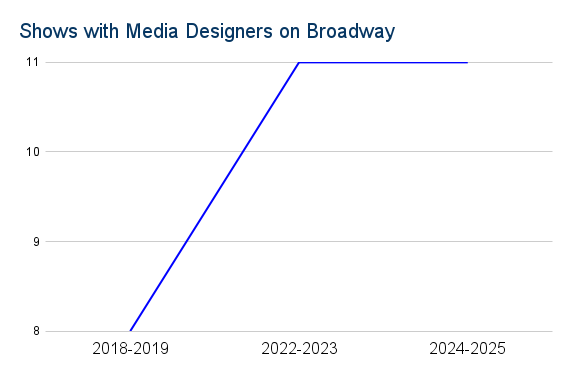
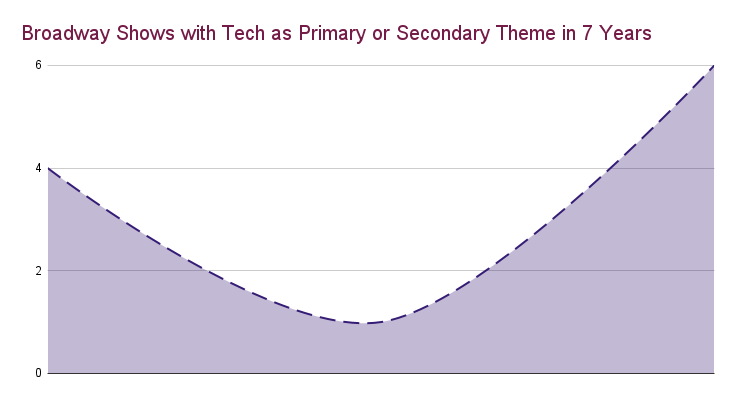
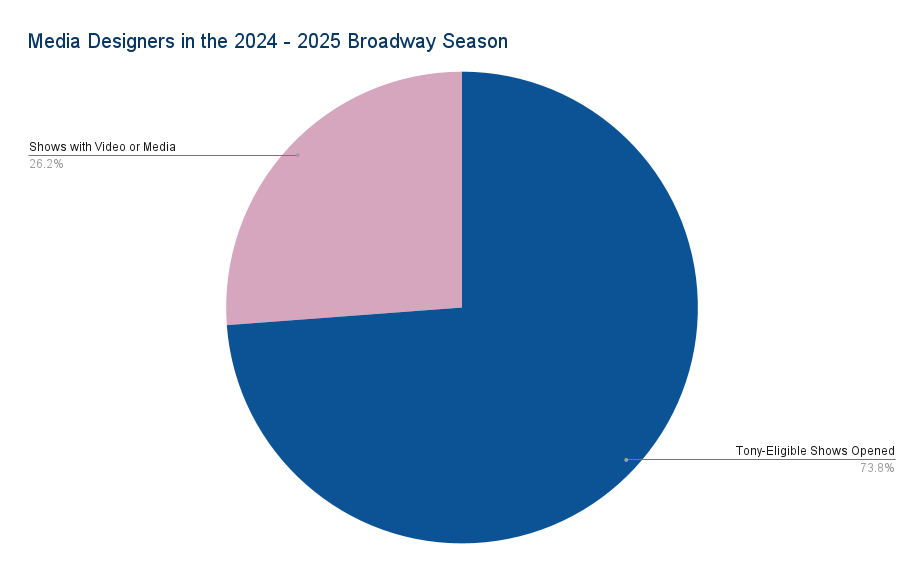
Interestingly, only 54.55% of shows that incorporated high-tech last season actually had themes of technology. In other words, the other half of shows might reasonably have taken a technology for technology’s sake approach. For example, a critic who reviewed last season’s production of Sunset Boulevard, insisted that the screen was “so big” it “almost blots out the show below” (Green, 2024). Notably, the story of Sunset Boulevard does not explicitly suggest the use of such screens nor does it discuss the technology itself.
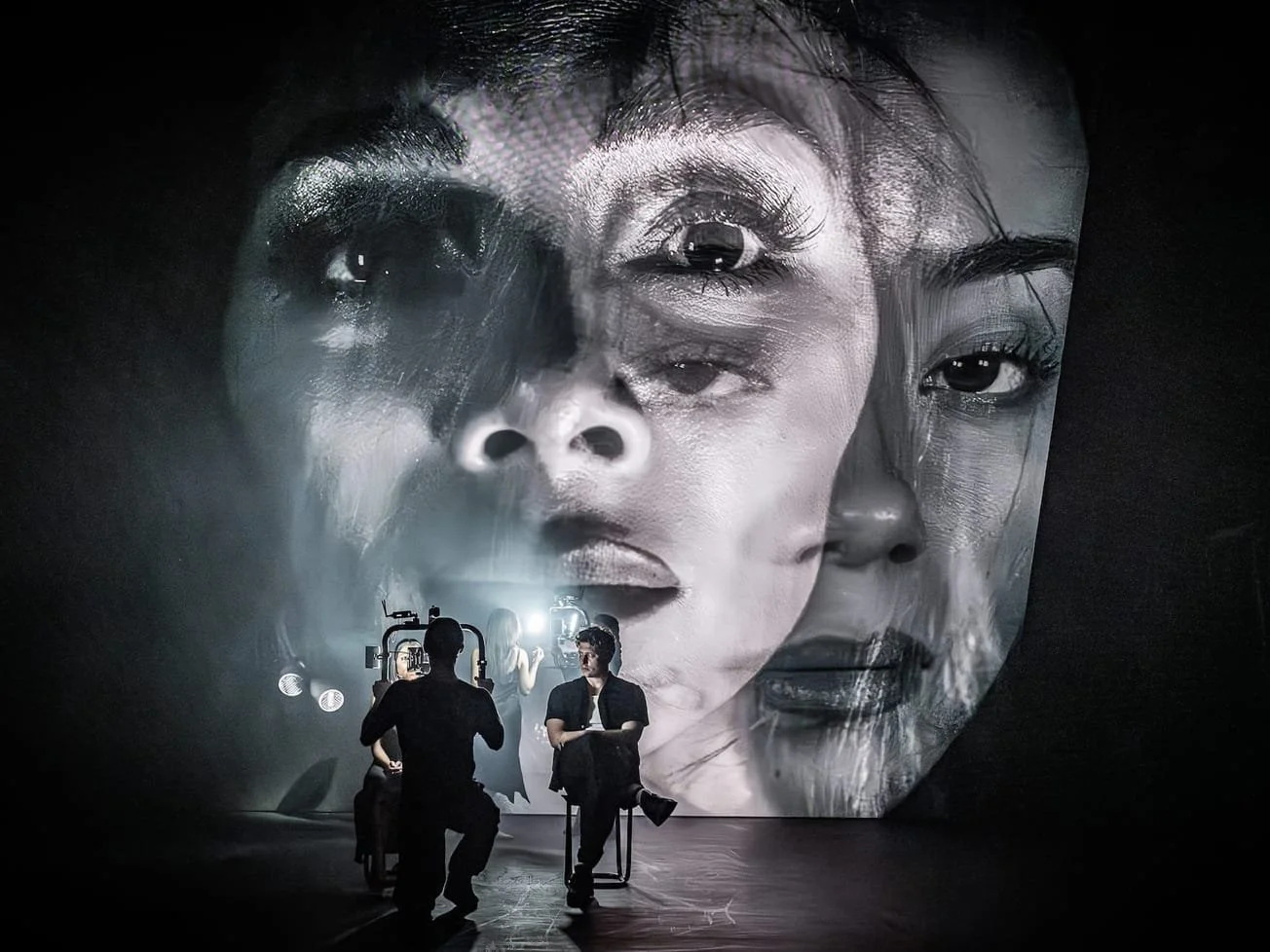
The revival of “Sunset Boulevard” on Broadway. Photo by Marc Brenner.
views on technology from the field
Technological implementations like Sunset Boulevard’s have caused some industry professionals to regard screens and projections as gimmicks, “attention-grabbing” tricks or “not deep," catering too much to the digital era instead of the stories being told on stage (Paulson, 2025). Others who agree with this idea say that digital media “ruins the liveness” of the experience of theatre and that a “firm division” should be established between live theatre and the world of screens (Fine, Oliszewski, Roth, 2025).
On the other hand, theatre makers acknowledge that high-tech integrations can strengthen shows, specifically when they are “suggested by the stories” (Paulson, 2025). Many also recognize that incorporating screens aligns with how younger generations are consuming stories, in shorter videos and images via social media. In some cases, directors and producers push for media as a way to “add production value” or “make the production more relevant to a younger audience,” encouraging alignment with the digital age (Fine, 2015).
TECHNOLOGY AS NARRATIVE
For high-tech to be effective in theatre, its integration must be purposeful and aligned with the show’s narrative in a way that emphasizes the meaning of its story. To not take away from the liveness of theatre, digital media should not only have a dramatic relationship with the other elements of design, but be married to the core themes of the text itself.
The study of digital media and projection design teaches that designers “should not be guided solely by the effects of the equipment” but rather focus on “the needs of the story” and the “aesthetic and dramaturgical goals” of the production team (Fine, Oliszewski, Roth, 2025). As previously mentioned, it is common for directors and producers to advocate for media for value and relevancy, which leaves some designers, such as Daniel Fine, hesitant to take this ‘technology for technology’s sake’ approach. As such, Fine often suggests that some productions “do not need media,” being more invested in how technology can serve as a storytelling device that creates “meaning” and becomes “essential to the audience experience” (Fine, 2015). Fine also emphasizes that the industry must understand not just the visual capabilities of media, but the narrative ones too.
“In order to fully achieve the infinite possibilities of storytelling we need to take the time – grounded in dramaturgy – to develop our new language. ”
INTERVIEW with production designer kolton cotton
Kolton Cotton, alum of the MFA Video & Media Design program at Carnegie Mellon University’s School of Drama, provided insight into the topic of media and theatrical storytelling. One of the reasons that Cotton enjoys media design is that it intersects with other areas of production including dramaturgy. His creative process when designing digital media for the stage “seeks to refocus the potential of media design… toward the deliberate incorporation of the artist's hand: a direct embodiment of human creativity through tactical manipulation between mediums” (Cotton, 2026).
Cotton believes that the key aspect of any production is the human collaboration behind it, which he aims to highlight with “a mixed media, collaborative approach” (Cotton, 2026). When asked his opinion on the relationship between story and technology, he replied that he views the question “through the lens of Jerzy Grotowski’s Poor Theatre, which prioritizes the actor’s presence and the simplicity of production over elaborate technological enhancements” (Cotton, 2026). To ensure that the digital elements he creates are integrated into the story, he typically asks himself whether the media design can truly “propel the story forward,” whether the text demands a “suspension of disbelief” or allows “asking the audience to look at how they are observing the mediated image,” and whether digital media is “part of the physical world of the play (diegetic)” or “psychological fragments (non diegetic)” (Cotton, 2026).
Overall, Cotton expressed a dedication to ensuring that the digital media he creates deepens the narrative for audiences rather than remaining surface-level. This is because he believes “the most resonant work will happen outside the traditional ‘spectacle’ mindset” and that the future of digital media in theatre is heading “toward systems design that enhances traditional elements” (Cotton, 2026). Cotton believes that as digital media matures as an element of stagecraft, the quality of a great technician will be subtlety rather than spectacle.
Cotton's insights and process inform us that a narrative-centric approach is key to incorporating media in the theatrical space. Moreover, theatre is a very collaborative art form, and Cotton acknowledges that though media is capable of being spectacle, it should work alongside the other elements of design to drive a narrative, rather than take its own spotlight. Cotton’s description of successful digital media design provides three criteria by which the following case studies can be analyzed: how tightly is the technology integrated into the show, how is it supporting the narrative, and how is it supporting the actors?
CASE STUDIES
DEAR EVAN HANSEN
Dear Evan Hansen is often referred to as the “first great American musical about social media” that successfully conveyed the realities of being a teenager in the digital era by incorporating media in its staging (Jones, 2016). Opening on Broadway in 2016, the show’s subject matter is also timely, as the musical conveys the harsh realities of a teenager’s life in the age of social media.
“Dear Evan Hansen revolves around a teenage boy named Evan Hansen who has severe social anxiety. As assigned by his therapist, he writes letters to himself in order to build up his confidence. One day, his letter ends up in the hands of a student named Connor Murphy, who takes his own life. When Connor’s parents call Evan to the office to give him the letter ‘addressed’ to him, Evan finds himself caught in a whirlwind of events, leaving him in the center of it all.” – The Daily Wildcat; (Rascon, 2023)
In an interview with Jeff Kofman on StoryTech, Stacey Mindich, the lead producer of the original Broadway show, explicitly states that “social media” is designated as a “ninth character” and that “the ensemble is virtual” (Kofman, 2023). The projections, at least in the original Broadway production, are highly choreographed and are aligned with the show’s staging, acting as a vessel between reality and the online world. “It had to feel like you saw it on your screen two minutes ago,” says Mindich (Kofman, 2023).
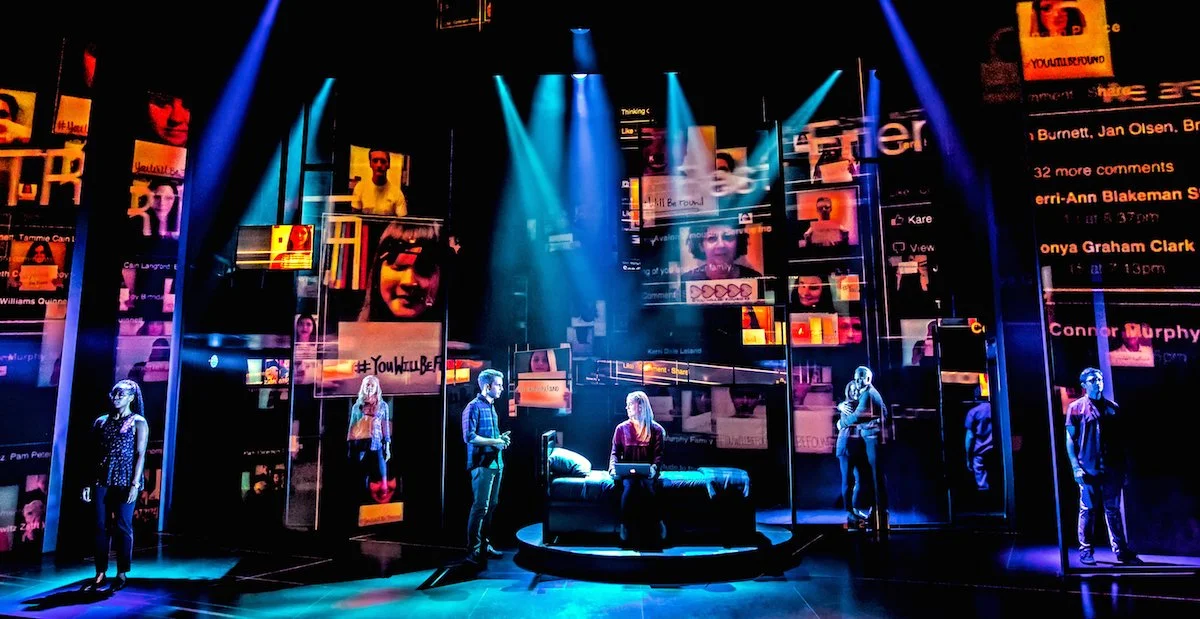
The original Broadway production of “Dear Evan Hansen.” Photo by Matthew Murphy.
The script of Dear Evan Hansen explicitly asks for the set to be “a blank, empty space, filled with screens” and throughout the play, directs those screens to “hum and buzz to life” (Levenson, 2017). Throughout the libretto, the screens portray an idea of a “virtual community” especially in musical numbers such as “You Will Be Found,” when Evan shares his letters to Connor with the world (Levenson, 2017). As the story moves along, so do the screens as a “stream” of “voices” and “messages” should begin to create “a dreamlike feel” which may be like “some kind of collective hallucination” that represents “what it would feel like to fall into the internet” (Levenson, 2017).
Towards the climax of the story, when the truth of Evan’s letters is soon revealed, the energy from the screens changes, telling a new side of the story. The libretto describes this as “voices from the virtual world begin to pile up on top of each other, stacking, accumulating, accreting” that is a contrast from the original “virtual community” suggesting it to be the opposite of communal and instead, “ravenous and cruel” (Levenson, 2017). The script’s detail gives designers a thorough understanding of how media should emphasize the narrative throughout the play.
Evan Hansen’s use of digital media is a strong example of how high-tech can be both dramaturgically critical and directly aligned with a production's story, thus connected to the script. The stream of on-screen messages serves as a chorus, framing the protagonist’s arc and driving the story forward. The tech also supports the main actor’s performance as Evan, especially when the “accumulating, accreting” voices during the climax of the story provide a lens into how overwhelmed and anxious Evan is becoming. This case study shows how Broadway can utilize high-tech as a concrete storytelling tool while maintaining relevance with the audiences of today.
MAYBE HAPPY ENDING
Maybe Happy Ending “won big” at the Tony Awards in 2025, receiving the award for Best Musical. The story of Maybe Happy Ending centers around robots, known as “helper bots,” and the cast only consists of four performers, the two others being human characters. The musical is set in 2064 in Seoul, South Korea. Interestingly, Maybe Happy Ending is often described as a “gentle, contemplative piece,” and the idea of robots did not initially draw people in (Paulson, 2025). However, when the show finally opened, the reviews were “overwhelmingly positive,” with one critic referring to it as a “darling gem” (Paulson, 2025; Kumar, 2024).
““Maybe Happy Ending is a musical set in near-futuristic Seoul, where two outdated, human-like machines called HelperBots forge a profound bond. Starting when Claire asks her neighbor, Oliver, to borrow her charger and continuing as they take a road trip to South Korea’s Jeju Island, the pair go from strangers to friends to lovers. As Oliver and Claire explore companionship and romance, they grapple with their limitations and the human emotions they’re discovering. It’s a moving tale of embracing change and finding humanity in unexpected places.” ”
Helen J. Shen and Darren Criss in the 2024 Broadway production of Maybe Happy Ending. Photo by Matthew Murphy and Evan Zimmerman.
The libretto is not yet publicly accessible. However, the high-tech within the show has been described to consist of enormous screens that “depict” the characters’ "digital memories” which is a vital aspect of the show’s plot (Paulson, 2025). Thus, the digital media is deeply connected to the story. Darren Criss, who originated a leading role in the musical, also suggests the connection to the show’s use of screens and our everyday lives.
“We talk about screens all day anyway. What’s another one on stage? ”
One potential criticism of the show is that the use of screens to portray the characters’ memories might draw attention away from the performers on stage and towards a digital representation. This is an example of how even when technology is an integral piece of the libretto and is used for narrative purposes, it may not fully support the performers. Overall, Maybe Happy Ending is a strong example of how technology as both theme and practice can be integrated together. As Broadway looks to the future, it is also a reminder that human themes also still resonate with audiences, and high-tech can play a role in emphasizing those themes too.
MCNEAL
McNeal, is a play by Ayad Akhtar that starred Robert Downey Jr. as a “novelist whose entanglement with generative artificial intelligence is woven into the scenic design” and was another 2025 Tony nominee that incorporated high-tech (Paulson, 2025). Notably, the script of McNeal demands the use of technology on stage and describes it in great detail, stating that “the projections are an essential dramatic and narrative element and should have a place and scale commensurate with their importance” (Akhtar, 2024). As the story tackles generative AI, specifically ChatGPT, the play calls for very distinct projections that depict both prompts and responses involving AI.
““McNeal, a modern morality tale, centers around the thorny implications of using artificial intelligence, particularly in writing.” ”
The play is a reflection from writer Ayad Akhtar on the realities of not only being a writer in the era of AI, but also living in the technological era. In an interview, when asked about a specific line that suggested books were being developed by AI, Akhtar explained that the question of the story is “understanding that this technology is taking over the world” (Henderson, 2024). Jake Barton, the play’s projection designer, justifies the use of high-tech screens in the show explaining that “the majority of Americans’ waking conscious moments are looking at screens” and “on one level, this is just theater naturally evolving” (Paulson, 2025).
McNeal shows us that high-tech cannot only play a role in a story, but that it can also play the role of technology itself. The technology in the show is required by the script and the way in which it is executed is a central part of the story. In this case, the technology becomes a character in itself, driving the narrative forward through its interactions with the other characters. It also supports the performers by allowing them, specifically the performer who plays McNeal, to perform alongside the projections, not forcing them to pause and wait for the spectacle.
SUMMARY OF CASE STUDY ANALYSIS
Overall, the case studies provide references for how Broadway shows can utilize technology as narrative while still resonating with audiences in a digital world. The technology is so integrated in these cases that it is directly included in the script. However, this does not mean that in order for technology to be incorporated into a show, it must live in the script. These examples reveal the extent to which dramaturgy and technology can be joined together. There is an opportunity for Broadway to convey themes through media while also using that media to serve the story and the performers on stage. Not only does the digital world resonate with audiences, but so do the stories themselves.
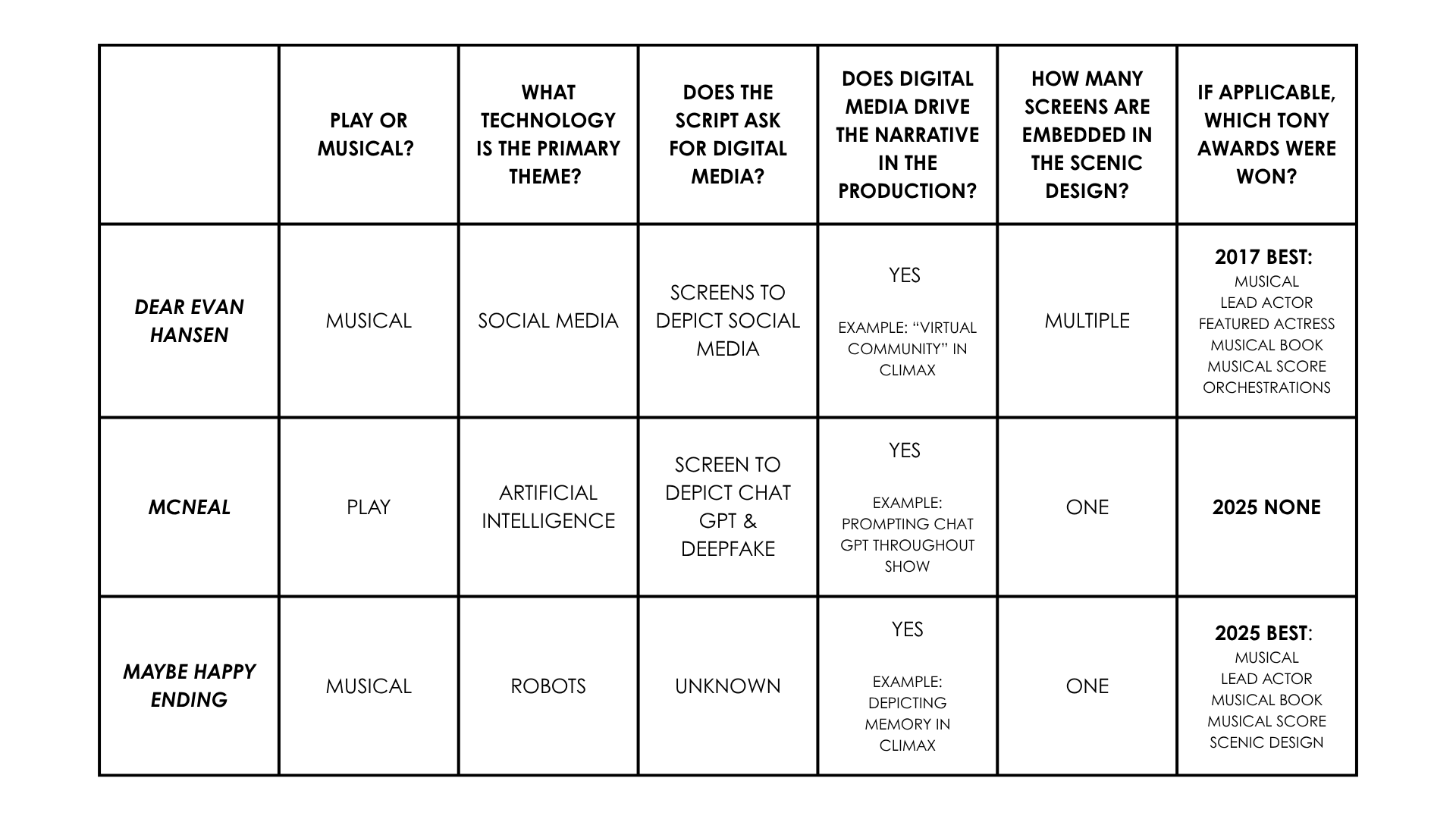
Table comparing Dear Evan Hansen, McNeal, and Maybe Happy Ending.
CONCLUSION
As more shows are produced that reflect on the complexities of the digital world, on stage digital media will only become more common. More projection and video/media designers are being credited in playbills than ever before. Additionally, technologies such as computers, projectors, media servers, and cameras have become more accessible in price and advanced in quality. It is no surprise that Broadway is responding to the digital era and making a space where screens play their own role in stories.
“And technology should come when the story tells you it should come. ”
As a consequence, it is now more important than ever that digital media integration is rooted in dramaturgy and used to emphasize narrative, not only as an aesthetic construct. As Broadway navigates the rise of technology as a primary theme, narrative and high-tech elements must be married to each other in a foundation of dramaturgy, with an understanding of when the script needs technology to push its dramatic action forward and play a part, either directly or abstractly, in its story.
In summary, Broadway’s commercial quality primarily looks to create a theatrical experience with spectacle that resonates with audiences, and in this case, audiences in a digital world. However, to truthfully convey the complexities of the digital era, the story must make space for technology to emphasize its message.
-
Akhtar, Ayad. “McNeal.” The Atlantic. 2024.
Atler, Alexandra. “How a Play About A.I. Lured Robert Downey Jr. to Broadway.” The New York Times. October 26, 2024. https://www.nytimes.com/2024/10/26/theater/robert-downey-jr-mcneal-ayad-akhtar.html?smid=url-share.
Auslander, Philip. “Liveness: Performance in Mediatized Culture.” 3rd Edition. Routledge. 2022.
Barekat, Houman. “Our Phones Are Making Us Lonely. There’s Drama In That.” The New York Times. December 10, 2025. https://www.nytimes.com/2025/12/10/arts/smartphones-onstage-porn-play-the-maids-evita.html?searchResultPosition=7.
Ben, Bratley. “Review: A High School Meltdown Heats Up in ‘Be More Chill’.” The New York Times. August 9, 2018. Photo in Infographic by Sara Krulwich. https://www.nytimes.com/2018/08/09/theater/be-more-chill-review.html.
Berger, Bennat. “The Tech That’s Bringing Broadway Into the 21st Century.” Medium. April 25, 2018. https://bennatberger.medium.com/the-tech-thats-bringing-broadway-into-the-21st-century-bc856fd5aad8.
Cash, Justin. “Erwin Piscator: Multimedia Pioneer for the Theatre.” The Drama Teacher. September 27, 2023. https://thedramateacher.com/erwin-piscator-multimedia-pioneer-for-the-theatre/.
Chandler, Clare. Scheuber-Rush, Simeon. “‘Does Anybody Have a Map?’: The Impact of Virtual Broadway on Musical Theater Composition.” Wiley Online Library. May 4, 2021. https://onlinelibrary.wiley.com/doi/10.1111/jpcu.13013.
Cotton, Kolton. Interviewed by Skyler Baker. April 1, 2026.
Cox, Nathan. “The 100 Biggest Musical Flops in Broadway History: 12. Via Galactica (1972).” August 19, 2019. https://biggestmusicalflops.home.blog/2019/08/24/12-via-galactica-1972/.
Dixon, Steve. Digital Performance: A History of New Media in Theater, Dance, Performance Art, and Installation. Cambridge, Mass: The MIT Press. 2007.
Dziemianowicz, Joe. “Everything you need to know about ‘Maybe Happy Ending’ on Broadway.” New York Theatre Guide. January 8, 2025. https://www.newyorktheatreguide.com/theatre-news/news/everything-you-need-to-know-about-maybe-happy-ending-on-broadway.
Dziemianowicz, Joe. “‘McNeal’ review – Robert Downey Jr. brings real acting chops to an AI-centric play.” New York Theatre Guide. September 30, 2024. https://www.newyorktheatreguide.com/reviews/mcneal-broadway-review-robert-downey-jr.
Fierberg, Ruthie. “How the live camera work in Broadway’s ‘Sunset Boulevard’ elevates in theatricality.” Broadway News. March 24, 2025. https://www.broadwaynews.com/how-the-live-camera-work-in-broadways-sunset-boulevard-elevates-its-theatricality/.
Fine, Daniel. “Media Design and Dramaturgy: Creating Meaning.” HowlRound Theatre Commons. August 19, 2015. https://howlround.com/media-design-and-dramaturgy.
Fine, Daniel. Oliszewski, Alex. Roth, Daniel. Digital Media, Projection Design, and Technology for Theatre, 2nd Edition. Focal Press. January 2025.
Green, Jesse. “Down By the Blue Purple Yellow Red Water.” The New York Times. February 22, 2008. Photo in Infographic by Sara Krulwich. https://www.nytimes.com/2008/02/22/theater/reviews/22geor.html.
Green, Jesse. “In ‘Sunset Boulevard,’ Nicole Scherzinger is 23 Feet Tall.” The New York Times. October 20, 2024. https://www.nytimes.com/2024/10/20/theater/sunset-boulevard-review.html?smid=url-share.
Green, Jesse. “Sunday in the Trenches with George.” The New York Times. July 28, 2021. Photo in Infographic by Martha Swope. https://www.nytimes.com/2021/07/28/theater/james-lapine-stephen-sondheim-sunday-in-the-park.htm.
Henderson, Kathy. “Playwright Ayad Akhtar on Blending Literature, Technology, and Star Power of Robert Downey Jr. in MCNEAL.” Broadway.com. October 16, 2024. https://www.broadway.com/buzz/204791/playwright-ayad-akhtar-on-blending-literature-technology-and-the-star-power-of-robert-downey-jr-in-mcneal/.
Higgins, Molly. Vizcaino, Jeffrey. “Video: Why Broadway’s Maybe Happy Ending Is an ‘Analog Story in a Digital World.’” Playbill. November 6, 2024. https://playbill.com/article/video-why-broadways-maybe-happy-ending-is-an-analog-story-in-a-digital-world.
Ignacio, Daniella. “Maybe, Maybe Not: A Casting Controversy and the Conversation It's Started.” American Theatre. August 2, 2025. Photo in Infographic by Matthew Murphy and Evan Zimmerman. https://www.americantheatre.org/2025/08/02/maybe-maybe-not-a-casting-controversy-and-the-conversation-its-started/.
Jones, Chris. “‘Dear Evan Hansen’ on Broadway gets both teens and screens.” Chicago Tribune. December 12, 2016. https://www.chicagotribune.com/2016/12/04/dear-evan-hansen-on-broadway-this-musical-gets-teens-and-their-screens/.
Kofman, Jeff. "The Stagecraft of Dear Evan Hansen." StoryTech. WAER 88.3, Syracuse Public Media. February 14, 2023. https://www.waer.org/podcast/storytech/2023-02-14/the-stagecraft-of-dear-evan-hansen.
Kumar, Naveen. “Darren Criss in a robot rom-com that will fly you to the moon.” The Washington Post. November 12, 2024. https://www.washingtonpost.com/entertainment/theater/2024/11/12/maybe-happy-ending-broadway-review/.
Levenson, Steven. Paul, Justin. Pasek, Ben. “Dear Evan Hansen.” Theatre Communications Group. New York. 2017.
Meiler, Kassie. “Social Media’s Role in the Tony Award Winning Musical, Dear Evan Hansen.” Medium. April 9, 2019. https://kassiemeiler.medium.com/social-medias-role-in-the-tony-award-winning-musical-dear-evan-hansen-fed53cc00758.
Paulson, Michael. “Broadway’s Season of Screens.” The New York Times. June 24, 2025. https://www.nytimes.com/2025/06/24/theater/broadway-ai-screens-projections.html.
Paulson, Michael. “‘Maybe Happy Ending’ Wins the Tony for Best Musical.” The New York Times. June 8, 2025. https://www.nytimes.com/2025/06/08/theater/maybe-happy-ending-tony-awards-best-musical.html.
Rascon, Tereza. “REVIEW: ‘Today is going to be a good day’ for a ‘Dear Evan Hansen’ review.” The Daily Wildcat. March 27, 2023. https://wildcat.arizona.edu/147032/arts-and-life/review-today-is-going-to-be-a-good-day-for-a-dear-evan-hansen-review/.
Rooney, David. “‘Dear Evan Hansen’: Theater Review.” The Hollywood Reporter. December 4, 2016. Photo in Infographic by Matthew Murphy. https://www.hollywoodreporter.com/lifestyle/arts/dear-evan-hansen-review-952531/.
Ryan, Patrick. "More than ever, Broadway is 'reflecting who we are' as Americans." USA Today. March 8, 2026. https://www.usatoday.com/story/entertainment/music/2026/03/08/broadway-theater-history-diversity/88553845007/.
Small, Zachary. “On the Need for a Technological Theatre.” HowlRound Theatre Commons. October 17, 2026. https://howlround.com/need-technological-theatre.
Soloski, Alexis. “This Playwright Has Seen the Future. It Isn’t Human.” The New York Times. January 5, 2026. https://www.nytimes.com/2026/01/02/theater/jordan-harrison-marjorie-prime.html.
Tepper, Jennifer Ashley. “10 Musicals About Technology That Came Before MAYBE HAPPY ENDING.” Broadway World. October 19, 2025. https://www.broadwayworld.com/article/10-Musicals-About-Technology-That-Came-Before-MAYBE-HAPPY-ENDING-20251019.
Tracy, Marc. “ How a Meeting about Vaccines Devolves, Hilariously, on Broadway.” The New York Times. January 27, 2025. https://www.nytimes.com/2025/01/27/theater/eureka-day-broadway-vaccines.html?smid=url-share.
Worthen, W.B. Theatre as Technology: Apparatus, Nostalgia, Obsolescence. Cambridge University Press. 2025.
Images Used in Timeline Graphic:
“How Do You Do, I Love You.” Ovrtur. 1967. Poster in Infographic from Ovrtur. https://ovrtur.com/production/2894884.
“Season 2024-2025.” Internet Broadway Database. Accessed on March 28th, 2026. https://www.ibdb.com/season/1297 .
“Season 2022-2023.” Internet Broadway Database. Accessed on March 28th, 2026. https://www.ibdb.com/season/1295.
“Season 2018-2019.” Internet Broadway Database. Accessed on March 28th, 2026. https://www.ibdb.com/season/1288.
“Shelter.” Playbill. Poster in Infographic from Playbill. Accessed on March 2, 2026.https://playbill.com/production/shelter-john-golden-theatre-vault-0000008421.