



Audience Engagement

An Uncontroversial Use of Cell Phones in Movie Theaters with This American Life Live

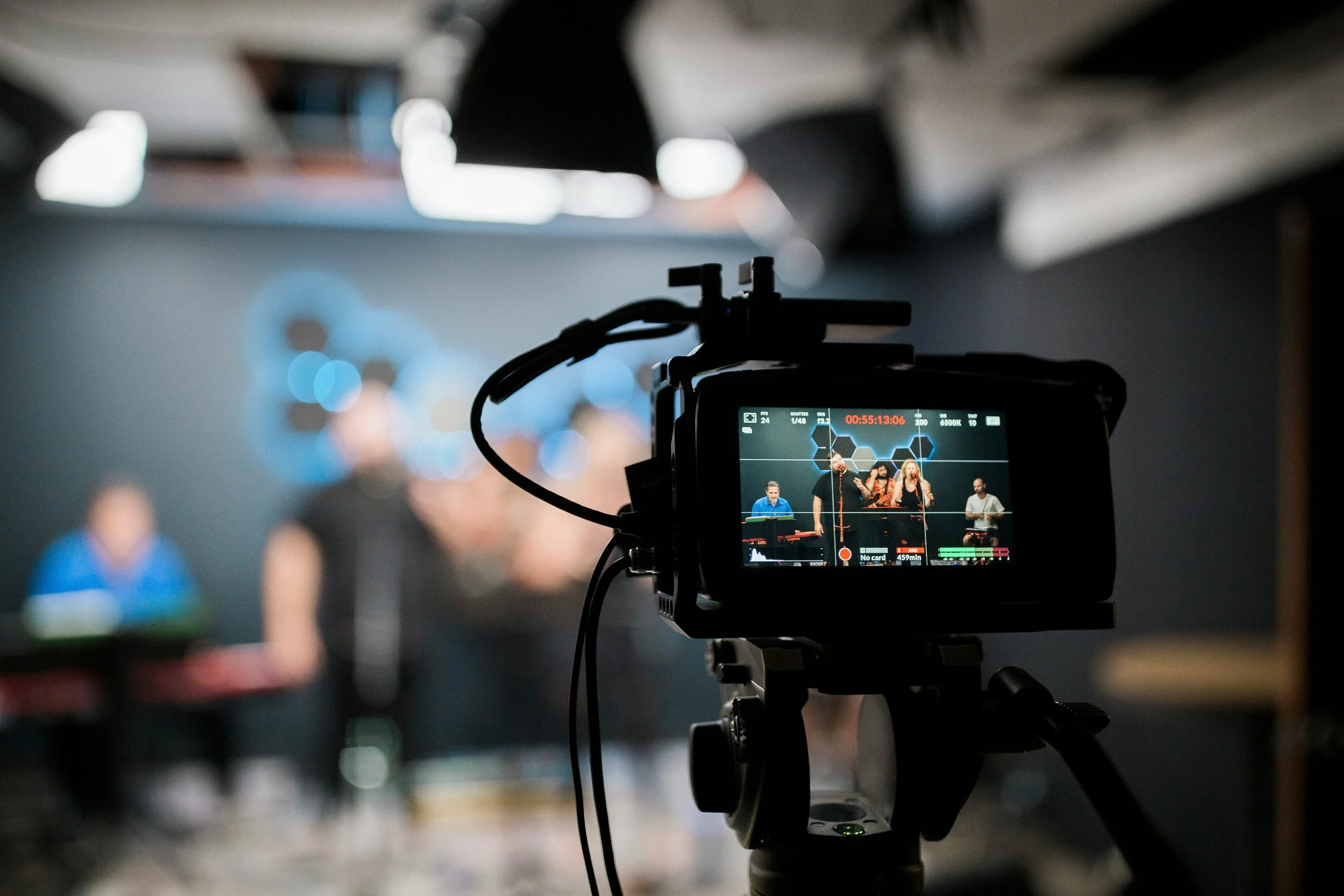
This American Life Live made us use our cell phones in theaters this last Thursday, May 10, 2012.  It was great.  In fact is was so engaging that we made music together.  The audience stomped and snapped their fingers along to music that OK Go was playing live. The instructions were:  if you have an iPhone or an Android you were to download the This American Life Live app before coming to the show.  The app was written in part by one of the members of OK Go to enable the audience to play a backup part to the music that the band was playing.  Those without smart phones had a role too.  They stopped and snapped their fingers.  The cues for this were scrolled down a split screen (with the band on the other half of the split screen) in a similar fashion to the cues for Guitar Hero or Rock Band (though actually a bit easier to read).  The warm up song was a hand bell version of Nirvana's Smells Like Teen Spirit followed by Ok GO's Needing/Getting.  The theater rang with music from over the speakers but was lent depth by the sounds generated by the mobile devices.  There was a palpable sense of excitement as people tried to keep up with the musical instructions and percussive stopping directions. It was easy to sense the engagement and the audience was giddy and laughter rang out after the collective performance.  All in all it was a great success.

The success of this event want predicated upon the idea that the rules will have to be broken.  Ira Glass stated during his introduction to the piece using cell phones that he, himself had to call the heads of two movie theater companies to clear the usage of cell phones in the theaters he was using.  The convention of not using cell phones helps to create a positive experience for other patrons during a regular show.  The usage of these devices as part of the show was a refreshing and creative way to break the rules and to let the cell phone juju out.  Interestingly after the cell phone piece no one in the audience ventured to use their phones.

Perhaps the best and most effective way to discourage cell phone use in a theater is to provide engaging and captivating content.  A sure sign that a performance is failing to engage is cell phone use which is an indicator that checking out is occurring.  A recap of the This American Life Live event has links and images of the performance including a Terry Gross and Mike Birbiglia short film which is priceless.
The O: Audience Engagement at the Museum of Old and New Art in Tasmania

A recent blog post by the Walker Art Center featured some highlights from the Museums and the Web Conference that took place in San Diego earlier this month. Among these conference notes, the audience engagement practices at the Museum of Old and New Art (MONA) in Tasmania were undoubtedly innovative. The 6000 sq ft privately owned museum, which has an “eclectic collection of 2210 antiquities and artworks,” has not a single wall label or sign to guide its visitors. Instead it relies on The O, “the first mobile interpretive solution designed to replace traditional wall labels and signage.”

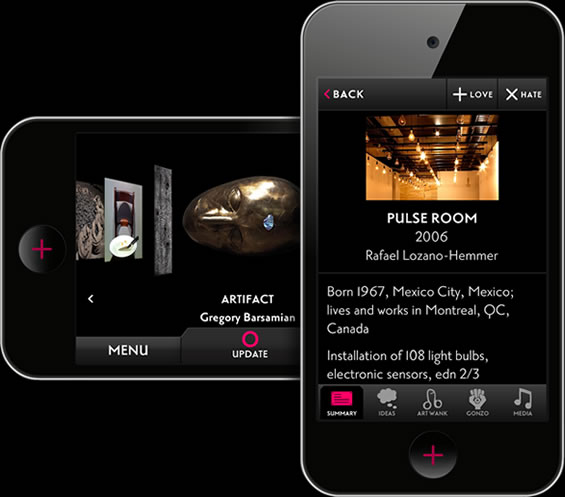
The O, a mobile device, equips a visitor with all the information they require including museum maps and cafe hours. Additionally, the O uses a visitor’s geo-location to suggest nearby artworks, allowing them to select the artworks they would like to know more about. It then goes on to provide them with curatorial information such as viewing notes and artist interviews. But even here, the approach is unique.

A visitor at the MONA recently wrote about her experience with The O and she mentioned how information on a particular artwork can be viewed in different styles. So Artwank presents you with information in “a formal curatorial style,” while Gonzo provides you with “personal musings on the art from MONA’s owner David Walsh.”

Besides curatorial information, The O lets a visitor interact with an artwork by leaving comments, tweeting about it, and sharing it on Facebook. It even has features that allow them to indicate whether love or hate it; art lends itself well to such extremes. Visitors also have the option of saving their O Tours and retrieving them the next day on MONA’s website. In fact, access to the museum’s online collection is reserved exclusively for those who saved their O Tours.

For the MONA’s curators and museum staff, The O unlocks a lot more than art. It provides them with a whole array of statistics that can be used to improve the visitor experience.The shuffled movement of MONA visitors using The O can provide stats on the most visited artworks,  the most visited rooms, artworks with most likes, the number of tours, museum traffic, repeat visitors etc. Yes, The O is for omniscient.

According to Art Processors, the creators of The O, the device is used at the MONA by over 40,000 visitors per month. Since the MONA’s opening in January, 70% of visitors have indicated that they prefer The O to traditional signage and 80% said that the device enhanced their museum experience.

http://vimeo.com/40188545

The O improves on the visitor experience in several ways. They no longer huddle around a single text panel, reading the description at unimaginable speeds. Their path through the museum is altered by The O’s suggestions, leading them in unexpected directions and towards unseen artworks. They can revisit their tour in 3D on the museum’s website.

Museums have much to benefit from a device like The O.  They may, at times, miss the reassurance of wall texts.  But they can rest assured that with a device like The O, visitors will have access to a lot more than curatorial text.  Conversely, the same visitors will leave behind a dotted trail that can be traced and analyzed by the museum. The O is for opportunity.

BMW Tate Live: An Online Space for Performance Art

On March 22nd, Jérôme Bel, a french choreographer and dancer, performed in an unknown room at the Tate Modern to an equally unknown audience. Odd as it may seem, there was not a single audience member present in the room. Those who were watching the performance were watching it online, inhabiting a newly unveiled virtual space called the BMW Tate Live: Performance Room. BMW Tate Live bannerThe BMW Tate Live: Performance Room is an innovative series of performances broadcast viewable exclusively online around the globe, as they happen.

It is the outcome of “a partnership between BMW and Tate, which focuses on performance, interdisciplinary art and curating digital space.”  Jérôme Bel’s performance was the first in a series of five online performances that will run through July, featuring the work of artists Pablo Bronstein, Harrell Fletcher, Joan Jonas and Emily Roysdon.

The idea of an exclusively online performance is perhaps more innovative than the technology being used to showcase it, a Youtube channel and a single camera. Catherine Wood, the Tate’s curator of Contemporary Art and Performance, explained in article on Artinfo that they wanted to transmit the work in the “simplest means” and a single camera essentially acted as the “fourth wall” of the performance space.

Additionally, the integration of Twitter, Facebook, and Google+, allows the audience to write comments during the performance and later pose questions to the curators and artists. This allows for the creation of a virtual audience that is connected in real-time through reactions, thoughts, and the Twitter phenomenon, hash tags (#BMWTateLive). Access to these real-time reactions from around the world truly is phenomenal and wouldn't be possible in a traditional setting. The trade-off, however, could be the evolution of an audience that tweets more than it sees, and comments more than it listens.

When asked by Artinfo on whether this online medium may take something away from a live performance, Catherine Wood replied that there has already been much debate “about how much performance documentation is the work and how much it is a record of the work.” But she added that “Live-ness is inherently mediated by technology in the world we live in now. There will always be a place for just a person in a room and a live audience, but I think this is part of the evolution of performance art that we can't ignore."

http://www.youtube.com/watch?v=kf77fzBOoNo

For those afraid of testing the niche waters of contemporary performance art, the increased accessibility and chance to experience an unfamiliar genre through YouTube cannot be ignored. A few swells of interest, a little online momentum, and the waters of performance art will seem a lot less murky or impenetrable. As of the 4th of April, Jérôme Bel’s performance has been viewed 862 times, but that doesn't take into account the number of people who watched it live.

In order to participate in the ongoing conversation, a viewer must to tune into the Tate's website or YouTube channel as the performance is being broadcast. Since the remaining performances are scheduled to take place at 20.00 hours (London), they will be most accessible to audiences in North America (~15.00 hours) and Europe (~21.oo hours), with the exception of a few arty insomniacs in Asia (~1.00 hours). But for those who may be asleep or at work, each performance is archived and uploaded to YouTube.

The next performance is scheduled for April 26 and features Pablo Bronstein, an Argentinian artist who uses “architectural design and drawing to engage with the grandiose and imperial past of the built environment.” In his performance, Bronstein “will work with up to ten dancers to create a baroque trompe l’oeil stage set that exaggerates the perspective within the Performance Room.”

If time permits, tune in to BMW Tate Live for Pablo Bronstein! You may lose your sense of perspective, but find a deeper understanding and appreciation for performance art. If time doesn't permit, don’t miss out on the opportunity to watch these performances on YouTube at a later date.