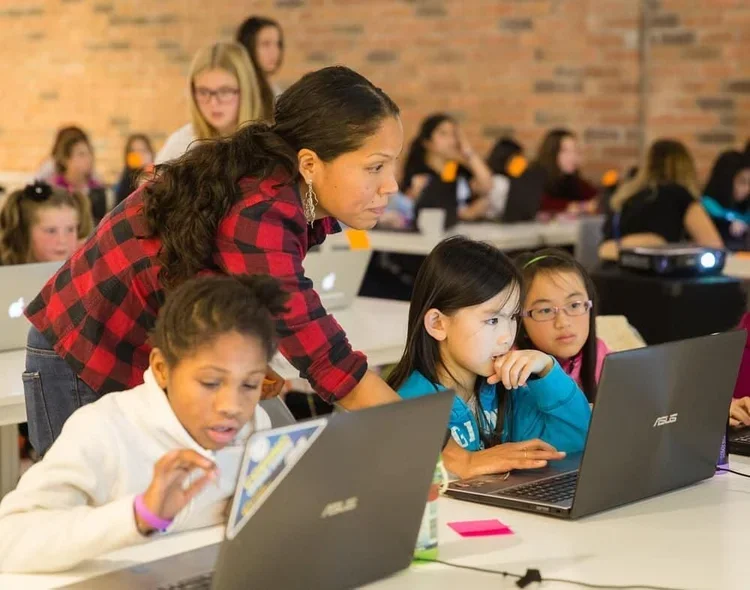
Artificial Intelligence (AI) is already reshaping how children learn — in private schools, public classrooms, homeschool environments, and museum galleries. The question is no longer whether it will arrive, but who controls it and who benefits. AI is not new. It has been part of education and research since the 1960s. The PLATO system at Stanford used AI for basic math/science, and by the 1980s, intelligent tutoring systems emerged. These AI try-outs continued across the country. For example, before the onslaught of generative AI, the Montour School District (2018) introduced a comprehensive AI curriculum (ethics, robotics) into K-12, embedding it across electives and core subjects, making it the first public school AI program. The opportunities exploded in 2022 with the rise of generative AI. Now, LLMs are not supplemental tools but are being positioned as instructional replacements.
The Alpha School Model and the Rise of AI-First Private Education
As covered in an earlier article here on AMT, the Alpha Schools (Austin, TX, Tampa, Miami, Charlotte, Raleigh) model replaces traditional teachers with AI-delivered instruction for two hours each morning, supplemented by "life skills" workshops. At Alpha School, AI programs teach personalized math, science, language, and reading lessons while human "guides" cheer students on. Ultimately, AI allows for a self-pacing education model that should lift all students in their education goals more efficiently. What the AI is trained on, however, and how it meets the core standards for education, becomes problematic in a complex, interconnected global ecosystem. For those of us in the arts, it becomes even more complex as screen-based learning privileges STEM education over the humanities and arts. Learning science has determined that deeper understanding often happens in social spaces, actively engaging with ideas and tools (this is often called active learning). Increased screen time for rote learning is further problematic for those who learn in ways that are simply not available through screen experience. Ultimately, this model raises deep questions about the teacher's role: if it is no longer content-based or pedagogical and more focused on socialization and emotional development, will there be a new teacher certification process and teacher training curriculum?
The deeper risk is cognitive, not logistical – it is cognitive offloading. Research describes a pattern of "cognitive offloading." The convenience of AI tools has created what researchers term "cognitive offloading" — a condition where students who rely heavily on AI demonstrate substantial declines in analytical reasoning capabilities and decreased study motivation.
AI in schools is increasingly a wild-west of AI interventions. Everyone is making predictions, but what we do know is that students use AI frequently and often without a clear understanding of its failings. So much so that in October 2024, California passed a bill mandating the integration of AI literacy into K–12 curricula across math, science, and social studies.
Furthermore, public schools, private schools, and homeschool families are adopting AI at wildly different rates and with wildly different tools. In 2024, a survey of K–12 educators reported already using AI to create personalized learning experiences, provide real-time performance feedback, and foster critical thinking skills.
AI in Museums and Cultural Institutions
This shifting landscape opens opportunities for cultural institutions. Museums sit at the intersection of formal and informal learning and are uniquely positioned to shape public AI literacy. Research continues to show that museums are the most trusted institutions in the US for fact-based information. Critical thinking and media literacy are becoming increasingly important in the age of AI, and museums are uniquely positioned to reach the public on these issues. Museums offer an embodied experience through object-based learning, a process that remains a vital and "AI-proof" pedagogical tool in education. Object based learning, be it in a zoo, a natural history museum or an art museum offers direct contact with a real object, forcing them to use their own mental ‘tool-kits’ rather than retreating into internet based theories. These experiencees offer deeper connection making, encouraging students to bridge the gap between theory in the classroom to a material reality, fostering critical, ethical and expansive thinking.
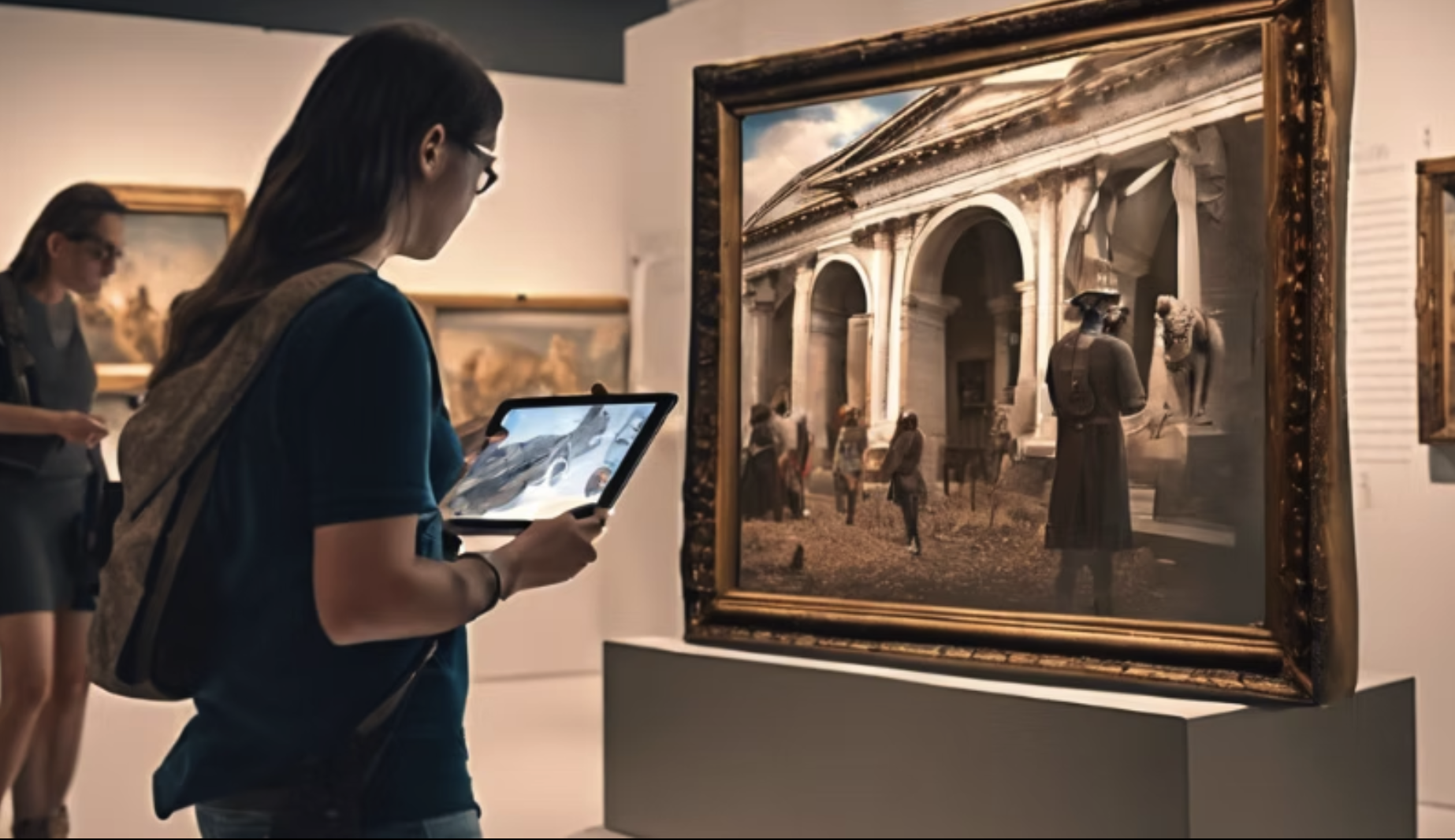
There are also cases where museums are engaging AI in their education and public programs. Much like schools, AI can help learners have a more personalized learning experience. The Metropolitan Museum of Art is actively incorporating AI in its public programs and education.
Source: Canopy Creative
“The Metropolitan Museum of Art is exploring AI-enhanced storytelling through interactive displays and augmented reality experiences. AI-powered chatbots answer visitor questions, provide directions, and offer tailored recommendations based on individual interests, catering to diverse learning styles and preferences.”
Ultimately, museums are knowledge sources and knowledge outlets, and AI will become part of their ecosystem. “Museums, archives and libraries are stewards of cultural values, and being human-centered is one of our sector’s core tenets. The Smithsonian is a dedicated keeper of America’s unique knowledge capital—art, science, history and culture. AI systems should amplify these human capabilities, not replace them."
Conclusion
Artificial intelligence is not new, but generative AI and LLMs have accelerated its adoption across the education spectrum. How schools, museums, and cultural institutions will have to adapt as this emerging technology continues to evolve in the education and public programs marketplace.