
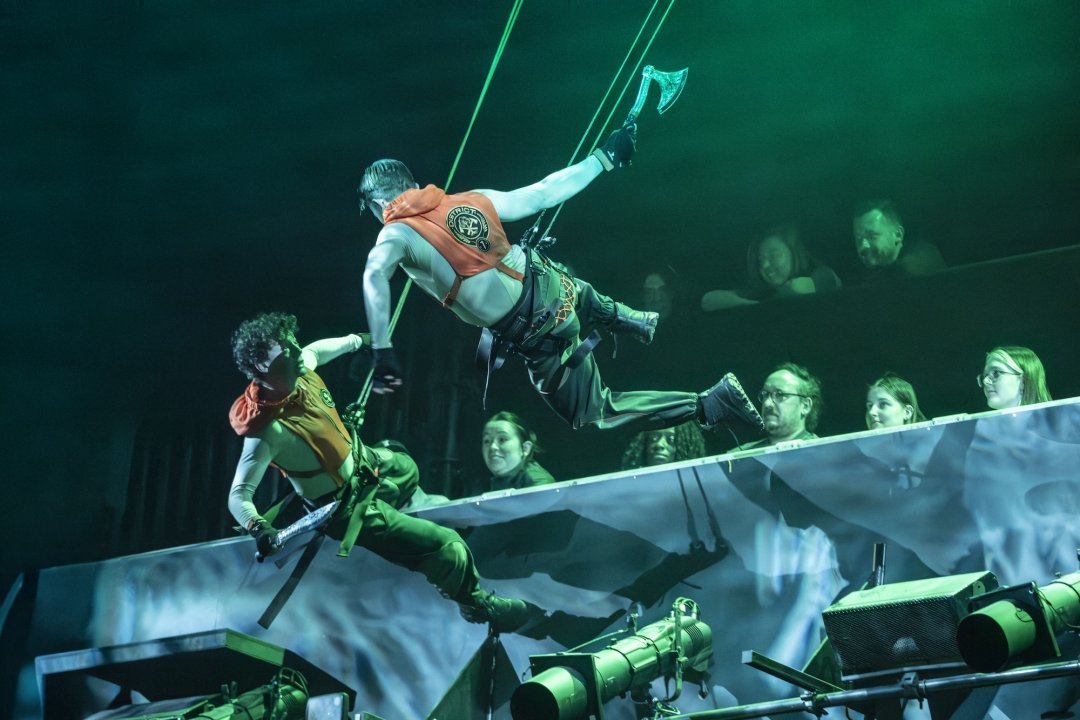
Over the past decade, particularly as theatre recovered from the impact of the pandemic, producers searched for solutions to attract audiences. One apparent solution is turning to existing fandoms, drawing on their enthusiasm to drive ticket sales. There has been a growing trend of large, spectacular straight play productions based on popular intellectual property. To determine how commercial theatre might develop in the future, we examine how this trend fits into a larger context, what patterns exist, and how fans respond.
The Rise of Corporate Presence in Commercial Theatre
The cost of producing commercial theatre has continued to rise for decades. Starting in the 1990s, alongside the revitalization of Times Square, Broadway theatre began to see a growing corporate producer presence that tackled these larger costs. This was exemplified by Disney bringing some of its properties to the stage, beginning with an adaptation of Beauty and the Beast.
This led to a model of corporate synergy in theatrical productions, defined by Brent Salter and Kathy Bowrey as “the notion of selling a particular product and integrating it into its broader web of properties and commercial opportunities.” For fans of an IP, going to a see a show became part of deeper participation in a corporation’s property.
Going into the 2000s along with a rise in tourism, familiar properties became a safer bet for new Broadway productions. Original new shows, with new books and scores, have held a declining share of new productions for decades now. Researching corporatization on Broadway, Kyla Thomas found that “almost half of the new musicals produced by [for-profit corporation operating businesses in multiple industries] from seasons 2000 to 2013 featured books adapted from popular films.”
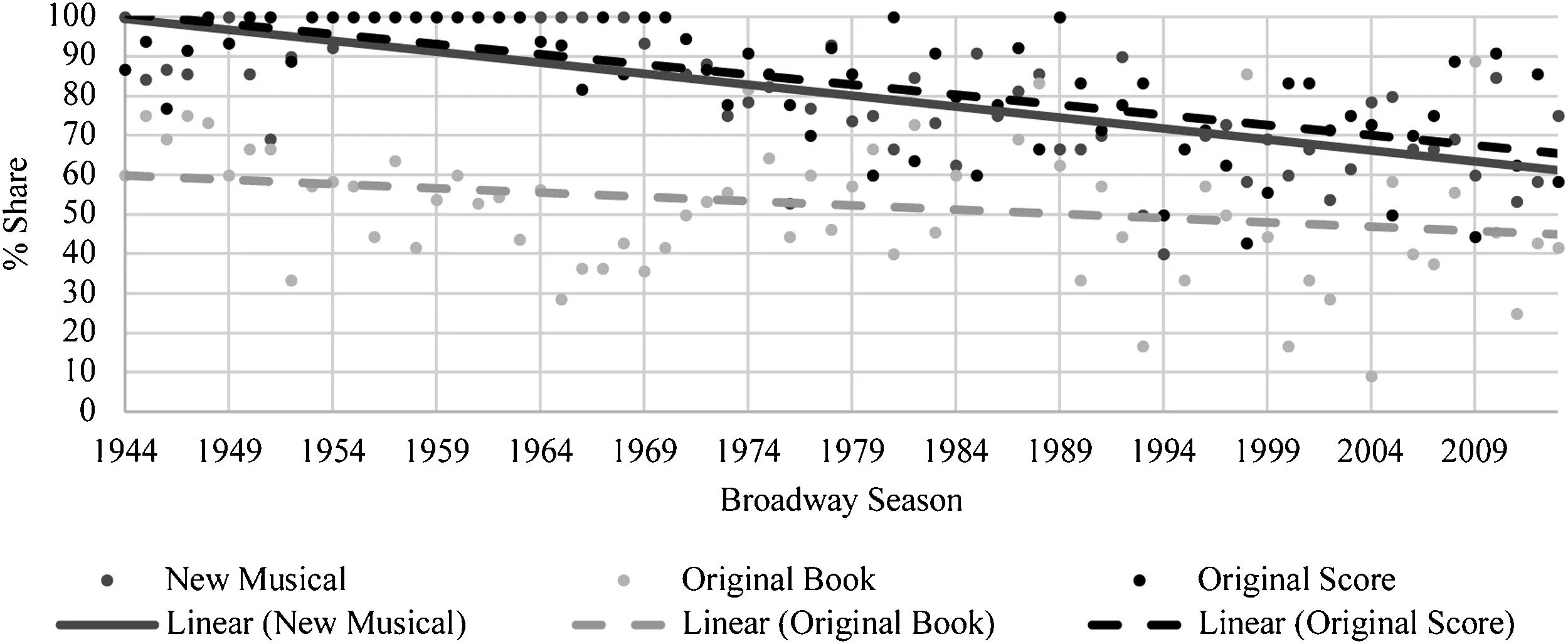
Graph from Kyla Thomas’s research, showing the decline of original books and scores in Broadway musicals from the 1940s to the 2010s.
The rise of the corporate producer came with a new theatrical model that “prioritizes producer control over ownership of theatrical property, as the studio’s interest is in maintaining control of the content and its extended commercial potential” (Salter and Bowrey).
Moving into the 2020s, the COVID pandemic upended all parts of life, including live performances. As theaters started to reopen, theatre companies needed to recover audiences. The cost of producing theatre continued to accelerate, leading to greater risk for producers and investors. Fewer and fewer shows recoup their investment on Broadway, especially musicals that are generally far more expensive.
With such high costs to produce in New York, many American producers and productions have turned to the West End with London-first productions. Still, while London theatre is substantially less expensive than New York, it is also experiencing sharply rising costs. If producers and investors hope to see returns from their commercial productions, they can’t take risks: they have to find sure bets.
Enter corporations, looking to expand their media domains and find synergy between mediums. For example, Netflix’s media presence in recent years includes several live experiences, appealing to fan desires to be immersed in the worlds they love (Maas). The idea is to “super-serve” fans in a way that keeps them coming back to the original corporate material.
IP-based theatre is one way to do just that. Here, IP-based theatre is defined as theatre productions produced in professional theatre venues that are based on an existing popular piece of intellectual property (IP) or entertainment franchise. Historically, many IP-based theatre productions are direct adaptations of existing material: think animated Disney movies turned into musicals. But more recently, corporations have started using the stage to officially expand the canon source material of these franchises.
A major goal of these productions is to serve fans – and fandoms. Fandom is defined as a community of fans, which can exist in any modality. In the 21st century, fandom has started to be heavily associated with online communities that share thoughts, art, and derivative works based on the original property.
Defining Spectacle
There are many kinds of spectacle, but this article focuses on three in particular:
Technology with “visual effects produced by machines”, as defined by Douglas L. Reside in “Humming the Scenery”
Illusion work, drawing from the existing work of magicians such as sleight of hand and misdirection techniques
Celebrity, particularly actors previously seen in popular films and TV shows appearing in plays
The Birth of a Trend with Harry Potter and the Cursed Child
Opening in July 2016 in the West End and April 2018 on Broadway, Harry Potter and the Cursed Child is a sequel to the events of the original seven Harry Potter books. The story follows some of the key figures from the books 19 years later, featuring their children as the next generation of wizards.
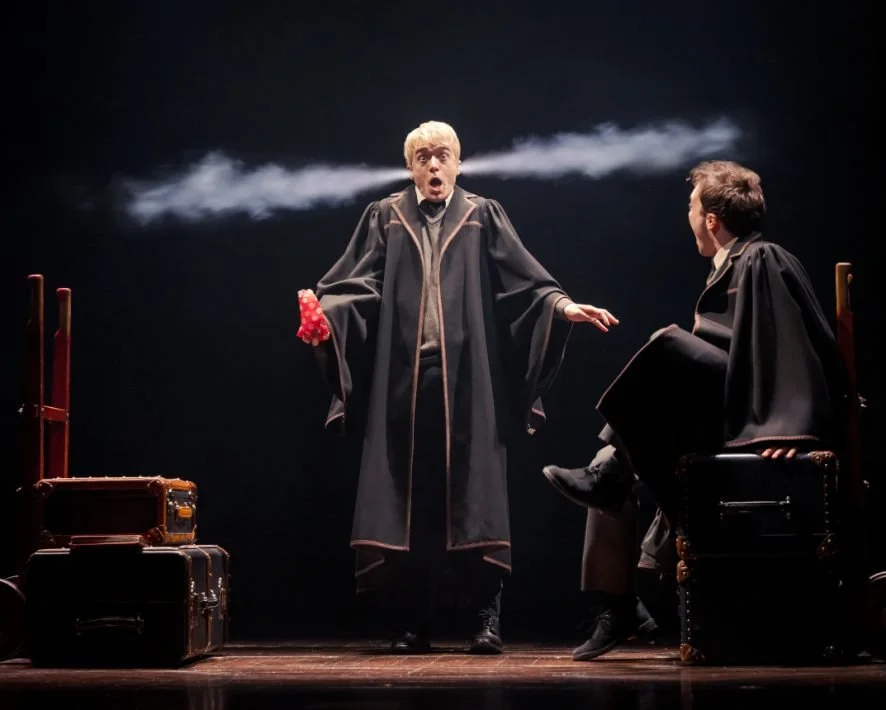
One of Harry Potter and the Cursed Child’s many special effects in action in the Broadway production. Photo by Matthew Murphy
Theatrical Magic
Both the London and Broadway productions received strongly positive reviews. The West End production won a record-breaking 9 Olivier Awards, while the Broadway production received 6 Tony Awards including Best Play and Best Direction for director John Tiffany.
What stood out was the strength of the production as a whole, with special emphasis on the illusion work crafted by Jamie Harrison and Chris Fisher. The two focused on bringing in traditional techniques from the world of magic, integrating technical skill and creative innovation rather than overly relying on technology.
This resulted in a production that audiences and critics called magical, enchanting, and enrapturing. By making the impossible happen before people’s eyes, the production effectively captured the famed wizarding world with a sense of wonder.
Script vs. Stage
In summer 2017, the play’s script by Jack Thorne and J.K. Rowling was published and sold to fans all around the world. As the first official follow-up to the original series available, the script quickly became the best selling playscript of all time.
While the published script made the play accessible to far more people, it could not transfer the rest of the experience. Without the spectacle seen on stage, many fans only had the story in front of them. That story, without production design and illusions, seemed incredibly weak.
“Reading through the respective reviews, it seems inconceivable that audiences can possibly be talking about the same story.”
The tale that had enchanted theatre critics and audiences, racking up award after award, fell completely flat on the page. Many online reviewers negatively compared the script to fan fiction, making it clear that the story on its own was poor quality and not what fans wanted. The spellbinding stagecraft of the productions was what made Harry Potter and the Cursed Child shine, but this simply wasn’t accessible to those who couldn’t travel or afford tickets.
Post-Quarantine Life
Harry Potter and the Cursed Child is the only play examined in this article that opened before 2020. Both the West End and Broadway productions have continued to run into the 2020s, facing challenges along the way.
In addition to the industry-wide rising costs, the productions faced issues with aging technical effects and negative press associated with author J.K. Rowling’s vocal transphobia. In the year ending February 2025, the Broadway production posted a $3.5 million operating loss, with operating costs of over $1 million weekly. While the West End production fared better, it also began to see operating losses. While the Broadway production recouped its investment in late 2022, returns for investors have been modest. Evidently, producers needed to take major action in order to sustain the production and continue generating profit.
In a prime example of celebrity as spectacle, actor Tom Felton joined the Broadway cast in 2025, reprising the role Draco Malfoy he had played in the films. This move proved very effective: grosses more than doubled when he initially joined the cast, and the production broke its box office record with a staggering $3.7 million week in late December. Since Felton’s arrival, weekly grosses have consistently stayed above $2 million.
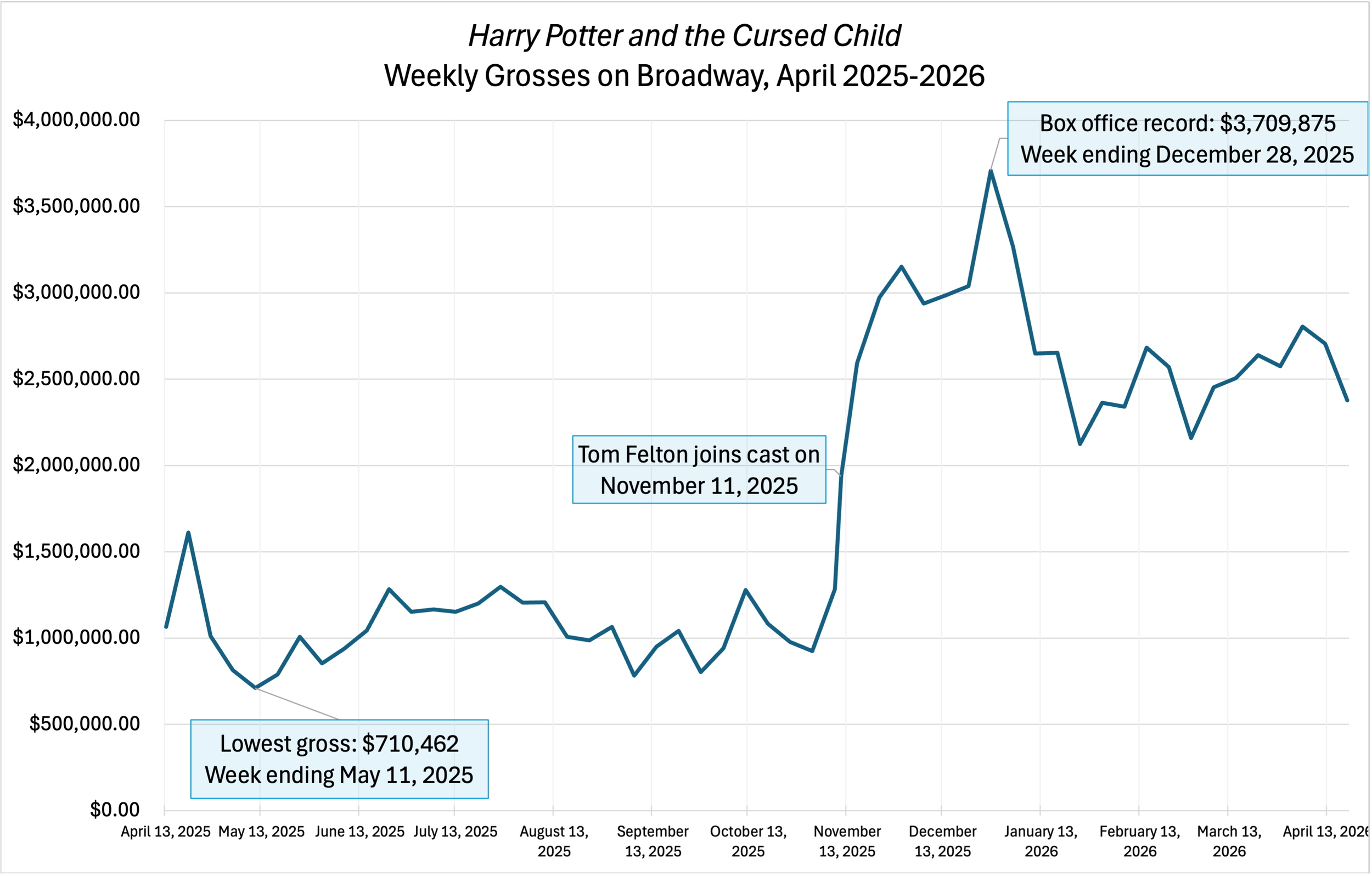
Line chart displaying Broadway box office figures from April 2025 to April 2026. Data from the Broadway League, via Playbill.
Felton has extended his run in the production until November 2026. If the current level of box office success continues, the Broadway production can expect a strong financial comeback even against all the many industry-wide challenges.
Establishing the Pattern with Stranger Things: The First Shadow
Stranger Things: The First Shadow follows Henry Creel, also known as Vecna, as he discovers supernatural abilities and begins his descent into becoming the main villain of the Netflix television series. Set in the 1950s, several decades before the Stranger Things TV show, the prequel story features many core characters as high schoolers.
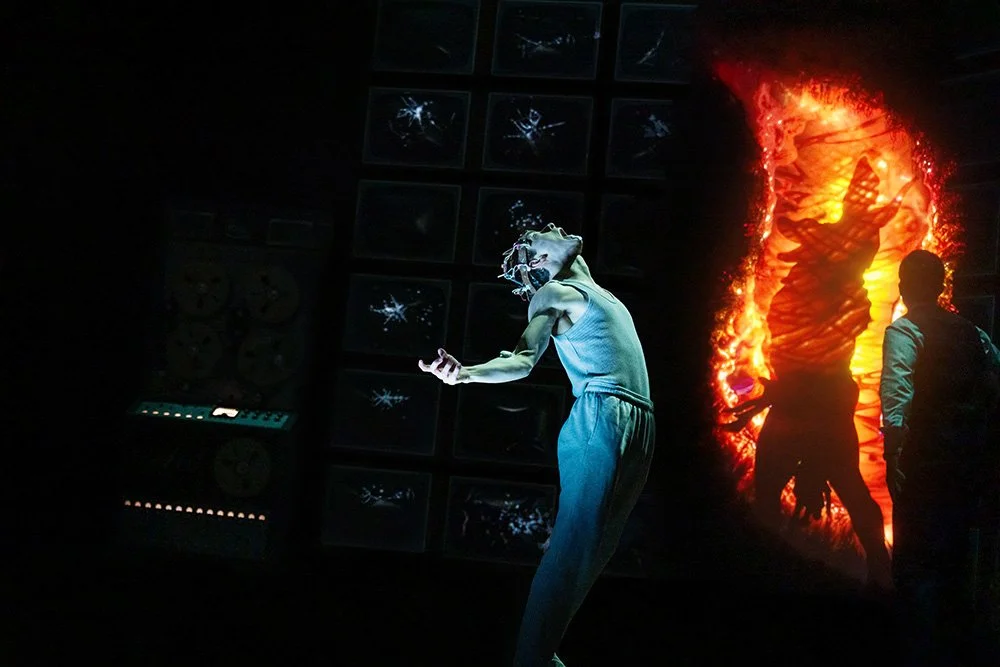
Louis McCartney as Henry Creel in the Broadway production. Photography by Matthew Murphy and Evan Zimmerman.
innovative stagecraft
Both the Broadway and West End productions received acclaim for their special effects and stagecraft. The productions racked up numerous design award nominations and wins, including a Special Tony Award for the illusions and technical effects. With a team including the illusions duo of Jamie Harrison and Chris Fisher, from Harry Potter and the Cursed Child, the show pushed boundaries and awed audiences with seemingly impossible feats.
“We’re often asked how we compete with CGI, and the truth is, we don’t have to compete. We’re different. Theater is live.
You’re in the room where the magic and the effects happen, and that makes it thrilling.”
The technical craft takes center stage from the first moments of the show, where a giant battleship suddenly appears on an empty stage. With about 40 crew members and 75 cues, the bombastic opening requires pulley systems, automations, LED screens, projections, and clever lighting to pull off each performance. The team claims the sequence took two and a half years to perfect.
Technology is a key part of the show’s many illusions and visual effects. One of the most important elements is screens, including an LED wall used as a “visual canvas.” Innovations in video technology had to be seamlessly integrated with all other aspects of the production, while also staying reliable for long runs. Everything had to be in service of the overall story and worldbuilding, rather than an individual impressive element.
Expanding the Lore
An important element of The First Shadow is timing relative to the TV show. Both the West End and Broadway productions opened between seasons of Stranger Things, with the Broadway production opening less than a year before the final season aired.
As a prequel story about the series’ main villain featuring many key characters, the play promised to give fans a new glimpse into a familiar world. The play was written by Kate Trefry, a writer and producer on the TV show, during the development of the final two seasons. The idea was to ensure everything that happened in the play properly fit into the larger story of Stranger Things.
For fans eager to explore favorite characters and uncover possible story threads for how the series would turn out, the play offered an exciting opportunity. Hype for the final season rose along with the box office. Broadway grosses grew as the first part of the season aired, peaking at over $2.5 million in the week before the finale aired. Notably, this was also during the lucrative holiday season, which often sees high box office numbers on Broadway.
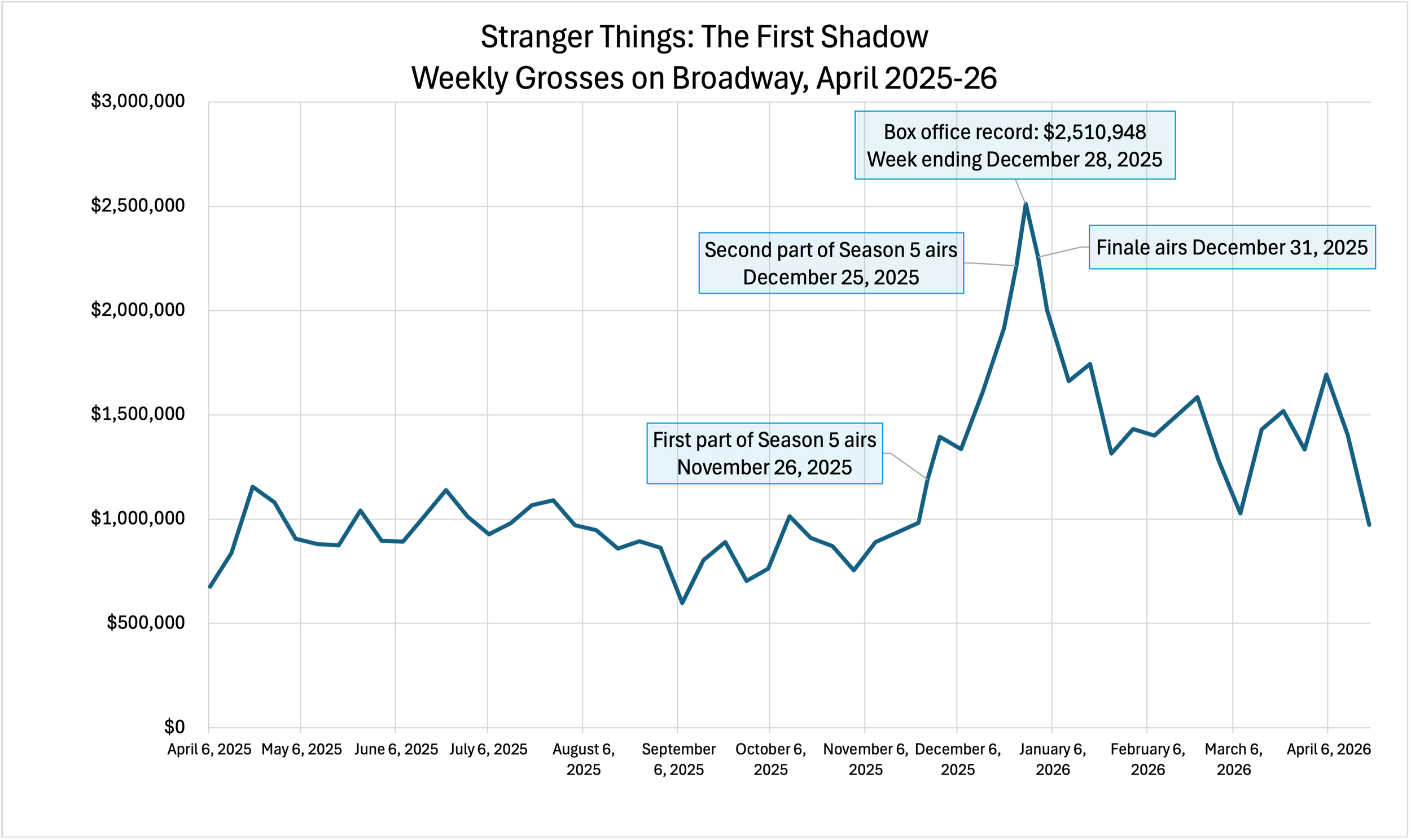
Line chart displaying Broadway box office figures from April 2025 to April 2026. Data from the Broadway League, via Playbill.
With Stranger Things buzz everywhere, fans flocked to see what they could discover about the story before it all played out on Netflix. In turn, fans who weren’t able to physically attend one of the productions flocked to the Internet to figure out what they were missing and request Netflix record the show. Many fans commented below the stage show’s official trailer:
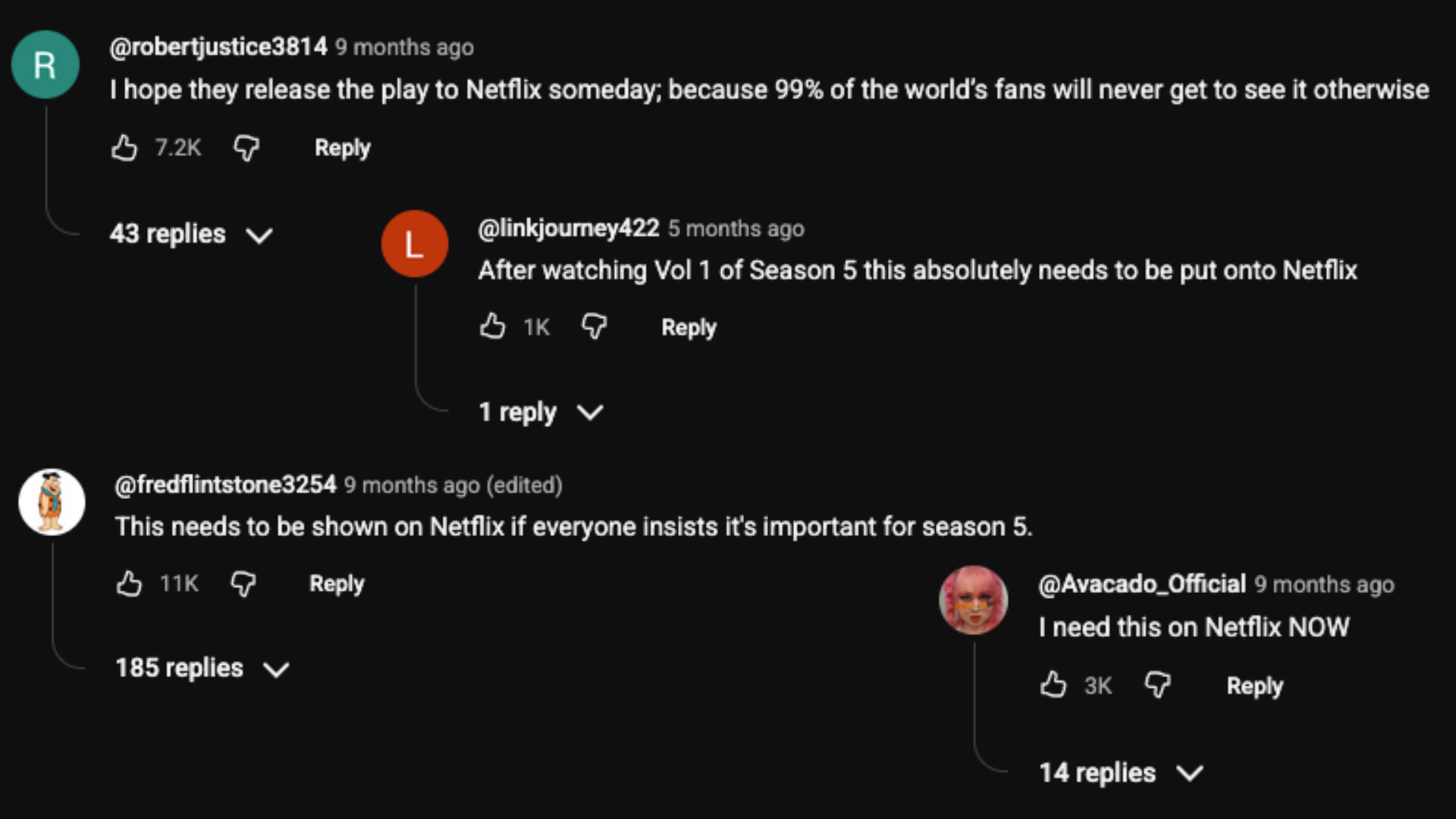
A selection of top comments on The First Shadow’s trailer wanting to see the production filmed and put on Netflix for fans. Source: YouTube
back to the screen
The final episodes of Stranger Things were not well received by fans, to the point there was a conspiracy theory that there would be a secret new episode that would retroactively fix the season’s issues. This secret episode never materialized, leaving numerous fans disappointed.
In early February 2026, about a month after the finale aired, Netflix announced that the Broadway production would be filmed and released as a proshot on the streaming platform. The requests of many online fans were finally being answered, and many plot holes and questions about the final season could be addressed. Netflix has yet to share when The First Shadow will be available to stream, but performances were cancelled for a week in February specifically for filming.
With Stranger Things buzz quieting and the knowledge that the production would be accessible to stream at some point, the Broadway box office declined substantially from its late 2025 peak. While the approximately $973 thousand gross and 73% capacity numbers from the week ending April 19, 2026 are fairly similar to numbers from about a year ago, it’s unclear how much longer the production will sustain itself.
The Failure of Spectacle in The Hunger Games: On Stage
Unlike Harry Potter and Stranger Things, The Hunger Games: On Stage does not tell a new story set in the franchise’s universe. Instead, it is an adaptation of the first book with some influences from the film. Set in a dystopian future for the United States, the story centers children forced to battle to the death, televised for the amusement of the Capitol elite.
Actors Redmand Rance and Rory Toms perform a fight scene, suspended in the air next to audiences. Photo by Johan Persson.
A Purpose-Built Venue
While other productions had to adjust to existing theater spaces, The Hunger Games: On Stage had its space built from the ground up. Located in Canary Wharf, a London financial district, the 1200-seat theater space created by the Troubadour company includes a massive sub-stage and hydraulic stage, bars, a restaurant, and moving seating banks. Combined, the production and space cost £26 million (approximately $35 million). The “purpose-built” language points toward making a theater space specifically for this play, but the space is modular, able to shift to suit different productions.
A new theater space offered opportunities to fix some key pain points for audiences: insufficient bathrooms leading to long lines, difficulty accommodating physical accessibility concerns, and poor sightlines from some seats. However, when the first public performance of The Hunger Games: On Stage took place, it seemed that the Troubadour Canary Wharf space failed to address many of these issues.
Sophie Butler, a YouTube creator who uses a wheelchair, shared her personal experience attending the first preview. She identified numerous problems, including:
A long queue outside the theater in the rain
The venue was still under construction in places
Many bathrooms were not open, leading to long lines
Less than 10 wheelchair bays available
Paneling in front of seat blocking the view of the stage
Sophie ended up leaving and receiving a full refund without seeing any of the show. While some of the issues would be resolved for future performances by finishing up construction and ironing out production elements, the fundamental problem of inaccessibility remained. In short, Troubadour Canary Wharf did not consider fans’ accessibility needs when creating the home for The Hunger Games: On Stage. No matter how spectacular the space was, it couldn’t properly serve audiences.
Attempting Celebrity as Spectacle
President Snow is a key character in the Hunger Games series as the dictator controlling the dystopian states and ensuring the deadly Hunger Games continue. His presence hangs over the series as a clear central villain. In the films, the role is filled by Donald Sutherland, whose performance received acclaim and expanded the character beyond the books. Bringing the character to the stage would undoubtedly lead to comparisons with Sutherland.
The Hunger Games: On Stage chose a renowned, well-known actor for the role: John Malkovich. Name recognition combined with knowledge of the character, promoting “John Malkovich as President Snow” as a key feature of the stage play. This became prominent in the marketing, including three short videos posted on YouTube:
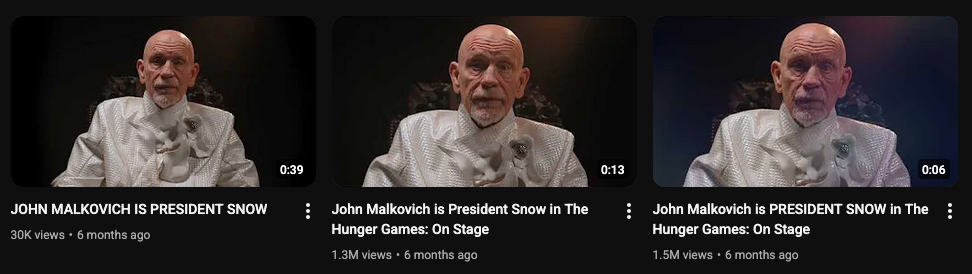
Thumbnails from three videos in a row advertising John Malkovich as President Snow on the Hunger Games: On Stage YouTube channel. Source: YouTube
However, this marketing didn’t make it clear that John Malkovich wouldn’t be performing the role in person. Instead, his performance was pre-recorded and projected onto screens in the space. This meant any actors in scenes with President Snow would have to say their lines in the recorded silences between Malkovich’s lines, unable to react in the moment.
In addition to these issues with the actor only appearing over video, Malkovich’s performance received substantial negative response from critics, described as low energy, stilted, and emotionally vacant. The comparison with Sutherland’s performance only exacerbated the problems.
The Hunger Games: On Stage attempted to harness the spectacle of celebrity, but suffered from marketing that was unclear about the pre-recorded video and a weak performance. Rather than a strong, in-person performance by a lesser known actor, the Malkovich appearance failed to deliver on spectacle.
Thematic Dissonance
The Hunger Games is a politically charged franchise, drawing attention to autocratic government, commodification of suffering, wealth inequality, and more political topics. When these themes aren’t handled properly, fans notice.
Throughout fan response to The Hunger Games: On Stage, including videos by YouTube creators Anna’s Era and Ashley Norton, dissonance with the political themes comes up repeatedly. This begins with the fact that the production is in Canary Wharf, known as a wealthy financial district in London.
Beyond that, fans note how the attempts at spectacle and commercial appeal undercut political themes. Especially with the existing book and film as direct points of comparison to the stage show, many fans and critics found that The Hunger Games: On Stage rung hollow.
“Ultimately, this show felt like it had all the spectacle of the movie without any of the political messaging. ”
Photo opportunities and themed cocktails in the lobby exist beside content warnings about extreme violence involving child and teen characters. The seating banks, named for the different districts of the dystopian country, are higher priced for the wealthier districts in the book. The minimal set appears industrial and lacks immersion, using the spectacles of screens, pyrotechnics, flying rigs, and moving seats.
The experience is big, flashy, and expensive. But for many fans, it’s not The Hunger Games.
The Future of IP-Based Theatre
All three productions continue to run, while the trend of plays from popular franchises continues. One of the latest announcements is the upcoming production of Game of Thrones: The Mad King at the Royal Shakespeare Company (RSC).
This play follows many patterns established by these IP-based productions: it is a prequel story not previously seen in books or on screen, promising an “immersive” experience with “familiar faces.” Early articles following the announcement directly compare it to Stranger Things: The First Shadow and Harry Potter and the Cursed Child, positioning the IP-based theatre as “holy grails”.
Much like the West End and Broadway productions coming out of the pandemic, the RSC faced significant financial strain. Its programming has expanded to familiar names, often outside of the Shakespearean canon. This included a high grossing production of The BFG based on the Roald Dahl book and numerous productions starring celebrities like Kenneth Branagh. Fans flocked to see something new from a franchise they already knew. Game of Thrones: The Mad King is a natural extension from this pattern.
As theatre costs rise and audience demand fluctuates, IP-based theatre productions provide substantial financial backing and box office appeal. By harnessing spectacle to recreate and expand familiar worlds, these plays draw in countless fans and curious onlookers. The trend of IP-based theatre is now established and poised to continue, so long as fans keep buying in.
-
Anna’s Era. The Hunger Games Stage Play Is Capitol PROPAGANDA...! 2025. 1:06:17. https://www.youtube.com/watch?v=wlkoZXv_Tg0.
Bahr, Sarah. “‘Masquerade’ Reimagined ‘Phantom,’ and the Fans Are Flocking.” Theater. The New York Times, January 19, 2026. https://www.nytimes.com/2026/01/19/theater/phantom-of-the-opera-masquerade.html.
Bailey, Lorna. “RSC Game of Thrones Play Will Be an ‘immersive’ Experience.” BBC, Coventry and Warwickshire, February 21, 2026. https://www.bbc.com/news/articles/cge8ge71lpno.
Boroff, Philip. “HARRY POTTER’S CURSED RETURNS.” Broadway Journal, December 22, 2025. https://www.broadwayjournal.com/p/harry-potters-cursed-returns.
Broadway.Com. “Tom Felton Extends Broadway Run in Harry Potter and the Cursed Child Through November 2026.” Accessed April 13, 2026. https://www.broadway.com/buzz/206923/tom-felton-extends-broadway-run-in-harry-potter-and-the-cursed-child-through-november-2026/.
Canavan, Gerry. “Hokey Religions: STAR WARS and STAR TREK in the Age of Reboots.” Extrapolation 58, nos. 2–3 (2017): 153–81. https://doi.org/10.3828/extr.2017.10.
Cavendish, Dominic. “‘What Does the RSC Really Need? A Better Train Line to Stratford.’” Yahoo Entertainment, February 26, 2026. https://www.yahoo.com/entertainment/tv/articles/does-rsc-really-better-train-083000389.html.
Davis, Caroline Jane. “SKYLAR FOX ‘You Are the Actual Magic’.” Southern Theatre 64, no. 2 (2023): 26–32. 171887343.
Dodge, Jeff. “Stranger Things’ First Major Spinoff Officially Crushes Massive Franchise Box Office Record Ahead Of Netflix Series Finale.” ScreenRant, December 30, 2025. https://screenrant.com/stranger-things-the-first-shadow-box-office-record-december-2025/.
EW.Com. “‘Harry Potter and the Cursed Child’ Wins Best Play at Tony Awards.” Accessed April 13, 2026. https://ew.com/tony-awards/2018/06/11/harry-potter-best-play-tonys/.
Extra Ashley. The Hunger Games on Stage Is a Chaotic Mess. 2026. 30:46. https://www.youtube.com/watch?v=GbG_f2xd5WU.
Hornik, Caitlin. “‘Harry Potter and the Cursed Child’ Recoups Investment.” Broadway News, April 18, 2023. https://www.broadwaynews.com/harry-potter-and-the-cursed-child-recoups-investment/.
Hurwitz, Nathan. “The Corporate Musical, 1993–2001.” In A History of the American Musical Theatre, 2nd ed. Routledge, 2024.
Johnston, Dais. “The ‘Stranger Things: The First Shadow’ Movie Could Redeem The Disappointing Finale.” Inverse, February 10, 2026. https://www.inverse.com/entertainment/stranger-things-the-first-shadow-broadway-play-pro-shot-movie.
Kumar, Naveen, and Shelly Tan. “How Celebrities Dominated Broadway Plays in 2025.” The Washington Post, January 1, 2026. https://www.washingtonpost.com/entertainment/theater/interactive/2026/broadway-celebrities-box-office/.
Maas, Jennifer. “Living the Stream.” Marquee. Variety (Los Angeles, United States), September 2, 2025.
MickeyJoTheatre. Did Critics Hate THE HUNGER GAMES? | Review Roundup for the 2025 London Stage Adaptation. 2025. 38:58. https://www.youtube.com/watch?v=3APWukCqugM.
Newkey-Burden, Chas, and The Week UK published. “Why Are West End Theatre Ticket Prices Soaring?” The Week, June 28, 2024. https://theweek.com/culture-life/theatre/why-are-west-end-theatre-ticket-prices-soaring.
Ostwal, Trishla. “Marian Lee CMO, Netflix.” Adweek (New York, United States), October 2025.
Paulson, Michael. “Fed Up With High Costs, American Theater Takes a Trip to London.” Theater. The New York Times, March 10, 2026. https://www.nytimes.com/2026/03/10/theater/broadway-theater-london-prices.html.
Paulson, Michael. “With Tom Felton as Draco Malfoy, ‘Harry Potter’ Breaks Its Own Broadway Record.” Theater. The New York Times, November 24, 2025. https://www.nytimes.com/2025/11/24/theater/harry-potter-tom-felton-broadway.html.
Playbill. “Harry Potter and the Cursed Child Broadway Grosses.” Accessed April 26, 2026. https://playbill.com/production/gross.
Playbill. “Stranger Things: The First Shadow Broadway Grosses.” Accessed April 26, 2026. https://playbill.com/production/gross.
Reside, Douglas L. “Humming the Scenery.” In The Routledge Companion to Musical Theatre, 1st ed., by Laura MacDonald and Ryan Donovan. Routledge, 2022. https://doi.org/10.4324/9780429260247-27.
Romano, Aja. “Canon, Fanon, Shipping and More: A Glossary of the Tricky Terminology That Makes up Fan Culture.” Vox, June 7, 2016. https://www.vox.com/2016/6/7/11858680/fandom-glossary-fanfiction-explained.
Salter, Brent, and Kathy Bowrey. “Dramatic Copyright and the ‘Disneyfication’ of Theatre Space.” In Law and Creativity in the Age of the Entertainment Franchise, edited by Kathy Bowrey and Michael Handler. Cambridge Intellectual Property and Information Law. Cambridge University Press, 2014. https://doi.org/10.1017/CBO9781139626781.009.
Sedgman, Kirsty. “When Theatre Meets Fandom: Audience Reviews of Harry Potter and the Cursed Child.” Journal of Fandom Studies 6, no. 1 (2018): 81–99. 129900516. https://doi.org/10.1386/jfs.6.1.81_1.
Sophie Butler. WHY The Hunger Games On Stage Preview Was a DISASTER...(from Someone Who Was Actually There). 2025. 46:22. https://www.youtube.com/watch?v=9XNyDcdhYrw.
“‘Stranger Things’ Fans’ Conformity Gate Theory Suggests Secret Last Episode.” Accessed April 29, 2026. https://www.rollingstone.com/tv-movies/tv-movie-features/stranger-things-finale-conformity-gate-fan-theory-1235494380/.
Stranger Things Prequel Play Combines Darkness and Fun, Creators Say. March 21, 2023. https://www.bbc.com/news/entertainment-arts-65013620.
“Stranger Things the First Shadow: Video Technology Brings the Upside Down to the Stage.” STAGE DIRECTIONS. Projection, Lights & Staging News (Las Vegas, Las Vegas) 26, no. 9 (2025): 56–57.
Tartaglione, Nancy. “Olivier Awards: ‘Harry Potter And The Cursed Child’ Wins Record 9 – Full List.” Deadline, April 9, 2017. https://deadline.com/2017/04/olivier-awards-2017-winners-harry-potter-and-the-cursed-child-record-full-list-1202066425/.
Thomas, Kyla. “When Disney Came to Broadway: Assessing the Impact of Corporatization in an Art World.” Poetics 77 (December 2019): 101384. https://doi.org/10.1016/j.poetic.2019.101384.
Wyver, Kate. “‘A Venue like This Doesn’t Exist Elsewhere’: Inside the Colossal Arena Built for The Hunger Games.” Stage. The Guardian, September 30, 2025. https://www.theguardian.com/stage/2025/sep/30/the-hunger-games-on-stage-premiere-canary-wharf-london.
Wyver, Kate. “‘That’s Impossible!’ Why UK Theatre’s Gone Mad for Magic and Wild Special Effects.” Stage. The Guardian, January 29, 2024. https://www.theguardian.com/stage/2024/jan/29/theatres-magic-wild-special-effects-stranger-things-time-travellers-wife.