
This May has been a somber month for arts and cultural organizations across the United States. Flurries of executive orders coming out of the Trump Administration have made good on day-one promises to gut government spending, nix entire funding agencies, and weaponize the state apparatus against public media, information, and culture. While various digital outlets have begun tracking the various lawsuits pushing back on these orders, the present situation has morphed into a competition of administrative capacities. With the executive branch outrunning the bureaucracy of the courts, real damage is rendered before any reparations can even begin to be considered. Read on to learn more about five different news paths you might have missed, from the executive orders, funding cuts, and the unbalanced, precarious funding landscape in which nonprofits currently stand.
Source: National Endowment for the Arts
NEA Grants Cancelled
Several U.S. arts and literary organizations were thrown into disarray after the National Endowment for the Arts (NEA) abruptly rescinded or terminated previously awarded grants for fiscal year 2025. One impacted organization was n+1, which lost a promised $12,500 grant with no clarity on whether the funds would still be received. The NEA said the decision was part of a shift to align with President Donald Trump’s new funding priorities, which include supporting initiatives like HBCUs, skilled trades, houses of worship, and military and veteran services.
The cuts sparked outrage across the arts community, especially among small literary publishers. According to the Community of Literary Magazines and Presses (CLMP), at least 37 of 51 funded literary organizations—such as The Paris Review, McSweeney’s, and Oxford American—had their grants affected. Some were allowed to request reimbursement for expenses incurred before May 31, while others were not offered that option at all.
The timing and rationale behind the NEA’s decision have drawn criticism for their vagueness and perceived political motives. Many recipients saw the move as a de facto form of censorship or ideological targeting. The shift followed Trump's proposed federal budget, which calls for dismantling not only the NEA but also other cultural agencies like the National Endowment for the Humanities and the Corporation for Public Broadcasting (CPB).
The impact is expected to be severe, especially for smaller organizations already operating on limited budgets. Arts leaders say it's uncertain whether private donors or foundations can make up for the lost government support. The NEA's authority to rescind already-awarded grants remains a legal gray area, as the agency cited its right to cancel funding that no longer aligns with its evolving priorities.
This decision is the latest in a string of controversial moves by the NEA, under Department of Government Efficiency (DOGE) oversight, including canceling a grant program for underserved communities and issuing guidelines restricting content related to diversity and gender. These developments reflect an increasingly politicized landscape for federal arts funding and have intensified anxiety across the cultural sector.
All NEA Grant Directors Exit
The National Endowment for the Arts (NEA) has also recently experienced a major upheaval, with a significant number of senior leaders and grant directors resigning. This includes the resignation of all ten discipline directors, individuals responsible for overseeing grants in key areas such as literature, theater, and traditional arts. Their exits follow ongoing efforts by the Trump administration to diminish the agency’s scope. Additional departures include senior leadership figures and program officials, many of whom accepted early resignation or retirement options. Critics argue these exits were coerced, reflecting broader attempts to dismantle the NEA and cut funding for numerous arts programs, especially those serving underserved and rural communities.
These changes coincide with the termination of a substantial number of NEA grants, which many arts groups depend on for programming and outreach. The Trump administration’s 2026 budget proposal calls for eliminating the NEA and similar cultural institutions, redirecting millions in funding toward initiatives like the National Garden of American Heroes and the 250th anniversary of the Declaration of Independence. Cultural leaders warn that these moves threaten the foundation of publicly supported arts in the U.S., emphasizing the NEA's historic role in democratizing art funding. They argue that without such support, the cultural landscape will be shaped by private interests rather than the public good.
Image Source: National Public Radio
Renewed Attacks on Public Media
With cuts spreading beyond the arts and across the humanities, renewed efforts have mobilized to eliminate federal funding for public media, such as National Public Radio (NPR) and Public Broadcasting Service (PBS), as part of a broader plan to reduce government spending. With 1,500 affiliate stations serving millions of Americans weekly, public media plays a vital role in delivering local, national, and emergency information, particularly in areas underserved by commercial outlets. The administration has accused NPR and PBS of political bias and has moved to cut funding through executive orders and congressional hearings. Additionally, the FCC, under Trump appointee Brendan Carr, is scrutinizing public media’s underwriting practices to determine whether they breach regulations by resembling commercial advertising.
Public broadcasting in the U.S. has its roots in early 20th-century efforts to bring educational content to rural communities. It developed through university-led radio initiatives and eventually evolved into today’s NPR and PBS networks, supported by the CPB, which was created to insulate public media from political and corporate influence. Although federal funding supports infrastructure and program development, most public media funding comes from private donations and sponsorships. Still, removing government support would disproportionately impact rural stations and their ability to deliver educational and cultural programming. As debates over public media’s future intensify, the stakes remain high for preserving equal access to trusted, noncommercial information.
New Research into Funding Models for Nonprofit News
When considering shifts in how the news and media are funded, it is useful to understand the history of funding models for newspapers. Newspapers once relied heavily on advertising revenue, but the rise of digital platforms like Facebook and Google eroded that model, leading to the closure of one-third of U.S. newspapers in the past two decades—mostly local outlets. In response, some have transitioned into nonprofit organizations, while others have begun to seek philanthropic support and reader donations.
A journalism researcher interviewed 23 leaders of local nonprofit news outlets to understand how they are navigating funding challenges. The findings show that while foundation grants—especially from groups like the Knight Foundation—remain the primary revenue source (about 50% in 2023), there's increasing pressure to diversify income streams. Foundations now require grant recipients to demonstrate efforts to reduce reliance on foundation funding, reflecting the old adage about “not putting all your eggs in one basket.”
Nonprofit news outlets are branching into individual donations, advertising, and sponsorships, though each comes with drawbacks. Donations require significant outreach and marketing, advertising is taxable and may risk tax-exempt status, and “earned revenue” remains underused due to unclear IRS rules. Meanwhile, a growing solution is pooled donor funds — such as NewsMatch and Press Forward, which combine support from multiple donors and encourage individual matching donations. These efforts offer promise, but managing diverse revenue sources remains a significant challenge for small, resource-strapped local newsrooms.
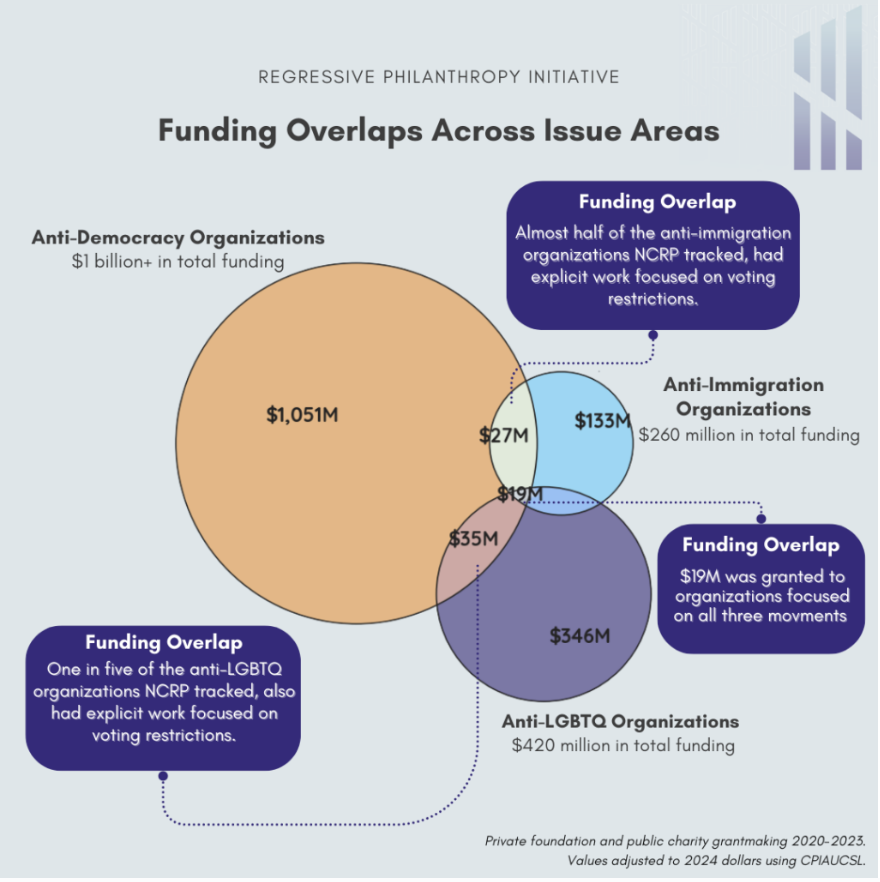
Image Source: The Regressive Philanthropy Initiative, National Committee for Responsive Philanthropy
Understanding Regressive Philanthropy
Amid the turmoil taking place in the funding landscape for arts, culture, and the humanities, a new initiative has arisen to direct increased scrutiny toward toxic philanthropic actors. The Regressive Philanthropy Initiative by The National Committee for Responsive Philanthropy (NCRP) exposes how some philanthropic foundations and donor-advised funds, instead of promoting equity and democracy, actively fund efforts that undermine civil rights, democratic norms, and marginalized communities. This "regressive philanthropy" supports anti-democracy, anti-LGBTQ+, and anti-immigration agendas, often more strategically and generously than justice-focused funders. NCRP’s research documents how these funders maintain disproportionate power by investing in nonprofits that push policies restricting voting rights, endangering LGBTQ+ people, and criminalizing immigrants. Through original data analysis and mapping these funding ecosystems, the initiative aims to inform and mobilize progressive funders to better support organizing and advocacy work that defends democracy and human rights.
-
AP News. “Tracking the Lawsuits against Donald Trump’s Executive Actions,” February 21, 2025. https://apnews.com/projects/trump-executive-order-lawsuit-tracker/.
Fink, Katherine. “Nonprofit News Media Leaders Are Struggling to Stop Leaning on the Foundations That Say They Should Branch out More.” The Conversation, May 20, 2025. http://theconversation.com/nonprofit-news-media-leaders-are-struggling-to-stop-leaning-on-the-foundations-that-say-they-should-branch-out-more-255821.
“National Endowment for the Arts Cancels Grants to Publishers, Theaters - The Washington Post.” Accessed June 3, 2025. https://www.washingtonpost.com/entertainment/theater/2025/05/04/trump-budget-nea-arts-grants-canceled/.
NCRP -. “The Regressive Philanthropy Initiative - NCRP,” April 16, 2025. https://ncrp.org/the-regressive-philanthropy-initiative/.
Nguyen, Sophia, and Janay Kingsberry. “Every Arts Director at the NEA Exits Federal Culture Agency.” The Washington Post, May 7, 2025. https://www.washingtonpost.com/entertainment/2025/05/07/nea-staff-departure/.
Shepperd, Josh. “Trump and Many GOP Lawmakers Want to End All Funding for NPR and PBS − Unraveling a US Public Media System That Took a Century to Build.” The Conversation, May 2, 2025. http://theconversation.com/trump-and-many-gop-lawmakers-want-to-end-all-funding-for-npr-and-pbs-unraveling-a-us-public-media-system-that-took-a-century-to-build-253206.