
Arts & Technology

The Most Artistic City in America? The Answer Might Surprise You

Merely the question itself is bound to spark controversy: what is the most artistic city in America? It is a difficult question, and the answer is often hard to gauge. Just what do we mean by “artistic?” And how does one measure how “artistic” a city is? Cities across America will often claim their museums are better and more unique, their shows are of superior quality, and their artistic communities are thriving. But when it comes to actually quantitatively measuring how artistic a city actually is, the answers are few and far in between. Thankfully, two writers have sought to settle the debate once and for all: which city holds the crown as the most artistic city in America? The answer might surprise you.
Two months ago, Richard Florida of The Atlantic sought to find which American cities had the highest concentration of artists, along with which cities had the highest concentration relative to their overall population. The data that Florida used was derived from the U.S. Census Bureau’s American Community Survey (ACS), a handy site that offers a treasure trove of data about Americans’ professions, income levels, education, and much more.

Florida, and his colleague Kevin Stolarick of the Martin Prosperity Institute, looked specifically at the number of Americans that self-identified their profession in the field of “artists and related workers.” While this is not an exact measurement of all Americans working in the arts field (some artists will naturally label themselves in a different way, and others may not have participated in the survey), it provides a good measurement of how many Americans are employed and self-employed in the arts field today. The ACS found that about 237,000 Americans identified as “artists or related workers,” with the vast majority of these individuals living in cities or metropolitan areas.

There are a couple of ways to measure how “artistic” a city is, and if you just do an overall count of the number of self-proclaimed artists in a given city, naturally, the largest metropolitan areas in the country will populate the top of the list. Listed just by population, to little surprise, New York City tops the list, followed by Los Angeles, Chicago, San Francisco and Seattle. The rest of the top 10 is comprised of other large cities/metropolitan areas known for their artistic communities: Atlanta, Washington, D.C., Philadelphia, Orange County, California, and Dallas.

If we really wanted to be specific, however, we could take a look at which areas have the highest concentration of self-identified artists relative to their overall population. The ACS is capable of producing this data, by using what Florida describes as a “location quotient,” or LQ, that takes a ratio of an area’s proportion of artists and compares it to the national average. By using this metric, we can take a look at smaller cities that have disproportionately larger artistic communities that may be somewhat of a secret at the national level.

After running the data, some surprises leap out. While larger cities that were present in the original list re-appear here, some much smaller cities make the list as well. Here is the Top 10 list of self-identified artists in the United States, relative to their overall population, in order:

1. Santa Fe, New Mexico

2. San Francisco, California

3. New York City, New York

4. Los Angeles, California

5. Santa Cruz-Watsonville, California

6. Danbury, Connecticut

7. New Bedford, Massachusetts

8. Boulder-Longmont, Colorado

9. Barnstable-Yarmouth, Massachusetts

10. Jersey City, New Jersey

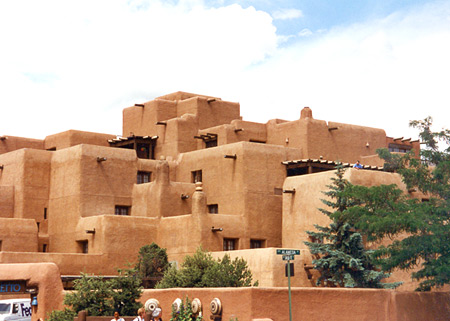
Santa Fe! Not only is Santa Fe at the top of this list, its LQ score is double the score of the #2 city, San Francisco. Some of the other cities on this list, most notably Boulder, are home to universities and have a high percentage of young people living there. Another point: every city on this list except for Santa Fe and Boulder are situated on either the West Coast or the East Coast.

Santa Fe has always been home to a vibrant and proud arts scene, albeit being unknown by most Americans. The state capital of New Mexico is very proud of its arts community, as artists provide an important economic engine for the town in this tough economy: the arts community as a whole provides more than $1 billion in revenues each year and supports more than 17% of all jobs in Santa Fe County.

Every city and metropolitan area across America can certainly make their claim about why their area deserves a spot on this list. While a city may not have a high percentage of self-identified artists, they can still point to unique works of art, groundbreaking museums, or even highly ranked arts schools. This is, after all, only one metric, and there are certainly other ways to measure how “artistic” a given city is. We here at Tech in the Arts would certainly vouch for our home base of Pittsburgh (home of Andy Warhol!), and I have a soft spot for my home town of Phoenix. But by strictly this metric, and information derived from the U.S. Census and the American Community Survey, Santa Fe takes the crown for now. With the amount of change and innovation taking place in the arts community these days, especially through the use of technology and social media, this list could be completely different five to ten years from now. And the more artists that are employed and working in all of these cities, the better it is for arts lovers like us everywhere.

 

Coming Soon - MOCA TV

Wanna check out a documentary on street artists? Maybe an interactive, educational art program? Turn your dial to YouTube, and check out the new channel from the Museum of Contemporary Art (MoCA) in Los Angeles, called MOCA TV. Part of YouTube’s original programming initiative, MOCA TV is the first contemporary art and culture channel in the programming. It will be “aggregating, curating and generating the strongest artistic content from around the world” according to MOCA TV Channel Executive Jeffrey Deitch. MOCA TV original programming will feature global art news, art and music, art and fashion, artists in the studio (think MTV “Cribs” style), and aforementioned educational pieces in a series called “MOCA Univerisity”.

Deitch referred to MOCA TV as “the ultimate digital extension of the museum”, which has us curious about this growing digitization of art museums. The Walker Art Center’s new magazine-style website, increasingly sophisticated web exhibitions around the world, and MOCA TV point to general embrace of modern technologies.

MOCA TV has a July 2012 release date, so we have a while before we start streaming any shows. Shepard Fairey’s design studio is doing the graphic identity and an extensive social networking campaign promises MOCA TV will be cool and on point with tech-savvy Millennials. In the mean time, what original arts programming do you like to enjoy on YouTube?

Pinterest, Instagram, and Percolate: The Latest in Social Media

Today’s social media networks are engaging in covert retrospection. Even as the world preoccupies itself with its future, social media platforms are becoming uncannily reminiscent of the past. Twitter is the modern day telegram, Facebook the diary that is no longer hidden, and recently, there has been a flurry of activity on Pinterest and Instagram, both of which are equally retro savvy.

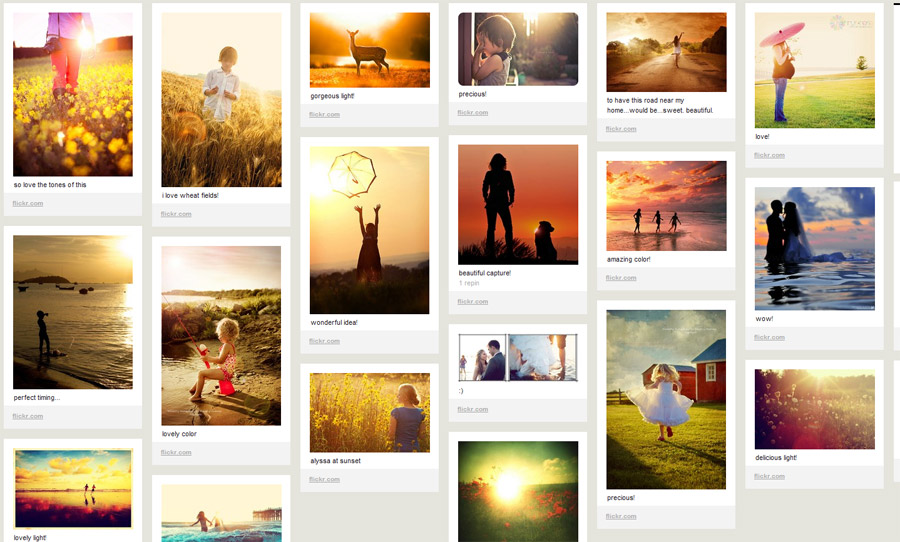
A board where you can pin up your favorite ideas and images. A lens that lets you transport your photos back to 1977. Yes, Pinterest and Instagram are definitely retrograde in their outlook, and more importantly, incredibly popular. In fact, so many have taken an interest in Pinterest that last year it was “one of the top ten most visited social networks.” Hence, a host of organizations have begun to use these networks to visually engage with their readers, customers, or audiences.

Pinterest is a virtual pin board where you can “organize and share all the beautiful things you find on the web.” Users can categorize their interests into boards and subsequently build on that interest through pinning up images that inspire or appeal to them. Moreover, each pin can be re-pinned, liked, and commented on, leading to the creation of a social dialogue.

Recently, there was an informative article in Outspoken Media about how to effectively use Pinterest.  In her article, the author mentioned that while it is against the Pinterest’s etiquette to use the site for self-promotion, brands could nevertheless use it to narrate their own story, rather than the story of what they sell.

“Pinterest works best when brands show customers what’s going on below the surface. When they allow consumers to see the spirit of their brand by showing them not what they do, but why they do it – what inspires them, what moves them, what the company culture is based on. They do that all through topic-specific boards.”

Given the entirely visual motivations of Pinterest, it’s striking that not many arts organizations are on the site. There is even a whole category of pins under Art! If your organization’s mission, vision, passions, and inspirations can be conveyed visually, then you may want to check whether Pinterest is hiding behind more significant pins (Facebook, Twitter) on your social media brown board.

While Pinterest is teeming with inspiring and beautiful pictures, the social media app Instagram, may just be the source of those pictures. Instagram is an app that lets you filter your images in a variety of styles, which can then be uploaded to the Instagram site and shared with other users. The filters, which are remarkably, aesthetically attuned, have probably redeemed many a picture from the depths of Dante’s photographic inferno, (if one were to exist).

And for an app that is used, even by the President of America, for politically strategic if not aesthetic reasons, Instagram has certainly gained a lot of momentum. Arts organizations can use the app for sprucing up images they’d like to share and publish them on a wide variety of sites, including Instagram itself. The app can also work as a marketing tool and was recently employed by Tiffany & Co in their ad campaign titled What Makes Love True.

Finally, if the muse of social media content generation has marooned you on the island of blankness, Percolate is here to help. Percolate helps brands generate content through the process of online curation.  As stated on their website, “Percolate bubbles up interesting content from around the web and presents it back to a brand editor to add a comment and publish back out to social channels and websites.” As of now, the site is invite only, but brands can get in touch and learn more about the dissipation of social media content on their website.

So before you despair at the idea of building yet another social media platform, wait a while. Let the possibilities that these sites open up... percolate.

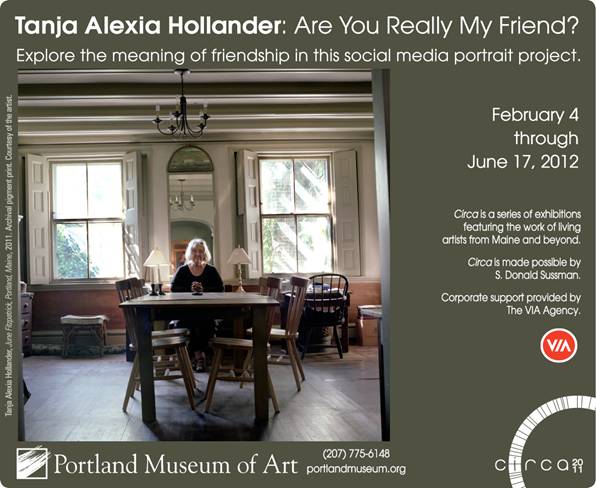
Are you really my friend? The Facebook Portrait Project

I went to elementary school with her- confirm request. He is the son of my mom’s friend from work- confirm request. She’s a friend of a friend that also likes Amos Lee, Portland, Maine and the Peggy Guggenheim Collection in Venice, but we’ve never actually met- confirm request. The word “friend” is now synonymous with Facebook and its meaning has been redefined to incorporate relationships formed as loosely as in the situations above. Regardless of how intimate your real world relationships are with your newest virtual “friends,” they receive the same amount of information and become privy to the innermost private details of your life through your Facebook activity, statuses and photos.

Yes, you can “poke” others on Facebook, but Maine photographer Tanja Alexia Hollander, has discovered through her own Facebook friendship odyssey that Facebook cannot replace human interactions

Social media has become a fundamental part of our society in the 21st century. Its convenience allows us to instantaneously communicate and share a level of intimacy with those we know well and many we don’t know at all. Despite its presence in our lives today, social networks cannot replicate human interaction. It is arguable, however, that the online environments we’ve created and the resulting reduction of human interaction have an impact on our relationships.

Since the beginning of 2011, Hollander has embarked on a journey to meet (some for the first time) and photograph all 626 of her Facebook friends, traveling across the state, country and world to reach them in their most intimate and private space: their home. Hollander’s photographic and personal journey grew into the project and upcoming exhibit “Are you really my friend? The Facebook portrait project.”

More than just an exploration of virtual social networks and humans’ dual existence in a cyber space and physical, real world space, Hollander’s project and exhibition explores the evolution and modern-day role of formal portraiture, the meaning of home and the future of human interactions and American culture in an increasingly virtual world.

My project is an exploration of friendships, the effects of social networks and the intimate places we call home. Facebook seemed an ideal forum for this exploration. Though we are in the initial stages of understanding the effects of social networking on American culture and photography there is a pervasive feeling that it is changing our interactions with each other and building a false sense of community.

But do not misinterpret Hollander’s project or exhibition- she is neither defaming Facebook nor purging herself of it upon completion of the project. Quite the contrary, actually. As a result of visiting with and photographing each of her friends, Hollander discovered they do in fact pay close attention to her life online and wanted to follow up about what they saw or read. To Hollander, this gave greater merit and value to the relationships she maintains via Facebook and lessened the gap she was questioned between our simultaneous existence in cyber space and the real world.

I had the pleasure of speaking with Hollander before the holidays as she approached the final stages of preparing for the exhibition. Since her project has received wide coverage and media attention, I wanted to discuss Hollander’s relationship with social media as co-founder of the self-serving, fine arts photography studio, the Bakery Photographic Collective in Westbrook, Maine. As a manager and artist, Hollander is in the unique position of successfully managing the studio and doing so with a great sensitivity and passion for the arts.

Hollander is admittedly still overwhelmed by the possibilities, perks and opportunities of blogging and social media, though she now considers herself a Facebook expert (and if you have been following Hollander, the project's Facebook page and photographs, you would most definitely agree).

I asked Hollander specifically about the use of Facebook as both an artist and co-manager of the Bakery Photographic Collective

Now I’m obsessed with it. I’m learning as I go. It has been a process of realization of the perks Facebook offers. It has created an audience. Facebook is really important for an artist promoting their own work. In this down economy, artists can’t rely on galleries for sales- that model is shifting.

Hollander plans to turn her Facebook love loose on the Bakery Photographic Collective’s page once preparations for her February exhibit are complete. For Hollander, Facebook has helped her maintain 626 “friendships,” locate each person geographically and most impressively, create a virtual exhibit to complement her real world exhibit at the museum, as each of her photographed friends were asked to upload their portrait as their Profile Picture.

What started out as a personal documentary on friendship and environmental portraiture has turned into an exploration of American culture, relationships, generosity & compassion, family structure, community building, storytelling, meal sharing, our relationship to technology & travel in the 21st century, social networking, memory, and the history of the portrait.

The possibilities of Web 2.0 for artists as creators and managers promoting their work are endless- Hollander says

I am able to post work as I make it, have a dialogue with a global audience, and market - in one location.

Hollander's exhibit opens February 4th at the Portland Museum of Art in Maine.

(Photo Credit: Tanja Alexia Hollander)

SOPA and PIPA - Fighting online piracy or stopping innovation? Open source alternatives to common utilities.

This Wednesday, 1/18/2012, WikipediaReddit , and Boing Boing will go dark in protest of the Stop Online Piracy Act that is being considered in US House and the Protect Intellectual Property Act in the US Senate.  These protesters are asking for the US public to call or write to their elected officials regarding the proposed legislation.   Bloggers in this forum have taken a stance against limiting open source and net neutrality in the past and these two bills pose no less of a threat to the innovative culture that is open source.

Although there has been a healthy open source community for decades, legislation like SOPA or PIPA would exclude open source software opportunities to developers in the US if passed.  These bills would essentially lock down portions of the internet to users in the US by creating a federally kept blacklist of internet sites that internet service providers would in turn prevent from being served to their US customers.  This would prevent the US public from accessing the steady stream of free content from the open source community that has been continuously redefining the online world for decades.

Open source has been the frontier of technological innovation for decades and by passing this legislation the US Congress will simply ensure that the next Facebook, Google, or Amazon simply never get off the ground from US soil.  In celebration of Open Source a list has been compiled with some great open source alternatives to common commercial software packages that can be downloaded for free:

1)  OpenOffice:  Similar functionality to MS Suite with modules for word processing, spreadsheets, databases, presentation and drawing

2) Dia:  Produces charts and flowcharts like MS Visio.

3) WordPress and Joomla:  WYSIWYG web page builders that compare favorably with aspects of Adobe Dreamweaver.

4) paint.net:  An image editing program with much of the some of the same functionalityof Photoshop.

5) Pidgin:  A messaging aggregator, useful in communicating with all the disparate messaging programs out there.

*) Foxit:  A pdf reader that won't bog down your system and won't update every six hours like Adobe Acrobat does.


The Future of Cities, in Sculpture Form

As the resident policy nerd here at Tech in the Arts, few things excite me as much as infrastructure policy, especially as it relates to cities and how they will evolve and change in the years and decades to come. The “city of the future” concept has been around for as long as the republic itself, with the same questions often being asked: how will people live? What will our houses look like? And, perhaps most importantly, when will we get the flying car? Instead of futuristic fantasies that have little hope of implementation, I often favor the realistic side of things, and am drawn to concepts of future cities that incorporate existing technologies and the gradual improvements that we will no doubt see in our future metropolises. With mega cities becoming a larger part of the American psyche and gradually accounting for a higher and higher percentage of our nation’s population, the incentive to promote and showcase cities of the future has never been higher.

A new exhibit opened this past weekend in Los Angeles seeks to show what kind of city we may gradually evolve into. Metropolis II, by artist Chris Burden, currently on display Fridays and weekends at the Los Angeles County Museum of Art, is a living, breathing, working model of a futuristic city designed around transportation and infrastructure. Instead of a computer model or video game, this exhibit is a handmade, painstakingly detailed work of art that shows a city in action.

The scale of the exhibit is quite impressive. In total it is about 500 square feet and is about ten feet tall at its highest point. While there are no flying cars, there are actual miniature cars included in the exhibit, and lots of them: over the span of an hour, over 100,000 tiny cars whiz through the exhibit, speeding between buildings and skyscrapers. There are eighteen roadways handling all of these cars, including a 6-lane freeway. Trains are included as well, with tracks that loop through the exhibit; taken together; all of these cars and trains speeding through the exhibit at such breakneck speed produce a visual and audio experience unlike any other, as the viewer is able to experience the sights and sounds of a futuristic and thriving metropolis.

Designed and built over a span of five years, the exhibit is absolutely worth a look. Here’s a short film looking at the design and production of the sculpture:

http://youtu.be/YqSkRgySAEg

While some may prefer the futuristic futures of films like ‘Blade Runner,’ I enjoy the works of art that look at how cities will evolve and change in the short term. Faster cars, more drivers, taller buildings, denser neighborhoods; these are all characteristics of future cities that seem to be realistic in the short term. The great thing about Burden’s exhibit is how he takes modest changes to our current city structures, like more cars and expanded expressways, and is able to depict the frenzied and bustling future of our cities in a simple and straightforward way.

The exhibit is currently on display in Los Angeles, and if you are in the area, it is definitely worth a look. It may not appeal to futuristic film lovers, but for transportation and infrastructure policy nerds like myself, it is a reminder of why we are so interested in the futures of our wonderful and dynamic major cities.

(Photo credit: Los Angeles County Museum of Art)

All things 2.0: Web, Museum and Photo

Before I introduce Maine artist Tanja Hollander in a soon-to-be-published post, take a look at these persuasive and content-rich lectures addressing certain topics of Hollander's project Are You Really My Friend?: the impact, opportunities and shortcomings of web 2.0 for artists, museums, cultural institutions and art venues. Not sure what exactly Web 2.0 is or how museums can best use it? Start here, with Nina Simon’s informative and practical explanation of what it is, what it is not and how the museum exhibition can be used as platform for user generated content. Additionally,  the video allows viewers like you to leave voice comments following the presentation.

I believe that museums have the potential to undergo a similar (r)evolution as that on the web, to transform from static content authorities to dynamic platforms for content generation and sharing. I believe that visitors can become users, and museums central to social interactions.

If you are well-versed and comfortable with Web 2.0, Andy Adam’s lecture explores the many possibilities for photographers through Photo 2.0 and the role of Photo 2.0 in redefining photography as a medium.

Photo 2.0 – Online Photographic Thinking / SPE Conference at Light Work from Light Work on Vimeo.

Stay tuned for next week's blog featuring Hollander and her upcoming exhibition at the Portland Museum of Art in Maine which celebrates, challenges and responds to the future of a Web 2.0 society.

It's Game On At The Louvre!

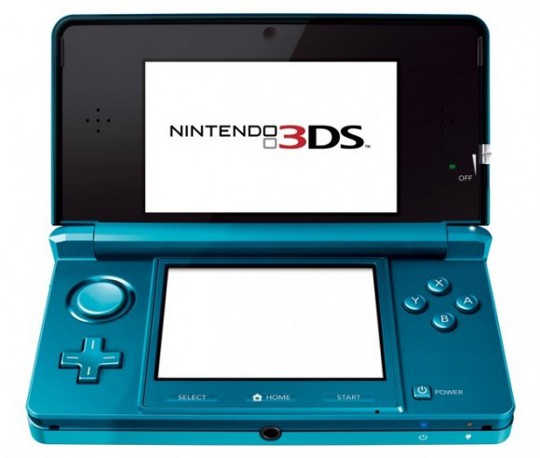
This March, it’s game on in the world’s most visited museum, the Louvre. A delivery of 5000 Nintendo 3DS consoles shall be left at the footsteps of the museum in an effort to revamp its audio guides, which are currently used by a mere 4% of its total visitors.

Not much is known regarding the content or how the in-built 3D capabilities will be utilized but  Mashable reports that visitors will “have access to themed itineraries and commentaries, including child-appropriate ones, in seven languages.”  The content of the tour is being developed by Nintendo in collaboration with the Louvre, who will have editorial control.

With so much emphasis on the Tablet-Smartphone duumvirate, gaming consoles have certainly been overlooked. Even though certain games have surfaced, such as Tate Trumps, they have hitherto, been developed for the hand-held tour guide technology that triumphs; the iPhone, the Droid, the HTC, or the iPad.

Additionally, there has not been much innovation in the field of audio guide technology, and even the audio tours themselves are static because they are based on a one-way communication channel. Thus, the Nintendo 3DS does sound promising as an audio guide technology that can offer 3D visuals and maybe, some playfulness?

So now the question everybody would like to ask; will there be games, intellectually inclined games? Let’s hope so! Last year, Andre asked whether the arts can successfully have a game dynamic? In his article, he argued that games would help arts organizations “overcome certain aesthetic hurdles” and organizations should adopt games because of their “potential for growth.”

And growth there shall be. In fact, an article in the Economist states that “video games will be the fastest-growing and most exciting form of mass media over the coming decade.” Furthermore, the current figures for the gaming industry itself are astounding; “the global video game market was worth around $56 billion in 2010”, which is “ more than twice the size of the recorded-music industry, nearly a quarter more than the magazine business and about three-fifths the size of the film industry...” And this market is expected to reach sales of $82 billion by 2015!

Interestingly, the Economist also notes that the average age of players in America is 37, with 42% of them being female. With the incredible popularity of a bunch of angry birds and virtual farming, it's no surprise that the adult world surely likes to play every now and then. Yet playing on gaming consoles such as the Nintendo 3Ds falls in the domain of a somewhat younger demographic. So the Louvre’s new entry will certainly entice children to go whizzing about the museum, but what about the adults?

Maybe they will, for once, follow in the footsteps of their children. Maybe they won’t. Only March will tell. But one can’t deny that Nintendo consoles are certainly a fun way to begin the auditory odyssey towards art appreciation and knowledge of art history.

Meanwhile in the Louvre, behind her glass enclosure, and with onlookers abound, the Mona Lisa smiles. Gaming is her secret.


The Dummy is Present

Chatroulette. You’re either confused, or you winced at the very mention of the website. For those of you not in the know, Chatroulette is a website that allows anyone with a webcam to be paired up with another random user. Users can chat for as long as they want, until one party hits the disconnect button. The website is notorious for users prominently displaying their genitals, but could it be art? Pittsburgh artist T. Foley seeks to answer that question in her piece “The Dummy Is Present”, a re-interpretation of Marina Abramović’s The Artist Is Present. (She spoke a little on the impetus of this piece in our previous interview with her). If you’re in Pittsburgh tonight, head to the Andy Warhol Museum to see this unique combination of art and technology, as Hector the Dummy responds to ChatRoulette users before a live audience.

The Dummy Is Present will be a part of the Andy Warhol Museum’s performance series Easy Pieces, Friday, January 6th, at 7:00 pm in Pittsburgh, PA.


In Case You Missed It - December 2011

What a month December has been! As the month comes to a close, so does 2011, and here at Technology in the Arts we covered a lot of great topics as the year ended. For practical application, we took a look at that oh-so-cool demographic, the Millennials, and how they donate. We discussed some of the basics of crowdfunding. New technologies are everywhere and we showed you how some theatres are using mobile technologies during performances.

2011 was a year of activism and we took at look artists are taking on the issues of public policy. To wrap up the year we had some excellent posts on the Best of 2011 and all the great things that happened at the intersection of art and technology in a 2011 review.

Before we go, the staff here at Technology in the Arts had some resolutions for the New Year:

Andre Bouchard -

I resolve to pay for more online arts content when the opportunity presents itself.

Rachael Wilkinson -

I will finally get Pinterest on my phone to keep track of artistic inspirations on the go.

 Sean Bowie -

In 2012, I resolve to become more organized in the world of technology. This would involve better organizing my Gmail, Google Calendar and Dropbox accounts. Also, purchasing a new laptop ranks pretty highly as well.

Naina Singh -

1. Become more active on Twitter
2. Actually listen to music on my iPod instead of just browsing the web!
What are your resolutions for 2012?

The Year That Was

The clock’s ticking is becoming ever more pronounced, 2011 shall soon be placed in the archives of our collective history. So as we bid farewell to this year, let’s not forget the events that made the technology-art axis rotate for a full 365 days!

The year began with the unfolding of the Google Art Project, which revolutionized not only the way we view and how much we could view of an artwork, but also how art in museums became accessible at a global level.

And as art became accessible to a host of people, people became accessible to arts organizations through crowdsourcing. This year, we saw an incredible rise in the use of crowdsourcing, in many different areas and for many different purposes. Operas were crowdsourced, exhibitions were crowdsourced, and even art-works were crowdsourced. But it was the concept of crowdfunding that received a standing ovation from a crowd of people, organizations, and artists.

And in the pockets of these crowds of people were smart-phones and tablets, all glowing with the slide-to-unlock signs. With the rise of the iPhone/Droid/Blackberry and the iPad, many museums developed apps for specific artists or exhibitions in order to augment and guide the viewing experience. In fact, apps revolutionized the way audiences interact with art and museums were quick to capitalize on this opportunity.

Moreover, some galleries and museums relocated to the online world, and entire exhibitions moved from the realm of the physical to that of the virtual. Paddle8 and Art Micro-Patronage were both introduced this year, and only time will tell whether online exhibition spaces can be just as successful as offline ones. Moreover, there was an increasing emphasis on tailoring the arts towards one’s aesthetic and visual interests through Art.sy and Artfinder, the Pandoras of the art world. Additionally, s[edition] rebelled against the procurement of tangible art forms through its effort to sell digital limited edition prints of big name artists such as Damien Hirst and Tracey Emin.

As always, social media analytics remained at the forefront, and arts organizations realized the importance of sharing and conversing with their audiences through social media platforms such as Twitter, Facebook, and Google+. Many studies were done on Millenials and their motivations, which helped organizations engage and connect with this tech-savvy generation.

And as conversations became heated in social platforms, the world of art and technology did not let us forget that Earth itself is experiencing global warming. There were some excellent fusions of art and technology aimed at the problem of climate change and the move towards green energy by organizations such as GlacierWorks and SolarFlora.

But what will the year 2012 bring in the technology-arts realm? Innovation, progress, the unexpected, awe , wonder, but surely not an apocalypse, right?

Happy New Year!


The Website Exhibition: Old and New

Open, explore, type to enter, and browse; ever notice how the Internet's functioning, even jargon, is quite similar to that of a museum, where websites appropriate the role of continuously changing exhibits. Moreover, with the Internet steadily acquiring a past, websites have become historical databases and locations where this past continues to surface, as long as it is deemed relevant by Google or Bing. In the art world, knowingly or unknowingly, this phenomenon of virtual longevity has led to the rise of online exhibitions, where the artworks never have to be shipped, mounted, dismantled, and sheepishly monitored by security guards.
SPACE
SPACe
One of the best online exhibitions was created in lieu of the Monet exhibition at the Grand Palais in Paris in late 2010. For the virtual component, the exhibition designers were faced with a both a challenge and an opportunity; how could they affect a lasting impression on the viewers through the artworks of one of the most ubiquitous artists of Impressionism? How could they ask viewers to look past the commercialization of Monet? (You can buy impressionist laptop sleeves and coffee mugs).
SPACe
The answer lay in the development of a virtual exhibition component that reminded us that the brilliance of Monet cannot ever become part of the everyday vernacular. The exhibition takes us on a journey through an impressionistic world set against the backdrop of a canvas. In this journey, which begins with the spill of Monet’s inkwell, we travel through the medium of color as it makes it’s way across a virtual albeit realistic canvas. A series of gradual and beautiful spreads of color transform before our eyes into changing land/city-scapes , where we see ink-cloud shaped sections of Monet's paintings.
SPACE
Moreover, playing in the background and transporting us to another era, is a wonderful piece by Debussy. Thus, as we glide from from one image to the next, we are given a chance to view not an impressionist painting, but an entire impressionist world! And all along the way we are encouraged to take part through a series of interactive sections, some of which involve waving and even blowing air into our microphones!
SPACe
If impressionist artwork of the 19th century can be so wonderfully exhibited online, surely there are contemporary art mediums that can be displayed within the virtual bounds of a website. Maybe digital and new media art, which requires digital space, not wall space. This is where Art Micro-Patronage comes in, digitally.
SPace
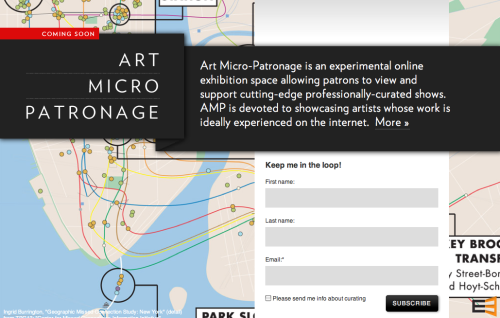
Art Micro-Patronage is an experimental online exhibition space featuring monthly curated shows of digital, new media, and intermedia work. As visitors navigate through the exhibitions, they are encouraged to become micro-patrons of the arts, associating their appreciation of the works with small monetary values.
SPACE
SPace
In Art Micro-Patronage, a visitor can navigate through a series of artworks, all of which have been adapted to the website format. Their current exhibit is titled Dériving An Imaginary City: Virtual Psychogeographies, which “looks at the use of digital tools in mapping the interplay between psychological states and urban environments.” The exhibition was surprisingly easy to follow and some of the artworks were truly interactive, while others were video exhibits displayed via YouTube or Vimeo.
SPace
A nice twist to Art Micro-Patronage is that instead of simply liking an artwork, viewers can become micro-patrons by pledging a small sum of money (.50 cents to 20 dollars) to a particular artwork. The use of crowd-funding to support an artist is not entirely novel but Art Micro-Patronage removes the intermediaries. Moreover, viewers may be more likely to pay for completed project rather than one that is still in the conception phase. Yet, the figure for the amount of money pledged to the exhibition is not exactly stellar: $83 dollars. In due time, perhaps teems of micro-patrons will be able to make difference at the macro level. Nevertheless, Art Micro-Patronage has some intriguing exhibitions planned for the upcoming year!
SPAce
In both the Monet and the Art Micro-Patronage exhibitions, the website exhibition format was employed in a manner that enhanced a visitor’s interaction with the artwork. While the Monet exhibition used the virtual aspect to draw visitors and facilitate interaction, Art Micro-Patronage is simply using the medium of the artwork to display the artwork! And as the Monet exhibition continues to exist beyond the physical, tangible exhibition, it has become encased in the museum that is the World Wide Web, while Art-Micro Patronage is the latest gallery that raises money through the very act of a visitor opening, exploring, entering and browsing their space.

The Best of 2011

As the year comes to a close, let’s take a look at what topped the charts in the art world in 2011.

1. The top 100 of the art world’s most powerful figures from ArtReview

2. The top 32 Facebook Best Practices from DIOSA Communications

3. The top 10 reasons to support the arts

4. The top 10 companies supporting the arts in America according to Americans for the Arts

5. The top 10 works of art and architecture according to Philip Kennicott for the Washington Post

6. The top Twitter topics and hashtags according to Mashable

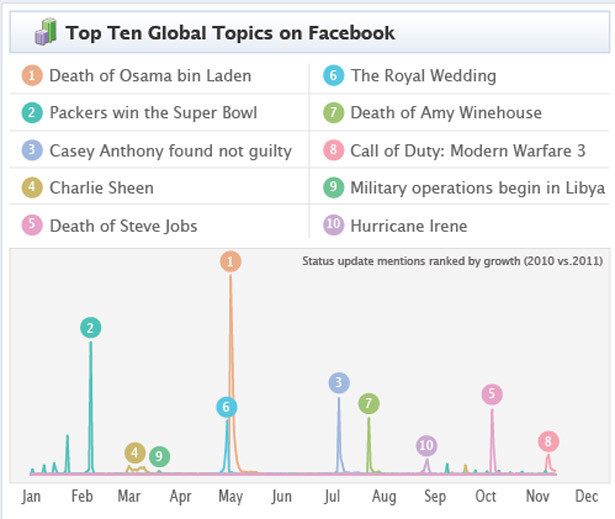
7. The top global topics, statuses, sports teams, music, articles and the like shared on Facebook (for all the locals: the Steelers obviously made the cut) according to Mashable

8. The top 50 not-for-profit executives according to the NonProfitTimes

9. The top 15 museums in the world according to the Huffington Post

10. The top 10 private museums worldwide

We here at Technology in the Arts look forward to sharing with you new technological advances, best practices and trends in the upcoming year!

Public Policy Through the Eyes of Artists

In the world of public policy, ideas are a dime a dozen. From issues ranging from education to trade issues, everyone has their opinion about the best course of action the government should take. What’s often missing, however, are new and exciting ways to present these ideas, taking formally bland issues and finding new ways to solve them. This is where the arts community comes in.

While city planning and urban development may not be the most exciting issues to talk about, an exhibit in New York City is showcasing four artists who are attempting to use the power of artistic expression to bring attention to urban planning issues that are present in their communities. By offering a unique way of examining these often complicated public policy issues, the hope is that visitors will leave with a heightened sense of the issues that are affecting their community.

The exhibition, “Civic Action: A Vision for Long Island City,” opened on October 13th of this year and continues until April 22, 2012 at the Noguchi Museum and Socrates Sculpture Park in the Long Island City community of Queens, New York. The exhibit has received a fair amount of press attention, including a great write-up in The New York Times last week.

There have been similar art exhibits where policy ideas are presented by artists themselves, who often have no connection to the policy community or stakeholders. What’s unique about this project is that the four artists involved where all invited to partner with an urban planner or architect to imagine and conceive new developments in the Long Island City area, bringing a degree of realism and practicality to the individual projects. Instead of imagining idealistic public spaces or infrastructure improvements, the artists were advised to come up with ideas for spaces that would compliment already existing structures.

The ideas range from practical to the more unrealistic. The four artists featured in the exhibit are Natalie Jeremijenko, Mary Miss, Rirkrit Tiravanija and George Trakas.

Jeremijenko’s exhibit, titled “UP_2_U,” combines the worlds of art and technology (something we love!) and offers some unique ideas of her own. The exhibit includes robots, computer components and more simplistic things as do-it-yourself fixes to become more sustainable. The crux of the exhibit involves asking visitors to take more action to improve the communities around them; as a play off the title, she tells visitors it is “UP 2 U” to bring about the change you’d like to see.

Mary Miss’s exhibit includes a “City as a Laboratory,” where artists, policy makers and stakeholders come together to solve complicated policy problems. Another installation, titled “If Only the City Could Speak,” includes large visual thought bubbles containing ideas and policy ideas for the community. The larger tone of her exhibit invites a sense of participation engagement and encouragement for visitors to get involved in their community. One of the proposals in her exhibit concerns a local issue: four smokestacks that dominate the skyline of the Long Island City community. She proposes to turn the stacks into a kind of environmental sustainability center that creates long-lasting environmental improvements for the area.

My favorite area of the exhibit comes from Tiravanija, who among his proposals includes an idea for a section of Broadway: growing drivable grass. Yes, you read that right. Not all of his ideas are that outside-the-box, however; another favorite is more practical and involves building a community kitchen in the area.

Finally, Trakas’s work involves an area that urban planners and architects around the world have embraced more and more over the years: waterfront development. Naturally, as an artist, Trakas is less concerned with creating stores and condo complexes and stadiums on the waterfront; instead, he envisions a waterfront area as a place where residents can learn more about the community’s history through exhibits and public information. The idea is creating a public space that is less commercial and more about the community itself.

Throughout all four exhibits, the greater message seems to be that the intent is to start a conversation about the future development of the Long Island City area. What types of planning ideas should be implemented? What approaches should local government officials take to complicated public policy questions? While the artists and those involved in the exhibits may not have all the right answers, the exhibit itself is a refreshing reminder that sometimes the best policy ideas do not come from government offices or elected officials: sometimes, the best and most original ideas come from those who are active in their communities, aware of local issues and problems, and passionate enough to devote time to the issues. In this case, that category just so happens to include the arts community.


Tweets and a Show

The lights dim, the orchestra tunes one final time, and the audience begins to liveblog. Perhaps you’ve heard about operas creating apps or navigating an art museum with your iPhone, but have you considered tweeting during your next trip to the theatre or musical hall? While most venues view cell phones as a rude violation of decorum, others have embraced this modern culture of mobile communication in an effort to enhance the artistic experience. Enter the “Tweet Seat”, as defined by the New York Times section Schott’s Vocab

"Theater seats reserved for Twitter users"

The Milwaukee Chamber Theatre is a notable instance of this phenomenon. During an April production of “The Lion in Winter”, Tweet Seat tickets were sold. Patrons who purchased Tweet Seats stat in the upper-level balcony and were encouraged to tweet during the production. Staff provided a handout with the Milwaukee Chamber’s Twitter handle as well as a special hashtag for their tweets about the show. It should be noted that at the bottom of these instructions was the bolded phrase: “Please silence your phone”. (It should be further noted that no cell phones rang or interrupted the performance.)

Tweet Seats may sound like a fun, edgy experiment to some, but other arts organizations are embracing mobile technologies as a part of their internal culture.

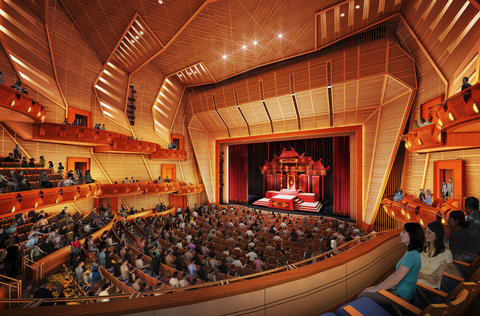
Take a look at the future Tateuchi Center of Bellevue, Washington. When given a choice of blocking cellular service in the building, John Haynes, the CEO of the Tateuchi Center, chose to increase cell phone capabilities in the facility.

Audience members will be encouraged to tweet, liveblog, and interact electronically during performances. The Tateuchi Center is self-described as,

 " ...one of the first, great performing arts centers of the 21st century, distinguished by its having been planned not just for a new era, but a new generation..."


What do you think? Is this the natural progression of performing arts? Or does allowing audiences to have their phone out detract from the performance? Is it unfair to the performers?

Would you tweet during a performance?

Social Media Analytics are totally.awe.sm

Its not often that one comes across a company named awesome. Perhaps, companies fear the mighty implications of cool contained in those two syllables. Yet, one San Francisco based start-up has accepted the challenge of living up to those expectations by putting forth an awe-some value proposition.awe.sm is the leading platform for companies to harness social data. We measure how social marketing like Facebook posts and Twitter updates leads to meaningful outcomes, like signups, purchases, and other business goals.”

Space
True to their URL address, their work is totally.awe.sm because they are helping developers, marketers, and organizations effectively monitor and measure their social media and marketing campaigns. While awe.sm has been around for the past two and a half years, the company recently made headlines because it received $4 million dollars in funding from the Foundry Group, and it plans to use the money for further development and expansion of its social data monitoring platform.
SPa
Besides its additional services that are tailored towards marketing professionals and developers, awe.sm helps an organization in two ways; through optimizing their sharing and understanding their fans.
Space
Firstly, awe.sm can help further an organization’s social media strategy through individually tracking each post that uses awe.sm’s url shortening code. By tracking each tweet or post individually, an organization can learn about the type of posts that attract web traffic, the optimal time for posts, and the actual monetary returns on social media campaigns. It is this last measure on returns that really differentiates awe.sm from other social media tracking tools because awe.sm lets “publishers analyze just how much a Like is worth to them.

While Awe.sm’s tracking tools have been Facebook centric in the past, they have recently “evolved to include other social networks like Twitter and developed a more sophisticated set of APIs that allows content publishers more insight into who is Liking and Sharing their posts on Facebook, and who among those converts to paying customers for the content publisher.” Hence, organizations can now use awe.sm to track their posts on Twitter as well as Google+ along with gauging the monetary value of their social media campaigns on each of those sites.

Secondly, awe.sm enables an organization to visualize its social media sharing pattern through some very nifty graphics, which can help an organization identify its influencers, the people who can sway public interest towards a particular product or cause. An example of these graphical and interactive interfaces can be found at VIPLi.st, which is “a fun visualization of the data awe.sm tracks for Plancast.”


While awe.sm is geared towards for-profit organizations, not-for profit organizations can still gain some valuable insight into social media analytics. Awe.sm’s capabilities could be used for fundraising, where organizations could track the kind of posts that are leading to the highest ROIs, shares, signups, and clicks. Moreover, awe.sm would also be very useful  in determining which social media channel (Facebook vs Twitter vs Google+) is most effective in connecting and conversing with followers or fans.

And for those interested in learning more about social media analysis, the awe.sm team runs an interesting blog, in which they provide valuable insights into the world of social media along with some great advice on social media strategies, industry predictions, and best practices. Awe.sm also holds webinars for those interested in learning more about the application of their social media platform.

The world has become a sociable place, at least as far as online sharing, liking, and conversing is concerned. And organizations should be careful not to overlook social media analytics because, in essence, they provide insight into people’s emotions, which is a very powerful and influential piece of information for any organization in any field.

Earlier this year, Technology in the Arts wrote a three part series on The Art of Social Media Analytics and with companies such as awe.sm, these analytics truly become an art form because awe.sm’s tools are able to create a compelling and powerful visual story around a set of clicks, retweets, plus ones, and likes.

The Walker, venturing into online magazine style content

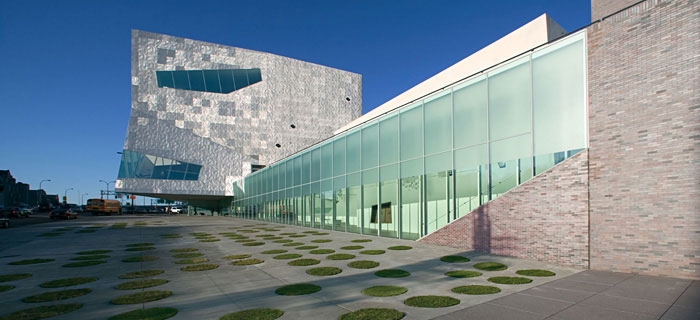
The Walker Center in Minneapolis has a new website that has broken the mold and is venturing into offering content in a way that could help define a new paradigm of online content for large arts organizations.  As the executive Director states in her press release:  "The intent of the new site is to make visible our role as a generative producer and purveyor of content and broadcast our voice in the landscape of contemporary culture."

By becoming broader purveyors of arts knowledge and information The Walker makes itself more relevant in the broader context of the arts across the country.  The expertise that was only available through a visit to a lecture, through a docent on a museum tour, or a talk-back during a performance is now available through the we interface as the Walkers experts are now the gatekeepers for the online content.  Thus the reach of the organization becomes multiplied by those people who share content and the organization.

This platform has the potential to lure entirely new audiences through the principle that traffic online follows quality of content.  Also by revealing the values of the artistic staff of the organization The Walker is potentially connecting with like minded individuals in the arts community across the world.  This in turn could make them into a destination city for arts tourists.   By using the multi-disciplinary focus of the institution they are harnessing the the trend but by putting it online they are making it about the global dialogue and making themselves a shining example of what is to come.

A Bear-y Familiar Conversation

Here is a little video to poke fun at the public's all too common misconceptions of not-for-profit arts organizations. After all, Kanye and Bieber do not ask you to make an additional donation for their performances, why on earth do not-for-profits?! Happy Monday to our arts community!

Crowdfunding for the Arts

Crowdfunding and the fund-raising miracles it can achieve is certainly a popular issue. It’s not a new topic for technology in the arts, but it is a constantly evolving topic and worth a revisit. If you’re familiar with the basics, we’ve got some more advanced tips for crowdfunding. This article is meant to aggregate some of the more popular tools out there and help beginners with the basics.


Crowdfunding is usually based on the idea that through micro-donations organizations can achieve goals or projects that they would normally struggle to fund. From that point, all bets are off, as different crowdfunding tools are for different goals. A lot of deciding which tool you will utilize will be based on your organization or its goals. Here are some of the major websites that focus on or include the arts in their projects.


  • Basics: We’ve talked about Kickstarter before and it is one of the most popular crowdfunding tools. Users have two months to raise funds and provide rewards to their patrons. Kickstarter’s guidelines specifically state you cannot use Kickstarter to fund a charity - you can, however, use it to fund projects for a non-profit. For example, No-Space of Brooklyn used Kickstarter to fund the move to and costs associated with their forced relocation.
  • Pros: Kickstarter has an “all or nothing” platform, if funds are not raised within the 60 day limit, all pledges are dropped. Kickstarter is well known and a fairly safe bet for those looking to fund their first project.
  • Cons: The project-centric ideology limits what can be crowdfunded. Also, Kickstarter uses Amazon Payments. While Kickstarter itself does not require those creating projects to be US citizens, Amazon Payments does, which makes Kickstarter out of the reach of international organizations.
  • Fees: Kickstarter charges a 5% fee to successful projects. There is also a 3-5% fee associated with credit card transactions on successful projects.


  • Basics: USA Projects is another crowdfunding source we’ve discussed before, and it is a project of USA Artists. Potential projects have three months to raise the funds or receive nothing. The Project sponsors “new creative efforts by accomplished artists across the country” and has raised over $1 million so far. All suggested projects are vetted by artistic experts in the related field.
  • Pros: USA Projects has a strong institutional background with USA Artists, allowing it to have a gift-matching component, and the average donor gives more than Kickstarter users. All donations are tax-deductible, and artists offer perks for donating.
  • Cons: USA Projects only accepts artist members who have previously received a grant or award from their partner and recognized organizations as an individual artist.
  • Fees: 19% of all donations go to USA Projects “for use in furthering its general charitable and educational purposes.”


  • Basics: IndieGoGo touts itself as “the world’s leading international funding platform”, and is open to “anybody with a great idea”. Projects are not curated. Users have up to 120 days to reach their goal, but unrealized goals still receive the pledged funds.
  • Pros: Donations to non-profit organizations on IndieGoGo are tax-deductible, different donor levels have perks related to the campaign. Analytics tools allow campaign managers to track where/who funds are coming from, as well as capture contact information from funders. Anyone can use IndieGoGo for anything, which is has unlimited possibilities. IndieGoGo also has partnerships with non-profit organizations that fiscally sponsor projects.
  • Cons: No vetting process on campaigns means your next big, great idea may not carry as much weight for donors as a website where projects are curated. Also the website caters more to individual artists’ projects than arts organizations - arts campaigns are not listed under “Causes” unless they have an educational component.
  • Fees: IndieGoGo takes 4% of the money your project manages to raise, if your goal is met. Should your project fall short, IndieGoGo takes a 9% cut of funds raised. International campaigns may have higher fees.


  • Basics: RocketHub is a crowdfunding platform for anyone who would like their creative work to be funded, developed or distributed. RocketHub has two levels of fundraising, one is a crowdfunding tool open to anyone. Campaigns have between 15 and 90 days to be funded, unrealized goals will still be funded, but met goals have rewards within RocketHub. The second is called a “LaunchPad Opportunity”, which is a reoccuring vetted submission process. Projects chosen receive an opportunity that will advance their business or campaign beyond simple fundraising (for example, the winner of the LaunchPad Opportunity will work with an expert publicist on generating buzz for their project).  A team of judges at RocketHub examines all submissions, and Facebook users vote to help decide which projects to put on the website to fund.
  • Pros: Successfully funded campaigns on RocketHub allow the campaign creator to submit 5 entries to their LaunchPad Opportunities without a cost. RocketHub has partnerships with non-profit organizations that fiscally sponsor projects.
  • Cons: RocketHub does not have a specific “Art” category, although individual projects could fit well into their other categories.
  • Fees: For crowdfunded fees, RocketHub charges 4% of the money you raise if your goal is met. For unfunded projects, the fee is 8%. RocketHub also charges a 4% transaction fees for credit card charges. For first time submitters to a “LaunchPad Opportunity”, there is a submission fee of $8. Those who have a project successfully crowdfunded do not have this fee.

IndieGoGo and RocketHub work outside the states, but there are other crowdfunding tools internationally. There are also tools like Philanthroper, which is a daily deal crowdfunding site for non-profit organizations. There are resources for staying on top of crowdsourcing trends, too. Ultimately, an individual or organization has to consider what type of crowdfunding campaign will work for their needs before deciding on one. If there are any other crowdfunding topics or questions you’d like answered, leave a comment, and we’ll see how we can help.