Introduction
AI image generation companies have faced widespread criticism from the art community for their unethical use of artwork without consent—often scraping creators' work and justifying it under the broad and controversial claim of “fair use.” For many artists, particularly those navigating today’s challenging economic landscape, this raises a critical question: how can we ensure our creative work is respected and protected? In a previous article, Nightshade: A Defensive Tool for Artists Against AI Art Generators, we explored one potential response—tools designed to confuse AI systems by disrupting the correlation between images and text data. But what if a new kind of AI image generator could make such defensive tactics unnecessary? Imagine a platform built from the ground up with artist rights in mind—one that addresses these ethical concerns at the core.
What is BRIA AI?
Bria.ai is a startup that has developed AI image generation models trained exclusively on licensed content from major stock image providers like Getty Images, Alamy, and Envato. Unlike many AI platforms that scrape data from the internet, Bria emphasizes a responsible approach by using only permissible content, aiming to address the aforementioned copyright concerns in AI-generated visuals. The company has also introduced an attribution model to track how specific photos influence AI outputs, facilitating compensation for creators when their work contributes to generated images. This payment system is similar to Spotify's model, providing micropayments to artists based on usage. Bria's strategy seeks to solve copyright and privacy issues in AI by ensuring transparency and fair compensation for artists and content creators.
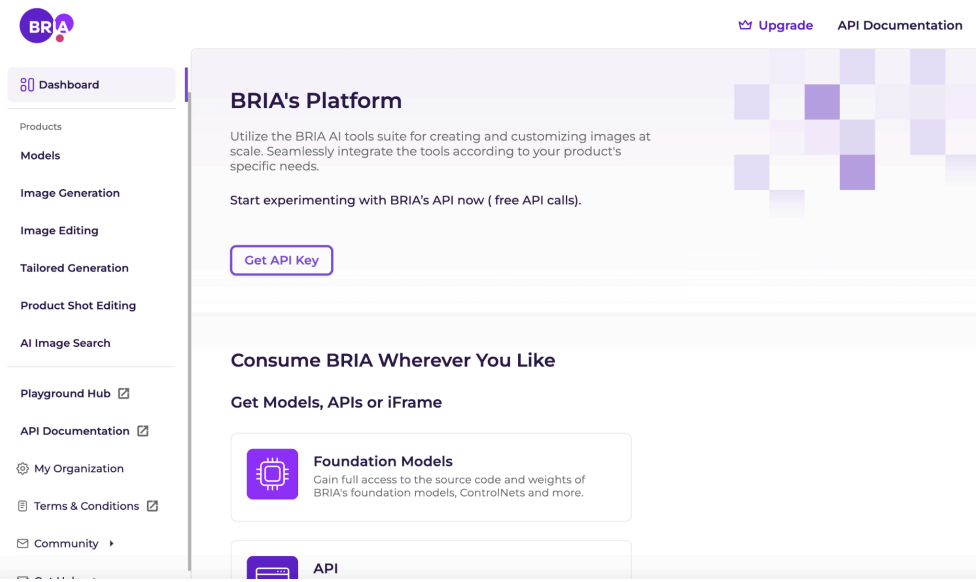
Image: BRIA AI platform home page
Image Source: Screenshot by author
VALUE PROPOSITION
Bria provides a suite of visual generative AI tools and resources designed for enterprise use, including:
Tailored Generation: Customization of AI models using brand assets to ensure consistent and compliant content.
Product Shot Editing: Creation of uniform product imagery while maintaining product integrity.
Ad Generation: Production of advertisements at scale, ensuring brand consistency and regulatory compliance.
AI Image Generation and Editing: Features such as background generation, object removal, and caption generation.
PRICING MODEL
It must be acknowledged that this higher ethical standard comes with a cost. Bria offers a demo playground for users to test its capabilities, allowing exploration of features like image generation and editing before committing to a paid plan. However, there is a limit as to how many prompts you can generate.

Image: BRIA AI platform home page pop-up message
Image Source: Screenshot by author
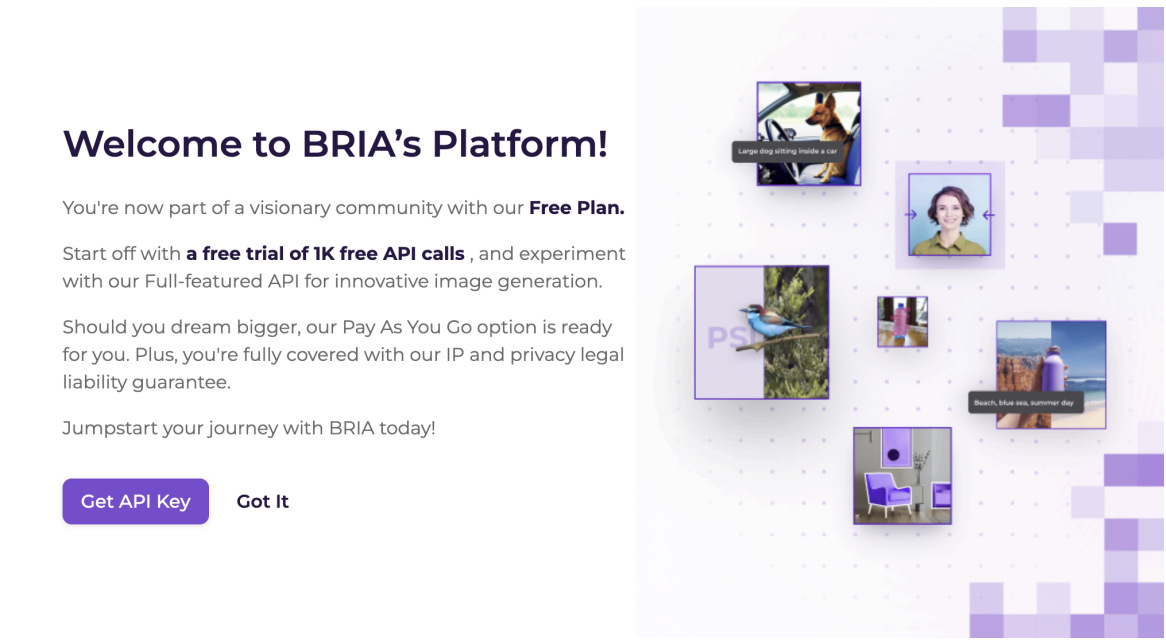
Image: BRIA AI platform home page pop-up message
Image Source: Screenshot by author
Bria.ai offers a distinctive pricing model tailored for startups, emphasizing ethical AI development and scalability. Their startup program provides access to Bria's full platform to early-stage companies (up to $10 million in funding and 1–20 employees) for $700 per month, which includes 5,000 API calls (prompts) or "model actions." For growth-stage startups (Series A/B with more than $10 million in funding and 20–50 employees), the monthly fee is $1,800, encompassing up to 50,000 actions. Beyond these limits, additional usage is billed on a sliding scale, ranging from $0.005 to $0.04 per action, depending on volume.
For developers and enterprises, Bria also offers additional scalable solutions:
Starter Plan: Includes 1,000 actions per month, with additional actions priced at $0.08 each.
Pro Plan: Offers 1,000 actions per month, with additional actions priced between $0.06 and $0.02 each. This plan includes features like automated branded content generation and enhanced support services.
Enterprise Plan: Provides custom pricing, with actions priced between $0.04 and $0.005 each. This plan includes all Pro features, plus the ability to train models with custom training pipelines and access white-labeled APIs and SDKs.
This pricing structure stands out from other AI image generation platforms that often rely on pay-as-you-go models or fixed subscription tiers without integrated legal safeguards. Bria's approach includes full legal liability coverage through its patented attribution engine, ensuring that all generated content is licensed and that original creators are compensated. This commitment to ethical AI practices provides startups with a compliant and scalable solution for integrating generative visuals into their products.
In contrast, platforms like Midjourney or DALL·E typically offer lower-cost plans but may not provide the same level of legal protection or transparency regarding data sourcing. Bria's model is particularly advantageous for startups in regulated industries or those prioritizing brand safety and ethical content creation.
IMPACT ON THE INDUSTRY
Ethical AI and the Protection of Artistic Works
In an age where generative AI is rapidly reshaping creative industries, Bria is setting a new standard for how this technology can respect and protect artists. Unlike many AI platforms that scrape the internet for data without consent, Bria trains its models exclusively on licensed visual content. This commitment to ethical AI development ensures that artists, illustrators, and photographers are not only shielded from unauthorized use of their work but are also fairly compensated when their art is used to train generative models. This responsible approach helps establish a sustainable creative ecosystem, where innovation is not achieved at the expense of artist rights.
Impact on the Art Industry
Bria's technology is already being used across sectors like marketing, media, and e-commerce to streamline visual content creation—but its implications for the art world are even more profound. By providing tools that generate content while maintaining clear licensing paths and attribution, Bria helps prevent the misuse of original works and sets a new precedent for how AI can coexist with traditional and digital art practices.
For artists, this means greater transparency, new revenue streams, and enhanced protections in the face of an increasingly AI-driven creative landscape. For the industry at large, Bria offers a responsible alternative—one that balances efficiency with ethics, and progress with protection.
CONCLUSION
However, while Bria.ai’s vision is making great strides, it is also important to recognize the potential downfalls concerning implementation. For instance, how will Bria determine fair compensation across a vast and diverse creative economy? What verification systems are in place to ensure content is licensed appropriately? These logistical gaps leave us with unanswered questions about scalability and enforcement, but perhaps this comes with time, trial, and error.
Still, the value of Bria's contribution lies in its clear ethical commitment and its call to action. As generative AI tools become more embedded in sectors such as entertainment, marketing, and education, the demand for ethical AI infrastructure will only grow. Bria’s article provides a blueprint—albeit an aspirational one—for aligning technological advancement with creator rights.
-
“AI Image Generation Platform for Startups | Bri.” Accessed May 25, 2025. https://bria.ai/for-startups.
“Bria Blog.” Accessed May 25, 2025. https://blog.bria.ai.
Bria.ai. “BRIA.Ai | Visual Generative AI Done Right.” Accessed May 25, 2025. https://labs.bria.ai.
Capterra. “Bria Pricing, Alternatives & More 2025.” Accessed May 25, 2025. https://www.capterra.com/p/10018322/BRIA/.
“Modernizing Our Royalty System to Drive an Additional $1 Billion toward Emerging and Professional Artists – Spotify for Artists.” Accessed May 25, 2025. https://artists.spotify.com/blog/modernizing-our-royalty-system.
Swant, Marty. “Startup Debuts New AI Models Trained on Getty Images and Other Content as Copyright Concerns Loom.” Digiday (blog), September 8, 2023. https://digiday.com/media-buying/startup-debuts-new-ai-models-trained-on-getty-images-and-other-content-as-copyright-concerns-loom/.
“Why Bria Stands With Data Owners and Creators For Visual Generative AI.” Accessed May 25, 2025. https://blog.bria.ai/the-fight-for-a-fair-ai-future.