
MuseumNext’s virtual Green Museums Summit took place on February 26 and 27, 2025, featuring speakers from institutions worldwide. Speakers represented a variety of museum types - including history museums, art museums, children’s museums, and more. Each institution had a unique approach to addressing climate change, whether through their facility, day-to-day operations, or programming. Speakers shared projects from their own institutions, how the projects were executed, and what they learned through the process. Throughout the conference, there was also significant overlap in these approaches and the organizational values that informed this decision-making. Highlights and key themes discussed in this article include:
Regenerative thinking
Technology for Change
Learning from Our Heritage
Progress > Perfection
Regenerative Museums
This year’s summit emphasized regenerative museums, or thinking about a museum’s work as part of a living system. Beyond just reducing environmental harm, a regenerative management approach is focused on reversing damage and integrating human and natural systems.Gabrielle Macbeth from Glasgow Women’s Library articulated this connection with a quote by Nan Shepherd, “the first law of ecology is that everything is connected to everything else.”
At the Barbados Museum & Historical Society, they view their work through a “Rhizomatic” or root-like, decentralized approach to museology, where everything branches off and grows from something else.
Lucimara Letelier, creator of the web series Regenerative Museums, delved deeper into this concept, sharing how it might be integrated into our work through frameworks from authors such as Carol Sanford, Pamela Mang, Ben Haggard, and Daniel Wahl. Regenerative thinking is rooted in seeing each “stakeholder” as a whole being with value and potential. While museums are often models for community engagement, they rarely consider their relationship with natural stakeholders - from which we may have quite a bit to learn. Letelier pointed out that nature knows how to restore itself, and if we are curious and take time to learn about the world around us, natural systems may offer new ideas for the ways we manage our institutions.
Regenerative management systems may mean looking at collections as living objects, not solely as artifacts. For example, the Manchester Museum returned a collection of culturally significant items to the Anindilyakwa community, an indigenous group in Australia. In return, the community gifted a collection of new shell dolls to the museum, with a caveat: they had to take the dolls out and play with them at least once per year. These items were not intended to be kept in a display case, but understood through ongoing use.
Technology as a Tool for Transformation
The ways that we use technology in museums can have serious impacts on energy usage and associated emissions. Like many museums, the Bletchley Park Trust uses projections throughout its exhibitions for adaptable interpretation. However, realizing that this came with significant energy usage, they wanted to better understand and reduce environmental impact. Partnering with Sysco Productions, they identified a few relatively simple changes that could have a significant impact over time. Notably, the museum added motion sensors to start and stop projections, so they were not running when a gallery was empty. Not only did this switch cut the energy bill, it also extended the life of the hardware, lowering embodied carbon. As an added benefit, this system also collected valuable data for the museum about when and how often certain projections were triggered, which informed future efficient exhibition design.
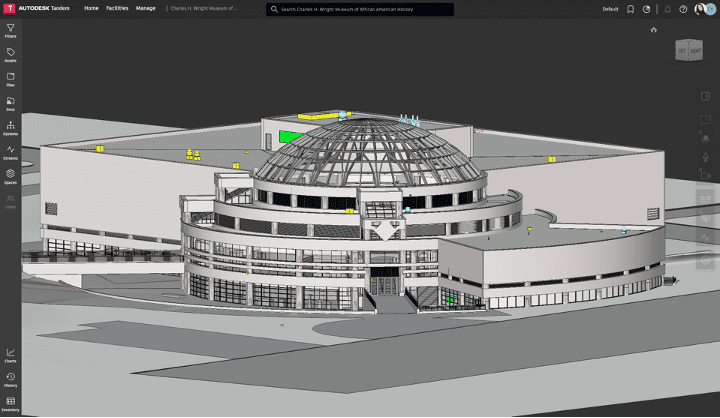
At the Charles H. Wright Museum of African American History in Detroit, blueprints for the facility were lost in a fire at the architect’s office, impeding sustainable improvement plans. They decided to commission new comprehensive maps of the museum, including the development of a digital twin. Paired with real-time sensors throughout the facility, the virtual replica helps collect and interpret operational data, like temperature and relative humidity, to inform strategies for energy efficiency and long-term maintenance.
Wright Museum Digital Twin, Exterior View
Image Source: Autodesk Tandem
Learning from Our Heritage
While technology-based solutions can play a role in reducing a museum’s environmental impact, we can also often learn a lot from the past. A number of institutions shared ways that they use the histories they represent to demonstrate sustainable alternatives. At Hørvævsmuseet, or the “Flax Weaving Museum” in the Netherlands, they show how to harvest and treat flax naturally, to create thread to weave linens. “By looking at the past, we can develop a more sustainable future,” said Hørvævsmuseet’s Gosia Kozłowska.
Meanwhile, the Beamish Museum uses its campus, historic buildings, and collection to show both sustainable ways of living and the reality of the industrial era. The open-air living history museum reenacts English life from the 1820s to 1950s, such as farming, mining, railways, education, and general town life. There are many low-energy, low-waste practices from this era that may inspire our work today, such as making and washing clothing or growing food. However, the museum finds it important to communicate the consequences of innovation in this era, and the lasting impact the industrial revolution has had on our planet.
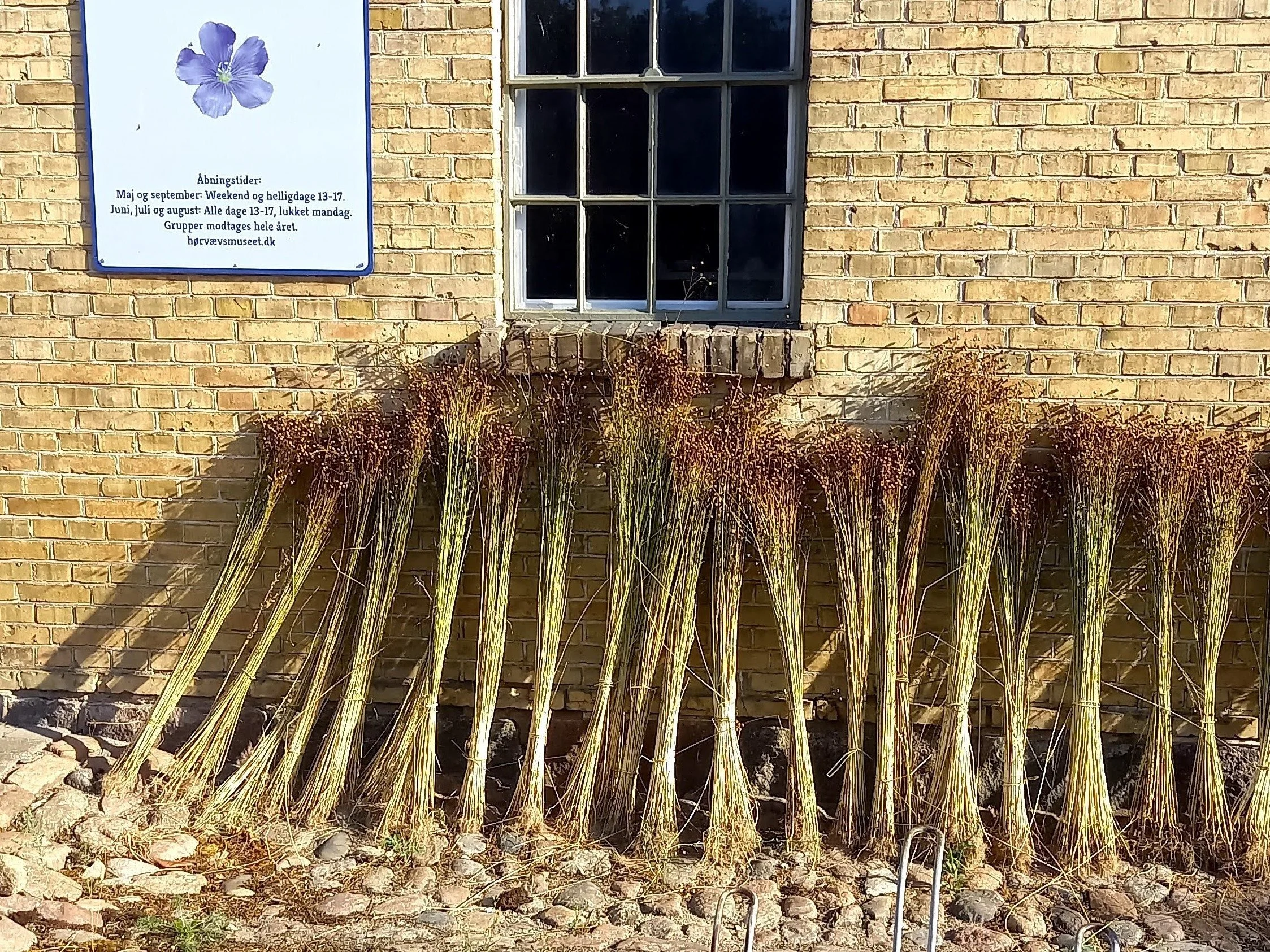
Processing Flax at Hørvævsmuseet
Image Source: Hørvævsmuseet
“Do Well by Doing Good”
Finally, a key theme to note is that you don’t have to be perfect to get started. In the words of the Detroit Historical Society’s Vice President of Strategy and Marketing, you can “do well by doing good.” In organizations that are often under-resourced, it may be hard to make a case for making large investments in sustainable alternatives. However, making climate-smart decisions supports the financial bottom line more than you may expect. Your organization may opt to make incremental changes based on your organization’s resources at a given time, like switching to efficient light fixtures as they burn out and need to be replaced.
At the J. Paul Getty Foundation in Los Angeles, they are opting to “not let perfect be the enemy of good.” Camille Kirk, the Getty’s Head of Sustainability, shared how a series of seemingly small changes have compounded to have a big impact. She also acknowledged that things will not always go as planned. For example, you may go to great lengths to source the most sustainable material, but it unexpectedly comes wrapped in plastic. At the Getty, after wildfires destroyed significant portions of their landscape, they prioritized native plants and biodiversity as they re-grow. Rather than feeling defeated, this can be an opportunity for transparency, conversation, and process improvement with your staff and community.