

Measure of Music is a one-of-a-kind virtual conference that gathers music industry and data analytics professionals and enthusiasts from all over the world for one weekend in February. The conference has two distinct roles: spectator and participant. As a spectator, you can attend workshops and panel discussions on a wide range of topics: from music marketing and synchronization to artist management analytics and coding. If you are brave enough, you may register as a participant to develop a music data project, using real industry data provided by the conference’s partners, and present it before the conference jury. In this case, you would be placed in a team and would have a chance to consult with mentors whose expertise ranges from data analytics and UI/UX to marketing, music licensing, and artist management.
Notably, it is not just a conference, but a community. Measure of Music was started five years ago by Christine Osazuwa. Christine is a music marketing, strategy, and data specialist, first-generation Nigerian American living in the UK, who saw international demand for the platform to explore and discuss music data for the sake of research, genuine curiosity, and love for the music industry.
The team also does a great job of making the online experience truly immersive with the Airmeet platform for online after-parties and speed networking. Participants also had a chance to connect with recruiters, among whom were industry leaders, including people from The Orchard and Kobalt. The conference’s data-providers provided music data from platforms including Chartmetric, Luminate, Songkick and others.
Key Insights
Music & Tech: Investment Ouroboros and The Demand for Problem-Solving Tech
Cherie Hu, the conference’s keynote speaker and the Founder of Water & Music, a music tech and business research and consulting agency, shared her insights on the key changes in the music tech industry over the last five years. Here are five highlights:
Post-pandemic, the demand for “shiny-glamorous” new tech made way for the tools that solve real problems and help daily operations. Five years ago the most popular investment sectors were live streaming, fan engagement platforms, and music production tools. In 2025, investors prefer rights management, live operations tech, and AI production product initiatives.
Investment ownership matters. Music Tech Ownership Ouroboros, an interactive map created by Cherie, gives a reality check on music ownership consolidation. It helps illuminate the logic of decision-making and the interplay of domestic and international capital in the music industry. Notably, one of the central nodes in the network is Chinese Tencent Music Entertainment and its affiliated companies, which might dispel some illusions of a U.S.-dominant industry.
Rights and revenue sharing are at the center of debate and are the main bottleneck for every new music tech startup. Hopes are pinned on blockchain, but it will not save the industry from copyright issues; instead, it will cement and multiply wrong data that already exists.
“Super-fan” became a buzzword and almost an industry obsession. Meanwhile, there are three major super-fan fallacies people overlook: emotional, legal, and technological. Superfans bring the biggest profits, but their consumer habits can be associated with unhealthy and toxic behaviors. At the same time, collecting and storing superfan data is an issue: it is currently fragmented and hard to manage, but excessive ownership consolidation in this sphere can be negative for both artists and audiences. Finally, while many super-fan platforms still emerge, sustaining users’ activity in any app is highly challenging, looping back to the data fragmentation challenge.
Industry players are continuously excited about data, and budgets allocated for data collection and analysis keep rising. Still, according to the Water & Music industry survey, half of the respondents do not know what the resulting ROI of their work is.
For those interested, you can watch the replay of the panel with Cherie Hu.
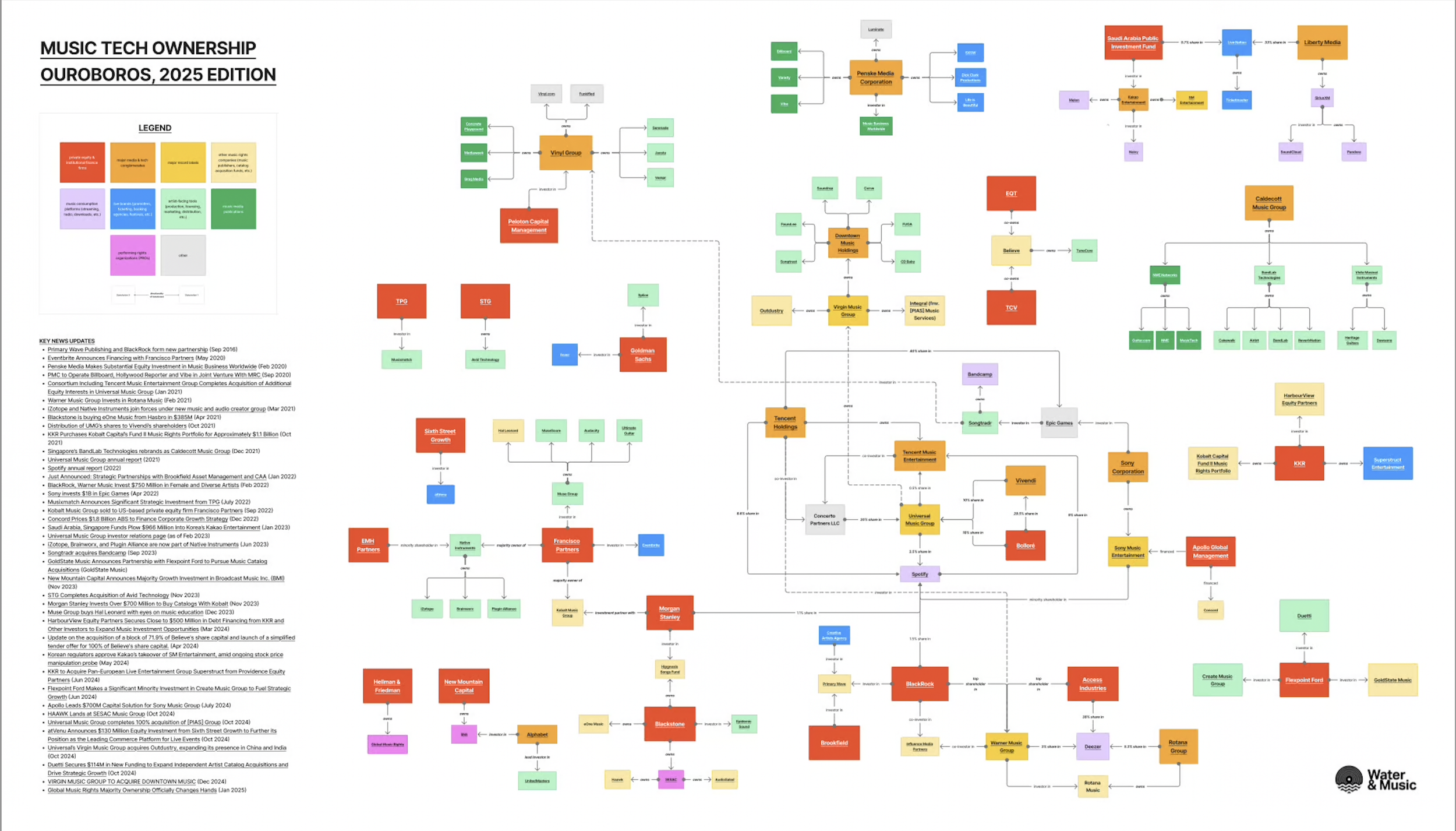
Music Tech Ownership Ouroboros by Cherie Hu
Source: Water & Music
Music Marketing: Redefining Engagement & Prioritizing Impact
Artists reaching audiences is the point. The conference offered some perspectives on how to create more impactful marketing and engagement opportunities, especially for indie artists.
Setting goals is good, but setting adequate and relevant goals is better. While modern promotion and distribution platforms make artists chase algorithms for “success,” it is crucial to craft your own definition of success. Setting relevant, achievable goals helps inform tactics and select metrics adequate for a particular artist’s specifics and career stage.
This principle is relevant for overall strategic development and each promotion campaign. Creating viral content is not a goal, it is a tactic. There should be a goal behind each content piece. One way to define that goal is to answer the question, “What do I want the fan to do?”
As BandLab’s Head of Artist Development & Education, Kevin Breuner, said, “Industry doesn’t always translate what you’re good at to streams.” It doesn’t always translate it into views, likes, or shares either. This is why assessing your artistic impacts, rather than dry numbers, is essential. Tracking various engagement ratios rather than absolute numbers also helps. Here are some examples of metrics and low cost-high impact tactics that might help break through the noise and maintain one’s artistic sanity while reaching to the stars:
Collect social proof: does your music bring people together, support communities you care about, have special meaning for people? Connecting with fans (even if it’s five people) and collecting that evidence will help to refine your audience portrait and understand your niche and marketing messaging better.
Engagement depth matters more than scale. Ratio metrics like tickets to room capacity, streams to saves, comments per like, or watch time to views, help focus on the existing audience and the ways to expand it, rather than chasing numbers.
Expanded community management and social listening are new black. As the Something Something social media agency’s experience proves, guerrilla and field marketing work in music better than huge ad budgets. Don’t wait for people to come, meet them where they are, and look for the right conversations to engage in. You should be showcasing your art, talking to fans on social media, replying to comments, and even creating your own fan page (yes, that’s ok to do). It is energy-consuming but extremely cheap and rewarding.
Build connection through direct communication and personalization. Talking to fans through direct messages, “close friends” stories on Instagram, newsletters etc. allows artists to break through the clutter. In the age of information overload, people value personal connection, especially Gen Z, who, on average, prefer to be less public than previous generations. This approach also helps spur user-generated content (UGC) creation. UGC does not appear by itself – you have to make it happen. Connecting with local fan community leaders and providing them with promotional materials to disseminate, as well as sharing upcoming releases or tour plans, is one way to amplify your voice. As shown in the Universal Music Capital Markets report, direct-to-fan engagement is the fastest developing part of the business.
If you would like to expand on the insights in this section, you can watch replays of the panels they’re drawn from: Beyond Streams and Sales: The Music Marketing Metrics That Matter with BandLab, Rethinking Music Marketing: Fans, Feeds & FOMO.
Measure of Music is a great event not only for the music industry and data analytics professionals, but also for those who are starting their career path or are just curious about the intersection of data analytics and entertainment. If you want to get a deep dive on the subject, connect with passionate professionals, and enrich your portfolio at no cost, make sure to register next year!