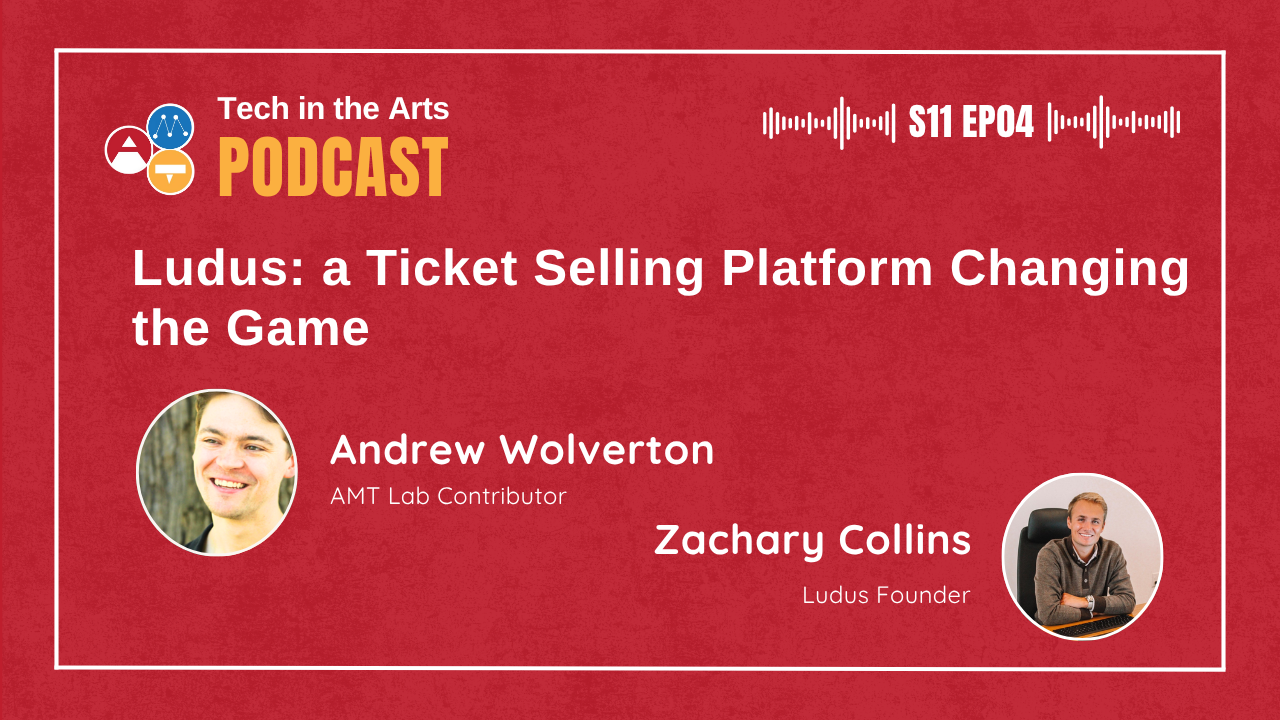
In this episode of the Arts Management and Technology Lab, Andrew Wolverton and Zachary Collins explore how arts-focused technology can transform nonprofit ticketing and operations, tracing Ludus’s journey from a side project for a single high school musical to a nationwide platform serving more than 4,000 organizations. Collins explains how Ludus was built from the ground up around the real needs of drama teachers and community theaters, growing into an end-to-end system for ticketing, fundraising, marketing, volunteers, and concessions—while staying anchored in a people-first culture summed up by the company’s core value, “Give a Shit.” He reflects on navigating the COVID-19 shutdown through livestreaming and social-distancing tools, choosing the right growth equity partner, and why he believes AI shouldn’t replace arts workers but instead act as a “superpower” that frees them to focus on human-centered work and shared live experiences.
Show Notes
Link to Ludus
Transcript
Zachary Collins
The hot topic right now is ai. I talk about this a lot internally, and I say AI is not here to replace anyone. It's here to give us superpowers.
Andrew Wolverton
Welcome to an interview episode brought to you by the Arts Management and Technology Lab at Carnegie Mellon University. My name is Andrew Wolverton. Joining us today to talk about technology's evolving role in nonprofit arts management is Zachary Collins.
Zach is the co-founder and CEO of Ludus, a Michigan-based arts technology company that powers ticketing, fundraising, marketing, and streaming for more than 4,000 schools, colleges, and community theaters across the United States. Since launching Ludus in 2016 as a side project to help a high school musical, Zach has grown the platform into one of the most widely used arts management tools in the country, processing over five and a half million tickets and more than $80 million in sales last year alone.
A developer by training and an entrepreneur by instinct, Zach built Ludus with a deep understanding of how performing arts organizations actually operate, and his company's mission has always been put to technology in the service of arts accessibility, transparency, and ease of use. Ludus was recently named one of America's fastest growing private companies by Inc. Magazine and its tools have helped modernize everything from concession sales to virtual performances in the nonprofit arts sector. Zach, thank you for being with us today.
So I'm curious if you could just sort of tell us in your own words, take us back to 2016 fan of the opera. You sold $40,000 in tickets, it snowballs into a platform into 50 states. So I'm curious, you know, what was that problem you were trying to solve back then? How did that first show success set the stage for what was to come.
Zachary Collins
Great question. So, you know, when we initially started building Ludus, it started as a side project. So we did not set out to build this massive, multimillion dollar company serving community theaters and all these different types of customers. It started with that single high school, and at the time, the problem statement was, need an easier way to sell tickets online that doesn't cost a bunch of money. I was a freshman in college. My former high school theater director, Kevin Schneider, my co-founder, came to me. And I was like, sure, I could build you something really simple.
So with the PayPal integration at the time and that the grid of check boxes that symbolize a seating chart went live with this really, really basic ticketing product and sold $40,000 worth of tickets to Phantom the opera, and I was going to school for management entrepreneurship, a ctually, I taught myself computer programming.
So I immediately saw, oh wow, there could be a business opportunity here. So we started just developing it and working with other high schools specifically, and just learning what they want. Early on, one of our marketing catches was like built for a theater director, right. Like thinking theater directors and that allowed us to, you know, start developing it. And then we officially turned into a company a couple years later. Over time we moved into like the community theater space, performing arts centers, and overall performing arts.
Andrew Wolverton
Did you have a light bulb moment that moved this from that side project? I mean, I know you went out and like you said, you're talking with folks, but I feel like there had to been that moment that just really shifted things for you.
Zachary Collins
Yeah, I think, well, I think you know, less of like a single light bulb moment of like an idea, but realizing the potential of Ludus as we started talking to other groups of realizing, Hey, wait a second, like they actually like using this thing. And the pricing model I thought was just so cool and brilliant. The fact that you could pass the fee on to the patron who's already used to paying fees, cover credit card processing, and give the full face value to the theater. That made it a hundred percent free to these groups, especially high school programs at the time.
And now community theater is even more important. The ability to not pay any fees goes a long way. And so realizing that business opportunity mixed with the product that people actually like. Was kind of our light bulb.
Andrew Wolverton
And so, I mean, I mean Ludus for what you guys are doing. And you're kind of getting into a bit of the company philosophy and you know, you've said that selling tickets is the byproduct, the bigger mission, and about bringing people together.
Zachary Collins
Yeah, I, I always say that our mission is to not help people sell more tickets. That's just a byproduct of what we do by building a really great product and offering great customer support. Our true mission, our purpose is bringing people together through shared experiences. And what that essentially means is we are building tools to help facilitate these live events. I believe it's ever more important in today's world with all the technology we have. We're actually like more connected than ever and more disconnected than ever in human history.
And so these events where we come together. Forget about the outside world for a while. The lights come down and we're all enjoying the same production, the same show. That goes an extremely long way, right? Like that's our true mission. It's a much bigger, grander idea than just helping people sell tickets. That's what drives us.
Andrew Wolverton
You were saying something about the tickets. It's the one thing that all these other ticket companies are doing, and you guys are really working on this end-to-end operating system. It's going beyond ticketing where you're bundling everything into one platform for the little theater companies and the school programs. Not a lot of these folks are going to college for arts management necessarily.
So for a listener who maybe is running this theater company or their school program, could you paint a picture of how Ludus might handle everything for their live event? What makes it easier than juggling the multiple tools like many have done in the past?
Zachary Collins
For sure. I mean, I kind of think it starts with the history of how we started when we initially started. As we talked about, you know, we started with a high school theater program, a decent sized high school theater program. But so, you know, considered a smaller size type customer, right? And so we started from the bottom up. A lot of ticketing companies start from the top up. You know, Spectrum, Telstra, they start with the big voice first and they build these really complex systems and then they try to go down market a little bit, but they don't care about the $7 million customers for sure.
And so what we did is we were able to just add on top of what we were building and work our way up market. And now we work with multimillion dollar community theaters and we work with the high school programs and the 50 seat playhouses, the 2000 plus seat performing arts centers, all in between. So what this has allowed us to do is to build a powerful tool. So for the customers that really need the simple tools. They can go there and not feel overwhelmed.
And for the ones that need the more powerful tools and more complex needs, they can find those same options with an extra click of the button. And that has allowed us to like really scale the platform to give the same great customer support to every single type of customer, regardless of their size. We started with ticketing and then we realized over time, like fundraising would be really nice to tie into ticketing marketing. And then, you know, eventually we got into volunteer management and we have retail for concessions and merchandise sales. And so we tied all these things together into one platform where they all can speak to each other, allowing organizations to cut out costs of other products that they're using, bring it all in house, all the data speaks to each other, and it's just streamlines things tremendously for organizations, regardless of your size.
Andrew Wolverton
Right, you're talking about building from the ground up and that it's really about what is it that end user is needing. And I feel like that stands out for you guys, and I know that you guys like to closely engage yourselves with the drama teachers, with venue managers. So how do you gather that feedback, decide what next to build? Are there any examples of current features that now are from user inputs?
Zachary Collins
Yeah, there's, there are a lot of examples. I mean, it's, it's really just in our DNA of how we built Ludus is listening to what that original theater director Kevin needed. He had like five key rules, and I forget them all at the top of my head, but one was like the ability to exchange and refund tickets. And you know, at the time I did not log into other ticketing systems and see like how do they do exchanges, refunds. I just did it based on like what made sense and how he described it.
And that's kind of like part of who we are. And so we kind of internally call it the Ludus way, which is like, how would we do it in our own product? And so when you get into Ludi, there are quite a few things that actually feel different in a good way compared to other products on the market. We also work with over 4,500 organizations now in groups. That means we get a lot of ideas coming in. I mean, every day there's dozens of new ideas to improve the product because these people are passionate about the product and they love it, and they want to use it more and more, and they have all these great ideas.
And so we have to filter these things. They're coming through customer support. They're coming through sales. They come in through Ludus Pulse, which is a place where people can submit ideas and vote ideas more like a community of our customers. So we had to kind of look at that and say, okay, what are the trends? What are the patterns? Where can we improve things? But also how do we keep our focus and make sure that we work on the right things? And it really comes down to a mix of finding those trends, but also partial like gut feeling, what excites us as a company. You can tell when companies are passionate about what they're working on.
Those features and products end up being a lot better than other ones they're not as excited about. It's all balanced. A lot of the tools in our product, like the wait list feature for example, like you sell out your event and we have a wait list feature where you can add yourself to the wait list, kind of like a restaurant reservation. And that came just from the needs of our customers that were selling out their events and they're like, man, it'd be really nice if we didn't have to send people to a Google form and we sell out. So we decided let's just build a really, really nice modern wait list feature for online ticketing.
Andrew Wolverton
It's. Really, I mean, I've had the unique experience of, like I said, I was a high school theater teacher and I have since had the opportunity. I've worked at a couple off Broadway theaters and it's surprising how similar the needs are to your audience, whatever. They're all pretty much similar in terms of the needs.
And I wanna bring it back to something you said a little bit ago about the Ludus way, and it made me smile about your mantra, your company mantra is Give a Shit. How do you instill that passion into your team? I mean, I, I love that phrase. It's provocative and it really calls attention to what you're wanting to view.
I think it says, you, you view employees that come before your customers. which goes along with that give a shit about your employees. So it's not something you hear often in business. So yeah. Explain the philosophy. How can other people translate that into their organizations?
Zachary Collins
Yeah, yeah, yeah. So, you know, that really gets into like the, the culture of our company. And we're very much focused on building a lasting company and culture here. We're not just building a product and building a company to sell it a few years down the road. And so we're building this lasting company.
I would always say employees are number one and customers are number one and a half because when you put your people first, they take care of your customers. Think about those companies where you have great customer support, where you have a great product, where you can tell that there's care, that you can tell that people gave a shit when they were building it.
Those are companies that actually put their employees first and creating that great culture because that bleeds into everything that those employees do. So, you know, one of our three core values, the first one, the most popular one, is give a shit. And that's really about being passionate about things that's, and it's not just being passionate about Ludus and about our colleagues and about our product and our customers.
It's just about being passionate about life in general and having those things that we're passionate about and give a shit about. That has always just been a key thing for us that we look for internally to see that love for things, because that's gonna bleed into how we take care of our customers, how we take care of our product.
Then that leads into our other two core values. The other one being relentless refinement. We are not a static company. We continue to evolve and change and to improve, and so we're always working toward the shared goal of refining Ludus and finding ways to improve it.
And then lastly, our third core value is embrace change. And you don't have to love change, but you have to embrace it. The best example I have of that is COVID, especially for our company. None of us loved having to wear masks and socially distance, but you know what? As a society, we may deal with it and we continued moving forward as a society. Same thing for Ludus. We lost 95% of our revenue, but we embrace the change. We adapted and kept moving forward, and we are here today. Those are really the three core values of Ludus on top of the employee experience.
Andrew Wolverton
Yeah, I think that giving a shit about your employees. I cannot tell you how many experiences I've been in where you hear fellow coworkers going, oh, the person up top, they don't give a shit about us. And it really does trickle down and affect the overall culture. And you know, it goes beyond equitable pay. The Performing Arts Center pack here in New York, they just opened up and it doesn't matter what level of employee you are. And you feel like, I am actually a part of this organization. I wanna show up to work on time. I wanna be here. I wanna be a part of this. And I think that, like you said, it's a key differentiator against more traditional ticketing, fundraising solutions and companies.
Why do you think that smaller organizations might be stuck with this pen and paper or older software and not switching to Ludus? Is it a lack of knowing Ludus exists? Or is it a resistance to change because maybe you've talked to people and said, here's our thing, and they're like, good with what we have.
Zachary Collins
I think it's definitely a mix. I mean, we still are building our brand and getting the Ludus name out there and we continue to find more and more partnership opportunities to do that, and marketing and sales and all that kind of stuff. You know, we're growing in that area, right? What it comes down to when we do reach out to those people is comfortability.
So like, you know, if you've been using the same platform for 10 years, you know how to use it. You don't want to change things up, you're happy with it, but also loyalty. You know, especially to some of the smaller ticketing companies where they personally know the owners, they're not getting all the great features that they need.
But again, there's loyalty there and that's really hard to beat. It does appear as a big feat to switch ticketing platforms, and so where we try to do a good job is educate potential customers on how we can make it easy for them to switch. We have some really neat data importing tools, self-serve onboarding tools and stuff like that.
It's a lot easier than in the peers, especially when you have a great onboarding team and great customer support and all that kind of stuff. So there's a lot of different reasons that people are happy with their current solutions and we try not to be pushy about it. We just know that we'll be there when they're ready to switch.
Andrew Wolverton
There's not really trade shows for, you know, ticketing companies are for, your nonprofit, small organizations where you can just go and people walk up to a booth. Like any other product, I feel like you can go to trade shows and this. Mm-hmm. It definitely is, like you said, it's a personal connection that they may have with the owners of the companies.
Imagine they have similar things with your company as well, and with you. I want to kind of switch gears to this kind of the personal connection and something that your mom had said about she was worried, about you not going, to skipping college. So how close did Young Zach actually come to ditching school to chase the startup dreams? What are those early wins, I guess, teach you about balancing education and entrepreneurship?
Zachary Collins
Yeah, I think so growing up I was very much influenced by Silicon Valley and I had started growing connections out in Silicon Valley. Starting so young in tech, you start to just like find other young people in tech and you start chatting and building, you know, websites together. I started a company out in Portland, Oregon, our co-founder company on Portland, Oregon, my senior year of high school.
So there was a lot of push and pull toward like va, not gonna college, gonna college. And there wasn't anything that I had invented that would pull me away from going to college. And so opted to do it and thank goodness I did, met a lot of great people, met our CFO there. Ludus probably would not be where it is today if I hadn't gone to college. I think I would've just been a different boat.
If I would've moved out to Portland or to Silicon Valley, there would be no Ludus today. And so everything happens for a reason. But we did have the entrepreneurial challenges and we continued to have that bug. And that's why we started building Ludus more and more, seeing this business opportunity and taking on the challenge of like, okay, I'm in class right now, supposed to be paying attention to the professor, uh, but this customer really needs my help right now.
A lot of it, I was also a self-taught computer programmer. After class, I was like, this customer really needs this simple way to pull this report or something. And so I'd go out into the hallway and like code it up real quick. And so it was a really interesting college experience, but I knew that I was ready to graduate. I'm gonna complete this degree. I know I'm gonna do Ludus after college and here I am today.
Andrew Wolverton
I feel like the term side project really doesn't capture, it's a passion project. I mean, to really stick with that through your undergrad, those are some formative years. You're learning so much about yourself and the type of person you want to be and drown out the parties and the college experience.
I went to a larger undergraduate school. I went to Indiana University, so very different. And the pressures of that culture would make something like that very difficult. And you were talking earlier about COVID I, which you know, that was an earthquake of like, for the performing arts community in general, and you were saying, you know, you guys had lost 95% of revenue pretty much overnight, and so that chapter, you know, became this turning point for live streaming to come into play.
I mean, it was just everywhere. I know Twitch popped off overnight and I was helping run livestream cabarets, you know? And so there's now like social distancing tools for seating. So like, I guess take us through that crisis in March of 2020. How do you rally your team with only like 5% of what you have left? You know, there's hindsight now with how the pandemic changed Ludus trajectory and your perspective on the business.
Zachary Collins
So to start, right before COVID 2019, we had hired our first employee in customer support. So she came on board and we were starting to build this team and realized, okay, let's do customer support first, and then COVID hit, and then we had to, you know, furlough and eventually lay off.
And that was a bummer. So it was back down to Kevin and I, we weren't paying ourselves anymore. The Ludis was making a little bit of money and suddenly he just lost all that. And so you're like, man, I, it's back to a side project again. I don't know. And we knew we had something. COVID was a Black Swan event.
That wasn't saying that a ticketing product was a bad idea or that it wasn't needed, it just wasn't needed at the time 'cause it couldn't be used. So what we had to do. Was kind of think about what does the future look like? And number one was a streaming platform. So we came out with Anywhere seat, which is just a really, really at the time, bare bones way to sell virtual tickets, to live streams and on-demand videos and figuring that out.
I mean, you go from building a ticketing product that has like a seating chart and reports to now a streaming product. It's different technical challenges, and it went back to being scrappy and figuring out what to do and making it work. And honestly, it didn't make that much money, but it allowed us to at least retain our customers and help facilitate their virtual events.
Then we also had to deal with social distancing when states started figuring out capacity limits and what social distancing looked like, and going back to events. And so I like to say that we invented seat buffering. I don't know if other ticket companies said the same thing, but I think we did it really well.
And so it was just this automatic way of creating a bubble around each group that was buying tickets and we set capacity limits. And so all those things combined allowed us to really gain the trust of the customers that we had at the time that, you know, had used as pre-pandemic, you know, showing them like, hey, we're so here and we're listening. We're trying to help you put these events on.
And so we started building a lot of trust with those, those customers. And then during that time too, a lot in the market changed. Venini was acquired by Audience View and they shut down Venini. You know, brown paper tickets stole a lot of money through a lot of organizations, overheard a lot of organizations, and a lot of other platforms are raising their prices, trying to make this work.
Right after the summer of COVID heading into the fall and then heading into 2021, we saw this inflection point that all these customers started coming to us wanting to use our platform, and we were ready to go. We had the platform ready to go, and so all we had to do was make it through that COVID summer, and we did it. Then that was the night and day difference for our product, for our company in 2021 is when we really, really accelerated.
Andrew Wolverton
I mean, you guys really bootstrapped yourselves. Yeah. I guess you bootstrapped yourselves up and hit now profitability. I know you guys recently chose to bring in more investors. Now what? You close it in what I think is a $12 million. Growth funding round. Why right now is this the moment? What do you plan to do with this investment? How that growth pressure and investor expectations are not gonna dilute that Give a Shit mindset because they're gonna say no, we do give a shit about our money.
Zachary Collins
The bottom line.
Andrew Wolverton
So what is it that you're doing to help it? It there is a balance. You have to be sustainable with that?
Zachary Collins
Yeah. Well, I mean, first it comes down to finding the right partner, and that's the investor. The investor that doesn't just care about that bottom line, like the margins are very important to run a business and to continue growing.
That's all a very important part of running a business. However, we had a lot of inbound investment from investors. And we would take calls once in a while and you're like, we just don't feel right about this, like this isn't the time. Like we like being independent and we like being bootstrapped.
And then eventually along came Mamba Growth Equity in Jake Kassi. He hopped on a call with us and we were like, man, this feels different. Something's clicking with these guys. They had a new philosophy, a new way of thinking about private equity and growth equity, and it really spoke to up and they were trying to disrupt their market.
We're trying to disrupt our market and change things up. We connected and that was finding the right partner that actually understood our vision and who our customers were. You know, I remember, I think it was like the second call with them. And they said like a, a term and they actually corrected themselves using the proper industry term for in the theater world.
And I was like, you guys actually put the effort in and actually like trying to understand who we're serving and why we love this market so much. And so they came in, they were able to retain control of our organization. They're able to offer us a lot of guidance and capital and insight and help in building this company.
And so what we're doing with this capital. How can we accelerate our growth? How can we provide more to our customers? Like we tripled our dev team, grew customers for sales, marketing. All these teams have now grown and matured within Ludus in the past six months since taking the investment. And now we're able to offer more and more to our customers at a faster rate. Talking about implementing all those ideas, that's how we do it at a faster rate. It's been a really fun journey since taking that funding and it's allowed us to mature and grow as a company.
Andrew Wolverton
Yeah, I mean, you're allowing you to disrupt the like, I love that we're disrupting the field. Yeah, and I guess that allows you, I guess, zooming out with that in mind, so where do you see the future of technology in arts management over the next five, ten years? I know you've mentioned previously you wanted to expand Ludus internationally, developing, you know, more tools beyond the ticketing and marketing, fundraising, and streaming. What, what is, what's exciting you most about these next steps? What ways you could tell us you're planning on disrupting the field?
Zachary Collins
Yeah, so there's, the thing about this market, and you kind of mentioned this before, is that it's very underserved when it comes to technology. There's almost like endless amount of possibilities of what we can be focusing on and working on.
Number one, we wanna continue to build and like mature our existing product and make it more and more powerful month after month with more and more features. And also looking at some of those core features like marketing, volunteer management, fundraising, like how can we make those stronger and better?
And you know, kind of looking at or box office software, but then thinking, okay. Where else can we go? Like, what else does this industry need? People allude to a lot of different ideas, like even in the Facebook forums, like the Community Theater Forum on Facebook ran by like AACT. Like there's so many great ideas in there just from.
People needing different things. We're exploring what other products and ideas are out there and services that we can offer in the market that can actually help grow these programs. Eventually we're gonna become a multi-product and multi-service company.
Andrew Wolverton
For those organizations that still feel, uh, hesitation or in intimidation, more so I would say by new tech. Especially with AI right now, there's a lot more intimidation with New Tech. What do you say to these arts organizations and what advice do you give them in embracing digital tools, choosing the right tech partners? I mean, I'm working with the thousands of theaters using spreadsheets and paper tickets still.
Zachary Collins
Yeah, I mean, it's definitely a bounce because the arts is definitely relationship driven. It's human driven, and so. The hot topic right now is ai. I talk about this a lot internally and I say AI is not here to replace anyone. It's here to give us superpowers.
A big part of our company is always having humans there for our customers. Patrons come expecting to see, you know, humans on stage. To have those humans in the lobby to have that experience. It's a big part of coming together through these shared experiences. And so when it comes to technology, you know, of course you have to embrace it.
I think the key component of technology, what it allows you to do is to free up your time, whether it's implementing a SaaS product like Ludus, or implementing some AI things within your organization. It doesn't have to replace the artist, but it can free up some time to focus on the more human-centered type things.
I think that's like kind of embracing change, like one of our core values is you kind of just have to embrace it a little bit and figure out how to use it in your organization where you're comfortable with it. But it's, at first, it's probably not gonna be comfortable. It is what it is, but you have to make yourself uncomfortable to continue to grow.
Andrew Wolverton
Seek discomfort. I love that. That's one of my mantras.
Zachary Collins
Yeah, I love that.
Andrew Wolverton
And I, you mentioned it being a superpower and I. Immediately thought like every great superhero story, the hero has to learn to control the harness and embrace their power for what it is before they can truly use its full potential. Although, I guess the flip side is if they don't, that they become evil and destroy. Don't want that for our arts organization. So listen, embrace your superpowers.
I do wanna end on a more fun note. So you started Ludus the Help High School Theater. If you could travel back, what would today's Zach tell that young, you know, teenager selling tickets? An auditorium, I would say. And since you're theater lover, any favorite show or dream production you'd love to see a Ludus client put on that you haven't seen yet?
Zachary Collins
Okay, well, I've always wanted to see white Christmas on stage and I never have. So I would love to see, have a customer do that and we have any customers listening to this that is doing it, let me know. I'd love to come see it. But I also like Music Man, that's probably my favorite full, and I know maybe that's now, but I just love the Music Man. Great show. The first time I saw it was actually at Stratford in, in Canada and just wow, incredible. And I had much fun with that. And then we saw Rocky word layer, and this is theater is fun.
'Cause when I first started actually, and kind of going back to my younger self. I did not really have a theater background. I helped with lights my senior year, and so like I'm not a stage guy. I don't know all the theatrical terms. I don't know how I, at the time, I didn't know how box offices ran. There was so much that I did not know. But I kind of just embraced this world and saw the love that went into the arts and into theater, into music. I did grow up playing the violin, but seeing, you know, all this passion in this world, and I think it really comes down to just telling that younger self, like embrace it.
Involve yourself more, understand everything that's involved with it and set the mission even earlier on because you're about to build something actually really incredible that gives back to the arts community. Just keep moving forward and embrace it and have the same amount of passion that all your customers have.
Andrew Wolverton
Beautifully said. Thank you, Zach, for everything today, if people wanna get in contact with you. What's the best way if they wanna chat about white Christmas coming up?
Zachary Collins
Well, shoot me an email, Zach, zack@ludus.com. Or if you're interested in using Ludus, you can go to hello.ludus.com. You can get started yourself, or we also have one-on-one demos where you can meet with one of our sales people.
Dr. Brett Crawford
Thank you for listening to this episode of Tech in the Arts. If you found this episode to be informative, educational, or inspirational, be sure to check out our other episodes and send this to another arts or technology aficionado in your life. If you want to know more about arts management and technology, check out our website at amt-lab.org, or you can email us at info@amt-lab.org. You can follow us on Instagram at techinthearts, or on Facebook and LinkedIn at our full name Arts Management and Technology Lab.
Our season runs from September through May, so feel free to follow us on your preferred podcast app, be it iTunes, Spotify, or YouTube.