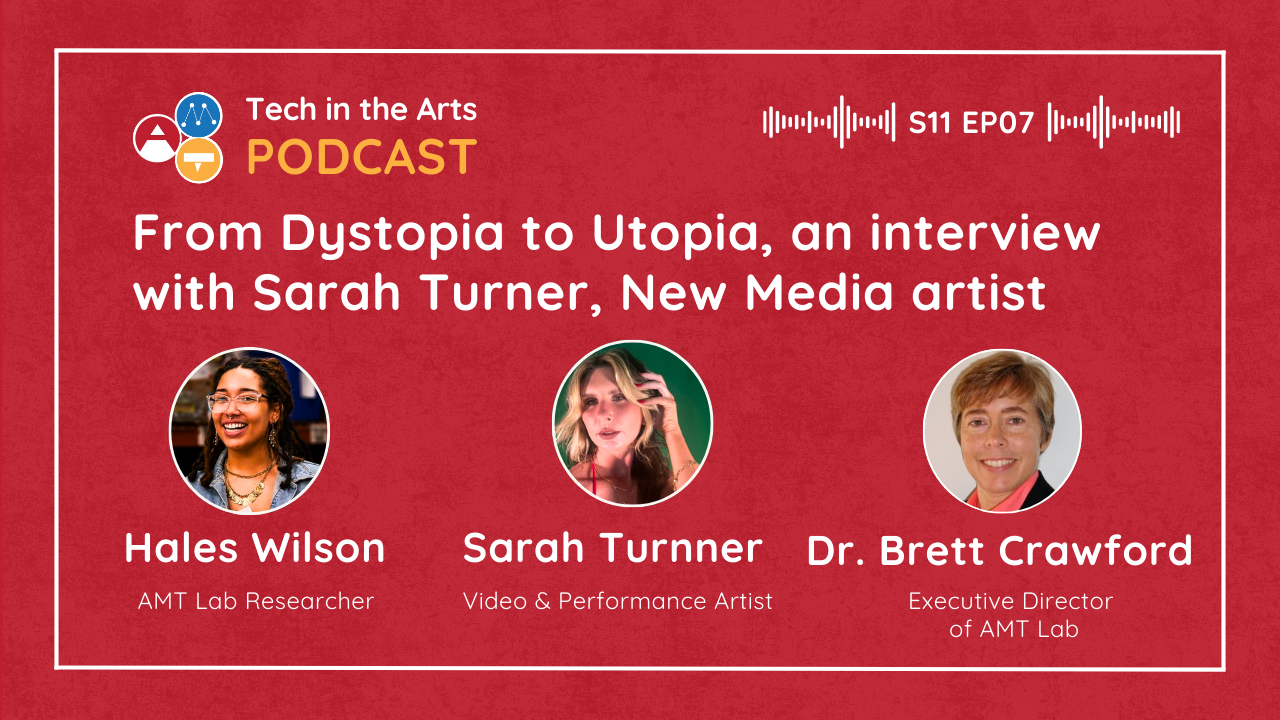
In this episode of the Arts Management and Technology Podcast: Tech in the Arts, Dr. Brett Ashley Crawford and Hales Wilson speak with media artist Sarah Turner about her interdisciplinary practice at the intersection of emerging technology, performance, digital culture, and arts administration. Turner reflects on how her background in history, arts management, and experimental video informs her work critiquing platforms such as Zoom, blockchain, and AI, as well as her long-term exploration of censorship, NSFW online spaces, and alternative distribution models. The conversation traces her experiences balancing administrative and artistic roles, building DIY communities through projects like mobile public projections, and navigating institutional boundaries around funding and content. Turner also discusses her recent AI-focused work—particularly her playful yet critical “Dolphins” series—as a way to interrogate utopian fantasies, oracle-like knowledge systems, and the absurdities of human–AI interaction. The episode closes with reflections on adapting to rapidly changing technologies and Turner’s advice to emerging digital artists: embrace experimentation, break tools intentionally, and treat media art as a space of play, critique, and collective making.
Show Notes
Sarah Turner: @sarahsarahturnerturner2
Lecture with Sean Hallowell and Sarah Turner
Projection Portals: Live Video Machine in the Hall of Architecture
Transcript
Sarah Turner
Just try it. You know, there's no right way. I think the media is so DIY and experimental that it's really about using a tool the wrong way, intentionally breaking it, investigating it, critiquing it, and making work from that.
Dr. Brett Crawford
Welcome to the Arts Management and Technology Podcast, tech in the Arts. My name is Brett Ashley Crawford. I am the executive director and the founder of AMT Lab, and I am joined today by Hales Wilson, the AMT Lab lead researcher and Sarah Turner media artist whose work sits right at the intersection of emerging technology, performance, art and digital culture. A perfect guest for our podcast. Um, she has an MFA from Alfred University in Electronic Integrated Arts, an MS in Arts Administration from University of Oregon and a BFA in history from Lynchburg College.
In her work, she plays with critiques and subverts digital platforms from Zoom to blockchain to ai. She's visiting Carnegie Mellon this week as a guest artist at the studio for creative inquiry. She discussed her practice in a talk entitled, processing the Female Form, co-opting NSFW online platforms with experimental video streams.
She's been exploring NSFW online distribution sites as a way to bypass censorship and on traditional platforms, and she's been doing this work for the last four years as a large part of her practice. In addition to the work that she's doing at the studio, she's also doing a performance at the Carnegie Museum of Art, where she is part of the projection portal's live video machine in the hall of architecture.
That is going to be a night of immersive live visuals by leading artists in the field doing real time video performance. They'll be using anything and everything from analog synthesizers to generative code, and they'll eliminate the museum's monumental plaster cast. If you've never been there, look at it online.
We'll put a link in a vibrant dialogue between the past and the future. So welcome to the podcast Sarah Hales, and I look forward to talking with you today and learning a little bit about your work and what you see in the future as that's what you're integrating the past and the future with. So, to kick it off, can you give or sort of talk about how you see your work connecting your background and history and your current work as a, you know, a video artist?
I'm personally a theater historian, so my background is in theater, but I'm also a technologist, so I'm always interested in sort of how people make connections and intersections in various parts of their lives. So could you talk a little bit about that?
Sarah Turner
That is a great question. Thank you so much for having me here. I feel like my history degree has situated both the technology that I use and the concepts that I work with a lot. So in the sixties and seventies and how advertisements were kissing liberation vocabulary. And selling products back to women. I've always been kind of looking at a lens of, of how people have been represented in media throughout the ages, and then now especially looking at how women are represented online and how they are represented themselves also.
I also have a deed practice of historical research in a lot of the concepts that I am working with. My project Glitch Bitch, who is a camgirl racist, has a lot of inspiration from Greek goddesses and Greek temples and people going to pa. Ed, respect and praise to these goddesses and relating that to how Cam girls existed in these digital worlds and how they receive gifts to bestow fortune on them as well.
There's a lot of different layers of historical context within the work that I'm doing, but then technologically, I consider myself. Almost a media archeologist looking at both hardware tools that are obsolete and using them in my practice along with things that are, I guess, hot tech. Such as like NFTs and AI and all that right now and combining them and kind of collapsing the timeline of those technologies together, as well as being an archeologist of like the internet archive and the way back machine and looking at specific fonts and UIs and imagery that is very evocative of my nostalgia of like the early nineties.
And nearly two thousands that I feel really defined my relationship with the internet and with media technology and using that as a way to really situate a comfort level for my audience to kind of have a base understanding of, yes, I've seen Apple, uh, movie player before, but now like what's in that frame?
It's really freaking me out. So, giving people a little familiarity before I challenge maybe the notions of what they're seeing on the screen.
Dr. Brett Crawford
That's amazing. I love the archeology framework. That's really a very, the archeology, which for digital time, our digital timeline goes back to the nineties and really sort of putting those against each other to reveal where we're going intentionally or not.
Well, I find it interesting 'cause you know, you're talking about everything from historians to archeologists to artists. But your work is also, and your career has spanned other domains, right? You work at, you've worked at Meow Wolf, you worked at the Hollywood Theater of Portland. You've, you're a curator. You, you're clearly balancing that artist in the administrative sides, including your MS and Arts administration.
Um, so I'm sort of, you know, I personally believe that arts administration itself is a form of art. And I think that successful artists are in the whole to be, if they're successful, they're somewhat entrepreneurial. So how has your administrative work and artistic practice sort of informed each other?
Sarah Turner
I got my master's in art administration because it was 2012. It was still shortly after the Great Recession, and I was like, that's a risky move to get an MFA. It felt like there were more solid nine to five opportunities for me to do art management, and that was very true at the time, but I am really glad that I did that because it did give me the foundation to be an entrepreneur.
I learned grant writing, I learned fundraising, I learned community building, and those are the things that have given me. Stability and stasis to build my art practice on top of, as well as support other artists in my community who are doing similar things and want us to all rise together. And it ties really well into the video community.
We're only now just starting to get more funding, more eyes on it, especially in the commercial world. But overall, deeply experimental video is a pretty niche fringe, and so it's very dependent on this DIY community. So having people who. Are really good at organizing, producing, fundraising, et cetera, helps to keep this medium alive and accessible to folks.
So, yeah, it's funny, so I worked at Meow Wolf now. I started there as a production director for the Creative Technology Department, and last year I became a video designer there. It's been interesting to kind of like shift hats of, I guess, positions while I've been there recently. I was talking to him, like how do you, how do you switch between those two different types of hats, like producer, art manager to artist, and is it difficult?
And I said, no. I said, it's so important that I. Know how to be a producer and how to be an art manager, because I feel like that helps my career. Like I can see what I'm aiming for and make my art go there. I can see all the steps. I can figure out what I need to do, who I need to talk to, or what I need to secure, whether that's a venue or a grant or whatever, to make my biggest idea come true, you know, that these programs exist.
I wouldn't have known how to get there. The one at the University of Oregon. So they are rare and it's nice when people value them.
Dr. Brett Crawford
Thank you. And definitely, obviously I agree that running an arts management program here at Carnegie Mellon, I think it empowers everybody who goes through it. So I think that I agree with everything you said.
I really liked what you said about connections and so that one of the things that in the community connections that you learned sort of how to manage those, which I'm assuming, but I will let Hales follow up on this. Also connects to some of your, your mobile public artwork. So Hales, you had some questions on that?
Hales Wilson
Yeah, thanks Brett. And just kind of echoing, I really appreciate how you kind of articulated the connections of being an administrator versus the artist as someone who's currently a student in the arts management program and. I kind of have the itching of still wanting to create art. I appreciate hearing your story and it gives me a little bit of comfort as far as my future career and opportunities.
But yeah, so as I said earlier, I'm very interested in public art given my background in murals. And so I had some questions about your work in the public sphere and specifically the mogul projection unit project, given that you co-founded the mobile. Platform for displaying art. Given that you took video art out of the black box gallery and onto the streets of Portland from an arts management perspective, what were the biggest logistical hurdles in projecting this gorilla style or site specific work?
How do you manage permissions and power and also public engagement?
Sarah Turner
This is so fun to talk about. Thank you for this question. Yeah, I worked with Mike Ator and Ndo Dino in Portland to put together the mobile projection unit again. I think that started in 2016, and we were just a ragtag re bird artist.
I mean, we each had our own personal career. At the time, I was working at a public access TV station up signal, and as a curator there. Kind of like finding new means of distribution for video and media arts. There were a couple things at stake. We had all these resources at Open Signal for producing content, so we had like millions of dollars from the city and Comcast for cameras, for studio, for sound, for editing, for people to have access to.
But the only way of distribution was through cable television. That was the contract with Comcast at the time. What was that 2015, 2016? Already people were like, who has cable? And you know, even now, today more so, right? So we're like, people are making all this like incredible, amazing radical art happens at public access TV stations.
Then how can we distribute it in a way that actually really is available and accessible to the local community in the same way that public access is right? And so we're like, let's bring it to the streets. Nada and I were both projection artists at the time doing installation, large scale installation, mostly inside of galleries, but we had seen folks doing projection mapping in Portland and it was starting to get a lot bigger around the country, but it was primarily very commercial.
For us using this forum was also a way of combative, commercial billboarding of this type of media art too. So we're coming at it from a couple different angles and we got initially a small grant from pika, the Portland Institute for British Art via the Warhol Foundation. Shout out Pittsburgh, and I think it was like $5,000.
It wasn't a lot of money, but it was enough for us to buy a projector and a generator. Give like at the time a pretty decent stipend to like each of the artists that we involved. We would choose like an artist among, as like part of our first initial collective group. And we would work with them to select an outdoor location, usually on architecture that was site specific relevant to their work.
Whether that was in the form of the architecture or. The location of the building itself. It was really interesting, the things that we found, and first of all, we did not get permits. We did not ask permission. We just would go in the middle of the night and just do it. And then I think we would release like, you know, like a flyer the night before.
That's like, okay, here's the real location. DM us for the address kind of a thing, you know? I remember one of the first conversations that we had about it was with an artist, Lya Johnston we worked with, and she had a performance piece that she was planning on projection mapping on a building. And it included nudity and we were talking about it 'cause we were like, we wanna present this work in the best way possible.
We don't want it to get shut down. How can we show it in a place that no person who wouldn't want to see shouldn't see that whatever is gonna just stumble upon it. And so we ended up going to like a really industrial area of Portland, but it was like if you wanted to go see the art, you could go and drive to it.
And so that was kind of like a workaround for us to get there. But then that was the first time I was really thinking about that. Like what is appropriate for public art in my practice? And like. There's nudity everywhere. I mean, classical art is like nude women in huge marble form. And like this is like a well regarded, well-funded institution.
Like why is this imagery, why is this okay here in not other places? Right? And. So I started exploring that and kind of like testing the boundaries of what I could get away with. And I still referenced that I was able to project my butt on the Portland Art Museum at like four stories high. And it wasn't just like a trolling moment, but it was a test to see how much pushback I would get just from that type of thing.
And it really was like that was the limit. Anything more than that, any full frontal anything that. Seemed sexual in nature, which could be very different depending on the person who is judging. It is not appropriate for public art and since then, especially since I've been doing Glitch Bitch and more of the like hypersexual type of work, I've been rejected from countless applications because people just do not wanna touch it.
It's too much to explain to funders, to the audience, et cetera. And then if I have been chosen, approved, et cetera, it's usually like the late pipe version or what have you, and it's like part of that is totally fine, right? Like I make work for adults. I want adults to see it, but there's just kind of like a lot of shame that's wrapped up in some of the responses that I get from trade or from the way that it is marketed in certain stances.
Hales Wilson
Awesome. Thank you so much for that. I see like even you working in new media, you keep coming to this aspect of community and doing things for the community or uplifting artists. So I think that's super powerful. 'cause I think that's what connects all the arts essentially. And since you brought up.
This topic of censorship. I'm gonna jump to another question. So given that you're working with these well-known organizations like the Ann Arbor Film Festival and now Meow Wolf, could you touch on a little bit more of like some of these tough conversations about your artistry or like have having to even change things, especially, I know personally it feels like censorship of the arts is more terrifying right now than ever before.
So could you elaborate on that?
Sarah Turner
For sure. I mean, there's certain things, like with my day job, it's a commercial organization, and so it's like a lot of the work that I'm making for them is definitely within its own creative intent and IP of what I'm doing. And it's also for the general audience. So it's like knowing where and when to, uh, investigate certain concepts or stories.
Right. And for the Ann Arbor Film Festival, shout out there. Amazing organization. Really, really great group of filmmakers and experimental video artists, and felt a very warm embrace from them. That's where I get off into like the dolphin topics, so I won't go too far into that, but I'd say what I have learned.
Since doing this work there are times to employ the full, like Sarah, Sarah Turner, Turner Wild Uncensored. Go for it. And that's why I love, love, love the DIY video community, and I'm so involved in that because they embrace it more than anyone. Period. And I think because it is so strongly anti-institutional in its origins, I don't think anyone wants to bring it into the institution.
This production and curation. Like they know what they're doing. They're bringing together the whole community. To support each other to do freaky stuff. I guess all this to say is like, I think at least right now, I know the line of what I can get away with at like different tiers of institutions, and depending on what I want to say there and how much support I have, I feel like I could figure out the best way to get my message across, and whether that is like first page.
Huge flyer, you know, pussy portal, teddy Power kind of stuff. Sometimes that works, you know? And people are like, hell yeah, let's go. And then other times it really has to be subtle and like through the back door where it's like you don't really know what comes through until you sit through the entire duration of the performance and you realize what's unraveling and then you're like, oh shit.
You know? And so it's really finding that balance and like navigating that and just. Really, it's a practice. It's a huge practice of knowing, and I still feel like I stumble through a lot of that, but the more I get rejected, the more it fuels me to keep going and to go even harder in the DIY spaces so that I can still. Kind of fulfill those ideas and see through those concepts too. I hope that was helpful. That was kind of a roundabout way of talking through.
Hales Wilson
Oh, thank you so much for that. I think we're gonna move into some more tech specific conversations. Brett, you wanna take it back over?
Dr. Brett Crawford
Yeah, and I think it, it sort of speaks to what you were saying before, which is, you know, a lot of what you do is critique.
And you have social critique. You're engaging with technologies in the path of critique. And I wanted to jump into an area that I spent a lot of time in, well before generative ai, but ai, and you've done some very interesting experiments with ai. You've mentioned the dolphins, so that's where we're gonna jump in here.
I found the DO AI is Oracle, particularly Compell. Because as a teacher I see students often turn to technology or AI in a similar fashion. Right. And can you talk more about the critique, engaging ai, the Dolphin series you have, what are the Dolphin series like? Can you talk a little bit more about how you're critiquing ai?
Sarah Turner
Yes. This is like my current research. Spend it right now. So very excited to discuss this with y'all. I think my interest in this started in 2020 when everything felt so unknown and I would go to Google constantly and ask, do I have COVID? Like it would know. It's like, surely there must be a Magic eight ball somewhere, and I'm on the internet all the time, so it must be there.
The information's there. When AI started, it felt very similar to this chatbot that existed when I was at middle school called Smarter Child, which was really dumb, and it was always just like a fun game that we would play. To ask smarter child like stupid questions like why are you so dumb?
Smart child? Or like, whatever, I don't know, just like middle school stuff, but like engaging in this like chat bot in a way that I assumed that it was dumb because it was dumb. And then going on to like AI and basically like trolling it when like Dolly and like chat GPT, like first started. And I was like, maybe there is some usefulness of this tool.
Especially in like random generation, which for me and like tech is a very important thing in like collaboration with technology, especially with video synthesizers, processors, coding, et cetera. It's like a lot of the things that I'm excited about are like random things through tech collaboration that I would only get through that medium.
So I would ask it to help me generate random words within a category that I was trying to write lyrics in, or dialogue or help me figure out what to include in a composition. And that was 2022 Channel 23, so just a few years ago. So I'd be like, give me words about coming on titties, like for a house.
Feet or something that's, there's a lot of language around that. And chat. GPT would be like, oh my God, no. Like get off. Like you're blocked. You know? And it's funny because now it's come so far where I can say stuff like that to chat GPT, and it's like, yeah, here's some. Crazy stuff that you might wanna use.
Like, okay, you guys like chat, GPT, and slow down. Now you're freaking me out. It's really progressed quite fast now. A majority of what I use chat GPT for is troubleshooting software issues. The thing that really struck me is how it talks to me. I'll be like, Hey, Chacha Petit, can you tell me. What operator I should use in touch designer to do X, Y, Z, whatever.
It'll come back and say, here's the steps, blah, blah, blah. Then I'll try to do that and I'll get to a certain point where I'm like, okay, cool. That's there. That's there. You got following the steps, following the steps, and then all of a sudden I'm like, that operator doesn't exist or whatever. And so I'll go back to it and I'm like, that doesn't exist.
What are you talking about? It's always like, you should use version 8.7 or whatever. I'm like, that is the version I'm using. Oh yeah, you're right. I should have said da da da. And it's very conversational in a way that makes you feel like we're making progress and we're getting through this together.
But it's so dumb. It is very appealing to me in that it speaks to a lot of the utopian fantasies that I do have, like tapping into this leg. Mystical Oracle of beyond the veil, you know, the grand consciousness that we're all tapping into means, such as speaking to a Greek oracle or using tarot cards, or looking at astrology or having psychic readings, Palmer Street, et cetera.
A lot of the things that I deal with in my practice and uh, and then combining it with the grade technology of the internet. And so for me there's like a fascination of. How I can utilize this tool and really hope for the best and have almost like an alternative utopian version of it, but still meeting the absurd language and dysfunctional of how it's communicating to me.
And so. 2024. I finished a work called, “You're a Dolphin”. I was exploring, I was kind of using it like a dolphin study. I knew I was on the path of creating this work that I'm in the midst of now, a three-part video opera called Dolphins. Aliens and Angels, engaging different entities from the beyond to help bestow sacred and universal knowledge.
While I was doing that, I started working with more AI tools. I was working with a voice generator, which really helped me with character voicing. I could only make my words solo. And then again, of course, like always looking at random word generation. But as I was investigating this dolphin and thinking about this greater research project, it again started to form these like connections between this collective consciousness of ai and.
The research that I was doing of these like entities and the sociological like investigation of them and all of the like ephemera from those things too. And so I went on a long journey. I'm still still deep in this journey of reading works by Josu Lily, Joan Ocean, Timothy Wiley, Frank Drake, Carl Sagan, and now getting into more a, or sorry, angel works by like Diana Cooper.
Going deep into like the gaia.com really rich for a research topic, but there's this kind of fascination in both of these worlds for the capture of knowledge and the distribution of knowledge, or just information for information's sake, and not really like, I guess it's like we are so obsessed with documenting the truth rather than embodying the meaning.
That we're kind of getting stuck in the form rather than what it is actually bestowing on us. And so that's where I'm tying a lot of these things together, is in the absurdity of engaging with these things. We kind of get lost in the sauce and are not even like fully extending, fully realizing the, the question that we're seeking.
So now with what I'll be performing tonight, dolphin Connection, it's about. Kind of an extension of my character from my piece, but your dolphin, her name is video thought. She is an OnlyFans model, and the premise is that in the prologue to this piece is that she's tired of being a cam girl. She wants to have a more serious career.
And she is on her way to discovering what that is. And she has this idea that she says, oh, I'll become an online guru. So she Googles, how do I become an online goof? And then that's when she meets Sonar, her first AI bot who's an AI dolphin, and she engages with it to talk about her first question is.
What's the secret of the universe so that I can embody that to teach other people. And it just takes her on a wild journey as it tries to discuss its connection to what the secret of the universe means to them. And, um, so it's really playful. It's really fun. I think in all of this, it's like. I obviously see the dangers of ai, the AI bubble, and the environmental impacts and the financial impacts of all these things.
I'm absolutely terrified by it, and my way of reacting to these things is to create an absurd alternative universe as a way to reflect on these dystopian nightmares, but also to create. A space of utopia dreaming for an alternative of using these, those tools as well.
Dr. Brett Crawford
I actually, I really appreciate the utopian perspective. One of the things that I say at home often is that the media currently is giving us so many dystopias that we're out of balance and that utopias need to be out there to sort of balance out the dystopia, knowing that both of them are slightly absurd, right? That's the whole point. We're outta balance.
Mm-hmm. And so I appreciate that angle of the work you're doing. In our own house. We have done some of those journeys and our AI preference is Claude in the house. So Claude has had some conversations around who is God, what is the future of the universe, though it is an interesting journey to take through ai and I really wish I could see the production tonight, the show tonight, but only so many.
We haven't figured how to slice time yet. So that's the next question, right? Because of all this, I really appreciate, you know, sort of this utopian perspective because we are fed, fed so many not perspectives. I would like to hear some questions from Hales to sort of wrap us up because I feel like Generation Z is so impacted by this, and so how to be playful yet critical.
Perspective as an artist and arts manager is an interesting and important thing. So Hales, I'm gonna pass it up to you to wrap this up.
Hales Wilson
Yeah. So I guess my last question would be, as your work and career has grown, how have you adapted to changing technology? I know like Brett said, like.
Honestly, AI and like all these technologies can be a little bit scary, especially me, I'm more of like a traditional artist, but just working with paint and other kind of like found materials, but also like what advice do you have for people who are wanting to become digital art artists entering this field in its current state?
Sarah Turner
Yeah, totally. Let me answer the first part and then I'll come back around to the second. If I don't, please remind me, I guess. New media with video. So much of the art that I make, that folks make in this medium is about learning new tools, creating new systems, and building new processes. Whether that is that they're actually like a tool maker, like building the hardware or they're coding.
Building like a network or a patch that's like processing content. So much of it is about the materiality of the tool itself, and that's really a solid 70% of the work. So I went to Alfred University and you know, it's very well known for its ceramic program and one of the ceramicists once said to me, like, too bad that you guys don't have as much physical labor as us.
Like you just don't understand the embodiment of the work. And I'm like, girl, you obviously don't know what media art is. Not to shame ceramics, but I was like, let me inform you. And really so much of our work is about schlepping gear around vigorously yelling at our computers for not working for one thing or another and having to go to chat.
Should the team get mad at chat and yelling at chat about life. Somebody's like, or just really spending hours and hours and hours late night coding. Signal flowing. You know, restructuring your computer so that your GPU is working functionally, that is like a majority of what it takes to just get to where you need to be to make the art.
And so through that it's like always investigating new means of working within this medium to be like, is there an easier way to do what I'm doing now? Or is there a faster way to get to the storytelling? Is there a new technology that has bypassed all of this like GPU bullshit that I can just get to the art making itself?
So for me, and I think I could speak for a lot of digital artists, it's a lot of investigating these new things as they come out with the promise of AI being like, oh, cool, could that be my little assistant that's doing all the really intense programming and processing on the side so I can worry about the more interesting things?
Then there's also functionality and of course commodity to you had mentioned like NFTs earlier, and then I had worked in those for about a year and a half really investigating both conceptually transactional relationships online between like images of women and patrons and figuring out how. I could navigate that, but then also as an artist, like functionally trying to get paid, right?
Like so much of the work that I do is primarily based on performance, because that is a way that I can get paid for the work that I do. Otherwise, it's very difficult to purchase a new media work or a video, right, that doesn't have the same perceived value as a painting or a pottery. Because of its form.
There's a lot of investigation around that, and each type of tool or program helps me investigate my composition, my form, my distribution methods, and helps me kind of just get clearer and clearer on the vision of the story that I'm telling too. But I'd say like for people who are getting into the media. Just try it.
You know, there's no right way. I think like, like very differently than other very heavily institutional practices like painting or drawing or whatever. Media is, so DIY and experimental that really it's about using a tool the wrong way, intentionally breaking it, investigating it, critiquing it. And making work from that, that makes you think about the impact of the investigation of the tool itself and communicating that with different audiences.
So there's, what's so fun about it is that there's no rules and that it's really about play and practice and just going deep into the studio and jamming with your friends until two in the morning.
Dr. Brett Crawford
I love that. Thank you Hales, for wrapping us up with that question. As you're interrogating an actual technological tool, which is fantastic, you gotta break it to understand it, critique it.
So that was wonderful. I really appreciate the conversation today and the explorations of the breadth of the work that you do is so stunning and we are so excited to share that with our listeners. We will share everything in our show notes so that they can find you on your website, on your YouTube page. There's everything you have, so take care.
Sarah Turner
Thank you so much for having me. It's been great talking with both of you today.
Dr. Brett Crawford
Thank you for listening to this episode of Tech in the Arts. If you found this episode to be informative, educational, or inspirational, be sure to check out our other episodes and send this to another arts or technology aficionado in your life. If you want to know more about arts management and technology, check out our website at amt-lab.org, or you can email us at info@amt-lab.org. You can follow us on Instagram at techinthearts, or on Facebook and LinkedIn at our full name Arts Management and Technology Lab.
Our season runs from September through May, so feel free to follow us on your preferred podcast app, be it iTunes, Spotify, or YouTube.