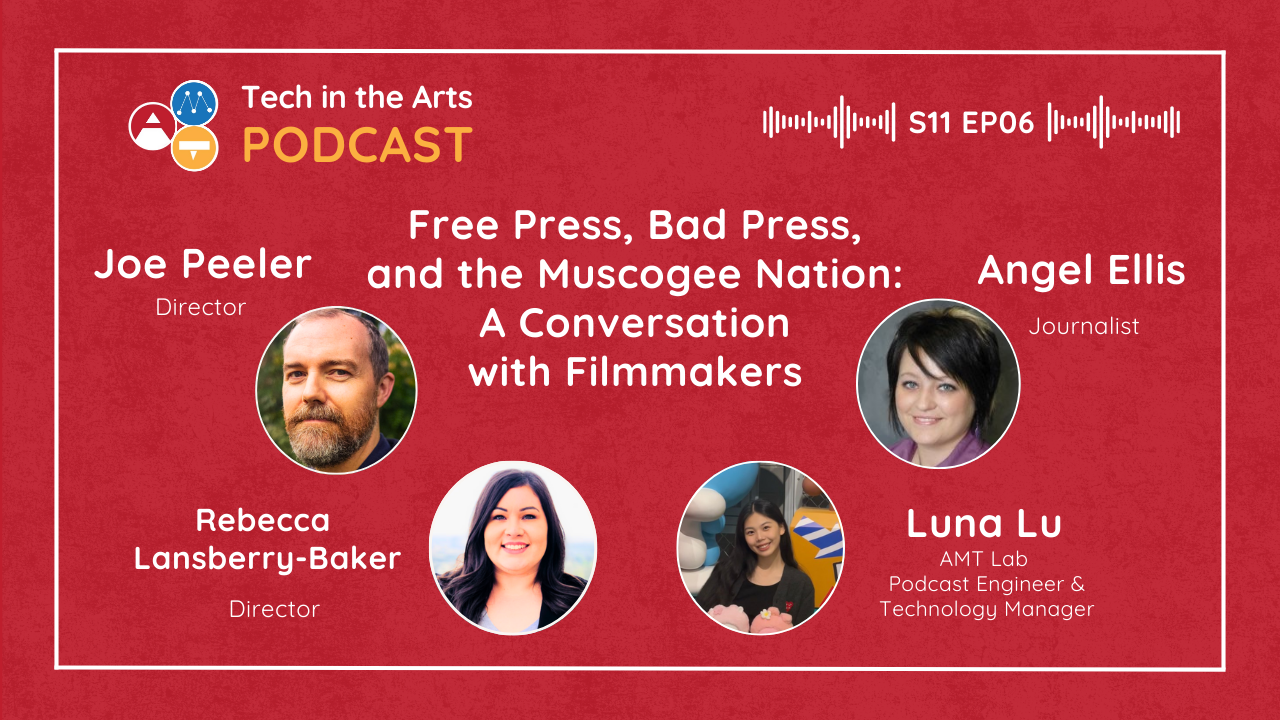
In this episode of the Arts Management and Technology Lab, host Luna Lu speaks with Bad Press co-directors Rebecca Lansberry-Baker and Joe Peeler, alongside journalist and film subject Angel Ellis, about the making of their Sundance 2023 award-winning documentary. The conversation explores how the team came together, the ethical and creative challenges of documenting press censorship within the Muscogee (Creek) Nation, and the tension between tribal sovereignty and press freedom. Through Angel Ellis’s experience as a journalist turned whistleblower, the episode highlights the vital role of independent Indigenous media, transparency, and civic participation, while also reflecting on trust, community-based storytelling, and the power of individuals to effect democratic change.
Show Notes
Bad Press (Official Film Website)
Transcript
Angel Ellis
Journalism serves a community, and journalism can't exist without transparency. So I have to advocate for press freedom. I have to advocate for free speech. I have to advocate for freedom of press, freedom of information.
Luna Lu
Welcome to another episode of Tech in the Arts. The podcast series from Arts Management and Technology Laboratory at Carnegie Mellon University.
My name is Luna Lu, the technology manager and the podcast engineer at AMT lab. Today I'm joined by the incredible team behind the Sundance 2023 US documentary special, jewelry award-winning film, Bad Press. Before I begin, let me share a little bit about the film and each one of you for our listeners.
Bad Press is a documentary about when the Muskogee Nation suddenly began censoring its free press. A reporter fights to expose her government's corruption, and a historical battle that will have ramifications for all of the Indian country. And we're joined today by directors Rebecca Lansberry-Baker and Joe Peeler, along with their generalist Angel Ellis, for the special session of AMT Lab.
Thank you all for being here. I'm so excited to dive into how this project came to life, your creative process as collaborators, and the impact you hope to make through this powerful film. So I wanted to start with how this story came to be. How did the three of you first connect around Bad press and when did you realize this wasn't just an inclusive story, it was something bigger?
Rebecca Landsberry-Baker
Hello? This is Rebecca Lansbury Baker, and I am a citizen of the Muskogee Creek Nation. I started my journalism career at what was then the Muskogee Nation News. And so I worked there first, a senior writer, and then moved up to editor, and that's really where I recruited Angel as our editorial assistant.
And so. This was again my first experience that I had professionally, like getting into journalism. And so I worked with a lot of the journalists in the newsroom that are also featured in Bad Press, including the late Great Gary Fife of Sterling Cosper, Jason Salzman, Jared Moore, so all of these folks that are featured again in the film.
I had worked with them previously when I was there as editor. Fast forward to today. My full-time role is as the executive director of the Indigenous Journalist Association on top of my full-time role as serving at IJAI. Also, at the time that Free Press was repealed in late 2018 in the lead up to an election, I was serving on the Muskogee Media Editorial Board.
Well, when Free Press was repealed and it was won out of only. Five out of 574 federally recognized tribes that had free press protection. But when those protections were repealed back then that dissolved the editorial board. And so I came with my husband, who's also a producer on Bad Press. Garrett Baker became to our friend, Joe, who we knew was into a documentary as an editor and said, Hey, Joe, what do you think about this as a story? Like could we follow this as a documentary?
Joe Peeler
I'm Joe, I'm the co-director and yeah, I think my initial response was I couldn't believe that I didn't know anything about the story that you guys were talking about. I just took freedom of press for granted in the US and didn't know that millions of citizens and AB ready access to it.
And also was kind of shocked to hear how brazen the repeal was. I considered myself a real, plugged in news reader, knowledgeable citizen. And so my initial thought was, okay, if I don't know about this, and it's surprising to me, but it wasn't really until Becca introduced me to Angel that I felt like, oh, there's a movie here, right?
They came to me. Maybe Saturday, Sunday. And I'll say like, I'm a career documentary editor. Freelance documentary editor. And so this is our first movie that we've directed both of our, like directorial debuts. So the thought process was kind of like, okay, well what exactly makes this a movie? Right? If we're gonna jump into this together, uh, could be an interesting article.
It could be pretty boring. You could write a textbook about Indian law, like, there could be a lot of different things. You already knew Becca. You already knew Angel, but I did not. And so you guys came to me on the weekend, maybe Wednesday, Thursday we had a Zoom with Angel and it's immediately apparent that Angel's like amazing.
And if there's anybody who's gonna go after their own government, try to solve a problem like this, like she's gonna do it and not stop. And I flew. Then on Friday to go start filming. So like the project I really like teamed together very quickly and that was really kind of the crux point is meeting Angel.
And I think if you meet Angel, which now I hope a lot of people have, but while we've been at CMU there's really no difference between Angel off camera and Angel on camera. There's kind of like no filter and so you're just like, oh yes, right. We just need to hang on and see what happens. And so that kind of like ticks the project off.
Luna Lu
That's amazing. I mean, Joe was talking about how you are so similar on and off camera, and Angel. This is the story of your life, not just the subject you report on. Right. So what was it like having cameras follow you through such personal and high-stakes moments? Did it ever change how you viewed your own work as a journalist?
Angel Ellis
To be on camera for the first time was super weird. I was used to pointing them at other people. I'm not necessarily used to sitting in front of him, but there was a point there in those very early days where I was explaining the audacity of the government and how it was censoring the press. And I look at Joe and he's next to the camera and his eyes get really big and he is shaking his head yes.
And it was really the first time someone from the outside the community really affirmed that this was kind of insane what was going on. And so. That really helped me settle into being followed around by a camera. And then also I was embracing it from a semi-whistleblower standpoint where these cameras would be a protecting shield for me too.
So I had to get cozy with them real quick. And that was important too, to the continuity of it. I remember sitting in the theater at Sundance watching the film, and I was with my daughter, and I was watching it in. She was looking at me and I was looking at her and we were both watching this film and I was like, and that lady's a badass.
You know, I picked her from my kickball team and, and then it was like, oh, that's me. Okay. Maybe I'm a badass and maybe this is, you know, a perfectly matched situation where I can actually do the thing that I love to do, which is. Do journalism and then also raise some awareness about how this isn't accessible for everyone, and it's kind of in a dire strait across the country really.
Rebecca Landsberry-Baker
Yeah. Just to add to what Angel said too, you know, I always like to think about it like you have the journalist in our story and you have the tribal politician. Their goal is the same, and it's to protect their tribal sovereignty, you know, of the nation, right? And so they're just going at it in two completely different ways.
So the journalists are saying. We need transparency. We need to know if there are challenges to our tribe and to our sovereignty to be able to combat those. We need to make sure that the citizens are aware of those to, you know, know that we even have weaknesses. And I just think that that's a very unrealistic way of thinking about that.
And the citizens absolutely. You know, have that right to know that is their information. This is our tribe. But yeah, it is ultimately in the service of, uh, supporting tribal sovereignty. It's just going at it in two different, very different directions.
Joe Peeler
Yeah. I think as an outsider, the way that I started to see it was that the tribe is a sovereign nation and they have every right to keep kind of a curtain around their affairs like a state or a federal US government.
It's none of their business, they should stay out of it. Right? And the issue is when that curtain shrinks and it becomes between the tribal government and the tribal citizens, and that happens almost immediately. It's like any kind of government corruption. And the curtain goes down to the citizens. And so I think in an ideal world, it's around the tribe, but in actuality it kind of gets messy.
And there's this kind of thing where the journalists aren't needed, puncture that veil, right?
Luna Lu
For sure, and I was curious about the funding side of things. This film was supported by the Sundance Institute, Ford Foundation, and NBC, yet it remains very grassroots in spirit. How did you ensure that outside funding didn't dilute the community driven authenticity of this story?
Rebecca Landsberry-Baker
Yeah, very good question, and I think for us, I mean. I'm very grateful that the relationships that we have with these funders, they're completely handoff and say like every single one of them, like you have complete editorial control over your own project, and that is what they want. That is who they are as funders.
Each of these, you know, organizations represents different pieces of the funding landscape. You have foundation support, corporate media, and then nonprofit film organizations. So, but yeah, I'm just very, very grateful that there was never a time that I felt like any pressure at all, like zero pressure.
And that's like completely the truth. To tell our story in a certain kind of way or from any certain perspective. So we have complete and total control the entire time, which is, I mean, that's the joy of being an independent team and. One of the challenges too, but I'm again very, very grateful for their support from all of those different sources.
Joe Peeler
Yeah, it was kind of a dream, even with our individual investors, we had kind of a dream relationship with them where they just kind of left us alone and were like, show us the movie when it's done. And that allowed us to follow the story for as long as it needed to be, and it took longer than we had expected.
And so it was nice to not have that pressure of like, oh, actually. It's gonna be a worse movie, but you need to get it done in two months or something like that. We had that time and that flexibility, so we were pretty thrilled at that. I would say a really ideal situation, luckily.
Luna Lu
Wow. That is just amazing and I understand it so much, especially as a film student of what that really means and how much support you guys are really getting.
And um, for Rebecca and Angel. You are both a citizen of the Muskogee Nation and a filmmaker telling a story about your own community. Did you ever feel conflicted between your role as a director, a reporter, and your responsibility as a tribal citizen? Like have you ever conflicted between whether or not you should be reporting this at all, or maybe will this turn my community into chaos, or things like that?
Rebecca Landsberry-Baker
I love this question. I wore my can't see it 'cause we're on a podcast, but decolonize the media shirt. One of the things that we talk about when we're on the IJA side of thing, uh, when we say decolonizing the media, there's, you know, old idea that in journalism, you know, if you're part of a community, you can't accurately and ethically report on that community.
And I think that that is out the window now and I'm so glad to see it. I feel like that is shifting. Not just in journalism, but in storytelling more broadly and certainly within documentary film, because if you're a part of the community, you know the people, you know the issues, you know what is important to that community, so you're the best person to tell those stories.
And so I think that's one of the things that we really like to champion from the perspective of the Indigenous Journalists Association. So Bad press is really an extension of. What we do at the organization. But again, like I feel very connected to the story in so many ways, and I don't feel like those are conflicts.
I feel like those are what this story needed to be told. Like this is kind of a culmination of all of my experience and all of these networks that I've built over the years, whether that's at the Muskogee Nation news and you know, it takes a lot to build those networks of trust even within your own community.
But I think it's really a great model for telling our story in the film, and then we can use that at IJA to, like, I can tell people all day long about what we do as an organization and as a nonprofit in supporting journalists, but I can also say, go watch Bad Press. And you can see the boots on the ground and the effort that it takes as a native journalist to be working in our own community and to tell those stories.
Because it's a very tight-knit community. So when you're covering the good, the bad, and the ugly, you know, angel talked about this before, like you put someone on the front page in handcuffs, you might see them in the grocery store the next day or whenever they make it out of the handcuffs. So they may not, may not be very happy with you.
But again, like that is, I think you know the responsibility that you have. It's a true responsibility to the citizens that you serve. That's again, what I hope this film, you know, highlights and how it tells the story of IJA and really the story of how tribal media supports tribal sovereignty because it provides that mechanism of accountability between the citizens and the elected officials that are supposed to be elected to serve them.
And so how are they supposed to be educated on those? Very, very important issues, if not for tribal media and local news. You know, more generally we're thinking about the news ecosystem. So that's a really important role that we all have to play. So I'm excited that I can kind of bring all of these strengths and experiences that I have to all of these different pockets of storytelling under the umbrella.
Luna Lu
Thank you for that. And just going forward with the film itself, it captures such raw, emotional truth. What were some of the biggest creative or ethical challenges you guys faced during production? Were there any moments where you thought, we shouldn't be capturing this very private moment at all? For Angel, were you ever uncomfortable about being filmed during those moments?
Angel Ellis
I couldn't say that I was ever uncomfortable. I really felt like the film team kind of showed up and they asked me what I was gonna do today, you know? And so I kind of led them through this like. Part of my everyday life. But some of the downsides were that people disagreed with how candid and exposed this was going to make things.
And then sometimes people disagreed with whether or not a reporter could be a part of the story. Those were ethical questions that were coming up. My answer to that was that journalism serves a community and journalism can't exist without transparency. So I have to advocate. Or press freedom. I have to advocate for free speech.
I have to advocate for freedom of press, freedom of information. Those are components of my job, and we cannot be complicit in our own demise because as indigenous people, we know that our stories have carried us through time and it's the reason we still have a rich and vibrant culture today. So if I'm not fighting for those things, then what am I even doing here?
So on the other hand, I didn't write about press freedom in the newspaper. After I became essentially a whistleblower, I left that to my colleagues and then I left that to my colleague in the film who told the story that I was going through, and I had zero input on the edits or anything like that. But I did have a very foundation of trust and care.
I knew they were gonna hold that story and treat it well. That's a duty and responsibility for every storyteller. It's not just an exchange in terms of, you give me this and I don't give you anything else. I knew that I was gonna give them a story. They were gonna hold that investment and use it in the best possible way, and it actually did.
Luna Lu
I love seeing the trust fell between the filmmakers and the reporter. I mean, there's a lot that can be done in post-production to change the true meaning of what the reporters reported on. Right? And it is just incredible to see the bond here and give all that good chemistry. What do you help people who watch Bad Press take away?
Or when audiences finish watching Bad press, what is the one thing you hope stays with them? Not just as viewers, but as citizens, voters and members of their own communities?
Rebecca Landsberry-Baker
I'll start. This is one of, I'm sure there's many, but we talk a lot about elections in the film, and I think in tribal communities, like in every community at the local level, the state level, the federal level, it's so important to vote in our tribal community.
You can see how a literal handful of votes, 10 votes, can make all of the difference in. Our elections and our leadership and that is huge. I think to be an educated and informed and engaged voter and citizen in our tribal communities is so, so important. I hope that's one of the many things that folks, you know, take away.
But that is in line of course with press freedom and having trust. Independent tribal media sources support our tribal sovereignty, but it's the citizens that have to exercise that right to vote. We are the decision makers in our tribe, and they have to actually take that action. But yeah, I hope they are inspired by our film to do that.
Joe Peeler
I kind of on, on top of that I, and somewhat related is sometimes I see the movie as a portrait of a democracy. That's still young enough that one person can change its course. And I like to keep that in mind. And I think on the national level, or even with international affairs, with things going on, a lot of people feel powerless.
I can say something, I can post something on social media. I can feel a certain way, but nothing's ever going to change. They don't actually have our interests at heart. I like that the film shows someone who is able to take it into her own hands and say, actually, I'm gonna do everything in my power to like actually change this.
And it's a good reminder that that's still possible. 'cause I do feel like politics writ large, feel hopeless
Angel Ellis
Right now is a very, you know, strange time to be advocating for anything. A lot of times if someone's advocating for something they believe in is right, then they have to worry about attacks on their integrity or physical threats or violence.
I hope that people watch this film and realize that stepping outside of your comfort zone a little bit and being vulnerable does gain support from others. This fight that we engaged in was generations long. If you really look at it, and it was. The help of many hands once you see somebody stepping out into a zone of vulnerability, if we come together and protect each other, then we still stand a chant.
Luna Lu
And I wanted to say thank you. Not only as a person who's interviewing you guys, but also as an audience, just seeing how much thought and effort and. Courage it takes, I mean, angel, you were fired around 2011 due to what is said to be in subordination, right? But you guys still film this, so thank you for bringing such good work onto the screen.
And finally, what's next for each of you? Are there upcoming projects or themes you're excited to explore in your future work that you can share with us? Right now,
Angel Ellis
I'm doing a lot of work with the Indigenous Journalists Association to strengthen the Ethics and Press Freedom Committee. Working with the Oklahoma Media Center to help support journalism in my home state.
So I'm working to support journalism administratively as best I can, the tribe, the state, and then globally with the Indigenous Journalists Association and building those supports for, because I'm not the only one. There's other journalists experiencing this right now, today, and so we're trying to build resources to help.
Film and the things that we learned from this in trial and error. We're trying to make sure that the next person who experiences it has a little bit of an easier time and feels like the support is there.
Rebecca Landsberry-Baker
Yeah, I'll just add on to that. I think one of my next adventures, I was recently just last week confirmed to the Muskogee Media Editorial Board again, so I will be serving again my third.
Term, I think will be the second one. Got cut short. So I was there the first time as, or the most recently under the Chief Hill administration as their appointee. And then this time I'm the National Council of Appointees. So for the next three years I'll be helping Muscogee Media. And I, I, I said I would be helping anyway in a volunteer capacity, but I'm happy to be there.
In an official capacity for the next three years, so I am ramping up for that,
Joe Peeler
And I am editing a film that I started before Bad Press and trying to finish that next year. It's called Rena Serena Wild Ballerina, and it's about a 55-year-old Israeli Jewish immigrant who is experimenting with death, midwifery and kind of sexual taboos, and runs a commune in Los Angeles.
Kind of as a way to unearth and heal childhood traumas. And it's been kind of an epically long journey on that film that hopefully I'll get it done and I think it will be. We finished bad press in just under four years, and Rena will be, I think, just under 14 years. So it's a crazy long process.
Luna Lu
Well, good luck finishing that and good luck going forward with filmmaking and everything in general. Just before I wrap this up, are there anything else you guys would like to share with the audience?
Angel Ellis
And I think we'll all just keep working to make sure that other people have access to bad press and these civic lessons.
That's something that, as long as people need it, we're all on board for and I get a lot of joy from it. Sharing that story and helping to inspire journalists who don't have a lot of reasons to celebrate, and this is one of them. And so I'm delighted that we can do this.
Luna Lu
Well, then, thank you all so much for joining us today.
It's been an honor hearing about your creative process and the heart behind BAP Press. For our listeners, please check out the links in the show notes for more information about the film. Angel, Rebecca, and Joe,
Dr. Brett Crawford
Thank you for listening to this episode of Tech in the Arts. If you found this episode to be informative, educational, or inspirational, be sure to check out our other episodes and send this to another arts or technology aficionado in your life. If you want to know more about arts management and technology, check out our website at amt-lab.org, or you can email us at info@amt-lab.org. You can follow us on Instagram at techinthearts, or on Facebook and LinkedIn at our full name Arts Management and Technology Lab.
Our season runs from September through May, so feel free to follow us on your preferred podcast app, be it iTunes, Spotify, or YouTube.