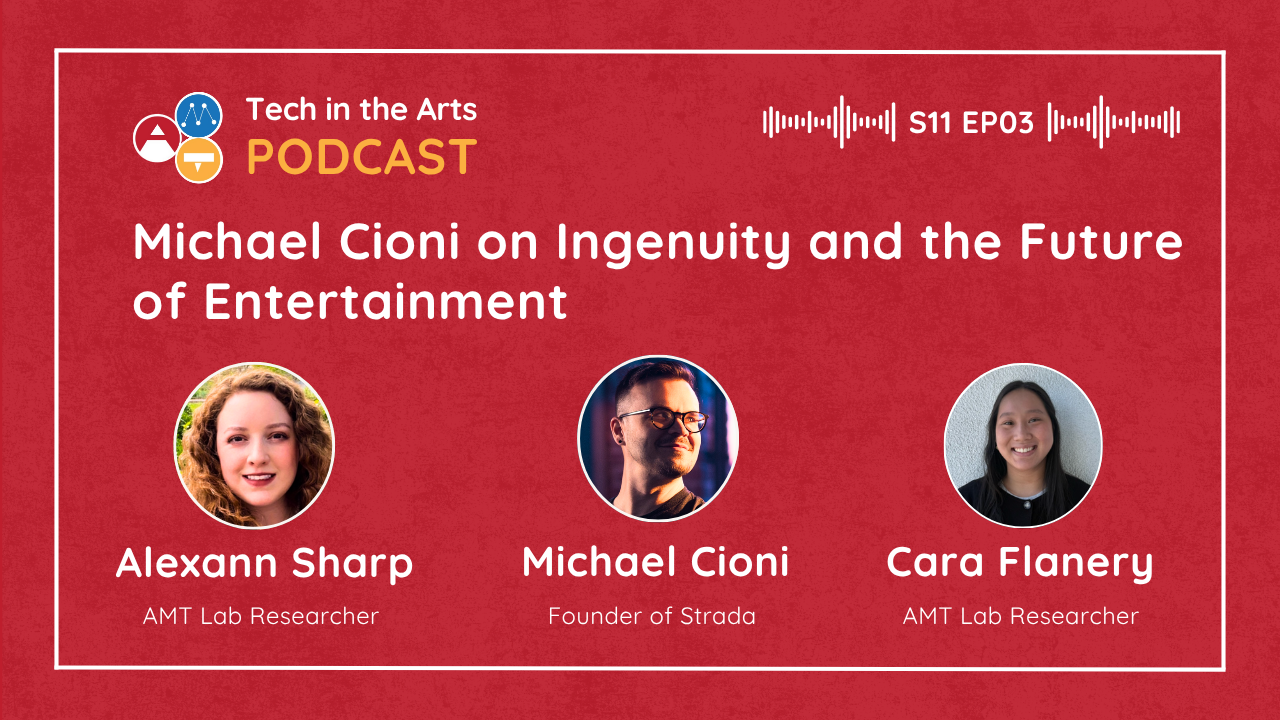
In this episode of the Arts Management and Technology Lab, Alexann Sharp and Cara Flanery sit down with four-time Emmy-winning innovator Michael Cioni to unpack how technology and creativity converge in modern media workflows. Cioni introduces Strada, a peer-to-peer platform designed to enable remote collaboration without cloud storage, and shares career lessons on building networks through industry events (NAB, Cine Gear, IBC) and assembling complementary teams (“Swiss-cheese” collaboration). He distinguishes generative vs. utilitarian AI, predicts a shakeout and rebound for GenAI, and outlines his Skills Gap Principle and “Technative” mindset for balancing creative and technical strengths. The conversation closes with candid advice on taking smarter risks and betting on yourself.
Transcript
Michael Cioni
We have to all accept and, and submit to the fact we're all swiss cheese. We all have holes, and none of us are one whole slice when it comes to talent and ability and resources. Right? What you have to do is find other people with the opposite swiss cheese holes and work together, because then eventually you catch all those limitations. Through the way of working with your collaborators.
Dr. Brett Crawford
Welcome to another episode of Tech in the Arts, the podcast series of the Arts Management and Technology Laboratory, also known as AMT Lab. The goal of our podcast series is to exchange ideas, discuss emerging technologies, and uncover ideas that arts managers and arts geeks like us that you need to know.
My name is Brett Ashley Crawford. I'm the executive director and publisher for AMT Lab. In this episode, our LA podcast team, Alexann Sharp and Cara Flannery are taking over. The show notes, related links and a full transcript are available on our website, amt-lab.org/podcasts/interviews. Enjoy the show.
Alexann Sharp
My name is Alexann Sharp.
Cara Flanery
And my name is Carol Flannery. We are both in the Master of Entertainment Industry Management program at Carnegie Mellon University. Today we are talking to Michael Cioni,
Alexann Sharp
recognized by the Hollywood Reporter as one of Hollywood's most influential figures in tech. Michael Cioni is a four-time Emmy-winning innovator with credits on over 150 films.
He founded The Post House Light Iron acquired by Panavision, where he helped develop the Millennium DXL 8K camera, and later led major workflow advancements like Adobe's camera to cloud while at Frame io.
Cara Flanery
An active member of the Academy of Motion Picture Arts and Sciences, and the American Society of Cinematographers.
Michael Bridges technology and creativity across global filmmaking through his latest ventures Strada co-founded with his brother Peter. He's now re-imagining media workflows by eliminating cloud storage for creative professionals.
Alexann Sharp
Hi Michael. How are you doing?
Michael Cioni
Doing great.
Alexann Sharp
Thank you so much for being here.
We're really excited to speak with you, hear more of your thoughts on everything going on in tech and the arts, and also hearing about your amazing startup Strada. So we first wanna just kick off what is Strada? Why is it called Strada? What is your goal with this?
Michael Cioni
Yeah, sure. My name is Michael and yeah, why did we make Strada?
What's the name from? We want to try to cut the cloud out of media workflows. And if you know, working in media, you know, it's very easy for us to shoot a terabyte or multiple terabytes or hundreds of terabytes. And when it comes to the cloud, the amount of cost associated with storing that kind of material is pretty much financially impossible.
So we wanna cut the cloud out of media workflows because people still wanna work remotely, but they can't transfer the files into the cloud and store them there. So Strada is the first peer to peer network for creative professionals. So it's sort of like a supercharged version of Napster from 25 years ago, which was sort of the infamous first peer-to-peer experience that millions of people had stealing music.
We've sort of built on a quarter century of technological advancements and security, and now we can make ProRes 4K playback off someone's computer literally 5,000 miles away instantly. That's really what we wanna try to solve is give people collaboration control without cloud costs. And the name Strada is actually the Word Street or in Italian.
And I'm Italian, my brother's Italian. We started this business together and we also, not only are we sort of nodding towards the Italian heritage, but we also think of workflows in media. Workflows as like a road, a map, and you kind of map out where you start and how the media's gonna travel and your process for editing and color correction and visual effects and sound, right?
And we draw these out in these workflow charts and they look like maps. And so Strada is our way of building a platform that helps you kind of create the entire workflow sans cloud.
Alexann Sharp
Wow, that's so cool. Like I've been watching all of your videos on this and I don't have a lot of editing background, but just from the little bit I've done, I've seen how you've been able to make the workflow so much more simple, like cutting dailies, the multi-camera perspective, being able to match some of that.
What are the key traits of Strada that you think are most attractive to people who are really into editing?
Michael Cioni
Well, the number one thing is being able to literally access a file on someone else's computer. That is kind of weird when you think about it, like how do you gain access to someone else's computer?
But we built a way to do that. You could almost think of it like the airdrop experience, which everybody's uses airdrops. It only works about half the time, but when it works, you're glad it did, right? You can only airdrop, there's two major limitations. One, you have to be within about 10 or 12 feet of the person. And two you can't airdrop between mac and windows. It's not cross-platform. Strada is sort of in a way like airdropping, which editors and visual effects and teams need to be moving files around. It's like airdropping across an ocean and it doesn't matter if it's macro windows or iOS or Android, and so it's like a very freeing experience when you don't need a cloud to sort of temporarily relay through.
You just kind of go point to point. That's the benefit of peer-to-peer. That's why we think we can really activate creative workflows in a way that people have really never had before.
Alexann Sharp
It's amazing.
Cara Flanery
Yeah. So this technology is so new, and I know that you've recently spoken at a conference in Amsterdam. It was called the IBC 2025. Can you talk a little bit about that experience and maybe what was the reaction to Strada there?
Michael Cioni
It's really important that anyone listening really starts to think about how their career builds their own network, because these events, trade shows, film festivals, even like special events in the evening.
One of the benefits of living in Los Angeles is literally every night there's an organization that has an event. You need to be there on some level. And then there are a few times a year, big events, NAB, the National Association of Broadcasters in April, Cine Gear, which is a cinema technology show in Los Angeles in June, and then IBC is the International Broadcasters Convention, which is European Technology for media professionals in Amsterdam in September. These are just three examples where you need to get these on your calendars. If you're in LA there's no excuse not to attend Cine Gear and NAB cause NAB is only about a four hour drive from here, so anybody can do that. IBC is a little bit bigger, but if you're in the European continent. It's easier to get to. But see, the important thing is when we are looking for jobs as creative professionals, many creative professionals live a life of freelance. Normally, you wouldn't want that, right?
Like lawyers, they want to get hired at a law firm. Doctors, they wanna get hired at a hospital. Teachers, you wanna get hired in a university. Media professionals are often living a life of freelance, and so we are responsible for building our own networks. And people wonder how come person A is always working and person B is never working.
It may not come down to talent. It may have a lot to do with their ability to network themselves. IBC is just one example. I always save up miles and I use my airline miles. I go every year and I go to Amsterdam because now I have an international layer of networking that comes into play, and you have to build this up over years.
I'm not saying this is a bucket list experience. You don't go to NAB once you go every year for 20. Years. And when you do that and you do NAB, IBC, Cine Gear, even NAB is another one. There's NAB Atlanta. There's NAB, New York, there's a really great one in Berlin called MTI or Tech Media Hub, TTMH, I think it's called now.
This is another one that's really great in Berlin in late September. All of these events and there's lots of 'em. And then there's the film festivals 'cause festival programmers have learned that if you get all these creative people at a film festival, you can also have panels and talk about the process.
And people love that as much as the movie because when you see the movie, you're like, how did you make it? I wanna know. And you're right there, I can ask you. I remember my first Sundance experience, must have been 2002 maybe. My first Sundance experience, I went there. I was looking for films that were shot digitally because my inspiration was contrarian to the Kodak filmmaking world.
It was what is the digital world offer? And in 2001, that was very, very contrarian. It was very different. It was very new, and there were a few breakout film making films digitally. So you go to Sundance to see them, right? And I remember seeing this film called The Technical Writer. Small movie, and the DP was named David Lightner.
And David put on, there was a panel about how they made this movie digitally. And I sat in the front row, I think it was like at nine o'clock in the morning. We had been out now all night partying. We looked terrible. But I just remember just all this information being given to me from 10 feet away and it changed my life that one panel got in my head that there are alternative solutions that people can innovate because David and the technical writer team that made that small film, they didn't have money, they didn't have resources, but they had ingenuity.
And that's what creative people forget. That's what makes great creative people great, is you have to have an innovative mind. You gotta have ingenuity, you gotta be clever, right? I remember seeing something so that we've all seen a million times, and I just learned this, I just learned this and it's just so fantastic.
In the movie, the Wizard of Oz. There's this beginning of the film, everybody knows it's black and white. It's kind of this tone. And then she opens the door after the house crashes and it's all in color. And you can imagine that almost a hundred years ago when that movie came out, people's minds were blown.
Alexann Sharp
Right.
Michael Cioni
But what I learned, I'm like, how the heck did they do a hundred years ago? A CBA tone to color moment? How do you do that? And I just learned this. It was shot practically. And the house in the foreground is all painted sepia. And they had a fake Dorothy wearing a epia tone Dorothy dress. And she opens the door steps out of frame and the real Dorothy wearing a color walks in and it's just clever.
Alexann Sharp
Yeah.
Michael Cioni
The cleverness of that, it just gives you goosebumps because the director sees this in his head. And says, how do we pull this off? And you just get clever.
Michael Cioni
And I think that's what it comes down to. So it's a long answer. But when you go to these events and you shake these hands and you build this network of people, you start to get inspired. And you build a network of resources that I promise you will count on as the years go by.
Cara Flanery
Yeah, I think your passion for like what you speak about really shines through and I definitely did not know that about the Wizard of Oz, and I think that your passion that comes through really helps in your networking with other people as well. Thanks for sharing that with us.
Alexann Sharp
It's interesting too, like personally for me, whenever I'm around people who are forward thinking like that, it tests me to be that way. And I feel like if you really need to surround yourself with people who are both motivated and also. I'm gonna encourage you to say, you know, if you have an idea, you should really try that.
If you are passionate about something, you should really explore that because I mean, being here in LA has just been so eye-opening, being around people who are in that mindset. So how do you develop that mindset to make sure that you are looking for opportunities that you are seeing? Advancement or how do you find things that you see as being interesting and innovative?
Michael Cioni
Easy. You have to surround yourself with a team. I use this phrase, if you imagine a piece of Swiss cheese, it has these random holes in it, right? We have to all accept and submit to the fact we're all Swiss cheese. We all have polls. And none of us are one whole slice when it comes to talent and ability and resources, right? Some people have all sorts of different things, but each slice has a different set of holes. Some slices are bigger with holes over here, and some are smaller with holes over there. So if you look at each person individually, you see all these gaps and that's where you fail. That's where you're not good.
That's where you're not capable and it can come from anything from, someone might be a great writer, but they're terrible at at speaking and it can't convey their feelings, right? Someone might be really great at giving direction, but they're really bad at reading and they don't have a really good mind to be able to sit and read. Someone might have a really great visual style, but hey don't know how to communicate that with a team. Someone might have the financial resources, but they don't have a team to be able to underwrite for that. What you have to do is find other people with the opposite Swiss cheese holes and work together, because then eventually you catch all those limitations.
Through the way of working with your collaborators. Now for me, I learned this, we learned this in junior high. You start hanging out with a click. And those cliques start to work together. And then when you get to film school, you find a click. In film school, everybody kind of does that, but as you come to a city like la, which everyone, even though the entertainment industry is slowly bleeding to death, this is still ground zero. So no matter what happens in the media and entertainment industry, LA still today remains the epicenter of everything technologically, creatively, financially, and talent wise. So this is still the place to go. Even though, LA is has got its big problems. I still recommend if you're serious about this, get your butt on a plane. And get yourself out here. Book a one-way ticket like I did, and just start figuring it out and fail up. That's critical. But when you get here, you start finding that team that if you get around the right team of people. Good people prop each other up. And you find someone who compliments you, who is not intimidated by what you bring to the table?
When I started building my first team, I had a guy, Ian, who is exceptional at visual effects and the nuance of those things. He loved the color correction and visual effects precision.
Today, he's one of the top colorists in the world. And he's kind of quasi famous for coloring movies like the Social Network and Dragon Tattoo. But back then he was just dabbling in it. Another guy, Jody, he was all about the precision of nonfiction storytelling, and he was really good at crafting raw footage and just figuring out how to pull a great cinematic story, but it was nonfiction. Now, Jodi is one of the top editors at Viacom doing all these reality shows and just did the MTV Music video awards, like that's what he does all day, nonfiction stuff. And those are just a couple examples of people who I wasn't good at those two things. And so by complimenting my skills with them, we were able to build a business that was like one of our first businesses. And people recognized, wow, these, this little team together. It was pretty awesome. And then we found out what we weren't good at.
We weren’t really good at audio. We weren't really good at, you know, bookkeeping and things like that. We had to bring in team members that bought into the mission and they believed in the same thing. And for a lot of people it's identifying an adversary. Nothing brings people closer together faster than a common enemy.
If you can identify an adversary, an opportunity, and you can quantify it. And in business, for us it was digital was what we wanted to represent, and film was the bad guy. It started getting us motivated because we looked at Kodak as the enemy, and we started attracting other people who agreed with that philosophy, right?
Alexann Sharp
Yeah.
Michael Cioni
And some people would say, oh no, everyone's equal, we should always, you know, everyone's included. And I'm like, but if you wanna stand out, you have to pick sides. It's Dodgers town right now, and it's like, it's no fun. If everybody cheers for every team equally, that's no fun.You wanna beat somebody, right?
You're in this building with all these people. You just feel it. And I'm sure people that aren't Dodgers fans could be at a Dodgers game in the playoffs and they're gonna be cheering for the home team. Right. That's, mm-hmm. That's kind of the sentiment that you gotta bring into your business as well.
Alexann Sharp
Yeah. This might be, I was watching some of your videos and some of the interviews you've done, and you might be tired of talking about ai, but I do think you came up with. You made a distinction between regenerative AI and utility AI. Can you talk a little bit about that? Because when you're talking about teams, there's clear teams here, I feel like. Especially people I speak to in the town, a lot of creatives are worried about it. Do you think that's valid? Do you think there's more opportunity than threats? I would just love to hear your thoughts on this. As someone who's seen how technology has changed the industry time and time again.
Michael Cioni
Well, I could be wrong, but it's October, 2025 at the recording of this. So, you know, we'll see what happens. But myself and my team here at Strada, we believe that generative AI and most of the AI investments right now are about to experience a major collapse. We predict the collapse in the next six to 18 months of AI.
Alexann Sharp
Really?
Michael Cioni
But that isn't the elimination of AI because mm-hmm. In 2007, the housing mortgage market collapsed, but it's not like nobody wants to buy houses, right? So, and in 2001, the internet, they called it the.com bubble, where Dot com companies, because the internet had sort of just gotten its first big wave, people were investing in companies that weren't really companies. They were just websites. And that collapsed. But of course the internet didn't break and websites didn't go away. AI will collapse, but it will not go away. It will then reform with a much more stable business model, just like websites that were overvalued, collapsed, and then they reformed and their new business model was created. The housing market collapsed, but it was reformed and a new mortgage system, including new regulations to protect that from happening again formed, and the mar economy grew on that. The same thing will happen with GenAI.
It's gonna collapse. Then it will reform into a better business model. Today there really isn't a business model for it. In fact, as much AI as you read about, I challenge anybody to, you know, I'm sure there's someone who could disagree with me, but I find that most people in the world are not generating GenAI content every day in their social media campaigns in their lives. Like a lot of people don't even do it every week, some people don't even do it once a month. Like they don't literally go into Midjourney or Runway or SORA and generate anything. And I should ask you, do you use those products weekly, daily, monthly?
Alexann Sharp
I use it for research, for research organizing. I don't use it to create images or anything artistic.
Michael Cioni
And I know we're a small sample size here, but people need to ask themselves, are you using GenAI daily, weekly, monthly, or perhaps bimonthly, things like that. The fact of the matter is, if you have a technology that is valued at hundreds of billions of dollars and it takes hundreds of thousands of kilowatts of energy to produce the result, then therefore you must have. Daily active use, like it must be used by people every single day. The compute required to do something like Google Maps or something like that is very high. People use it every day. So the value is offset by the compute that it's cost to run something like that as an example. But generative AI costs, it's like the most expensive compute you can create as a consumer. It is very expensive. Physically in terms of the amount of air conditioning required to do it, amount of time it takes, all of that material is expensive, and because it's so early in the business model, it doesn't financially generate a lot of money.
So it's a loss. So these companies are working at a loss, and the only way they could prove that this technology is going to be viable is if people are using it every single day like a Google map. It has to be that innate to daily use, and it just isn't. Most people, if you said, do you take a picture with your phone every day, every week, every month, everyone would fall into one of those categories.
You post a picture of something you do every day, every week, every month. Almost everyone would fall into one of those categories. But do you generate one every day, every week, or month? A lot of people fall out of it. That's the flawed of the business model. Everything just comes down to a business model.
If the business model doesn't work, it eventually won't matter if people love the tech or not, or they're impressed or not, because it won't be affordable for the companies backing it to keep it going. Therefore, it collapses. And then there's a repatriation to like, okay, what tech do we have? How do we actually make this work in a business model in version 2.0, that's likely what's gonna happen.
On the flip side, you mentioned research. I qualify a category of AI as utilitarian, which is AI that is not generating creative components and utilitarian AI, which, by the way, Google Maps is utilitarian AI people. People sometimes think AI is new or all bad. Well, that's silly because every person with a picket sign that's protesting AI is bad for creative people, they all used Google Maps to find a parking spot when they got that protest. But they're using AI to get to the protest that's anti AI.
You have to like break out categorically, okay, well what are you actually protesting? What are you pissed about? And if you can't qualify that, then don't carry the sign. But the utilitarian is useful and it's helpful. And it can better our society. And you have to understand those variations. I have been investing a lot of time and energy in the utilitarian side to help mundane tasks get executed faster or even automatically so that we leave a little bit more time for the creative tasks that we can do.
Cara Flanery
So do you hope that utilitarian AI would fall into that category of these people use it every day, every week, every month?
Michael Cioni
Totally. Yeah.
Cara Flanery
Okay.
Michael Cioni
A good example. Like right now we're on a Zoom call. Zoom is using a utilitarian AI to actually transcribe everything that's happening and about two minutes after this talk, they will spit out a transcript of everything and summarize it.
They're using a tool, probably something like Anthropic, which has a component to do that or a Whisper. And Whisper is a analytics transcription, translation and summarization AI utility. And it's a great resource 'cause you can get notes, you can search for things and it comes completely, automatically, barely five, six years ago, people would've to sit and type all this out all day if you wanted a copy of it. It took forever and it was expensive, and it certainly was slow. These are the types of things that people are now becoming accustomed to in their daily active lives. We can simply take that a step further.
When you say, well, if I can have a transcript of this, can I have, can I ask it to edit the best parts? That are suggesting about, you know, edit to me a highlight reel of all the AI stuff, or edit me a highlight reel, a highlight reel, and remove all the AI stuff. Now we're thinking about time code and clips and things like that and sub clips.
That all becomes very useful and that's the type of stuff where this utilitarian space will start to work its way into a more traditional, typical experience and think about it. If a director who's not the editor is able to actually get a file and say, I want a noodle on this stuff. They could start editing, even if they're not a traditional editor, or if you are not a colorist, but you're an editor, you're editing and you're like, I just wish this looked a little better. You could bring AI in as a utility, add some color flavor to your look. 'Cause you're like, I'm not really good at. But I want it to look like this film or that film.
Alexann Sharp
Right.
Michael Cioni
And these are the things that. The creative professionals can start to leverage over time and they'll eventually become so normalized and the business model will make sense.
So it's not just over energy driven without any return on the investment, it'll all start to level out. And a lot of the companies that don't belong here will extinct themselves. And the ones that are strong enough to withstand the scrutiny in a real business model, they are the ones to make it through and succeed.
Alexann Sharp
You've talked about AI filling the skills gap. So is that what you mean by like these more utility uses for AI or do you think companies are, I think the obvious answer is probably no, they're not doing enough to train their employees on how to use AI. And you know, I think people are scared still of even touching it. People who are maybe not as tech savvy, they're just kind of scared still. Do you think companies should have more of a responsibility?
Michael Cioni
That's a great question, Alexann. And if you google my name, Michael Cioni and skills gap principle, people can kind of find a little section about that. I'm glad you found that.
The skills gap principle essentially suggests if your vocation is color correction, then cinematography would be something that you could utilize AI to help you with, or color correction. If your vocation is editing, then you would use AI to help you do the stuff that is not your vocation. What I think a lot of people get wrong is they think AI will take their vocation over, and what I'm trying to say is no, AI will infiltrate every possible vocation, but the proper use of it. Or the use you will prefer is to use it in a thing that you are not good at, right?
Like I mentioned, I am not a great reader. It is hard for me to sit down and focus and not let my mind wander when reading. I was just created that way. It's just mm-hmm. I'm not a great reader. I'm jealous of people that can just whip through books too.
Alexann Sharp
I am too.
Michael Cioni
And we all know these people. They are out there, right? But I can, if a car honks, I can tell you what pitch it is. So I have a dip. My brain is wired differently, right? And I can understand. And when I think of mathematics, I see colors and so I visualize things with color. And different mathematics or different sizes of things all resonate in my head in these colors.
That's how I see. So we all see things differently, right? The point is, if you have a vocation of something, I augment and effectively enhance the stuff that I'm not good at with the AI stuff. So I can use AI summaries to help my deficiency in reading, which allows me to get to the point quicker where I need to make a decision about a creative this or that or something.
And I'm getting the advantage, a mechanical advantage of AI for that. There are tools out there that can do temp sound mixes for you, or even final sound mixes if you want. And someone would say, but I'm a sound mixer, you just took my job. No, this was an editor's job who used it to sound mix. And that's different.
Just like a sound mixer might use an automatic AI color correction job and it's like, hey, you just took the color job. No, I'm a sound mixer. I don't color correct. There was never gonna be a color correction. I'm able to do it now by leveraging AI to help me with my vocation, which I'm doing, which is the color correction or the sound mixing, or whatever it is.
So the skills gap principle is really this interesting theory that my brother and I. Peter came up with to kind of help explain where AI should fit in people's worlds. And it isn't designed to replace you. It's designed to give you a leverage in areas that you're deficient more of that Swiss cheese hole.
Cara Flanery
Right. So speaking of leveraging AI for your own vocation, we know that you've coined the term tech native. Do you see that leveraging of AI for your own technology? Do you see that as being part of tech native or how would you describe that?
Michael Cioni
Yeah, you're doing a great job. And I would say, I actually pronounce it Technative. And the reason is it's an amalgamation of the words creative and technology. And so it's not meant to be like native, like to be original. It's meant to be creative and it's a made up word, so it doesn't really matter. It's my way of trying to describe two things. One, it's how I describe me to people. And two, it's how I try to encourage, especially newcomers to media and entertainment to think. And the reason is what happens in the past, your parents, your grandparents, what happens is people would become an expert in something and they would decide, and this was really big in schools, which I didn't like. Is that you're either left-brained or you're right brained. And they would say, if you're left-brained, then you're probably right-handed and you're really good at math and science and logic, right? And if you are right-brained, you're probably left-handed and you're really good at arts and music and you probably speak multiple languages or you're really emotional and you're constantly crying, like these are all things this left brain, right brain.
And what they try to do in school is try to teach you, well, you are this way that's just how it's, and I had teachers 'cause I was extremely left-brained. Sorry, extremely right-brained. I was always being told like, well, that's why you're bad at math and science. I was terrible in school, horrible test taper, test taker, C and D student. But I played like nine musical instruments.
And I, you know, could do all the, I could shoot and I could edit and I could color, and I did all these creative things I could compose. I composed musical cortex and things like that in high school. And what they said, well, that's just because you're really right-brained.
What I learned is that just keeps going in life. Mm-hmm. And what happens as adults, we start to pigeonhole ourselves based on that ideology that we're told as children. And then all of a sudden you have adults saying, I'm not technical. I can't do that job. Or I don't know this, I'm not technical. We all have a parent or a grandma who's like, I'm not technical, right?
And then we have people who are technical who say, well, I'm not creative, so I can't sing. I don't play an instrument. I don't wanna get involved with that. I'm not in touch with my emotions. I don't wanna go to therapy. We have those people too. And what the idea of Technative is, it's the acceptance that we have to learn how to balance them out.
Just like weight training, you have to basically apply. Exercise the part that is weaker, because I admit we're not equal. People are either dominantly left or right brained, but that's not an invitation to overdo it. It's the invitation to try to balance them out. So if you are one or the other, you need to exercise the other side.
And a good coach would tell you your jump game is bad. And what we do as adults is the opposite. We say, I'm not technical, so I'm not gonna practice. That's what we do, and you get to blame some teacher that told you, your brain is this way. That's bad doctrine. It's bad, it's bad. So what I like to do is encourage people to balance that out and learn and recognize one, you have to be equal. You gotta work to be equal. 'cause it's in your best interest as a professional in any industry to be able to do both. You end up surprising yourself with what you can actually accomplish when you understand these two worlds better. And so if you can be more equally Technative then things will come easier to you.
And if they come easier to you, you perform better. And if you perform better, you get promoted or you get noticed. And that leads to more wealth and more opportunity in a larger network and all this good stuff comes. But if you know that one person in your life that's always saying, no, this is me. I'm in this box.
I gotta fit here. Who wants to be friends with them? Nobody, right?
Alexann Sharp
Yeah.
Michael Cioni
Who wants to hire them? Who wants to promote them? You know, we all know that they can be very proficient in one thing, but there's an attitude with it, and that's like, I don't know if I want that. I know a ton of people. Who are exceptional, but they have a chip on their shoulder, they're less desirable to work with, right? It actually hurts them, even though they have a great skill. But if you find someone more well balanced, some people say, oh, a jack of all trades is a master, is none. I don't believe that. I don't think that's true at all. I think it's just a fun phrase to say, butI don't actually know that that's true because I can do left and right brain things as proficiently as some people who would say they are dominant. I had to work harder for that.
Most people think I'm a technologist. I have to work harder to understand and synthesize the technology, which is why when I explain it to other people, I have to explain it in sort of a remedial way, and that's just the approach that I use to make it stick so that I can make good advisements of my team. So, 'cause I'm responsible for steering the ship, I gotta understand a little bit of all the components, right?
Alexann Sharp
Right. Well this has been such an amazing discussion. You have so much wealth of knowledge to share with people. We could talk for hours, and I know you'd still have even more like amazing lessons about your past and your history.
I am gonna encourage people to check out more of the podcast you've been featured on. I know I've learned a lot from that, but we just wanna say thank you so much for your time and just one final question is in addition to the things that you've talked about, do you have any final advice for both educators and students that you think is that you've learned over the years or that's been on your mind lately? Anything that you think people should be aware of or should just know?
Michael Cioni
Yeah. If you wanted to be a media professional or a content creator, or work in creative professional roles. Then you all have someone who's inspired you, someone you looked up to. Somebody that you've been seeing or watching or you celebrate their catalog and I'm talking, that goes back decades, right? What you have to really recognize, and if you do research on these people, you'll prove this out.
They all took tremendous risks. And the risks that they took often were unproven and seeing what we do as professionals again. It is baseball season in the postseason. But you know, if you think about baseball, you have a base and you stand on the base, you're safe.
So if I get on base, what should I do? I should stay on base the whole time. Well, not exactly, because if the ball gets hit again, you gotta get the other base and it's 90 feet away. And you gotta go 90 feet. So what runners do is they take a lead off. Now what's the good side of the lead off? You're a little closer to the next base. What's the downside? You can get tagged out.
Like creative people need to do is take healthy lead offs. You've gotta let go of the safe space and get yourself inching towards the next thing, even though you're exposed and you're putting yourself at risk. But what you're doing is you're trusting other people in your team to do their job, to get you to the next checkpoint. And you're willing to take that risk as a team together. And when teams do that right. They win. And so my advice is to bet on you and be willing to take bigger risks.
If I were able to talk to a younger version of me and give myself advice, I took a ton of risks in my career. I didn't risk enough. That would be my advice to me. I should have risked more. I should have tripled down, quadrupled down, penta down, because I felt I could have absolutely done more if I would've just trusted me even more because I placed bets that were strong, but I actually was still a little closer to the base than I probably needed to be.
So that's my advice is risk taking. And one thing that's important about risk taking, especially if you're young, when you come from a good family, it means you should take that blessing that you have and risk more because you can always come back. To that, they'll take you back. And when people have the advantage of a great family foundation, there's no excuse to use that and expand your tolerance of risk, because you're gonna be fine. You're gonna be fine. The problem is when people have all those advantages and they still don't bet on themselves, that's pathetic.
Alexann Sharp
Yeah.
Michael Cioni
And so this is the opportunity. Then they see other people doing well and they're like, what are they doing that I'm not?
They're risking, they're taking bets on themselves and they're building teams and they're trying stuff. The filmmakers we adore, all invented stuff and took crazy risks, and they all have amazing stories of how they barely succeeded, but they'll tell you what it felt like to take a lead off that exposed them to major catastrophe, and yet they built a team to succeed in spite of it. So that is what I would encourage everybody to really do.
Alexann Sharp
Thank you. You're definitely an example of that, just seeing all the advancements and the way you've inspired so many young professionals. So thank you so much again for your time. We've really enjoyed this discussion.
Michael Cioni
Thank you.
Dr. Brett Crawford
Thank you for listening to this episode of Tech in the Arts. If you found this episode to be informative, educational, or inspirational, be sure to check out our other episodes and send this to another arts or technology aficionado in your life. If you want to know more about arts management and technology, check out our website at amt-lab.org, or you can email us at info@amt-lab.org. You can follow us on Instagram at techinthearts, or on Facebook and LinkedIn at our full name Arts Management and Technology Lab.
Our season runs from September through May, so feel free to follow us on your preferred podcast app, be it iTunes, Spotify, or YouTube.