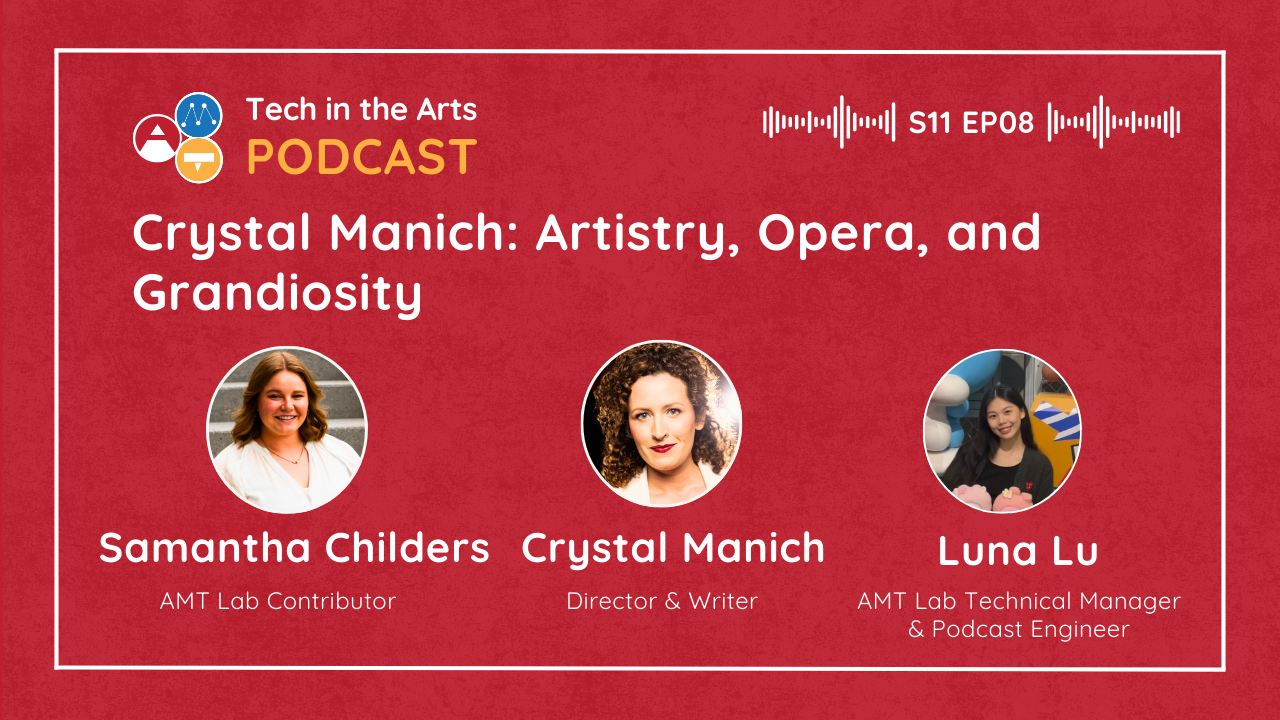
In this episode of the Arts Management and Technology Podcast: Tech in the Arts, Samantha Childers and Luna Lu speak with Emmy-nominated director and librettist Crystal Manich about her international career across opera, theater, and Cirque du Soleil, the development of her new opera Time to Act, and how emerging technologies like AI are reshaping creative work in the arts. Crystal reflects on storytelling in opera, directing large-scale productions around the world, and the importance of preserving human creativity while responsibly integrating AI as a tool for research, organization, and artistic production.
Show Notes
Transcript
Crystal Manich
I think that AI, there's a lot of controversy about it right now, and I get it. All of that is great. Like the more that it can be knowledgeable in the arts and in the history and everything, that's been fantastic. What I'm not a fan of is using AI to help me write a screenplay or help me come up with an idea of a libretto.
Samantha Childers
My name is Samantha Childers and I am a guest contributor to the Tech in the Arts podcast through the AMT Lab at Carnegie Mellon University. I'm a second-year master of arts management student here at Carnegie Mellon, and I'm joined today by Luna Lu, who is our AMT lab technology manager and podcast engineer, and she's a first-year master of entertainment industry management student.
We're really excited to introduce you to our guest, Crystal Manich. Crystal is an Emmy-nominated, multi-talented director, librettist writer and arts administrator whose work has spanned across the fields of opera, film, theater, Cirque de Soleil, and more. Crystal holds a BFA in Drama from CMU, and a Master of Arts Management from CMU and a professional certificate in screenwriting from UCLA School of Theater, Film and Television. As an international arts professional, Crystal has directed over 90 productions worldwide in the past 20 years, and she was nominated for an Emmy for her direction of the 2021 Chicago production of “La Hija de Rappaccini”, which was a multicam live-streamed opera.
Crystal's artistic leadership has spanned across multiple sectors of the performing arts field, serving as the artistic director of the Mill City Summer Opera in Minneapolis. The founding co-artistic director of Opera Omnia in New York, assistant artistic director from Quida in Brazil, and Cirque du Soleil served as the artistic director of Cirque du Soleil Crystal North America and Middle East Tours.
She's been an artist-in-residence at Carnegie Mellon University, Boston University, Indiana University, Bloomington, New England Conservatory, Rice University, and Simpson College. She served as adjunct faculty at the University of California, Los Angeles, and Westminster Choir College at Rider University.
Crystal has made quite the impact on the arts field. Especially in opera with her upcoming world premiere of Time to Act at the Pittsburgh Opera, which will run from February 28th through March 8th. Welcome, Crystal. We're so happy to have you here today.
Crystal Manich
Thank you so much. Thanks for running that down, all of that, that resume. I always get embarrassed like when people run down everything 'cause it seems like, wow, it's so much, and I guess it makes me embarrassed 'cause I'm just like, I don't even know where to start talking about stuff, but it's really, it's really humbling to hear that list, so thank you.
Samantha Childers
Yeah, it's quite an impressive resume, and it was really just a fantastic and fascinating time, kind of preparing and getting excited to talk with you.
So speaking of that resume, you truly are so versatile as a librettist, a director, an organizational leader, a teacher. Can you speak a bit about the contributing factors that have really supported your success?
Crystal Manich
I think number one definitely is the background that I had in education. I grew up in Pittsburgh.
I went to Mount Lebanon High School where we had a really strong fine arts program. So we had dance since if you didn't wanna go to the gym, you could do dance, you could do, you know, a band. There was an orchestra, there was marching band, there was theater, there was a television studio. So I took advantage of dance theater and television when I was there.
And I danced as a kid. And then I returned to it my senior year, in high school, 'cause I just, I, I just love dances and expression. And it's obviously influenced my directing work, but I just found those formative years of just having arts exposure, even from elementary school, was just incredible.
And I think that's what led me to Carnegie Mellon, really was just having, you know, I remember in Mount Lebanon I applied for the governor's school for theater for this, for the summer before my senior year. I almost made it, it sort of made the final cut, and I was sort of devastated 'cause I was like, well, theater's gonna be my life, so how is it that I didn't get into this program?
And then I had a friend who was a year older than me, and she said, well, I did the pre-college program at Carnegie Mellon. You can do it in acting; you should apply to that. And so I didn't even know that existed. So in the summer of 1999, I came to CMU for that program and met some great professors. I gained a little confidence that I could actually apply and maybe get into the drama school at Carnegie Mellon, 'cause it was like a pipe dream for a long time.
But it was amazing how the mentorship that I received from professors here at school, and I got into the directing program, and I was so grateful for that. And then, obviously, my years here are five very jam-packed years. You don't come to Carnegie Mellon if you're not willing to work. I think every student here knows that there's a lot of work involved in every department, and but it was five rigorous years.
But I really think it's set me up for working on multiple projects at once. You know, by having to navigate classes and tech crew and whatever else was happening. Juggling a dual degree and, and all of that in my last couple of years here. So I think all of those things really set you up for success in the professional world.
Samantha Childers
Absolutely.
Luna Lu
Well, yeah, thank you for that. All the round down and really all the factors. Right. And transition into Time to Act, you've done so much and are doing so much in Pittsburgh. Tell us a little bit about your upcoming premiere in Pittsburgh.
Crystal Manich
Yeah, I started working on the suburb. You know, the libretto are, are the words to the opera for people who don't know.
And I started writing it in 2018 after the Parkland shooting in Florida. A friend of mine who's a conductor and runs an opera company in California called me and said, you know, I just had this epiphany that these kids in Parkland who are sort of leading the charge on the protests and on the raising awareness of this epidemic that we have in the United States, they were all drama kids.
And he said, could you imagine an opera, where young people in a high school are affected by a school shooting in some way, and through theater, find some kind of healing, or that the power of theater has the ability to transform lives. And so I started writing like the treatment for it that week and then started writing the first draft.
And I didn't know, even though I had worked in opera for so long, didn't know the first thing about how you attack libretto and it was just trial and error and having people read it and. So then it developed over a couple of years, and then at late 2019, I sort of let it go. There were some factors that I just wasn't finding a composer to collaborate with.
I just thought, well, maybe this project won't happen. And then it was during COVID that I started writing every day, starting in 2020, and I wrote a screenplay, and I started really then cultivating my writing experience. And then in 2021, that same friend came to me and said, I think Laura Kaminsky, (the) composer, wants to work on this with you.
And I said, no way. And we met on Zoom in 2021. It was like all suddenly we were having this creative conversation about how (could) what you've already set up in the libretto, how could it transform? Laura had very specific ideas about how to really make it about empathy and having as little violence on stage as possible, and it's really about the aftermath and the consequences of the aftermath of an event. And that really reshaped the entire thing for me. And in 2022, we met in person, and it was just obvious that we were going to be fantastic creative collaborators. I wrote this version of the libretto in the summer of 2024.
I was very fortunate. I was home for most of that time, and I was able to really sit down and it was like every day, just working on it for three months and really trying to hone it. Then we workshoped it with the students at Boston Conservatory, and they were so incredibly generous with their thoughts, and they felt seen, and they wanted to contribute to it.
And they said, "Oh, you know, this one thing just seems a little not true”. And so they have a heavy influence on what became the final libretto, but it was because of my relationship with Pittsburgh Opera that I was able to pitch this project with Laura and they immediately said they would be the lead commissioner as long as we can bring on two or three others.
And so Laura and I pitched a lot in 2023 and finally got those commissioners on board, and it's been an incredible journey of discovery and creation.
Samantha Childers
It's so clear the passion that you have for meaningful and, and live performance art and something so unique about your body of work and your leadership is your time with Cirque du Soleil.
So we would love to hear a little bit about that, 'cause it's common to see lateral movements between theater and musical theater, and even opera. But Cirque is so unique. So we would love to know a little bit about how that came into your life and your experience.
Crystal Manich
Yeah. They first came into my life a while ago. In 2000, I was in New York. I was sort of going back and forth from Pittsburgh to New York assistant directing opera, and I had long periods of unemployment in New York, and I would look at the Playbill.com job postings. And Cirque du Soleil at the time was doing this wide casting of the net for artistic, technical, and every, I mean basically every position that they had available on their touring shows.
And so, of course, I submitted my resume 'cause I was still starting out, but I thought, well, I have a few things and I have opera, which is comparable to sort of the grandiosity of the Cirque that they do. And they wrote to me and they said, you know, we're doing this weekend in New York, can you come to that?
And so I went to, I think it was the Millennium Hotel in Times Square and just did a general, just a general interview with a few members from the HR department at Circ. They noted my profile. They said, look, we think that your profile really fits. So I had dreamed of working at Cirque at that point.
And then I had, several months later, I had a follow-up interview with a more senior person in the artistic department at Cirque. She said, " Well, I'll throw your name into the hat of the mix of people, because they were just at that time creating these assistant artistic director positions on tour as a way to create a pipeline for artistic direction”.
And it was about a year and a half after that that I had an interview and landed that first job, where I traveled in Brazil in 2009 on that job. And I did decide to leave after that point. I didn't wanna pursue another show right away. I felt like the things that I got out of that experience showed me everything that I still needed to learn.
Yeah. And things that I still wanted to explore in my own creative life. So it was, you know, it's hard to step away from a full-time job in the creative arts, but at the same time, I felt confident that I was gonna be able to come back to my own work and it, and it was true. My eyes were so much sharper. I had more to say in terms of the visual language of my work because of my experience at Cirque and what I, what I saw there.
I obviously kept in touch with, I had so many connections at Cirque, including with my former boss and everything, and eventually, when they were really looking for people to fill some positions a few years ago, I said, well, maybe I'm ready to go back for another tour. So I went back for about a year and I had a great time, you know, returning as an artistic director, going to the Middle East was crazy. That was like a cool, once-in-a-lifetime experience, and just every time I go back, like what I learned from the artists there, I think about learning about bodies and how acrobatics work, and in the case of the second show that I worked on, it was an ice show.
So learning about ice skating and ice skaters and how those things can combine together, again, expanded my mind as to what's possible, grandiosity of spectacle. And that was the first thing that they pointed out in my first interview was, you know, because you work in opera, you understand large scale and that that was the toughest thing and still is the toughest thing that Cirque faces when looking for people to take these positions because it's not a black box theater. You know, it's an arena. It's a big top. It's whatever the venue is.
Samantha Childers
That's so interesting and I think that that is such a niche, but also such a grand, as you're saying, such a grand experience that all of that is connected. But I think that, the parallel between Cirque and opera is not immediately obvious.
Crystal Manich
I had a band on the last show that I did, Crystal, not named after me. I sat in the pit with them, the pit, the backstage on the side, kind of thing. But they called it the pit, that orchestra pit. And it was the first time they said that the artistic director had sat with them in that pit and I just thought, well, this is no brainer for me 'cause I come from music and I wanted to see, 'cause they work in a system called able to, they had no idea what that was. So just seeing all of those sequences triggered and how the show keeps on a time schedule, it was fascinating to learn process.
Samantha Childers
Shifting a little bit more into opera. You gave a wonderful presentation last week at CMU. You spoke about getting a degree in directing from the School of Drama, where you worked in opera, and about how the School of Music and Opera changed your trajectory as a director, and opera is such a unique and powerful art form. So I'd love it if you could talk a little bit about what makes opera so special and so powerful.
Crystal Manich
I think what I loved about studying theater and getting the degree at drama was learning the nuts and bolts of what it is to tell a story on stage, directing people, directing bodies, directing emotions. That was the biggest takeaway, and that's the training that I really wanted, 'cause in the back of my mind, I always wanted to apply it to opera.
I had seen in opera was disappointing to me in a lot of ways, where I didn't really see people doing a lot of acting, connecting together on stage. And I set up from the beginning to shift that, and I'm known for that now as making people work to create that emotional connection and, and reach an audience in that emotional way.
And so I was really grateful for that opportunity that while I was in drama, able to come over to the School of Music and direct my first opera scenes and some other programs. And you know, I think that that has definitely influenced me, what I wanted to do, but I was also encouraged to do that, and I think that without that, again, from mentorship and professorship, that you can't achieve that.
Samantha Childers
Can you talk a little bit about any opera companies that you've seen or have worked with that are making a mark on this kind of trajectory that we're seeing opera move in and hopefully move in in the 21st century?
Crystal Manich
It's interesting. It's not the bigger companies, you know, it's not the companies that have what you would think is all the money in the world, it's actually the smaller companies that are doing, I think, the most meaningful work. We're talking, I mean, Pittsburgh Opera as, as one example, who is committed to new works, committed to doing a variety of big shows, small shows in different venues in order to attract audiences maybe that are varying, you know, they may not wanna go to the Benedum Center. They want to come to the Bitz Opera Factory. And there are other companies now starting to do that. And they're acquiring their own buildings like Austin Opera. They're creating a black box now because they recognize that the smaller programming and the new programming can actually build that new audience that we've been looking for.
And that's also thinking outside the box. I know Austin Opera's looking at a lot of Spanish and English, you know, bilingual, theater pieces that are opera-based. I know Opera Theater of St. Louis is buying, it bought a building and they're, and they're doing their whole, they're, they're building a whole theater for themselves.
So I think this idea of self-producing and, and being able to not depend on outside venues that you have to fit into is really where the industry's going. And there's also like North Carolina Opera and Raleigh, they're doing really, are you from there? From North Carolina?
Samantha Childers
Yeah
Crystal Manich
So they're doing great. I just spoke with the general director the other day. He said that they're in the black and they have audiences coming to their shows. So it's really these smaller B and C city markets that are actually doing really well because I think that there's a sense of community now. That hasn't maybe existed before that each company is now looking at their immediate community and saying, okay, we're part of this larger conversation of opera, but what's actually here and what do we need to focus on in our market?
And I think that's really changing the way that people are viewing themselves and that they don't have to conform to what they're doing in Chicago or San Francisco or Dallas or New York. You know that it's actually, it's their own backyard and they need to protect that. So I think I find that really inspiring.
Actually, in the shows that I've been doing lately, it's been sold out and that hasn't happened in a long time in the 20 years that I've been working in the business.
Samantha Childers
Yeah, I think in my experience, having seen opera and large venues, which can sometimes be really difficult, just to fill the space and then there is more intimate venues, just such a unique experience, when you are in that more intimate setting, you really can provide just almost a personalized experience that you really feel like there's a connection there.
Crystal Manich
We talk a lot about immersive experience and what does that mean? Installation art has been doing that forever, that immersion, but I think that immersion is not just like a Sleep No More or something like that.
It actually can be, just the proximity that you are to the performer. I think hearing an opera singer 20 feet away, it's a very different experience from hearing them a hundred feet away, and I, I think that there's just a vast difference in that. That's why I find that opera's really powerful and intimate setting because the human body and the voice have to do so much more in order to generate that sound.
And when you experience it right there firsthand, it's pretty amazing. Opera just heightens human emotion and I think that's why maybe there's this resurgence in opera with people wanting to experience that.
Samantha Childers
We passed it over to Luna now
Luna Lu
And you built a truly international career, right? Directing, leading production across not only US, Latin America, mid East and just Europe. When you are moving between different culture and production environments, what skills and mindset have been most important for collaborating effectively across those differences?
Crystal Manich
I think being multilingual has really helped me in my life. I grew up speaking Spanish and English and then learned Italian while I was here at CMU and studied abroad in Italy and, and became pretty fluent just because of how similar it is to Spanish.
But I also have a facility with languages. I've picked up a bit of Portuguese when I was in Brazil. Obviously, directing operas in French, German, even, you know, Serbian here at Carnegie Mellon. I directed a Serbian opera in 2019 with the students here, and that was a cool experience. I've directed operas in Czech, a little bit of Russian, so in opera, you're forced to get outside of your comfort zone and even, even don't have to be fluent in those languages to do that.
But I mean, I study them to try to be competent in the pronunciation and obviously translation of every single word in my score, so that I know obviously what I'm directing and what's going on. So I think that ability has allowed me to travel to all these places with a lot of facilities and being able to engage with people in those years that I spent in Buenos Aires directing operas, I mean, it's just fantastic. 'cause obviously I speak Spanish, but Argentina is different kind of culture and flavor. And so I would pick up their dialect, and they loved it. And I would try to like, oh, is this the right way to say this word? You know? And just that camaraderie and that trust was really, it's part of the success of a show.
You can't just show up and not connect with people and think that you're gonna get a good product. It just doesn't work in business and it doesn't work on stage. And so, yeah, and I think also every place has what they like in the arts, when Buenos Aires has a very sophisticated audience that is used to high-level opera, like at the Lon, you know, they used to, Maria Callis would sing there. I mean, the biggest stars of the past were always there. And so they're used to a level of sophistication and what they're listening to and seeing. And that also has to influence how you're gonna approach the show. And you can be innovative absolutely within constraints of whatever that is, but you have to be conscientious about whose the audience there and what they want. And for sure, when I did my big Cirque show in Luxembourg on the 24th. It was an outdoor venue. It had to be a big spectacle. Intimacy wasn't really something that you could achieve because everyone's gonna be standing and that's when technology comes in, these projections and high-end lighting in order to achieve that, to have that emotional reach across 4,000 bodies standing out in the mud. Because it was really rainy and muddy in Luxembourg. We had to cancel one show, but we ended up doing the second one.
You just have to, I think, be sensitive to what people want in those places and what is the bridge that you can, if you try to speak their language, they, they really appreciate it. I actually miss their own language. I mean, you have to learn Luxembourgish. If you're gonna become a citizen of Luxembourg, they wanna keep the language alive, which is incredible.
I would try to learn some words, but it was beyond me as to how to do that. But I, I really respected that they wanted to maintain that in their culture, even though they speak German and French interchangeably. So it was, it was really a great experience.
Luna Lu
I love hearing all the experiences. Seeing how sensitive you are to not only the languages, but really truly just building the connection, like you really care. You care about your audience, you care about the artwork that you're building, that you're making. I love seeing the connection you build throughout.
Crystal Manich
I wouldn't be doing this if I didn't love to travel, and for me, traveling is not about anything other than learning about something outside of yourself. All of those experiences have been so meaningful to me. You know, like in Abu Dhabi, I just loved so many aspects of coffee culture, and I went to
Kuwait as well with Cirque. Some of the locals like this cardamom coffee set up to understand what it is and why people drink it and you know, such a different tasting kind of coffee experience.
But yeah, I just, I love that. I love the sharing of that 'cause I just feel like I grow as a person. And why do this work if you're not gonna grow as a person? The work is too difficult. This is what I always tell people. This work and the travel and the toll that it can take on your body and all of those things.
And some days I'm just so exhausted, but if you are doing it for the right reasons and you understand why you're doing it, it's not difficult on a daily basis. It's only difficult sometimes.
So I'd always tell people like, if you can imagine yourself doing anything else, do it. Because this is too hard to not be dedicated a hundred percent.
Luna Lu
I just love that despite all the jet lag and traveling, you are so passionate. Like I can feel your passion about the art you're doing, and especially just traveling around different countries, it's so exhausting and especially productional things.
Samantha Childers
So to kind of wrap us up, we would love to hear a little bit about your work in tech, working with AI and LLMs, and how you see emerging technologies affecting the field.
Crystal Manich
I think that AI. There's a lot of controversy about it right now and I get it and there are some things that I'm not sure about myself, but I've done a lot of reading and worked a little bit in training AI specifically with the arts, like art history.
I did a project where I was contributing opera history and theater knowledge to an LLM, and I think that all of that is great, like the more that it can be knowledgeable in the arts and in history and everything. That's fantastic. What I'm not a fan of is using AI to help me write a screenplay or help me come up with an idea for a libretto. It defeats the purpose. Like I, I love the process of sitting down and for myself trying to figure out what's the story I wanna tell in this screenplay, in this libretto.
I would think that AI would rob me of that joy of trying in that, 'cause it's it's difficult creative process, but man, once you unlock it, then you know where to go with the writing.
But AI is a tool for organization for basic knowledge of things that you don't know about. I think that that is where I'm finding the most use out of, out of AI, it's obviously helped me, like it's helping me create a 30-day campaign for a crowdfunding that I'm going to do right now for our Time to Act documentary.
But it helped me lay out a 30-day plan, and it wasn't perfect, you know, but I went in and adjusted. But just to have that work, beginning that legwork done for me, and then I was able to work on it, I just think that's more of where, I've worked with a lot of projection work in my operas and I have a projection designer who is starting to use AI to create the content.
I think that is obviously something that is, is very much being put into practice right now, but he's creating the content using AI tools and I find that to be really useful because there's so much more that you can create now that you weren't able to, I think with the basic tools before, I think that once it starts really replacing people's jobs is gonna come to sort of a crisis point where a decision's gonna have to be made. And I'm not sure that Hollywood would certainly make the right one, but I think that in the independent film space, which is where I live, very scrappy, independent film stuff that I do.
I think that's where, again, like I said about the big companies in opera. Not necessarily doing the most exciting work. I also think the same is Hollywood versus really small, independent film areas. And AI can certainly help independent film with special effects and things like that, but I do think that most people in the independent film space are only looking for owing AI as a tool, not as a replacement.
Samantha Childers
Yeah, I resonate with that very strongly that I think that's something that we're trying to navigate here at Carnegie Mellon. It's one of the top, or it is, if not trying to be the top and training area in ai, but as a creative, trying to balance that and how do I preserve and enhance my own creative work, my own creative and artistic process with a way that is still working within the system that is being served on a platter in front of me?
And how do I navigate that? And then how do I work within that system, like you were saying, with trading AI and LLMs in a way that can be responsible as an artist.
Crystal Manich
And I understand too, that when you're asking for something, it's not a friend and it's not a collaborator. And I think it's hard though, even when I'm on the thing and asking it something, when it responds, my immediate response is to say, thank you.
But I, but I'm like, wait a minute, but this isn't a person. So I can understand how people get wrapped up into thinking that this entity is actually a human on the other side. And that's where the slippery slope is, Is, and I think that's where we need to be careful and deviate from.
Samantha Childers
Thank you so much for your time today and for such a wonderful conversation. Crystal's world premiere of her opera, Time to Act, goes up February 28th at the Pittsburgh Opera.
Dr. Brett Crawford
Thank you for listening to this episode of Tech in the Arts. If you found this episode to be informative, educational, or inspirational, be sure to check out our other episodes and send this to another arts or technology aficionado in your life. If you want to know more about arts management and technology, check out our website at amt-lab.org, or you can email us at info@amt-lab.org. You can follow us on Instagram at techinthearts, or on Facebook and LinkedIn at our full name Arts Management and Technology Lab.
Our season runs from September through May, so feel free to follow us on your preferred podcast app, be it iTunes, Spotify, or YouTube.