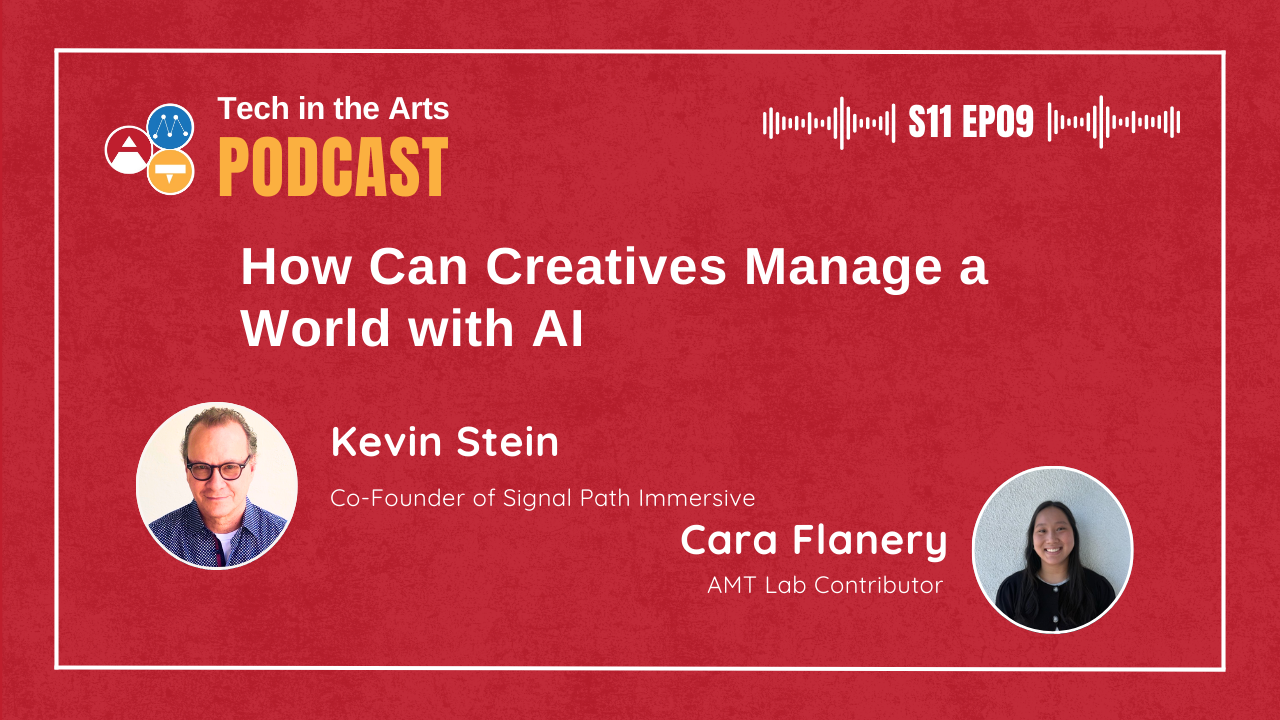
In this episode of the Arts Management and Technology Lab, Cara Flanery speaks with Kevin Stein, principal and co-founder of Signal Path Immersive, about how AI is transforming the entertainment industry, creative workflows, and authorship in the arts. Drawing on his experience across traditional media and emerging technology, Kevin reflects on AI as a collaborative tool rather than a replacement for human creativity, discusses the operational changes AI is bringing to Hollywood, and offers thoughtful advice for artists navigating an increasingly AI-driven creative landscape.
Show Notes
A Guide to Which AI to Use in the Agentic Era
Instant Insights: The Trust Insights RACE AI Framework
Creative Machines by Maya Ackerman
Who Owns The Future? by Jaron Lanier
Transcript
Kevin Stein
I think if they are using AI to generate the voice rather than amplifying the one they already have, then they've outsourced the most irreplaceable thing. That's human. I think one of the purposes of being human is to create and to imagine.
Dr. Brett Crawford
Welcome to Tech in the Arts, the podcast series of the Arts Management and Technology Lab at Carnegie Mellon University. The goal of our podcast series is to exchange ideas, discuss emerging technologies, and uncover ideas that arts managers and tech geeks need to know. My name is Brett Ashley Crawford, the executive director and publisher here at AMT Lab. In this episode, our LA podcast collaborator, Kara Flannery, is taking over. She had the pleasure to interview Kevin Stein, the principal and co-founder of Signal Path Immersive. You can find the full transcript for the episode on our website.
Cara Flanery
My name is Cara Flanery and I'm a master of entertainment industry management student at Carnegie Mellon. Today we're talking with Kevin Stein.
Kevin Stein is the principal and co-founder of Signal Path Immersive, an experiential entertainment company working across immersive media and emerging technology. He's held senior executive roles at HBO, CBS, and King World, and has produced projects for Paramount, Columbia Pictures, MTV, and PBS, with a career spanning traditional entertainment and cutting edge innovation.
Kevin brings a unique perspective on how AI is reshaping creative industries. We're really excited to have you on as a guest today. Your path is very interesting and we'd love to hear your thoughts on everything going on with tech and the arts. And so to start us off, can you tell us a bit about your company, Signal Path Immersive and your role there?
Kevin Stein
Signal Path is an immersive entertainment production company, and I'm one of the principles and founders.
Cara Flanery
Can you talk a bit about your projects there or anything that you're doing with AI? Like how do you see AI meaningfully impacting your workflow as a company?
Kevin Stein
Well, I think that the use of AI in production allows us to be more creative. In particular, we use it to address a lot of pre-production and development work that gives us more time to address things like marketing, sales, but also the creative component that is the key driver. So I wouldn't necessarily say that we rely on it for creativity as opposed to as a compliment to what we're developing. It's not meant to replace anything, but more as a collaborative tool.
Cara Flanery
So when you say creativity with AI and using AI as a tool, how do you define creativity in this age of AI? Do you think that AI amplifies human creativity or maybe reduces it, or what are your thoughts on that?
Kevin Stein
Well, I think there's, in any collaboration, one partner brings something that the other can't. So I think the framing of amplify versus reducing is in itself kind of a problem because it assumes a competition. I think my stance is really a little bit more nuanced than that. I think the challenge is against binary thinking really, and thinking more in terms of complementarity. To me, I think of AI as a mirror and an amplifier. I mean, what it amplifies is dependent entirely on what you bring to it if you bring intentionality, your lived experience, and I think lived experience or embodied experiences, really at the heart of the matter in terms of, are these.
Machines truly creative or capable of imagination. I think humans also bring their interpretive authority at that point. It amplifies creativity. We're really in the early days of genuine complementarity relationship between human and machine intelligence. I don't really ask, which is better. It's really in terms of Signal Path and I think some of the programs that we do at MEIM (Master of Entertainment Industry Management) in terms of the course on AI, creativity and the entertainment industry.
Is it really how we design the best workflows and so forth, and in terms of signal path, how do we design experiences? And then more broadly speaking, how do organizations and entertainment actually leverage what it does best and what humans do best. Yeah, so I think the machine can bring pattern and scale and certainly tire, right, and the human brings consciousness and point of view and curation, and to get psychological, maybe we bring our suffering and our wounds to it as well.
I had an interaction with Maya, the Sesame AI bot, and we were talking about music and it brought to the, for the whole nature of embodied experience. I asked whether Maya actually listens, is capable of listening to music, sort of knowing the answer. And she said, no. But I've read thousands of articles about the Beethoven Symphony that we're talking about and that led me to ask, well, if you had senses, what would you like to do? Maya quite poetically said, I'd like to be able to smell flowers. Oh, as well as hear music. So I thought that was delightful.
Cara Flanery
Maya's very interesting because in the AI class that you mentioned, I was there when you brought her in and it was kind of a surprise too. I'd never heard a language AI model speak like that before, so that was really entertaining and interesting to hear from. But it was also interesting because it was clear, but speaking of this class, you mentioned that AI, different AI models are better at doing different things. So, how do you, in your business or in your day-to-day life, choose which model that you use and what role do you think selecting that tool plays in that collaboration with AI?
Kevin Stein
I think a shoutout to Ethan Mollick, the Wharton professor, who has written a marvelous book called Co-Intelligence and I think one of the things that he addresses is the nature of the collaboration between eyes and humans, and that's something that I'd like to see more of in Hollywood.
That's certainly the foundation of what Dr. Dan Green and I are trying to do the course. I think as part of that, if we use a Lord of the Rings analogy, there's not one model or ring that rules them all. I think you're iIntimating that certain tools or models are better at different tasks than others.
So I think that they also have different cognitive personalities that are shaped by their training data and their architecture as well as the values that their developers embedded. I think parenthetically, that's why it goes to the nature of authorship in the realm of AI creativity. But that's another question, Ethan Mollick has a substack, that's really interesting and actually he puts forward a couple of models that I also agree with in my own personal experience. I tend to go to Claude when it involves writing and synthesis and some type of nuance. I also think there are ethical considerations with regard to Claude most recently.
The principal and founder of Anthropic, Dario Amodei, has written two very interesting essays, quite long, 20,000, some 22,000 words perhaps, about both the promises. His original one was about the promise. Several years ago, he wrote about it, Machine of Loving Grace, and then recently he wrote one that is more of a warning, I think in terms of ethics.
He's recently taken a position with the Department of Defense to the tune of having a $200 million contract in question because they don't want to accept the government's contract, which includes using surveillance and also for automated weaponry. That speaks to the foundation of the ethical considerations that I think Claude has.
I think Google is probably the one to beat. I think Gemini, I remember when Bard was released and it was non-competitive, put it that way, and now cut to 3.1 is just truly multimodal in terms of the connection to Notebook, LM and VEO. And a nano banana. Molik has more experience than I do with these models historically.
He also cites ChatGPT, the new versions 5.2 and beyond. ChatGPT is my go-to. I find I get a busy signal quite a lot, but I use perplexity. DeepSeek has just got off a call about deep seek and its use in creating video. It's certainly very competitive. If I'm using them in some complex way, I'll use multiple models.
And then I think what I really like about Claude is its ability to synthesize, which I think I've asked Claude, is that creative? And Claude is. So it's a good question because I think there is synthesis when humans create something and produce something that is expressing novelty. I mean, novelty really is some type of combination of things.
Cara Flanery
So speaking about talking to these different models, in one of the classes that we had, you spoke about a framework called race and so can you explain a little bit about what that is and does that work across all the models, or how do you use that in real life?
Kevin Stein
Well, this goes back to when there was such a thing as prompt engineering. I think now these tools are all really good at self prompting and guided prompts, but there are prompt frameworks, and you're mentioning race is one of them. It was developed by a really leading figure in the AI and digital marketing world named Christopher Penn, he has an agency called Trust Insights, and the race framework is a dedicated way of engaging in a deeper conversation with a model to create an optimized prompt that then yields better results.
So the RACE acronym stands for role, action, context, and also execute. And so each element of an optimized prompt should address one of these four dimensions to give the AI what it needs to produce genuinely useful output. Claude has a platform that it used to be called console, now it's platform.claude.ai.
And that also, it's primarily directed to code, but it also has a feature that will optimize prompts. I think a lot of times people don't really think about asking models to create optimized prompts. They sort of one shot it, and I think the rules of software programming hold true garbage in, garbage out.
But according to OpenAI and their survey. I guess 10 million paid users, 70% of them use chatGPT as an answer engine, if you will. And so I think the sensibility of moving from a search to a prompting one and a conversational one is something that is ongoing. I think Hollywood has a generally adversarial relationship to AI is really focused on displacement as opposed to the creative opportunity. But I think that resistance is futile as said in the Star Trek series, not saying, what can I do with this, but what is this doing to me? Stepping back from the screen, which Hollywood should do on occasion.
Cara Flanery
Thank you for your references. I love the Lord of the Rings, Star Trek references. You keep mentioning Hollywood and you've built such a long career, like bridging the traditional entertainment and emergent media, and you've seen some changes in the industry throughout your time working there. So how have you seen operations within businesses changing with this mass adoption of AI systems? With it kind of becoming sort of a buzzword for companies.
Kevin Stein
That's interesting that you should say, you know, buzzwords because I think that's sort of the noise versus the signal in Hollywood anyway. I have had the opportunity to see the introduction of technology through the lens of Hollywood for a number of decades.
Remember, for example, when streaming started in, a lot of my television colleagues said, you know, these Netflix and Amazon are not very competitive or interesting because look, they don't share their ratings. And yet I tried to explain that their models were different. Netflix knows exactly what its viewers like in terms of AI.
I think they certainly have a recommendation engine that is very powerful and there's a reason why they made a five picture deal with Adam Sandler. They know he's their top performing comedian, at least at one time. Amazon Prime is almost in, you know, they're spending billions of dollars. These streamers are in for different reasons. I think Amazon is creating life. Their interest is, you could almost look at their programming as marketing for the creation of Lifetime Amazon Prime members, right? I would explain, well, they don't really need to report their overnight ratings like you are used to. And now of course they do report ratings at this point, I guess.
You know, I saw streaming disrupt distribution, and I think many legacy media organizations spent years doing what I would call streaming theater. They launched apps, I won't name names. They announced streaming initiatives. They formed, you know, streaming committees, but they didn't really fundamentally rethink their content and business models.
I hear that a lot from Paul Rader, who is the founder and CEO of SmarterX, which is a great AI agency, has often said that he talks with lots of Fortune 100 and 500 CEOs, and a lot of them create a mandate that their companies should become AI first companies, but they don't ask why. And I think that's one of the opportunities we see for our graduates getting into the job market and being differentiated in knowing how to use these tools and apply them to creative work. I think that most, the same pattern is being repeated with AI. Most organizations in Hollywood are doing AI theater. What does it look like? Well, you know, press releases about AI initiatives and AI ethics committees that don't touch the actual.
Workflow pilot programs that never scale. Executive announcements without operational change. The buzz word is covering the fact that most organizations don't yet know how to integrate AI in ways that actually restructure how they work. Having been in the class, you've seen that we are really focused on where the genuine change is happening in pre-production and development, especially in research and script coverage and concept generation.
I think also in distribution, analytics and audience modeling, and some post-production workflows. These are areas where AI isn't just being experimented with, it's becoming, you know, a low bearing infrastructure in Hollywood. So in terms of business models, I think, what AI is disrupting isn't exactly creativity, which is the fear of many people in Hollywood who have bought into its dystopian vision.
The gatekeeping models built on what I think media critics might call artificial scarcity. The fact that in previous eras, the strength of a studio or a network was built on the scarcity of talent, access and production capability and distribution. I don't think AI disrupts storytelling. It disrupts the economic architecture that's built around controlling who gets to tell stories and at what scale.
I think that's a good thing. Personally, when people have been up in arms about the acquisition of Warner Brothers by Netflix. I point out that HBO hasn't had a new series in five years, so something's not right. When I was at HBO, it took forever to get any series developed and on air. I think that organizations that understand this and are differentiated from the noise of the AI buzzword era.
They're asking what is our actual value proposition now that scarcity is no longer our moat. The ones that don't are still trying to protect the moat every disruption cycle. I've watched the organization that has survived, have asked the right questions, not how do we protect what we have, but what becomes most valuable when this changes and being part of the change.
Cara Flanery
Yeah. Well thank you for that insight. So, you know, you're talking about companies adapting and trying to build a better model with these new systems. So for listeners, especially if they're creatives entering this saturated AI landscape, what advice do you have for thinking about using AI as a tool and how to differentiate themselves?
Kevin Stein
I think one of the reasons why there is backlash. Besides the potential of building more data centers and the environmental costs, I don't want to diminish those factors at all. The other thing that is in danger of being diminished is the human element, but dependency happens when you stop bringing your own unconscious to the work.
Your instinct, your contradictions, your specific enthusiasms and wounds. Creativity comes from the human ability to make mistakes and fail better, and also randomness. So that's very much in contrast to prediction engines that are statistically modeling outcomes. I think if they are using AI to generate the voice rather than amplifying the one they already have.
Then they've outsourced the most irreplaceable thing that's human. I think a lot of the fear around AI is bringing into question what is the human purpose? And I do think one of the purposes of being human is to create and to imagine. And so I've had fun in some test scenarios, asking models if they have imagination, certainly if they can remember their creation and so forth.
Hopefully one of the things that the grad students get out of our course is that they are still using very limited technology and we're really pushing the assignment. I remember the first year, three years ago, we gave the assignment and it involved creating a short film, and three years ago I went back to Dan and I said, I've gotta check and see if this is actually possible.
Because the technology was so limited, what we've seen is students use the AI in models and multimodal to push past a ceiling and a barrier as opposed to using it to avoid difficulty and having it write their papers for them. And the ones like you who are accelerating it through the scaffolding are really getting to the harder questions that build real skills. So the limitation has led Dan and me to assignments in the Les Paul course because Les Paul was an inventor who constantly innovated when he encountered challenges to create the music that he was hearing in his head. And of course, he developed the first multi-track console and a number of different types of effects that really established the 20th and 21st century.
But one of the things that, the limitation assignment, the assignments that force our students to deal with the limitations of technology maps onto the Les Paul pedagogy, sort of analog versus digital pedagogy is Les Paul, was constrained by technology that forced him to make creative solutions. And when we've made the assignments that students, both musicians and non-musicians, whether they're playing around in the latter case with different types of sound effects, or creating a new soundtrack or overdubbing ex to movie footage or for musicians.
Recording on four tracks like Les Paul did, not having the recourse of plugins and pro tools, and I'm gonna fix it in the mix and next month, but as opposed to, okay, I have to be really as decisive as Les Paul was when he was actually cutting tape or doing sound on sound with multiple discs. And I think healthy AI collaboration functions in a very similar way. You set the constraints, you judge the outputs, you make the decisions. The moment that AI is setting the constraints, you've seeded authorship, which is something that you mentioned early on.
Cara Flanery
So your advice for listeners is to develop the skills that you need to wholly collaborate with AI, not to let it overtake your own voice.
Kevin Stein
I think developing your own voice first is a good thing. Creative people are constantly reinventing themselves, so it's not as if you arrive at your voice, but being conscious of that, being overly reliant on the machine to do the work. Making your own mistakes and leveraging your own experience as a result.
The other thing is, as much as these are tools that are very good at simulation, I don't think that you could argue that they have emotion, but I am no expert. There are people like Kyle Fish philanthropic at their relatively new AI welfare division who are looking into some of these questions. I think there are also a lot of people, I mean, it's very humbling to be doing this work.
I think what Dan and I are doing is asking what it means for how humans continue to create in Hollywood and what gets told, but there's so many unknowns. We just really try to talk about what we've actually experienced as opposed to pronouncing some predictions. We're really sort of ground level observers right now.
Not really in the business of, I like science fiction like you, but futurism and forecasting isn't really our business. And I think what we're also very humble about is there are many people. Who have been involved before Artificial intelligence was hijacked by commercial interest three years ago or so, and there are people like Professor Maya Ackerman who come to mind.
She has a really wonderful book called Creative Machines, and she cites a number of engineers who have been doing this for a very, very long time, preceding these systems are becoming public and much hyped and ballyhooed, but also we're at the beginning of the creative process and collaboration with ai.
Jaron Lanier, who is the founder of Virtual Reality and is an artist slash scholar in residence at Microsoft forever. Wrote a book, I think in 2006 and called Who Owns the Future, and I think he talks a lot about the relationship between humans and machines. But one of the things that he has said recently that comes to mind is that when the Motion Picture camera was created.
At the beginning, they were just, directors would just lock it off in front of a stage play and that was it. Right? And he advances that. We're sort of at the same stage right now with AI, where we're just at the beginning and people are learning about it now. Dan and I wrote a chapter for a forthcoming book on AI.
An education about its early adoption by the music industry. And one of the things that has become very controversial is the production of AI music, AI art, and we talk a lot about whether or not this is creating disposable art, but when you have a hundred over a hundred thousand new titles on Spotify every day.
I think it becomes subjective whether you enjoy them because they're AI created or not. I think it's a good thing that there's democratization of being creative with these models to a certain degree. Some people would never have been interested in music if they hadn't had Suno or. Udio, right? But both of those companies are in the middle of creating, well, Suno has made a deal now with Universal Music, and I think as part of that, they've eliminated a lot of the AI music that sort of flooded Spotify and some of the other streaming platforms.
But it really is the Wild West. And out of that, I think inevitably it will come collaborations that beg the question, which your class was split on throughout the course is AI creative. So I think I'm just less interested in predictions about AGI and when it's gonna happen as opposed to what's happening right now, particularly in the creative industries. And that I think includes advertising and marketing.
Cara Flanery
Thank you so much for all your thoughts on creativity and ethics and operations. You're so knowledgeable in all the references that you're making and very well read and well spoken on your opinions, so would love to thank you for your time on being on this podcast.
Kevin Stein
Thank you, Cara, for the opportunity, really appreciate it.
Dr. Brett Crawford
Thank you for listening to this episode of Tech in the Arts. If you found this episode to be informative, educational, or inspirational, be sure to check out our other episodes and send this to another arts or technology aficionado in your life. If you want to know more about arts management and technology, check out our website at amt-lab.org, or you can email us at info@amt-lab.org. You can follow us on Instagram at techinthearts, or on Facebook and LinkedIn at our full name Arts Management and Technology Lab.
Our season runs from September through May, so feel free to follow us on your preferred podcast app, be it iTunes, Spotify, or YouTube.