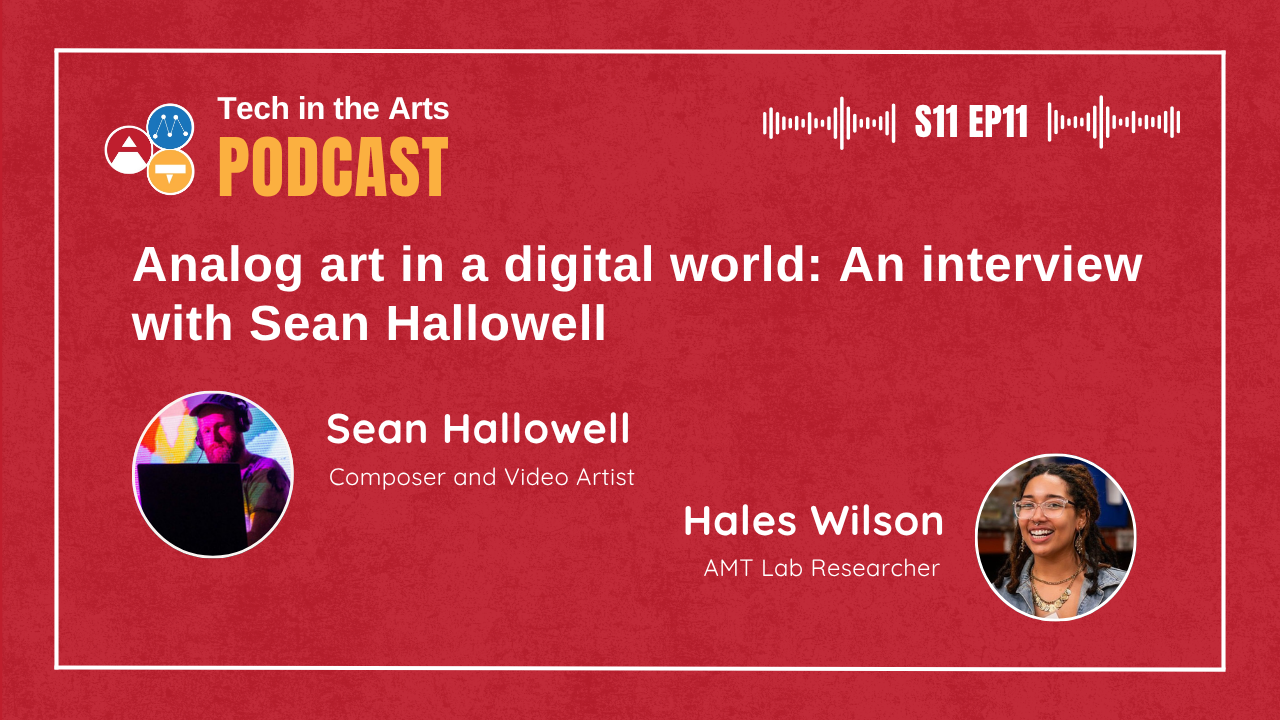
In this episode of the Arts Management and Technology Podcast: Tech in the Arts, Hales Wilson speaks with Sean Hallowell about building a hybrid analog–digital artistic practice, the creative potential of obsolete media technologies, and the evolving role of AI in music and visual art. Drawing on his background in music theory, handmade circuitry, and immersive audiovisual performance, Sean reflects on the value of constraints in artistic creation, the cultural significance of analog media, and the importance of preserving human expression in an increasingly automated creative landscape.
Show Notes
Transcript
Sean Hallowell
AI is good at copying something that already has clear boundaries and parameters, and there's this old way of thinking, which I think is correct about consciousness, which is that you cannot synthesize it. Computers are not programmed that way, and from that perspective, the idea that it would replace all music or something is just absurd to me because it can't have that kind of creativity. It's philosophically impossible.
Dr. Brett Crawford
Welcome to another episode of Tech in the Arts, the podcast series of the Arts Management and Technology Laboratory, also known as AMT Lab. The goal of our podcast series is to exchange ideas, discuss emerging technologies, and uncover ideas that arts managers and arts geeks like us need to know. My name is Brett Ashley Crawford. I'm the executive director and publisher for AMT Lab. In this episode, Hales Wilson, our lead researcher, talks about analog technologies in a digital world with Sean Hallowell. Take it away, Hales.
Hales Wilson
Thanks for being here, and yeah, we can go ahead and get started. As I said, I'm Hales. I'm joined today by Sean Hallowell, AKA Isorhythmics, a composer and video artist who synthesizes experimental techniques developed from handmade circuitry with a cosmic perspective on music as a conduit for physical and metaphysical energy. His music and installations have been showcased at venues and festivals across the US as well as internationally, in Mexico, Chile, South Korea, Japan, Belgium, just to name a few.
Additionally, his immersive audiovisual works have also been installed in galleries in San Francisco, New York City, and London. A few weeks ago, he visited Carnegie Mellon University as the guest artist of the studio for Creative Inquiry, where he discussed theoretical foundations for his audiovisual work.
In addition, you were also a part of projection portals live video machine at the Carnegie Museum of Art in the Hall of Architecture, a night of immersive live visuals by leading artists in the field of real-time video performance. And real quick, I wanted to ask another artist, a part of that, that we previously interviewed, Sarah Turner, was also a guest artist and featured at CMOA. I see that you also had, did some, had some experience at Alfred. Did you meet her by chance there before or did y'all meet at this performance in Pittsburgh?
Sean Hallowell
Yeah, we actually go back quite a bit. It's funny, it's a very small world, actually. So analog's video is, I mean, there's, it's in a way experiencing kind of a moment right now. I think it's the aesthetics of it and then also the technology; people are kind of getting more into it.
But I was a visiting artist at Alfred, under a National Endowment for the Arts grant for like two weeks. I had a residency there, and I was actually the last, I think that was Sarah's last year of grad school there. So we did meet, and there were maybe four or five grad students in that program that we're all doing, I can't remember what they call it, but it's effectively like real-time video, multimedia art. I can't remember the name of the program. But yeah, so we did know each other, and then we had just about, I guess, six months ago, we played a show together in Portland, Oregon, which is where we saw Nica, who runs the studio for Creative Inquiry. And that's the connection that brought us to Pittsburgh. So it's cool. Small world, close-knit community of folks.
Hales Wilson
I think I definitely get that, especially now being in this arts management world, even though the program is like people from all of the arts, from performance all the way to art history, you do realize a lot of the way that things may happen is connections, is people who you know, so.
Sean Hallowell
I wish somebody would've told me that long ago, but yeah, it's true. You gotta have those connections.
Hales Wilson
So, yeah. You said you did artists-in-residence at Alfred. Could, do you mind sharing a little bit more about your professional journey becoming a video artist and composer, and how those experiences have shaped where you are now and how far you've come?
Sean Hallowell
So it's a little bit of a roundabout way that I got into video. I'm not a trained visual artist. I never did any visual art, anything. I was a musician from a young age, and then went to school when I was an undergrad, I majored in music, and then from there you fell into the wrong crowd and got sucked into a humanities PhD. So then I was a music theory grad student for like eight years. I was studying medieval music theory, which is a whole side quest that I could get into at some point, but basically, I was thinking I was gonna become an academic. At the same time, I was making my own music as I always had, even though I was studying something that was pretty out there and obscure. My music has always been sort of more grounded in, I guess pop or electronica or whatever you want to call it, not necessarily classical or whatever.
And I just kind of had a moment where I realized that I wanted to make stuff instead of studying it. And so left that world kicked around for a while, just kind of being an artist and not making a whole lot of money. And then eventually kind of got back into academia through friends of friends who got me some jobs. And there I started to make this particular kind of electronic music, which sometimes they call it electroacoustic music. I'm making a pained face 'cause it's a little bit pretentious and also not really my thing, but basically, you use computer software to make kinda like soundtrack music, is what I call it. It's like, imagine like the sound of glass breaking and then you reverse it and it goes all across the stereo field. It's very kind of, it's not like a beat or a melody. It's more like sound design kind of, and that's like a whole academic scene. So I was in that for a while where it was good, I learned how to use these tools and things.
But then I realized I'm not really, you know, I like playing music for people and having them like move to it and enjoy it. So I'm like, that's what I wanted to do. So then I got out of academia again and started making more of that kind of music with samplers and drum machines and things that I built, 'cause at that time I was, you know, building my own, like soldering circuits and kind of learning how to do that for electronic music.
So video happened when I realized that you can basically take the design for an audio synthesizer, which is effectively just the thing called an oscillator, which vibrates at a particular frequency that you can control. And if you customize that signal a little bit, you can make it talk to these old school video monitors like the CRTs, right? Like the retro gaming looking things, which have technology that's different from, like a flat screen or an LCD or whatever. The signal, if you look at it from an electricity standpoint, is like totally different.
And so I got obsessed with this idea of making video art patterns, geometries, or something on a CRT, like an old monitor. With these custom circuits, and so that's how I got into video. I mean, I don't know if you can see it back there, but there's like this crazy advisor there that's like an analog video synthesizer that I built, and then I used that to make these patterns and things on the old televisions. And then that got me into performing with that as, as like a element alongside my music. And I kind of got into doing like live audiovisual stuff. And then that is what introduced me really to the video art community. And it's interesting because video art is, historically, it's a weird discipline 'cause it doesn't have that pedigree of like painting or sculpture or whatever, right? It's like came around in the fifties, sixties, seventies as like an outsider experimental thing, and still is pretty much that. And it comes out in different ways. Like if you go see a lot of electronic music, lots of times there's like a visualizer or a visualist or somebody who's like doing projections or something, but they don't often get credit as an artist.
They're sort of like just an addition, kind of almost, not really recognized as like a proper artist in a way. And I think that's still kind of shaking out. I don't really know what the ultimate destiny for video art is, but it's always kind of adjacent to other things. But the people who do it as its own thing or like are very passionate about it, but it's like a very small kind of group of people.
Hales Wilson
I wanted to ask because I do wanna get a little bit into more of your specific inspirations, and kind of taking these forms of old media technology and reinventing them in comparison to just working with new technology. Yeah, I wanted to ask, 'cause it seems like with your background, you have been deeply within working in institutional settings as well as being a practicing artist, you know, from Alfred, and also I saw that you did some work at the School of Art Institute of Chicago. So I wanted to ask, does working in an institutional setting change the creative process compared to like the universities versus being in the artist's marketplace or being exhibiting?
Sean Hallowell
I think my relationship to academia as an institution is a little complicated because I studied something that, so my PhD in Medieval music theory, which is like a punchline now, anytime I tell anybody, it's like, well, what do you do with that? Right? And it's like, well, really the only thing you do. If you want, if you're talking about how do you get paid for that, right? It is like you get a job as a professor of medieval music theory. There's really no other, I mean, sure I could use my knowledge of, I don't know, like just writing conventions, or I would like to spin off some part of it into a career, probably.
But if you're looking at it from a perspective of how do I make it as an artist with this training, it's kind of only. As far as stable employment, healthcare, whatever, like you gotta get a job at university. And I tried for quite a while and got close in lots of different ways. I had a pretty good postdoc that was like a three-year gig that I was in up until COVID happened.
And then I was actually on the job market when COVID hit, and that was kind of a disaster. And that was kind of what kicked me to the curb for the last time, where I was just like, and as I'm sure you know, especially in the arts and humanities, academia is just like, it's, it's brutal, right? Like getting a real job and kind of maintaining it.
And all of my friends are sort of humanities people who have varying degrees of horror stories about trying to make a living off of it. So for me, as much as I realized that would've been the stable path, I also realize that if you wanna make what you wanna make as an artist, you have to embrace a certain degree of uncertainty about where your next paycheck is gonna come from.
It's not that I necessarily would have scoffed at the right job if it had come along, but I think I understood that, you know, if you want to put your art first, then you have to do that and kind of trust/hope that you can piece together a living through various different things. So when I work for institutions now, like when I've did the Alfred, and it's kind of ironic 'cause like after I said more or less, you know, thanks, I'll call you. Don't call me to academia in 2020.
Then a couple years later I started getting all of these really kind of like invitations and gigs to do things. And same thing with CMU, where it's like, you know, maybe 10 years ago, I would've been actively applying to like conferences or things. And now it's just sort of like, well, through my network of folks, like I get sort of hit up for gigs or jobs or whatever.
And that's what happened at Alfred is that I built my crazy synthesizer, and then somebody found out about it and was like, we have something that needs to be fixed that works on similar technology, could you come, you know, have a look. And then that got me the SAIC gigs and basically just kind of like we were talking about, word-of-mouth or like your network kind of moves things along and, and with institutions, I think it's, you have to really know who you're working with and what the capacity of that place is, to kind of, and I think that's, you know, maybe something that's different when you're an independent artist than, rather than like an employee or a, you know, like faculty or something. If I'm giving advice, which is not really what I set out to do, but it's kind of like, know who you're dealing with and know what the broad possibilities are of that place, like don't try and do more than that place can handle or don't ask for more than you're gonna get, I hate to say it, but you have to be kind of political or kind of strategic about how you interact with institutions as opposed to when I'm working, that's me playing a show at a club or working with other artists.
You can kind of just trust your instincts a little bit more and go with what you want to do and worry about how it fits into somebody else's box later on. And I think that's an important thing too, is like you need both, I think. That is the scary part about being an artist, is like you do actually need to just let yourself make whatever you want to make, 'cause that's what's gonna speak to people. Like when I started doing video art, I didn't have any gigs lined up or any kind of jobs or any kind of guaranteed payout for it. It was something that I was obsessed with and wanted to figure out and do. And. Looking back now, it's easy to be like, well, yeah, it all worked out.
But at the time there was no guarantee that it was gonna come to anything. But I think every artist I know and admire has a similar version of that story, where it's like, what makes you, you as an artist, is your particular experience, your upbringing, your community, where you're coming from, and that's what you gotta tap into. Otherwise, you're just kind of trying to make something to please somebody else, and that's usually not successful in my experience.
Hales Wilson
Thank you so much. And I think our listeners will really benefit from here 'cause that's such a real perspective, and I think that's a thing that, whether you're going the academic route or trying to make it as a freelancer or finding yourself somewhere in the middle, there are gonna be potential challenges when it is a situation, there might be a sense of comradery if we all realize that we may have or may be at that point, you know.
But I do appreciate your sentiment about artists just really sticking with what makes them an artist and really cultivating that. And it makes me wonder, so what really drew you to reconstructing or reactivating these old school media technologies instead of using contemporary tools?
Sean Hallowell
Oh boy. I mean, I don't wanna like put anybody to sleep here, but this is a little technical. You just the like words version of it, you know, usually if I'm like teaching a class, I'll have like some visuals or something, but so basically like if you think about the two main display technologies that exist in our sort of little western world these days, so you have sort of digital displays like LCDs projectors, and then you have analog monitors, cathode ray tube monitors.
And if you don't know anything else about them, you can at least spot them in that the LCDs tend to be bigger and they're flat. And the CRTs are sort of square, and they have like a nice, you know, 3D depth to them, and that's because their technologies are different. And if you've ever seen them, they're very different.
My opinion is that LCDs and digital displays are a little bit lifeless. They feel a little dull to me, whereas if you look at a CRT. It seems almost like it's a glow, like it's alive, almost like it's a very vibrant technology, and that's 'cause of the way the display works is you're actually shooting electricity through this little thing called a cathode ray tube that is beaming with electrons. The screen is phosphorescent, which means glows when you hit it with electricity and there's masks. There's like a red, green and blue mask on the front. So there's three electron beams. At any point on the screen, you're illuminating some percentage of the red, green, and blue spot, so you can get different colors.
And the way that the scanning process works, it's like a raster. So if you've ever used one of those old printers that do like one line at a time, it's just like scanning left to right over and over and over again. The other thing I say is if you ever try to film a CRT, like an old television, with your phone, you'll often see the black bar that kind of cuts across it.
And so that's like an artifact of the scanning process, 'cause if you think about a scan, it's like you're only ever illuminating one spot on the screen at any given time. But the scanning happens so fast that our eyes can actually see it, so your eyes basically are too slow to see the beam, but your phone is fast enough to see the beam.
So it can like, it only gets a little part of it, and the part that's dark is the part that's not being illuminated at that moment, but our eyes kind of like synthesize it back into a full picture kind of after the fact. It's like a trick of perception, more or less.
What that means is the television has this pattern that's regular, it's like an oscillator that's going beam beam, beam beam, scanning, scanning, scanning. And it has a particular frequency, which is about 15.7 kilohertz. But if you stand close to A CRT, then you can hear that whining, and that whining sound is the frequency of the horizontal raster scan.
So it's different the way they make the image. And then if you make this thing. It's called a video synthesizer. What you're doing is you're taking that pattern and then you're sort of locking onto it and then generating signals that are in synchrony with it. So if you see like on a screen, some bars, like maybe just like lines on a CRT, what that is is a signal that's taking that scan line rate 15 Kilohertz, whatever, and maybe multiplying it. So if I took that and I multiplied it by three, that's 45 kilohertz. And if I had a signal that was just on off, what I would see on the screen are like three bars. And those three bars are that signal going three times as fast as one line scan. And it's difficult to kind of imagine, but if you sort of get there, you can realize that, any patterns that you see on the screen, they're all happening in relation to this like baseline frequency that doesn't change, which is the scan line pattern rate.
And if you don't match that, then you just get chaos. It looks like squiggle lines or like noise or something. And if you ever see an old television that looks like it's kind of noisy. What's happening is it doesn't have that signal that's giving it the timing. This is actually really difficult to do as an engineer. It's like I always tell people, if they want something to read, falling asleep at night. The Wikipedia page on composite video is really good 'cause it tells you the whole history of how they developed it.
It's easy to forget, but like television was only analog until like, well, it stopped being analog broadcast, I think in the mid two thousands or something. So pretty recent, there was still analog TV being sent over the radio waves, and yeah, it's the accomplishment of being able to make this work basically is insane and it's kind of like, my joke is that it's engineering accomplishments relative to the technologies people had was like the moon landing is maybe number one, not even real computers as far as we know them today. Like they, they're basically like electromechanical, hacked together things that somehow they made work and put somebody on the moon and then composite videos number two, and then everything else is kind of below that 'cause it's just a very sophisticated problem that they solved with very minimal means in a way.
I'm really interested in the history of that technology. And it's unique, right? It's not like anything else. It also gives you, as an artist, kind of the opportunity to make things that really work just with that technology. You could approximate all of this by building a digital video synthesizer that kind of does similar things, but it's kinda like the difference maybe between painting and screen printing or something, right? It's like when you're doing a painting, there's all sorts of things that you can't control, but that are part of the uniqueness of the painting, like the grain of the paint and like how much gets on the canvas and the brush stroke, like is it strong, is it light versus a screen print or like a digital print or something?
You have a file and you've made it all just so, and then you put it to the printer and sure it comes out on a piece of paper. So that's like the same medium in a way, but the process is totally different, and it's like all predetermined, right? So, with analog video, there's just all sorts of texture and grain and uniqueness to the signal. That's a product of the fact that it's like this thing that happens in real time and has all of these messy engineering elements to it that you just don't get out of a digital workflow.
Hales Wilson
Like I said, a lot of our listeners are gonna want to really get that nitty gritty aspect to the technology, but also wanting to know the artistic interpretation. And that kinda leads me to my next question. So, within this medium, how do you balance technical precision with artistic intuition when building or modifying equipment? Like, for instance, the color encoder that we talked about earlier?
Sean Hallowell
Yeah, I mean, I think it's probably similar. I can't really speak for all the different mediums, but probably similar for different artists in different mediums. But for me, there is a line between, or there's like engineer mode and there's artist mode. And when you're in engineer mode, especially if you're working on something for somebody else, like you're trying to fix something that's broken, you kind of have to have a different set of priorities, like it's about getting it functioning so that somebody else can use it and it's reliable.
So there's a certain element, I think, to building your own instruments or working on these kinds of older instruments, analog things that require you to kind of shut off the part of your brain that is thinking artistically when I'm in that mode.
I actually don't want to understand how it all works in a way. I kind of just want to react to what happens. It's a pretty fine line, and I've heard this from other people too, who work with digital tools. Maybe if somebody is familiar with Touch Designer, as this visual thing that you can generate similar types of things, kind of patterns. And a lot of times with digital tools, like if you have total control over everything that you're doing, that can be actually a little bit, it's a little bit stifling.
It's like you end up with, if anything's possible, then nothing is like special, I guess. Like you kind of sit down and you're like. Well, what should I do? I could do anything, you know? And I think when I'm working with these technologies as an artist, what I like about them is that they have constraints and they have things that you just are, that they're good at doing and other things that they're not great at doing.
And so you sort of are already guided into one kind of set of possibilities. And for me, that helps as an artist 'cause then I'm like, I can actually work with this. I know. What this thing is capable of and I know how to like make it the best version of itself. So I'm gonna work with that as opposed to like pushing it in some other direction.
And also the fact that it's analog and it has all these sort of messy dimensions to it. A lot of times the things that look the coolest, and I think most people who do like glitch art or video, that's like analog, would agree with us. The things that look cool are the like mistakes or the artifacts or the things that aren't actually that you would, if you were an engineer, you would want to be, you know, deemphasizing or like eliminating artistically. Those are the things that provide that moment of individuation or like make it look like nothing else. And that's the cool thing to chase to go back to the painting analogy, it's like if you give somebody one of those paint-by-numbers, things of some famous painting, maybe you could recreate that painting, but you wouldn't arrive at something new and original with that method, right? You gotta like go through the process of kind of struggling with the material and like listening to what it wants and how it works and that kind of thing.
So yeah, I think about it a lot when I'm working and it's hard to switch and you have to be very, at least I have to be very like, boxed out about it, where it's like, today I'm not making stuff, I'm fixing something, and then tomorrow, like make something. That's hardest to do is to not want to fix the thing that's not working when you're like, I'm in maker mode.
Hales Wilson
No, thank you so much for that. And it actually goes, I have one more kind of slightly philosophical question, like on that, do you see technological reconstruction as preservation reinterpretation or something entirely else?
Sean Hallowell
I mean, I love it. These are the kinds of things that I think about, but I don't often have the opportunity to, you know, like guess on, on about. So this is good. I think that that's really like a cultural question, and as much as I would like to have my opinion, I think that there's a preservation element to it.
When I work with older things, like I also do stuff with tape as a musician, like I work a lot with cassettes and things, whatever, just like using audio tape. Both of those worlds, they have pretty healthy niches. Like there's people out there who are still making cassettes or buying blockman, and there are people who are hoarding CRTs and there's people out there doing the work, whether or not it's a primarily archival thing versus an artistic thing.
I think that just depends on who's using it and the purpose. I mean, I think it needs to be both 'cause the artists don't have anything to work with if people don't preserve this stuff and knowledge about it. I think ultimately the reason I'm struggling with it is like it is philosophical. I think it's a value judgment in a lot of ways, like it's not just a descriptive answer. It's more of like, how should it be? Like, should it just be one or the other?
And I would say. It should be a creative thing. I think the idea of something being just archival, I don't wanna like step on anyone's toes out there, but I think that that's a little bit of a fantasy and maybe also like a self preserving one for people who work in those fields like that, you're gonna preserve this thing just as it is.
I completely understand that impulse and I've worked with institutions who their primary mission is like preservation. So maybe there's a group in Chicago, I can't remember the name of it, but they're basically like a VHS tape archive. And their point is that they're preserving all these things that are on analog video that are gonna disappear because people who don't digitize something, if it's just on tape, like that's once the tape degrades, that thing is gone.
So I totally get that. There's this impulse to save all this stuff. But I think it's a bigger point about technology that like, it's easy for me to say as an artist or whatever, to be like, all technology is creative technology. None of it is, there's no such thing as technology that's just an empty medium, it's always gonna influence what you're communicating or like how you're working. And that's an opportunity if you're looking at it from an artistic perspective, to turn that into something aesthetic instead of something, I don't know, like again, just preservational or archival. I think that's the question is like, will people continue?
I do think there are different impulses. I guess that's where I'm saying that it's an ethical value judgment thing, 'cause like there are just some people who only want to keep that preservation alive and aren't interested in exploring the technology for, its like creative. Possible uses. And then there's people who are, you know, like, yeah, let's break this open and like see what happens when we change this or that and kind of mess with it. I don't think they're mutually incompatible, but I do think that they're kind of different modes, and we'll see. I find that like surprisingly, my stuff resonates with people who are much younger than me who did not grow up with these technologies, and so that gives me hope that, like, there will continue to be this interest in them as a creative technology and not just as an archival preservational kind of thing.
That's a bigger trend, I think, with physical media that's happening now, but it is encouraging. Most people, I think, just see these things as relics and possibly trash. I often get hit up by friends or people in my community who know that I'm like an analog video person and are like. I have all these old TVs, do you want them?
Like otherwise I'm gonna throw 'em away. And it's kind of like, well yeah, don't send them to the landfill. You know, I guess I gotta take 'em. So there's just different layers to the cultural attitude about it, and I think I'm hopeful that it'll stay alive. I think it will, gotta get the youth into it.
Hales Wilson
I think it's actually funny, and I chuckled a little bit earlier because I do a lot of mixed media, like sculpture stuff. And so I'm always picking up, found stuff that I'm like, okay, I'm gonna collect this and one day I'm gonna make artwork out of it. And when I used to live in the southern part of Pittsburgh, I used to live in more like residential area. And one day I literally picked up down south, we call it the Fatback TVs, but it's, and I literally picked it up and I'm like, oh my gosh, I can turn this into some type of sculpture. Now I will say I've just had it with my other art supplies really journeyed into it yet. But I hope that gives you some hope that young people who are kind of interested, or at least me, where I grew up with that stuff, like very young.
I think I would say maybe middle school, 'cause I'm 23, so I think middle school, maybe high school is when my family first got their first flat screen TV. So before that it was just. the big TVs, the big computers,
Sean Hallowell
You know, it's pretty fun if you get like a really big magnet. The easiest thing to do with one of those old TVs is if you have a magnet and you put it on top of the TV, or you like put it across the front. Because of the way that the electrons and the phosphorus work, you can basically distort the colors and sometimes it'll distort the shape of the TV. So yeah, just next time you plug it in, get a magnet, and start doing that. It's like kind of instant installation, right?
Hales Wilson
I'll definitely have to work in a magnet now. On that, I wanna switch a little bit 'cause I only had a couple more questions. I won't keep this long. Yeah. I see that this past January you announced an album, delicate Citadel, and on your social media you stated that it's about big feelings, some that you knew and some that you didn't. Yes. Did you have any like specific inspirations in mind for this and then if there's any specific little like production techniques that you also wanna share, or experimental approaches as well.
Sean Hallowell
The thing about feelings, which is funny 'cause I, you know, you kind of throw stuff out there and you don't ever really expect anybody to read it. But I'm glad you asked because yeah, the thing that happened for me, and this is, I don't want to turn it into like a throwing shade on anybody else kind of deal.
But in the art tech world, maybe you've encountered this too. I feel like a lot of times people gets so obsessed with the technology side of things that the artistic expression side of things kind of gets pushed down the ladder. And for me, being a, I'm not, I'd never trained as an engineer, so I didn't like really know that culture of building sense at all. And it can be pretty, I mean, I'm trying to choose my words like it's pretty bro-y. It's like a lot of dudes. It's a lot of like gear talk and it just is not at all what resonates with me about making art. And I guess I'm kind of old. That way, or old school, whatever, like music for me is like a form of emotional expression and it's a form of communication, connecting with other people.
And so as I was making this album, I did get into the kind of weeds with it, like a lot of the, I mean the, the basis of all of the music. So in a way, half of the, of the live performance that I did at CMU and I've been like touring over the last couple years playing it. So there's music and there's the visuals and they happen at the same time.
And this is just the music side, which I had always intended to be a standalone thing, but the technology for it is this drum machine that I built that's kind of like one of the older style sort of synthesizing drum sounds from scratch. Like if you had an old keyboard. That had like the different drum presets on it, or maybe if you had like a fancier drum machine, like a 8-0-8 or like any of these older Roland models, it works the same way.
And so all the drum beats in the album are these drum machine things. It's actually this thing here, the two box thing that's sitting up there. And so it's like a patchable drum machine. And so I did get into the like technical weeds with it. Like I was really for a long time thinking about how do I get this, sound right? And how do I use this tool to achieve this particular synth sound? And that actually led me to a bit of a dead end where I was like, I don't know how to finish this because every single element that I work on becomes this like technical black hole where I'm just like, uh oh, I could tweak this forever.
And it wouldn't, you know, I just like keep sort of walking in circles. And then I had this moment where I actually was playing a show with a friend of mine who is a singer. Her name is an Karyyn Armenian vocalist, and really great performer, and she's very much about promotions and feeling kind of on stage. And I just realized, I'm like, yeah, that's what I'm also doing, but it's just easier for me to get lost in the details.
And so that helped me snap out of that technical mindset and be like, no, this sounds good because it sounds like the emotion that I'm trying to convey, that's what I'm trying to do. So it doesn't matter if the drum sound isn't perfect or like this thing isn't perfect like it can be done. And that was like a big breakthrough for me.
So something that I always knew when I used to be in like regular bands, regular bands like play guitar kind of deal. And like that's a much more conventional way of, you're like on stage singing to somebody, like there's an emotional exchange there, but electronic music is harder 'cause you're like behind the gear and you know you're using your computer. And I find those as very like distancing in a lot of ways from social connection. It's like you're, you're in your own little world. That's kinda what the feelings come from.
Hales Wilson
Two more questions and this next one, you know, 'cause even though AMT Lab we're our own brand, you know, we're still under Carnegie Mellon. What are your thoughts on AI and do you engage with it?
Sean Hallowell
I was just asked this question. Actually, I did a separate interview yesterday, wrote a friends radio show and he hit me with it too as the last question. So I'm ready for it. So I have a couple different takes. But really the foundation is that it's a tool that can be used for good and bad.
Just like all tools, no tool is ethically, inherently one thing or the other, right? It's like how people use it. So this is maybe kind of a basic observation, but as far as the AI stuff goes with music, I think it depends where you are in the world of music, right? So a thing that came out of that conversation with my buddy Kris, is that what one person says, or calls music may be very different to another person. And that's like the starting point for this, I think, which is that I, for better, well I'm gonna say for better 'cause I think it's important. But you know, my relationship to music is really intense in that I like to listen to things for long periods of time while like not doing anything else, right? I'll just focus on listening to something.
I think a lot of people don't experience music like that anymore. It's like on in the background or? It's study music, and I think a lot of what I understand to be the AIification of music is kind of taking that, I don't wanna say easy listening genres, but like the study playlists and the lo-fi beats channel on YouTube, and like that kind of thing.
And it's like, yeah, AI can do that because AI is good at copying something that already has clear boundaries and parameters and qualities. I'm pretty hardcore about consciousness, and I've always used to teach the philosophy of consciousness to like undergrads back in my academic days, and there's this old way of thinking, which I think is correct about consciousness, which is that you cannot synthesize it. It's like there's a difference between analyzing something, you're taking it apart, and then when you try and put it back together, you can't sort of just snap your fingers and recreate something that is a unified phenomenon already, so we all experience consciousness 'cause we're born into it. It exists before us, and it will exist after us.
Computers are not programmed that way and so I'm not like, personally, I'm not worried about the apocalypse. I'm more on the, this is a really good text generator, like guessing game machine, basically. And from that perspective, the idea that it would replace all music or something is just absurd to me because it can't have that kind of creativity. It's philosophically impossible. So there will always be artists who are doing things new. That true, they were true to their experience, their lived experience, their lives, their feelings. When you see this sort of clickbait hot take of like, oh, so and so said that like AI will replace all music in 10 years.
I mean, that's just ludicrous. But if you're working as a sound designer and your job is like making bumper music for NPR or something like, yeah, you're probably screwed because AI can do that. And more importantly, the people who are deciding where to spend their money are gonna choose the, you know, rock bottom AI option over paying a real human to do it. And that sucks, like no way around it. I don't know if there's an effective way of counteracting that other than, you know, total system overthrow, but that's a bigger problem. That's not like a just a music problem. So yeah, that's kind of where I stand on it. And then there's people who make music with AI tools and I personally don't do that, but, and that's not as judgy as it sounds. It's more just that that's not part of my, like, worldview. I still have yet to interact willingly with a single AI agent. I've never chatted with a chatbot, never prompted an image generator, and it doesn't move me, so I just don't do it.
But I do know there's lots of electronic musicians that I like quite a bit who have used it to generate a vocal part for something that they couldn't find a singer for, or maybe as a production tool to achieve some effect. And it's not like they're just doing the whole song with AI. They're using it as a tool within that workflow.
And I don't see the issue with that. In fact, I think that's interesting. I just personally can't. Wrap my mind around it 'cause I've got too many other things that draw me in. What do you think?
Hales Wilson
I will say I am also one of those people, especially now being at CMU and I realize how like, especially like this semester, there are certain, like classes there are like, yeah, we're going to expect you to be using a little bit of AI, you know? And like I said, it comes up at least once a day, I think, in my opinion, if not, once a week as far, and I've learned that it is something that I, I agree. I always say it's not gonna replace good art. It's not gonna replace like good artists. I, I was never on that side of the spectrum, but I understand, or I can empathize with some of the people who do have those reservations.
And I think a lot of it is rooted in just people, a lot of people just don't know about it. And it is one of those things where I feel like we're not having an open conversation about it, you know, but we're constantly into everything and powerful people are having conversations about it. And so I'm in the spot where it's, I met Carnegie Mellon, where I feel like I'm using it a lot now because I'm in this space and they put, we have so much to do and I feel almost kind of backed in the corner, but at the same time I see like, okay, I hate that I, I don't feel confident enough in myself to write an email anymore. I have to always run it through something. So I do hope once I am, I've graduated, I can get a little bit back to the basics. I have just one last question.
So, as I said, we're the Arts Management & Technology Lab, so we have listeners from all across those intersections as well as adjacent careers. So do you have any advice for our listeners who would want to pursue a career in immersive media or live visuals, but also how arts managers could better support those artists?
Sean Hallowell
Yeah, you know, it's something that I don't have a ton of experience with in terms of my personal interactions and gigs and things as far as like I do work with institutions like we were talking about before. I think it's a tough question 'cause at least in my experience, every person I've met who has figured it out in some way, and by that I just mean is able to make art and make a living in some way. Their arrangement is very specific to them. It'd be really hard for me to generalize what works for people doing this kind of thing across many instances because each person I know is patching their life together in a very specific way where it's like they are part-time at a university, but they also do code for some company on the side. Maybe they like drive Uber or something, you know what I mean? There's just a lot of piecing it together, I think.
So one thing that I would say as far as like areas to focus on. I'm not sure this is exactly what you're asking, but for artists, just knowing and appreciating your community of people who support you is a really big, important thing.
I could never do what I do without my family, who have supported me in an inconceivable number of ways. Not just financially, but emotionally, and just all the ways, right? So to do something, where you're effectively working for yourself, but trying also to hustle as many different things as you can. You need that stability.
No different from anyone else who needs that stability in order to be successful, but I think when you're working independently as an artist, it's pretty pronounced. And then the other side of it is like the professionalization. At least for me, I didn't get these skills that way, but I did, I think, over time develop the skills of just like the old thing about like 90% of life is just showing up, right?
Be there on time, do what you said you're gonna do, respond to the emails, just the kinds of banal tasks that come with. That's one thing if you're part of an institution and there's infrastructure that's helping you do that. But if you're an artist coming from the outside of some institution and you're working with them, or you're working with a venue, or you're working with somebody, like always kind of showing up and being there and doing the thing you say you're gonna do.
That goes a really long way. I feel like often gets you gigs just because people know that you're gonna do what you say you're gonna do. And there's so many people who are maybe wanting to be in that world, but don't have those skills or don't have that follow through.
I don't know if that's like a specific recommendation, but it's just something that I've noticed being in the world of, you know, loosely affiliated with different places, but really kind of working for myself like the follow through and the professionalism side of it is, it's the kind of thing that you don't notice if it's working right, and then if it's not, it's very disruptive sending an invoice somewhere and like you don't get paid for six months because the person who you know, supposed to fall forward it along to accounting, never did or something like that.
It's like those little things that take on a much bigger proportion, I think, when you're out there on your own than if you're sort of part of this, you know, whatever company, or if you have a sort of more stable job that way. Is that what you meant?
Hales Wilson
I think you gave me some great information that I would consider, I guess from the arts management standpoint like for instance, I could potentially work as like a gallery director or the people who were leading the event at CMOA. Are there considerations when bringing in an artist, working with your type of media? Do appreciate your sentiment about the community? Even though more so from the artist standpoint, but I know at least me personally, what I've been gathering as artist management, like one of the most important things is the community and respect within that and whatever programming you're doing, making sure that it's compatible, I guess.
Sean Hallowell
Like, from that perspective, the way that you connect a visiting artist or somebody from outside the community with the community that you're working with? I can just speak to, I guess, good experiences I've had with that. Actually, this thing at CMU at the museum was amazing, and I can't remember who the contact at the museum's name was, but they did a great job of, you know, not just the technical side of like getting everything set up and made sure that when we got there, we just had to sort of plug in and do our thing. But setting our expectations, telling us like, you know, this is what it's gonna be like, just how many people are gonna be here. This is what the layout's gonna be coming in from outside, it's always really helpful to have as much information as you can about the space. I think it's easier to say after the fact because. If you are there already working with that space institution, then you're going to assume a lot of knowledge that might not be there for the artist who's coming in. So just giving as much background context, this is what to expect as possible. That's really key.
And then as far as curating something, or when you're bringing somebody in and talking about their work, I've had mixed bag experiences on that. I think. It does really maybe just boil down to how well that person knows their community and how well the relationships that already exist within it.
I've had situations where I've been dropped into a venue or whatever, like a context that I didn't understand and I had to figure it out as I went through whatever I was doing, and that's always way harder. So maybe just looking at it from the perspective of the artist and thinking if I was coming into this without knowing anything about where I am and who these people are, being able to get that conversation started. And it is also, I think when it doesn't feel as much like you're just showing up and doing a thing, but you're coming in to connect with specific group of people, like that's always a more rewarding experience for me. So that's, yeah. I don't know. As far as the arts management side of it goes, but maybe that's what they tell you to do anyway.
Hales Wilson
No, yes. They said visitor experience and our relationship's very important.
Sean Hallowell
I mean, that's the truth of it all. At the end of the day, it's all relationships with people and how you treat those people, how you connect. So I think that's a big important lesson though 'cause you can forget that. It's easy to forget that the longer you spend in these big places with lots of people and departments. That's kinda what happened to me in academia. I feel like I lost touch with why I was doing what I was doing and the people that I was connecting with, you know about it, it became sort of, I don't know, like a faceless institution kind of feeling as opposed to a, I'm really connecting with people through what I'm doing, and that's the goal.
Dr. Brett Crawford
Thank you for listening to this episode of Tech in the Arts. If you found this episode to be informative, educational, or inspirational, be sure to check out our other episodes and send this to another arts or technology aficionado in your life. If you want to know more about arts management and technology, check out our website at amt-lab.org, or you can email us at info@amt-lab.org. You can follow us on Instagram at techinthearts, or on Facebook and LinkedIn at our full name Arts Management and Technology Lab.
Our season runs from September through May, so feel free to follow us on your preferred podcast app, be it iTunes, Spotify, or YouTube.