Congratulations!

Congratulations to the four winners of the Institue for the Management of Creative Enterprises iPod Nano giveaway. We collected business cards during the National Performing Arts Convention in Denver, CO, last week, and our winners were picked on Friday. The lucky quartet:

  • Jodi Schoenbrun Carter, Managing Director, Westport Country Playhouse
  • Julie Hawkins, Vice President of Public Policy, Greater Philadelphia Cultural Alliance
  • Conrad Kehn, Composer/Vocalist
  • Trevor Hunter, Technical Producer, Counterstream Radio

To all of those who entered but did not win, please remember this quote from William Shakespeare: "Having nothing, nothing can he lose."

Rocky Mountain High, Chorus America

We were fortunate enough to catch an impromptu performance of Rocky Mountain High by members of Chorus America, the national non-profit service organization for choral music. Rocky Mountain High.

We are also featuring the group's performance in our most recent podcast, Technology in the Arts #44, which is dedicated to interviews from this week's 2008 National Performing Arts Convention.

Trade Show Booth Setup Blues

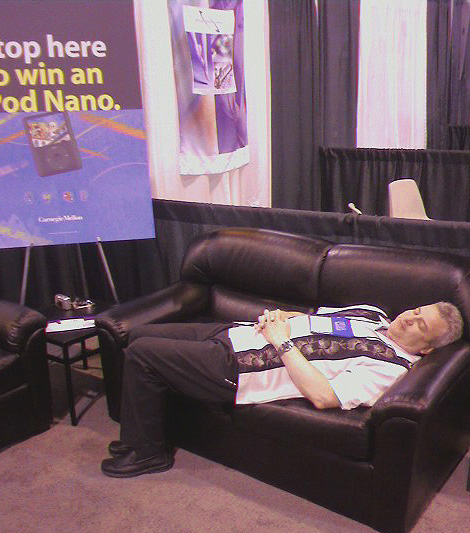
Though tomorrow is the first official day of the National Performing Arts Convention in Denver, CO, I had to arrive last night so I'd be ready this morning to set up our booth in the exhibit hall. Ain't she purty? Yes, that's a leather sofa.

Fortunately, everything arrived as scheduled, so there was no need for my late night cold sweats from anxiety about a crucial booth component getting lost in transit. But when I say "everything," I mean four large 100-pound crates, two large 50-pound boxes, a cylindrical container and a large flat box.

Why so much packaging? Well, this booth is a monster. For this particular show, we're exhibiting as the Institute for the Management of Creative Enterprises, which is the parent entity of our research center (CAMT.Artsnet.org), and two master's programs (MAM.Artsnet.org and MEIM.Artsnet.org).

During a particularly hairy moment this afternoon, one of the booth's walls toppled, nearly killing the guy at the neighboring exhibit space. If I had knocked him unconscious, my plan would have been to drag his body into a restroom, pack everything back up, and fly home to Pittsburgh. Surely he would have been hit hard enough to forget who or what had struck him, right?

Anyway, the booth is all set up, and I'm looking forward to the convention. I'm especially excited to tour the exhibit hall, as on display will be hundreds of amazing performing arts groups, technology providers, arts management companies, etc.

As you can see from the image at the top of this entry, our booth features a seating area with a leather couch and chair. I'll feel a little like Dick Cavett when I sit and chat with passersby.

Do You Know the Way to San Jose?

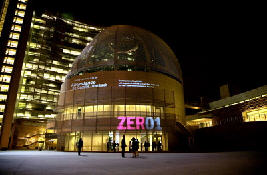
This week saw the arrival of the second biennial 01SJ - North America’s newest and largest festival of digital arts, and a great deal more. From a hip hop, multi-media meditation on Antarctica to robot art, from conversations with artificial intelligence to operatic performances of Google headlines about the environment, from avant-garde cinema to new musical forms - well over 100 artworks, performances, screenings, talks, and workshops will be featured at 01SJ. Festival organizers expect it to be a perspective-altering experience that entertains, enlightens, educates and involves attendees in a new understanding of our changing world.

The 2nd Biennial 01SJ Global Festival of Art on the Edge consists of over 100 events, exhibitions, concerts, performances, lectures and workshops at many venues across the urban landscape of downtown San Jose.

According to Artistic Director Steven Dietz, “This has the potential to be the South by Southwest of digital media in the United States.”

01SJ aspires to become the North American answer to the Ars Electronica Festival – the annual celebration of digital art in Linz, Austria first staged in 1979. “Linz is now a cultural center for the country,” said 01SJ founder and board chairwoman Andy Cunningham, “We hope to do that with San Jose.

Better Than Handing Out Flyers?

ArtistData LogoBuilt for bands, musicians and music performing organizations, ArtistData is a site that enables you to enter upcoming performance information once and then sync it to many different social networking sites that are musician friendly or oriented. I have to say that I was impressed with the simplicity of the system, based on their demo video.  With a few minutes and clicks, performance listings were updated on the sample band's MySpace, PureVolume, Eventful, and Virb profiles.  Also, the show details were sent out to other sites such as JamBase, Last.fm, Mojam, Pollstar, and ShowClix.

A real treat is the site's ability to notify local newspapers and media about your performance directly from ArtistData.  I would assume that ArtistData keeps art & music PR contact emails for major newspapers and publishers.  I wasn't able to see how comprehensive their listings are, but, if you know of a publication that exists in the area you will be performing that is not on the list, you can notify ArtistData and they'll do what it takes to get it added for next time.  I wonder, though, if this replaces the need to send out press releases or to cozy up to your local papers' inside sources.

All in all, ArtistData seems like a very expedient way to get your performance information out there.  It would be especially useful if you, your band, or your organization already use more than 1 of the social networking tools listed above.  And, it seems like ArtistData intends to expand its offerings and resources as time goes on.  Sites such as Amie Street, BETA Records, Buzznet, FameCast, and Hooka/indie911 are on tap to be added to those sent performance info.

Oh, it's free, by the way (at least for now).

I am really interested to see if, in the near future, a similar technology is developed for visual, graphic, and illustrative artists to help them manage their profiles, exhibition information, and work sample images across the plethora of social networking sites that cater to them.

Props to Mashable! for tipping me off to ArtistData.

Free Web Sites for Artists...

I know the subject of this post sounds like a bit of spam that might roll through your inbox, but thanks to Artlog.com, artists can create Web sites that are easy to use and offer some nice features. Most importantly, the sites are free to registered Artlog.com users (for the time being). Artlog.com is designed to connect people to art and artists to other artists. Their portfolio section is particularly intriguing because it not only allows artists to create their own Web sites with gallery, blog and resume modules; it also allows artists to use their own Web domains. For instance, if I create a site on Artlog.com, it can either be bradartsite.artlog.com (in which case, I don't have to own a domain) or bradartsite.com (in which case, I do have to own a domain).

Want more info about domain names? Check out this recent blog entry.

I recently interviewed the site's creators, Manish Vora and Dylan Fareed, for the Technology in the Arts podcast. Their interview will be released in episode #45 on June 27.

Get LinkedIn to Technology in the Arts

For those of you who use LinkedIn to build your own professional network, we invite you to join our new Technology in the Arts group on the site to connect with others observing and exploring the intersection of the arts and technology. LinkedIn Groups offers extra features to networks and group-based organizations to help their members stay in touch with one another and discover powerful new business contacts within their groups and beyond.

How might LinkedIn Groups serve as a connecting tool for other professional networks and member groups with which you interact?

It always feels like somebody's watching me...

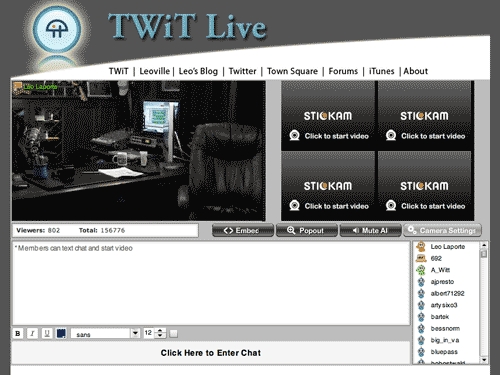
I recently interviewed podcast superstar Leo Laporte for the Technology in the Arts show, which was a great experience for a geek like me. Leo recently started broadcasting streaming video on a daily basis (about 2-7 PM Eastern, he says) at TwitLive.tv. Basically, he streams a video of his podcast studio constantly so you can catch all of his recordings live as they're being created. It's fascinating because you get to hear all the outtakes and pre- and post-recording conversations. Also, Leo's live stream features a chat window and in between shows, he responds directly to chat room messages.

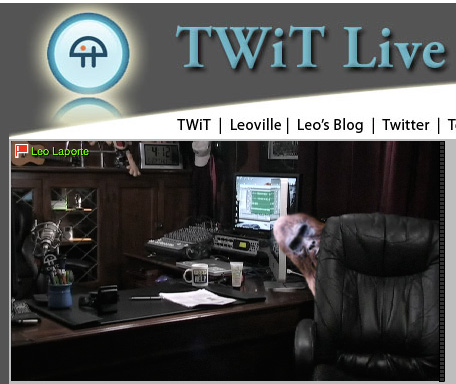
There's something artistic about an empty studio, isn't there?

The amazing thing is that you can set up something similar to Leo's studio rather inexpensively, because there are a number of free streaming video services available. Leo uses Stickam.com, and UStream.tv is another very popular service. Obviously, Leo's equipment is very expensive, but anyone can set up their own broadcast empire on the cheap and with relative ease.

CAMT is tossing around the idea of creating a Technology in the Arts membership program, and we're in the process of laying out the services that would be available to members. One thing we've discussed is creating a weekly tech Q&A show for artists and arts managers using a streaming video service.

If you have thoughts on the structure of such a show or on other services we could offer Technology in the Arts members, please feel free to comment on this entry or email us.

By the way, my favorite UStream video feed is "The Ketucky Incident," which is basically set up to track the movements of bigfoot in Kentucky. I've yet to actually see Bigfoot walk past the Web cam... surprise, surprise.

But I have seen some unexplained things on Leo's cam late at night:

Okay, folks, it's time for YOU to drop some serious knowledge!

October 9-11 -- Pittsburgh, PA Proposals for sessions and workshops are now being accepted for Technology in the Arts 2008 conference to be held at the Hilton Pittsburgh in downtown Pittsburgh, Pennsylvania from October 9 - 11. The conference has two primary types of programming - Hands-On Workshops and Conference Sessions.

  • Hands-On Workshops: Thursday, October 9th: Held in a computer lab environment, these workshops will provide "nuts & bolts" instruction to guide participants through technical processes toward concrete solutions to challenges. Each hands-on workshop will last 2 hours and 30 minutes.
  • Conference Sessions: Friday, October 10th & Saturday, October 11th: Held in breakout rooms near Conference Registration and the Tech Expo, conference sessions may use a number of possible formats to cover relevant issues relating to the use (or potential use) of technology in arts management or production. Conference sessions will last 1 hour and 15 minutes.

Not an expert? You don't have to be one to organize a session. Here are some tips for pulling together a top notch session.

Proposal Criteria: A panel of arts and technology practitioners will review all submitted proposals to select the final program in early July. Sessions will be selected based on the following criteria:

  • Exploration of new or compelling ideas, technologies or practices
  • Speakers' expertise and/or experience with the topic
  • Session's relevance to the conference

In addition to the above criteria, the panel will be charged to select workshops and sessions with an eye toward providing a well-rounded gamut of topics and ideas for conference attendees.

Benefits for Session Leaders and Participants: Individuals who propose sessions selected for the conference program will each receive a complimentary registration for the conference and hands-on training day. Other session participants or speakers will be offered a severely reduced registration rate of $50 for the conference and hands-on training day. All session participants will be responsible for their own travel and hotel expenses.

Proposal Components: To be considered, proposals must include the following information:

  1. Session title
  2. Session type - Hands-On Workshop or Conference Session
  3. Session format - For Conference Session proposals only
  4. Description of the proposed session
  5. Explanation of relevance to the conference
  6. Contact information and bio paragraph for session leader
  7. Other potential presenters and what they would add to the session

Submit your session proposal online by June 30, 2008.

All applicants will be notified of their proposals' status by July 11. For questions or additional information, contact David Dombrosky.

Your Second Life Avatar is Killing My Planet...

It was recently determined that a Second Life avatar uses as much energy as a real-life Brazilian. So try as you might to escape your polluted first life, you're doing even more damage as a Second Life user. The following campaign has been created in order to promote a campaign on the energy-conscious site Big Green Switch that urges Second Lifers to offset their avatar's carbon footprint.

Second Life users: Give a hoot and check out Big Green Switch.

SlideShare - the largest community for sharing presentations

So after the Technology in the Arts: Canada, we were posting presentations and resources from the conference when we ran into a slight snag. A number of the PowerPoint slide presentations were too large to e-mail. At first, I recommended that the presenters use a large file transfer site, but then a colleague showed me the virtues of SlideShare. SlideShare allows you to:

  • Embed slideshows into your own blog or website.
  • Share slideshows publicly or privately.
  • Synch audio to your slides.
  • Market your your event on slideshare.
  • Join groups to connect with SlideShare members who share your interests
  • Download the original PowerPoint / Pdf file

For example, here's the embedded version of Linda Roger's presentation "Virtual Concerts in the Park" from last week's Technology in the Arts: Canada conference:

Did I mention that SlideShare is free? With all of the arts conferences and presentations I have attended over the years, it's amazing that I had not heard of this resource. I can't wait until I get to play PowerPoint Karaoke!!

2008 MUSE Awards Announced

Now in its 19th year, the MUSE awards competition recognizes outstanding achievement in museum media. The competition is an activity of the Media and Technology Standing Professional Committee of the American Association of Museums.

The MUSE Awards competition received nearly 180 applications from a wide variety of museums in North America, Europe, Australia and Asia. Entries included audio, cell phone, and interactive handheld tours, interactive kiosks and multimedia installations, podcasts, blogs, games, websites, online collection and image databases, videos, and e-mail marketing campaigns.

Thirty eight judges – museum and media professionals from across the county – were involved in the process of selecting the winners. Winning entries were expected to demonstrate outstanding achievement in content quality; interface design; functionality; production quality; visual appeal; the user’s experience; and the intent to which new directions were charted or old challenges resolved through technical innovation. A complete list of judging criteria and MUSE Award winners can be found on the Media and Technology website.

AVG Free 8 Released

AVG Anti-Virus Free 8.0 was recently released, and I've been wanting to share this info for a couple weeks, but I am just now getting around to it.

AVG Free is as good as (or better than) most of the top paid anti-virus solutions, so I strongly recommend this product for Windows users.

To get AVG Free 8.0 or for more information, visit the AVG Free site.

Check out PCMag's recent review of AVG Free 8.0.

Web Usability Notes from TitA: Canada

Josh Futrell and I are sitting in a Web usability workshop at Technology in the Arts: Canada at the moment, and I thought I'd share some notes from the session. The workshop is being led by Robert Barlow-Busch, director of product design at Primal Fusion, a semantic web startup in Waterloo, Ontario, Canada. Robert's overriding thought about usability testing is quite simple but very important: "Observe people using your Web site."

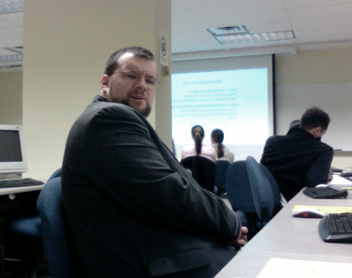
Josh Futrell at TitA: Canada Josh looks please to be learning about usability.

Why conduct usability testing?

  • More useful
  • Easier to use
  • More desirable (more positive emotional responses)

Aside from basic usability testing, Robert also just talked about projective exercises, which determine what type of emotions people attach to your organization. In the session's particular projective exercise, we were asked to imagine that a group of car manufacturer logos were members of a family. Who in the family would each of the logos represent? Robert's point was that this type of activity is more engaging than simply asking, "What do you think about Ford, Chrysler or Volvo?"

By the way, the entire group agreed that Ford was the drunk uncle. Sorry, Ford.

How does this translate to the arts field? An example that Robert presented was for an arts organization to use this type of activity to test how people view the organization's logo in comparison to the logos of other available activities (cinema, zoo, arcade, video games, Netflix, etc.).

Other resources:

The full set of slides from Robert's workshop will be available soon at TechnologyInTheArts.ca.

Stage is set for Technology in the Arts - Canada

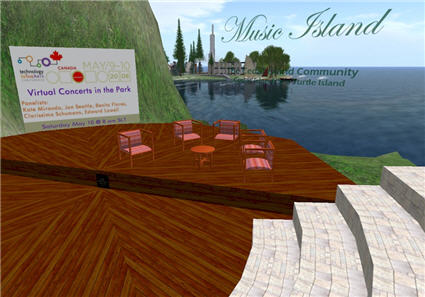
This week\'s Technology in the Arts - Canada will feature a virtual panel in Second Life on Saturday morning.

Everything is ready for tomorrow's conference.  Brad starts off the conference with his podcasting workshop in the morning; Josh teaches an afternoon session on content management systems; and I bounce around throughout the day to make sure session leaders have everything they need.

If you are not able to join us in person, perhaps you can attend a virtual panel session in Second Life.

The image above shows the set for Saturday's panel being held in Second Life on "Virtual Concerts in the Park" which you can attend in Second Life on Saturday at 8:00AM SLT (Second Life Time = Pacific Time) by going to this SLURL - http://slurl.com/secondlife/Sea%20Turtle%20Island/46/26/22/ - which will take you to the telehub behind the amphitheatre.  Hope to see you there!

Going North

Technology in the Arts bloggers David Dombrosky, Brad Stephenson, and I are packing up to go to our sister conference, Technology in the Arts:  Canada, hosted by the Centre for Cultural Management at the University of Waterloo in Ontario.  We're flying out tomorrow for the Friday-Saturday conference. I'll be giving a presentation on navigating the murky waters of CMS selection in a session called Content Management Systems: Would You? Could You? Should You?  The simile in my presentation that I'm most proud of myself for writing?  "Open Source Software (OSS) is free like a piano listed in the classifieds is free:  Free grand piano.  Needs tuned and refinished.  You haul."

Brad's delivering his hands-on session Attack of the Pod People: Engaging Your Audience with Audio Podcasts.  He's currently trying to figure out how to get 50 pairs of headphones into Canada without breaking them or causing him to be pulled aside at any security checkpoints.

If you're going to be at the conference, be sure to stop us and say hello.  If you're not, no worries.  We'll be posting thoughts and musings about what we learn from our friendly neighbors to the north during and after the conference.  Plus, there's the U.S. conference coming up on October 9-11, 2008, in Pittsburgh.