



Check out our expanded Technology in the Arts 2006 In Review page, where you can view conference photos on Flickr, read our press coverage in the Pittsburgh Post-Gazette, and download summary reports for conference session evaluations. While you're reflecting on TitA 2006, please consider taking a brief survey to help us better understand what you would like to learn, share and experience this year at TitA 2007 (October 19 - 20). The survey will remain open until Friday, March 2 at 11:59 PM, Pacific.
Pittsburgh Bloggers unite!
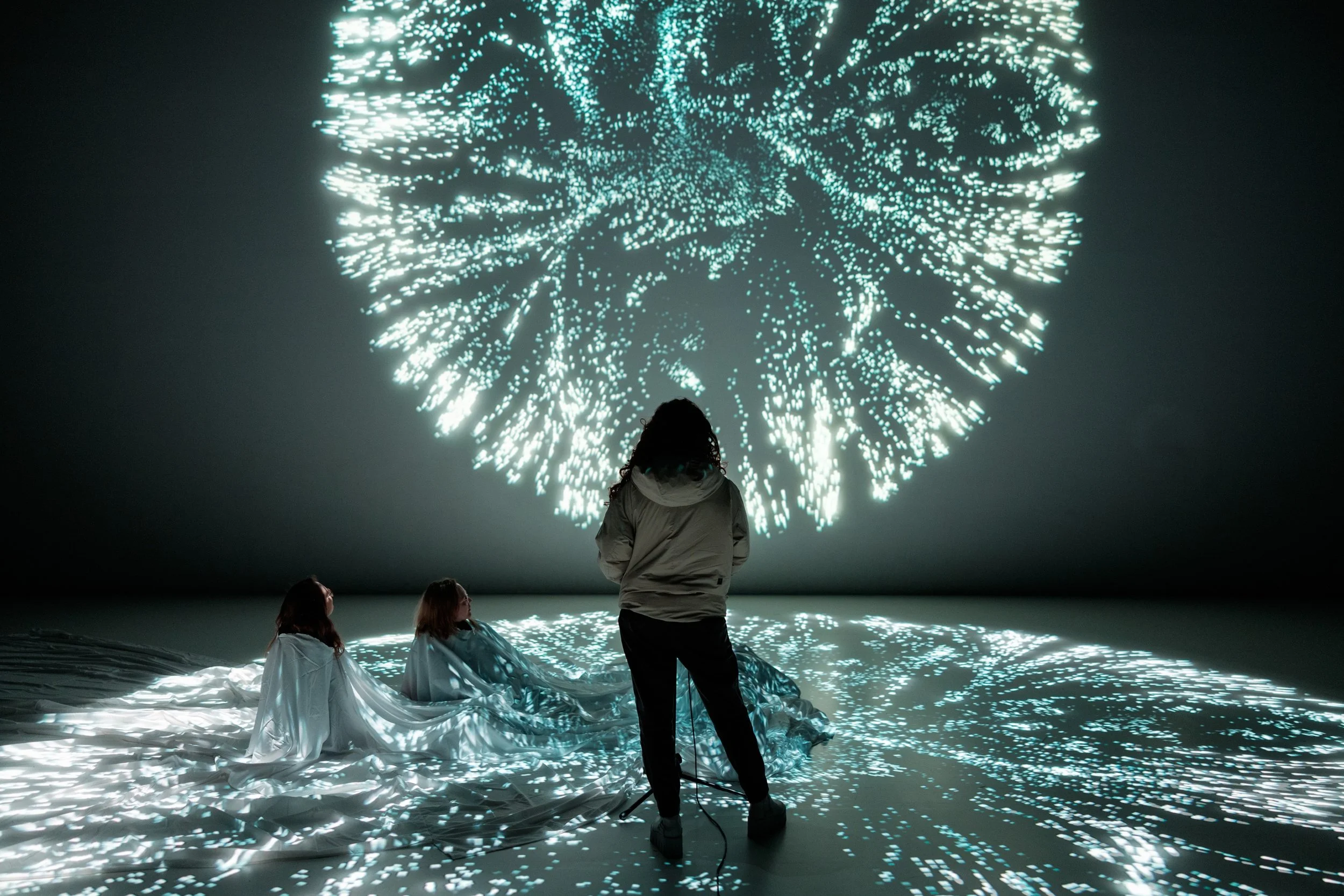
On Sunday, February 18, the Pittsburgh Symphony will host a "Blogfest Extra" concert - a two-part community outreach event. The afternoon's concert will include traditional works from Mahler and Beethoven as well as a new work, Rainbow Body by Christopher Theofanidis. The work's title is derived from a Buddhist idea that when an enlightened being dies, his or her body doesn't decay, but instead is absorbed back into the universe as energy and light. As a spectacular display of technology-enhanced art, the PSO will perform Rainbow Body along with projected images of dying stars taken by the Hubble Telescope. Following the concert, the PSO will host a blogging reception, during which "blogging after the concert is strongly encouraged!"
The PSO recently established its own pair of blogs, one featuring staff contributors and the "internal perspective" and the other featuring community members, composers and volunteers who provide the "external perspective". The PSO blog has come a long way since its founding last fall, and now even includes a few video blog posts. It's clear that the blog has become an internal priority, and I hope the Symphony's artistic team will continue to create innovative events like this one.
Are you accurately profiled on the Internet?
Recently, I was doing some research on a local emerging leader who I am nominating for an award. In my Internet search, I stumbled across a professional profile for her on an interesting site called ZoomInfo. According to their website, " ZoomInfo is a unique summarization search engine that finds, understands and saves useful information about people on the Web. The patented search technology continually scans millions of corporate Web sites, press releases, electronic news services, SEC filings and other online sources. Then, it intelligently compiles a concise summary about a specific individual or company." Of course, I had to search for myself - just to see what it would pull up. I was surprised to find seven listings for David Dombrosky. (Obviously, my name is not quite as singular as I thought it was.) Once I selected the profile I recognized to be my own, it was interesting to see both what was present in my profile and what was missing from it. While not everything was accurately described in my profile, the disparate pieces were pointing to the correct person - which is fascinating in and of itself. How did this site know to add these pieces of information to MY profile versus the other six guys listed in the search?
ZoomInfo gathers and conveys its information using proprietary Natural Language Selection, Artificial Intelligence Algorithms and Information Integration logic:
"Using Natural Language Extraction tools, our computers are able to read English sentences ("Steve Jobs co-founded Apple Computer with...") and understand what they mean. ZoomInfo then extracts relevant pieces of information about people, such as the companies they work for and their job titles.
Artificial Intelligence Algorithms allow our computers to analyze a Web site and extract information based on an understanding of how the Web site is constructed. ZoomInfo can deduce that a specific paragraph describes a company, or that a specific address contains the location of a company headquarters.
Once ZoomInfo extracts requested data, Information Integration logic then sifts through and organizes the data. Biographies of people found on various Web pages are assembled into summaries, and inconsistencies in the information are interpreted and resolved."
As I said before, the technology is not perfect. In that early version of my profile, the program misinterpreted NEA to stand for National Education Association. It also failed to correctly "understand" the nuances of my work. For example, it listed in my Employment section, "Coordinator of Operation Homecoming - National Education Association." In actuality, I coordinated logistics for the Operation Homecoming project created by the National Endowment for the Arts. Close - but not quite the same thing. The problem is that anyone using this site to find individual profiles will most likely take the profile at face value. Thankfully, ZoomInfo allows you to update your professional profile - free of charge. Here's what an updated profile looks like.
To my mind, ZoomInfo has the potential to become an amazing research tool. Want to find out more about a potential donor or board member? What about a panelist or subject of an interview? What if you need to find information on someone you are nominating for a award, but you don't want to ruin the surprise by asking them for their resume? There are a number of wonderful uses for this information -- provided that more people go to the site to update their information!
Hopefully, we will see a major marketing push from this site and others like it to maximize the potential for utilizing this technology.
Will the real artifact please stand up?
Italian geophysicist Pietro Cosentino is on a mission to identify works of art through unique "sonic fingerprints". Cosentino began using sonic tomography to study art in 2005, and hopes his work can help to end Italy's ongoing problem with faked and stolen artwork. Based on the principle that every object emits a distinct vibration, Cosentino's process involves fitting a network of sensors to an artwork, then tapping the sensors with a small rubber hammer. Recorded vibrations are unique, and even allow an educated listener to distinguish between artworks made as part of a series. The noninvasive process takes several hours, and can be used on stone, wood and ceramics.
The sonic fingerprinting system, in the process of being patented, has only one significant drawback - like X-rays, the scans must be performed every few years to provide up-to-date information.
Read more at Wired.com.
Aspiration Nonprofit Software Development Summit
On Feb. 21-23, Aspiration will be holding its first "convening to bring together the range of developers, technologists, managers, eRiders, integrators, users and other practitioners who self-identify under the umbrella of 'nonprofit software development,'" in Oakland, CA. I will be attending on Thursday and Friday and hope to network with the many pioneers of this niche sector. It's a loosely organized event, but it aims to base its content on the following themes:
- Practices, Processes and Community will address concepts, themes and essential issues in the nonprofit software development realm.
- Software Engineering Topics and Trends will dive deep on a host of technical and strategic issues relevant to nonprofit software developers.
- Going Vertical: Application Focus Areas will explore specific “vertical” categories of nonprofit software.
Check out the website for more details, and I'll be sure to report on how my experience went.
�
Wikimania
Penguin publishers and De Montfort University recently launched the first wiki novel - an experimental project designed to see if "the wisdom of crowds" can apply to more artistic disciplines. Contributors to "A Million Penguins" will include Masters students in Creative Writing and New Media, who study writing in the evolving fields of online communities, blogs, and wikis. The project went live on February 1st, and the wiki has already seen a flurry of editing activity. The novel's current cast of characters includes a penguin "trying to save mankind from its own destruction" and the mysterious "Tango Prisoner".
The experimental novel will be online for at least six weeks, according to Penguin, who insists that this project is not a talent search for the publishing house. Even if fleshing out the character of the "Tango Prisoner" won't lead to your big break, writing in this new collaborative medium will certainly be a great challenge.
Attend an opera in New York for $5
All you have to do is accompany a teen, and buy your tickets online. Patron Technology recently featured High 5 Tickets to the Arts in their monthly newsletter as an e-marketing superstar. High 5 offers tickets to hundreds of performances and events in New York for the low price of $5 per ticket. In 2006, the New York non-profit conducted roughly 85% of ticket sales online with some tickets sold out in a matter of hours. High 5's idea of making arts more accessible to young audiences through inexpensive tickets has also spread to other cities including Columbus, OH, and Montreal. Cultivating younger audiences is a hot topic in my arts management program at the Heinz School of Public Policy and Management, so I imagine it may also be of interest to you as arts managers in the field.
It would be interesting to evaluate the effectiveness of High 5's service. Will the teens snatching tickets up today be our loyal patrons and donors twenty or more years from now? Some of my classmates believe the best way to ensure a lifelong commitment to the arts is through arts education more so than just accessibility. I agree with them to some extent, since through my own experiences, I was exposed to the wonderful world of opera in Dallas through an education program focused on introducing new (and diverse) audiences to the art form. The combination of severely subsidized tickets and education sessions made the experience complete. I doubt I would have attended an opera out of my own volition if it weren't for the empowering educational experience I had through that program.
Is Art and Shopping the new Art and Entertainment?
In our Strategic Planning class last night, our professor and CEO of the Pittsburgh Symphony Orchestra, Larry Tamburri, made mention of the current trend to link art with entertainment. On city websites and in tourist guides, "Arts & Entertainment" abounds- correlating performance and visual arts spaces with movies, bowling alleys and roller rinks. While these sectors, along with sports, are competitive for the use of our leisure time, one has to ponder whether the arts is becoming diluted or just marginalized by efficient marketing. This discussion, however, becomes completely moot as a whole new space and concept has presented itself in Winston-Salem, NC.
It's mildly disturbing and yet I can't help to acknowledge that it might just be another form of corporate sponsorship. There is also the chance that it was just a clause of the negotiation that allowed Wal-Mart to set up shop there.
A true test would be to see if the sculptures are "Public Art" or "Art in a Public Space." Without having a good picture to make reference, I would be really interested to see if Wal-Mart finally designed a building that reflected the community architecture, and by extension, contracted a sculpture that reflected its environs. �
Recent Articles Worth Reading
Here are just few articles I have come across lately that I think you might find interesting: Web Refocus - Jeremy O'Neal examines Web 2.0 and forecasts the role that media arts organizations will play in it - namely preserving and promoting the noncommercial space.
Welcome to Wi-Fi-Ville - Kristina Dell reports that more than 300 cities and communities nationwide plan to have wireless ventures in the next year. While we all want free Internet access, what are the contentious issues surrounding the offering of a low-cost or no-cost wi-fi municipal plan as a public service?
Can't Touch This - Welcome to the future of the human-computer interface. Jeff Han, a research scientist from NYU's Courant Institute, wowed the tech world with his touch-driven computer screen. Learn more about this amazing device and watch the demo video.
This last article comes from the current issue of Fast Company magazine. Another article in this issue that is not available on the web, "An Unlikely Story: Tech Where You Least Expect It," documents the success that the Isabella Stewart Gardner Museum in Boston, MA has had with podcasting its classical music concert series. Check it out.
Press Releases and Web 2.0
Recently, Erika Block with www.blockwork.org steered me toward an article from Entrpreneur.com titled "PR Trends: A Press Release for Social Media," which discusses how the PR field is attempting to respond to the "social web" phenomenon by adapting the age-old press release to create a new template for social media containing the following items:
- A brief description of the news announcement
- Quotes from the CEO or other execs, customers and analysts, if applicable
- Photo/video attachments, or links to web pages that host these items
- Links inside the release copy to background information, and relevant links to other news stories or reference sources
- Digital tags (used to link to web tools such as Del.icio.us and Digg)
- RSS Feed links
- Links to podcasts and MP3 files, graphics and video
The article states that the social media release is primarily used by those in the tech industry, which makes sense as they are obviously early adapters to changes in technology. There is a lot of potential here for arts organizations dealing with any discipline. Are any of you using this new template for media releases? Have you seen an impact in the consumption of your press materials?
Click here for another take on press releases and web 2.0 from Ericka's blog.
The $150 Laptop
CNN.com recently featured a nice piece about EXTREMELY affordable laptops that will be made available to children in Libya, Thailand and other developing countries through the One Laptop Per Child program. The "XO" machine, which will run on a version of the Linux operating system, will cost about $150. They aren't incredibly powerful - they have a 512 megabyte flash drive in lieu of a traditional hard drive - but they will offer a leg up to children who otherwise wouldn't have access to technology.
Time Magazine's Person of the Year: YOU
 The explosion of social networking sites into the public consciousness and the corresponding user-content-creation phenomenon convinced the editors at TIME that you are the Person of the Year.
Click here for the article.
The explosion of social networking sites into the public consciousness and the corresponding user-content-creation phenomenon convinced the editors at TIME that you are the Person of the Year.
Click here for the article.
Art on the Web and Other News
I read an interesting article on CNN.com today, and I wanted to pass it along. The piece examines STUART, a site for art students to hock their creative wares. Also, check out our latest podcast, which features part one of our interview with Microsoft's Ian Lindsay. He was very engaging and a very good sport.
Oh... and Happy Holidays!
Call for Papers for Journal of IT in Social Change -- deadline: tomorrow
Please see the posting below for a call for papers relating to innovative uses of technology in the non-profit sector. I encourage you to participate if you have relevant research! * * * * * * *
Organizations in the nonprofit and voluntary sector have recognized that information technologies are a vital part of their effective mission achievement. While a large and growing body of practical knowledge already exists, practitioners, managers, and policy makers still lack systematic scholarly research about how information technologies are changing the nonprofit sector and the organizations within it.
NTEN and Nonprofit Online News are seeking research papers for a panel and a publication. The panel will be held at the Nonprofit Technology Conference, in Washington DC April 4-6, 2007 and will focus on "The State of the Art in Nonprofit Technology." We will publish papers in the inaugural issues of "The Journal of Information Technology in Social Change." We are seeking rigorously designed research that explores all facets of ICT implementation, use, and innovation in nonprofit and grassroots organizations and sectors. We are interested in research that engages with these and similar themes:
- Technology adoption in the voluntary sector
- The relationship between open ICT ecosystems and civil society
- Issues around the use of technology platforms, e.g., free/open source software and proprietary systems
- How nonprofits and grassroots organizations use information technologies
- Organizational change and technology implementation
- The unique technological needs of nonprofit and grassroots organizations
- The role of technology in promoting social change
We are taking a multidisciplinary approach. Original papers and proposals are sought from researchers in all relevant subject areas. Proposals submitted should address facets of nonprofit technology, broadly construed.
Complete papers are strongly encouraged and will be given priority over abstracts or proposals. Two to three page proposals that include a summary of research findings and methods used will also be considered.
Send submissions including the author's contact information, position, and affiliation as PDF, RTF, or DOC files to research@nten.org.
Timeline:
- Deadline for Submissions (complete papers preferred): December 15, 2006
- Author notification (and editorial requests) by: February 15, 2007
- Complete Papers Due: March 10, 2007
- Journal Publication Date: April 5, 2007
- Conference: April 4-6, 2007
Partners:
- NTEN: The Nonprofit Technology Network
- Nonprofit Online News
- Michael Gilbert, Co-Editor
- Katrin Verclas, Co-Editor
- Paul-Brian McInerney, Co Editor
Stay Tuned...
After all the audio interviews from the 2006 Technology in the Arts conference have been published, CAMT will continue its podcast as a series of arts/technology discussions and interviews. Jason Hansen, Carnegie Mellon IT professor and a former CAMT developer, will join me as co-host, and we plan to speak with artists, arts managers and tech professionals from all over the country about their work and interesting trends in the field. Today we discussed Windows Vista, Microsoft's new operating system set for consumer release next month, with MS account technology specialist Ian Lindsay. Lindsay explained what organizations interested in upgrading to Vista should know and how much they should expect to spend.
Our two-part interview with Lindsay will be released to our podcast feed in a couple weeks. For now, enjoy our most recent podcast update, featuring my interviews with state arts agency representatives Philip Horn (PA Council on the Arts) and Carla Dunlap (MD State Arts Council).
If you have any questions or interesting technology updates, please submit them to podcast@technologyinthearts.org.
Social Networking Technology and Arts Organizations
Recently in the Artful Manager blog, Andrew Taylor discussed how social networking technology evident in popular user-driven sites (MySpace, YouTube, Flickr, Dandelife, etc.) is rapidly changing the nature of the web and how we use it by enabling individuals to share their voice, vision and story with the wider world. For many months now, I have been ruminating over how to (a) strategically integrate the use of social networking technology into my programs and services, and (b) convince my organization's leaders that we need to move in this direction.
I know many artists are finding ways to utilize this technology as a tool for furthering their artistic endeavors. Comedian Dane Cook has used his MySpace network to catapult himself into the national spotlight as today's top-selling comedian on tour; Boston painter Jeff Hayes produces a successful painting-a-day blog to sell his work on a daily basis; hundreds of filmmakers post their trailers and short films on YouTube to promote awareness and generate buzz for their work.
So what can social networking technology do for arts organizations?
- Given the current trend in the field for arts organizations to market the "artistic experience" coupled with contemporary audiences' desire for greater interactivity, social networking technology has great potential to assist arts organizations in deepening their audience's experience by providing more avenues for engaging with the art, the artists, the organization, and each other. For example, check out Chicago Classical Music (CCM). Founded by nine classical music organizations, CCM launched in March 2006 as a six-month pilot program under the auspices of the Arts & Business Council of Chicago. This online community is dedicated to connecting its 11 current membership organizations with classical music enthusiasts through a blog, interactive forums, a chat room, a ticket swap feature, an events calendar, and more.
- Due to the "tell your friends, who will tell their friends, etc." nature of this technology, another benefit for arts organizations is the viral expansion of their reach and awareness. Earlier this fall, I started a weblog for our Southern Circuit - Tour of Independent Filmmakers program wherein touring filmmakers post about their experiences on the road in the South. Even in its nascent phase, the blog has been viewed throughout the United States, Europe, Asia, and South America; thereby providing our program with a reach and awareness we could never afford to garner through another channel.
- A third potential function for social network technology is to galvanize a virtual community around a mission, goal or issue to spur positive change in the real world. Take a look at how the New Orleans Video Access Center has been using YouTube to answer the question "Why should New Orleans be rebuilt?"
These are just a few ways in which these sites and online services can benefit arts organizations. With every passing day, further innovative uses are realized. So why stay behind the curve? What could social networking technology do for your organization?
Making art from the internet
I recently had the opportunity to attend one of the Artist Lecture Series here at CMU hosted by the College of Fine Arts. Because they joined forces with the Human Computer Interaction Institute, a lot of the guest speakers were amazingly innovative technology artists. Martin Wattenberg, who leads the Visual Communication Lab at IBM Research, creates visualizations based on content from the internet and other data sources. Check out some of his research projects. I also came across an interesting article today that strikes me as really relevant- especially as I sift through the hordes of spam I receive everyday. Alex Dragulescu, an alumnus of UC San Diego, develops algorithms to process his spam emails to create botanical and architectural looking digital structures. He likens his process to a contemporary version of found art.
Sexiest Geeks of 2006
I just wanted to remind everyone to enter your nominations for the sexiest geeks of 2006. Any one of us here at CAMT would make an excellent choice. ;) Just kidding. We aren't that conceited... and our humility is a large part of our sex appeal.
Pittsburgh Podcamp: Nov. 10-12
If you caught the podcasting bug at our conference last month, join Pittsburgh Filmmakers and Three Rivers Film Festival this weekend for an "un-conference" and participate workshops on blogs, vlogs, audio podcasts, web video, content networks and new media monetization. In addition to the broad range of sessions, the schedule includes several social events, including a networking event at the Art Institute of Pittsburgh on Friday night, and a Saturday night dinner at Bossa Nova. If you can't make it to Pittsburgh this weekend, check out upcoming podcamps planned for Philadelphia, Atlanta, San Francisco, Toronto, and New York.
Interpreting Culture, Part 2
As the shelf life of “new” continues to be defined by smaller and smaller time increments, how do we as arts administrators help artists to do their jobs – ask the timeless questions – in a timely fashion? I’m a big fan of John Seabrook’s 2001 book NoBrow: the Culture of Marketing and the Marketing of Culture, a series of essays that illustrate how these two phenomena work in contemporary American society. In one essay, Seabrook compares his own life to that of his father’s, noting the evolution of high-brow/low-brow distinctions are made through clothes: his father had a suit for every occasion, whereas “a Chemical Brothers T-shirt will get me further in many places than my father’s suit.”
One implication of Seabrook’s message is that in order to communicate effectively in a time when identity is defined by taste, arts organizations must realize that an artist’s message will be read in the specific context of a highly customized, consumption-driven life. People filter “high art” messages through the same lens they use to see billboards, print advertising, television commercials, product placements, movie trailers, product jingles…
What tools can we use to deliver artists’ content quickly and effectively? What role do we play in making sure their voices are heard clearly, and on time (particularly on a day like today)? How do we “buy in” to all the exciting two-way communication technology tools available to us now without “selling out”?