Windows Vista: What does it mean for arts organizations?

Microsoft will soon be releasing the latest version of its operating system, Windows Vista. Microsoft's marketing campaign touts that Vista, being released to the company's business customers on November 30 and everyone else in January, will help users be "connected, clear and confident." The "connected" part of this campaign refers to the ease of connecting to people and information, and the "clear" part is meant to infer that the product's user interface will be straightforward and simple to grasp.

However, it's the "confident" part that most people are interested in, because past versions of Windows have had numerous security flaws. Vista is supposed to feature more advanced methods of detecting and preventing spyware and other electronic threats to your computer. We'll see...

The Technology in the Arts podcast (new episode available now!) will feature interviews from the 2006 TitA conference for the next several weeks, but one of our first non-conference podcasts will examine what Windows Vista will mean for arts organizations: How much will it cost? Will my current computers run Vista? What do I need to know to upgrade?

Digital Time Capsule

On October 10, Yahoo! launched the Yahoo! Time Capsule project, a brainchild of the artist Jonathan Harris. For 30 days, Yahoo! users worldwide can contribute photos, writings, videos, audio files, and drawings to this innovative digital anthropology project. On November 8, the collected files will be entrusted to Smithsonian Folkways Recordings in Washington D.C., and the data will be preserved as historical artifacts.

The time capsule is organized around ten themes: Love, Sorrow, Anger, Faith, Beauty, Fun, Past, Hope, Now, and You, each of which was chosen to encourage a broad range of submissions. In addition to creating a historical record, the time capsule's design is intended to foster online community building. Users can submit original content, view other submissions, and engage in conversation about submissions with other users.

Harris's recent work has focused on the exploration of humans through the artifacts they leave behind on the Web. His background as an artist/techie/anthropologist makes him an ideal candidate to mold the project's creative vision.

As he wrote in his artist's statement, " . . . the Yahoo! Time Capsule sets out to collect a portrait of the world – a single global image composed of millions of individual contributions. This time capsule is defined not by the few items a curator decides to include, but by the items submitted by every human on earth who wishes to participate. We hope to reach a truly global expression of life on earth – nuanced, diverse, beautiful and ugly, thrilling and terrifying, touching and rude, serious and absurd, frank, honest, human. The Time Capsule itself is realized digitally so that the maximum number of people can have access . . .

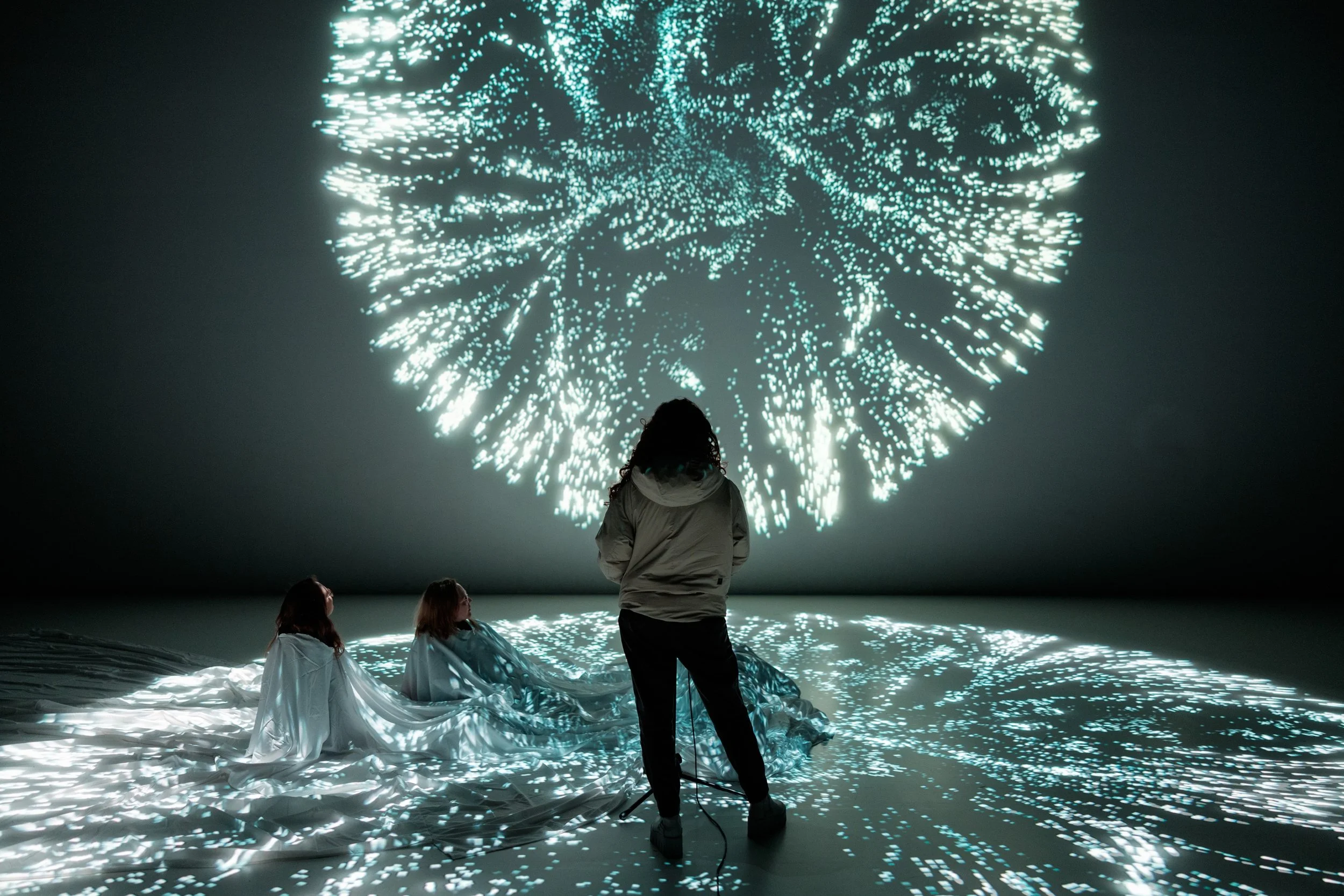
The aesthetic of the Time Capsule is that of a ball of thread, spinning like a globe, its shifting surface entirely composed of words and pictures submitted by people around the world. The thread ball concept relates to threads of memory and threads of time, where threads are taken to be any continuous and self-consistent narrative strand. When the Time Capsule opens, it displays the 100 most recent contributions, which form the spinning globe. The ten themes orbit the globe in a pinwheel pattern. At any moment, any individual tile can be clicked, causing the globe to fall away and the selected tile to expand, revealing detailed information about the tile and the person who created it. Using a search interface, viewers can specify the population they wish to see, exploring such demographics as “men in their 20s from New York City”, and “Iraqi women who submitted drawings in response to the question: What do you love?”. There are an infinite number of ways to slice the data, and each resulting slice then becomes its own thread, which can be browsed independently, tile by tile, like a filmstrip."

With only 6 days, 8 hours and counting, there's not much time for procrastinating. Go and contribute now.


Attack of the Pod People

As I mentioned during Attack of the Pod People, the session Jerry Coltin and I presented during the Technology in the Arts conference, I love to hear myself speak... even if other people don't. Our first podcast episode, which features my interviews with Jason Hansen and Jerry Coltin, is now live in the Podcast category and available at our Feedburner site.

Also, please check out some great photos from the conference, taken by Pittsburgh photographer Suellen Fitzsimmons, at our Flickr site.

See you soon!

It's hard to believe it's the Monday before the conference! The programming is set, the program book is done, the rooms and equipment are reserved, the party planning is down to the nuts and bolts of setup and installation...

Now all we need is you! I'm so excited for Friday and the chance to welcome all of you to our first Technology in the Arts conference. We've got a deliciously wide spectrum of organizatoins attending including theaters, ballets, museums, arts service orgs, arts agencies, universities, arts funders...

There will be about 120 of us representing 75 organizations, which will make for a nice, intimate atmosphere, ideal for in-depth dialogue, brainstorming and relationship building. We'll be in Hamburg Hall (home of CAMT) on the CMU campus, with shuttles running us where we need to go throughout the event.

Also, the committee for our closing party has truly outdone themselves, and all indicators point to a fun, art-filled conference-closing camt@ten.

As always, if you have any last-minute questions or concerns, feel free to contact us!

Visualizing musical structure

Students of music theory may be familiar with the principles of "voice-leading", rules which govern the way in which notes move from one chord to the next. (The rules say the steps should be fairly small.) To help music students understand these concepts, Princeton professor Dmitiri Tymoczko recently developed ChordGeometries, software that generates a 3D musical map in real-time and illustrates how far a piece of music diverges from these rules. Tymoczko's accompanying paper, "The Geometry of Musical Chords," was published earlier this year in Science and explores voice-leading from the perspectives of both musicology and mathematics. To see the program in action, download one of three demonstration movies or the software itself, available for Mac OSX and Windows XP.

Starting a Podcast, Part 5

Now that I have some actual mp3 files from my interviews with CAMT staff - check them out and subscribe to the podcast - it's time to release them to the world. My first attempt to build a listenership - yes, that's a real word - is to use a site called Feedburner, which facilitates the distribution of blogs and podcasts.

First, I added to our blog site a "Podcast" category where my new CAMT mp3 files can live. It is important to add each podcast in its own post. Otherwise, a feed reader such as Feedburner or iTunes will only recognize the first audio file in the post and skip the rest.

Next, I registered for a free account on Feedburner. There are fee-based services, such as enhanced subscriber tracking, but I don't imagine this thing will take off fast enough for us to worry about that just yet. I'm charming, but I'm no Bill O'Reilly. (Disclaimer: The previously linked site is not my own, nor do I endorse it. I simply searched "Bill O'Reilly" and that is the funniest result.)

Once you sign up for a Feedburner account and enter the URL for your "Podcast" blog category, Feedburner will automatically create a page where visitors can either download your content or get your feed URL for use in their own podcast aggregators.

Learn more about Feedburner.

Ladies and gentlemen, start your cellphones.

On Sunday, the Chicago Sinfonietta played a new work with unusual instrumentation: the world premiere of the Concertino for Cellular Phones and Symphony Orchestra. During the performance, audience members were signaled to active phones by the illumination of colored lights — red for the balcony, green for the orchestra seats. The Sinfonietta's Music Director, Paul Freeman, discussed the work in the context of music with random elements, including pieces by John Cage and Charles Ives. However, the October 1st premiere was highly organized; the orchestra provided directions via email and in the program, and the conductor held a practice session before the performance.

To get a flavor for the music, you can view the Chicago Sinfonietta's television commercial featuring the Concertino.

Starting a Podcast, Part 4

Yesterday I interviewed three of my fellow CAMT staffers: Guillermo Marinero (Senior Information Systems Specialist), Haebin Kim (Information Systems Specialist), and Melody Fleishauer (Systems Administrator). These interviews are roughly 5 minutes each and aren't thrilling, but you can hear a little about each of their backgrounds and how they became intrigued by technology. Listen to the interviews in our Podcast category.

Next week: I will discuss how to get these mp3 files out into the world as Podcasts.

EDIT: After publishing this post, I caught a mistake: I posted three mp3 files to one post. In order for a Podcast aggregator like iTunes to catch your audio files, it's important to post them as separate links. Since this blog is meant to be instructional, I thought I'd call myself out on this error publicly, so we can all learn from my mistake. I have added two more posts in the Podcasts category of this blog forHaebin and Melody, so iTunes will snag them for me. More on this next week...

Carnegie Museums have gone digital

Through the Art Collection Search, people can now browse the Carnegie Museums of Arts' collection online. I think this is a perfect segue to our Successful Digitization Projects Funded by the IMLS presented at the conference in October. After resolving some of their copyright issues, and following up on the statute of limitations for art (the artist's death + 70 years) the site is up!

No registration is required. Just go to the website and browse!

Š

Ode to Odeo...

While the audio interviews with CAMT staff as part of my continuing series on podcasting will be delayed until next Friday, I didn't want to let this week end without providing something fun and exciting. Odeo, recently named one of the hot Web 2.0 apps by WIRED.com (read the article), is a tool for creating and sharing podcasts without any muss and/or fuss.

Odeo Logo

Try it out. Simply choose a category and a podcast, then hit play. You can also download all files to your portable listening device. (Note that I did not say iPod... I'm being open to the fact that other mp3 players exist. In fact, I bought my wife an iRock. She liked it until I got my iPod, which was sleeker, smaller, and far more advanced. I'm a jerk.)

Acquity Joins the Technology in the Arts Lineup!

A huge thank you and a warm welcome are extended to Technology in the Art's newest sponsor, the Acquity Group. Rick Nash, Managing Director of the Kansas City branch, will join us in Pittsburgh October 20-21. Acquity Group is a leading provider of business and technology solutions designed to optimize business performance. For more information, visit them at www.acquitygroup.com or in person at Technology in the Arts!

Genius among us

The John D. and Catherine T. MacArthur Foundation announced this year's MacArthur fellowships, otherwise known as "Genius Grants". Among the artists receiving the fellowship are painter Shahzia Sikander, jazz violinist Regina Carter, multimedia artist Anna Schuleit, and sculptor Josiah McElheny. The fellowship award includes a $500,000 grant over five years, and is intended to allow these highly creative individuals to pursue their work free of obligations. According to the foundation's website, "The Fellows Program places its emphasis on individual creativity because the discoveries, actions, and ideas that shape our society often result from the path-breaking efforts of individuals. The MacArthur Fellowship is designed to support people, often unrecognized, who are expanding the boundaries of knowledge and human interaction."

Pittsburgher and Carnegie Mellon Professor Luis von Ahn was also recognized for his work concerning cryptography and artificial intelligence.

Starting a Podcast, Part 3

I now have a microphone connected to my mixer, and the whole shebang is linked to my laptop through an RCA-to-1/8 cord. Here is a pic of the cord: Cord

The black end connects to the laptop, and the red/white end connects to the mixer.

As luck would have it, someone here at CMU was disposing of a microphone stand simply because the plastic clip that holds the mic in place was broken. As my mics came packaged with their own clips that fit perfectly on the unwanted stand, I turned someone's trash into my treasure.

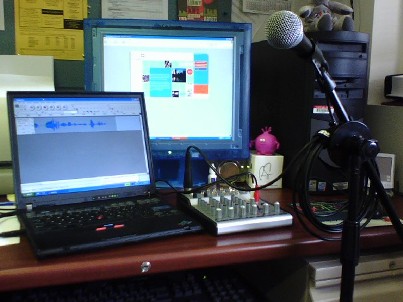
This is a picture of my desk-turned-recording-studio:

Setup

Note my beautifully salvaged microphone stand. Also note the Technology in the Arts Web site on my monitor. (Plug, plug, plug.)

Maybe it was annoying, but I walked around the office most of the day on Friday describing my mini podcast studio as "totally awesome." Not everyone shared my enthusiasm. I try to be professional about things, and what happens?

1) The guy that works across the hall from me leans into my office, notices the equipment, and says, "I have to ask." Yes, but I don't have to answer.

2) Jerry Coltin, CAMT's former executive director, tells me the USB mic that came with my computer will work just fine for podcasting. While this may be true, it won't look like I'm getting ready to produce the new Boyz II Men comeback album, which is exactly the look I'm going for.

3) Cary McQueen-Morrow, CAMT's current executive director, says I'm the biggest geek at CMU -- and that is like calling someone the ugliest person at the University of Pittsburgh. (By the way, that is ONLY a joke. As a West Virginia University fan, I'm obligated to say horrible things about Pitt.)

Next Week: Audio Interviews with CAMT Staff

(Art) World Here I Come!

As a graduate student, I don't have a lot of free time to experience the arts in Pittsburgh. However, when I came across this program offered by the Pittsburgh Cultural Trust, I vowed to make time for the arts this school year. Keeping accessibility in mind, the Pittsburgh Cultural Trust developed a program called ARTSpassport. As a member, students are eligible to purchase $10 tickets to selected performances - a great deal when most tickets on the schedule are $30 and up!

To sweeten the deal, local restaurants agreed to offer discounts on meal tickets so hungry students can grab a bite before the show. I think this is a great way to get young people to venture into Downtown Pittsburgh and make an evening out of it.

Find out more about the Pittsburgh Cultural Trust's ARTSpassport by clicking on the following link:

http://www.pgharts.org/education/ArtsPassport.aspx

And if you have a similar program you are especially proud of, please share by commenting to this entry.

Opera in the digital era

This week, the Metropolitan Opera announced it will broadcast live performances to movie theaters in the US, Canada, and Europe. The Met also plans to make more than 1,500 historical recordings available online through Rhapsody, a digital on-demand audio and video subscription service. Now that the Met has the rights to distribute both new productions and historic broadcasts on virtually all electronic formats, opera lovers can even watch streaming video of performances on the opera company's website. Read the full article here.

A growing number of opera companies are using technology to reach out to new audiences. According to DRoxy, a digital radio blog, the British opera company Hatstand Opera was the first to release opera podcasts, with its first edition of Podopera in the summer of 2005.

Starting a Podcast, Part 2

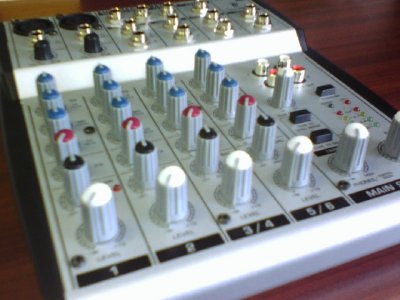
Not much to report for now, but I wanted to update on the arrival of our podcasting equipment! Very exciting... it's almost like having a newborn baby. (Well, the podcast equipment doesn't spit up on me or make frequent stinkies.) Here is our mixer:

mixer2.jpg

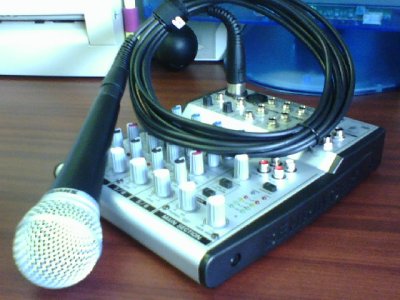
And here is our microphone:

mic2.jpg

Note that there are inputs for two microphones, which is the setup we'll be using during the conference. Also note the cleanliness of my desk. I use Lysol wipes every day because I am a germophobic freak of nature. Am I sharing too much?

Now comes the experimentation stage. In the coming days, I will be testing different connections to my laptop to determine what gives me the best sound quality. My research indicates that two cables with RCA (red and white) plugs at one end and a 1/8" plug at the other will work well, so I plan to try that first.