




Fundraising

Foursquare: Helping You Find Your Favorite Playground

foursquare logoFoursquare is one of the newest social media platforms to be embraced in the last year and one of the most promising new applications for businesses. According to the website, foursquare is “a mobile application that is a cross between a friend-finder, a social city-guide, and a game that encourages users to explore their neighborhoods and rewards them for doing so.” The point of the application is to help users explore their surroundings, discover new things and share their experiences with others. Foursquare uses micro-blogging similar to twitter and interfaces all of the check-ins (posts) with a virtual map. In doing this, users tag locations, businesses and events that they are currently attending for their friends to see and read about. It is a way to share knowledge, play a game and receive promotions and rewards from businesses simultaneously. Due to the mobile aspect of the application, most Foursquare users interact with the site through smart phone applications.
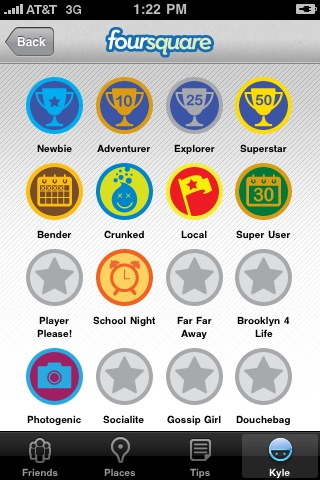
badgesThe game portion of Foursquare is what sets it apart from other applications that allow users to tag locations with their posts. In foursquare, a user gets points and earns badges for checking-in at different locations, the frequency of their check-ins and the uniqueness of where they travel. An example would be the Starbucks honorary barista badge. If someone checks into five different Starbucks locations, they become an honorary barista and earn the barista badge. Starbucks is tying this badge into their customer loyalty program and offering promotions and discounts to their honorary baristas.

Collecting badges has become very trendy in many urban settings and adds a fun aspect of competition to social media. Badges are just one option that Foursquare is offering for businesses to promote themselves on the site.

Many businesses are using:

  • Mayoral specials – specials unlocked by foursquare to the person who has checked-in most frequently over the past 60 days
  • Frequency specials – specials that are unlocked by foursquare to users every ‘X’ number of check-ins
  • Check-in specials – a one time special unlocked by foursquare after ‘X’ number of check-ins or for checking-in at a specific time or date
  • Wildcard specials – not managed by foursquare, but verified by the businesses staff

Once a business sets up an account with Foursquare and tags its location on the Foursquare map, users can click on the location to receive a brief description and a To-Do list. The To-Do list is a list of recommendation that the business and other user have provided for the location. A museum might add an exhibit, event or activity to their to do list along with whatever recommendations other users have added. This along with check-in based promotions adds a new level to social media marketing and community building technology for arts organizations.

How businesses can utilize Foursquare:

  • Tag the location and business on the Foursquare map
  • Add a brief description of the location to the map
  • Link twitter account to Foursquare to increase activity
  • Add items and recommendation to the To-Do list of the location
  • Integrate check-in and badge based promotions
  • Use Foursquare as a part of a customer/patron loyalty program

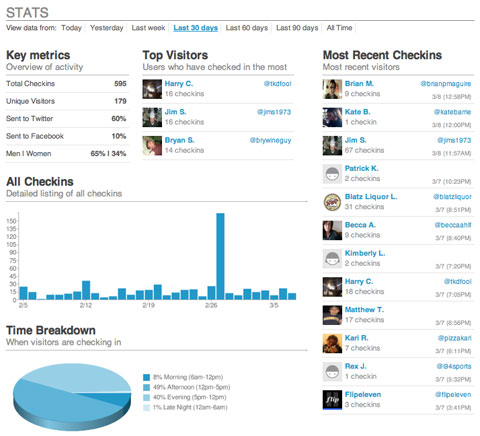
Foursquare is also providing an analytics system for businesses. Foursquare analytics has a personalized dashboard for each business that shows which users are checking-in at their locations most often, what time the location has the most Foursquare traffic, and how many check-ins are being linked to other social media plat forms. It gives a demographic breakdown of their Foursquare patrons and provides information such as total check-ins, total unique check-ins, and statistics based on daily, weekly, monthly and annual traffic. This type of data is priceless to organizations and adds a way to track profitability, return on investment, and patron use.
foursquare stats

Foursquare is less than two years old and already has over 500,000 users. The integration of social media, entertainment and business prowess makes this company a very promising investment for the arts community. Foursquare has shown enormous potential and incredible growth. It has the possibility of becoming the next Twitter and is offering much greater potential for businesses to harness the power of social media while creating a new outlet for promotions, marketing, and community building.

How to Opt Out of the Facebook Mistake

Facebook’s privacy settings and the wave of controversy they caused have created a new level of user awareness when it comes to personal information on web-based technologies. The Palo Alto giant decided to roll out a new program where people were automatically opted in to share their personal information across the web that they had saved on Facebook. Facebook coupled this roll out with a poor explanation of what it was, who it was affecting, and how users could manage it. The convoluted privacy controls and constitutionality were hit hardest, but they were not the real problem in this case. The actual problems here lie in communication and choice. I agree with Mark Zucherburger that a more open Internet is a better Internet and that the more people share, the more social the Internet will become. Unfortunately, sharing ones personal information needs to be a choice and users need to understand how and why they are sharing their information. “Because it’s good for you” is not an acceptable answer for most people.

Arts organizations in the US need to take this Facebook quagmire and use it as a case study for their own e-marketing and e-mailing policies. Communication and choice will lead to stronger web based support and a happier constituency.

Things arts organizations should keep in mind:

  1. E-mail and e-marketing should almost always be opt in for supporters
  2. Organization should explain why and how they will be contacting people
  3. If possible, users should be able to customize what they receive
  4. Opting in and opting out should be very easy and take little effort
  5. Safety measures on how the organization will protect a users personal information and contact information should be clearly stated on the website and reiterated in the first e-contact

Opt in policies are generally the most effective and considered to be best practice. This is where Facebook made their fatal mistake and where arts organizations need to ensure they are excelling.  Organizations only want people to receive information that want to receive it. By allowing people to opt in to programs, the organization is letting the individual take responsibility and targeting individuals who want more contact with the organization.

Once someone has opted in to e-marketing and/ joined the e-mail list for an organization, they should be able to choose what they want to receive information about. Maybe they only want information on ticket sales or a certain type of programming. Maybe they only want the annual report and education programming. Being able to customize what information they receive will help keep them more engaged with the organization and make them less likely to opt out or stop reading e-blasts.

Finally, people should feel safe giving an organization their e-mail address and personal information. With all of the information sharing, spamming and possibilities for profit, consumers are very wary of giving away any contact information these days. Post on your website and in the confirmation e-mail how you are protecting their identity and their personal information. These practices will help any organization build a strong e-mailing list and e-marketing campaign.

Micro-donations: Proving Size Doesn’t Always Matter

The Obama campaign, the Nelson Mandela Foundation, and The American Red Cross have all embraced electronic micro-donation campaigns as an effective tool in gathering financial and community support for their causes. The prominence of these cases and their rampant success provides the evidence necessary for arts organizations to begin adopting this new technology to enhance their current giving campaigns. These organizations altered the traditional view of contributed income by looking at three hundred $10 donations as equal to and in many ways greater than one $3,000 donation. This logic has very little to do with the amount of money being given and much more to do with the amount of people giving it. Micro-donation campaigns are about involving as many people as possible and using their collective support to raise awareness as well as funds. They are not just about filling the coffers. They are about educating donors, building support, and cultivating future participation and giving.

A micro donation can be defined as a small gift usually given through electronic media and most often associated with the support of a cause, project, or individual. Point-and-click web based interfaces, e-mail, and SMS txt messaging are the most popular and effective platforms.

Reasons to start a micro-donation giving campaign:

  • Small time commitment from management
  • Little implementation cost leading to a large return on investment
  • Widening donor market segments
  • Generating new donors and interest
  • Creating ‘buzz’ and word-of-mouth support
  • Ease of social media integration
  • Building momentum, education, and visibility of the organization

Having acknowledged these benefits, micro-donation campaigns have not been proven effective for annual giving platforms, large gifts or operating funds. They have been proven effective in supporting specific projects, programs, campaigns, and Individuals.

A recent article written by Rich Mintz, the man behind both the Obama Campaign and the Haiti relief effort by the American Red Cross provided 5 big tips to help organizations set up a successful micro-donation campaigns and/or internet giving program.

  1. Make it easy to give money and sign up online
  2. Reward people who have just signed up with useful follow up contact and content
  3. Communicate how much donations matter (even the very small ones)
  4. Create online participation opportunities
  5. Give people a sense of what’s going on backstage – and in your back offices.

To elaborate:

  • Micro donations should be the easiest way a person can give money to an organization. It should take less than three clicks on a website or the simple task of responding to an SMS txt message or e-mail.
  • Donors want to know more about an organization once the feel they have invested in it. Send an initial personalized e-mail or SMS text message to donors within 24 hours elaborating on what they are supporting and how they helped.
  • Every donor even one who only gives $5 should feel like they have made a difference and created impact. By framing their support this way, the organization is setting itself up for future involvement and donations.
  • Creating an online community and an interactive online space provides an outlet for people to be involved with the organization outside of the physical space.
  • A behind the scenes look at an organization shows transparency and provides a sense of community. It puts faces, personalities and people with the names, this is important when building support,

Technology has provided a new and proven opportunity for cultivating contributed income in the current economy. If adopted, these campaigns will soon be key in cultivating new donors, creating new support and sheering up funding for new and innovative projects in the cultural community.

Giving Habits, Technology and the Millennial Misunderstanding

In a recent study focusing on the giving and technology habits of millennial donors from Achieve & Johnson Grossnickle Associates, researchers found that many people under 40 are willing to become donors but are not being approached in ways that lead to increased patronage and giving. The study found that Millennials prefer their primary contact with an organization to be Internet based, with e-mail being the preferred form of direct communication and Google searches, web pages and social media outlets ranking highest for researching organizations and building relationships. While this in itself is not shocking, the rest of the study revealed some much more interesting facts about younger donors.

  • Millennial donors were over 91% likely to give a gift to an organization when asked face-to-face, as opposed to 51% likely when asked through e-platforms, and only 17% likely when asked through direct mail.
  • When asked what type of information they wanted to see before they would give to an organization, over 53% of Millennial donors wanted financial documents and proof of stability, and 86% wanted documentation of current programs, services, and community impact.

These facts could easily represent the traditional donors of any arts organization in the United States; this similarity should be a red flag to non-profits about their misconceptions surrounding younger donors. Millennials are concerned with the health of the organization, Millennials do want to get involved, and Millennials require face-to-face personalized interactions to become donors. Studies like this help to show that Millennials are not that different from the traditional donors which arts organizations are already cultivating. The differences emerge in how Millennials prefer to gather information and communicate with organizations rather than in the information itself.

So how can arts organizations mix the technological communication preferences of Millennials with their need for face-to-face contact?

Some recommendations for communicating with Millennials:

  • E-mail annual reports instead of direct mailing them or make them available as a downloadable pdf from the organization website
  • Update projects and project outcomes on websites and blogs in real time
  • Continuously post pictures, testimonials, press and videos to social media
  • Create an interactive online environment that allows donors to feel involved with the organization even when they are not at the physical space
  • Use events, parties, fundraisers, shows, and exhibitions to begin the personal face-to-face cultivation of the new donors

The objectives of these techniques mirror traditional forms of development, but the tactics have been updated for a fresher approach reflecting the technology based millennial lifestyle.

All of these online efforts support the face-to-face meetings and personalized mailings that are already in use by many organizations. Millennials can and will support organizations that take the time to reach out to them. The misconception that Millennials are not a target market willing to donate is simply leaving cash on the table and failing to connect arts organizations with their future funding base.