Since artificial intelligence (AI) remains, in essence, a probabilistic “stochastic parrot,” (Bariach, 2026) lacking consciousness yet already capable of cognitive functions comparable to those of the human mind (though not through the same pathways), while language, text, and images can be arranged algorithmically through correlation and probability without being understood, then the “Machine Hallucination” (Seth, 2026) does not lie in generation but in understanding. Generation is intrinsic to AI; understanding, by contrast, is a judgment filtered through the symbolic-cognitive system of the human brain.
In truth, humans themselves struggle to define what “understanding” is—otherwise the profession of teaching would not exist. Inversely speaking, to “be misunderstood may be the destiny of anyone who expresses.” (Wong, 2004)
Put differently, what is most astonishing about large language or image models is not merely their generative capacity—after all, our own brains also predict and generate (Hüseyin, 2025)—but the fact that humans are able to understand the machine’s interpretation. It may sound like a foreign language, yet it is a foreignness that traverses the level of elemental substrate.
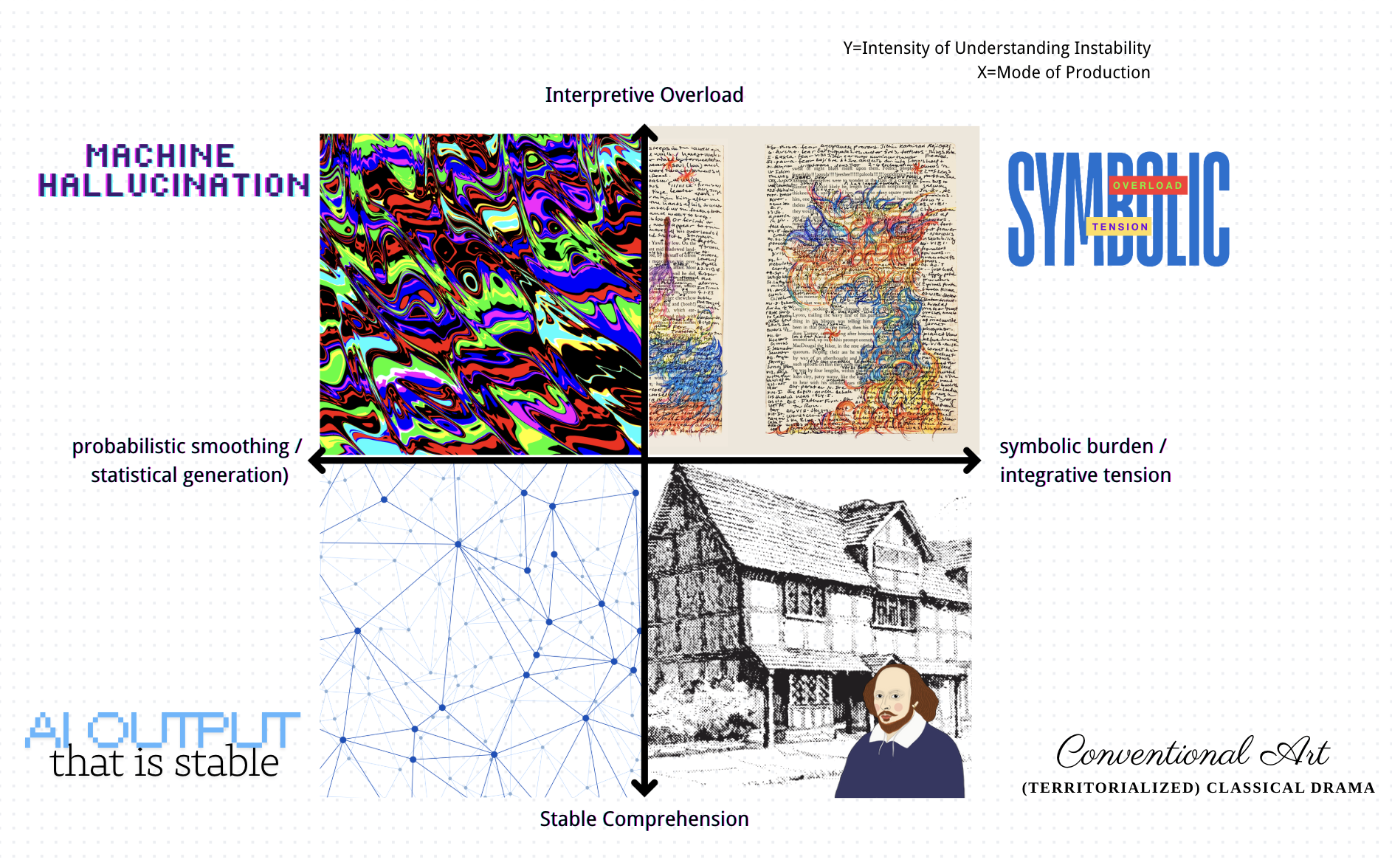
From this perspective, human artistic practice might be divided along at least two dimensions: first, whether it employs a symbol system that can be understood or translated (most likely yes—though perhaps avant-garde composer John Cage complicates this); and second, whether it is generative or territorialized. Classical drama largely belongs to the latter, while Italo Calvino’s novels carry a generative temperament. Yet humans, limited by physiology, cannot sustain infinite generation— indeed, even a prompt is itself a territorial act.
On this basis—art as the territorial arrangement of combinatory elements within a symbol system that can be understood or translated—the next question becomes whether an artist enriches the human symbolic system, whether he or she innovatively reconfigures the relation between signifier and signified (that is, rhetoric). The coordinate infographic below is my preliminary modeling of the academic problem.
Created by Ziqi Xiang
Art, in fact, seems to occupy a position farthest from AI. AI does not understand the generativity of symbols, nor does it enrich symbolic systems and their combinatory relations. Its “hallucinations” arise from inaccuracy rather than from the innovative rhetoric artists invoke when describing their creativity.
Yet after completing this initial modeling, I realized something unsettling: human artistic creation appears to be an extraordinarily rational process requiring symbolic construction and organizational talent. In this light, to speak of hallucination seems almost like a gesture of modesty. Even if archetypes of human narrative exist, as psychologist Carl Jung suggested, the interweaving of symbols has never ceased to animate the dream of art—especially now that I have extended the concept of symbol to language itself.
If art is essentially the arrangement and recombination of elements within a symbolic system, then its value does not lie in generating new content, but in altering the boundaries of what that symbolic system can make intelligible. This shift moves the question away from “Can AI generate art?” toward a more fundamental inquiry:
How does understanding occur?
Where are its limits?
Does art actively push against those limits?
Within this framework, James Joyce’s Finnegans Wake is no longer a “hallucinatory text” or a formal experiment, but rather a pressure test of the mechanisms of understanding themselves. Joyce is not flaunting linguistic virtuosity; he is forcing language to reveal its limits, driving understanding into zones of instability.
On this basis, “hallucination” is no longer treated as an irrational anomaly, but as a precursor to the reorganization of cognitive structures. Machine hallucination may be understood as probabilistic misalignment, whereas human “hallucination” more closely resembles over-association or cross-domain matching—when the system of understanding can no longer stably align experience, it forges connections that exceed its existing structures. This is not irrationality, but a reconfiguration of understanding under conditions of overload. What artists describe as inspiration, dream, or “channeling” may not be mystical posturing, but the felt experience of a cognitive structure being compelled to reorganize itself. Art, in this sense, may lie in the deliberate production of instability within the mechanisms of understanding.
If this is the case, AI does not directly threaten the core value of art. AI tends toward generation, smoothing, and the averaging out of conflict, producing statistically stable structures. It does not bear the weight of symbolic systems, nor does it experience scale disparity or the pressure of the sublime.
The real anxiety may arise elsewhere—namely, from the fact that much contemporary artistic production has already devolved into generative arrangement: the production of style, the replication of structure, the optimization of recognizability, and the accommodation of algorithmic logic.
In this context, AI functions merely as a mirror, reflecting structural shifts that have already occurred within artistic practice. The crisis may not originate in the machine, but in art’s outsourcing of understanding to pre-existing symbolic systems.
The question thus returns to a deeper level: What does art ultimately seek?
If it is not information, knowledge, or representation, then perhaps it seeks to unsettle the very mechanisms of understanding (like a philosophical gam?). The value of art may not lie in producing content, but in generating tremors within structures of comprehension—tremors that are embodied, temporal, not fully translatable, and that preserve tension.
What I experienced in reading Joyce was an overload of imagery, an impulse toward integration, and the posture of a subject bearing the weight of an immense symbolic system. It is precisely within such tension that art distinguishes itself from systems of probabilistic smoothing.
-
Bariach, Ben. “Why AI Doesn’t Need a ‘Mind’ to Matter.” NOEMA, February 24, 2026. https://www.noemamag.com/why-ai-doesnt-need-a-mind-to-matter/.
Beyköylü, Hüseyin, John Vervaeke, and Daniel Meling. "From Flow to Mystical Experiences: Connecting Entropy and Fluency Along the Unifying Framework of Cognitive Continuum." Philosophical Psychology (December 16, 2025). https://doi.org/10.1080/09515089.2025.2601717.
Seth, Anil. "The Mythology Of Conscious AI." Noema Magazine, January 14, 2026. https://www.noemamag.com/the-mythology-of-conscious-ai/.
Wong, Shuo 1958-. Could Be Beautiful. Tianjin Shi: Tianjin People’s Press, 2011.