
In the United States, funding for the arts is primarily a private matter. In his blog The Nightingale's Sonata, consultant and academic Thomas Wolf traces the relatively brief history of the National Endowment for the Arts (NEA) as the main public funding body for the arts in the U.S., and attempts to counter certain philosophies that prioritize advocating for greater public funding for the NEA. He notes that, despite the NEA only receiving appropriations of $207 million in 2024, private donations to the arts topped $25 billion the same year. Given the federal government’s method of incentivizing private philanthropy through tax deductions, Wolf estimates that this policy alone is responsible for at least a $5 billion subsidy for the arts which. While not publicly funded, this public subsidy is far greater than the NEA’s appropriation alone, even if the appropriations were doubled, tripled, or quadrupled.
Wolf’s history and analysis sets the stage for understanding the contemporary landscape of arts funding in the United States. Over the course of our nation’s history, we have consistently chosen to subsidize the arts via tax policies more often than direct government funding, leaving the economic survival of the arts reliant primarily on private philanthropy. Individual giving and structured philanthropy in the form of foundations and corporate giving delineate this field. While philanthropy can be considered as government via the almighty dollar, it does not account for the fact that a small minority of participants possess a vast majority of the votes.
Philanthropy is not a monolith, and ever-changing approaches to philanthropy come and go over time. As philanthropic disciplines have evolved, so too have their preferred recipients, giving vehicles, and social values. In the absence of government forces, philanthropy steps in to effectively “govern” arts and culture by financially shaping institutional priorities in response to the constantly evolving philosophies, priorities, and demands for proof of impact made by foundations.
To survive as arts and cultural institutions in the present funding landscape, a knowledge of the trends shaping philanthropy is paramount. Knowing how to appeal to donors with disparate values maximizes the potential for coalition building among the funder base for an artistic organization and can strengthen grant applications - knowing how best to position a unique cultural mission in the eyes of funders and advocate with the appropriate data can allow the arts to regain footing in a precarious funding landscape and thrive under ever-changing philanthropic regimes.
Contemporary Philanthropic Trends
To begin understanding the values driving philanthropy we can start by casting a broad net over recent historical trends across the literature of philanthropy to see how it is most frequently framed and qualified. Google’s Ngram viewer is an efficient tool with which to analyze the frequency of such words and phrases across 5.2 million books in the Google Books Corpus which date back over hundreds of years. While limited in certain ways (i.e. only representing the information from each book once in its corpus, disregarding relative size of print runs) the tool can serve as a powerful means of indexing a term’s breadth across publications and change in semantic use over time.
Using an attributive (directly preceding) adjective wildcard search to isolate top philanthropic attributes or “trends,” we can easily observe how specific approaches to philanthropy ebb and flow in use over the last century.
At first glance some broad trends are highlighted: multiple qualifiers exist regarding philanthropy which reinforces the underlying notion of competing “schools of thought.” Such approaches rise and fall in use over time, signifying changes in the way philanthropy has been framed throughout recent history and written about in contemporary publications. Old approaches such as “Practical Philanthropy” seemingly died out by the 1930s, never to return to prominence again, and it can clearly be seen how newer approaches battle for dominance today. An explosion in the variety of qualifiers can be seen post-1960, giving rise to our present collection of philanthropic approaches.
The contemporary use of private, corporate, and various ethnic and national philanthropy paints the picture of a fragmented philanthropic landscape primarily governed by private foundations, corporations, and governments: a triumvirate commonly used to organize development departments in contemporary nonprofit offices.
There are disruptions being felt in the field of philanthropy, however, with new philosophies challenging old approaches.
Effective Altruism and the Arts
Source: Google nGrams Viewer: “*_ADJ Philanthropy, *_ADJ Altruism” search from 1900 to 2022.”
Introducing the more general yet increasingly discussed term “altruism” into the mix paints a different and eye-opening picture. While philanthropy seemed to maintain more breadth across time, a noteworthy entrant into the field has risen out of altruism’s camp since the mid-2010’s and currently sits at higher publication frequencies than much of Philanthropy's subfields combined: Effective Altruism.
In December of 2024, Emma Goldberg published an op-ed in the New York Times bemoaning the seemingly incessant push toward optimizing charitable donations. Goldberg cites the rise of Effective Altruism (EA) as a core perpetuator of this type of thinking, noting that, among the general decline in giving over time, local community based organizations often lose the most in this realignment. Goldberg critiques the EA approach as valuing quantifiable returns over more qualitative benefits like those provided by community amenities like museums, parks, and public libraries. By no means are any of these saving lives, but they all assist in creating communities.
A critical point within the article is presented in the case of the rebuilding of the Notre Dame Cathedral which had generated a slew of criticism from EA philanthropists, believing the funds effectively wasted on the rebuild, noting the lives they could have been used to save in developing countries. Citing author Amy Schiller’s response to EA philosopher Peter Singer’s question regarding how many lives could have been saved using the money from the cathedral, she inverts the question asking instead “How could anyone put a numerical value on a holy space?”.
Ultimately, Goldberg presents alternatives to EA in the form of non-dogmatic community and passion-oriented giving, based on Schiller’s concept of “magnificent giving” as well as philanthropy aimed at shifting public policy and enacting economic and social justice - a longer-term view looking to reshape social institutions over saving lives in the short-term.
In direct response to Goldberg’s piece, Dylan Matthews of Vox published a counterpoint less than one week later defending EA beliefs in charitable optimization, particularly highlighting the lack of efficiency within nonprofits as evident in a cherry-picked example of the Lincoln Center’s costly negotiations with David Geffen over naming rights to a performing space.
While both articles champion divergent views on the moral-underpinning of philanthropy, the fact that they are presented in contest to one another, as evident in both authors’ approaches, signifies a dueling state within contemporary philanthropic discourse. This type of discourse typically revolves around fallacies of false dilemmas and cherry-picking.
In Matthews' piece, Notre Dame is yet again referenced, with him stating “if the question is really Notre Dame versus dying kids, there is only one right answer.” He later draws into question Washington D.C.’s housing voucher program for the homeless, again siding with EA approaches stating “As horrific as conditions for DC-ers experiencing homelessness are, am I willing to let a couple of kids in West Africa die to put up one of my neighbors for a year? I’m not.”
The Paradox of Cultural Philanthropy In the Eyes of Effective Altruism
It is important to note the trend in these arguments to often cite arts and cultural initiatives as scapegoats - monuments to wasteful spending. In these two articles alone, two separate cultural institutions are prosecuted (Notre Dame and the Lincoln Center) with other cultural staples like libraries and museums implicated as collateral. Indeed, often the arts find themselves entirely outside of an effective altruist’s agenda, and even the subject of scorn paired with claims of entitlement.
Rhys Southan writes in Aeon of their experience at an EA retreat in which the virtue of art and its position within this philosophy is debated. The central tenant being that art, like all production, requires resources which could theoretically be spent on alternative actions that could save lives and therefore makes any art which might appear as frivolous, impractical, or subpar effectively indefensible. In discussing this predicament with two creative EA advocates, Southan notes that the most defensible artistic endeavors would tend to be as far-reaching as possible, and aimed at altering social and political behaviors toward reducing suffering and maximizing welfare in society. This position would privilege production of mass media and narrative while disparaging avant garde, esoteric, and elitist production.
Harkening back to the utilitarian values of art in premodern societies, Southan notes that “EA artists could have something to learn from the medieval period, when social value and impact were the goals of art, before the ‘art for art’s sake mythology’ shifted the focus to intrinsic merit.”
This direct subversion of art for arts sake, intrinsic merit, and the value of beauty, intentional or not, underscore the contemporary mode of artistic philanthropy at large. Very few foundations, governments, and corporations will fund a project on aesthetic merit alone, tending to prefer to measure some aspect of economic, social, urban, or social justice inherent in any given artistic program.
Effective Altruism, in its present omission of any humanitarian benefit of the arts, might be swayed by artistic metrics highlighting the health and psychological benefits of artistic engagement - efforts which link arts and culture to the more foundational levels of Maslow's hierarchy of needs. Shifting the arts away from the highest level of self-actualization (and therefore least important to Effective Altruists) to lower levels like love and community belonging might build a stronger case for funding under more utilitarian mindsets.
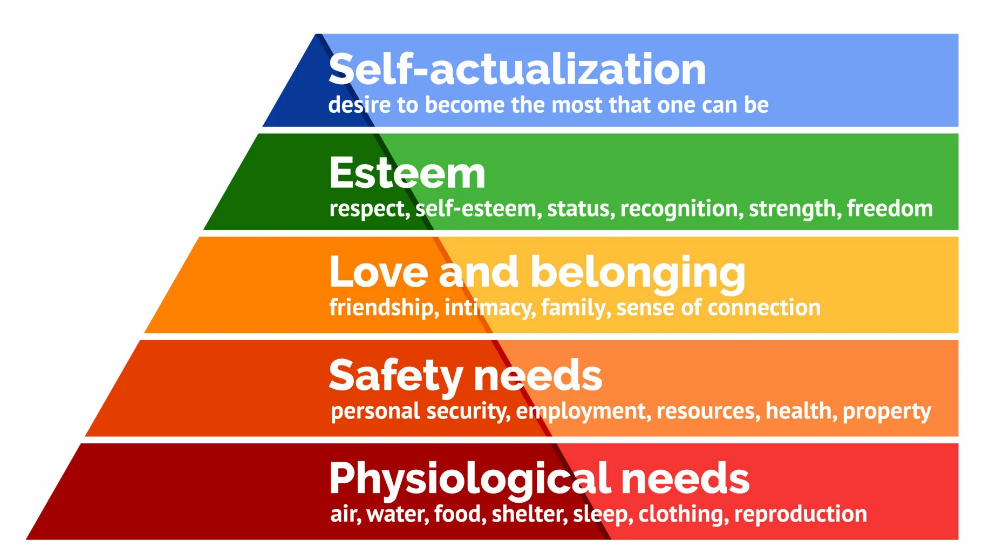
Maslow’s Hierarchy of Needs. Source: Simple Psychology
The rise of art therapy and the growing body of research on the psychological benefits of the arts might present one path for the arts to advocate alongside humanitarian efforts currently favored by EA. U.S. states piloting experimental healthcare programs incorporating arts prescriptions into health plans present an effective case for arts-related benefits beyond just aesthetic enjoyment (itself often studied for its mental health benefits). Massachusetts, with its CultureRX program, is demonstrating the advocacy potential for the arts beyond their native spheres of influence - whole-human health and wellbeing are not beyond the influence of the arts and should be considered within funders’ cause-prioritization methods.
Effective Altruism in Action: Cause Prioritization & Impact Evaluation
This systematization of cause-prioritization is not a new phenomenon but it may seem as though more thought and effort is being put into calculating the greatest return on investment per philanthropic dollars than ever before - a natural result of such thinking linked to effective altruism and utilitarian approaches to philanthropy. Those in the arts seeking to cultivate donations from grantees and donors that subscribe to such decision frameworks should know how they operate and how arts and cultural organizations can still compete under such models.
One example of a foundation institutionalizing this approach is Open Philanthropy, a foundation explicitly informed by effective altruism. Open Philanthropy frames their approach to grant-making as the social equivalent to optimizing an investment portfolio: With the goal of equalizing marginal returns among their giving portfolio, the organization seeks grant opportunities based around measures of importance to society, neglect among present funders, and tractability of the project (INT framework).
This economization of thought is not just relegated to philanthropy. An entire field of investing, impact investing, straddles the line between traditional financial investments and social enterprise as well.
Impact Investing may prove to be more inclusive of the arts than effective altruist approaches, with organizations like Upstart Co-Lab focusing their efforts entirely on investing and grant-making within the creative sector, as well as tapping cultural institutions with large endowments to make such investments themselves to align endowments with missions.
Regardless of the method for raising or investing funds, impact seems to have become an inescapable term within the nonprofit landscape - and perhaps rightfully so, given the socially relevant missions that nonprofit organizations strive to deliver. To play by the rules, effective altruists and impact investors now requires well-articulated data and evidence of impact to stand out, not only from other arts and cultural institutions but all of civil society.
A Crisis of Legitimation & The Rise of Cultural Indexing

Source: Unsplash
Whether to catch the attention of effective altruists or simply to better perform with more traditional funders, the need for data and legible metrics is being made apparent for arts and cultural nonprofits. Even if a funder is not explicitly subscribed to the philosophies of effective altruism, data and evidence have come to define the modern age of fundraising. In order to hold their own in this new environment defined by data-driven philanthropy, the arts are constantly given the quixotic task of quantifying the quality of programs in which they specialize. Quite simply, the rules of the game do not easily allow for the arts to play.
Measurements and empirical analysis of the arts and cultural sector have been attempted over and over again throughout the years, in part to better equip organizations for advocacy and in another part for benchmarking. For ten years, Americans for the Arts compiled a national Arts Index measuring a variety of data points from arts participation and production to educational statistics, such as annual graduation rates for arts degrees and demand for classes.
The merger of DataArts with SMU’s National Center for Arts Research in 2018 resulted in the national database now known as SMU DataArts. In addition to publishing research reports on a variety of issues within the arts sector, SMU DataArts also runs the Cultural Data Profile as a tool for arts nonprofits used both when applying for grants as well as to provide financial and programmatic data for advocacy purposes. The Arts Vibrancy Index is an annual dashboard published with the aim of communicating a county-by-county index of arts dollars, providers, and government support for the arts nationally.
The most recent initiative to “measure the arts” on a national scale is the National Arts Statistics and Evidence-Based Reporting Center (NASERC). Established in 2022 by the National Endowment for the Arts, NASERC developed the Arts Indicators Project which indexes a variety of data about artists and arts workers, participants, organizations, and education.
Out of Chaos… Come Consultants
Whether it be aggregate industrial indices like those published by NASERC or more niche accounting formulae developed by private consulting firms and think tanks, metrics seem to multiply so long as novel forms of interpretation are demanded by those seeking to fund the arts.
Beyond governments and think tanks, consulting firms specializing in nonprofit fundraising have been steadily expanding their scope and designing their own proprietary approaches to quantifying various aspects of cultural impact. Whether it be measurements like those published by AEA Consulting to communicate the social impact of the arts and cultural sector or multi-modal measurements of arts participation as proposed by Wolf Brown, the question they attempt to answer is always the same: how can arts and cultural nonprofits communicate their multifaceted and qualitative effects in terms of quantitative data as increasingly demanded by funders?
With this data-publication comes a new role for consultants: that of data brokers. No longer merely advisors and temporary problem solvers, consulting firms are now key players within the cultural information ecosystem, gathering information from client participants and aggregating their own research, knowledge production, and monetized publications to leverage for both increased credibility and to position as exclusive knowledge for sale.
This role of consulting firms as data-brokers reflects broader trends of information leakage and dissemination within a field; Consulting firms operate these business lines more successfully when there is less information flow within an industry and therefore greater demand for their data. Counter to this, when there is perfect information-spill across an industry there is theoretically no incentive for a secondary market for knowledge given the high frequency of labor and information sharing.
While the rise of consultants as data-brokers may aid in greater information-flow within an industry, monetization of such data can split the market into haves and have-nots, with organizations remaining dependent on consultants and unable to reestablish their own autonomy regarding data. Multiple alternatives exist, with funders having a unique opportunity to strengthen data cultures as well. While programs aimed at developing data-analytic capabilities are helpful, “these programmes should also foster partnerships between ACOs and tech companies to ensure the sustainability of the investments in the long-term.”
The modern topography of the institutional funding landscape for cultural nonprofit can now be clearly seen: in the struggle to balance paid programming with stakeholder donations, foundations and larger corporate funders can provide access to either general or project specific grants. These grants have become increasingly formalized over time, with ever-evolving demands for specific data from nonprofits.
Cultural Nonprofits have historically struggled to quantify their inherently qualitative product - often resorting to third party data and consultants for benchmarking, metric-development, and quantitative communication strategies in order to compete for grants. The risks of such dependencies are made clear through explorations of data disempowerment through drift and fragmentation, further perpetuating this deleterious cycle - a Sisyphean struggle.
New Frontiers for Cultivating Patrons - Digital Philanthropic Matchmaking Approaches

Source: Unsplash
Such dramatic shifts in 21st century approaches to philanthropy might appear to threaten the success of cultural organizations by cutting them out of the equation altogether. One method of survival appears to be adapting to the utilitarian views of these new funders through more specific data and broader positioning of the arts as beneficial to health, community, and the economy. While this adaptation might breed novel interpretations of the arts as beneficial social instruments, it continues to crowd out more models of patronage operating on purely aesthetic levels - the enjoyment of art for art's sake without needing to necessarily save the world. While this patronage model may encounter its own issues of dependency, an important question might be raised: how might the methods of soliciting grassroots patronage be evolving in the 21st century?
While not a singular answer, the development of new philanthropic platforms on which nonprofits can connect their missions and their programs to potential funders are being developed - often in online spaces across various forms of digital media. Whether it be the rise of DAFs as philanthropic social media platforms or the construction of foundation data collectives like the philanthropy data commons as spearheaded by the MacArthur Foundation, certain spaces are evolving with this 21st century hunger for data and market efficiency in mind. The development of such digital spaces intent on fostering information brokerage and financial transactions may best be understood through the lens of platform economics, a new model of platform philanthropy to some degree.
This new path is not without its benefits, and digital funding platforms have already demonstrated the ability to reconcile disparate philanthropic approaches across a market of diverse nonprofit initiatives. Research published in Management Science found a method of unifying both efficacy oriented donors with egoistically motivated donors on philanthropic crowdfunding platforms to both maximize donor utility as well as funds raised for listed projects. They found that both motivators tend to play a symbiotic role in fundraising, with ego-driven donors often more critical for raising initial funding for projects before any proven implementation, and with efficacy-minded donors helping to achieve the ultimate goal in the campaign’s last stages.
Therefore they find that by prioritizing the matching function of such platforms, maximizing funds raised over individual donor preferences actually opens the door to maximizing donor utility by providing more funding stages at which to donate, opening up opportunities for both passion-driven and outcome-driven philanthropists to engage in their preferred projects at their preferred stages.
In this way, philanthropic platforms that focus on solving the matching problem at the core of philanthropy can create a “rising tide to lift all boats” and potentially illuminate a third way to navigate between quantifiable outcomes and implicit social benefits. Organizations seeking funds maximize exposure to philanthropists whose values and giving philosophies best fit the project, and donors are in turn offered a large menu of projects in need of funding - similarly discovering their preferred recipients and now easily able to compare with others.
These developments point to a path leading beyond dependency on consultants or think tanks and beyond a need to appeal to an elite collection of philanthropic funders demanding bespoke data, intensive reporting, and regular re-approval. Effective navigation within emerging online spaces and platforms that connect nonprofits to a legion of donors may provide a path toward revitalizing the grassroots of philanthropy, incentivizing access and mutual aid over top-down demands and tournament style competitions for funding. By maximizing philanthropic connectivity at its core and promoting the act of giving carte blanche, all causes can benefit and, hopefully, all of society too.
-
Emma Goldberg, “What If Charity Shouldn’t Be Optimized?,” The New York Times, December 7, 2024, sec. Business, https://www.nytimes.com/2024/12/07/business/charity-holiday-giving-optimized.html;
“Upstart Co-Lab,” accessed 2025, https://upstartco-lab.org/about-upstart-co-lab/;
Dylan Matthews, “The Problem with US Charity Is That It’s Not Effective Enough,” Vox, December 11, 2024, https://www.vox.com/future-perfect/390458/charity-america-effective-altruism-local;
“The Literature Review of Platform Economy - Xue - 2020 - Scientific Programming - Wiley Online Library,” 2020. https://onlinelibrary.wiley.com/doi/10.1155/2020/8877128;
“The Cultural Data Profile. DataArts,” DataArts, accessed 2025, https://culturaldata.org/what-we-do/for-arts-cultural-organizations/the-cultural-data-profile/;
“State of the Arts 2024: Arts Vibrancy Rankings for All 50 States. DataArts,” DataArts, accessed 2025, https://www.culturaldata.org/state-of-the-arts-2024/overview/;
Emily Oehlsen, “Philanthropic Cause Prioritization,” The Journal of Economic Perspectives 38, no. 2 (2024): 63–82;
Mariagiovanna Baccara, “Outsourcing, Information Leakage, and Consulting Firms,” The RAND Journal of Economics 38, no. 1 (2007): 269–89;
“Measuring the Impact of the Nonprofit Sector on Society Is Probably Impossible but Possibly Useful | SpringerLink,” 2002. https://link.springer.com/chapter/10.1007/978-1-4615-0533-4_15;
Yicheng Song, Zhuoxin Li, and Nachiketa Sahoo, “Matching Returning Donors to Projects on Philanthropic Crowdfunding Platforms,” Management Science 68, no. 1 (January 2022): 355–75, https://doi.org/10.1287/mnsc.2020.3930;
“Google Books Ngram Viewer,” accessed 2025, https://books.google.com/ngrams;
“Five Years of Arts Research Innovation: Celebrating SMU DataArts’ Milestone Merger Anniversary. DataArts,” DataArts, October 2023, https://www.culturaldata.org/learn/data-at-work/2023/five-year-merger-anniversary/;
Massimiliano Nuccio and Enrico and Bertacchini, “Data-Driven Arts and Cultural Organizations: Opportunity or Chimera?,” European Planning Studies 30, no. 9 (September 2, 2022): 1638–55, https://doi.org/10.1080/09654313.2021.1916443;
“Data Cultures Part II: Breaking Free from the Cycle of Disempowerment,” AMT Lab @ CMU, November 9, 2024, https://amt-lab.org/blog/2024/11/data-cultures-breaking-free-from-the-cycle-of-disempowerment;
“Crafting Grant Narratives - Approaches to Justifying Arts Funding — AMT Lab @ CMU,” January 14, 2025, https://amt-lab.org/blog/2025/1/crafting-grant-narratives-approaches-to-justifying-arts-funding;
“Arts Index | Americans for the Arts,” accessed April 26, 2025, https://www.americansforthearts.org/by-program/reports-and-data/research-studies-publications/arts-index;
“Arts Funding—Is Direct Public Funding for the Arts Worth the Headache?,” The Nightingale’s Sonata, December 3, 2024, https://www.nightingalessonata.com/blog/2024/11/26/arts-funding-is-direct-public-funding-for-the-arts-worth-the-headache;
“An Open-Data Approach to Transform Grantmaking,” accessed April 26, 2025, https://ssir.org/articles/entry/an_open_data_approach_to_transform_grantmaking.