Let us not forget the artists...

As we concentrate on the many ways arts managers are using technology innovatively, we should not ignore the fact that artists are also taking advantage of technology. A recent 'Wired' article features the Edgetone Music Summit, a four-day San Fransisco Bay event dedicated to experimental sound.

This might be my inner old man talking, but I'm wondering if a lot of technology-based "music" isn't just noise.

Read the full 'Wired' article.

What is the cost of saving art?

In 2001, the Taliban destroyed two 1,500 year old stone Buddhas in Bamiyan. Five years later, UNESCO is proposing to rebuild the statues at an estimated cost of $30 million each. In case you are not familiar with this story, you can read more in an article featured in the Washington Post earlier this week. Several thoughts and emotions ran through my mind as I read this article. First and foremost, I was disgusted at the violent destruction that took place in the Bamiyan valley. It is beyond my comprehension to understand how humans can completely disregard the sanctity of a site and crush the culture and religion of a group of people. But there are far worse crimes against humanity happening all over the world, and so I continued to search for more articles on the stone statues.

My disgust quickly turned to despair. There are two sides to every story, and Mullah Mohammed Omar, then leader of the Taliban, has his own reasons for destroying the statues. He claims to have ordered the destruction of the statues after he was refused foreign aid for food and medical attention. Instead, money was offered solely for the conservation of the statues. You can read more about the Taliban side in an article posted by the Asia Society on Asia Source.

We may never know or understand why the statues were destroyed, however I think the bigger issue is figuring out where the people of Afghanistan go from here. I wonder if spending $30 million dollars to try to put the pieces of a statue back together is the smartest and most favorable decision. My opinion is that the money would be better spent on food, agricultural tools and medical facilities. Rather than funnel millions of dollars into the preservation of an object, why not prepare the people of the Bamiyan valley for a more stable future? I understand the need to preserve art, particularly that which reflects cultures long gone. At this point, however, the residents in the Bamiyan valley are also on the verge of disappearing. And I think preserving their lives is more important than putting back the pieces of a statue.

Guess What Else is Turning TEN!

Flash is turning ten, just like CAMT! Flash is an animation and graphics software product used to create movies and animation for web pages. Flash can be used to create advertisements, games, or other eye-catching elements to make a web page more interactive.

Originally Flash was developed by Macromedia, but was acquired by Adobe in 2005.

Read the article here from wired.com, or visit Adobe's microsite commemorating Flash's tenth birthday.

HAPPY BIRTHDAY TO YOU... HAPPY BIRTHDAY TO YOU!

Thank you, Pair Networks and N-TEN

I am pleased to announce that Pair Networks has joined the PA Council of the Arts as a sponsor of Technology in the Arts, and that N-TEN will have a table at the conference.

Pair Networks is a Web hosting firm based in Pittsburgh that houses thousands of Web sites from all over the world. We are delighted to be included amongst the prestigious Web sites and organizations sponsored by Pair.

N-TEN is a service organization for the non-profit technology field. In addition to their fabulous annual conference, they offer seminars, webinars, online affinity groups and more. Another N-TEN connection with Technology in the Arts: executive director Katrin Verclas will be speaking at the conference on Beth Kanter’s panel about IT resources for small non-profit arts organizations.

We are very appreciative of the generous support of these organizations. Thank you.

Diary of a Server Move

As many of you know, CAMT moved most of its servers and upgraded systems over the weekend to provide a more sustainable network. We strive to offer our partner organizations nearly 100 percent uptime, and co-locating our servers so our hosted sites are accessible in the event of a power failure is a major step towards achieving that goal. The following is my log of the day's events:

7:05 AM - Guillermo and I arrive at the CAMT offices on the campus of Carnegie Mellon. It is one of those beautiful Saturdays that are rare to Western Pennsylvania... no rain, no humidity, blue skies. You know, perfect weather for sitting inside and staring at computer screens all day.

Melody was at the office until 8:30 PM last night, and she came in at 4:30 this morning to get a head start. She looks cranky. She needs coffee.

7:30 AM - The CMU IT reps show up to move our servers. This process is complicated by the fact that Melody has to set up a router in our office and make sure the servers communicate with us once they're in their new home. Otherwise, the servers would have to be assigned new IP addresses, which would mean days or weeks of downtime for our clients.

8:00 AM - There is still no coffee. Somehow, I had expected it to magically appear, but it doesn't look as though that's going to happen.

"Gosh, in the four hours that you've been here already this morning, I would have thought you could at least get some coffee," I joke with Melody. She is not amused. I head to Starbuck's to feed the corporate monster and our caffeine addictions.

8:45 AM - Everyone's computers are able to connect to the network but mine. I complain to Melody and Guillermo that I'd really like to read celebrity gossip Web sites while I drink my coffee and eat my donut. My cries fall on deaf ears... or maybe they're just ignoring me.

9:10 AM - As is to be expected of all technology endeavors, there are a few snags. We run afoul of several of Murphy's Laws, and the servers are hiding from us. If I had a time machine, I would travel back in time and smack Murphy. Unfortunately, the building of the official CAMT time machine has been postponed until after the server move.

Melody and Guillermo are talking about Spanky, Alfalfa, Pickle and Porky. I think they've lost their minds, but it turns out that these are the nicknames for some of our servers.

9:30 AM - I still cannot connect to the Internet. Melody informs me that I am not today's top priority. I am simply flabbergasted.

10:15 AM - My computer is finally connecting to the Internet! Paris Hilton is up to no good, as usual.

11:30 AM - Guillermo is configuring DNS settings for our servers. For those who don't know, DNS is short for Domain Name Server/System/Service. DNS translates domain names into IP addresses and vice-versa. While everyone is most familiar with URLs like www.google.com and www.yahoo.com, these domain names are all associated with IP addresses, such as 198.105.232.4.

Noon - When routers attack! We experienced a brief moment of panic when the router at CAMT and the router at the new server location were refusing to communicate. I quell everyone's panic by blowing bubbles. This is the extent of my contribution thus far, but let us not downplay the importance of bubbles during a crisis.
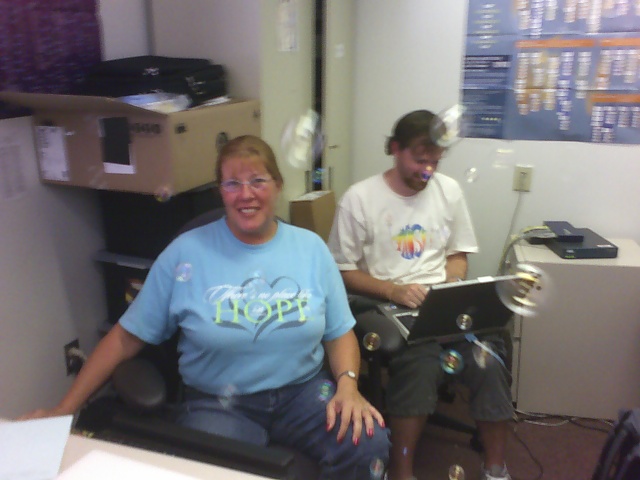
Bubbles Pretty bubbles ease the stress.

12:45 PM - Eureka! It seems that one tiny, miniscule setting was incorrect, and it was the root of all our problems. I blow more bubbles, but the novelty is beginning to wear off.
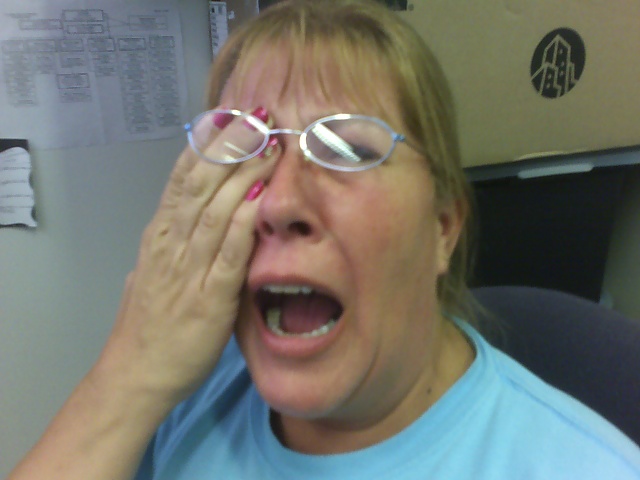
Stinging Note to self: Do not blow bubbles directly into the eyes of the systems administrator.

Fortunately, we were able to correct the routing issue quickly, but it's often the case with technology projects that the smallest mistakes cause hours of agony.

1:20 PM - Once again, my expertise pays off in a big way; I am the only one equipped to handle the intricacies of our lunch order. Very important - Guillermo does not want mayo. If this step of the server move is botched, we could lose precious time waiting for him to scrape his bun clean.
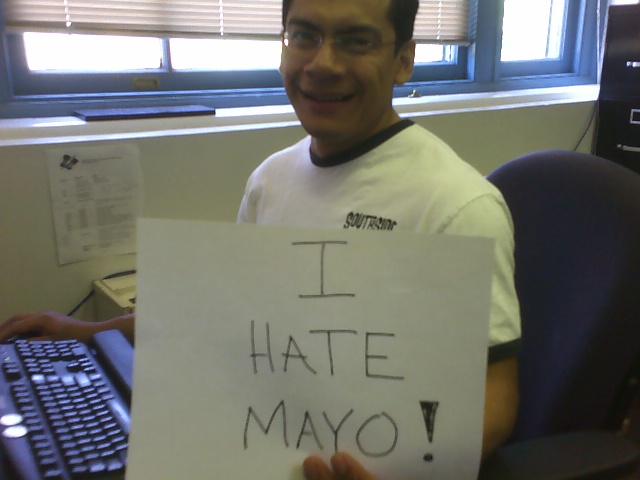
No Mayo! Guillermo hates mayo. Is this absolutely clear?

While we wait on our lunch delivery, Melody and Guillermo settle in to spend the next hour or two configuring our new routers to allow the appropriate traffic into and out of our network, while blocking unauthorized access.

2:00 PM - Uh oh! The entire Carnegie Mellon network is down because of a water leak at the institution's Internet Service provider. Unless it comes back up soon, we will have no way to test our settings and changes.

3:00 PM - Just in the nick of time, the CMU network is back up and Melody and Guillermo have finished modifying the router settings. We have started our testing of client sites, and it appears that everything is up and running.

It was a long and hectic day, but we learned a little about ourselves, a lot about each other and nothing about dinosaurs or hydrogen fuel cells.

My Computer is My Best Friend

An article, reporting on a survey by the woman friendly Oxygen network, shows some very interesting and long overdue trends with woman and technology. ”Diamonds are no longer a girl's best friend, according to a new U.S. study that found three of four women would prefer a new plasma TV to a diamond necklace.” More and more women are buying and using technology. Read the article here.

Although I must question if owning a technological device is the same as understanding how to utilize the device and how the device works. Using a computer to write email and to surf the Internet is very different then writing code or designing web pages.

Even though a plasma screen TV is tempting, I think I would pick the diamond necklace. I have to think about the long-term benefits. While the plasma TV is more entertaining, it will almost worthless in twenty years. Technology advances so fast that my new plasma TV will soon be ancient technology. On the other hand, the diamond necklace will not wear out and retain its value for years. Unless, they find a cheap way to mass-produce diamonds, which is possibility, again the endless technological advances.

Arts and culture boosting local economy

Lately there seems to be an abundance of attention focused on the impact of arts and culture on local economy. I thought I would share a couple of articles I found on the Cultural Commons Web site: Think tank promotes arts as an economic draw Detroit Free Press, 7/23/2006

Creativity seen as economic key Toronto Star, 7/25/2006

This is a trend I saw in a couple of Texas cities. In 2003, the city of Dallas announced plans for the Dallas Center for the Performing Arts, an amazing collection of venues in the Arts District of downtown Dallas. Indeed 2003 was a great year for Dallas as it also marked the opening of the Latino Cultural Center and the Nasher Sculpture Center.

The sleepy town of Marfa in West Texas credits its economic revival through arts to Donald Judd. You can read more about it on TravelandLeisure.com.

Finally, I must mention Austin, my favorite city to visit in Texas. Earlier this year, the Blanton Museum of Art celebrated the grand opening of its new building with an incredible attendance of 13,000 people. Thousands of visitors also flock to the capital city every spring for South by Southwest (SXSW), an annual film and music festival in its thirteenth year. If you are looking for something off the beaten path and have some vacation time, I highly recommend visiting any of these cities.

Interpreting Culture, part 1

When I think about the skills required to “read” artistic messages I always go back to the late French sociologist Pierre Bourdieu’s idea of “cultural capital.” Bourdieu’s notion is essentially that in the marketplace of identity, individuals build up a kind of capital that enables them to be understood by and communicate with other members of their “class." His long-term qualitative and quantitative study of the French has led him to several conclusions around this idea, especially as it relates to education and parents’ vocation as a predictor of cultural capital. Bourdieu holds that all cultural taste results from “the unintentional learning made possible by a disposition acquired through domestic or scholastic inculcation of legitimate culture.” In other words, “legitimate culture” or “high art” can only be taught and conveyed through proper socialization. Bourdieu’s idea is in line with empirical studies like Richard Orend’s 1989 study for the NEA that draws statistical correlations between arts attendance and socialization in the arts.

Bourdieu argues that as cultural taste develops, viewers become increasingly able to digest abstract ideas and symbols. An individual who has high “cultural capital” will not only be able to interpret and understand the kinds of artifacts and experiences available through the mediation of cultural institutions but will also enjoy them more. Again, Bourdieu: “The generalizing tendency is inscribed in the very principle of the disposition to recognize legitimate works, a propensity and capacity to recognize their legitimacy and perceive them as worthy of admiration in themselves.”

In the Knowledge Age, the relationship between production and consumption is shifting. Ease of communication has broken down barriers such that two folks in an Indiana can start a business, be in touch with a manufacturing plant in Guangzhou, China, and then have their products delivered directly to clients in Berlin, Germany.

As production of consumer goods becomes increasingly decentralized, so, too is the production of cultural goods. How do we determine what, in Bourdieu’s terminology, is “legitimate” and what’s not? What is the role of cultural institutions in creating these distinctions? How do we maintain our relevance in the face of relativity?

What exactly is RSS?

Often when people talk about RSS, others simply nod knowingly but have no real idea what they're nodding about. I've discovered that a great deal of people are lost when it comes to RSS and how the technology works. It's actually quite simple (and very cool), so I thought I'd break down the barrier by providing some info and a few helpful links. RSS - or Rich Site Summary - is an easy way to distribute news and other content on the Web.

For instance, if you have eight blogs and three news sites you follow regularly, you can download an aggregator to follow all your favorite content from one convenient digital location.

Getting started:

1. Download a news aggregator. Most are free, and here is the one I use and like for its simplicity.

2. Visit your favorite blogs and/or news sites and find their RSS addresses. For instance, here is CNN's RSS page.

3. Subscribe to the RSS URL by following the instructions provided by your aggregator.

Here is a very helpful page with a nice overview of RSS and aggregators.

You can use the Technology in the Arts blog RSS URL to test yourself. The URL is: "http://technologyinthearts.org/?feed=rss2." Copy the link and subscribe to our blog using your new RSS reader.

Peace of mind is so cheap these days...

I read an article on CNN.com today about an online data backup service called Carbonite, undoubtedly named after the substance in which Han Solo was frozen in the original Star Wars trilogy. (I'm so nerdy, I just might cry.) For $5 per month, users can back up an unlimited amount of data. Though this solution might not be ideal for large organizations requiring an extensive disaster recovery plan, Carbonite seems like the perfect fit for small arts organizations requiring an inexpensive way to ensure the safety of their valuable data.

Read the full CNN article about Carbonite and other online backup solutions here.

Check out the Carbonite Web site.

It's easy!

Do you notice anything different with today's post? Let me give you some hints. I used a word processor, but it wasn't designed by Microsoft. I was able to write, edit, and spell check this document with one on line tool. I used ZohoWriter.

ZohoWriter is an on line word processor with many added features. You can create a document, format it, and edit it (with spell check) all on line with ZohoWriter's WYSIWIG editor. Once you created a document you can access it and share it with others from anywhere. All you need is your Internet browser, thus less emails with attachments to keep track of. To keep your documents private just lock them while they're in shared mode. When you are done you can export your documents in different formats such as word, txt, html, or pdf. ZohoWriter even periodically saves your documents so they don't get lost when your PC decides that it wants to shut down by itself.

ZohoWriter can also post a document directly to your blog. No more editing in one application just to cut and paste to another.

It's all so easy! Yay!

Not just tech geeks...

I thought I'd post a picture of myself as Peter Ingleton from the Noel Coward play "Relative Values," running through Saturday with the Summer Company here in Pittsburgh. This post is meant to do two things: 1) Provide proof of how charmingly self-deprecating I am and 2) remind the world that the CAMT staff is not just a bunch of tech geeks. Most of us are artists first and IT professionals second, which helps us understand the goals and needs of arts organizations and their constituents.

So here it is... Brad Stephenson as a dandy fop:

Brad as a Dandy

The CAMT staff has had a lot of fun ridiculing my tiny moustache these past few weeks. I plan to shave it immediately after curtain call on Saturday.

UPDATE - SUNDAY, JULY 23

The silly moustache is gone. Good night.

Registration and Scholarships are Live

Online registration for Technology in the Arts is now live! Register by August 20 to take advantage of the early bird rate.

Also, if you or your arts organization is based in the state of Pennsylvania, you are eligible to apply for both registration and travel scholarships for the conference, thanks to the generosity of the Pennsylvania Council on the Arts.

Carnegie Museum of Art in New York Times

More great reasons to visit Pittsburgh this fall...the museums, pleasant autumn weather, and Technology in the Arts. For our out of town guests, sadly you'll miss the exhibition “Fierce Friends: Artists and Animals, 1750-1900” featured in the New York Times this week, but you will have an amazing choice of exhibitions to explore if you so desire. The Carnegie Museum of Art and Museum of Natural History are less than a five minute walk away from the Carnegie Mellon University campus. You can read more about upcoming exhibitions by clicking one of these links:

Carnegie Museum of Art schedule of exhibitions

Carnegie Museum of Natural History schedule of exhibitions

Or if you prefer to sit in a quiet area and decompress, visit the main branch of the Carnegie Library, also within walking distance from the conference.

As an aside, I'm from Texas where there are only two seasons: "humid" and "hot". Fall is a great time to be in the 'Burgh, especially for those of us from warmer climates...who knew seasons actually changed?! Last October, I saw for the first time in my life the changing of seasons from summer to autumn. It was a truly amazing display of color and shape, and perhaps something taken for granted by people who have seen it many times. May this October in Pittsburgh also bring you unexpected beauty.

Online Art Communities- Sales or Support?

Interact with Other Artists / Buy & Sell Artwork Like Never Before The Vision Grove is more than an online art gallery. Here you can also get involved in a vibrant art community and interact with artists and buyers from all over the world.

It begins with the above subheading... emphasizing the community aspect of the site, but then the release continues to inflate the sales potential of an online gallery. Although I understand the that the E.D. is directing his business to attract people interested in sales, the mission on his website seems to suggest the opposite:

From the press release: "The reasoning behind using art communities is fairly obvious: absolutely no pressure, gorgeous original art for sale, and instant connections with top-quality buyers and sellers."

From "Our Philosophy," it doesn't mention the sales opportunities once... It references an idea of growth.

I think this person is making the mistake of focusing on sales. The sales will happen through networking... but I doubt online. Art is about a tranformative experience. I cannot fathom the idea of buying a piece of art without having it in front of my face. Moreover, lots of artists like to establish relationships with the people they sell to, and vice versa. Art enthusiasts bask in a glory of superstarness when they can say they "know" the artist. Will this be accomplished over a web portal? I doubt it.

The website is sophisticated and clean... a rendition of a visual artist MySpace. The E.D. should generate enthusiasm about the aspect of networking and community and let the sales happen on their own. Web art communities are great and I think tech-saavy artists would really embrace this type of support. If it develops organically and with integrity, website advertisers will find their niche as it's represented on the site- not as it's projected.

What other web art communities are out there? Could we do something like this locally, with each arts agency acting as a host... beyond artist rosters?Š

Your English professor will catch you!

With the incredible amount of content on the web how do we know if we’re just repeating ourselves? The Internet has given many a chance to publish their thoughts in a public forum where many were never able to before. It’s become easy to publish a blog or a personal web page with services such as My Space or Word Press. With as much content on the web there has to be a blog or two or a web page or two where the content is similar or almost identical. It may be highly improbable, but can it happen? What I really wonder is, can my brief ramblings I posted on a blog end up in someone’s term paper or book report? I don’t claim to be an expert on anything you would want to turn in to your English professor, but I would find it humorous and a bit incredible.

Here’s an interesting article I found on the high tech battle on plagiarism.

Don’t copy any of this without proper citations. Your English professor will catch you.