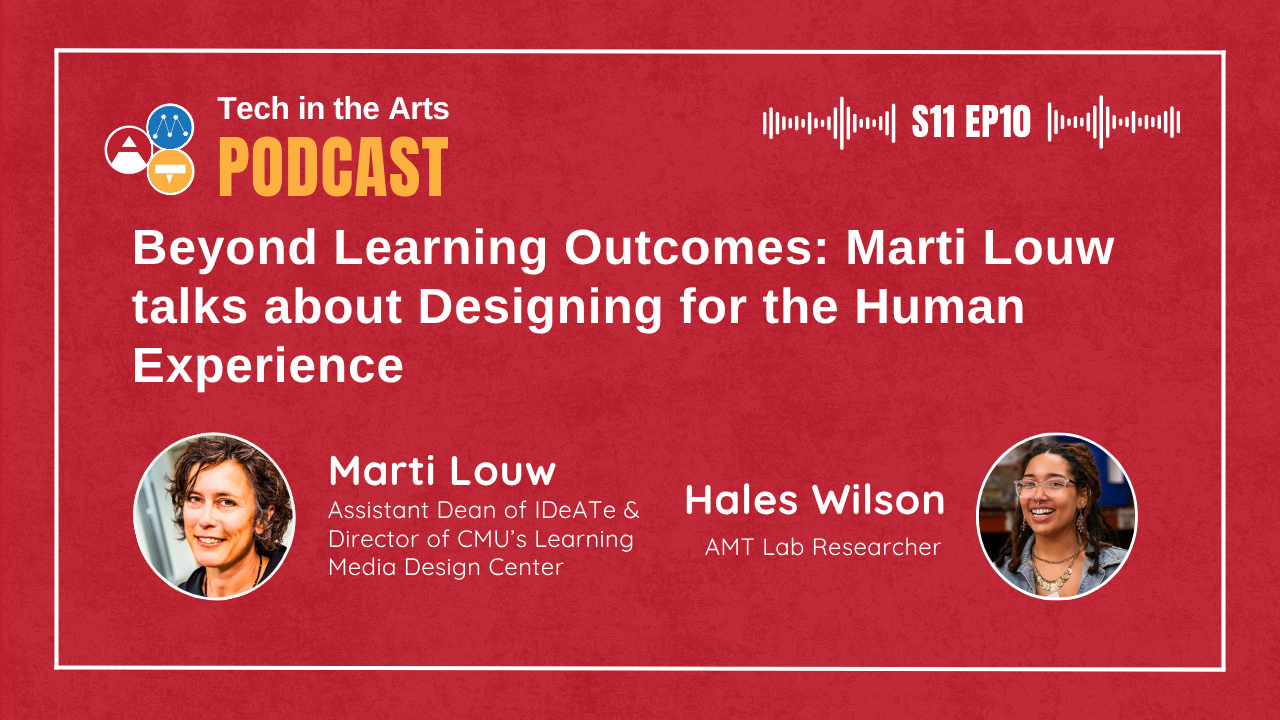
In this episode of the Arts Management and Technology Lab, Hales Wilson speaks with Marti Louw, design-based researcher and co-director of Learning Sciences for Innovators, about the intersection of learning sciences, educational technology, and human-centered design. Drawing on her background in media, museums, and interaction design, Marti discusses how interdisciplinary approaches shape learning experiences, the challenges of scaling EdTech globally, and the importance of cultural relevance in educational innovation. She also reflects on the emerging role of AI in education, emphasizing the need for careful, research-driven implementation to ensure equitable and meaningful learning outcomes.
Show Notes
Transcript
Marti Louw
I think there's just a lot of complexities to get worked out in the use of AI and education, and we're seeing sort of small, bright spots of success in limited ways, but a wholesale kind of translation of curriculums and pushing through entire populations of students. Through AI-generated curriculum, it is probably not where we're at yet.
Hales Wilson
Welcome to another episode of Tech in the Arts, the podcast series from the Arts Management and Technology Laboratory at Carnegie Mellon University. My name is Hales Wilson, the lead researcher at AMT Lab. Today I'm joined by a design-based researcher and co-director of the Learning Sciences for Innovators, Marti Louw.
She's a faculty member in the Human Computer Interaction Institute at Carnegie Mellon University, where she directs the Learning Media Design Center. She also serves as the Assistant Dean of Curriculum for the Integrative Design, Arts and Technology IDeAte Network. She also teaches the Masters of Educational Technology and Applied Learning Sciences and Undergraduate IDeAte, Design for Learning Minor programs.
While there is much to gain in this conversation about all that she does today we'll be focusing on her work with the Learning Sciences for Innovators Program. It is a flagship initiative with CMU Africa in partnership with the MasterCard Foundation. It is designed to bridge the gap between academic research and research in the learning sciences and a practical need for the EdTech industry, specifically within the African context.
The program’s primary goal is to help growth stage companies and EdTech entrepreneurs refine and scale their products using evidence-based methods by applying human-centered design and data-driven analysis. LSFI aims to ensure that educational technologies are not disengaging, also demonstrably effective for learners.
So before we get into the weeds of the Learning Sciences for Innovators program. Could you go into a little bit how your background as a designer may influence the way you think about how people learn?
Marti Louw
I don't come from an educational research or a traditional kind of learning sciences background. Both a lot of sort of practical experience that kind of drove me towards educational research and design. And so I spent the first, probably, 10 years of my life right after college in television and film and documentary. And my first job out of college actually was a youth and families program at the Science Museum of Minnesota.
And while I was working there, a local public television program came in and was filming the assembly of a dinosaur there. And I got really excited 'cause I'd been doing film studies and work in college. Got interested in this idea of children's television and documentaries, and basically television is an educational medium, which sort of started this trajectory.
I ended up working for about five years in New York for a Japanese production. I speak Japanese pretty fluently in news and television and documentary, and then I moved up to Boston and started working for a production company there that did a combination of both broadcast as well as museum. Exhibit design, particularly in that case, interactive media in the early days of interactivity was LA laser desk space, but it was kind of a form of early interactivity and ended up working at WGBH in the science unit on the NOVA program as well as sort of a special program we do.
And around that time, the internet started emerging as a companion to the broadcast. That became this really interesting medium for games and ancillary material and putting out resources for teachers and educators, and that was starting to shape my interest. It was at that point, like I actually decided to come back to school and was really interested in interactive media as both for education and engagement.
That's when it came to CMU. I did a master's in our interaction design program here at the School of Design, and during that work I became really interested in learning and how we design for it. And I subsequently went over to the University of Pittsburgh to the Learning Research and Development Center and worked for about 10 years at the Center for Learning and Out of School Environments with Dr. Kevin Crowley and started writing grants and really building a research base to inform the design of, of learning experiences.
And so I guess to answer that, that's a long way around answering your question. I come from a very practical and a design-based approach, and I see a lot of value to learning research, but trying to figure out ways to take what we know from a research and theory base and let it inform, but not weigh down the design process.
Because I think there's always this tension in the creation really, even if it's online courseware or educational media or exhibit designs or play based kind of engagements, is how do we choose the learning goals and do they come first? Do we backwards design them or do we think first about the human experience and the storytelling and the narrative?
And then kind of lead our way into the learning goals. And you different people will argue different ways. Because of my training and background, I started a little bit more open-ended and a little bit less focused on the learning outcomes initially and more focused on the narrative. So I would say that's probably one of the ways in which my background shapes how I think about research.
Hales Wilson
Thank you. I didn't realize how extended your background with working specifically in organizations and institutions like museums are. So that kind of leads me to my next question. Yeah, so the Learning Science for Innovators program seems like a natural extension of much of the work you do with learning in science and museums.
Could you talk a little bit about your journey specifically through EdTech and how the Innovators Program pulls from both your human computer interaction and media background?
Marti Louw
So the Learning Science for Innovators program that you described earlier is really building on a strength at Carnegie Mellon in education and learning and computational approaches to really trying to understand both the human mind expertise and how we sort of support robust kinds of learning outcomes using data and evidence.
And so CMU has been for a long time pioneering kind of complex computer systems and using data and really exploring how to support learning with technology. We are learning sciences. It's not a department, but it's situated within the Human Computer Interaction Institute of Learning Design and, and computers because educational research focuses a lot on educational impacts and outcomes.
And HCI brings. A lot of these concerns of humans, the humans and usability and psychology and human factors, and some of these other kinds of fields blend because learning is such a complex human phenomenon. It's embodied, it's cognitive, it's social and effective. And so it is truly interdisciplinary.
And so I think CMU and HCI are really well positioned to think about how to bring technology to under-resourced learning environments. And so one of the challenges we see both here in the US and in many countries, including many countries in Africa, is just a lot of first, a lack of trained instructors who are having trouble in many parts of the world, having enough teachers and educators and structures in place to meet the demands and needs of young populations and in these environments where they're low resource in terms of spaces and just the learning materials.
There's not yet enough trained instructors. What is the role technology can play? What I really like about this program is that it's not us coming to tell or do the technology. There's so many kinds of global technologies that get pushed into emerging economies. The intent of this program is to really work with local entrepreneurs who know their cultures.
They know their school districts, they know their schooling systems. They know their. National curricula. They know all, all the nuances of, of these very complex countries that often have multiple kinds of home languages. Very, very different cultures, different religions, and, and creating learning materials that are culturally relevant is not, I think, really different, difficult for outsiders to do.
So our goal is to go in and work with EdTech incubators or hubs that bring together every year a cohort of 12, 12 companies that have been selected as either as growth stage and really ready to scale. And we bring aspects of our metals curriculum, so our Masters of Educational Technology and applied learning sciences aspects of our HCI curriculum and really work with these entrepreneurs and their teams to upskill and try and help create them, just improve them products and, and achieve their kind of both commercial bit as well.
Educational goals and make sure that the products are continued to prove.
Hales Wilson
I appreciate you bringing up that point about some of the disparities that are happening in education just overall, and that kind of bleeds me into my next question. One of the interests that I have, especially after taking our technology transforming the arts class, that's like our work, bridge in the arts management world. I really got into this interest of AI and how it's impacting K through 12 education. And I know that one of the courses offered now is AI and education from foundations to innovations, which provides a full overview of how AI works from basic machine learning concepts to generative AI and teaches us how to apply these tools to design, build, and improve educational technology and learning experiences.What responsibility do you feel that designers and developers have when building AI systems that impact real people's opportunities for outcomes?
Marti Louw
Without being a technology Luddite, I think one has to be really, really careful about when and how and why to integrate AI mechanisms and AI layers into educational technology, and it is one of the things that we're struggling with.
There's obviously a rush to, especially if you're an entrepreneur, to layer in an AI component. I think it's especially challenging when we think about doing the work and the use of these models in context, like on the continent where these models have not been trained. There's not a lot of cultural relevance.
It's kind of a normal normalization and a reduction of culture in a way that we're involving these kids in. On the one hand, you can see ready access to information that's been so difficult to access is a wonderful thing. How do we check that? The accuracy of it, the accountability of it. I think there's just a lot of complexities to get worked out in the use of AI and education and we're seeing sort of small, bright spots of success in limited ways, but wholesale kind of translation of curriculums and pushing through entire populations of students through AI generated curriculum is, is probably not where we're at yet.
And so I think it's very much in an exploratory stage and trying to understand what's working and really truly spending the time to research and understand what's positively and what's also negatively impacting learners and not disenfranchising those kind of, especially at the margins, the women or young girls, as we rush forward to just adopt AI.
Hales Wilson
Thank you for that cause I know sometimes when we have an AI discussion, especially like in different courses and people coming in, it's like a situation where like AI, yes, it's of the future. We better just get on board with it before it passes us by. But I appreciate you bringing in that point of like having to like, okay, but let's kind of assess the situations where it's at now and trying to almost, I guess, meet people where they're at before pushing this new concept and technology onto them,
Marti Louw
It's like it can, things can be designed well and not well. And there's ways in which, and the researchers starting to come out that used inappropriately AI can, you know, cognitively stunt intellectual development and shut down questioning and exploration and inquiry and a lot of things we know about how the human mind works.
And so, you know, being really, really careful before we deploy at scale. And over time is important and the responsibility of those of us in not just the EdTech research, but the people who are pushing it out into the world.
Hales Wilson
On that, I kind of want to move, as I said, the technology's not my area of expertise, truly. So I kind of wanna move into maybe some of the more management aspects, specifically like the donor ecosystems that went into this project. So, as we said earlier, Learning Science for Innovators is a Carnegie Mellon University Africa initiative as well as being in partnership with the MasterCard Foundation.
But some additional partners include the Co-creation Hub, Adventures, Entry Labs, and Hive Colab Are there any ways that partnerships have changed the direction of the program? Maybe, um, in who you serve, what you teach, or how you deliver it?
Marti Louw
Yeah, absolutely. I mean, from the get go, this was positioned as knowledge co-creation and a participial kind of process.While it is funded by the MasterCard Foundation, we're working with nonprofits for the most part, or hubs in each of the countries. And in working with each of the hubs, different needs and things have emerged. So, for example, in Tanzania, their hub was really seeing a need to make sure that the fellows or the EdTech entrepreneurs.
We're really adopting and valuing usability early on in the EdTech, in the testing process, and making sure that you were testing not just with private schools, but also public schools and with learners. With different kinds of abilities and with learning kinds of resources. So, you know, with them we've developed a kind of usability test bed model as a way to kind of upskill folks on how do you do rapid and effective usability testing and use that to kind of feedback into your development cycle and making sure that your designs are at many, kind of taking the temperature of your designs with learners at many points along the way.
And doing it in a way that's cost effective and still allows you to move rapidly to market. That's kind of an example of you, I guess you're asking about each of the countries. We're working in West Africa as well too, with francophone speaking countries and so. There's a lot around translation and making sure our materials are meeting the needs of folks who are Arabic speaking or French speaking, which of course, you know, getting down in the weeds of what making examples and materials linguistically and culturally relevant is something that we work a lot with our partners with and there to improve the work.
Hales Wilson
And then with the sustainable ed tech program, you're man, and with managing this major like international partnership, what has that experience taught you about scaling this like CMU born idea into a global context while keeping like funding and management sustainable?
Marti Louw
I think the way I would answer that, and that's not just specific to this project, but kind of in general, one of the challenges. I think university based projects of this, you know, big large scale center level kinds of work do is I think academics and I think university and the students and the people that ended up working on the projects are so ambitious and have so many ideas and there's a constant kind of new and more, cause there's a lot of reflection.
And I think one of the challenges with these kinds of things is to keep them scoped. And to keep them manageable and not keep letting every new idea kind of drag the focus and get beyond what actually the resources of the team are. And so we're constantly having to rebalance and look at what are the priorities and what are the impacts, and trying to not do that based on intuition, but work with evaluation both kind of process as well as external evaluation to check on like are we really keeping our eyes on the prize and, and delivering on the things that matter most? And so I think that's really important is both scope creep, not overpromising, and then having some sort of reflective evaluative process on what you're doing, you know, as a team, pretty periodically.
Hales Wilson
Thank you, and it actually kind of answered my second question about whether when you're kind of cultivating this pitch or like this project or like helping build technology, are you more focused? And I think you mentioned this earlier on, this human centered impact.
Marti Louw
To me, those things are so deeply entwined that learner impact and human impact are like, both have to be in first position. You know, you could just be showing cognitive outcomes. People, if they drill and skill on some sort of adaptive tutor that they can increase their outcomes or like they're doing better on a math unit or something, which is fantastic as a learning outcome.
But if you haven't thought about that learner and why they're showing up and what they're trying to accomplish, and if their day becomes just one long series of drills and skills on cognitive tutors. You're gonna lose the learner's motivation and interest and willingness to come participate in these experiences.
And so I think we have to think about the totality and the ecosystem, the learner experience and the learning ecosystem, and the sort of multiplicity of kinds of learning experiences, the human peer learning, the use of technology, the not being on the tools and things like that. And really design, for a whole learner experience.
So both learning outcomes, human motivation and human aesthetics, you know, the stories and the process of becoming ourselves that education ultimately supports. All of that needs to be wrapped into thinking about when and how and where to deploy, what kinds of solutions and with who and who's teaching them, and who's a technology without a socializing aspect and a facilitator and making it matter is destined to probably not succeed.
Hales Wilson
I think I wanna come out of the context of just learning science for innovators and move to your role as the assistant dean for IDeAte as well as Professor of Learning in museums class. I wanted to ask the department, that's IDeAte and that kind of spans over like 15 different academic departments.
How do you take, determine which learning objectives are core when you're building different fields, such as the Sonic Arts versus like intelligent environments.
Marti Louw
Yeah, super good question. So IDeAte just had its 10th year and one of the things that we did kind of, well, I mean obviously whenever you start a program you have to have program objectives and then you have to have minor objectives, and then you have course learning objectives.
So there's a huge curricular mapping process involved behind making sure all of these things align. But one of the things early on in IDeAte, well midway actually, we really revisited and thought about what are our program objective learning goals? Because when you're trying to pull together nine different minors that are themselves interdisciplinary in the courses within them, how do we keep some sort of identity around what is the learning and what are the outcomes that we as a program are trying to share with students?
And so I don't have the learning objectives right in front of me. There are things that our courses by nature are intentionally interdisciplinary. They say that you're gonna be learning something from an art, something from a technology, something from a humanities kind of viewpoint, and that you're going to use those to integrate and build and make something in the world.
There's like a project based or a making component. It doesn't always have to be physical. A lot of our classes do have a tangible, physical kind of computing aspect to them, but other things are more conceptual, but you're constantly putting the ideas to work with other people in teams. Those are some of the core qualities of IDeAte courses.
We also have that our courses want to make sure that it's not just, we're hearing the histories and the perspectives and fields of art, design and technology that aren't normally heard. So there's kind of a requirement that we bring those viewpoints into the curriculum. Another thing is that whenever we're looking for courses or new courses, there's some sort of fundamental, some basics that are kind of a requirement for them to be part of the IDeAte’s network. One is that there're no prerequisites. They're open to all students on campus and there is this kind of making involved that the ideas are not just gonna be written and talked about. They're gonna have to be implied in some sort of creation of an object or an installation or an experience, an arts based kind of experience.
And so that's been a way to kind of frame and continue to try and, and build a program of courses instead of minors organized around things like. Intelligent environments or physical computing or soft technologies or in designed for learning in, in the case of this minor,
Hales Wilson
You brought up, you know, some of them being like you're creating something tangible versus not. And I know in this specific class we're asking us students to test prototypes with actual users, such as our children's museum visitors. How does real world feedback inform the way you iterate on your curriculum year over year?
Marti Louw
Real-world feedback from the museum or more from the students?
Hales Wilson
From the museum and those who are being observed and who are being used to test the prototypes.
Marti Louw
The public's participation in the students' product creation, their own learning. There's the museum and what they are, I guess I'll say I worked really hard over the years. First, I worked with the Natural History Museum for probably the first four or five years, and the last couple years I've been working very closely with the Children's Museum. But developing one of these deeply engaged courses with a lot of access to the museum takes a lot of relationship building.
And maybe because I've worked with both of these institutions through research and grants. And have kind of, and have worked with both the education and the exhibits teams in both kind of a way in to know to, to start a conversation, knowing what their priorities are, knowing where their funding's coming from, know where they're struggling with their professional development or areas of future programming that they're not quite sure how to handle.
Both these museums, for example, have really large, kind of naughty problems to try and understand. How do you interpret a 20th Century Museum in the age of the Anthropocene, right? How do you talk about nature? Do you still call it the Hall of Geology, or if your funders wanna call it the Hall of Energy, you know, how do you handle these kinds of, you know, disciplinary boundaries that are breaking down in the case of a natural history museum and becoming much more interdisciplinary.
And then you walk into the politics of, you know, climate change, or not climate change, or the languages that you use and does evolution exist or not? So, those kinds of issues that, like for example, a Natural History Museum works on finding a way that a group of young students who represent a future or current museum going population, what they're thinking about, how they would think about engaging youth, that the twenties are often a difficult group of learners to bring into a museum. Similarly, with the Children's Museum, you know, they're responding and museums as civic institutions have to respond to kind of the discourses of the moment, the ideologies, the politics, the challenges, and the Children's Museum for the last couple years has been looking a lot at empathy and kindness.
Like this is something that we actually need if you do not teach, but we need to sort of become platforms to engage in conversations in families and groups as public. What do we mean by kindness? What does it mean to have empathy? How can we care for people that don't look like us or talk like us, or having a group of really talented CMU students work with them in a really integrated fashion about those ideas? There's just a lot of mutual benefit going on, and so I think that's been kind of the learning I've had over the years is not bringing a topic idea to them, but really sitting down with them and understanding where are the hardest things that they're working on and how could we have their investment of time and their opening up their doors and spaces to us provide this idea of mutual benefit and the thing that surprisingly come out of it.
That's kind of interesting and both museums got to this and not explicitly as they used the engagement with us a lot, is professional development. Getting your staff members to talk about what they do to present to the students, to review the students’ work, to learn along with the readings and the things that the students are learning allows this kind of, what do you wanna call it?
Life learning community and lets again, their staff have a moment on the stage to articulate what it is, what they know and do, and, and see that to a young group of professionals and open up this, what do you wanna call it? Getting into the museum world is not an open door. It's kind of, there's not a lot of jobs and it's not clear how to add what the entry is. So some, you know, showing students what this nonprofit world looks like, I think is a lot of benefit as well too.
Hales Wilson
Yeah, to your point about it being, building relationships is an important part of like, kind of cultivating this project and how the class is set up. And me being in the arts management world, we're hearing all the time about, you know, like having to network and your network is super important.
But what I really reflect about this class so far is the, like we are out there. In the world, you know, talking with Anne and now actually going there this weekend to do our observations. I think there's kind of something beautiful about that mutual benefit, you know, as far as we are getting kind of that real world experience, but also for instance, these things of like behavior and how truly environment can shape our understanding and how we can impact other people's understanding of learning is very beautiful, but also understanding that a lot of arts organizations, they don't have the funding to hire a group of researchers to come and help them design their exhibits. So it's great to have something like this overlap. But, so yeah, I'm really enjoying the class and I'm very happy for this partnership that we're doing with the Children's Museum.
So I think we've covered a lot in our conversation from topics like your design and research background and how that's impacted your work in museums and then here at CMU and vo, both like the human computer interaction and of course the learning science for innovators. Do you have any words of wisdom for people who are wanting to work in learning or technology or both?
Marti Louw
First of all, I'm always surprised that more students don't see education as a sector and as a professional area. And I think that maybe we need to do a little bit more work showing all the incredibly exciting opportunities you can get involved in when you know something about human learning and what delights and engages and, and allows people to have kind of growth and development.
And so I guess one thought I have is, learning is core. When you, even if you work in corporations, there'll be professional development and upskilling and creating training materials that as you rise through the ranks of an institution, you might be having to help professionally develop your own team or yourself.
There's, you know, these arts-based and museums and informal kinds of learning. There's the kind of learning as a parent and parenting that you'll do, and then there's the whole field of education. And education is always in such dire need of talent and I would just love to see as many people who could find a love and a passion around teaching and learning and creating these resources and systems and projects maybe. Really think about education and learning broadly as a place that you could make change in. It may not always pay the highest bucks, but will be super rewarding and I doubt it's going away.
Hales Wilson
Thank you so much, Marti. This has been, I think our listeners from all over the arts and management and technology sphere will be able to pull a lot of really good and like pertinent information from this interview. So thank you so much for being here!
Dr. Brett Crawford
Thank you for listening to this episode of Tech in the Arts. If you found this episode to be informative, educational, or inspirational, be sure to check out our other episodes and send this to another arts or technology aficionado in your life. If you want to know more about arts management and technology, check out our website at amt-lab.org, or you can email us at info@amt-lab.org. You can follow us on Instagram at techinthearts, or on Facebook and LinkedIn at our full name Arts Management and Technology Lab.
Our season runs from September through May, so feel free to follow us on your preferred podcast app, be it iTunes, Spotify, or YouTube.