411 on GOOG-411

This may be old news for some, but it was new to me when I found out about it this morning (maybe I've just been too busy working on my life-size, papier-mâché sculpture of Dwight Schrute). Google is now offering a new 411 service that is toll-free and pretty darn useful. Simply call 1-800-GOOG-411. (1-800-4664-411). The system uses voice recognition software, which I’ve found to be clunky at times with other systems that use it, but I had no trouble tracking down my favorite comic book store's address and phone number.

Tell GOOG-411 your city and state and either the name of the company or a category of businesses that you’re looking for (i.e. "comic book stores"), and a friendly, helpful GOOG-411 computerized operator will help you out.

Also, if you are calling from a cell phone, just say "text message" and GOOG-411 sends you a text message with your search results phone number, address and an optional map link.

For more details, check out the GOOG-411 site:

http://www.google.com/goog411/

Logistical information for TitA 07 Attendees

Hello TitA 2007 Attendees! We are very excited to welcome you to Pittsburgh this week for the 2007 Technology in the Arts conference. This email contains information to help you with orienting yourself and getting around during the conference. If you have any questions that aren’t answered here, feel free to email me (cmorrow@cmu.edu), Brad (bstephenson@cmu.edu) or Josh (jfutrell@cm.edu) with any questions or concerns.

Conference Hosts:

Technology in the Arts is made possible by the generous contributions of time and expertise of members of the arts community around the country. Event volunteers and CAMT staff will have the designation “HOST” on their nametags. Seek out these wonderful people at any time if you have questions.

Preconference:

Those of you registered for the pre-conference tours to the Entertainment Technology Center and the Pittsburgh Glass Center should plan to be on the CMU campus in time to check in and orient yourself before the 1:00 departure time. Please see the shuttle information below, in the “getting to and from the CMU campus” section. The shuttle will leave from the front of Hamburg Hall at 1:00.

If you’re participating in the Heinz School Career Services mock interviews and lunch prior to the tour, you will be directed to the shuttle pick up point following lunch.

Birds of a Feather dinners:

Anyone registered for the conference is welcome to join us for our dutch treat Birds-of-a-Feather dinners on Thursday evening. We will be meeting in the main lobby of the Omni William Penn Hotel at 6:30 p.m. A CAMT staff member will be serving as the host for each of the interest groups, will be posted in the lobby at 6:30 with a sign, and will escort your group to its designated restaurant.

If you haven’t indicated an area of interest for the dinner, don’t worry! Just plan to meet us in the lobby of the Omni at 6:30 and we’ll get you taken care of.

Getting to and from the CMU campus:

The Technology in the Arts conference takes place on the campus of Carnegie Mellon University. The majority of programming will be held in Hamburg Hall (the same building as last year), with the keynote and plenary lectures in the University Center. The campus is in a different neighborhood than the hotel, which is downtown.

We have Technology in the Arts shuttles that will be running throughout the conference between the Omni William Penn Hotel (downtown) and Hamburg Hall on the Carnegie Mellon University campus (Oakland).

THURSDAY: 8:45 – first shuttle to campus departs from the Omni William Penn 1:00 – pre-conference tours shuttle departs from Hamburg Hall 1:15 – last shuttle to the hotel departs from Hamburg Hall

FRIDAY: 8:30 a.m. – first shuttle to campus departs from the Omni William Penn 7:30 p.m. – last shuttle to the hotel departs from Hamburg Hall

SATURDAY: 8:30 a.m. – first shuttle to campus departs from the Omni William Penn 6:30 p.m. – last shuttle to the hotel departs from Hamburg Hall

Internet Access:

We have arranged for all Technology in the Arts conference attendees to have access to Carnegie Mellon’s wireless network throughout the event. Once you’re on campus, you may register your computer by opening a Web browser, and entering the following login information: USER ID: cc347 Password: Z!1xeqed

Flickr Site:

We encourage you to bring your digital cameras (or camera-enabled phones) to help us document the 2007 conference. To have all our images together we invite you to add your photos to our Flickr group: http://www.flickr.com/groups/tita/

If you don’t yet have a Flickr account, creating one is free and easy: http://www.flickr.com/. If you’re a Yahoo! member, you can use that ID to set up your Flickr account. Once your account is set up, you sign in and go to the TitA group page, join the group and then you can return to your photo pages and add any of your pics to the group.

Close out bash:

The closing party on Saturday will be held at the Andy Warhol Museum. The Museum is just blocks away from the hotel, and conference hosts will be escorting attendees from the hotel to the museum from 8:00 – 9:00. Look for the people with Technology in the Arts signs in the lobby. There is also a map to the museum located in your program book. Everyone registered for the conference may attend the party.

The VIP dinner preceding the party will be held at Bossa Nova (the same location as last year’s VIP dinner). I and another CAMT staff member will be meeting up with everyone attending the dinner in the lobby of the Omni at 6:00. We will depart for Bossa Nova at 6:15. If you haven’t already purchased tickets to the dinner, you may do so at the registration desk when you arrive.

Should you need it later, this information is available in the program book you’ll receive when you check in at Hamburg.

Call for participation

Steve Bradley, one of our illustrious speakers at next week's conference, sends the following invitation: cell stitch an open participatory mobile media project by URBANtells

sample_grdi.jpg

Call for cell phone based photographic and textural contributions. Create a series of photographs that best describe the place where you live, work and play. Take as many images as you like focusing on details that make the place you live perhaps unique, mundane, or like every other city in the U.S. Include one to twosentencenarratives along with your pictures and send them to: urbantells@wintermute.org

It takes anywhere up to 5 minutesfor the image to show up on the page, http://urbantells.net/cell-net/

Reload the page until the image appears within the grid.

Building a Home on the Web

The National Museum of African American History and Culture has built is home on the Web, years before it actual finishes construction on its physical home (scheduled to open in Washington, DC, in 2015). The site is a great example of using the Web for community building. Most interestingly, they have developed a Memory Book, which allows site visitors to contribute stories, thoughts, photographs, and any other insights they have. The NMAAHC also has posted several audio interview samples from its StoryCorps Griot, which aims to collect and present the voices, experiences and life stories of African Americans.

http://nmaahc.si.edu/

Third in the Search Engine Optimization article series

Make Your Nonprofit Website a Top "Hit": A 30 Day Step-by-Step Guide to Dramatically Improved Search Engine Optimization Part 3 of 4

By Lance Trebesch and Taylor Robinson Lance@TicketPrinting.com www.TicketPrinting.com

Week 3: Objective: to plan and develo9p a sound link recruitment campaign

What you need to know:

Links: A link is a connection between one webpage to another. Search engines value links because if many links are pointing to the same webiste, then the wesbsite is deemed to be important and is given a higher pagerank (range 1-10) or level of importance. Having inbound links from "quality" sites will booste yor website's SEO campaign more than any other factor.

If we think of keywords as the means to telling search engines what your site is about, then links are the channels that tell search engines how important your site is. Links are also where your nonprofit can truly shine. Other websites are generally more willing to provide a link to an informational or nonprofit organization making link recruitment considerably easier.

Link Recruitment Strategies - There are three basic strategic approaches to acquiring links:

  1. Get as many links as posible
  2. Get a few high quality links
  3. Have a combination of quantity and quality links

Having a combination between quality and quantity is currently the most effective and recommended strategy. Remember, search engines do not value all links equally and neither should your organization. Having some low quality links from directories (week 1) will give your organization a slight boost, but the real gains in ranking will be derived from the quality of incoming links.

Inbound Link Partners - The question you need to ask yourself now is, "What webistes are similar in topic and would benefit from the contents of my webiste?" To answer this question, you will first need to identify the informatino or service your site offers that makes it unique and friendly to link to. As a general rule, websites will only link to you ify ou give them something of real value. If you find yourself thinking, "My website has nothing to offer," then you should go back and work on your website's content before continuing any further. If you do have value to offer, take some time perusing the Internet to find organizations which focus on similar topics that would possibly link to you. In the first 30 days, try to develop a contact list of at least the top 50 possible link partners. Look for sites with a high pagerank (although keep in mind pagerank is a rough estimate not an exact measurement). Pageranks range in value from 1-10 and show up on the top of your Web browser. You will want to install the free pagerank toolbar to acquire this tool.

Reciprocal Linking - Some entities inevitably will only be willing to trade links. This is called a reciprocal link. Establishing a reciprocal link entails placing a link on your site which directs visitors to a partner's site in exchange for a link back to your own. Search engines do not value reciprocal links very highly, but a few reciprocal links will not hurt the organization as long as it contributes to a natural looking link structure (searchenginenews.com). Reciprocal links should rarely be sought out, but rather used as a fallback position in link negotiations (this topic will be covered in week 4).

Link Placement - The placement of your link on a partner's site is often equal in importance to the quality of the partnering organization. This makes it critical to have a link placement strategy in place before you contact the organization. A good strategy consists of a best case scenario which almost always is a link on the homepage, and a backup position which will be where you feel your link is the best fit to the organization. Having your link placed in a topically relevant area of the partnering organization is critical because search engines use link placement information to determine the purpose of your organization.

Anchor Text - Another factor that is pivital to achieving a natural linking structure is establishing varied, keyword rich anchor text for each link obtained. Anchor text is the text displayed in the link on another page linking back to yours. If websites linking to your site are willing to accept suggestions for the anchor text, make sure each one is varied and include common keywords. Avoid links that say "click here" etc. because they will be much less valuable to your site than a specific targeted keyword that you identified in the first week.

Voluntary Links - If your website has quality content; it is very possible that sites will want to provide a link to your site without you even having to ask. To facilitate this, provide an easy "link to us" section of your webpage where sites can sign up to link to you. Be sure to approve each link personally so that you ensure overall quality.

Additional Resources - The Unfair Advantage book, "101 Link Building Tips to Market Your Website" (SEOBook.com), and How to Achieve Higher Rankings and Stay Out of Google Hell Via Optimized Internal Linking are good sources for more information about linking.

Week 3 Checklist:

  • Decide your link recruitment strategy
  • Identify what valuable service/information your organization contains
  • Develop a list of the top 50 possible links with contact information
  • Set your link placement goals for each contact
  • Decide what anchor text you will use for each contact.

Spam turns Arty!

Here's a fun site that mixes technology, art, and social themes. Spam Recycling is a site devoted to turning ugly, useless spam messages into beautiful works of art. Essentially, you forward a spam email that you have received to spam@spamrecycling.com (after removing all of your own personal information like your name and email address) and Spam Recycling emails you back a link where you can watch as your spam message explodes and rearranges itself. Here’s what I created using a spam message with the subject line “Have Some Fun Tonight...”

Recycled Image from Spam Recycling

Not exactly a Picasso (or useful beyond the five minutes of enjoyment during its creation), but an interesting blend of art and technology nonetheless.

http://www.spamrecycling.com/

NYT article about Second Life

Check out this article in today's New York Times about the Royal Liverpool Philharmonic's performance in Second Life. For $16,000, the orchestra built a concert hall over two "sims" (parcels of land) and produced a concert, the music of which can be reused any time thanks to a new contract with the musicians. As the article states, using Second Life as an outreach/programming activity in the classical music realm is still "bleeding edge"... the conductor Michael Tilson Thomas calls it a "stunt phase." Still, if we can reach new audiences and put the traditional arts in places that make them accessible to new audiences, I say let's do it!

ajaxWindows: Web-Based Operating System

ajaxWindows - Your Desktop Anywhere Small arts organizations frequently express to CAMT the need for document sharing on a shoestring budget, so an actual network of servers (or even a single server) typically isn't feasible. We often recommend online shared document solutions, such as Google Docs, that allow people to work collaboratively in a Web-based workspace.

ajaxWindows, designed by Ajax13, takes shared documentation one step further by providing an online operating system that mimics the functionality of Microsoft Windows. In fact, it mimics the software so well that I'll be surprised if no lawsuits are filed against Ajax13.

While the system has an extremely high "wow, you can do that all in a browser?" factor, the practicality is questionable. You can accomplish nearly everything ajaxWindows offers by using a combination of other online productivity tools.

Below is a video of ajaxWindows in action:

Online Videos by Veoh.comYou can also visit the ajaxWindows Web site to try a free demo.

Powered by ScribeFire.

Brother, Can You Share a Desktop?

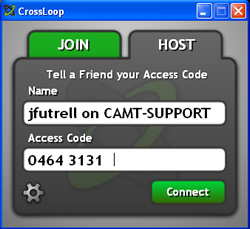
Need a quick and cheap (how about free) way of holding an online meeting with someone else on your computer? Try out CrossLoop. This free, secure screen sharing utility is easy to download and install. And even easier to use. I actually just used this program this morning to host a meeting; my attendee, who had never used CrossLoop before, had everything set up and ready to go on their side within two minutes or so. And presto! CrossLoop is still a relatively new program, so the longevity of its service and gratis status remains to be seen. Also, it is currently on available for Windows machines. But, in terms of quick and easy desktop sharing, it's something definitely worth looking at.

CrossLoop

Collaborative Script Writing

I recently stumbled upon one of the most exciting (to me, anyway) Web 2.0 endeavors ever to hit the Internet: Plotbot. Plotbot allows two or more users to work on a script collaboratively. It's designed for the screenplay format, but it could be used just as well for collaboration on a new stage play.

Beyond simply adding and editing scenes and other elements to the script, collaborators can comment on their partners' efforts, and the site's project pages allow for blog postings and document sharing. The project pages act as a dashboard, providing a great deal of useful information about each of your projects.

Plotbot's project page

The system's script-writing engine (powered by AJAX) streamlines the formatting of dialogue, action and sluglines. Here is the "Add an Element" tool: Add an Element to Your Script

And here is how a full scene page looks: Scene Page

As you can see, it's a very slick interface, and every line that is modified has information in the right margin about who made the modification and when. You can also roll a change back if you're unhappy with it.

One other cool and useful aspect -- Each of your projects gets its own RSS feed, so your collaborators can subscribe and get instant updates to their RSS readers when changes are made.

Best of all, the site is completely free. I'd urge anyone doing collaborative script writing to register and check it out.

Second Search Engine Optimization Article

Make Your Art Organization’s Website a Top “Hit”: A 30 Day Step by Step Guide to Dramatically Improved Search Engine OptimizationPart 2 of 4

By Lance Trebesch and Taylor Robinson Lance@TicketPrinting.com www.TicketPrinting.com
Week 2: Objective:Your week two objectives are to implement a sitemap and create and maintain a successful blog.

What you need to know:

Sitemap- Having a sitemap that connects the entire website will eliminate the need for having multiple links on the homepage and will make the pages more crawlable by search engine spiders. A sitemaps purpose is to provide a central link hub for the website, allowing search engines or users to easily navigate the various pages. Search engines recognize new pages by following links from existing pages, so having a sitemap will ensure all pages are indexed properly. While this will have no effect on the websites SEO campaign, it is an important element of any successful website and will also help when introducing a blog (below). To download software to create your own sitemap, visit Site Map Pro.

Blog- A blog is basically an open forum where participants can discuss various topics. Nonprofits can utilize them to tell readers about organization projects, outreach programs, and upcoming events.

Reason for a Blog- In my article “10 Reasons every Art Organization Must Have a Blog,” I emphasize the important role blogs play. For SEO purposes, a blog is beneficial because other sites/blogs link to read the blog’s content and therefore the websites overall pagerank (level of importance) increases. However, blogs are not only important for SEO purposes, they are also excellent tools for marketing, fundraising, and allow organizations to convey the true “heart” of their efforts.

Create a Blog- Starting a blog is not only easy, but also inexpensive. There are dozens of free or nearly free services to create a blog including Blogger (recommended), Blog-City, EasyJournal, Blogeasy, Typead, Grey Matter, Userland, or Movable Type. Simply follow their step-by-step instructions to create your own blog today.

Blog Directories and Related Blogs- Once you have created a blog, you will need to spread the word about it. To do this, begin by submitting your blog to directories. Good blog directories include Technorati, Blogcatolog, Topblogarea, and Bloghub. The directories will categorize your blog and make it available for others to read about it. Next, use one or more of the listed directories to find other blogs focused on similar topics. Identify what blogs are most closely related to art organizations, and read posts to gain a better understanding of their blog format and writing style. One of the best ways to get new people looking at your blog is to post entries on other blogs with a link back to your own. According to the March, 2007 Blog Readership Report, 67.3% of bloggers found information by following links from other blogs. However, bloggers do not appreciate worthless entries with the sole intention of back links. When you make a post, be sure to add something useful to the conversation and explain why your link will be worth following.

Subscribers- Arguably the greatest measure of blog success is the number of subscribers. Subscribers are usually consistent readers and often post entries onto the blog. The greater number of subscribers your blog has, the more easily you can promote an upcoming event or inform constituents of a recent projects success. Copyblogger’s article, “10 Effective ways to Get More Blog Subscribers,” gives great tips for how to increase the number of blog subscribers. You will want a RSS feed for your blog to allow subscribers to receive updates when you add new blog posts.

Blogs True Purpose- Blogs have helped a countless number of organizations achieve their SEO objectives. More importantly however, blogs have allowed art related organizations to connect with their supporters in a completely new way. The stories, issues, and projects surrounding the organization reach a number of people who would otherwise not have been exposed. To learn more about how to put blogs to work for your organization, read one of the many informational articles on problogger or copyblogger. For examples of other nonprofit organizations that have successfully used blogs visit:

http://www.aspca.org/aspcablog/index.html http://network.bestfriends.org/Blogs/ http://www.waterconserve.org/blog/water_conservation/ http://www.davidsuzuki.org/blog/ http://www.intelligentgiving.com/the_buzz/the_blog/ http://blogs.walkerart.org/ecp/

Week 2 Checklist:

  • Create Sitemap
  • Find blog provider
  • Create your blog
  • Visit topically relevant blogs and post entries
  • Submit your blog to directories
  • Get subscribers
  • Research other ways to harness the power of the blog

Rhizome.org

Rhizome.org (part of the New Museum of Contemporary Art) is an online community devoted to the merging of art with technology. Their ArtBase is an archive of works that "employ materials including software, code, websites, moving image, games and browsers to aesthetic and critical ends." Rhizome.org Mission Statement - Rhizome.org is an online platform for the global new media art community. Our programs support the creation, presentation, discussion and preservation of contemporary art that uses new technologies in significant ways. We foster innovation and inclusiveness in everything we do.

Music and Video and iPods, Oh My!

On August 4th, the National Symphony Orchestra in Washington, DC, performed a concert entitled "Fantastic Planet" which combined classical music (of course) and more modern elements, such as video projections and....iPods? Prior to the show, NSO conductor Emil de Cou had recorded a commentary track that offered insights into the music of the evening. Pieces of history, trivia, and background that concert-goers eager to experiment could download to their iPods (or other MP3 players) and listen to during the live performance.

"I thought it would be neat to have the conductor being your seatmate, whispering into your ear at key moments," Emil de Cou said before the performance.

Reading the review on the Washington Post, it's obvious that the experiment achieved mixed results. Some folks had trouble syncing their iPods to the live music. Others found the commentary track distracting. With music, spoken words and video, all swirling around the brain at the same time, it's no wonder. According the Stephen Brookes, "Two minutes into the opening piece I quietly slid off my headphones, and by intermission it was impossible to spot anyone still plugged in."

But the idea of commentary tracks for classical music is not a bad one. DVDs almost always have commentary tracks. But usually those tracks are switched on during a movie you have seen countless times and know the plot, characters and dialogue stone-cold; so, it becomes quite easy to concentrate on the commentary and the movie at the same time. I doubt if many in the audience on August 4th knew Vaughan Williams's "Serenade to Music" as well as I know every line in the "Princess Bride."

Also, in commentary tracks, syncing is vital. Especially if the track refers to something occurring at a specific moment. With live music, it is probably hard, if not impossible, to truly craft a commentary track that will sync up, because the beauty of live performance is the fact that it is live, and thus different every time.

Regardless of the evening's perceived success, kudos to the NSO for trying something new! If I lived in Washington, DC, I would have been there with my iPod in one ear, the music in the other, a smile on my face, and a big thumbs up to their creative experiment combining arts with technology.

Original Washington Post Article

First in a series of Search Engine Optimization Articles

We are pleased to present the first in a series of four articles written by Lance Trebesch and Taylor Robinson from TicketPrinting.com related to search engine optimization. Read on...

Make Your Art Organization a Top “Hit”: A 30 Day Step-by-Step Guide to Dramatically Improved Search Engine Optimization Part 1 of 4

By Lance Trebesch and Taylor Robinson

Lance@TicketPrinting.com www.TicketPrinting.com

Do you ever wonder why some websites seem to steal the top positions on search engines? No, it is not magic, and yes, your art organization can do it too. The “secret” to achieving this success for your website is by harnessing the power of search engine optimization. By following this step-by-step guide, you will be well on your way to drastically improving your websites standing in only 30 days.

Overall Objective:

The overall objective should be to improve your websites position on search engines.

What you need to know:

Despite what some companies may want you to believe, there are no tricks or shortcuts to SEO and you will not top the list of search results overnight. Three major areas should be focused on for a successful SEO campaign. These areas include:

1. Keywords 2. Website design 3. Links

Week 1:

Objective:

Your objectives in the first week include submitting your site to several link directories and improving your websites keyword structure.

Let’s Get Started:

Directories- Submitting to nonprofit directories such as CharityNavigator, Yahoo Health, idealist.org, and fundsnetservices or general directories such as Business.com, Best of the Web, and DMOZ will immediately affect your websites search rankings. While listing your site on directories is worth your time, the links are of little overall value and will only have a minimal impact on your ranking.

Keywords- Keywords are the words/phrases that tell search engines about the purpose of your site. It is important to identify which words are most advantageous to your organization so they can be optimized in your content. Begin selecting keywords by brainstorming every word/phrase that is topically relevant to your organization. Remember, put yourself into the shoes of the searcher and avoid industry jargon. Be sure to include the name of the organization and the main service the organization provides. Additionally, when selecting keywords try to avoid general terms such as “theater”, “art”, or “fundraiser” and select keywords that are unique and relevant. Two problems arise when general keyword terms are used:

  1. The phrase becomes more competitive and harder to rank well on.
  2. The site receives traffic from people who are looking for a different service than your organization provides.

Art organizations in particular need to include action keywords such as “donate” or “contribute” to make their fundraising campaigns more successful. If you are still unable to generate keywords, browse through websites of similar organizations and look which keywords are used on their sites.

Keyword Tracker Tools- Once you have developed a starter list, you are ready to test the words using one of the many online keyword tracker tools. The best free online tool today is yahoo’s Overture. This will show the popularity of the keyword entered during the last month and give a rough idea of what additional keywords may work for the organization. However, for the organization that wants to launch a more targeted and successful SEO campaign, Wordtracker is the correct instrument to use. Wordtracker has additional features such as the inclusion of plurals and misspellings in its search. Most importantly Wordtracker includes the competition for each of the keyword phrases. The trick here is to select keywords that are popular searches but not commonly used by other organizations.

Keyword Density- There has been a great deal of hype regarding keyword density and finding the correct density for each search engine. Keyword density refers to the frequency that the keyword is used. According to the most current and accurate articles written on the subject, such as the Unfair Advantage (within searchenginenews.com), keyword density is in fact much less important than originally predicted. The only standing rule of keyword density is not use “keyword stuffing” techniques where the phrase is repeated multiple times. Search engines now monitor this tactic and will actually lower your sites ranking if they detect stuffing. Search Engine Land’s article, SEO “Don’ts”: 20 Fatal Mistakes You Must Avoid to Succeed, gives an accurate list of pitfalls such as keyword stuffing that you will want to steer clear of when implementing your SEO strategy.

New Website Content- When incorporating keywords into the websites text, be sure to look at the content from the users’ point of view, and strike a balance between the user and the search engine (priority always goes to the user), making content friendly for both. For further reading on how to layout your website to optimize its effectiveness with search engines read Matt McGee’s 21 Essential SEO Tips & Techniques or one of the many articles on the subject in Search Engine Land.

Title and Header Tags- The most important keywords identified should be included in the websites title and header tags. A title tag is a short html code that tells search engines about your site, while headers are viewed by users on the top of each page and tell the purpose of the page. The 7 Essential Title Tag Strategies of High Ranking Web Pages in 2006 has further information about how to improve title tags to optimize your search performance.

Week One Checklist:

  • Submit your website to directories
  • List keywords
  • Test your keywords with online tools
  • Research title and header tags
  • Improve your websites content by adding keywords
Tux the Linux Penguin vs. Bill Gates

Can a little penguin destroy the Windows empire? (Photo Uncredited)
On one of our recent podcasts, we talked about Ubuntu, the Linux-based open source operating system. I recently discovered that Ubuntu is, in fact, the OS Dell and Lenovo are now offering as a Windows alternative.

People often ask about Linux and the move to open source, and I typically advise against it... at least in the current tech environment. While the open source model has its benefits, the most important being the leveraging of collective developer wisdom, there are also many pitfalls for the novice user.

When you buy your next computer and the sales rep or online form asks you, "Windows or Linux?," what will you choose?

The following article provides a few bullet points to consider before taking the open source OS leap:

Is it time to exit from Windows?

Powered by ScribeFire.

A few good articles...

One thing that's consistently true about information technology is that you can't trust what was true today to be true tomorrow. If it's hard to identify and articulate the scope for your technology project, it can be even harder to find the tools that match up with your requirements. Founded in November 2005 by a brave woman named Laura Quinn, idealware.org is a nonprofit organization that publishes unbiased articles about technology tools in a wide variety of areas, from electronic newsletters to blogging to Constituent Relationship Management. Laura seeks input from a wide variety of technology professionals and all the authors involved strive to provide honest, plain-talking information about a given subject, and in my humble opinion, they're doing a great job.

Check out Idealware.org's "A few good tools" report series on topics like Web Analytics and CMS, or more theoretical articles like "In Search of CRM" or "Building Peace Through Information and Communication Technologies."

Saving the Planet One Search at a Time

Back in January, 2007, Boston Blogger Mark Ontkush decided to do some fancy mathematical magic and figure out how much energy could be saved if Google switched from a white background to a black background. I had never considered this before, but it makes sense that a mostly black screen uses less energy than mostly white. Not an incredible amount (15 watts) less, but if you consider how many hits a day Google gets (about 200 million) it starts to add up. After his computations, Ontkush announced that changing Google to a black background would save 3,000 megawatt-hours a year. 3,000 megawatt-hours! Holy batteries, Batman! I was astounded. Primarily because I didn't know what a megawatt-hour equated to. After some quick research, I had some additional perspective. It turns out that 3,000 megawatt-hours could power roughly 95 homes for an entire year. Not quite as mammoth as I original thought, but still not inconsequential.

And other people took notice. Specifically, an Australian company called Heap Media decided to put Ontkush’s musings into action. And so, Blackle.com was born. Powered by Google Custom Search, Blackle returns Google quality search results while saving energy with its black background. A running tally on the front page notes how much energy Blackle has saved (at the time of this posting, approximately .147 megawatt hours).

For my own part, I’ve set Blackle as my new home page for my browser (sorry Google) to see how it feels to use this inverted color scheme as my primary search engine. Luckily, I don’t use any features of Google beyond the search engine; I don’t have a Gmail account or custom iGoogle pages, so I’m not really losing any functionality by switching to Blackle. It will be interesting to see if I can make the change stick.

In reality, using Blackle is not going to save the world. But it is a small, small step. And if it helps keep me conscious of my energy consumption, that’s something.

Visit Dresden's Art Gallery in Second Life

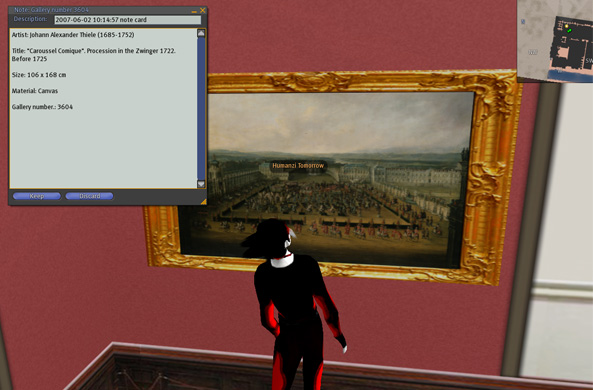
Not everyone can afford a trip to Dresden, Germany, but now anyone with a computer and a Second Life account can visit the city's famous art gallery. In June, a digital version of the entire building - 37,700 square feet and 750 paintings - was launched in the 3-D virtual world of Second Life.

My Second Life self viewing a painting in Dresden's gallery. (View Full Image)

Check out the full story and some images from WIRED.com.

Powered by ScribeFire.