
Blogs?

Some of you may be new to blogging. I know I am. This is the very first blog I’ve been involved in. I’ve stumbled across some blogs on my Internet travels, but I never really thought too much about it. Now that I am a blogger I wonder…What is a blog and where did they come from? I’ve attempted to research the history of blogging on the Internet and there doesn’t seem to be a clear path of how blogs came to be. I did find out that blogs evolved from online diaries. Once upon a time someone decided to make their personal diary public to friends and anyone who stumbled across the web address. These online diaries evolved into online journals and then web logs, or something like that. Web logs are what we know today as blogs. Blog is the shortened version of web log.

This only leaves me with more questions. Why did blogging become so popular? Is this all just a fad? What comes next after blogs?

If you have the answers to any of my questions your wisdom would be greatly appreciated.

Here's what I found when I entered "blog" in the Google search engine.
A couple recent victories for us geeks...

Among the 100 new words just added to the new edition of Merriam-Webster's Collegiate Dictionary are two very geekish items: Mouse potato (n) - an intensive computer user.

Google (v) - to use the Google search engine to retrieve online information.

As I've yet to get my copy of M-W's new edition, these definitions aren't taken directly from its pages. I usually wait until the dictionary's new edition drops in price (around November) before I make my annual trip to Wal-Mart to purchase my copy. I then spend a long weekend sipping brandy at fireside and reading every page of my new treasure.

It is amazing how something like Google can so rapidly capture the concsiousness of society that it becomes an official word in the English language. It was just eight short years ago that Google, Inc. first started its three-person office, based in a Menlo Park, CA, garage.

While an arts organization can't expect to become a dictionary word, this is further proof that technology is the fastest and most powerful way to connect with people. After all, "mouse potato" wouldn't be a word if there weren't tons of them out there just waiting to hear about your art. ;)

Geeks rejoice... we have two new rungs on the ladder of legitimacy!

New Domain Lookup Service Launched

Though this will be of interest to just a handful of readers (most people don't think much about Internet domains), I thought it was worth a post anyway: According to a piece on Wired.com, one of the Web's best technology news sites, a new domain lookup service called OpenDNS launched today. Among other things, the service automatically corrects typos entered in browser address bars and detects known Internet scams to provide an elevated level of safety.

Click here to read the full Wired news article.

Or click here to go directly to the OpenDNS Web site.

Guggenheim expansion

Guggenheim Foundation builds its largest museum in Abu DhabiThis article really highlights some fundamental issues that art organizations will face in the coming decades as our world continues to forge through Middle Eastern issues and globalization as a whole.

Some questions that come to mind:

  • Was the money simply available, or did the Guggenheim solicit the UAE based on extensive marketing research?
  • What benefits does the Guggenheim Foundation receive in positioning itself in Abu Dhabi?
  • What type of curatorial concessions, if any, will the Guggenheim make to successfully market their collection to the Abu Dhabi patrons?
  • If concessions are made, is this considered censorship or cultural sensitivity?
  • Will the development strategy be focused on monies in that region, or will most donations be solicited from the U.S. and the Guggenheim's current contribution sources?
  • How are other large arts organizations positioning themselves in the global economy?

And I feel as if I might be able to question the relevance of the Jewish associations in the Arab country- but that might be just too trite.

I'd like to hear of other's impressions of this event, in addition to examples of other arts organizations taking on new frontiers.

What is Web 2.0 anyway?

The concept of “Web 2.0” has been touted as the “solution” to any number of non-profit management issues. Though the term has been used to mean a wide range of things, in general, it’s the idea that the Web is no longer about one-way information flow, but a dynamic portal where users contribute, comment on, revise and maintain data contained on Web sites. Think of the difference between the Encyclopedia Britannica Online (first generation Web site) and Wikipedia (Web 2.0).

TechSoup, through its NetSquared project, is categorizing the tools most commonly associated with Web 2.0 (blogs, RSS feeds, wikis) as the “social web” because of their ability to affect social change. Although I wasn’t able to attend, I heard wonderful things about the conference they held in May -- we had a MAM grad student who came back revitalized and excited by the possibilities for of Web 2.0 for the arts sector.


As John Falk and Beverly Sheppard point out in their excellent new book, Thriving in the Knowledge Age, the dawning of the “Knowledge Age” has resulted in increased public interest in museums and other cultural institutions. The book points to the new challenge for cultural institutions: can we adapt to this new landscape and become “bottom-up” entities?

The Web is a good place to start.

How do we “customize” arts experiences so that users feel the same kind of buy-in as they do with their other leisure activities? NFL.com has a “My Team” section on its front page that I can customize, when I browse over to Fandango.com I see “Cary’s Favorites” on the right side of the screen, and Amazon has been giving me recommendations for years.

How do we reach the people who truly care about our missions? Google has based its business model on only advertising to people who have indicated interest in a product or topic while MySpace links bands with their fans in a very personal way.

Blogging allows us to communicate frequently and informally with our constituents; creating an “Audience Reviews” section on our Web site allows our visitors to have a voice; hosting discussion forums lets us tap into what’s top of mind for our members.

What works for one organization may not work for another – we all have different audiences who will each have a unique response to an initiative.

One final word… It’s important to carefully consider the time commitments involved in starting any Web 2.0 initiative. Planning new online initiatives should be done just as strategically as for “bricks and mortar” programs.

We’d love to hear about how your organization feels about Web 2.0… Please comment.

It's a claim to fame

Bringing literature and art to the city of Steel Pittsburgh ranks as eighth most literate city and as third best mid-sized arts city

Pittsburgh was also ranked recently as one of the top livable cities in some report I read, in addition to having one of the highest rankings in cultural and arts organizations per capita. Over the weekend, I even heard that we have one of the best city fireworks show in the nation.

I'm always dubious of such statistics, but I do concede there is an essence of truth to such claims. Since moving here from California, I can attest to the following:

  • Pittsburgh is affordable, pretty and in a great location.
  • For a small (mid-sized?) city, there is an incredible amount of performance and visual venues, well-supported by the community, coupled with events and education outreach programs.
  • The fireworks show was, well- average.

Statistics, reports, data or not... I am finding Pittsburgh to be a hospitable and fun home.

You don't have to be a dancer to attend their conference...

I recently attended the Dance/USA National Round Table in Portland, OR, and thought I'd share a few things from the event... First, I am scared to try and move in any way that might be considered "graceful."

On my second day at the conference, I decided to check out one of the "Get up and Move!" morning warm-up sessions.

"Heck," I thought, "They can't be doing much more than stretching at this ungodly hour."

When I peeked in the session room, it looked like the cast of Cirque du Soleil warming up for a show. This was nothing like my high school P.E. stretch-out activities.

I walked past the session room and got a donut instead.

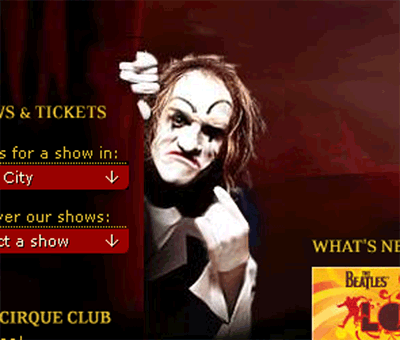
Speaking of Cirque du Soleil, please check out their Web site for an example of how extreme site design can be a hassle for visitors.

While it's important for arts organizations to offer aesthetically pleasing and stimulating Web experiences, it is equally important to offer alternative sites for users with older computers. If you're going to include fancy Web elements, such as Flash animation, on your site, be sure to offer a non-Flash version as well. Otherwise, you could be shutting out a large portion of your audience.

By the way, the clown that greets you on the Cirque du Soleil front page is absolutely terrifying:

Cirque du Clown

"Mommy, I don't want to go into that Web site. Please don't make me go."

It was also confirmed during my time in Portland that technology is unavoidable. Many of the discussions at the Dance/USA conference revolved around technology. Dance company administrators seem to be very interested in how their organizations can begin using MySpace, YouTube and other popular Internet tools to increase audience and potential audience awareness.

YouTube works especially well for arts groups with visually gripping programming. The site is a free service that allows you to upload and share videos. Click here to visit the National Alliance for Media Arts and Culture (NAMAC) Web site and read about some documentary filmmakers that are using YouTube to share their work about the rebuilding of New Orleans.

One hundred years from now...

Will your organization's files, images and records still be around? And if so, will people be able to view them? I highly enjoyed these thoughts by Momus in wired.com about the creation and demise of the formats with which we store our music, photos, film, literature and more. As paper documentation succumbs to the proliferation of digitized formats, cultural and art institutions are joining the race to keep up. A decrease in office paper may be great news for the environment, but what will happen to these gigabytes upon terabytes of historical data 100, 50, even 10 years from now when the technology we used today is a relic?

Colonial Attraction Using Latest Technology

At Colonial Williamsburg you expect to see a true historical representation of what life was like over two hundred years ago. At a living historical museum butter churns, horse drawn carts, and triangle hats are usual sights, but how about iPods? Colonial Williamsburg is one of the latest museums to use iPods to lead visitors along tours of the grounds. This device that has only been around for a few years has had a huge impact on how tours are conducted and accessed. Visitors can now hear the portrayal of Thomas Jefferson on an iPod as they cross the grounds as well follow audio tours. Pretty savvy for a museum that shows how life was without any modern conveniences like electricity. Read an article here. What do you think of the latest trends using iPod technology? Let us know!

Welcome!

Welcome to the Technology in the Arts blog!

We’ve set up this space as a way to open dialogue around the technology issues facing arts managers, from the high-level stuff (how will the senate’s vote on net neutrality impact non-profit arts organizations in the long term?) to the very practical (the difficulties of merging several mailing lists).

Several of us who are working on planning the conference will be posting here regularly between now and the event. But our voices are not enough – we want to hear from you!

I invite and encourage you to participate by commenting on what we’ve written here, or by emailing us a post you’d like us to put up. (Please include your name, where you are, what you do.)

We are living and working in an exciting time. I can’t wait to hear about what your organization has been doing, and sharing a little with you about what we’re up to here.