Marketing

Mobile Advocacy Resource

I've been subscribed to the blog at MobileActive.org for a while now, and a recent post that highlights the top 10 do's and don'ts for mobile advocacy made me realize that it was time to give a shout out to this great site on our blog. MobileActive.org aggregates mobile technology tools and resources for the international NGO community, and the information they offer is applicable and valuable for any non-profit arts organization considering using mobile technology as part of its marketing, development, or advocacy strategies.  You’ll find:

  • A blog with case studies and news related to the use of mobile technology.
  • A directory of projects that have utilized mobile technology.
  • A directory of mobile tools and vendors (such as consultants, SMS and MMS providers, polling tools, software and mobile content developers, and more).
  • Brief strategy guides that offer overviews of using mobile technology for fundraising and advocacy (you’ll need to register on the site to access these PDF’s).

So check it out and let us know what you think.  Also, if you know of any other useful resources, books, or sites out there that delve into the world of mobile technology, please post those in the comments.

YouTube Opens Screening Room for Indie Shorts

Okay, so I love short films.  In addition to appealing to ADD-afflicted by not requiring us to sit through 180 minutes to "understand the narrative," short films are more financially viable for indie filmmakers to create.  The problem with short films is that you can usually only see them at film festivals -- until now.

YouTube has set up a virtual screening room to bring the short films of independent filmmakers to a global audience.  Not only can you view top-notch shorts (curated by a YouTube editorial panel), you can also buy them to watch whenever you want on your computer or portable device.  While the majority of these films have played at international film festivals, occasionally you’ll find films that have never before screened for wide audiences.

They just launched the screening room last week and plan to add four new films every two weeks.  So, show the indie filmmakers some love and check it out!

Click here to learn more about the YouTube Screening Room.

What I Learned at the Americans for the Arts Convention...

Remember those essays you had to write in elementary school - e.g. "What I did for summer vacation"?  That's sort of what this post feels like since Brad chastised me for being remiss in my blogging duties.  Of course, I fired him - again.  I do that a lot.  It just never seems to stick. AFTA held this year's convention in Philadelphia - the city of brotherly love (and sisterly affection).  The hotel sold out long before I climbed out of my procrastination long enough to book a room.  Thankfully, I found a room at a nearby hotel - directly across the street from where they were filming Transformers 2.  If only I hadn't gotten bored and walked out of Transformers, then I might have been more starry eyed.

After three days in Philly with Americans for the Arts, I return to the Burgh with three essential take-aways:

1.  Affirmation -- In a recent (soon to be published) environmental scan of the arts community conducted by Americans for the Arts, it has been determined that, "The influence of technology, unconstrained access, and the new immediacy of communication on traditional and new and evolving production/delivery mechanisms is not yet entirely understood."  While the influence of technology on production/delivery may not be fully understood, the impact of technology on the arts community has been seismic.  Between AFTA and the NPAC conventions this month, I come back to the Burgh knowing that our Technology in the Arts conference, blog, podcast, and site resources are truly useful tools for the field to assist them in navigating unfamiliar terrain.

2.  Futurists Rock -  The Keynote Address was given by futurist Andrew Zolli, founder of Z+ Partners and organizer of the PopTech conference, in the manner that I've yearned for at all of the conferences I have attended throughout my professional life:  highly engaging, provocative and witty.  He touched on a multitude of issues - from innovation and "the tyranny of choice" to experiential economics, "the Long Tail" and "Citizen Brand." I think it was the first time that I went to a conference where the keynote speaker talked for 45 minutes, and I wanted to hear more!  For those of you who were not able to attend AFTA this year (or for those of you who just want to hear more of what Andrew has to say), check out these video clips on YouTube.

3.  The RenGen is Here - On Friday, I had the pleasure of listening to Patricia Martin talk about the premise behind her book RenGen: Renaissance Generation - The Rise of the Cultural Consumer and What It Means to Your Business.  Here's a brief bit from Patricia about the event that inspired her to do the research for this book:

I tried to run out to the AFTA bookstore to buy RenGen - but of course, it was already gone.  Amazon, here I come!

My two favorite concepts that she talked about during her session are:

  • RenGen is a psychographic NOT a demographic. What characterizes this psychographic?
    • Lifelong learners
    • Time-starved idealists
    • Sensualists
    • Eco-conscious
    • Fusionists
    • Inner-directed creatives
  • Collective Creativity - a post on the concept from her blog.

Okay, folks, I have blogged enough today to keep the Brad at bay.  I pinkie-swear to do better!

Better Than Handing Out Flyers?

ArtistData LogoBuilt for bands, musicians and music performing organizations, ArtistData is a site that enables you to enter upcoming performance information once and then sync it to many different social networking sites that are musician friendly or oriented. I have to say that I was impressed with the simplicity of the system, based on their demo video.  With a few minutes and clicks, performance listings were updated on the sample band's MySpace, PureVolume, Eventful, and Virb profiles.  Also, the show details were sent out to other sites such as JamBase, Last.fm, Mojam, Pollstar, and ShowClix.

A real treat is the site's ability to notify local newspapers and media about your performance directly from ArtistData.  I would assume that ArtistData keeps art & music PR contact emails for major newspapers and publishers.  I wasn't able to see how comprehensive their listings are, but, if you know of a publication that exists in the area you will be performing that is not on the list, you can notify ArtistData and they'll do what it takes to get it added for next time.  I wonder, though, if this replaces the need to send out press releases or to cozy up to your local papers' inside sources.

All in all, ArtistData seems like a very expedient way to get your performance information out there.  It would be especially useful if you, your band, or your organization already use more than 1 of the social networking tools listed above.  And, it seems like ArtistData intends to expand its offerings and resources as time goes on.  Sites such as Amie Street, BETA Records, Buzznet, FameCast, and Hooka/indie911 are on tap to be added to those sent performance info.

Oh, it's free, by the way (at least for now).

I am really interested to see if, in the near future, a similar technology is developed for visual, graphic, and illustrative artists to help them manage their profiles, exhibition information, and work sample images across the plethora of social networking sites that cater to them.

Props to Mashable! for tipping me off to ArtistData.

Web Usability Notes from TitA: Canada

Josh Futrell and I are sitting in a Web usability workshop at Technology in the Arts: Canada at the moment, and I thought I'd share some notes from the session. The workshop is being led by Robert Barlow-Busch, director of product design at Primal Fusion, a semantic web startup in Waterloo, Ontario, Canada. Robert's overriding thought about usability testing is quite simple but very important: "Observe people using your Web site."

Josh Futrell at TitA: Canada Josh looks please to be learning about usability.

Why conduct usability testing?

  • More useful
  • Easier to use
  • More desirable (more positive emotional responses)

Aside from basic usability testing, Robert also just talked about projective exercises, which determine what type of emotions people attach to your organization. In the session's particular projective exercise, we were asked to imagine that a group of car manufacturer logos were members of a family. Who in the family would each of the logos represent? Robert's point was that this type of activity is more engaging than simply asking, "What do you think about Ford, Chrysler or Volvo?"

By the way, the entire group agreed that Ford was the drunk uncle. Sorry, Ford.

How does this translate to the arts field? An example that Robert presented was for an arts organization to use this type of activity to test how people view the organization's logo in comparison to the logos of other available activities (cinema, zoo, arcade, video games, Netflix, etc.).

Other resources:

The full set of slides from Robert's workshop will be available soon at TechnologyInTheArts.ca.

Sponsor Technology in the Arts 2008 and be the envy of all your friends...

Want to be one of the cool kids? Sure you do. Who doesn't? The Center for Arts Management and Technology is currently offering sponsorship opportunities for its 2008 Technology in the Arts Conference, scheduled for Oct. 9-11 in Pittsburgh, PA.

Be almost as cool as this guy.

Some additional sponsorship notes:

  • Any sponsorship of $1,000 or greater secures a spot in our Tech Expo.
  • We have built into our three-day schedule more than four hours dedicated exclusively to the Tech Expo. We will also be promoting the Expo as a primary feature of the conference.
  • The Tech Expo will be located near registration in a very prominent location in the hotel.
  • All coffee breaks will be held in the Tech Expo area to provide additional exposure.
  • We will be providing a 15-minute recognition announcement and demo/speaker opportunity for the sponsor of our Keynote/VIP Luncheon.

Want more info about the conference? Follow this page for regular updates.

Want more info about sponsorship opportunities? Get it here.

Come on... everyone's doing it.

(Image in this post licensed under Creative Commons, courtesy of ninjapoodles' Flickr photostream.)

OPEN NOW! - The Power of the Subject Line

Recently, I attended a webinar from Patron Technology on how to effectively use the subject line in e-mail marketing messages. And they should know! Patron Technology, a sponsor of the 2008 Technology in the Arts Conference, has been on e-mail marketing with arts organizations for years with its PatronMail service. Why does the subject line matter?

According to Christine Blodgett at Patron Technology, "The subject line IS the marketing message. It is your first point of contact with an e-mail recipient. If they don't like it, then they won't open it. If they don't open it, then it won't produce the desired effect."

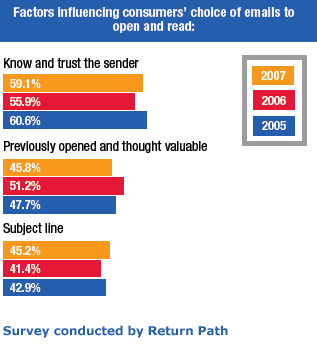
A recent survey conducted by Return Path reveals the subject line to be the third most important factor for determining whether or not someone will open an e-mail marketing message.

So how do can we best harness the power of the subject line?

Make every word matter - When you look at your inbox list, how many words do you typically see in the subject line? Not very many, right? So:

  1. Keep it concise - Under 50 characters (approximately 7 to 10 words)
  2. Pay attention to word placement - Place incentivizing phrases ("Free tickets for.."), time-based phrases ("Last chance to..."), and informative labels ("______ Monthly Bulletin") toward the beginning of the subject line.
  3. Be clear - Tell them what's inside. Make sure the content promised in the subject line is easy to find in the e-mail.
  4. Be honest - DON'T oversell it!
  5. Be consistent - If you have a type of message that you send out on a regular basis (like an e-newsletter), make sure to label them in a consistent way so that recipients will easily recognize them in their Inboxes.

Google Grants...and Google for NPO's

UPDATE: Be sure to read our most recent post on Google resources for arts organizations.

I know this makes two in a row from me on Google.  However, in my defense, I have been meaning to write this post for a few weeks now and, since I just found out (thanks to the Non-Profit Tech Blog) that Google has a launched a new non-profit portal that aggregates all of its services that apply to NPO's, I figured now is a good time to highlight one of Google's services that, I think, totally rocks:

Google Grants.
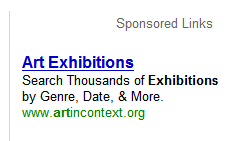
Google Sponsored LinksTo really explain Google Grants, I first need to explain Google AdWords.  You know those “Sponsored Links” that sometimes appear to the right of your search results on Google?  Those are brought to you by Google AdWords.  I’m not going to explain any more than that since Google has already done that work for me with the detailed information and demos on its site.  Suffice to say, Google AdWords can help increase traffic to your Web site.

And Google Grants is a program that Google has developed to help non-profit organizations have access to free Google AdWords advertising.  Organizations who are awarded Google grants get at least 3 months of AdWords service with cap of $10,000 worth of advertising per month.  Awesome!  Google Grants even goes beyond just giving away free advertising, by helping organizations to define and refine ad campaigns.

Click below for a Q & A with a past Google Grant recipient after the jump.

If your organization wants to learn more about Google Grants, please visit the new non-profit portal that Google has launched and click the Google Grants link.  Or, you may click here.  Google also has developed a Google Grants Blog.

One of the reasons I’m so interested in Google Grants is that one of CAMT’s clients, Art in Context, was a recipient of a Google Grant in late 2007.  I’ve interviewed Teresa Schmittroth, Program Director at Art in Context, about her organization’s experience.

JOSH:  How was the Google Grant application process?

TERESA:  The process was actually pretty easy. The grant application requires standard information about the organization such as nonprofit status, mission statement, contact information, a brief statement on how Google Adwords would contribute to the organization, and a description of the organization's target audience. In addition we were asked to submit a proposed ad campaign and a sample of key words relevant to our organization. We applied for the grant on July 12, 2007. Within 24 hours we received [a confirmation] response. By November 29, 2007 we were notified that our organization was selected for a Google Grants award and our account was activated.

JOSH:  How did you find using AdWords?

TERESA:  I was really impressed with the depth of the ad campaign that the Google Grants Team set up for Art in Context. Upon activating our account there were several 'ad groups' they had developed for us specifically addressing the type of information we provide public access to, e.g., Exhibition Listings, Artist Listings, Image Listings, etc. The ads were slightly commercial-eze for a nonprofit library, but compelling. I spent several days tweaking the language and the key words, but the structure Google set up was really good. By January, when searching for the word "artists" on Google, Art in Context was among the first results in Google's Sponsored Links.

JOSH:  Did you see an increase in your site traffic as a result of your work in AdWords?

TERESA:  We did experience a very noticeable spike in phone calls from researchers after the ad campaign began. Also, the following comparison of page views between February 2007 and February 2008 demonstrates a definite increase in information displayed, which is key to our mission:

February 2007 February 2008
Page Views 1,514,630 2,042,540
Average per Day 54,093 70,432
Average Page Views per visit 4.27 7.09

Here is a snapshot I just put together for our board:

Google Grant activity for Art in Context Dec 1, 2007 to Feb 29, 2008

  • There were 30,188 clicks to Art in Context from Google's Sponsored Links.
  • There were 2,146,880 ad impressions for Art in Context displayed in Google's Sponsored Links.
  • It would have cost us $20,510.48 for this service if this were not a grant!

JOSH:  Any other thoughts/comments about the Google Grants program and Google AdWords?

TERESA:  Thank you, Google!

And thank you to Teresa Schmittroth, Program Director at Art in Context, and Google Grants.
Creative Commons: Not perfect but it works

Thought I'd give a little teaser on our upcoming podcast interview with independent musician Jonathan Coulton, known by millions of geeks as the guy who wrote the song Still Alive for the award-winning console game Portal. Jonathan Coulton

Coulton will be featured in Technology in the Arts Podcast episode 38 (to be published Friday, March 14) talking about how he's used Creative Commons and other online practices to build a rabid and connected fan base.

Creative Commons, Coulton explains, allows an artist to apply a standard copyright and then scale back the restrictions. While many musicians and record executives are trying to find ways to lock down their songs, Coulton has found a way to make money giving his music away for free.*

Coulton, and others like him, understand that once you establish a fan community hundreds of thousands strong who are deeply connected to your work, you'll have no problem paying your bills. And Coulton certainly likes people to pay if they can... After all, he has a family to support.

Check out our upcoming podcast for the full Coulton interview, and check out Coulton's songs here.

So what do you think? Can free work for musicians? Should musicians run their own careers?

*Free is fine, but you can also support Coulton's work. Find out how.

The Good...& Just the Ugly

Online artist registries are ubiquitous nowadays. In lieu of or in addition to a personal web site, they are a great way to make your work as an artist available to the larger world. Some are open to all, while others are curated by discipline, geographic region, quality of work, etc. I participate in several registries as an artist, but my hands-down favorite is the Irving Sandler Artists File offered by Artists Space in NYC. Developed by artist/former staffer Letha Wilson and her colleagues, the registry went online a couple of years ago with great success. It is free, uncurated, and still fulfills its primary mission marvelously: to showcase artists, their work, and ideas. Plus, the user-friendly search interface enables you tag selected artists and add them to your online portfolio for further review.

Other registries, however, are far less successful. A perfect example of what not to do is Saatchi Online. It is poorly designed, an aesthetic disaster really, and attempts to do too many things for too many people. I question if this registry is even really for/about the artist community. Ambition can be good thing, but never mission creep.

Artists: Be selective about the context in which you show your work. Context always has a profound impact on how your work is perceived and understood. Weigh the pros and cons, and choose wisely.

Stanford Lively Arts Strikes a Deal with iTunes

Stanford Lively Arts, Stanford on iTunes U and iTunes have launched a new promotion that will allow Stanford University's faculty, staff, students and Lively Arts patrons to download music by artists featured in the upcoming Lively Arts season using free iTunes gift cards. From now through March 15, the cards will be made available to patrons at all Lively Arts performances and to customers at the Stanford Bookstore, Tresidder Express, the Track House Sport Shop, the Cantor Arts Center Gift Shop and the Stanford Shop at Stanford Shopping Center. Lively Arts plans to mail the cards to Stanford students, faculty and staff in early February and will make the cards available to its community partners, including the Palo Alto Unified School District and East Palo Alto's educational program College Track.

The first Lively Arts event where patrons received the iTunes gift cards was the Merce Cunningham Dance Company's performance on Friday, Jan. 25, which featured a new work with music by composer Mikel Rouse titled eyeSpace. During the performance, the audience used iPods distributed at the theater to select and personalize the music that accompanies the dance. Rouse's music is also on the gift card.

In addition, the card will include music of the Jazz at Lincoln Center Orchestra with Wynton Marsalis, Blind Boys of Alabama, Meridian Arts Ensemble, Academy of Ancient Music, Turtle Island Quartet, Rosanne Cash, Kronos Quartet, Rob Kapilow and the Pacifica Quartet. Recipients of the cards will be able to download complete tracks from the artists at no charge until they expire on March 31.

This is iTunes' second such promotion with the performing arts at an educational institution. The first was with the University of Illinois' Krannert Center in September 2007. With all of the performing arts centers located at colleges and universities throughout the nation, I wonder if this is beginning of a new trend in the presenting and touring industry. It strikes me as a great way to use iTunes as an audience development tool.

JotYou!

JotYou is a site that allows you to send SMS text messages to mobile phones, but with a twist. You can set up the message delivery so that it only delivers when people are in a specific geographical area and you can adjust the send time and expiration time of the message. So, your recipients only get the message if they are in the area you have selected within the specified time frame. If they arrive too late or if they do not move within the location radius, they never get the text message.

After looking at the demo video for JotYou, I got to thinking that this service might actually be useful to arts organizations. I'm not going to go into the pros, cons, and etiquette of using mobile messaging as a marketing tool, since that's a whole other can of worms. But, for the sake of argument...

Let's say your organization sponsors a gallery or art crawl through your downtown cultural district. You could have people sign up beforehand to be part of the Art Crawl Mobile Messaging Tour, which would message the guests, as they navigate the streets, with tips about things to see, directions to get there, and maybe even clues that would lead them to Art Crawl Mobile Messaging Tour exclusive content (like free cups of hot chocolate and coffee).  How cool is that?

I have not actually tried JotYou, so I don't know how reliable the service is or how accurate its geographical-based messaging is, but I think that the potential for creating value-added experiences for willing participants could be interesting enough to start experimenting with JotYou.

The Next Generation of Market Research?

A San Francisco company called Emsense claims to have technology that will monitor a person's reactions to visual and auditory stimuli, such as a TV commercial or video game. Basically, the test subject wears a headset that looks like the visor Geordi La Forge wore on Star Trek: The Next Generation, and the device measures blink rate, breathing, skin temperature and head motion. Then the system's software analyzes the data and presents findings to the test administrator.

How useful would something like this be for arts organizations?

Since most arts ads are print based, the Emsense device wouldn't be very practical. However, imagine hooking up random ballet audience members and measuring their responses to a performance. Would funders be interested in how the 'Dance of the Sugar Plum Fairies' cause a substantial elevation in skin temperature?

Maybe not. But it's always good to be aware of new possibilities.

Read the full article from Technology Review.

Reporting Live from AFTA’s National Arts Marketing Project Conference

Well, I’m down in sunny, breezy Miami, FL, enjoying the warm weather and the Americans for the Arts NAMC. It’s been a busy two and a half days of conferencing, and I just wanted to take a minute and share a few cool things I’ve learned while here:

  • According to a survey conducted this past March by FireSpring (I think), when asked whether they use a particular medium more or less this year than the last, an average of 52% responders indicated that they were using the Internet more. Every other medium (radio, print, newspapers, television) all showed a decrease. Now, more than ever, organizations must put time, money and deep consideration into their Web presence.
  • The Philadelphia Orchestra is working in conjunction with Internet2 to stream real time content into educational venues around the world, giving viewers an inside and behind the scenes look into the concert unfolding live before their eyes. The have completed a pilot program, and plan to launch a more wide-spread, sustainable program soon. For more information, you can read their press PDF by clicking here.
  • Bijan’s on the River here in Miami makes a HUGE plate of paella (6’ or 7’ wide?) for parties. It was spectacular.

Well, that’s all for me. I’ve got to grab a bite, hop on a flight, and head back to wonderful, but cold, Pittsburgh, PA.

For more information about AFTA's NAMC, please visit: http://www.artsusa.org/events/2007/abc/namc/default.asp

MySpace as an Arts Space

Today's issue of The New York Times features "MyTheater, Seeking Friends," an article by Steven McElroy highlighting how various arts organizations are using the social networking site MySpace as a platform for marketing and promoting to younger audiences. For early adopters of technology, using MySpace as a promotional platform for the arts may seem like a "no-brainer," but for many others in field, the why's and how's of adding their organizations to MySpace are not readily apparent. I remember speaking with the director of a university's performing arts series at a recent conference. She told me that she had yet to find a successful tool for promoting her series to the university's students. I asked her if she had considered setting up a profile for the series on MySpace and using that as a platform for promotions geared toward the student and local Gen Y demographic. She admitted that the thought had not crossed her mind - even though she knew that a great number of the students at her university spent time on MySpace.

With a user base of 55 million and 28.4 percent of users under the age of 34, it is more difficult to find a reason NOT to use MySpace to reach out to new or younger audience members.

McElroy's article mentions how musicians and comics have been using MySpace as a promotional tool for quite awhile now. I would also add the independent film community to that list. My organization recently established a MySpace page for our independent filmmakers tour because of the enormous presence of independent filmmakers and film lovers on MySpace as demonstrated by the MySpace Film area. By joining this community, we have been able to promote our calls for entries to indie filmmakers around the world AND notify film lovers of our touring program - all in four weeks.

Next week, IMAGE Film & Video Center here in Atlanta is hosting a "Pimp My Space" workshop to teach local filmmakers (and folks like me) how to get the most out of your MySpace presence. I wonder if they are going to have a session like that at the National Arts Marketing Project conference in November? They should!

When I think about the organized areas of MySpace for film, music and comedy, I think wouldn't it be great if there were areas of MySpace set aside for dance, literature, visual art and other art forms?

  • Places where both emerging and established artists could promote their work - tours, performances, readings, publications, exhibits, etc. Maybe a fledgling modern dance group like Ash Contemporary Dance could become the Dane Cook of the dance world and play to audiences of thousands. (For those who don't know, Dane Cook became a stadium-selling touring comedian by developing a base audience on MySpace.)
  • Places where arts organizations could find hip "friends" to invite to their events and venues. (Did I mention that Dane Cook currently has 1.8 million "friends" on MySpace?)

Don't get me wrong. MySpace is not a marketing panacea for cultivating the next generation of arts enthusiasts - but it sure could be useful!

Attend an opera in New York for $5

All you have to do is accompany a teen, and buy your tickets online. Patron Technology recently featured High 5 Tickets to the Arts in their monthly newsletter as an e-marketing superstar. High 5 offers tickets to hundreds of performances and events in New York for the low price of $5 per ticket. In 2006, the New York non-profit conducted roughly 85% of ticket sales online with some tickets sold out in a matter of hours. High 5's idea of making arts more accessible to young audiences through inexpensive tickets has also spread to other cities including Columbus, OH, and Montreal. Cultivating younger audiences is a hot topic in my arts management program at the Heinz School of Public Policy and Management, so I imagine it may also be of interest to you as arts managers in the field.

It would be interesting to evaluate the effectiveness of High 5's service. Will the teens snatching tickets up today be our loyal patrons and donors twenty or more years from now? Some of my classmates believe the best way to ensure a lifelong commitment to the arts is through arts education more so than just accessibility. I agree with them to some extent, since through my own experiences, I was exposed to the wonderful world of opera in Dallas through an education program focused on introducing new (and diverse) audiences to the art form. The combination of severely subsidized tickets and education sessions made the experience complete. I doubt I would have attended an opera out of my own volition if it weren't for the empowering educational experience I had through that program.

Is Art and Shopping the new Art and Entertainment?

In our Strategic Planning class last night, our professor and CEO of the Pittsburgh Symphony Orchestra, Larry Tamburri, made mention of the current trend to link art with entertainment. On city websites and in tourist guides, "Arts & Entertainment" abounds- correlating performance and visual arts spaces with movies, bowling alleys and roller rinks. While these sectors, along with sports, are competitive for the use of our leisure time, one has to ponder whether the arts is becoming diluted or just marginalized by efficient marketing. This discussion, however, becomes completely moot as a whole new space and concept has presented itself in Winston-Salem, NC.

Wal-mArt

It's mildly disturbing and yet I can't help to acknowledge that it might just be another form of corporate sponsorship. There is also the chance that it was just a clause of the negotiation that allowed Wal-Mart to set up shop there.

A true test would be to see if the sculptures are "Public Art" or "Art in a Public Space." Without having a good picture to make reference, I would be really interested to see if Wal-Mart finally designed a building that reflected the community architecture, and by extension, contracted a sculpture that reflected its environs. �

Press Releases and Web 2.0

Recently, Erika Block with www.blockwork.org steered me toward an article from Entrpreneur.com titled "PR Trends: A Press Release for Social Media," which discusses how the PR field is attempting to respond to the "social web" phenomenon by adapting the age-old press release to create a new template for social media containing the following items:

  • A brief description of the news announcement
  • Quotes from the CEO or other execs, customers and analysts, if applicable
  • Photo/video attachments, or links to web pages that host these items
  • Links inside the release copy to background information, and relevant links to other news stories or reference sources
  • Digital tags (used to link to web tools such as Del.icio.us and Digg)
  • RSS Feed links
  • Links to podcasts and MP3 files, graphics and video

The article states that the social media release is primarily used by those in the tech industry, which makes sense as they are obviously early adapters to changes in technology. There is a lot of potential here for arts organizations dealing with any discipline. Are any of you using this new template for media releases? Have you seen an impact in the consumption of your press materials?

Click here for another take on press releases and web 2.0 from Ericka's blog.

Art on the Web and Other News

I read an interesting article on CNN.com today, and I wanted to pass it along. The piece examines STUART, a site for art students to hock their creative wares. Also, check out our latest podcast, which features part one of our interview with Microsoft's Ian Lindsay. He was very engaging and a very good sport.

Oh... and Happy Holidays!

Social Networking Technology and Arts Organizations

Recently in the Artful Manager blog, Andrew Taylor discussed how social networking technology evident in popular user-driven sites (MySpace, YouTube, Flickr, Dandelife, etc.) is rapidly changing the nature of the web and how we use it by enabling individuals to share their voice, vision and story with the wider world. For many months now, I have been ruminating over how to (a) strategically integrate the use of social networking technology into my programs and services, and (b) convince my organization's leaders that we need to move in this direction.

I know many artists are finding ways to utilize this technology as a tool for furthering their artistic endeavors. Comedian Dane Cook has used his MySpace network to catapult himself into the national spotlight as today's top-selling comedian on tour; Boston painter Jeff Hayes produces a successful painting-a-day blog to sell his work on a daily basis; hundreds of filmmakers post their trailers and short films on YouTube to promote awareness and generate buzz for their work.

So what can social networking technology do for arts organizations?

  • Given the current trend in the field for arts organizations to market the "artistic experience" coupled with contemporary audiences' desire for greater interactivity, social networking technology has great potential to assist arts organizations in deepening their audience's experience by providing more avenues for engaging with the art, the artists, the organization, and each other. For example, check out Chicago Classical Music (CCM). Founded by nine classical music organizations, CCM launched in March 2006 as a six-month pilot program under the auspices of the Arts & Business Council of Chicago. This online community is dedicated to connecting its 11 current membership organizations with classical music enthusiasts through a blog, interactive forums, a chat room, a ticket swap feature, an events calendar, and more.
  • Due to the "tell your friends, who will tell their friends, etc." nature of this technology, another benefit for arts organizations is the viral expansion of their reach and awareness. Earlier this fall, I started a weblog for our Southern Circuit - Tour of Independent Filmmakers program wherein touring filmmakers post about their experiences on the road in the South. Even in its nascent phase, the blog has been viewed throughout the United States, Europe, Asia, and South America; thereby providing our program with a reach and awareness we could never afford to garner through another channel.
  • A third potential function for social network technology is to galvanize a virtual community around a mission, goal or issue to spur positive change in the real world. Take a look at how the New Orleans Video Access Center has been using YouTube to answer the question "Why should New Orleans be rebuilt?"

These are just a few ways in which these sites and online services can benefit arts organizations. With every passing day, further innovative uses are realized. So why stay behind the curve? What could social networking technology do for your organization?