
Arts & Technology

Web 2.0 Expo: Day Two

The highlight of my day was interviewing Eileen Gittins, the founder, president and CEO of Blurb, an online publishing service that provides print on demand tools for the general public. With Blurb's book layout software, BookSmart, users can create books using their own text and images and upload them to the Blurb server for purchasing, printing and delivery. Like Lulu.com (see Josh Futrell's recent blog post), Blurb empowers writers, photographers, graphic designers, and other artists to control the publishing of their work.

Gittins is a passionate entrepreneur who truly understands her client base. (She started Blurb based on her own frustrations with the publishing industry.) Blurb and the related project Photography.Book.Now exemplify what is truly phenomenal about the power of the Web.

No more spoilers. You can listen to my interview with Gittins (and a few other Web 2.0 Expo players) on Technology in the Arts Podcast #51 on Friday, September 26. (Go ahead and subscribe already, you slouch!)

I also digested this morning some tips on viral marketing during Jonah Peretti's Web 2.0 Expo session, Viral Marketing 2.0. Peretti, known throughout Web circles as a guerilla media guru, is the co-founder of HuffingtonPost.com and BuzzFeed.

Peretti explained that, contrary to popular opinion, a message doesn't become viral because of influential users. Rather, a message spreads because of the network that supports it. For instance, he explained, a fire spreads when the conditions are perfect and not because the spark that ignited it was special.

"Facebook created a network that would make the driest forest possible so the fires would spread," said Peretti.

The network Peretti highlighted today is what he calls the "Bored at Work" network, which is a huge people-powered network comprised of distracted corporate employees. However, he explained that a big problem with trying to spread a viral message is the "radical unpredictability" of the Web. There is no way to know who will make something popular or what will become popular.

So how can Peretti possibly offer any advice on delivering messages that will succeed in a viral way? He admitted that he didn't have a perfect answer. Still, considering his repeated success at gaining viral acclaim (see The Contagious Media Project for a list of his online exploits that have blown up), there is a great deal of cred behind the tips he offered.

For instance, may absolute favorite of Peretti's techniques is one he dubs "The Mullet Strategy." As most people know, a mullet is a hair style that features a short, professional front-end with a long, flowing rear. Peretti compared this "business in the front, party in the back" approach to marketing. Since the most contagious media is often silly, fun and even shocking, it isn't always appropriate for that content to live on the front page of a Web site. However, if there is a "party in the back" and people are enjoying and sharing that party, it will most definitely drive traffic to the other areas of your site.
Go Publish Yourself?

A very good friend of mine, a writer by trade, recently completed a new novel, but found traditional publishing channels not quickly amenable to the work, which he characterizes as a "part travelogue, part historical mystery." Looking to self-publish, he found Lulu.com after an internet search and, within a short time, had his new book online, proofed, and available for sale. Lulu.com is a print-on-demand (POD) service. They do books, CDs, DVDs, and more. For writers looking to publish their work, the service is free, at least for now, and comes complete with ISBN number (although, I think that if you get an ISBN number for free through Lulu, they end up owning the ISBN - see Caveat # 3 below). You select your paper size/binding, upload your document, and upload or create front and back cover artwork. They offer technical help documentation along the way and even have support via live chat.

More than just giving you the chance to make and print your own paperback book for your own private pleasure, Lulu.com lets you sell your finished product on their marketplace and on other various online retailers' sites. While the base cost of printing varies depending on the type of paper/binding you select and the number of pages in your book, authors can set their own markup in addition to this base cost (plus a  commission cost for Lulu.com) and receive this surplus after each sale. My friend has only made a few bucks so far, but he wasn't really in it for the money.

POD Caveat #1: Be sure to thoroughly examine and understand the pay structure and remission timing/procedures of the POD service you use. My friend is computer saavy, so he had very few issues in getting his book onto Lulu, but things can get pretty complicated if you're not familiar with word processing, document layout, and graphic design.

POD Caveat #2: Be willing to invest significant personal effort, or find a friend who can help, in the technical side of preparing your work for print. Free POD services often offer paid technical support, but doesn't that defeat the purpose of free?

My friend told me, "Print-on-demand has become the wild west of personal capitalism" for artists. And, I think that he's right to use the phrase "wild west." You have to protect yourself and your art.

POD Caveat #3: Know the terms and agreements of the POD service you use in terms of your rights and control of your art.

POD Caveat #4: You are putting your art out there on the free marketplace. Generally, POD services are not liable for what might happen to you artwork. Read this interesting set of articles written by someone whose artwork was stolen.

All in all, with the right amount of technical muscle and persistence, cautiousness and research about which POD service to use, and vigilance after your work has been published, it just might be possible to have a successful, fulfilling foray into the world of print-on-demand.

Other POD Sites and Articles BookSurge CafePress CreateSpace iUniverse Zazzle

POD Article on Science Fiction and Fantasy Writers of America, Inc.

Lessons Learned Self-Publishing with Lulu

Early Bird Extension and Other Conference Deadlines

Believe it or not, the 2008 Technology in the Arts Conference is only a month away.  I know how fast the days and weeks have been flying for me, so I wanted to highlight upcoming deadlines for those of you planning to attend (or thinking about attending): September 10th - Extended Early Bird Registration Deadline We've heard your requests and will be extending the Early Bird Registration deadline to Wednesday, September 10th. As a reader of this blog, you are eligible to receive 25% off all conference registration fees.  When combined with the Early Bird discount rate, your total cost for registering for the 2008 Technology in the Arts Conference is only $187.50.

To take advantage of this opportunity:

  • Go to https://www.acteva.com/go/TITA2008 to complete the online registration form.
  • In the box labeled "Activity Questionnaire," enter one of the following promotion codes.
    • If you have previously attended the Technology in the Arts Conference, enter TITA01.
    • If this will be your first Technology in the Arts Conference, enter TITA70.
    • Either code will deduct 25% from your registration costs during the online payment process.
  • This discount applies to the Hands-On Training Workshops as well as general conference registration.

September 15th - Deadline to PA Residents to Apply for Conference Scholarships Thanks to the generous support from the Pennsylvania Council on the Arts, we are offering a limited number of registration and travel scholarships exclusively for artists and arts administrators living and working in Pennsylvania.  Click here to learn more and apply online!

September 16th - Hotel Reservation Deadline for Discounted Conference Rate Call 1-800-445-8667 and give them the group code - CAM - to receive the conference rate of $129/night.

OTHER CONFERENCE INFORMATION: Conference Schedule - Learn more about this year's conference lineup

One Man Enters, Two Men Leave (Kinda)

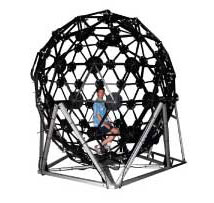
It's not quite Mad Max Beyond Thunderdome -  there are no chainsaws, no axes, and no high pitched whistles - but the recently developed and now-on-the-market Aguru Dome does make things interesting. The Aguru DomeA person enters the dome. Bright lights flash. A cornucopia of photos are taken. Many, many computers think. And, Bob's your uncle! A digital, 3D model of their face is created. A rendering so good, it can be then used to create incredibly realistic digital effects in film (think action sequences), video games, and so on.


Now, I'm not a CGI expert, so you can get better details from the BBC article I read (thanks to artsJournal), this DV.com article, and the Aguru Images Web site. However, I have been known to be an actor from time to time. The Aguru Dome makes me feel just a wee bit uncomfortable. Why in the world would I step into that thing? (Not that anyone would want a 3D model of my face.) I get in, and you get a digital copy of my face that, theoretically, can replace me so well that people won't notice the difference. And you have it forever.

There has been debate about whether CGI could replace live actors for some time now. There have been cases of actors and their performances being digitized, but facial rendering has been one of the weak suits of CGI. This technology seems to get us closer to technicians being able to animate the human face, without needing a live actor to do anything other than sit still for a few minutes.

I wonder if the actors' unions have started talking about this yet.  The Aguru Dome ships out to customers in September 2008.

Technology and the Media Arts

Earlier this week, Southern Arts Federation posted a podcast conversation in which Allen Bell and I talk about tools for new media and the impact technology is having on independent film and the media arts. Listen Now: SAF Podcast #38 - Technology and Independent Media

This conversation is a companion piece to an article that Allen and I co-authored for the National Alliance for Media Arts and Culture about the only remaining organized tour of filmmakers in the U.S.

Of course they chose Hendrix...

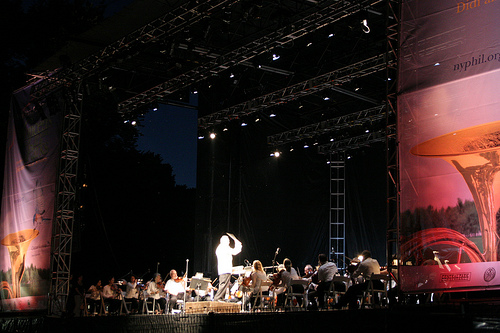
It seems the New York Philharmonic is taking a cue from American Idol. During a recent concert in Central Park, the Philharmonic asked the audience to text their votes to select the orchestra's encore piece. Naturally, the audience chose "Purple Haze." After all, what audience would prefer "Flight of the Bumblebee" over the Hendrix classic? Photo courtesy of froMJersey's Flickr photostream.

According to MobileActive.org, an online resource that examines the use of mobile technologies for social change, the Philharmonic has been using Kodime, a company based in the UK, as its mobile vendor for the past two seasons.

2008 ArtsTech Awards - Call for Nominations

Opens July 7, 2008 - Closes August 8, 2008

The 2008 Technology in the Arts Conference convenes representatives from the full spectrum of arts community, from the local to national levels, to explore the intersection of the arts and technology.

In honor of this exploration, the ArtsTech Awards recognize three categories of leaders in the arts and technology: artists, arts organizations and funding organizations.  For the 2008 ArtsTech Awards criteria, guidelines and nomination forms, visit the following category-specific links:

Nominations must be submitted through our online nomination forms.  Nominations must be received by 11:59PM EST on August 8, 2008.

The recipients of the 2008 ArtsTech Awards will be honored at the Technology in the Arts Conference during the Keynote and Awards Luncheon on October 10, 2008.

If you have questions about the ArtsTech Awards or the nomination process, please contact David Dombrosky.

Weekend Update (Don't Sue Me, SNL!)

Just had a couple notes I wanted to share before the weekend: Click! Exhibit Results Now Available

The online gallery for Brooklyn Museum's crowd-curated exhibit Click!, which I wrote about in a Technology in the Arts blog entry, is now available.

The exhibit asked users to register and adjudicate work that was accepted as part of a March 2008 open call. The submitting photographers were asked to “consider Brooklyn’s transformation over the years, its past and its present, and submit a photograph that captured the ‘changing face(s) of Brooklyn.’”'

The Click! online gallery with a very cool adjudication results feature is now available.

ICANN Relaxing URL Restrictions

The Internet Corporation for Assigned Names and Numbers (ICANN), which controls domain names on the Internet, has decided to relax its policy on domain naming conventions. Web site URLs will now be able to use characters other than Latin, as well as any combination of letters and numbers up to 64 characters.

Finally, I can register ethelslittleangles.sex, where my grandma plans to sell her handmade dolls. She's been bugging me about it for years. "Sex sells," she says. She's been watching too much TV.

Oh Grandma. You and your dirty mind.

Have a wonderful weekend!

YouTube Opens Screening Room for Indie Shorts

Okay, so I love short films.  In addition to appealing to ADD-afflicted by not requiring us to sit through 180 minutes to "understand the narrative," short films are more financially viable for indie filmmakers to create.  The problem with short films is that you can usually only see them at film festivals -- until now.

YouTube has set up a virtual screening room to bring the short films of independent filmmakers to a global audience.  Not only can you view top-notch shorts (curated by a YouTube editorial panel), you can also buy them to watch whenever you want on your computer or portable device.  While the majority of these films have played at international film festivals, occasionally you’ll find films that have never before screened for wide audiences.

They just launched the screening room last week and plan to add four new films every two weeks.  So, show the indie filmmakers some love and check it out!

Click here to learn more about the YouTube Screening Room.

What I Learned at the Americans for the Arts Convention...

Remember those essays you had to write in elementary school - e.g. "What I did for summer vacation"?  That's sort of what this post feels like since Brad chastised me for being remiss in my blogging duties.  Of course, I fired him - again.  I do that a lot.  It just never seems to stick. AFTA held this year's convention in Philadelphia - the city of brotherly love (and sisterly affection).  The hotel sold out long before I climbed out of my procrastination long enough to book a room.  Thankfully, I found a room at a nearby hotel - directly across the street from where they were filming Transformers 2.  If only I hadn't gotten bored and walked out of Transformers, then I might have been more starry eyed.

After three days in Philly with Americans for the Arts, I return to the Burgh with three essential take-aways:

1.  Affirmation -- In a recent (soon to be published) environmental scan of the arts community conducted by Americans for the Arts, it has been determined that, "The influence of technology, unconstrained access, and the new immediacy of communication on traditional and new and evolving production/delivery mechanisms is not yet entirely understood."  While the influence of technology on production/delivery may not be fully understood, the impact of technology on the arts community has been seismic.  Between AFTA and the NPAC conventions this month, I come back to the Burgh knowing that our Technology in the Arts conference, blog, podcast, and site resources are truly useful tools for the field to assist them in navigating unfamiliar terrain.

2.  Futurists Rock -  The Keynote Address was given by futurist Andrew Zolli, founder of Z+ Partners and organizer of the PopTech conference, in the manner that I've yearned for at all of the conferences I have attended throughout my professional life:  highly engaging, provocative and witty.  He touched on a multitude of issues - from innovation and "the tyranny of choice" to experiential economics, "the Long Tail" and "Citizen Brand." I think it was the first time that I went to a conference where the keynote speaker talked for 45 minutes, and I wanted to hear more!  For those of you who were not able to attend AFTA this year (or for those of you who just want to hear more of what Andrew has to say), check out these video clips on YouTube.

3.  The RenGen is Here - On Friday, I had the pleasure of listening to Patricia Martin talk about the premise behind her book RenGen: Renaissance Generation - The Rise of the Cultural Consumer and What It Means to Your Business.  Here's a brief bit from Patricia about the event that inspired her to do the research for this book:

I tried to run out to the AFTA bookstore to buy RenGen - but of course, it was already gone.  Amazon, here I come!

My two favorite concepts that she talked about during her session are:

  • RenGen is a psychographic NOT a demographic. What characterizes this psychographic?
    • Lifelong learners
    • Time-starved idealists
    • Sensualists
    • Eco-conscious
    • Fusionists
    • Inner-directed creatives
  • Collective Creativity - a post on the concept from her blog.

Okay, folks, I have blogged enough today to keep the Brad at bay.  I pinkie-swear to do better!

Victory is... Not mine?

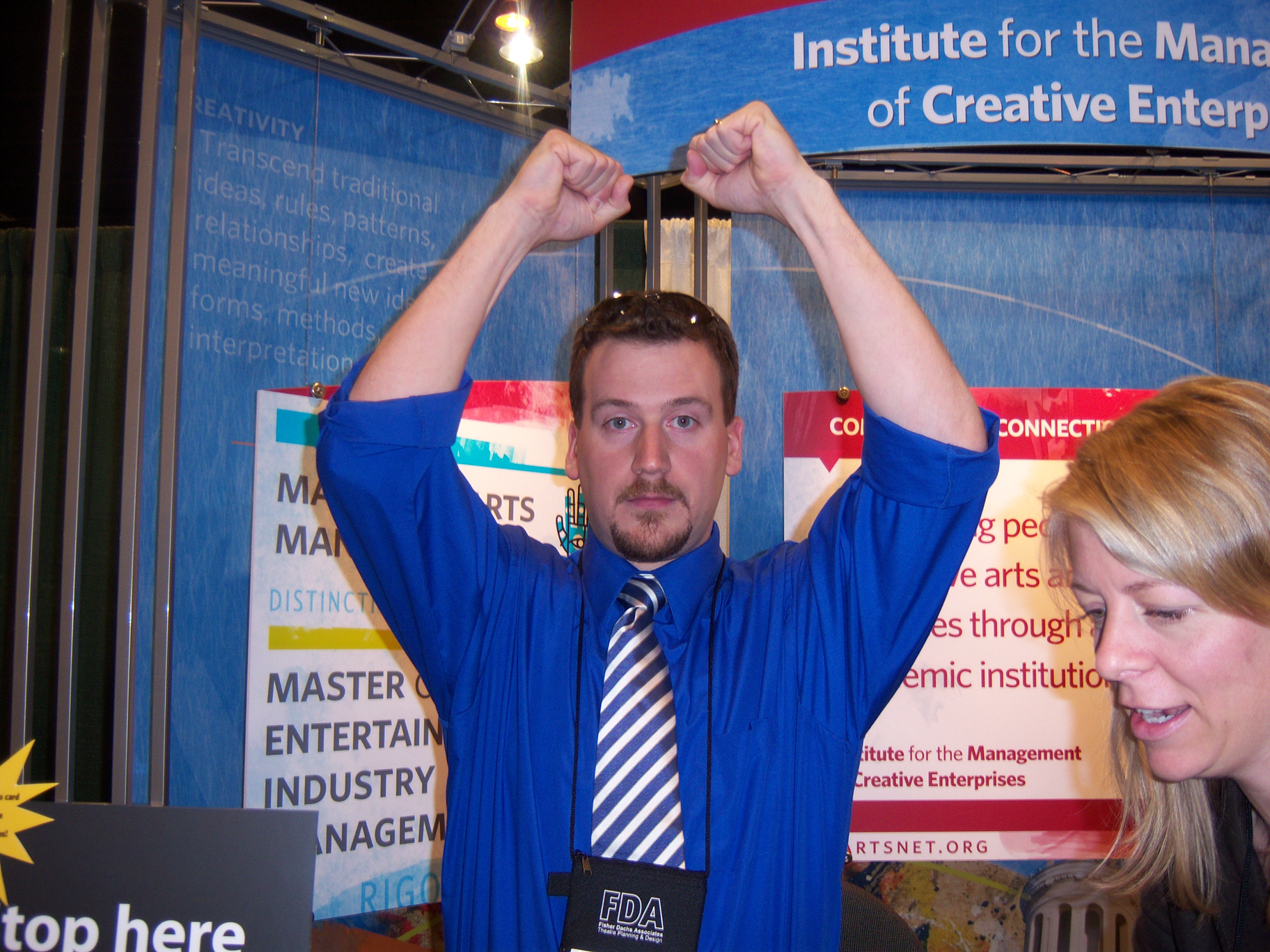
Pop Arts Marketing held their own iPod giveaway last week for the National Performing Arts Convention in Denver. But their contest required a bit more skill than ours, as they set up an online game called Harpsichord Hero, which riffed on the popular Guitar Hero. For most of the Convention, I held the high score, but someone finally bested me on the last day of the event. On Friday, I got what I thought was a perfect score and celebrated a bit more than any reasonable adult should. Then when I looked at the leaderboard, I realized that my adversary was still slightly higher than me in the rankings.

This is a photo of me in mid-celebration, before I was crushed by the realization of defeat:

I look more terrified than happy, really.

You can still play Harpsichord Hero and see my 2nd, 3rd and 4th place scores on the Pop Web site.

Congratulations!

Congratulations to the four winners of the Institue for the Management of Creative Enterprises iPod Nano giveaway. We collected business cards during the National Performing Arts Convention in Denver, CO, last week, and our winners were picked on Friday. The lucky quartet:

  • Jodi Schoenbrun Carter, Managing Director, Westport Country Playhouse
  • Julie Hawkins, Vice President of Public Policy, Greater Philadelphia Cultural Alliance
  • Conrad Kehn, Composer/Vocalist
  • Trevor Hunter, Technical Producer, Counterstream Radio

To all of those who entered but did not win, please remember this quote from William Shakespeare: "Having nothing, nothing can he lose."

Do You Know the Way to San Jose?

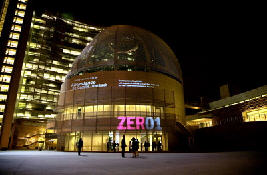
This week saw the arrival of the second biennial 01SJ - North America’s newest and largest festival of digital arts, and a great deal more. From a hip hop, multi-media meditation on Antarctica to robot art, from conversations with artificial intelligence to operatic performances of Google headlines about the environment, from avant-garde cinema to new musical forms - well over 100 artworks, performances, screenings, talks, and workshops will be featured at 01SJ. Festival organizers expect it to be a perspective-altering experience that entertains, enlightens, educates and involves attendees in a new understanding of our changing world.

The 2nd Biennial 01SJ Global Festival of Art on the Edge consists of over 100 events, exhibitions, concerts, performances, lectures and workshops at many venues across the urban landscape of downtown San Jose.

According to Artistic Director Steven Dietz, “This has the potential to be the South by Southwest of digital media in the United States.”

01SJ aspires to become the North American answer to the Ars Electronica Festival – the annual celebration of digital art in Linz, Austria first staged in 1979. “Linz is now a cultural center for the country,” said 01SJ founder and board chairwoman Andy Cunningham, “We hope to do that with San Jose.

Free Web Sites for Artists...

I know the subject of this post sounds like a bit of spam that might roll through your inbox, but thanks to Artlog.com, artists can create Web sites that are easy to use and offer some nice features. Most importantly, the sites are free to registered Artlog.com users (for the time being). Artlog.com is designed to connect people to art and artists to other artists. Their portfolio section is particularly intriguing because it not only allows artists to create their own Web sites with gallery, blog and resume modules; it also allows artists to use their own Web domains. For instance, if I create a site on Artlog.com, it can either be bradartsite.artlog.com (in which case, I don't have to own a domain) or bradartsite.com (in which case, I do have to own a domain).

Want more info about domain names? Check out this recent blog entry.

I recently interviewed the site's creators, Manish Vora and Dylan Fareed, for the Technology in the Arts podcast. Their interview will be released in episode #45 on June 27.

Okay, folks, it's time for YOU to drop some serious knowledge!

October 9-11 -- Pittsburgh, PA Proposals for sessions and workshops are now being accepted for Technology in the Arts 2008 conference to be held at the Hilton Pittsburgh in downtown Pittsburgh, Pennsylvania from October 9 - 11. The conference has two primary types of programming - Hands-On Workshops and Conference Sessions.

  • Hands-On Workshops: Thursday, October 9th: Held in a computer lab environment, these workshops will provide "nuts & bolts" instruction to guide participants through technical processes toward concrete solutions to challenges. Each hands-on workshop will last 2 hours and 30 minutes.
  • Conference Sessions: Friday, October 10th & Saturday, October 11th: Held in breakout rooms near Conference Registration and the Tech Expo, conference sessions may use a number of possible formats to cover relevant issues relating to the use (or potential use) of technology in arts management or production. Conference sessions will last 1 hour and 15 minutes.

Not an expert? You don't have to be one to organize a session. Here are some tips for pulling together a top notch session.

Proposal Criteria: A panel of arts and technology practitioners will review all submitted proposals to select the final program in early July. Sessions will be selected based on the following criteria:

  • Exploration of new or compelling ideas, technologies or practices
  • Speakers' expertise and/or experience with the topic
  • Session's relevance to the conference

In addition to the above criteria, the panel will be charged to select workshops and sessions with an eye toward providing a well-rounded gamut of topics and ideas for conference attendees.

Benefits for Session Leaders and Participants: Individuals who propose sessions selected for the conference program will each receive a complimentary registration for the conference and hands-on training day. Other session participants or speakers will be offered a severely reduced registration rate of $50 for the conference and hands-on training day. All session participants will be responsible for their own travel and hotel expenses.

Proposal Components: To be considered, proposals must include the following information:

  1. Session title
  2. Session type - Hands-On Workshop or Conference Session
  3. Session format - For Conference Session proposals only
  4. Description of the proposed session
  5. Explanation of relevance to the conference
  6. Contact information and bio paragraph for session leader
  7. Other potential presenters and what they would add to the session

Submit your session proposal online by June 30, 2008.

All applicants will be notified of their proposals' status by July 11. For questions or additional information, contact David Dombrosky.

Your Second Life Avatar is Killing My Planet...

It was recently determined that a Second Life avatar uses as much energy as a real-life Brazilian. So try as you might to escape your polluted first life, you're doing even more damage as a Second Life user. The following campaign has been created in order to promote a campaign on the energy-conscious site Big Green Switch that urges Second Lifers to offset their avatar's carbon footprint.

Second Life users: Give a hoot and check out Big Green Switch.

SlideShare - the largest community for sharing presentations

So after the Technology in the Arts: Canada, we were posting presentations and resources from the conference when we ran into a slight snag. A number of the PowerPoint slide presentations were too large to e-mail. At first, I recommended that the presenters use a large file transfer site, but then a colleague showed me the virtues of SlideShare. SlideShare allows you to:

  • Embed slideshows into your own blog or website.
  • Share slideshows publicly or privately.
  • Synch audio to your slides.
  • Market your your event on slideshare.
  • Join groups to connect with SlideShare members who share your interests
  • Download the original PowerPoint / Pdf file

For example, here's the embedded version of Linda Roger's presentation "Virtual Concerts in the Park" from last week's Technology in the Arts: Canada conference:

Did I mention that SlideShare is free? With all of the arts conferences and presentations I have attended over the years, it's amazing that I had not heard of this resource. I can't wait until I get to play PowerPoint Karaoke!!

2008 MUSE Awards Announced

Now in its 19th year, the MUSE awards competition recognizes outstanding achievement in museum media. The competition is an activity of the Media and Technology Standing Professional Committee of the American Association of Museums.

The MUSE Awards competition received nearly 180 applications from a wide variety of museums in North America, Europe, Australia and Asia. Entries included audio, cell phone, and interactive handheld tours, interactive kiosks and multimedia installations, podcasts, blogs, games, websites, online collection and image databases, videos, and e-mail marketing campaigns.

Thirty eight judges – museum and media professionals from across the county – were involved in the process of selecting the winners. Winning entries were expected to demonstrate outstanding achievement in content quality; interface design; functionality; production quality; visual appeal; the user’s experience; and the intent to which new directions were charted or old challenges resolved through technical innovation. A complete list of judging criteria and MUSE Award winners can be found on the Media and Technology website.