

Arts & Technology

Collaborative Script Writing

I recently stumbled upon one of the most exciting (to me, anyway) Web 2.0 endeavors ever to hit the Internet: Plotbot. Plotbot allows two or more users to work on a script collaboratively. It's designed for the screenplay format, but it could be used just as well for collaboration on a new stage play.

Beyond simply adding and editing scenes and other elements to the script, collaborators can comment on their partners' efforts, and the site's project pages allow for blog postings and document sharing. The project pages act as a dashboard, providing a great deal of useful information about each of your projects.

Plotbot's project page

The system's script-writing engine (powered by AJAX) streamlines the formatting of dialogue, action and sluglines. Here is the "Add an Element" tool: Add an Element to Your Script

And here is how a full scene page looks: Scene Page

As you can see, it's a very slick interface, and every line that is modified has information in the right margin about who made the modification and when. You can also roll a change back if you're unhappy with it.

One other cool and useful aspect -- Each of your projects gets its own RSS feed, so your collaborators can subscribe and get instant updates to their RSS readers when changes are made.

Best of all, the site is completely free. I'd urge anyone doing collaborative script writing to register and check it out.

Rhizome.org

Rhizome.org (part of the New Museum of Contemporary Art) is an online community devoted to the merging of art with technology. Their ArtBase is an archive of works that "employ materials including software, code, websites, moving image, games and browsers to aesthetic and critical ends." Rhizome.org Mission Statement - Rhizome.org is an online platform for the global new media art community. Our programs support the creation, presentation, discussion and preservation of contemporary art that uses new technologies in significant ways. We foster innovation and inclusiveness in everything we do.

Music and Video and iPods, Oh My!

On August 4th, the National Symphony Orchestra in Washington, DC, performed a concert entitled "Fantastic Planet" which combined classical music (of course) and more modern elements, such as video projections and....iPods? Prior to the show, NSO conductor Emil de Cou had recorded a commentary track that offered insights into the music of the evening. Pieces of history, trivia, and background that concert-goers eager to experiment could download to their iPods (or other MP3 players) and listen to during the live performance.

"I thought it would be neat to have the conductor being your seatmate, whispering into your ear at key moments," Emil de Cou said before the performance.

Reading the review on the Washington Post, it's obvious that the experiment achieved mixed results. Some folks had trouble syncing their iPods to the live music. Others found the commentary track distracting. With music, spoken words and video, all swirling around the brain at the same time, it's no wonder. According the Stephen Brookes, "Two minutes into the opening piece I quietly slid off my headphones, and by intermission it was impossible to spot anyone still plugged in."

But the idea of commentary tracks for classical music is not a bad one. DVDs almost always have commentary tracks. But usually those tracks are switched on during a movie you have seen countless times and know the plot, characters and dialogue stone-cold; so, it becomes quite easy to concentrate on the commentary and the movie at the same time. I doubt if many in the audience on August 4th knew Vaughan Williams's "Serenade to Music" as well as I know every line in the "Princess Bride."

Also, in commentary tracks, syncing is vital. Especially if the track refers to something occurring at a specific moment. With live music, it is probably hard, if not impossible, to truly craft a commentary track that will sync up, because the beauty of live performance is the fact that it is live, and thus different every time.

Regardless of the evening's perceived success, kudos to the NSO for trying something new! If I lived in Washington, DC, I would have been there with my iPod in one ear, the music in the other, a smile on my face, and a big thumbs up to their creative experiment combining arts with technology.

Original Washington Post Article

Visit Dresden's Art Gallery in Second Life

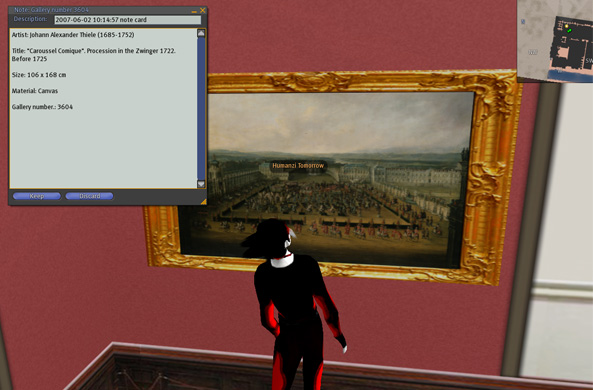
Not everyone can afford a trip to Dresden, Germany, but now anyone with a computer and a Second Life account can visit the city's famous art gallery. In June, a digital version of the entire building - 37,700 square feet and 750 paintings - was launched in the 3-D virtual world of Second Life.

My Second Life self viewing a painting in Dresden's gallery. (View Full Image)

Check out the full story and some images from WIRED.com.

Powered by ScribeFire.

ArtandCulture.com Joins Exhibitors

It is my pleasure to announce that ArtandCulture.com, a very cool Web site showcasing a wide array of artists and arts organizations, has joined the Technology in the Arts 2007 exhibitor fair. The preliminary plan is for the folks from ArtandCulture.com to set up an informational booth where artists can learn about the site, discuss the tool's many interactive features and future development plans and even add their own profiles.

ArtandCulture.com Logo

Thank you in advance to ArtandCulture.com for taking part in our conference.

And can you think of a better Web address than that?

Technology in the Arts - not the only reason to visit Pittsburgh this fall

Voters chose Pittsburgh as the best destination for the arts among mid-sized cities in the June 2007 issue of American Style magazine. Visit their Web site by clicking here to read the full article. You won't want to miss any of the museums or performing arts venues this fall so plan to come early or stay late. Pittsburgh is also at the top of the list of "most livable cities" according to Places Rated Almanac.

Check out these and other accolades at http://kdka.com/local/local_file_116160520/

Don't just read about it, come see what all the buzz is about. Online registration opens soon...sign up to get the Early Bird rate!

I can hear what you're thinking . . .

French philosopher Rene Descartes is credited with the phrase “I think, therefore I am”; now, nearly four centuries later, a young British woman may have taken the idea one step further – I think, therefore I create art. Interactive artist Luciana Haill uses medical electroencephalogram, or EEG, monitors embedded in a Bluetooth-enabled sweatband to record her brain activity, and send the data to a computer that plays it back as audio. Since the human brain operates in the same frequency as sound waves (hertz), it's a relatively simple process to use software to convert the brain's raw data into a sound format. Haill has been honing her craft over the last 14 years, and she now uses Apple's OS X operating system to trigger digital samples in GarageBand with each type of neural activity.

Haill's music has been featured in new music festivals, including Cybersonica 2006 and the recently completed Future of Sound tour, but she hasn't yet brought her music stateside. To hear it for yourself, visit Luciana's MySpace page.

Ice Cream [remix]

With summer finally on its way, ice cream trucks around the country are revving their engines and turning up the loudspeaker. Tired of the familiar (annoying) theme songs, New Yorkers Jeffrey Lopez and Lauren Rosati decided holding an online remix competition to come up with a new tune. The winner of the Ice Cream Headache contest will have their new song played on a Mister Softee truck driving through New York's five boroughs during Memorial Day Weekend. The contest has already received more than 40 entries, including the quirky Balinese Softee by Nina Katchadourian (my personal favorite).

To enter the contest, e-mail your entry to info@suite405.com. But hurry before it melts -- all entries must be received by Friday, May 5th.

please consider voting for SITI's social web project by April 14th

I work for SITI Company (an ensemble theater company led by Anne Bogart) and with the help of Erika Block we are developing a project that uses social media to build, connect and strengthen our international community of students and audiences through the creation of SEE (SITI’s Extended Ensemble). Rooted in SITI's commitment to international collaboration and the fostering of young artists, SEE uses social media to connect a community of artists and audiences, using an ensemble theater context to bridge virtual and “real” worlds by developing an online tool that fosters collaboration. Erika describes it as, "exploring ways to turn online connections into face-to-face connections - a networking meeting, getting out the vote, getting audiences into theaters. And to turn face-to-face connections into online communities. Deepening the impact of a performance or a workshop by creating a space for dialogue, shared tips, questions and, ultimately, repeat attendance. This is the potential of these tools - a seamless loop of participation."

She also points out "The Howard Dean campaign and MoveOn are early examples. MySpace is tremendously effective for promoting music and spoken word concerts (and, increasingly, other events). Last year’s Los Angeles immigration protests by young people were organized online. Just the other day, Andrew Taylor wrote about Charles Leadbetter's new book We-Think, which suggests that our traditional view of how innovations enter the market -- special people in special places creating things that are pushed down the pipeline to passive and waiting consumers -- is no longer true, if it ever was. Rather, the traditional, corporate approach to creativity and innovation is decreasingly able to develop radical innovation, and spends much of its time stifling the innovation of talented and networked amateurs [and professionals, I'd add]."

One of the things that's most interesting about SEE is its potential to become a model for the performing arts field, encouraging peer-to-peer collaboration and invention.

SITI has submitted the proposal for support from the NetSquared community (division of Tech Soup), which was developed to spur responsible adoption of social web tools by social benefit organizations. 20 projects will be chosen for support through a membership voting process, and anyone with an interest in this work can join NetSquared, for free. (Apart from the opportunity to vote, you can participate in a great conversation and draw on a growing resource base.)

We'd love for you to vote for SEE, and you can find the full project description here. The link to vote is here. (you'll have to register on the site)

MySpace as an Arts Space

Today's issue of The New York Times features "MyTheater, Seeking Friends," an article by Steven McElroy highlighting how various arts organizations are using the social networking site MySpace as a platform for marketing and promoting to younger audiences. For early adopters of technology, using MySpace as a promotional platform for the arts may seem like a "no-brainer," but for many others in field, the why's and how's of adding their organizations to MySpace are not readily apparent. I remember speaking with the director of a university's performing arts series at a recent conference. She told me that she had yet to find a successful tool for promoting her series to the university's students. I asked her if she had considered setting up a profile for the series on MySpace and using that as a platform for promotions geared toward the student and local Gen Y demographic. She admitted that the thought had not crossed her mind - even though she knew that a great number of the students at her university spent time on MySpace.

With a user base of 55 million and 28.4 percent of users under the age of 34, it is more difficult to find a reason NOT to use MySpace to reach out to new or younger audience members.

McElroy's article mentions how musicians and comics have been using MySpace as a promotional tool for quite awhile now. I would also add the independent film community to that list. My organization recently established a MySpace page for our independent filmmakers tour because of the enormous presence of independent filmmakers and film lovers on MySpace as demonstrated by the MySpace Film area. By joining this community, we have been able to promote our calls for entries to indie filmmakers around the world AND notify film lovers of our touring program - all in four weeks.

Next week, IMAGE Film & Video Center here in Atlanta is hosting a "Pimp My Space" workshop to teach local filmmakers (and folks like me) how to get the most out of your MySpace presence. I wonder if they are going to have a session like that at the National Arts Marketing Project conference in November? They should!

When I think about the organized areas of MySpace for film, music and comedy, I think wouldn't it be great if there were areas of MySpace set aside for dance, literature, visual art and other art forms?

  • Places where both emerging and established artists could promote their work - tours, performances, readings, publications, exhibits, etc. Maybe a fledgling modern dance group like Ash Contemporary Dance could become the Dane Cook of the dance world and play to audiences of thousands. (For those who don't know, Dane Cook became a stadium-selling touring comedian by developing a base audience on MySpace.)
  • Places where arts organizations could find hip "friends" to invite to their events and venues. (Did I mention that Dane Cook currently has 1.8 million "friends" on MySpace?)

Don't get me wrong. MySpace is not a marketing panacea for cultivating the next generation of arts enthusiasts - but it sure could be useful!

Technology in the Service of Art

Lately I’ve been experimenting with Ableton’s Live software, which allows me to create interesting arrangements, construct new pieces from scratch, and generally play with music. Live lets me lay down every single layer within a track… by myself… fast… with thousands of different sounds at my disposal. It’s fantastic. Best of all, the anal retentive freak in me is able to go back and revise music I record to make sure that in the “saved” version of the piece, I hit the note smack dab at the beginning of the third thirty-second of the beat, rather than the hairs-breadth off that I actually played. Far from weaning me off traditional music making, Live has deepened my respect and love for the craft of artistry. I find that when I’m fiddling around with the digital manifestation of the music, trying to bring down the volume on the pedal point tones, or simply arrange the notes into a harmonic minor scale with just the mouse, I’m incredibly impatient with a task that should just HAPPEN under my finger tips.

Don’t get me wrong. Technology is wonderful. With Photoshop I can manipulate my images without investing in a full dark-room setup. With Illustrator I can create versatile graphics that can be used just about anywhere. With Live I can be an entire orchestra without leaving my home. And technology is especially wonderful when it enhances rather than detracts from art. When it allows me to do things that aren’t otherwise feasible. When it lets me experience things I can’t normally access.

Like the use of technology in Lois Greenfield and the Australian Dance Theater’s new performance, Held. For this work, Greenfield photographs the dancers mid-movement and the images are instantly projected onto a screen. This is a perfect exemplification of the Technology in the Service of Art principle. Greenfield notes in the Telegraph that in these images “you are seeing something you couldn't without the benefit of the photograph. I capture 1/2,000th of a second and our brains can't register that. But we can see it on a picture."

Held uses technology to intensify our ability to cherish and appreciate the craft of the artists. It’s a beautiful marriage of media because it respects the strengths and limitations of every component involved, from the camera to the artists to the audience.

Pittsburgh Bloggers unite!

On Sunday, February 18, the Pittsburgh Symphony will host a "Blogfest Extra" concert - a two-part community outreach event. The afternoon's concert will include traditional works from Mahler and Beethoven as well as a new work, Rainbow Body by Christopher Theofanidis. The work's title is derived from a Buddhist idea that when an enlightened being dies, his or her body doesn't decay, but instead is absorbed back into the universe as energy and light. As a spectacular display of technology-enhanced art, the PSO will perform Rainbow Body along with projected images of dying stars taken by the Hubble Telescope. Following the concert, the PSO will host a blogging reception, during which "blogging after the concert is strongly encouraged!"

The PSO recently established its own pair of blogs, one featuring staff contributors and the "internal perspective" and the other featuring community members, composers and volunteers who provide the "external perspective". The PSO blog has come a long way since its founding last fall, and now even includes a few video blog posts. It's clear that the blog has become an internal priority, and I hope the Symphony's artistic team will continue to create innovative events like this one.

Will the real artifact please stand up?

Italian geophysicist Pietro Cosentino is on a mission to identify works of art through unique "sonic fingerprints". Cosentino began using sonic tomography to study art in 2005, and hopes his work can help to end Italy's ongoing problem with faked and stolen artwork. Based on the principle that every object emits a distinct vibration, Cosentino's process involves fitting a network of sensors to an artwork, then tapping the sensors with a small rubber hammer. Recorded vibrations are unique, and even allow an educated listener to distinguish between artworks made as part of a series. The noninvasive process takes several hours, and can be used on stone, wood and ceramics.

The sonic fingerprinting system, in the process of being patented, has only one significant drawback - like X-rays, the scans must be performed every few years to provide up-to-date information.

Read more at Wired.com.

Wikimania

Penguin publishers and De Montfort University recently launched the first wiki novel - an experimental project designed to see if "the wisdom of crowds" can apply to more artistic disciplines. Contributors to "A Million Penguins" will include Masters students in Creative Writing and New Media, who study writing in the evolving fields of online communities, blogs, and wikis. The project went live on February 1st, and the wiki has already seen a flurry of editing activity. The novel's current cast of characters includes a penguin "trying to save mankind from its own destruction" and the mysterious "Tango Prisoner".

The experimental novel will be online for at least six weeks, according to Penguin, who insists that this project is not a talent search for the publishing house. Even if fleshing out the character of the "Tango Prisoner" won't lead to your big break, writing in this new collaborative medium will certainly be a great challenge.

Attend an opera in New York for $5

All you have to do is accompany a teen, and buy your tickets online. Patron Technology recently featured High 5 Tickets to the Arts in their monthly newsletter as an e-marketing superstar. High 5 offers tickets to hundreds of performances and events in New York for the low price of $5 per ticket. In 2006, the New York non-profit conducted roughly 85% of ticket sales online with some tickets sold out in a matter of hours. High 5's idea of making arts more accessible to young audiences through inexpensive tickets has also spread to other cities including Columbus, OH, and Montreal. Cultivating younger audiences is a hot topic in my arts management program at the Heinz School of Public Policy and Management, so I imagine it may also be of interest to you as arts managers in the field.

It would be interesting to evaluate the effectiveness of High 5's service. Will the teens snatching tickets up today be our loyal patrons and donors twenty or more years from now? Some of my classmates believe the best way to ensure a lifelong commitment to the arts is through arts education more so than just accessibility. I agree with them to some extent, since through my own experiences, I was exposed to the wonderful world of opera in Dallas through an education program focused on introducing new (and diverse) audiences to the art form. The combination of severely subsidized tickets and education sessions made the experience complete. I doubt I would have attended an opera out of my own volition if it weren't for the empowering educational experience I had through that program.

Recent Articles Worth Reading

Here are just few articles I have come across lately that I think you might find interesting: Web Refocus - Jeremy O'Neal examines Web 2.0 and forecasts the role that media arts organizations will play in it - namely preserving and promoting the noncommercial space.

Welcome to Wi-Fi-Ville - Kristina Dell reports that more than 300 cities and communities nationwide plan to have wireless ventures in the next year. While we all want free Internet access, what are the contentious issues surrounding the offering of a low-cost or no-cost wi-fi municipal plan as a public service?

Can't Touch This - Welcome to the future of the human-computer interface. Jeff Han, a research scientist from NYU's Courant Institute, wowed the tech world with his touch-driven computer screen. Learn more about this amazing device and watch the demo video.

This last article comes from the current issue of Fast Company magazine. Another article in this issue that is not available on the web, "An Unlikely Story: Tech Where You Least Expect It," documents the success that the Isabella Stewart Gardner Museum in Boston, MA has had with podcasting its classical music concert series. Check it out.

Art on the Web and Other News

I read an interesting article on CNN.com today, and I wanted to pass it along. The piece examines STUART, a site for art students to hock their creative wares. Also, check out our latest podcast, which features part one of our interview with Microsoft's Ian Lindsay. He was very engaging and a very good sport.

Oh... and Happy Holidays!