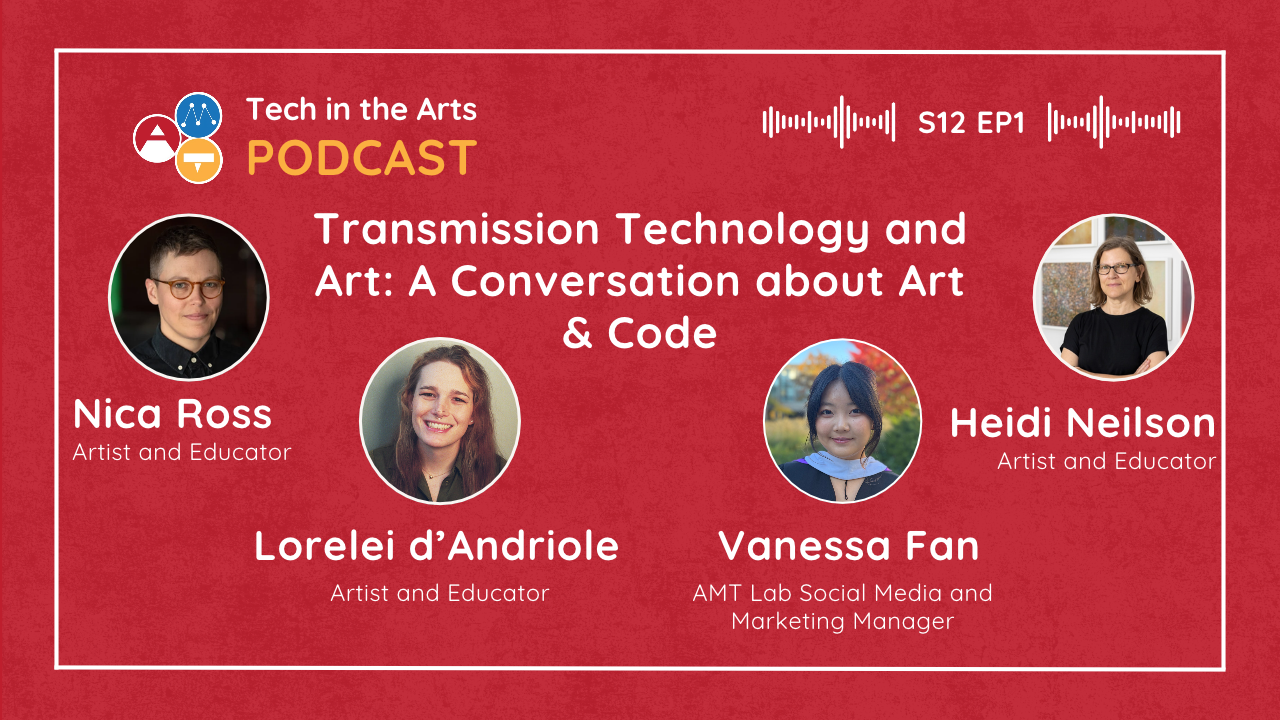
In this episode of Tech in the Arts, Vanessa Fan, AMT Lab’s social media and marketing specialist, discusses the artistic approach to radio frequency transmissions with artists and educators Nica Ross, Lorelei DeAndriel, and Heidi Nielsen. They reflect on their time at the 2026 Art && Code: Transmissions workshop hosted by the Studio of Creative Inquiry at Carnegie Mellon University. Our panel discusses their experiences with radio transmission, how it stands out as an art form, and the future possibilities of radio.
Show Notes
Transcript
Vanessa Fan:
Hi, everyone. Welcome to Tech in the Arts, the podcast of the Arts Management and Technology. My name is Vanessa Fan, and I'm the social media and marketing manager of the AMT Laboratory at Carnegie Mellon University. Today, I'm joined by three amazing artists and educators, Nica Ross, Lorelei DeAndriel, and Heidi Nielsen.
We'll be discussing their work and artistic perspectives on radio frequency transmissions, sharing our experiences with the Art && Code Transmissions workshop at CMU. First, we have Nica Ross, an artist, educator, and cultural producer based in Pittsburgh. Nica's work explores the intersection of art, technology, and social interaction, often using humor and play to create interactive experiences that bring people together.
They've worked across a wide range of media, theater, and live productions, collaborating with groups like Three Legged Dog Media and Theatre Group and the Joshua Light Show. From 2022 to 2026, Nica served as the director of the Frank Rachye Studio for Creative Inquiry, and they're currently an associate professor of video and media design at Carnegie Mellon University's School of Drama.
Next, we are joined by Lorelei DeAndriel, an interdisciplinary artist, musician, and educator whose work spans experimental radio, electronic art, and performance. Lorelei has exhibited her work across the United States at galleries, universities, and festivals. She hosted a weekly experimental radio art program at KRUI 89.7 FM, where she also served as production director.
She's been actively involved in the punk music scene since childhood and currently performs with the Michigan-based bands Pet Me and Danger Cat. In addition to her artistic practice, Lorelei has participated in several artist residencies, including at Wave Farm, and has advocated for queer and trans musicians throughout her work with the International Alliance for Women in Music. She currently serves as an assistant professor of electronic art and intermedia at Michigan State University.
Last but not least, we have Heidi Nielsen, an interdisciplinary artist based in New York City, whose work explores the connections between people, technology, and the world around us. Working across mediums like radio, sound, sculpture, and electronics, Heidi uses art to make invisible systems and forces more tangible. One of her current projects, Here Goes Radio Telescope, uses satellite transmissions and weather data to create unique experiences. Her work has been exhibited internationally and is held in over 100 collections, including the Library of Congress, the Brooklyn Museum, and the New York Public Library. She's also received numerous awards and fellowships, including recognition from the New York Foundation of the Arts. Heidi currently teaches at Parsons School of Design and the Fashion Institute of Technology in New York.
Let's first start with understanding some of your inspirations. So first, with Lorelei, what originally inspired you or drew you to work with radio transmissions as an art form, and what does it mean within your artistic practices?
Lorelai d’Andriole:
Thanks for the question, Vanessa. I grew up in Oklahoma City, Oklahoma, where the radio was primarily used to play post 9/11 country music and sell Ford F-150 trucks. So I didn't grow up with, a strong attachment to radio, but when I started listening to radio station WFMU, out of Jersey City, and being influenced by some of their radio shenanigans, radio pranks, and just, a radio station brave enough to play bad music really invigorated me as a musician and as an artist.
And so when I got to grad school at University of Iowa and learned that there was a student-run radio station, I did everything I could to embed myself in it to do my own radio shenanigans. And so when I think about radio and transmission as an art form, however, in a more serious way, I'm deeply influenced by, like, the writings of Tetsuo Kogawa, and there's an edited volume produced by the Walter Phillips Gallery called Radio Rethink that I was given as a graduation present from my undergraduate advisor, and it was very, like, transformative to my thinking and sort of introduced me to transmission arts as a conceptual site and as an artistic medium.
Yeah, radio's just so cool. I mean, when I think about radio now, what really excites me about it is its relationship to listeners and how much that has changed in the past 50 years, how physically you have these massive listening ranges, but then how many people are actually tuning in, and is it important if listeners actually tune in or not?
And what kind of very, like, special audience-performer relationships can be formed through that? And I know that was something that we talked about over the weekend a little bit, but for me, that's one of the most conceptually rich parts of radio as a medium, is its sort of inheritance as a medium of colonial imperialist technological advancement, and now the, that sort of relationship it has to audiences and how my students don't listen to radio, you know?
So, like, what does it mean to use telecommunications technology as a medium of art? There's... I think there's a lot of exciting stuff at play there, and I'd be curious what my peers have to say about that. But that's what comes up for me. Thanks, Vanessa.
Vanessa Fan:
No, thank you for your answer. I feel like radio is not the first art form that people think of when they think of art, especially since it's intangible, so that makes it a bit harder to even visualize in the first place.
This kind of transitions into my next question. This is specifically for Heidi. How do you approach transmission or the electromagnetic spectrum, and do you see it as a creative material in the same way other artists might see paint, sound, or clay? And what can you explore through radio that you can't explore as effectively through another medium?
Heidi Neilson:
Super broad question, but awesome one. I see radio as being super different than something that's really tangible, a tangible medium like clay or even drawing or something. It's a little more like a photographer thinks about light, you know? Or maybe related to sound, because it's so intangible.
I came to whole radio transmission art as a medium very indirectly in a way, although I also had a college radio program. Radio's always been there, you know. I had a college radio program and have been obsessed with shortwave in the past. But it came to me because I was researching satellites.
I was researching vintage satellites and the idea of these distant objects being space heritage, actually. And so it came to... I came to realize that you could, through ham radio essentially, you could kind of touch them yourself, you know, in a way. Like, you could actually, at a distance, be engaged with them.
And so I became more involved with that, with being able to actually receive these satellite transmissions directly, and I got into it more from that standpoint of being..., and I guess that addresses the other part. Different than other mediums or different than other forms of expression, you can really touch people at, touch things at a distance that you can't in other ways.
Even sound. Radio travels so much farther than sound, so you're able to sort of expand your horizon in a really, in a way that's super different than other mediums.
Vanessa Fan:
Yeah. Thanks for the insight. That's, like, really interesting, as radio is also sound waves, so I feel people might confuse it with sound or music as a medium.
But I think your insight on how it translates a further distance compared to sound, and then also how it's related to space exploration and satellites-
Lorelai d’Andriole:
If I could just jump in. When I'm, like, talking to students about radio versus sound, Heidi, I love using the example of, like, radio waves can go through your body.
Sound waves cannot. Sound waves can bounce off of bodies. They can respond to architecture, and radio doesn't care about architecture. It'll go right through the building, you know?
Heidi Neilson:
Yeah, and it's so cool- the way we often use them interchangeably in a sense because we're transforming them from one to another, sound into radio, and then radio back into sound. And so, it's sort of fluid between them, you know?
Vanessa Fan:
Yeah, I definitely think so as well. Yeah, let's move on to the next question. So this is for Nica, actually. Does a transmission need a receiver or audience to have meaning?
Nica Ross:
Yeah, I mean, I've been listening to everyone and just thinking about my own excitement about transmission as an art form, and just thinking, like, my own, like, origins of excitement, what came to mind was Close Encounters of the Third Kind.
Watching that as a child, and hearing, like... I can't remember the exact melody, but this melody that is translated over radio waves through space. Thinking about the distance that our transmissions are going, and this, that there are SETI and other programs that are intentionally making all these transmissions through the universe, through the galaxy that may or may not be received.
And what hubris this is of humankind to think that someone might be looking for us, or wanting to hear from us. Maybe they do. I don't know. I think we might be amusing. But also thinking, on a more local level, if I am sitting here with an FM Guerrilla radio station, whether or not someone's gonna actually be tuning in, or picking up what I'm trying to say, I think is actually one of my favorite parts of radio transmission is that you can choose to listen, and you can choose to be anonymous in listening.
Whereas when you're transmitting, you're making a choice about being available, possible to find because you could be, your transmitter could be found. And you are also saying something or playing something or giving some kind of message. And I came into, understanding the power of radio as kind of a spy myself because my father worked in public transit, and in his car was a little radio that could hear all the bus drivers of Phoenix, Arizona.
And it was the most dramatic, most interesting broadcast that I still to this day have ever heard. Just bus drivers on their daily route trying to deal with humanity was exciting, and just knowing also we could hear everything. And there were different radio channels, you know. The drivers couldn't hear each other. They could only hear the main person, but everybody could be heard on certain channels, and it was so intriguing to me as a child to hear that power of radio and get to spy. And spying has long been a core reason why I got into visuals and things like that.
I think it is not necessary to know whether or not you are being listened to, but I think it is necessary to know that you might be listened to when you are transmitting.
Vanessa Fan:
Wait, I love that perspective on it. I think a lot of art forms, they kind of are focused more on being seen or being heard, especially tangible art forms.
Lorelai d’Andriole:
Could I jump in?
Vanessa Fan:
Yeah, yeah. Go ahead ...
Lorelai d’Andriole:
'Cause I said something somewhat similar, and I was challenged by our peer at the event, Anna Friz, right? But I had said, like, "Oh, my favorite part about radio is no one is listening." As someone who is doing very vulnerable broadcasting.
And performance pieces that I was like, "Oh, I could get in trouble for this." But then, seeing to what extent I could get away with before there were any consequences was something that I was playing with. And I had said, "Oh, you know, that's my favorite part," and I do somewhat still hold that, and I think that's what makes radio so cool is the sort of outlaw element to it that you just can't really get with a painting, so to speak.
But Anna was like, "What are you talking about?" And was like... said something like... What was it? I don't know if y'all overheard this, but she said, "Radio is a lighthouse. It's for everyone, and the people who are looking for it, it's very special to them." So if you're... the lighthouse is like- it's this sort of broadcast beam of light, and if you're a sailor out in the night looking for land, it's for you.
And so where I was like, "No one's listening in," it was like, no, it's for everyone, and if you're listening, you're the audience, it's for you- because you tuned in. But I think that metaphor of radio as a lighthouse is a great challenge to some of these ideas that I don't think contradicts it necessarily, but complicates it in a way that I think is very beautiful poetically.
Vanessa Fan:
That is a really interesting perspective and take on -
Heidi Neilson:
Just to jump in to extend the metaphor a little bit further, satellites often are, they have, basically, a beacon signal, you know? They're just saying where they are. And that's really interesting, too, that radio is often simply trying to just say, "Here I am," you know?
"I'm right here. I'm over here. This is where I am," you know? A lot of times, so.
Vanessa Fan: Yeah, that's, like, such an interesting perspective. I'm feeling very inspired. But let's go into the sec- the next question. Participants during the workshop were building antennas; they were working with radio equipment and learning about signals, which can also be associated with engineering.
At what point does the process differentiate from engineering and become art?
Heidi Neilson: Yeah, that's a great question. It really is the same question as, like, where art becomes science or really what the boundary of art is with anything. You know, I was... I think of engineering as something that's, like, trying to solve a specific problem or,, answer a particular question or make a tool that's trying to do a really particular thing.
And art is where that tool or that question or whatever is sort of being turned on its end to ask another sort of question or to look at something different that you can't see, or to see something differently that you might not be able to. And I guess that would be where the line, to me, if we were to draw one between art and then how you delineate art.
But it does kinda make me think that engineers and scientists really kind of accidentally are artists all the time, and they might not recognize that's what they are. You know? They're really kind of bumping up against what their tools and questions ask and, you know, against things that look at things in a really different way.
Vanessa Fan: Yeah, I also agree. I feel that many of the equipment basically for artists and engineers and scientists. They do overlap, and there is like multiple opportunities where they could be producing some sort of art form. But maybe what differentiates it is the intention behind it. That's what I...
That's my perspective on it. I mean, you can make accidental art, but to be an artist, it's more about the intention behind actually working towards making the art pieces.
Heidi Neilson: Yeah, and maybe intentionally using tools not in the way they were intended. It's just using things in a different way, yeah.
Vanessa Fan: What can artists bring to technologies like radio that maybe scientists or engineers might miss, or they might not be necessarily looking for?
Lorelai d’Andriole: Yeah, I was thinking about this question in the sort of like field of study I've become a professor in, of intermedia, and qualities of intermediality in art.
And I would say, I think regardless of the specialty or field, the more we can sort of break down boundaries between disciplines, the better. Full stop. And so, it's not necessarily that like artists are these like incredible outside-the-box thinkers when they engage with engineers. It's just they have a different set of expertise, and are engaging with an expert in another set of specialized skills and knowledge, and that's where some really beautiful and magical things happen.
I think the... And I, hadn't mentioned this over the weekend, but the history of this field, that we would umbrella term call media arts, is like full of these moments of history where you have these interactions between artists and engineers. I always think about the Abe Pike video synthesizer, as an example, or the artist residencies at, like, Bell Labs or something.
And those, we have inherited those histories still. There are plenty of labs that have artist residencies, and that sort of thing. So the other thing that comes up for me is I think everyone in every discipline needs more unrestricted time. We all need more time and more resources.
And ideally, the things paying us to have time and resources are coming from, like, ethical, nice sources and, and not something like the Department of Defense in the case of, like, Silicon Valley, right? So I know that doesn't quite answer the question, but I would say, you know, the sort of, near feudalism that...
Or, yeah, that we've set our disciplines where, like, everything's very, there's a great chain of being within disciplines, so to speak, as Dick Higgins was describing it. The more we can challenge that, the better. And so, I applaud the weekend's organization. I applaud Nica for including an engineer, and us having that sort of cross-disciplinary engagement.
I think that's critical, because just being exposed to the engineer on the panel is like, "Oh, wait, hold on. I can maybe consider doing this." I love the sport, the hide-and-go-seek. That was so fun.
Nica Ross:
If I can piggyback. I mean-
Lorelai d’Andriole:
Yeah, please ...
Nica Ross:
This is something I think about all the time and is central to my own research and practice: I think that artists are essential as a part of any process of creation and any process of research because it – research and creation necessitates question-asking, and not simply mono-focused, goal-oriented development.
And, you know, there's many philosophies in all of our practices and all of them are valid, having a scientific method of saying, "Okay, I need to control things, I need to have specific variables, I need repeatability," great. Having an engineer kind of mindset of like, "There is a problem; I must solve it, I must solve it in a way that is also repeatable, that is steady."
The artist's role is to ask questions that, you know, could have an absurd purpose, you know? Could have unknown variables, could have all these entanglements in what it is actually to live in the chaos that we live in, and to hold all of the, like, mysteries that we hold that we still don't understand, but to leave space for that, to leave space for phenomena, to leave space for, you know, the weirdness of all of our bodies and minds. And that is essential in the development of knowledge, and that is essential in any kind of process that creates things that we will rely on or not rely on. So, I think that, you know, absurdity is one way to think about it; experimentation is another...unpredictable outcomes.
All of those things are what artists are so specially, able to point out. And I just wish that there were more, you know, I wish that the NFS required an artist on every single grant. Very- ... like very truly, that is something that I wish would happen. I think that we do look at, long-term, you know, projects in the institutions like Bell Labs as being uniquely powerful because artists were essential to the process.
Luckily, you know, I have some colleagues who were involved in that, and they are essential people who developed things. Another term is, like, skunkworks at, like, tech firms. You know, to have part of an institution that is–doing something that seems to not be purposeful for profit or for problem-solving, but yet it is.
So, that is the hill I will die on. That artists are essential to any process.
Vanessa Fan:
No, I totally agree. I feel that, whether you're an artist or a scientist, whatever field you're in, you have more insight within that field, and you tend to look at problems at a different angle. And it's always better to have more ideas or more people thinking about a problem in different ways, because that way you can always find the best approach, and you might be able to come up with an idea that you didn't have before or that you didn't even consider before.
So it's really important to have multiple different disciplinaries on one team working towards the same goal. So this one is for Nica. Why is it important that participants actually build, search, listen, and experiment rather than simply learn about radio conceptually?
Nica Ross:
Hmm. I love this. I, you know, as both an educator and also as a facilitator, I've witnessed how proprioceptive learning, like, learning with your body, and doing things, it...
You know, I'm also, you know, a nerdy athlete of sorts. So I also have my own, like, physical practices, and I can also speak from musicians learn an embodied practice, that their body is so essential to their instrument. I think that is true for all practices that we engage in.
And it was really cool to watch everyone in Heidi's workshop saw. Like, that was a huge part of the workshop. And then, you know, I was like, "Okay, we're gonna pair them up in twos so that this can be like a social, like, partnership, in helping each other."
And everyone used the saw differently based on, like, their own body and, like, needs, and it was frustrating, but I think frustration is a part of learning, and it's such an essential part of learning. Sorry, students. I apologize to myself, too. I've frustrated myself, but it was, it is very essential to all of the workshops, including, you know, the Meshtastic nodes.
Yes, you can buy a Meshtastic node that is fully assembled. And we had two very informed, you know, experts, Danielle and Gray Fox, who could tell us everything there is to know. But it was very different for people to push their little tiny antenna onto their own board and see the board and understand, like, when they were explaining what chip we had in these Meshtastic nodes that they looked and they saw the chip, you know?
We need to have an understanding of the materiality of what we're working with, what the manufacturing might look like, what–where those metals come from, all of that in order to live as informed makers and informed users. As an educator, I think it's essential for all of us to understand not only the conceptual and the practical, like this does this and that does that, and that's how that will work, but also, like, what is it physically in our hand?
We are a species that extracts from the world in order to create new things and, you know, we have to hold those things in our hands and acknowledge what it is that we are participating in. And I think the only way to do that is to, like, touch.
Vanessa Fan:
Yeah, I totally agree. I feel that especially when you're working with something maybe different or, like, intangible, such as radio transmissions, it is helpful to have something that you can touch or something that you can work with just to kind of bridge that gap between an art being invisible and intangible to an actual art form that you can manipulate and use.
Nica Ross: Yeah. If I can just add to that, I mean–... so Heidi came a year before for a residency, and I'll say out of the three of us, I am the least informed in transmission arts, and I was focusing in on this topic out of my own curiosity and desire for more knowledge.
And so during Heidi's time, she made all these antennas that are still in the studio for any students who wanna go look at them, and they all are physically so different, and different shapes. And what I really loved about, you know, seeing these different shapes was that they are reflective of the different waves that they are looking for and receiving.
And so, you know, there is direct responsiveness to shape, and that you can visibly see, and the shapes you cannot see. You know, the invisibility of this part of the spectrum is the coolest part of it that–I think antennas are so cool as a form to show us what we are, what we're trying to see.
And I loved seeing, like, everyone build their antennas, and then have to use them. They then became aware of the directionality of them. And so there became this choreography that I could see all ... this, like, large group of people spanning all over campus, pointing their antennas, you know?
And Tom had done such a great job of putting some antennas, like, up and down, and the CMU campus is like, it's Pittsburgh. We have hollows, and we have high parts and low parts, and we were, like, climbing through these mazes of buildings, and the directionality of our antenna was allowing us to see, oh, this is actually above me right now.
That was a really great way of not just, okay, you have this antenna. It looks so super cool, and we can hear things in this room, but now we can go out there and actually move with it, and understand what the waveforms are, and their shapes, and their directionality as well.
Vanessa Fan:
Heidi, you led one of the workshops, specifically the antenna-building workshop.
Is there any specific information that you intentionally withhold from the participants during that workshop, specifically regarding what they're supposed to do with the technology?
Heidi Neilson:
Um, not really. I mean, we've made these very directional antennas, which are a metal material, which we use tape measures, like metal tape measures that are set in parallel to each other along, like, a structure in the center, like a boom or you know, something in the middle that holds them to their spacing.
But no, so I was trying to have people really understand what the antenna was intended to do. You know, I certainly hope that by understanding how the antennas are used, you can also figure out how to not use them that way, you know? To, like, use them in some other way that could be related or not?
I love the idea, Nica, of them being a kind of choreography. That was really fun. It's unexpected to me. I kind of forgot that that sort of thing happens. Well, and it was so great 'cause we were like, you know, in different groups, and some of us were up a hill, and some of us were down, and then we had these little walkie-talkie type radios that were, like, beeping everywhere.
Nica Ross:
Yeah. We were, like, turning around in circles-
Heidi Neilson:
And I could just like- ...
Nica Ross:
Pointing, you know? Yeah, yeah, yeah.
Heidi Neilson: Yeah, I just looked across, and I could see more of us, like–... down below. Yeah. And, and then, like, you know, it was, it was a Sunday, so there were just not a lot of people, but there were people walking their dogs on campus and stuff, but they're just like, "Okay, well, I'm used to seeing some weird things at CMU."
'Cause people do, like, you know, test out their robots on campus and their drones and all kinds of stuff. So it's a good place for some technology in the outdoors. But at the same time, people were like, "What is this, like, performance troupe wandering around?"
Vanessa Fan:
Yeah, I also felt that as well; some students would walk by and they'd be staring at us.
But I feel like they were kind of more interested or, like, intrigued about what we were doing, which I feel like is part of the reason why the workshop exists: to kinda just bring more people into the idea of using radio waves as an art form, and kinda just, like, spreading the interest within people who might not even know about it in the first place.
I think now we can transition into some more questions specifically about accessibility and maybe the future of this art form, and what you want to see with future generations or future artists. What possibilities do you think artists still haven't fully explored with radio?
Lorelai d’Andriole:
I am really excited about this question 'cause it's something that really invigorates me about the medium.
If we look at the history of various other artistic medium, you know, ceramics has thousands of years. Oil painting is 500 years. These materials have had centuries for their theories, processes, systems of power, knowledge sources, techniques to develop and transition and shift over time. Radio maybe has 100 years as we know it now.
And, radio art, it seems, had maybe a couple of years where it was like, "Oh, we're having these big exhibitions across North America or across the world celebrating this material." And then it almost immediately becomes displaced by something like podcasting, like the internet, as the next art and technology hot material.
A few years ago it was NFTs, now it's AI art, et cetera. And so, it's almost funny that radio is seen as archaic. It seems almost anachronistic to be working with that material today. But that couldn't be further from the truth, obviously, 'cause we still have, as the Mestastic Nodes workshop emblemized, like, there's still these advances in the material happening for practical uses.
I think for me as an artist, what brings me to art and what excites me about art and what has me waking up every day fighting for – to be in this field is that it allows me to research systems of power. That's what I care about as a practitioner, as an artist, as a researcher, as a musician, et cetera.
And for me, radio is really interesting because of how it existed as an arm of the state to exert control, to exert propaganda, and but also how colonized people used radio as, like, a counter-colonial technology. So I think there's so much research that still needs to be done in these communities, in micro FM movements.
I think there's so much work that could still be happening because the material is so conceptually rich. And, we have to shout out Wave Farm for being the institution that we -- that the three of us can name as doing the work of supporting artists and researchers and giving them the resources to contribute to this field of knowledge.
And also shout out–the weekend that we all participated in and helped make happen because hopefully, that's contributing to the field and that's creating new, little satellites and new little radio stations, right? But there's so much I think that needs to be done. It's so underexplored.
That can't be stressed enough, you know, institutionally, in just comparing it to any other new media technology, any–I hate this term, but traditional media technology. I hate the term 'cause whose traditions, right? And it's for those reasons that I can't imagine being interested in anything else.
'Cause I love the weird stuff and the outsider stuff. That's exciting. I don't wanna research paintings or ceramics. I wanna research people like me, these weirdos who are excited about this tool that, you know...so my grad school advisor, John Winnett, he'd be so funny about radio 'cause he'd be like, "You have tens of thousands of listeners."
And he just didn't get it 'cause he's such an older generation that he was like, "Oh, you... It's a commercial media." And I had to be like, "John, no one's listening." I would get more views if I printed a poster and put it on a telephone pole. At times, that's how it genuinely felt. But also as an artist, I like art that you have to work for.
I like art that doesn't... that respects the audience in the sense that it's not just gonna tell you what it's about or it's not giving the audience what they want. You know, most art does that. I like things that are challenging, and maybe it's because I'm a brat.
Nica Ross:
And just to emphasize that, Lorelei is working on a radio show that will be on an extra bratty channel of shortwave, which is, you know, crunchy to hear, but also able to bounce off the ionosphere and bounce all over our planet, so it's literally a globally accessible channel of radio rather than FM, which, you know, only reaches a certain distance.
AM as well, but shortwave, you know, someone will be able to hear the radio show that Lorelei's producing from this weekend, and that you helped record. So you know, in terms of accessibility, yes, accessible. Crunchy, bratty, yes.
Lorelai d’Andriole:
Yeah, I can't help but think of the Nam June Paik quote where someone was like, "Why are your films boring?"
And he was like, "I'll let..." He was like, "I'll let Hollywood... Hollywood's making entertaining films. When they stop making entertaining films, I'll make entertaining films. For now, they're making the entertaining, so I have to make the boring stuff."
Nica Ross:
He's totally entertaining, but yeah…
Lorelai d’Andriole:
I agree. I agree, but you know how audiences are.
Nica Ross:
You know? Picky.
Vanessa Fan:
No, I love that insight. It definitely is a different point of view, but I feel that it's always important to kind of explore the underexplored parts of the artistic world, because, like, someone has to do it, right? Everyone is gonna do painting or ceramics or... Usually, the people are pulled more towards the more popular aspects of art, but I do think it's really important to have those people who are working with more underrated forms of art as well.
And then this is gonna be our final question for the podcast. If someone leaves this workshop and never builds another antenna or works with radio again, what do you hope has changed about the way they see the technological world around them?
Heidi Neilson:
I can jump in a little bit about antennas. So I'm hoping that by having a sense of the way that you build a directional antenna like we did in the workshop, that people recognize them out in the world.
Old ones, or kind of see this recognizable shape of the parallel rods, basically in kind of a V shape. That they see them as directional antennas and maybe consider, that they're pointing to something, and they're point—they're trying to communicate with something. And in fact, you could extrapolate where they're pointing to, and really have a sense maybe about the built environment and the way that there's systems in play that are going on around us that we can't really see, and kind of indicate, really kind of imagine what those might be.
And it's sort of like, too, you know, dish antennas that you see on rooftops and everything are pointing a particular way, you know, toward a satellite or toward a, you know, a transmitter. And so by knowing where they're pointing, you can really, like, you know, infer what, what else is going on, and so have that kind of sense of a system that's happening and the invisible world.
That's what I would like to have people kind of take away from it.
Nica Ross:
Yeah. I can jump from there and say that a big interest for me personally, but also something that I wanted folks to take away from this, is that the spectrum of radio frequencies is finite, but it's not, you don't, like, eat it, and then it's gone, you know?
Like it's still, it's still there, but there is a range in which we functionally use it, but that is also a natural resource and something that we share. And that, we are more and more reliant on satellites that are very expensive to put up, but very cheap to make, actually.
And, you know, but the rocket fuel, the fact that half of them explode on the way up and you have to do it again is a very true thing. And the impact that these places where they launch the rockets have, that is ... it's a huge impact on the nature and on the people around them. So but we are more and more reliant that internet access in most of the world is reliant on satellite internet access, and things like that.
So there's an, a general awareness that I want us all to have about what radio waves are in our life, where we rely on them, and also then what can we do about it. So, the mesh node building workshop was a, you know, way to respond to what we can do about it: that we can build our own infrastructures of radio connectivity in order to not rely on larger company-owned, privately owned things that we can lose access to without having a voice in whether or not we have access to an internet service provider.
All of those different ways that we connect with each other, that we talk to each other, are essential to our lives. There are so many people doing really great work on building mesh networks to expand internet access that you can have internet access without having an internet service provider.
These are things that we need in a constantly heating up planet, with more and more disruptions to our daily lives based on weather, infrastructure that's aging, and things like that. We need each other. And so radio is one way that we can connect with each other, and it's a way that we can also develop as individuals with our communities and be a resilient community of makers, artists, scientists, engineers, and just our neighbors who do whatever they wanna do, but we need to make sure they're okay.
Lorelai d’Andriole:
I love that, Heidi. Well said. I think my contributions would be–I hope everyone sees the poetic potential of transmitters, receivers, and radio, and recognizes that their bodies are just receivers of all the waveforms around them. And everything around us is just waveforms. That is how we interpret the world, essentially, through at least two of our senses, maybe a secret third sense.
I think what was really special, if nothing else, was that we learned that there's folks all over North America that are engaged in this material. We had participants, like local participants, but also some international participants, and that was really cool for me as a faculty to meet several grad students who were thinking about these technologies.
And I think exactly what Nica said about we can start our own. We can... We don't have to do it DIY, do it yourself. We can do it together, DIT.
Nica Ross:
I love that. Nice. DIT.
Heidi Neilson:
Yeah, me too.
Vanessa Fan:
Thank you all for joining this episode of the podcast. That's all the questions we have for now. But before we end, are there any social media accounts that listeners can follow to see your work, or do you have any accounts that you'd like to shout out?
Nica Ross: Follow Wave Farm.
Lorelai d’Andriole: Yeah, follow Wave Farm!
Nica Ross:
Sign up for their email list. They've got a lot of great things going on. They have a radio show, channel, and tons of shows on it, and they platform amazing people. Yeah, I would say follow them. I... Don't follow me. Yeah. But, you know, follow all the different institutions like the Studio for Creative Inquiry, AMT Lab, all these places that are platforming artists, and creative work and creative research.
Thank you for listening to this episode of Tech in the Arts. If you found this episode to be informative, educational, or inspirational, be sure to check out our other episodes and send this to another arts or technology aficionado in your life. If you want to know more about arts management and technology, check out our website at amt-lab.org, or you can email us at info@amt-lab.org. You can follow us on Instagram at techinthearts, or on Facebook and LinkedIn at our full name Arts Management and Technology Lab.
Our season runs from September through May, so feel free to follow us on your preferred podcast app, be it iTunes, Spotify, or YouTube.