
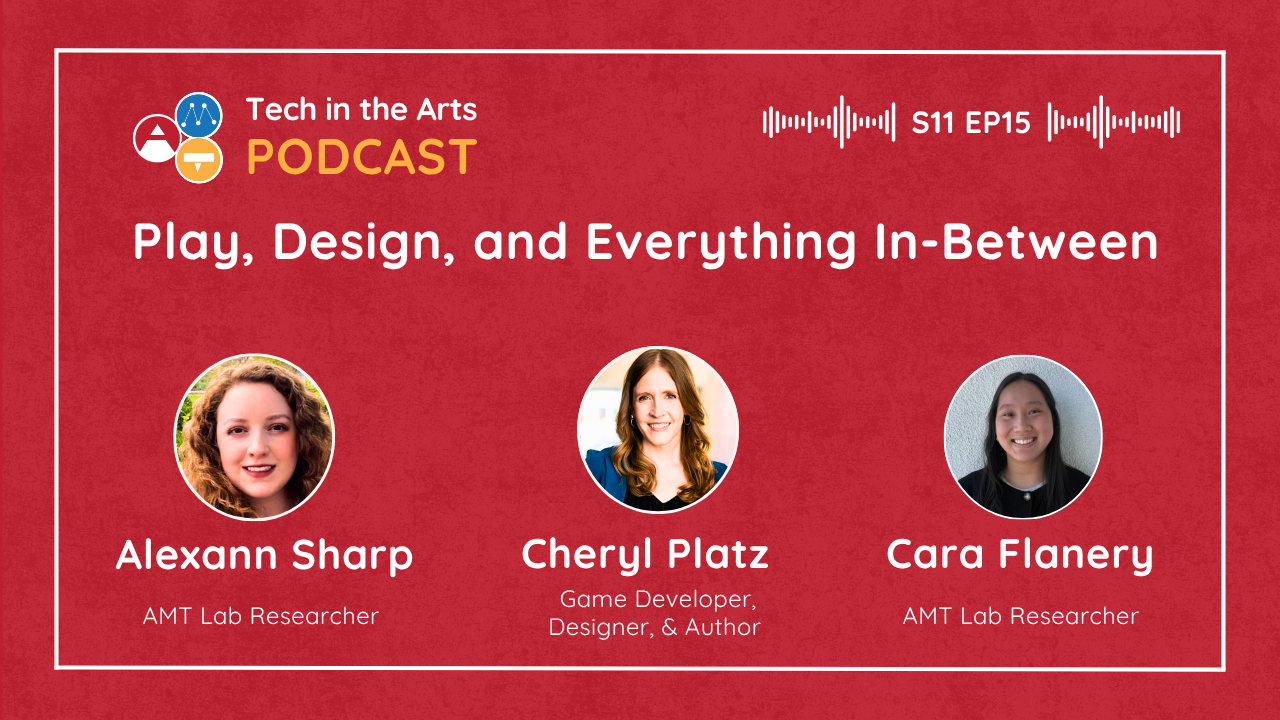
In this episode of the Arts Management and Technology Podcast: Tech in the Arts, Cara Flanery and Alexann Sharp speak with Cheryl Platz, game developer, designer, and author of The Game Development Strategy Guide: Crafting Modern Video Games That Thrive, about what makes games meaningful, the motivators that drive play, and the evolving distinction between UX and UI design in the games industry. Drawing from her career at companies including Electronic Arts, Griptonite Games, Amazon, and Riot Games, Cheryl discusses how self-expression became a central motivator of play, the collaborative challenges unique to game development, and the discipline instilled by working within the hardware constraints of early handheld consoles. She also reflects on her experience as a voice actor and performer, the importance of building community before a crisis hits, and the advice she offers students and aspiring developers navigating a volatile and fast-changing games industry.
Show Notes
The Game Development Strategy Guide
Transcript
Cheryl Platz
If you want an industry to thrive, you can do whatever you want, but like if your goal is, let's be honest for a second, if your goal is growth, capitalism, lots of money, maybe don't exclude people. And so that's so true. Unintentionally, what happened was it, there was this sort of latching onto identity as value in gaming, as opposed to the art as the value in gaming.
Cara Flanery
Hi, everyone. Welcome to the Arts Management and Technology Lab podcast. My name is Cara Flannery.
Alexann Sharp
And my name is Alexanne Sharp. We are both grad students in the Master of Entertainment Industry Management program at Carnegie Mellon University.
Cara Flanery
Today, we're talking with Cheryl Platz. Cheryl Platz is a game developer, designer, and author of The Game Development Strategy Guide: Crafting Modern Video Games That Thrive, a new book from Rosenfeld Media, which has been hailed by game design luminaries Will Wright as, "An amazingly broad and contemporary take on our industry," and Jesse Schell as, "An amazing crash course for anyone who wants to make games that actually succeed."
Alexann Sharp
Cheryl's past experience in the video game industry includes roles as a creative director, experience design director, lead producer, writer, game designer, and voice talent for companies like Riot Games, Sculpey Inc, Electronic Arts, and independent studios like Griptonite Games. Shipped and supported games include The Sims, Bustin' Out, The Urbz: Sims in the City, Disney Friends DS, MARVEL Strike Force, League of Legends, 2XKO, and more.
Welcome to the podcast. Okay, so we first wanted to discuss your definition of gaming, because we know in class you had everyone sort of have their own definition, and we just wanted to hear about your criteria for what you consider a game.
Cheryl Platz
One of the things up front that I tell everybody is that it's subjective, because it depends on what type of game you're building, what your audience thinks a game is if you look back at the history of gaming, for a long time people felt that the definition of gaming required a win condition, and that very much doesn't seem to be the case now. And so it's interesting to be in a position where people ask you for that definition, where you're like, "I don't wanna tell you what the answer is."
But I can say two things, right? I can say it's important for people to come to their own conclusions for the games they are making, and for me, it's an experience that uses friction intentionally to spark joy or curiosity. It's this interesting tension between user experience design and game design, right?
Like, what I was trained in both user experience design, we're removing unintentional friction, things we don't like, but on the other end, we're putting obstacles in place. We're making the path longer. And so somewhere in the middle is the magic of games for me and for the audiences. But games can mean different things in different contexts too.
So, you know, there are a lot of different definitions for a lot of different game designers, and some of them are very academic, and some of them are like a puzzle in context with meaning, and that's a fine, you know, those are fine. But meaning's an important one, I think, right? Like, what's a task without, you know, if you have a challenge without meaning, that's like a chore.
But we have so many games that are centered around things that would be chores, but you gave it meaning or you gave it something fun, and suddenly it's Overcooked or it's running some kind of business. There's a whole game called Game Dev Tycoon, which is literally just making games but the business of it.
But so there's this giving things meaning, there's this giving things structure, and giving people that sense of Yeah. Meaning's the best, like the most core giving friction meaning, like if I had to pick three words, giving friction meaning, that's probably where I'd land.
Cara Flanery
So speaking of giving value to people, different people have different things that motivate them. And you talked a bit about the motivators of play, both in class and in your book. So can you talk a bit about those?
Cheryl Platz
Yes. Yes, absolutely. Thank you for asking. I've worked in game design for a long time. I've studied game design for a long time, but when I started working on this curriculum for my class, What Makes Us Play, for the Masters of Entertainment Industry Management program, I was trying to come up with something, uh, like a framework that aligned with my values and what I had seen in the industry that would also be something that my students could memorize, manipulate, understand.
And that was where the motivators of play started for me, was it was sort of basically codifying what I was seeing in the books I was working from, Theory of Fun and, uh, Book of Lenses, and things like what were the patterns that felt most relevant to the market at an abstract level. And it was very much from the perspective of students really, because it was students coming in who are trying to potentially lead game teams, maybe not even from a perspective of building games from the beginning.
Maybe, or maybe they're a leader in a marketing team, or leader in a legal team, or m- lead in some other perspective where they weren't necessarily trained in deep game design and needed to un- have these abstract concepts. Interesting as time went, as I sort of dug in, was that a lot of the materials had been around for a while, right?
A Theory of Fun's been around for decades. Really, really, really good book, really based, Raph Koster's work, really based in, in cognitive psychology. And I love what he did at Game Developers Conference a couple years ago where he kind of talked about all the discourse that had happened since then, talked about a lot of in- people who had k- challenged some of his work, reconfirmed some of his work, some of the psychology stuff that had come out since then that, that had changed.
Another thing that's happened in the last 20 or 30 years is that the fundamental shape of gaming has changed, and broadband became prominent. The iPhone showed up. Consoles showed up. And the one unique thing that I have experienced in my career is watching the explosion of self-expression from almost ground zero, because my very first job was as an intern on The Sims, Sims 1.
The very first task, they're like, "Please go onto the internet and document all of the fan communities for The Sims." That was a lot of friction, 'cause those were dial-up, and that cost money to go find a server and, but people were still creating objects for The Sims and posting the screenshot stories of their Sims and using it as a storytelling tool.
That was UGC before UGC was cool, and that was 2003. And so it always, it had, like self-expression as a motivator of play has always been obvious to me, but it took me a long time to realize that it wasn't obvious to other people. Like, it kept happening outside, I'm like, "Oh, of course, yeah. People will pay a ton of money for skins in League of Legends.
It makes total sense." And it finally occurred to me that like, oh People did not realize this. When that finally clicked for me that that was one of the big story points for the industry that everyone was catching up to where Sims had been, I was like, "Oh, the motivators of play are an important insight for people to help them position their games."
And that's where it kind of went from, like, a cool class tool to something that was like, ah, this might be an industry conversation
Alexann Sharp
It's really interesting to think about the whole psychological aspect of gaming is something I never considered, because I was a little sister, and so I never had the player one controller.
And so all of the gaming decisions were made by my brother. And so just growing up in that and seeing how it's evolved over the years, and how I made my own decisions once I had my own controller, and had my own motivations, and choosing what kind of games that I want to choose. It's really interesting to think about the human behavior aspect of that, having that control.
Cheryl Platz
I love that you shared that story, and like it hit me so deeply, the like, "I didn't have the player one controller." Like, you make choices through games. Yes. You are a gamer. But there's so much to unpack in the history of the industry over the past 10 or 20 years that was unintentionally harmful the way it positioned itself about a certain stereotype.
If you want an industry to thrive, you can do whatever you want, but like if your goal is, let's be honest for a second, if your goal is growth, capitalism, lots of money, maybe don't exclude people. That's- And so that's so true. Unintentionally what happened, was it, there was this sort of latching onto i- identity as value in gaming, as opposed to the art as the value in gaming.
And g- you know, gaming kind of lost its way a little bit for a while there. And we focused more on it had to be the right f- type of who playing, instead of the right type of games to play. And that mattered more, I think, when it was harder to make games, because it felt like it was quite honestly, sometimes I think it felt like it was a political choice who got to make games, and it always is when there's a restriction in access. But now, e- uh, literally anyone can make a game at any time ever, so there's tens of thousands of games a year. Everyone is represented somewhere, and if you are not you can go make that game. And so now it's totally different, and self-expression is a very powerful motivator of play.
Alexann Sharp
Thank you for saying that. I did just buy a Switch, so I'm working on that title of gamer and finding out which games appeal to me, and it's been an experience and exploration, for sure. If you bought a
Cara Flanery
Switch, you are absolutely a gamer. So at the beginning of the conversation, you kind of mentioned the difference between UX design and then game design.
So we also wanted to clarify a little bit about the difference between UX and UI, because you had like a non-gaming background before you moved into gaming, so how does that experience shape your approach to player experience design? What a great question.
Cara Flanery
Thank you.
Cheryl Platz
And it's interesting, because for context, at Carnegie Mellon, I studied computer science and human computer interaction. And then I did a year at the Entertainment Technology Center, which is where I got to study game design with Jesse Schell, which was amazing. I've spent time both in the games industry and in more traditional consumer products, and that was where I spent a lot of time doing traditional user experience design.
And what's interesting is in more traditional user experience design, it's less demanding to do the visual part of the user interface. If you're doing an e-commerce site, there's not a lot of motion design. The branding you kind of define once and you can apply it fairly consistently, right? It's maybe not as expansive, but it's easier to and which is not to say that the work is of less value, it's just less, like, it's easier to capture in style guides or it's, like, easier to templatize, which is not always true of games because games, every inch of it is interactive. Like, there's physics models, it's 3D. It pushes things to a different level.
And so whereas often in a consumer products world, a user experience designer might be expected to both do what we would consider interaction design, like the conceptual stuff, the cognitive psychology, the information architecture, the wireframing but also the visual design aspect of it, like how the thing actually appears to people on the other side.
The, the deep complexity of how games work has led to a fairly consistent separation of the experience design field in games. And so you see user experience designers and user interface artists or designers, depending on how the company positions them. And the user interface role of artist or designer, however you want to frame that at the company Usually if in a games role, that role touches the game engine.
So they are both someone who is focused more on visual design and output, right? So they're probably not trained, or if it's bonus, on like the cognitive psychology side, like they don't necessarily have to be doing that. They're trained in visual design, probably some like sophisticated color theory, 2D or 3D, or motion design, or something in that space.
And because they're in games, they've probably learned at least one game engine enough to implement their work, at least at a basic level in a game engine. Now, they're still gonna need an engineer for things like data, uh, uh, connections, and refined hookups, and things like that. But there's a, this need to collaborate or like, "Hey, this is a, quote-unquote, gray boxing," is kind of like 3D wire framing, right?
And so there's this need for people who can speak game engine and get the user interface into that other world. And so that's where the UI role has gone. And it's even more, uh, hybrid roles than that. There's technical artist, which is a role that kind of takes the needs of the UI artists and the user experience designers in the engine, and builds tools or optimizations and things like that.
I've seen technical artists differentiated from technical designer, and that can be challenging for people on those career paths, because I've managed people of all of those designations, and the less of you that there are, the more misconceptions there are, the less people understand how to work with you, the less people understand what tasks to give you, and the more work you have to do, which is part of why I have that chapter in my book where I'm like, "Here's a bunch of roles and definitions, just so everybody has a shared understanding," 'cause there's so many roles in games, and that adds up.
And I think that's why it, the burden of collaboration seems like it's so much higher in games. Like, people are just like, "I don't know all these roles, and I don't really wanna ask a question like, 'What's your job?' So I'm just gonna stay over here and do my thing." And we can't. That's how everything gets out of alignment, and we end up with games getting rebooted or canceled because we just didn't collaborate well enough to make a game that was cohesive.
Did you find that was happening across different companies that you worked at? It's a pattern. I'll tell a story from earlier in my career, right? So I worked at Griftonite Games, and I wanted to run game development teams, and Griftonite Games gave me that chance and it was great. And I was successful at running the Chronicles of Narnia game development team as associate producer, and so I got promoted to lead producer and they were like, "Hi.
We need you to come help the Pirates of the Caribbean team. There is a problem." And so the consequence of my success was like, "There is a fire, go deal with it." I was like, "Oh, okay." And I, I had actually been working on the Pirates of Caribbean Game Boy design, and I was like, "Cool, I get to do another game.
I understand how to do this, and I'm doing my game design." They're like, "No, no, no. Go solve that fire." So I went to the Pirates of the Caribbean DS team, and they were farther along than we were because the DS took longer. It was a 3D game instead of a 2D game. But they were nearly in breach of contract when I got there, because they were behind.
I was like, "Oh. Cool. Cool, everybody." And I learned a lot very quickly. Like, you know, the first thing is to just listen, just talk to people, right? Just figure out, hey, what do you think's going on? The previous producer had gone on a paternity leave and then had another job had come up, and so there had been a period where there was not production help.
And what I found was that art and engineering, for a various number of reasons, they had almost no overlapping core hours, were not collaborating. Like, art came in at 7:00, left at 2:00. Engineering came in at 11:00, left at 11:00. And so perfect. And then it's mostly lunch there in the middle.
And so the art assets weren't compiling And so they were just making two different games. And so it's, you know, sometimes people look at games and they're like, "Well, making a good game is obviously about, like, technical prowess or, like, narrative." Sometimes, it a lot of the time, it's just about keeping people making the same game.
It's 2005, I, and I'm gonna have to introduce the groundbreaking idea of core hours so that we all make the same game.
Alexann Sharp
I actually bought a Game Boy Advance recently again, 'cause that was what I grew up on the Color, and then I got an Advance. I sold it probably for way too little when I was a child, and I thought 20 bucks was a lot.
And I rebought it recently with the Chronicles of Narnia game. I was so excited, 'cause that's my favorite IP. Like, I love Narnia and Pirates of the Caribbean, so when I saw that you worked on those, it's so cool. And you don't think you're a gamer. Uh, okay. Player, it's from being player two. I'm sorry. You know, I'm working on that.
Such good games. Like, yeah, and you can take it everywhere you go. It's actually at my house in Nashville now, so I have to go back and get it, but yeah, I accidentally left it there. But those games made me love the stories even more, so being able to be a part of those stories that I grew up on, it's just such an amazing experience.
So it's just such an honor to meet the person who made those happen.
Cheryl Platz
Well, thank you for sharing that. Like, the internet was not as prevalent, and so we very much felt like we were flinging games into an abyss and then just going on to the next one. Like, "Hope that one worked out." We didn't have, like, real-time sales numbers or anything.
Yeah. Uh, but the Narnia, Narnia project in particular is deeply emotionally resonant to me, 'cause that was the game. Oh, that brought me to Seattle. Yeah. Oh. And, uh, got me out of EA, and it was my first time running a team, and first time working on a game for Disney. Yeah. And that's, like, the first time I got, like, a game designer credit.
I showed up and the rest of my team was working on something else, and so Steve Etzer, who was the studio head, and was wonderful 'cause he just had full faith in me. He's like, "Hi, welcome. We're gonna need a whole, a whole game design document and a whole project, a schedule in two weeks. You got this."
Wow. I was like, "Cool." And he's like, Wow, here's the script for the movie, and you obviously know how to get the book." And I fell back on the training I had had in the class Jesse and the things, and it was so much fun to be like, "Okay, how do I adapt this, and what limits does the technology offer me, and how do I make that a gift?"
So when you can only load so many, uh, chars at once, right? That was the limit of the maps. Right. And so, like, how do I use that to inform, like, uh, the story and the way the chapters are structured to make it all make sense, and how do I take common game mechanics and forge them all together?
Like, the coldness mechanic was like, I don't want it to just be a combat game. What would feel like being in Narnia? Like, sleeping outside all the time, it's winter. That would make you feel like you're running away from the White Witch, so you better be finding warmth all the time. It's
Alexann Sharp
interesting if you think about, like, people return to these games, especially there's a point in your life.
Maybe it's 'cause when I'm in my 20s I'm returning to the nostalgia of certain things, and so I seek that out. And so gaming is a part of who we are whenever we have that experience at such a young age that we even seek it out later on and, you know, like, I feel like a lot of these older consoles are having such a massive comeback even for younger generations who never played them
Cheryl Platz
And it's so interesting because the current generation of games is not built in a way to support that, right?
Live service games fundamentally disappear off the face of the planet when they go. Single player games, more traditional games, even then, many of them that weren't on a cartridge, you have to jump through some hoops to get them to run on modern hardware. If you've ever tried to get an old DOS game to run on a modern machine, that is sorcery.
Yeah. Wow. But it, you know, some people have done it, and that's, GOG, uh, is great for that. But I, you know, it makes me very grateful for the Game Boy and DS years of my career. 'Cause unlike a lot of developers, I can, I, like, I have this weird sense of, like, comfort that, like, there's pieces of hardware that have my work on them and, and they're less likely to disappear. But that is deep privilege. And I, like in episode two of this season of my podcast, I talked to a games researcher who was like, “Yeah, I got a Game Boy. I'm doing, like, this retro hardware gaming." It's fascinating that we have all of this modern hardware, and like, this is a theme that's starting to come out, is people are like "Yes, that's fine that you have given me all this modern hardware, and I would like the modern.” Yeah. Like, do we bring those back? Do we just keep buying the retro consoles until they die? Like, what do we do? Is it something we honor, or is it just, like, a phase? Like, I, it's really fascinating.
Alexann Sharp
I mean, it ran like it did the day I had my first one. It still is so dependable. And the battery life, I'm telling you, the battery life on those Game Boys, for days.
Cheryl Platz
Well, let's get into that a little bit if you want. 'Cause, like I would love that. I'm deeply grateful for having worked on DS and Game Boy games because they were so constrained.
Constrained is a gift. Those games were 16 megabytes, 32 megabytes. Not gigabytes, megabytes. And so you learn every choice is intentional. Every thing you save is an extra kilobyte on the little EEPROM that's inside the cartridge. Like, you can only save so many things. You can't just save infinite number of things.
Like, every choice point, every quest marker, everything is data, like, is burning against the, a maximum amount of data you can save on the cartridge, either the permanent EEPROM or the save EEPROM. That is a sort of mindset shift that sticks with you, that efficiency, and it's not burned into this generation of devs.
'Cause when I'm like, I get, like, awards screener games, and I'm like, "Why are these all 80 gigs? I cannot install these all on my machine. I have work to do." I don't know but then it's, like, hard to get the discs, and I'm like, "What do these companies expect me to do if they want me to play their games for awards season?"
They don't wanna send physical media, but they're not sending me a hard drive. And I don't know what I'm supposed to do with that. But I, you know, what's, the one thing about the retro gaming thing that gets me that, like, I don't think a lot of people think about is most cartridges are a two-piece inside.
So there's the actual, like the burned permanent silicon, which is the code for the game itself, and then there's the save EEPROM, if there's a save game, which I assume there is for most. Have a shelf life, but the shelf life varies based on how much your publisher wanted to pay, and what type of, what type of interaction your, your developer wanted to have at the time.
Very few people talk about the fact that we had to make a choice when we started making the game, what type of save EEPROM we wanted to have. Some of them had more writes, but less space. Some of them had longer battery life. Some of them didn't need a battery, but they did, had less functionality, right?
And so if you didn't need a lot of save space, maybe you could take one that was just solid state and didn't need batteries. If you needed a lot of save space, so like going to The Sims games, I'm pretty sure there was, I think that they had battery backup. But some of these things will die after a while.
The save will die, and then you're gonna have to open it up and, like, either replace the part or something. There's like a whole maintenance of cartridge thing that would have to happen, and that's something we don't really talk about. But it was interesting to watch the evolution of that hardware, 'cause it was basically a couple of Nintendo games.
You could tell when their generation was about to move forward, 'cause new hardware would show up on the list. You're like, oh, there's a 32-megabyte cartridge now. Noted. We can save how many kilobytes now? That's so cool.
Cara Flanery
I love that. It's, it's interesting that you've, like, seen all these changes, you know, throughout your career.
So we also wanted to ask, because you're so expressive, and you have a great voice, we read that you have also done some voice acting. Yeah. So can you talk a bit about that, and how that has changed throughout your experience as well?
Cheryl Platz
Thank you, and the voice acting is interesting because I did acting at Carnegie Mellon. So I was the president of the Scotch and Soda Theatre Troupe, and I was in the improv troupe there. And so acting has been a part of my life for a long time. Actually, my first job was as a Muppet performer at the Sesame Place theme park in Philadelphia. So, and that explains a lot about me when you start, you're like, "You're very expressive."
And improv, it has been a deep journey for me. I've learned so much, and now I've taught so much improv, and it's brought me so many of my contacts. But- My relationship with voice acting in specific is, is interesting because, like, I, it was when I started actually getting the chance to do voice acting. I think I had done some placeholder stuff at Maxis, but when I really started to do work was at Amaze. We also had a sound studio. And the first time I did things was I actually did a full set of tracks for the Shrek PSP game as Princess Fiona when there was a SAG strike 'cause they needed placeholder tracks for the game.
Now, the SAG strike ended, and it, like, that was never intended, it was never intended to ship, right? Like, we just needed something to, so they could do timing and everything. And then the strike ended, and then we had to decide, like, were they gonna, like, have me go SAG or are they gonna cast someone from SAG?
And it was like, "Lindsey, should go hire a SAG actor to do this and stuff." So it's, it, it I, but that gave me a chance to, like, experience what it was like in a booth and, and, like, there was lines and things. And so that led to being able to do Sims 2 DS. I got to do, uh, Abba, uh, Abba Kadabra, I think. I forget, sometimes I forget how her last name is pronounced, but she was, like, the goth in The Sims 2 DS, and I got to sing Never Happy When It Rains.
And then, you know, I've done some, like, industrial voiceover and things like that. And, you know, I've also done things like, I did 18 months of a actual play about Shadowrun on Hyper RPG on Twitch, where I played Mainframe the Decker. And so I've done a lot of, like when you actually dig into my performance history, you're like, "So you've done multi-camera Twitch stuff, and you moderated a panel at Emerald City Comic Con with Leonard Nimoy." The Nintendo DS launch event in 2004, I was one of, like, seven people on stage that day. Like, Reggie announced me by name. Everyone else who was on stage was, like, a CEO. I'm, like whoa, 23-year-old and I got there, and they're like, "We're going to do a live stream."
In 2003, I'm like, in 2004, I'm like, "What? What do you mean by live stream?" They're like, "Well, everybody can see the demo in real time." I was interviewing for my job at Kryptonite, and I was so terrified. And suddenly they're like, "Everyone you're about to interview for your job with is going to be watching you live on the internet."
It's like, and here's the, like, most, this is just off the cuff, but, like, I, you know, I have a disability. I didn't know it at the time, but I just knew I had weird things. I have Ehlers-Danlos syndrome, and it comes with hand tremors when I get nervous. And that's, normally it's fine. Nintendo DS, I don't know if you've noticed, is a touch screen device.
And so I got to that stage in that room, and there was a camera pointed at the device. It was like, should've seen that one coming. So 20-minute solid straight demo solo with the camera pointed at me and broadcast to the internet on a development piece of hardware that could assert at any time and crash.
It's like, it's great, but whoa, so that was the one time in my life where I, like, channeled all of my energy into, like, other parts of my body like a cartoon character. But it worked, and I got through it. Once you get through things like that, you're like, "Everything else is fine. I, I can, I can do, you want me to be on stage at a comic convention with Leonard Nimoy? Fine, no problem."
Alexann Sharp
Wow, having people watch me do anything makes me nervous though. You running a whole demo like that, that's amazing. Like, I can't even have people watch me parallel park
Cheryl Platz
And the other thing, let's talk about the dynamics of performance for a little bit. Smaller performances are harder than larger performances for me.
Because when you're in a smaller audience, you feel personally responsible for everyone who's watching and their personal, like, reaction, right? So it's like to me, it's like two different things. But, like, the smaller the thing there is, like and so it's weird because it, for people's journey to the big stages, you have to go through something that's almost entirely different, and in some ways much harder.
Alexann Sharp
We also kind of wanted to talk a little bit about your passion for sharing your knowledge, because we know you have your own podcast called Enduring Play, a game development podcast, and you're an adjunct professor here at Carnegie Mellon, and you've written two books about gaming. Well, one is Design Beyond Devices: Creating Multimodal, Cross-Device Experience, and then the other is The Game Development Strategy Guide: Crafting Modern Video Games That Thrive.
So clearly you care a lot about education and sharing your knowledge. What inspires you to do that, and what does it mean to you to be able to share everything you've learned and to help guide people who are interested in this industry?
Cheryl Platz
Earlier in my career, I was this unicorn, right? Because I was a woman in gaming, I had gaming experience, and then even though I left gaming after three or four years to go to consumer products, but I still had all this really great experience on Sims and SimCity, so I got to start talking to the girls who were interested in technology.
But it rapidly became clear that I was never gonna be able to scale to the number of people who wanted, like, one-on-one guidance. And that always made me sad, right? I'm also fairly analytical. I'm like, it's always the same conversation. It's always the same questions. And why should, like, the people who reach out to me get that benefit when I could just share the answers to the questions people are asking me?
And I've also had a couple of experiences in my life now where I literally ran up against things that no one else had experienced. I never, for a long time, I didn't see myself as somebody who would be a writer. Like, I didn't actually set out on this journey and be like, "I'm going to be a games author," or something.
I had imposter syndrome. But when I found myself working on the Alexa products, and I got to the multimodality stuff of it, the transition from designing for a device that just does speech to a device that does screens and speech, I couldn't find any guidance about that. Like, there really wasn't anything.
And then when I left Amazon and got out to the other side and started speaking on the circuit, the reason was 'cause it didn't exist. And I realized that I was one of the first pe- very blessed to be one of the first people who was really doing that work, that, like, adaptive multimodal work across different screens, different form factors, different platform.
And most of the other people who were doing that were still at Amazon, which wasn't gonna let them share that perspective. And I remembered what it was like being at Amazon, trying to interview people for those roles, and nobody had any context. We were in there, we were like, "It's so frustrating. We can't find anybody who's qualified."
That's 'cause we're the only people doing it. Now, I understand there's a concern that people are just gonna blurt out all the secrets. There was an opportunity for me to take just the stuff that was general and share it with people, and hopefully that would lead more people to the jobs that needed to be done.
And, 'cause I was passionate about voice. I was passionate about multimodality. It did seem more inclusive. But there was no manual. And there I remember there was, like, one book, I was like, "Maybe this one will be the book." And then I read it, and it was super dry. I was like, "Oh, it's me. I need to do the thing."
I will say for people who wanna go on this journey, like, don't do it for money. Don't do it 'cause you want, like validation from the outside, right? It's, I don't have a lot of reviews on my books at Amazon, right? Like, I don't have, get a lot of external validation for these things. You have to do it because it's the thing you want to do or you feel like you need to do, right, because it's so much work. And especially if you're writing at the cutting edge, you might be ahead of your time, and people will look at you like you have a, like a diamond-shaped head. They're like, "What is this? Why did you bring this to us? What is this right now?" It can be very challenging. It can be really delayed gratification.
But when you do, you know, I had an experience where somebody reached out to me for an interview after I got laid off, and I found out that an entire innovation team at Dell was using Design Beyond Devices as, like, a manual. I was like, and I realized that, you know, you don't always know the impact you're having.
That's sort of a metaphor for people who wanna go into this. Like, you put your stuff out there and you don't know all the impact you're having. You have to be okay with that. But the best gift it gave me also was the gift to my future self, 'cause I still refer back to my own stuff a lot. Got some of that out of my head so I could move on to other things.
I refer back to my own frameworks a lot. It's a thing, a gift that I can equitably share these things with other people. I can help people understand how I work, and it's a gift to my future self.
Cara Flanery
With these last words, just to wrap up, you kind of touched on it a bit with doing it for your own self, but do you have any other advice that you would give students looking to learn more about or enter the gaming industry?
Cheryl Platz
Well, right now it's a fraught time. And I'm not gonna sugarcoat that because we all see the layoffs. I was laid off. Many of the people I've spoke to on my podcast have experienced layoffs, some multiple times in the last few years. So just like the book, don't pursue gaming because you think it's the coolest thing.
Don't pursue it because you think it's a secure job. For, if you're pursuing gaming, pursue it because it is the thing that your heart needs. And do it safely. Like, make sure you have a backup plan. Make sure that you're not just studying gaming, but something else. Make sure that you are saving. Make sure that you have like emergency funds.
And then most importantly, find your communities before you need them. Yeah. Because the people I see struggle the most with layoffs are the folks who... 'Cause here's the thing, passion jobs can consume you. When you get your, what you wanted, it's so seductive to just disappear. Especially some of these companies, which will be like, "I'll give you lunch, I'll give you dinner."
Like, you could just disappear and have no friends, no social life, no nothing. And then what happens when they stop needing you? There's no one to catch you. So, but there are so many game development communities, so many groups. Like, whether you want an identity-based community, a discipline-based community, just people who like a specific genre or a charity or something, there is a group out there for you.
But the trick is, if you start coming at people for networking the second you need them, that is not how you build valuable relationships. You have to build community before you need it. The reason I was able to hit the ground running after my layoff was because I had been out there contributing to the community, doing talks, doing books, doing free articles, engaging with the community before I needed it, and then the community was there when I needed it.
And so the second season of my podcast, Enduring Play, is very intentionally pointing at folks who have they either worked on games that have that community and self-expression element, or they are themselves community organizers. Like, it's pointing us at the collective because I think that you, I don't think you can survive this era of game development without also building that collect you know, finding that community for yourself and making sure you've built it before you need it.
And I will also just say tactically, like, LinkedIn matters. And that's not sponsored. That's just, like, yeah I see people be like, "I don't like LinkedIn." And I'm like, "Look, okay, I know you may not like social media, and that's fine. Maybe you have it figured out. Maybe you can get jobs somewhere else.
But I'm here to tell you that the last two jobs I got, people slid into my DMs on LinkedIn, and that is so much nicer than having to chase. And like, it takes time to build up that way, but have your profile work is like a recruiter that works for you when you are asleep. Making sure your profile represents your work accurately because it, recruiters will find you.
Like, it just, why wouldn't you want a recruiter working for you in your sleep? If you're working on AI and you're talking about agentic stuff, like, why not do the basics first before you do all that complex stuff? Just make sure your profile represents you well. So I want people to succeed, but it does take some of that, like, seeking out your community intentionally and making sure that you're passively represented even when you're not in the room.
Alexann Sharp
That's also so, that really speaks to me. I work in television, but everything you just said, for any students that might be listening who aren't into gaming and aren't going that route, it really speaks to me when you say invest in your community before you need them, and being a participant member in people's lives and not losing yourself.
So thank you for sharing, and your podcast, can people find it on all of the platforms? They can. Can indeed.
Cheryl Platz
Yes. It is on all the major platforms, and then also for people who don't like any of the major platforms, there is an RSS feed and a web player version as well. And you can go to enduringplay.com, which will redirect you to a site that has all of those links for you.
Alexann Sharp
Thank you so much for sharing. Thank you. This gave me a lot of insight as someone who doesn't work in the gaming field, and I have so much more thank you. Respect for everything you do just listening to everything that you've shared with us.
Dr. Brett Crawford
Thank you for listening to this episode of Tech in the Arts. If you found this episode to be informative, educational, or inspirational, be sure to check out our other episodes and send this to another arts or technology aficionado in your life. If you want to know more about arts management and technology, check out our website at amt-lab.org, or you can email us at info@amt-lab.org. You can follow us on Instagram at techinthearts, or on Facebook and LinkedIn at our full name Arts Management and Technology Lab.
Our season runs from September through May, so feel free to follow us on your preferred podcast app, be it iTunes, Spotify, or YouTube.