
Current
Podcasts & Interviews
Reviews
Reports
All Research Tracks
Engagement
Marketing & Social Media
Fundraising
Artificial Intelligence
Augmented & Virtual Reality
Blockchain
Inclusion
Data Collection & Analytics
Management
CRM Systems
Sustainability
About
Mission, Impact & Values
Staff
Current Contributors
Past Staff & Contributors
Tools
Contact

Arts Management and Technology Lab

Current
Podcasts & Interviews
Reviews
Reports
All Research Tracks
Engagement
Marketing & Social Media
Fundraising
Artificial Intelligence
Augmented & Virtual Reality
Blockchain
Inclusion
Data Collection & Analytics
Management
CRM Systems
Sustainability
About
Mission, Impact & Values
Staff
Current Contributors
Past Staff & Contributors
Tools
Contact
An Introduction to Open Badges
July 7, 2015
Education
Jackie Shimshoni
An Introduction to Open Badges
Jackie Shimshoni
July 7, 2015
Education

An Introduction to Open Badges

Jackie Shimshoni
July 7, 2015
Education

This is a second research update as part of a larger body of research on using digital badges as a credentialing tool.  For the first research update, click here.

Creating a digital badge is relatively simple. Since they are largely issued and displayed virtually, a reasonable question in terms of credentialing is how to validate the worth of the badge.  The most obvious is to look at who issued it—if a university or NASA, for example, provided the badge, then it carries the weight of those institutions.  However, this still provides little detail on how the credential was earned and no guarantees that the person claiming the badge actually earned it rather than just copy-pasting the image of a badge.  Open Badges solve all of these problems. 

The Open Badge framework was created by Mozilla, best known for the web browser Firefox.  Open Badges was released in 2013 after almost 2 years of research and development by Mozilla, the MacArthur Foundation and HASTAC.  The Open Badge software sets a technical standard that any organization can use to create and verify their digital badges.

How does an open badge differ from a digital badge?

A digital badge is the physical image of the badge that acts as a representation of the achievement.  It is essentially a trophy—all there is to see is what is in front of you. On the other hand, as former Mozilla employee Doug Belshaw described, the metadata in Open Badges is “baked” in.  Learning Solutions Magazine noted:

“An Open Badge (or similar badged credential) […] includes metadata with value beyond the image; for example, the metadata will usually include the identity of the badge issuer, the date of issue, and the criteria the badge holder met. In spite of the superficial resemblance, and the use of the word “badge,” Open Badges and credentials are not an example of gratuitous gamification.”   

What kind of metadata is found in an open badge?
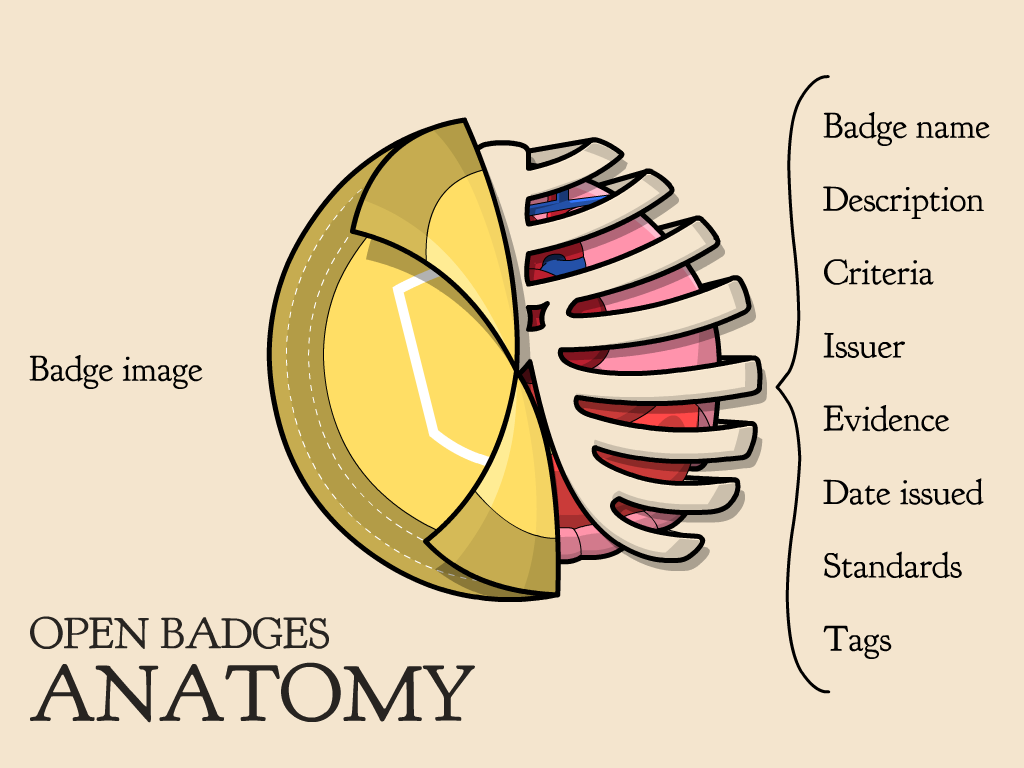
Image Source: Classhack

Image Source: Classhack

The above image summarizes the contents of Open Badge metadata fairly well.  Open badge metadata includes information about the skills acquired and what the earner had to do to show mastery, the qualifications of the issuing party, larger skill sets proven, and verification of the earner’s identity.  Open Badges include authentication channels; meaning that when someone is confirming the validity of a badge, they can “call back” the issuing party and confirm that this badge was in fact issued to this person.  Another useful tool is the Open Badge’s ability to expire.  Therefore skills that need to be refreshed or can become outdated have credentials that reflect the timeliness of the skill acquisition.

As digital standards become more widely recognized, the standards will probably become higher and more complex.  Educational innovator Timothy Freeman Cook wrote an article that details how deepening the accreditation system can further validate the information a digital badge conveys.    
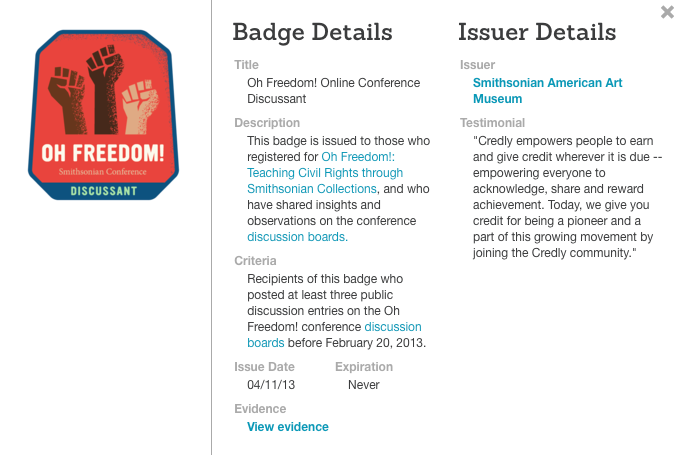
Credentials given for an Open Badge issued by the Smithsonian Museum

Credentials given for an Open Badge issued by the Smithsonian Museum

Credential sharing with Open Badges

The other advantage of the Open Badge is the ability to integrate multiple badges from different sources into a single location.  Open Badges have what is called a “backpack”, where the person who earns the badge displays all the badges that they earned.  The backpack is sharable on websites, social media, LinkedIn, resumes, and more.  This makes it easier for prospective employers or clients to access and view the associated metadata. 

There are several organizations issuing and/or developing badges on the Open Badge framework, and Mozilla lists them all here.  

Should an organization wish to issue Open Badges, the creation and issuing process is relatively simple. Open Badges is free software with an open technical standard, so anyone may be part of the Open Badge network.  Credly and Open Badge Designer are just a few platforms that can be used by those with little to no tech experience to create customized badges for any learning experience the organization wishes to recognize.  The most important thing is to ensure that the badge symbolizes a true credential—that is, the process of attaining the badge is worth rewarding and displaying.  In the final research paper, I will dive deeper into the types of learning that open badges can symbolize, as well as examples of how they are earned.  

An Open Badge Issued by the Smithsonian Museum

An Open Badge Issued by the Smithsonian Museum

Tagged: museums, open badges, digital badging, metadata, Mozilla

Newer Post#TBT: Arts and Tech Around the World
Older PostHow Socially Responsible Spending is Replacing Traditional Philanthropy


Subscribe

Sign up with your email address to receive news and updates.

We respect your privacy.

Thank you!

Featured
World-Building's Power Through Narrative Dimensions and Audience Immersion: Silence Wang's "One Hundred Thousand Volts"
July 27, 2026
Cosmo Wang
World-Building's Power Through Narrative Dimensions and Audience Immersion: Silence Wang's "One Hundred Thousand Volts"
July 27, 2026
Cosmo Wang

In an earlier article, we explored how live music concerts are evolving beyond mere performances into expansive, immersive storyworlds, using Silence Wang’s One Hundred Thousand Volts tour and its fictional setting of “Romance City” as a pioneering case study. By adapting world-building frameworks traditionally found in film, literature, and gaming—specifically the core principles of invention, completeness, and consistency—Wang transformed his stage into a dynamic socio-ecological system where the audience's emotional participation actively powered the narrative environment. Building upon this foundation of visual and spatial storytelling, this article will delve into the auditory and transmedia expansions of Romance City, examining the strategic role of sound and musical arrangement, the development of one of the world's first XR interactive concert films, and the unique integration of a "Concert Artbook" to deepen audience immersion and IP expansion.

Read more →
July 27, 2026
Cosmo Wang
Immersive Live Music Concerts: How Silence Wang Uses World-Building to Transform the Audience Experience
June 30, 2026
Cosmo Wang
Immersive Live Music Concerts: How Silence Wang Uses World-Building to Transform the Audience Experience
June 30, 2026
Cosmo Wang

How do you create an audience experience that drives not a one time purchase but a fan for life? Live concerts need to consider creating immersive worlds that engage fans before, during, and after their 2 - 3 hours in the space. This article uses a case study to unpack exactly how to to expand IP and build a world that creates a career sustaining model.

Read more →
June 30, 2026
Cosmo Wang
Toward Smarter Opponents: Rethinking AI in Turn-Based Games
June 22, 2026
Raven Fischer
Toward Smarter Opponents: Rethinking AI in Turn-Based Games
June 22, 2026
Raven Fischer

Turn-based games often rely on scripted opponents that are predictable, exploitable, and strategically limited. Through case studies from Final Fantasy X and Pokémon Trading Card Game Live, this article examines how current game AI falls short of creating engaging tactical experiences and explores whether more intelligent, adaptive opponents could improve player enjoyment and game design.

Read more →
June 22, 2026
Raven Fischer
The Price of Loyalty: Analyzing Consumer Behavior in Streaming TV, Part II
June 2, 2026
Staff Researcher
The Price of Loyalty: Analyzing Consumer Behavior in Streaming TV, Part II
June 2, 2026
Staff Researcher

In Part II, this research moves from market context and prior literature to empirical analysis and actionable strategy. While Part I established the streaming landscape, reviewed existing research on Gen Z and millennials’ consuming behavior, Part II presents findings from the online survey and interviews with industry experts. Synthesizing these primary insights with our secondary literature review, we identify what drives and what undermines the subscriber loyalty among 18–34 age group, and conclude with six recommendations for Roku across its SVOD, FAST, and AVOD platform ecosystem.

Read more →
June 2, 2026
Staff Researcher
The Price of Loyalty: Analyzing Consumer Behavior in Streaming TV, Part I
May 26, 2026
Staff Researcher
The Price of Loyalty: Analyzing Consumer Behavior in Streaming TV, Part I
May 26, 2026
Staff Researcher

This study examines what drives loyalty among 18-34 age streaming consumers. The problem we looked to solve through our study is how Roku can better reach older Gen Z (18-24) and younger millennials (25-34) and retain them, beyond an initial one-time acquisition. This is especially relevant in an age where streamers are continually competing with each other and other media companies for the consumer's attention. Part I analyzes the conceptual groundwork for our research, tracing the evolution of the streaming market, reviewing prior literature on Gen Z and millennial viewing habits, and introducing our mixed-methods research approach. Part II of this research will present the empirical findings, industry interview insights, and final analysis and recommendations for Roku.

Read more →
May 26, 2026
Staff Researcher

Subscribe

Sign up with your email address to receive news and updates.

We respect your privacy.

Thank you!
Back to Top
AMT-Lab @ Hamburg Hall, Carnegie Mellon University, Heinz College, Pittsburgh, PA 15213, USAinfo@amt-lab.org
cmu logo.png
cmu mam logo hi rez.jpg
 

Arts Management & Technology Laboratory

Carnegie Mellon University, John C. Heinz College III

4800 Forbes Avenue

Pittsburgh, PA 15213